

/Eras/Audi Sport Competition Cars R Era /R2/Sport quattro S1 E2 Pike’s Peak
MODEL DETAILS
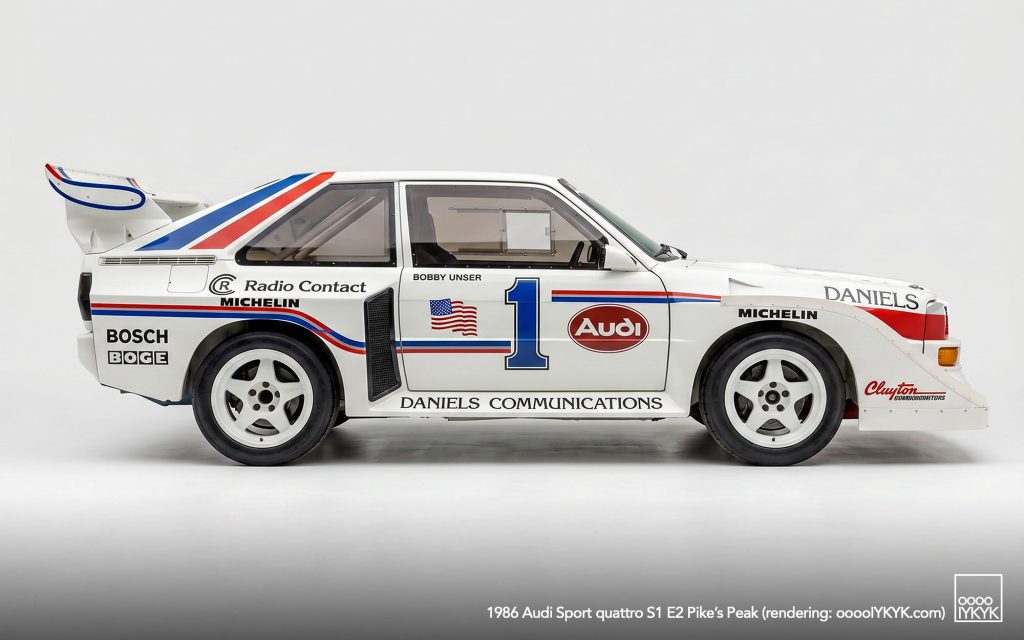
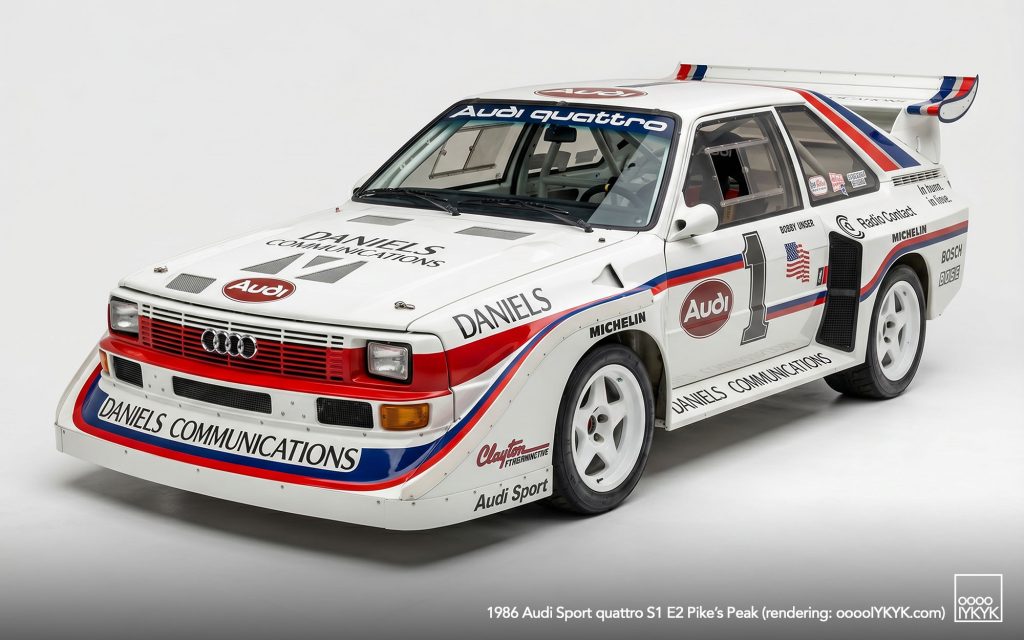
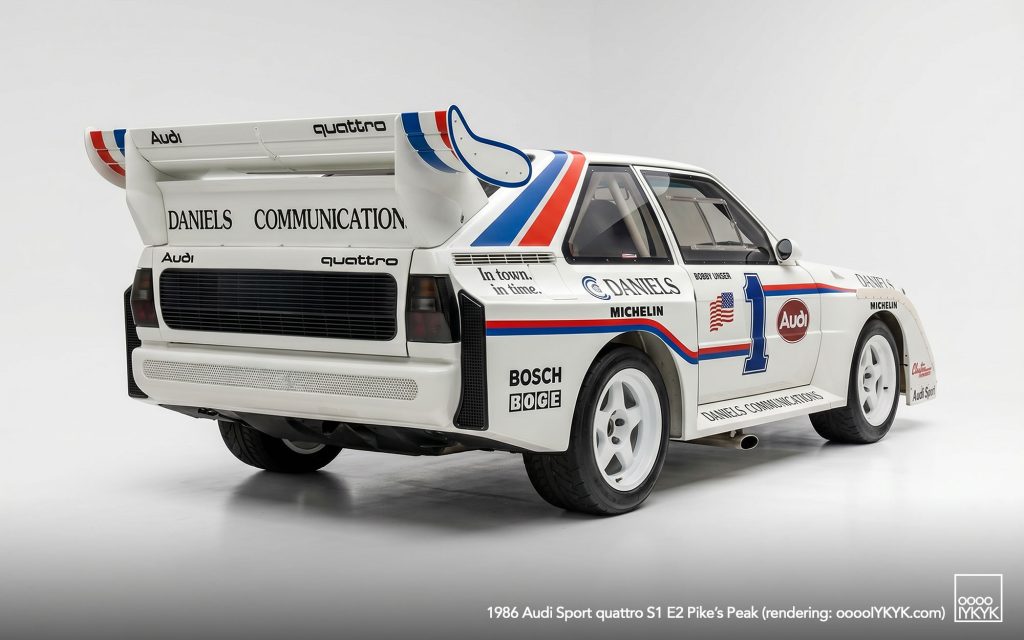
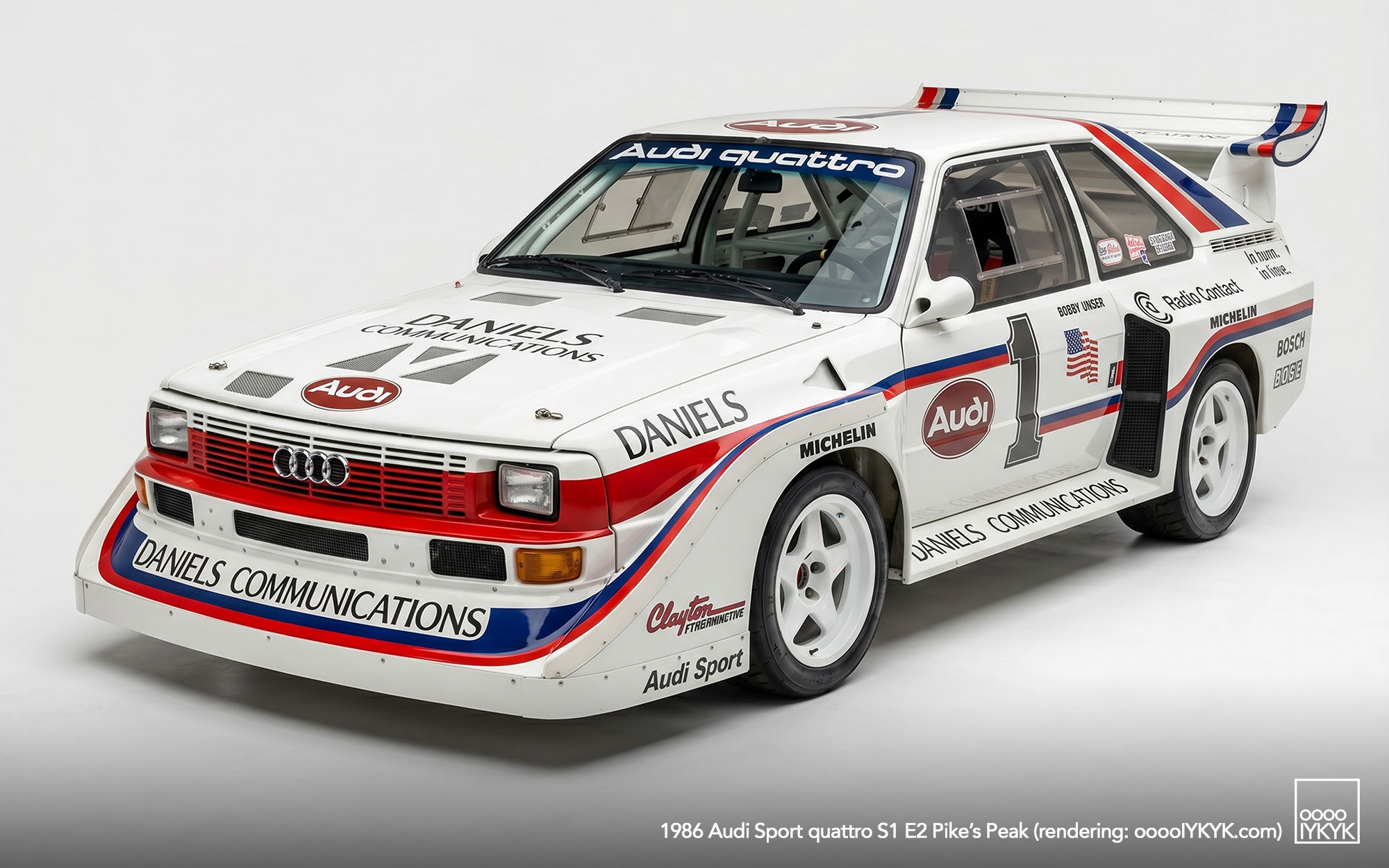
What: Audi Sport quattro S1 E2 Pike’s Peak
Series: Pike’s Peak International Hillclimb (PPIHC)
Class: Open Rally (PPIHC), Group B (WRC)
Era: Audi Postwar , Audi Sport R Era
Model Family: Coupé
Market / Zone: USA
Season: 1986
Model / Generation Code(s): type 85 / R2
Chassis / Matrix: B2
Registration:
Chassis Number:
Driver: Bobby Unser
Engine: Turbocharged inline five-cylinder, aluminum block
Displacement: 2,133 cc
Valvetrain: DOHC, 20 valves
Power: Approximately 500 hp (373 kW) at Pikes Peak altitude*
Torque: Estimated 480-500 Nm (354-369 lb-ft)*
Turbocharger: KKK turbocharger*
Transmission: 6-speed manual
Drive System: Permanent quattro all-wheel drive
Weight: Approximately 1,090 kg (2,403 lb)*
Weight Distribution: Approximately 51/49 front/rear*
Wheels: Competition alloy wheels*
Tires: Pikes Peak-specific competition tires*
Result: 1st Overall
Winning Time: 11:09.22
Course Record: Yes
*Specifications marked with an asterisk are based on contemporary Sport quattro S1 E2 Group B specifications and period accounts. Bobby Unser and Audi Sport extensively modified the vehicle for Pikes Peak competition, including suspension settings, throttle-body configuration, turbocharger calibration, tire selection, and other chassis adjustments. Exact race-day specifications have not been fully documented and may have differed from contemporary World Rally Championship S1 E2 configurations.
RESULT
1986 Pikes Peak International Hill Climb
July 12, 1986
Driver: Bobby Unser
Time: 11:09.22
Position: 1st Overall
Course Record: Yes
Victory Number: 10th Overall Pikes Peak Win
OVERVIEW
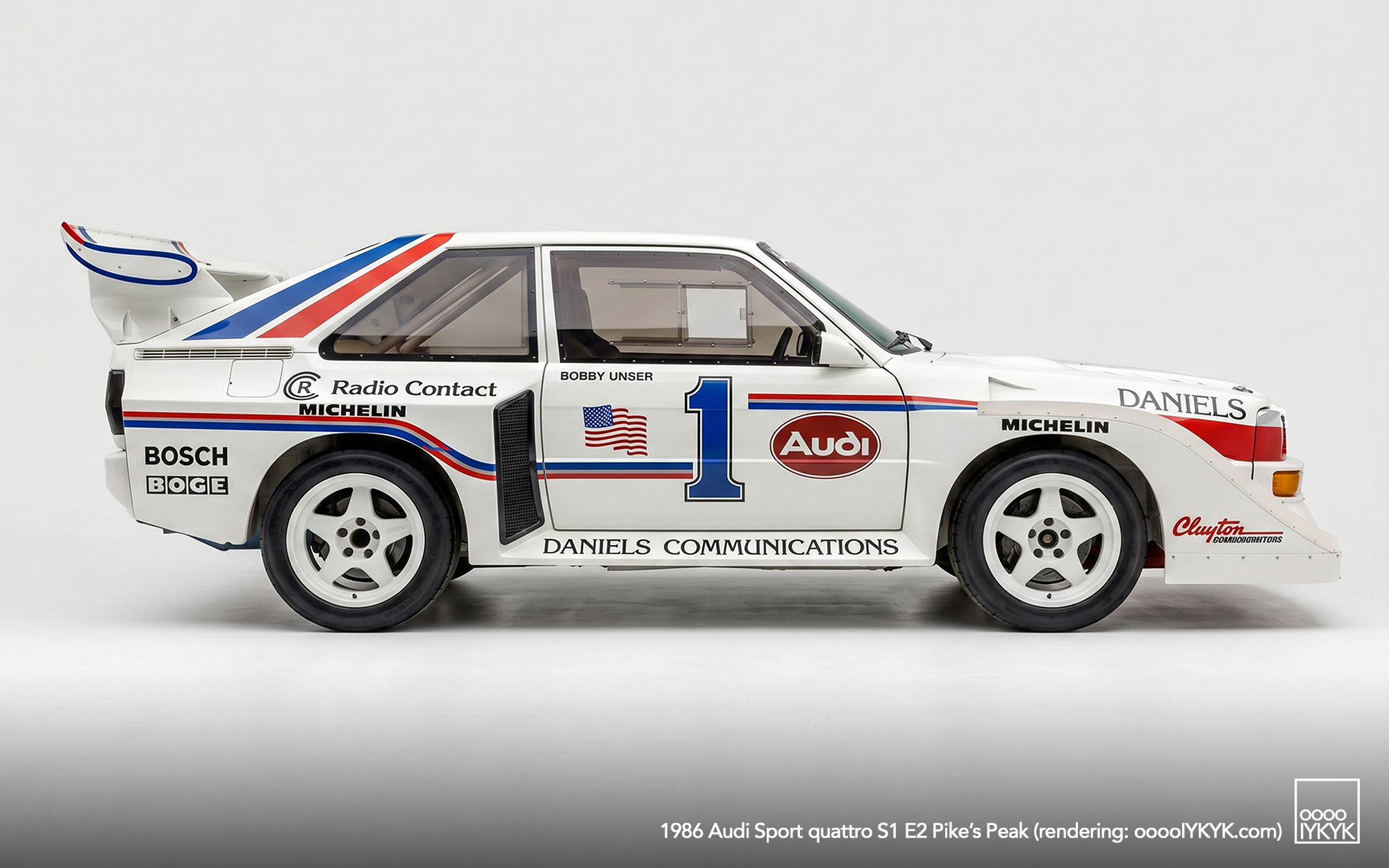
The 1986 Audi Sport quattro S1 E2 Pikes Peak occupies a unique place in Audi competition history. Driven by Bobby Unser to victory at the 1986 Pikes Peak International Hill Climb, it reclaimed the course record from Audi’s own Michèle Mouton and delivered Unser’s record-setting tenth overall victory on the mountain.
The car would also serve as the foundation for Audi’s legendary 1987 Pikes Peak effort. Following its victory in 1986, the chassis returned to Audi Sport where it underwent extensive redevelopment into the even more extreme Sport quattro S1 E2 Pikes Peak driven by Walter Röhrl. As a result, this single chassis contributed to consecutive overall victories in 1986 and 1987, making it one of the most successful and historically significant competition cars produced by Audi Sport.
BACKGROUND
Audi entered the 1986 Pikes Peak International Hill Climb under dramatically different circumstances than the previous year.
Michèle Mouton had departed Audi Sport following the 1985 season, while the future of Group B rallying had collapsed following a series of fatal accidents. Audi had already withdrawn from factory rally competition and was actively shifting its motorsport focus elsewhere.
At the same time, the newly developed Sport quattro S1 E2 had arrived. Featuring extensive aerodynamic modifications and significant mechanical revisions, it represented the ultimate evolution of Audi’s front-engined Group B quattro.
Audi initially intended to field Walter Röhrl for the event. However, Bobby Unser, fresh from his involvement in Audi’s Talladega speed-record program and possessing unmatched knowledge of the mountain, leveraged his relationship with Audi to secure the drive.
The partnership brought together one of the most advanced rally cars ever built and the most successful driver in Pikes Peak history.
THE CAR
The Sport quattro S1 E2 was developed to address the shortcomings of earlier Sport quattro models.
Engineers relocated numerous components rearward in an effort to improve weight distribution. Cooling systems, oil coolers, transmission coolers, and other ancillary components were moved behind the rear axle, helping shift the balance from the nose-heavy characteristics that had challenged earlier Sport quattros.
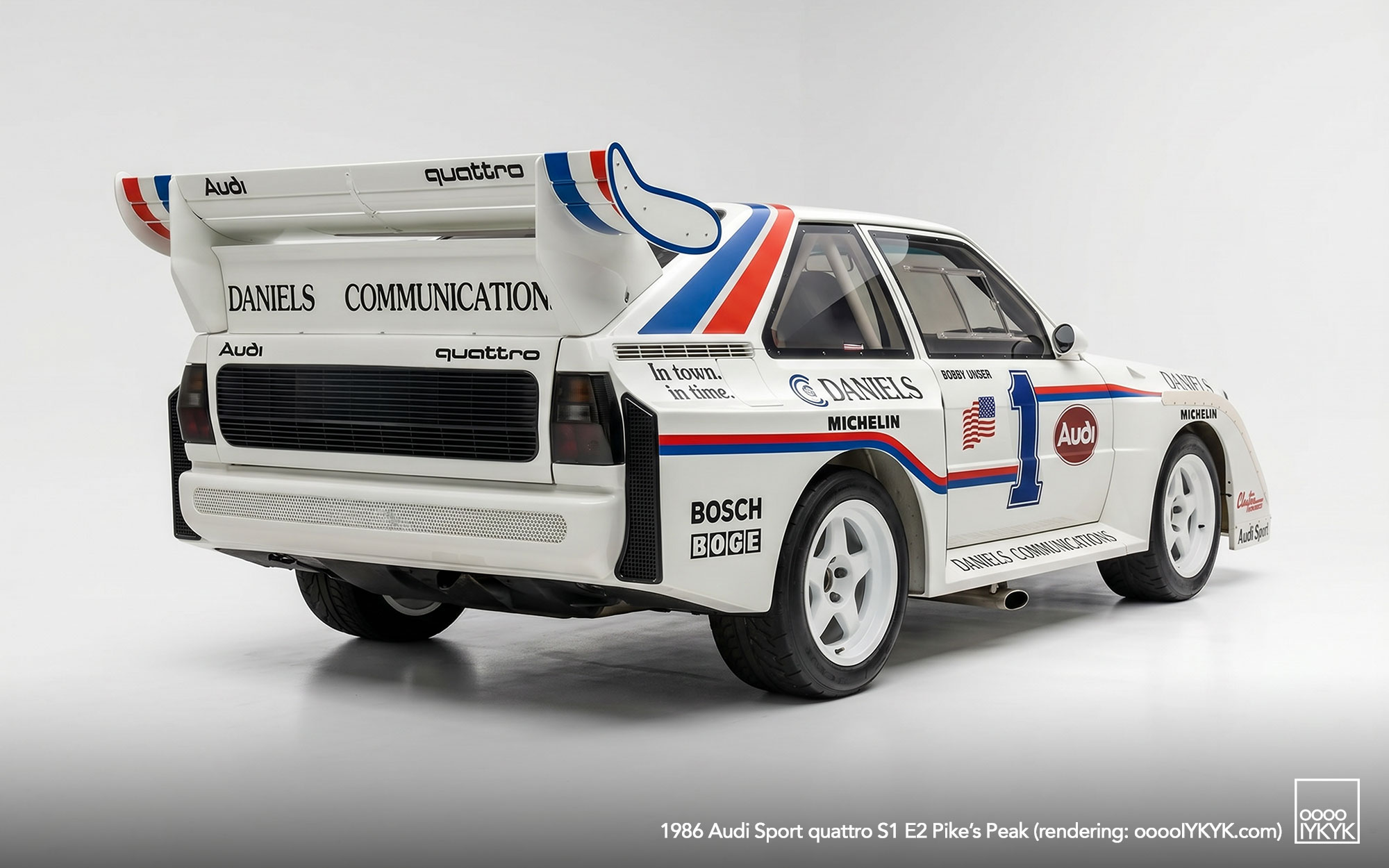
Aerodynamic development was equally aggressive. A massive front splitter, enlarged wheel arch extensions, rear bodywork modifications, and an oversized rear wing transformed the appearance of the car while generating significantly increased downforce.
Power output exceeded that of previous Sport quattros and was delivered through a highly developed turbocharged 2.1-liter five-cylinder engine coupled to Audi’s permanent quattro all-wheel-drive system.
The result was one of the most extreme competition cars Audi Sport ever produced. While developed initially for Group B rally competition, the chassis would ultimately find its greatest success on Pikes Peak. Following Bobby Unser’s 1986 victory, Audi Sport selected the same chassis as the basis for the heavily revised 1987 Pikes Peak car, ensuring its place at the center of Audi’s most successful era on America’s Mountain.
PREPARATION FOR PIKES PEAK
Although the S1 E2 formed the basis of Audi’s 1986 effort, Bobby Unser and Audi engineers spent considerable time adapting the car specifically for the mountain.
Unser’s decades of experience on Pikes Peak influenced suspension settings, tire selection, throttle response, turbocharger behavior, and overall chassis balance. He had earned the respect of Audi engineers through his involvement in the company’s Talladega speed-record program and quickly became an active participant in the car’s development.
Among the changes were revisions to throttle-body configuration and continued development of the turbocharging system. Both Unser and Walter Röhrl favored the aggressive driver-controlled turbocharger arrangement that allowed full boost to remain available whenever the driver desired.
As with previous Audi efforts, extensive calibration work was carried out to account for the extreme altitude changes encountered during the climb from approximately 9,400 feet to more than 14,000 feet above sea level.
The result was not merely a Group B rally car being repurposed for a hill climb, but a machine specifically tailored to the unique demands of Pikes Peak.
COMPETITION HISTORY
Pikes Peak International Hill Climb 1986
Driver: Bobby Unser
Following practice and final preparation, Bobby Unser lined up for the 1986 running of the Race to the Clouds on July 12.
The objective was clear. Audi wanted to defeat Peugeot, prove the capabilities of the Sport quattro S1 E2, and reclaim the course record established by Michèle Mouton the previous year.
Unser also had personal motivation. Mouton’s victory had interrupted decades of dominance by the Unser family, whose history on the mountain stretched back to the 1930s. The opportunity to reclaim the title of King of the Mountain was one he could not resist.
At 52 years old, Unser faced criticism from some who believed he had little to gain and much to lose. Even his brother Al questioned the wisdom of attempting to challenge the mountain once more. Unser disagreed.
The run was a success.
Unser completed the 12.42-mile dirt course in 11:09.22, lowering Mouton’s year-old record by more than sixteen seconds and securing his tenth overall victory at Pikes Peak.
The win made Bobby Unser the first driver to reach ten overall victories on the mountain, a record that remains unmatched.
For Audi, it marked a second consecutive overall victory at Pikes Peak and further validated the company’s commitment to the quattro concept in one of motorsport’s most demanding environments.
LEGACY
The 1986 victory represented far more than another course record.
While Bobby Unser’s win secured his historic tenth overall victory at Pikes Peak, it also marked the beginning of the final evolution of Audi’s Group B quattro program. Following the event, Audi Sport retained the chassis and undertook a comprehensive redesign specifically for Pikes Peak competition.
The resulting 1987 Sport quattro S1 E2 Pikes Peak featured dramatically revised aerodynamics, further weight reduction, improved cooling systems, and substantially increased power. Driven by Walter Röhrl, it became the first car to break the eleven-minute barrier on the mountain, recording a time of 10:47.85 and securing Audi’s third consecutive overall victory.
As a result, the chassis that carried Bobby Unser to victory in 1986 also formed the basis of Röhrl’s record-setting 1987 machine. Few competition cars can claim involvement in multiple outright victories at Pikes Peak, and fewer still can claim participation in consecutive course-record performances by two of motorsport’s most celebrated drivers.
Today the chassis survives in Audi Tradition’s collection in its final 1987 configuration, preserving the legacy of both victories within a single automobile.
NOTABLE DISTINCTION
This chassis won the Pikes Peak International Hill Climb in 1986 with Bobby Unser and was subsequently rebuilt into the 1987 Sport quattro S1 E2 Pikes Peak driven by Walter Röhrl.
In combined form, the chassis contributed to two consecutive overall victories and two consecutive course records, first with Bobby Unser in 1986 and then with Walter Röhrl in 1987.
SIGNIFICANCE
The 1986 Audi Sport quattro S1 E2 Pikes Peak combined the most advanced front-engined Group B technology Audi ever produced with the greatest Pikes Peak driver of his era.
Together they reclaimed the course record, secured Audi’s second consecutive overall victory on the mountain, and delivered Bobby Unser’s historic tenth overall win.
The car’s story did not end there. By serving as the basis for the even more extreme 1987 Pikes Peak machine, it became part of two of the most important victories in Audi motorsport history. Few competition cars can claim such a direct connection to consecutive record-setting performances by Bobby Unser and Walter Röhrl.
VIDEO
‘
PHOTO GALLERY