

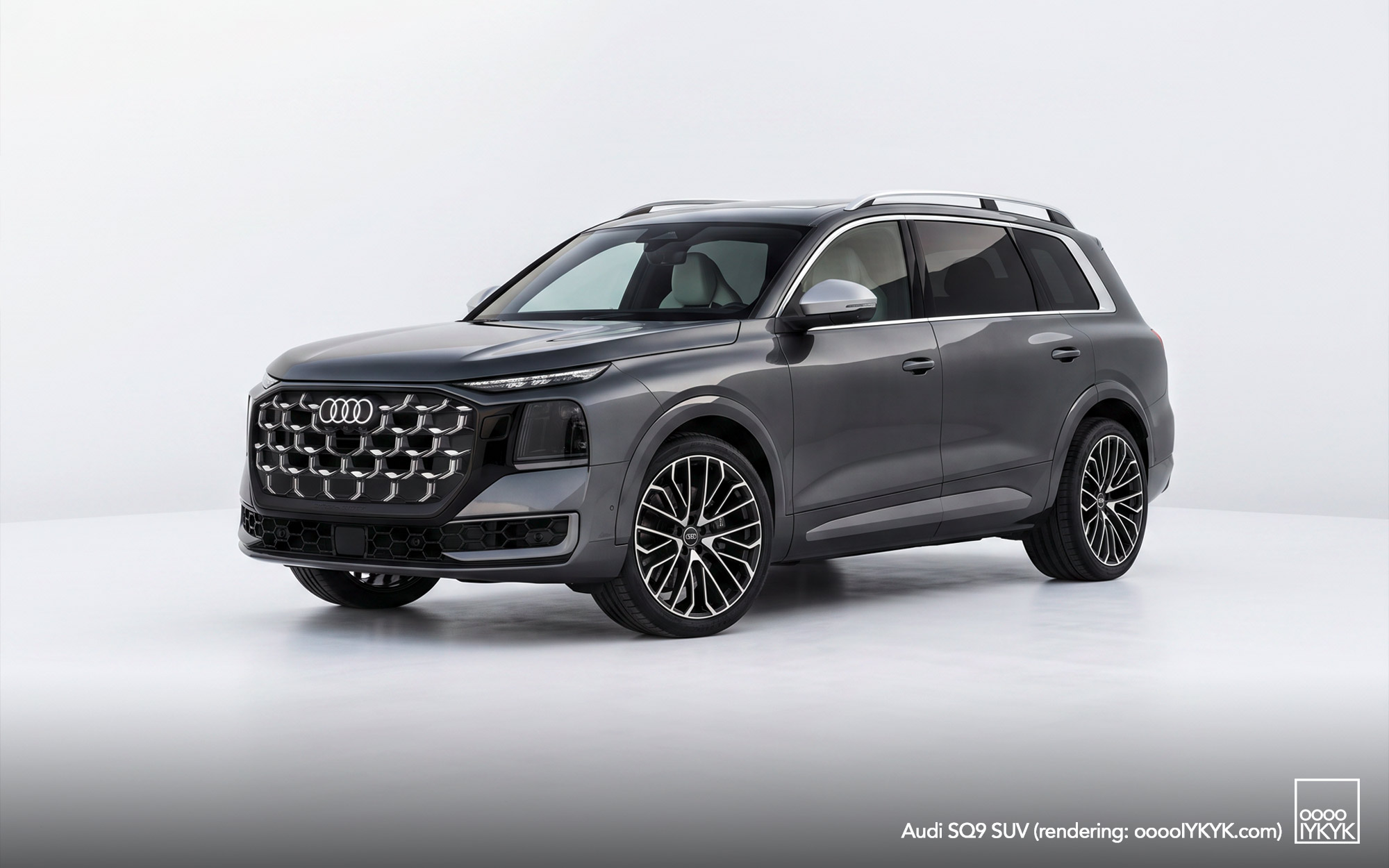

/Eras/Audi Modern Era /Audi SQ9 / Audi SQ9 SUV (PPC)
What: Audi SQ9 SUV
Era: Audi Modern Era
Model Years: 2027 – current
Market: United States
Internal designation:
Chassis / Matrix: PPC
Body style: Full-size SUV
Doors: Five
Seating capacity: Seven standard; six optional
Production location: Bratislava, Slovakia
U.S. market launch: Fourth quarter of 2026
Starting MSRP: $104,900 (excluding destination)
Scheduled maintenance: Three years or 30,000 miles of Audi Signature Care, whichever occurs first
The Audi SQ9 was introduced for the 2027 model year as the performance flagship of Audi’s new Q9 model family. Sharing its basic platform, body structure and interior architecture with the standard Q9, the SQ9 was developed as a substantially more performance-oriented vehicle, combining three-row practicality with a newly developed rear-biased quattro drivetrain, a 591-horsepower twin-turbocharged V8 and chassis technologies intended to deliver handling characteristics uncommon within the full-size luxury SUV segment.
The SQ9 occupies a unique position within Audi’s global portfolio. While Audi has offered high-performance versions of the Q5, Q7 and Q8 for many years, the SQ9 became the company’s first S model developed specifically around the requirements of the full-size luxury SUV market. It also marked the debut of a new rear-biased quattro architecture designed to improve dynamic response without compromising the refinement and all-weather capability traditionally associated with Audi’s permanent all-wheel-drive systems.
Unlike many previous S models that were engineered primarily from their standard counterparts through increased engine output and suspension revisions, the SQ9 received extensive mechanical changes throughout the drivetrain. Audi redesigned the center differential architecture, developed a new electronically controlled rear differential, recalibrated the suspension and steering systems and paired those components with a more powerful version of the 4.0 TFSI V8. The resulting package represented one of the most comprehensive mechanical revisions undertaken for an Audi S model in recent years.
Although developed primarily around North American customer demand, Audi subsequently confirmed availability in select additional markets, including the United Kingdom. The U.S. specification documented within this archive represents the reference model introduced during the vehicle’s initial launch.
MODEL HISTORY
Audi entered the luxury SUV market in 2005 with the first-generation Q7. At the time, the model represented the company’s largest production vehicle and introduced three-row seating to the Audi lineup for the first time. Subsequent generations refined the concept but retained dimensions more closely aligned with the midsize luxury SUV segment than the full-size vehicles increasingly favored in North America.
As the North American market evolved, manufacturers such as BMW, Mercedes-Benz, Cadillac, Lincoln, Jeep and Land Rover expanded their offerings with larger three-row luxury SUVs emphasizing passenger comfort, towing capability and increasingly powerful drivetrains. Audi’s Q7 remained competitive through continual development, while the Q8 established itself as the brand’s flagship two-row SUV with a greater emphasis on design and road performance.
The introduction of the Q9 created an entirely new flagship above both models. Rather than replacing either the Q7 or Q8, it expanded Audi’s SUV portfolio into the full-size luxury segment with significantly increased passenger volume, a longer wheelbase and greater cargo capacity.
Development of the SQ9 occurred alongside the standard Q9 but followed a distinct engineering philosophy. Audi’s objective was not simply to produce the fastest version of its largest SUV. Instead, engineers sought to preserve the long-distance comfort expected of a flagship luxury vehicle while delivering the steering response, drivetrain calibration and chassis control traditionally associated with considerably smaller S models.
This objective required changes extending well beyond engine output. The drivetrain, suspension, steering, braking system and electronic chassis controls were all revised specifically for the SQ9. Several of those systems, including the rear-biased quattro architecture, were developed expressly for the model and represented new technical directions for Audi’s performance SUVs.
The SQ9 therefore occupies an important place within Audi’s history. It represents the first application of a new generation of performance-oriented quattro technology in a full-size SUV while simultaneously introducing the company’s most powerful production SUV to date.
EXTERIOR DESIGN
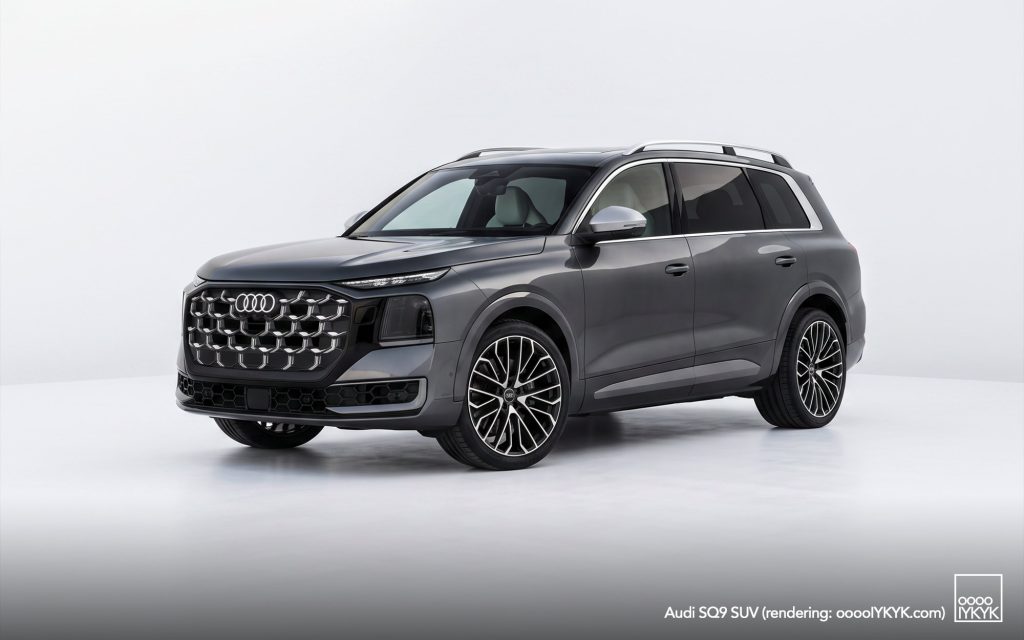
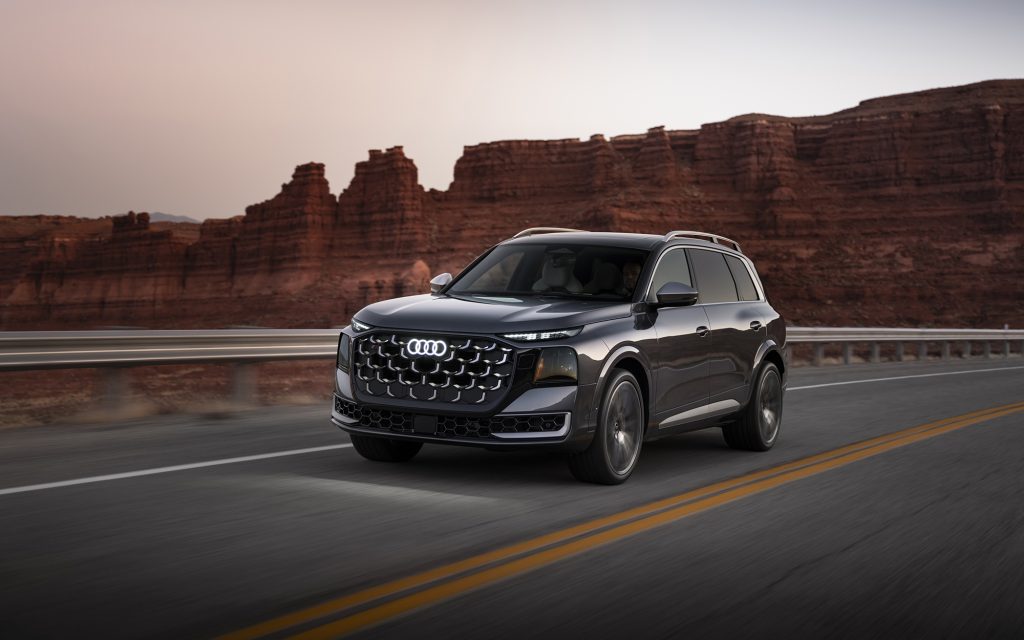
Although visually related to the standard Q9, the SQ9 incorporates numerous exterior revisions intended to communicate its increased performance capability while remaining consistent with Audi’s traditionally restrained S design philosophy.
Unlike RS models, which frequently employ dramatically widened bodywork and aggressive aerodynamic treatments, Audi’s S models have historically relied upon proportion, detailing and subtle functional changes to distinguish themselves from their standard counterparts. The SQ9 follows this approach.
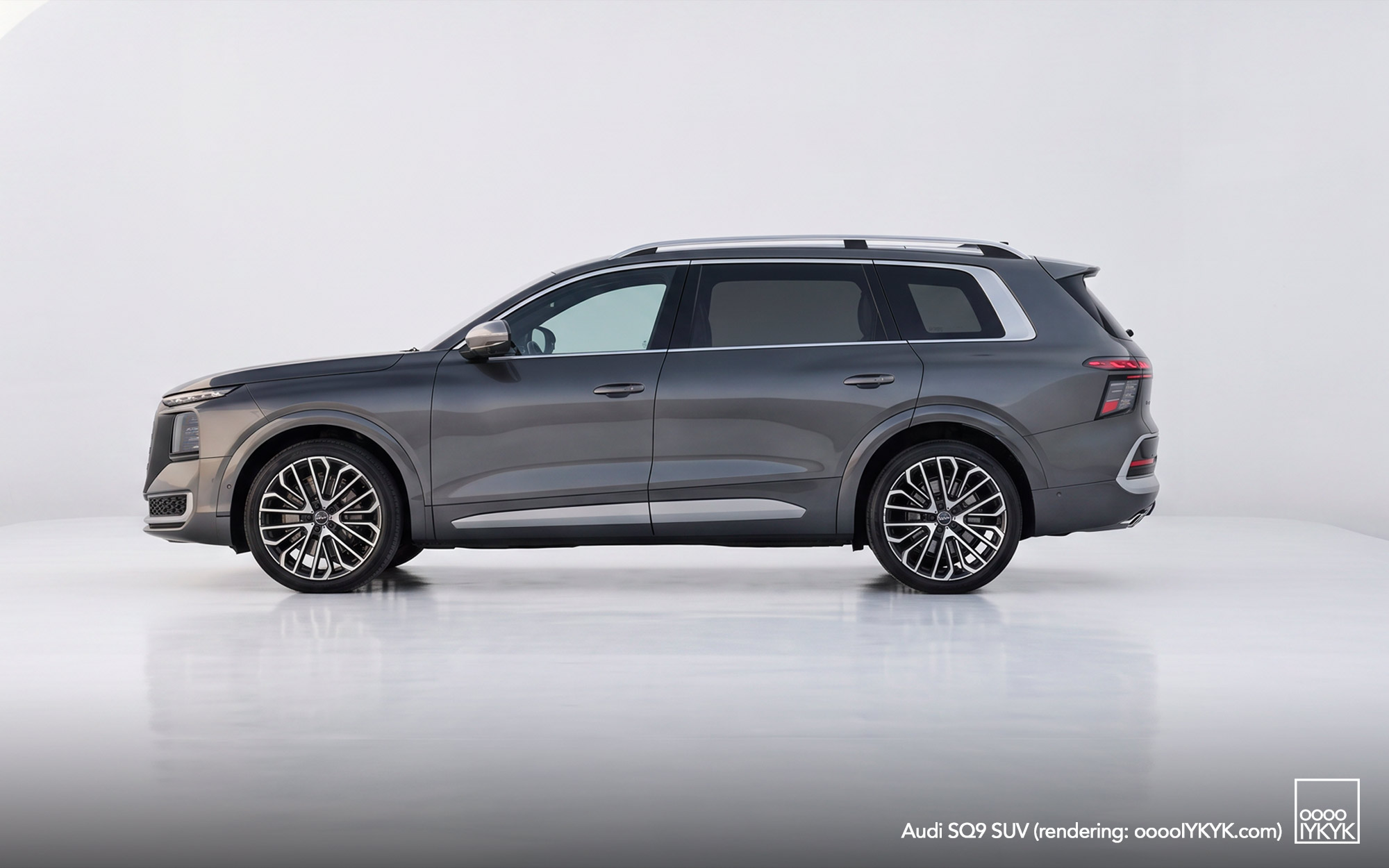
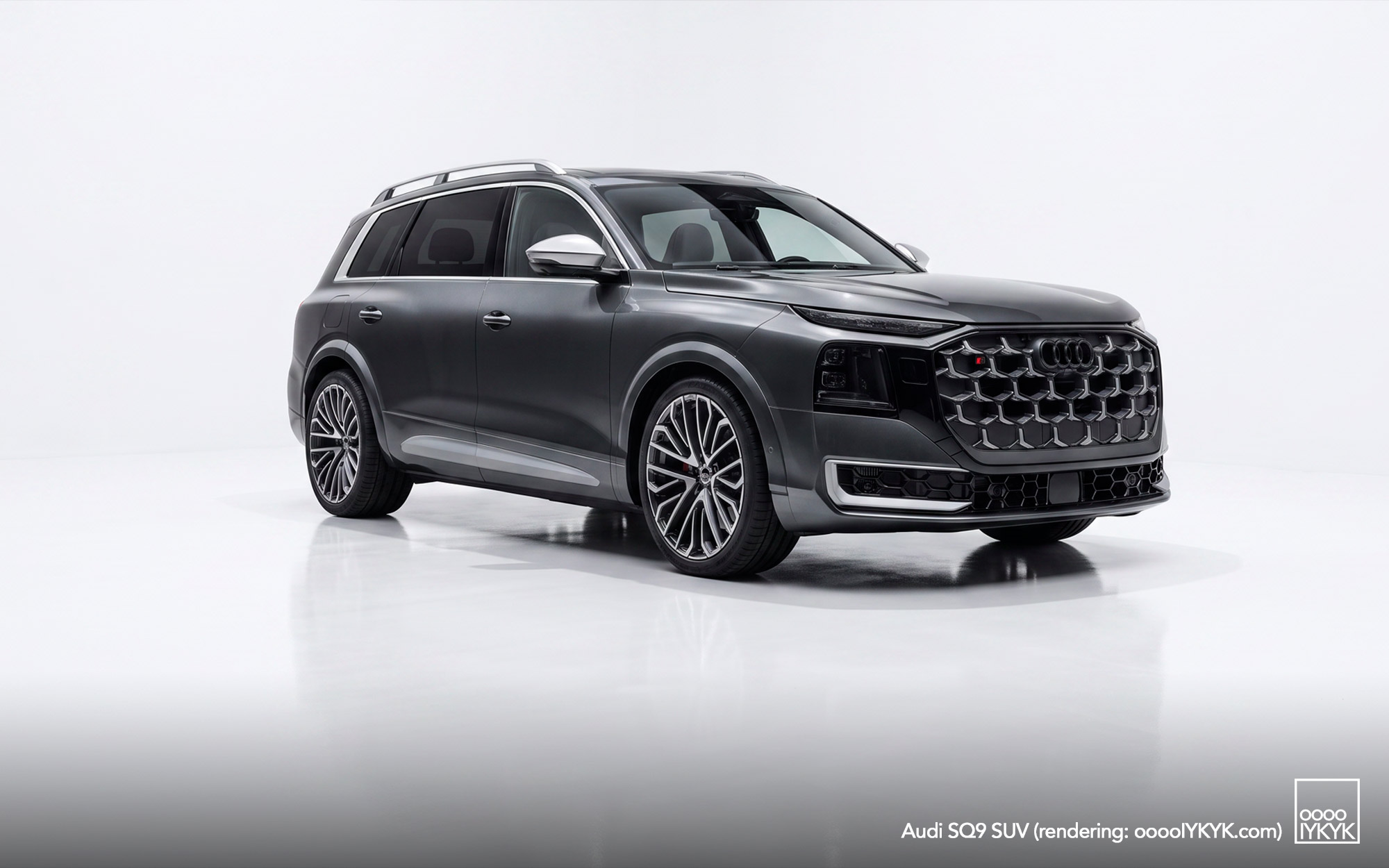
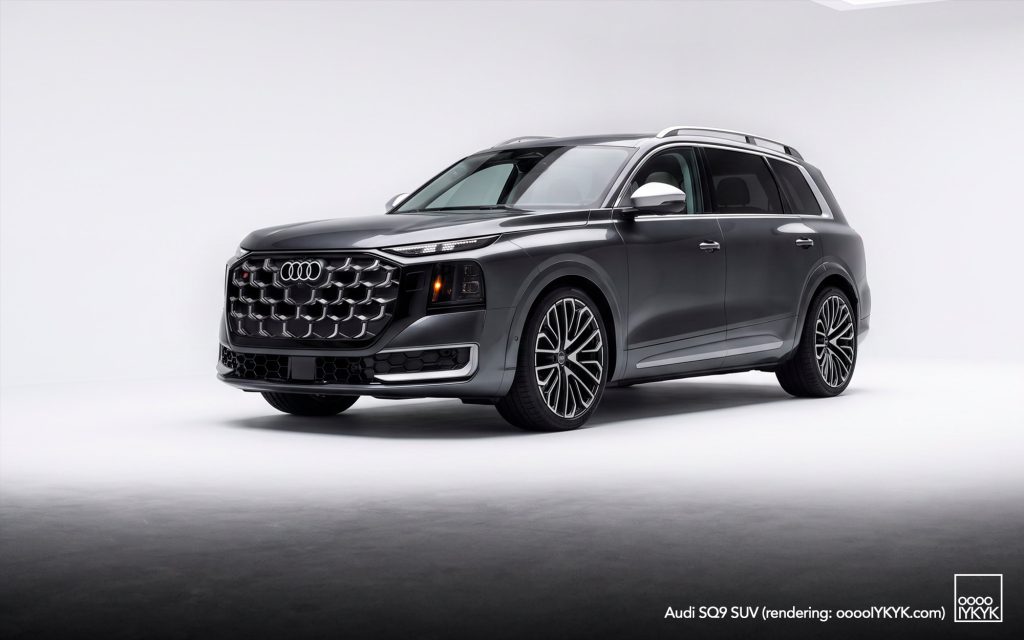
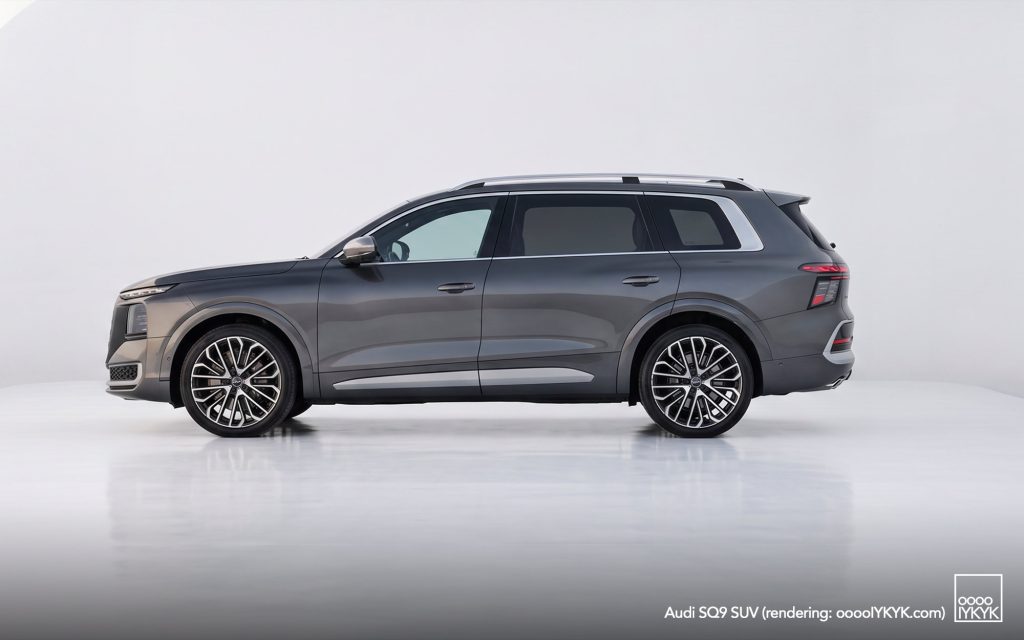
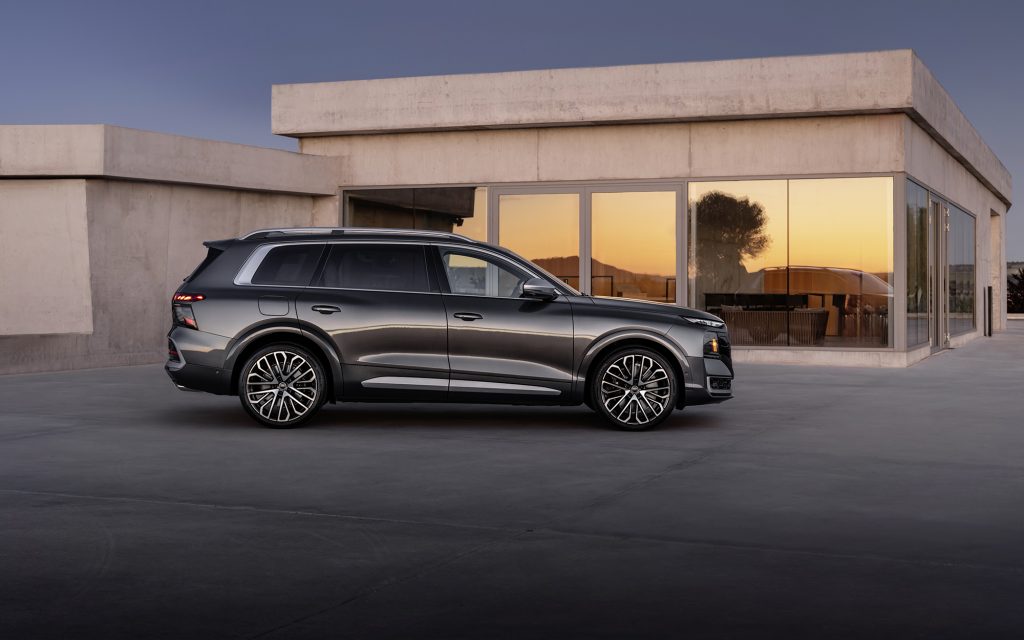
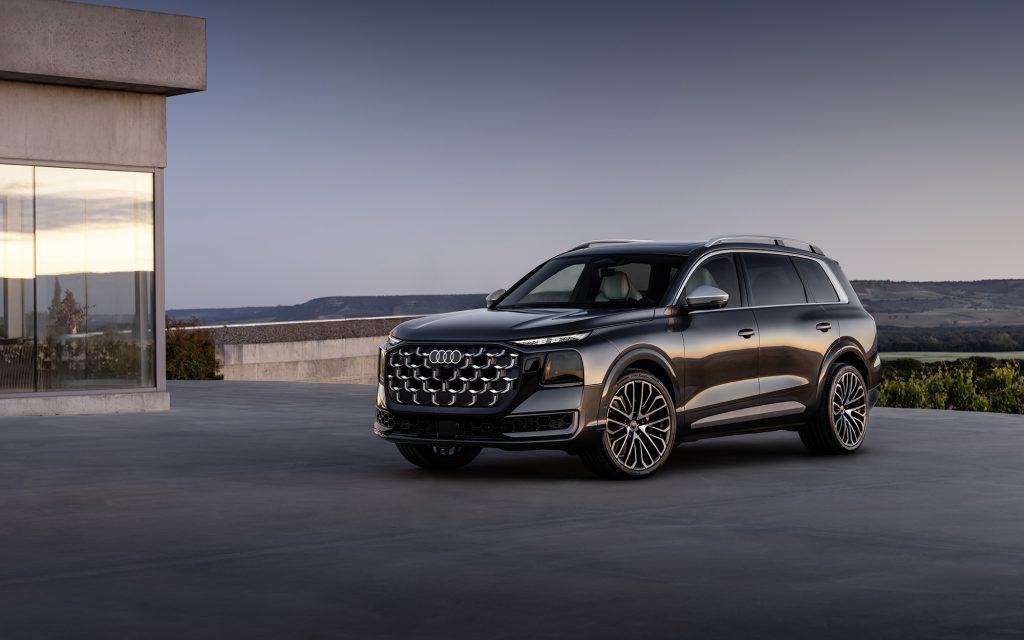
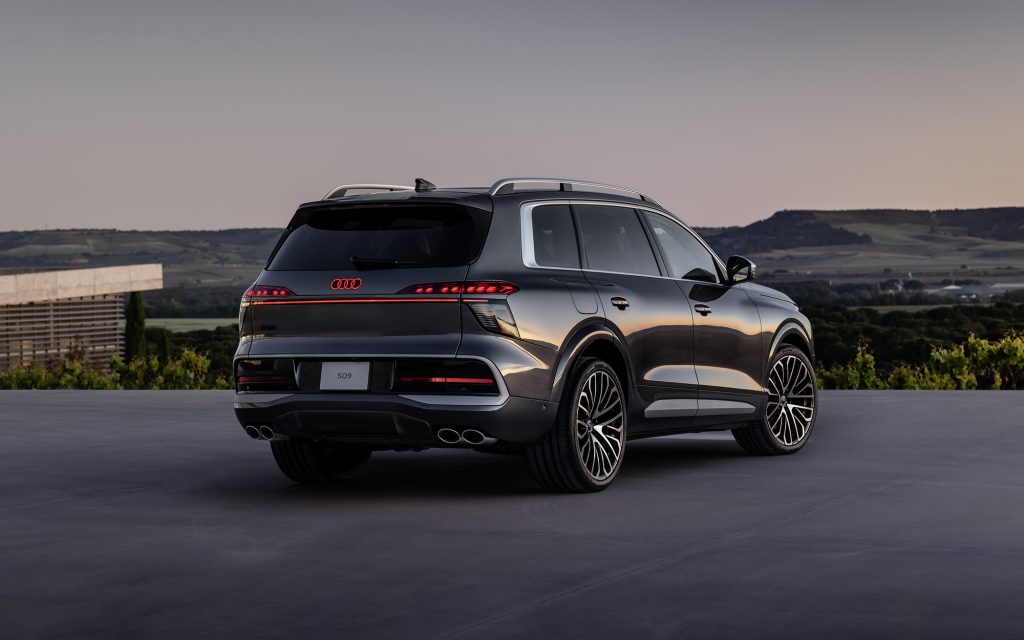
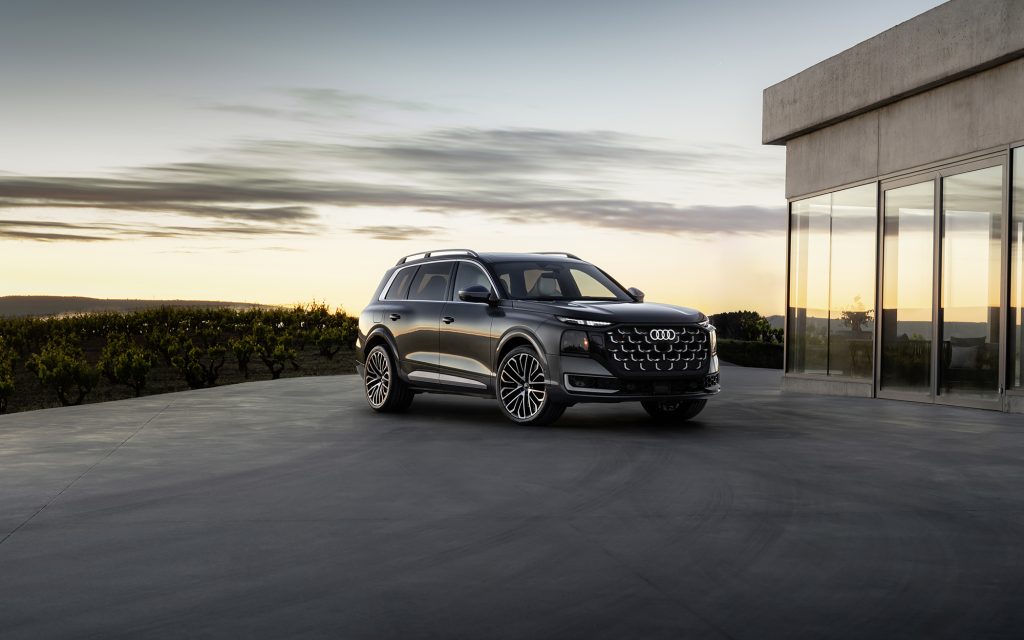
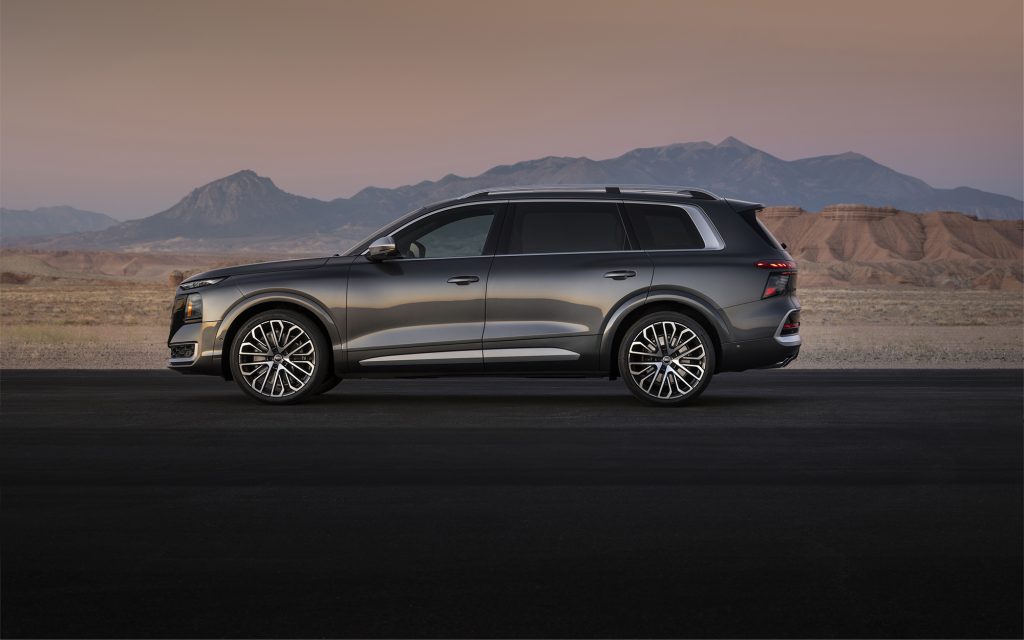
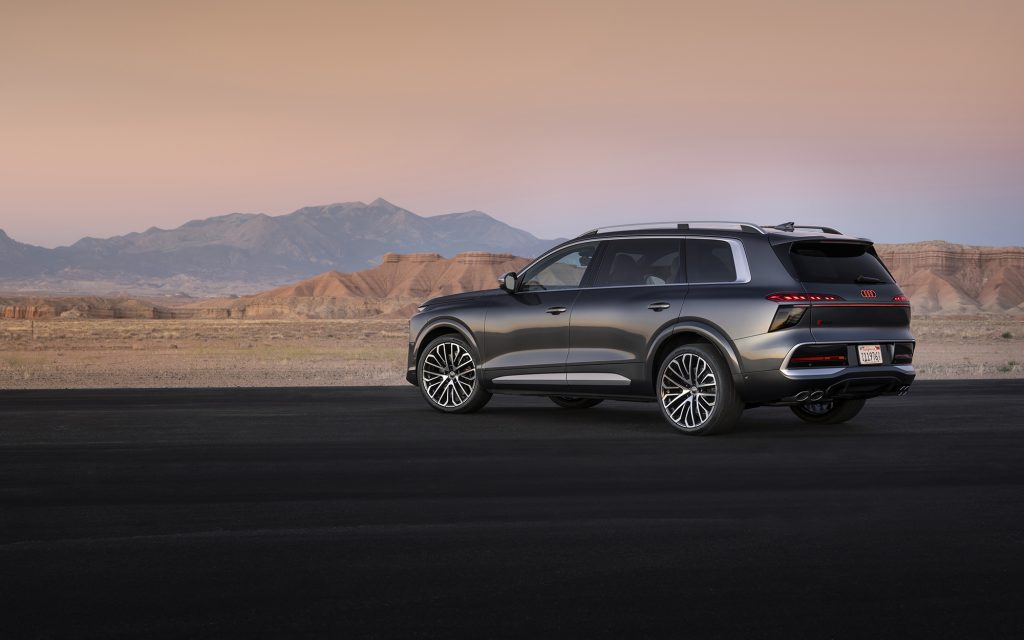
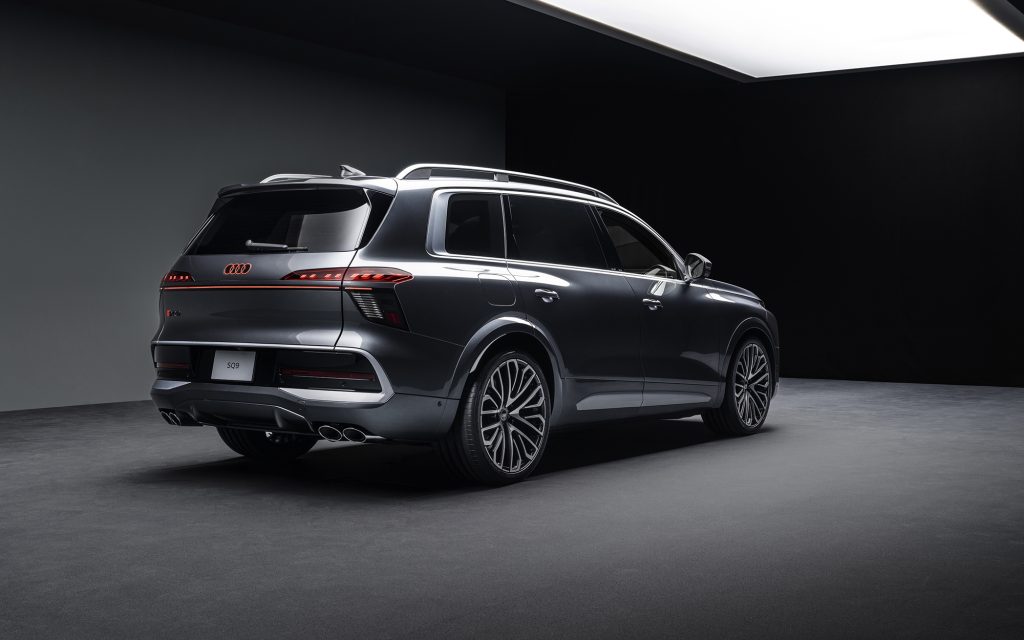
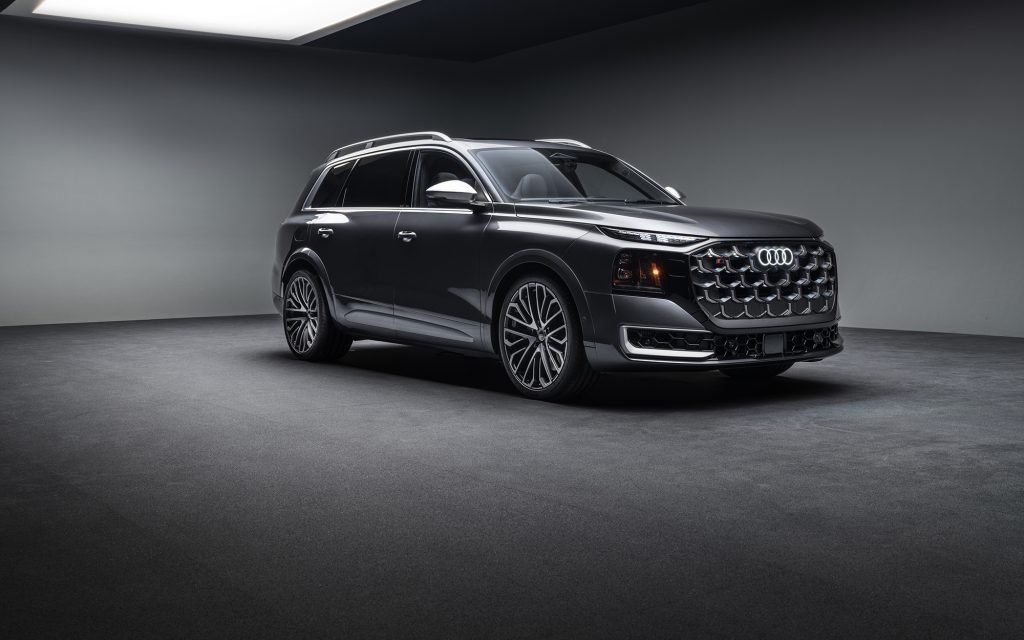
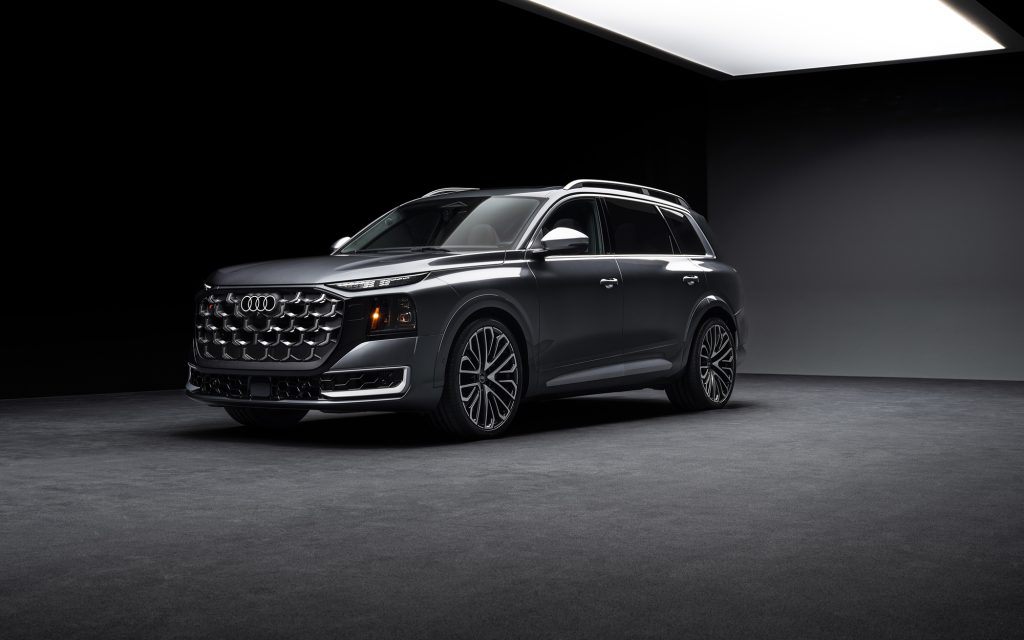
Its overall dimensions, roofline and body structure remain unchanged from the Q9, preserving the spacious passenger compartment and cargo capacity that define the model. The visual differentiation instead comes through revised bumper treatments, unique grille detailing, aluminum-look exterior trim, larger wheel packages and a more purposeful rear treatment.
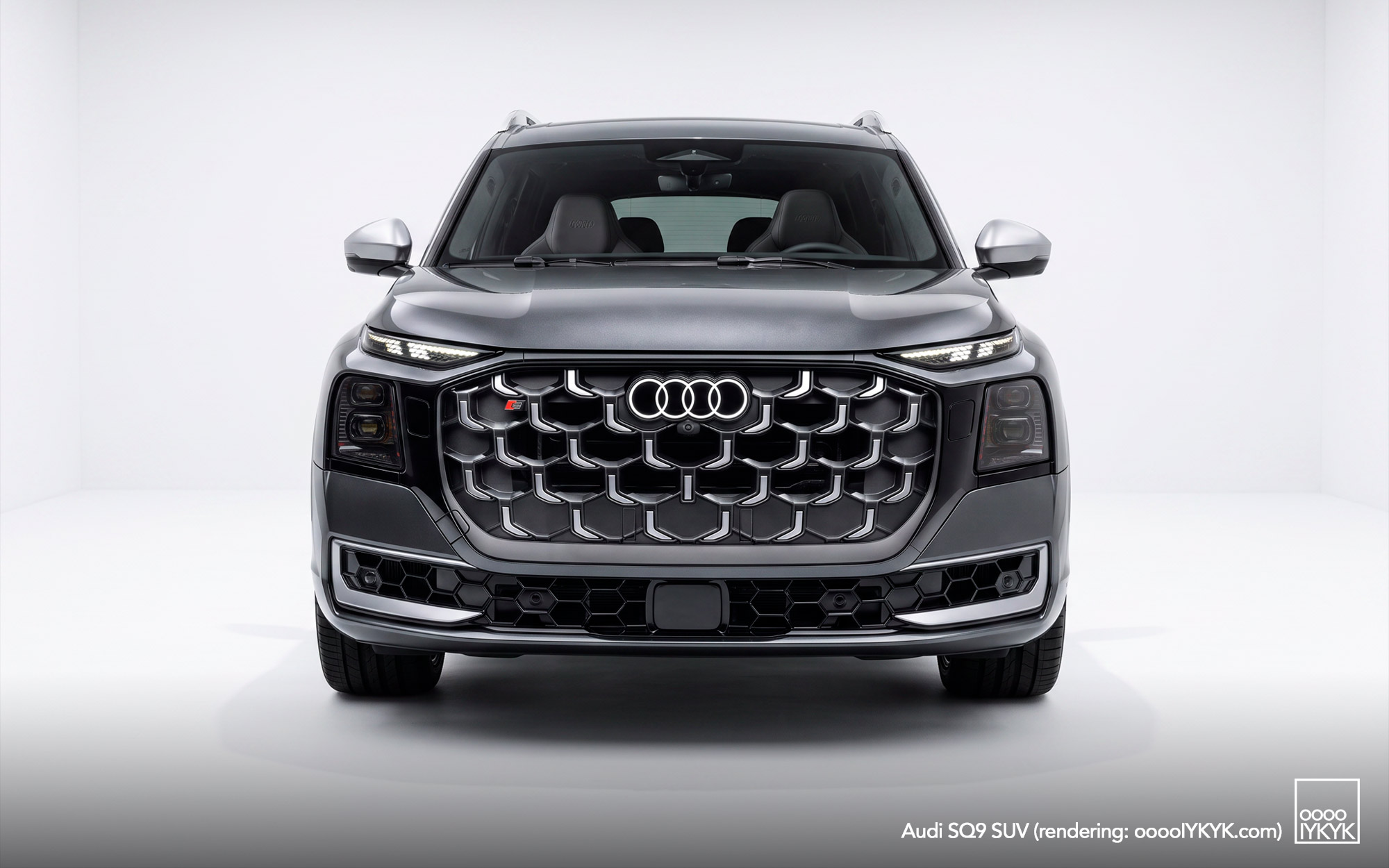
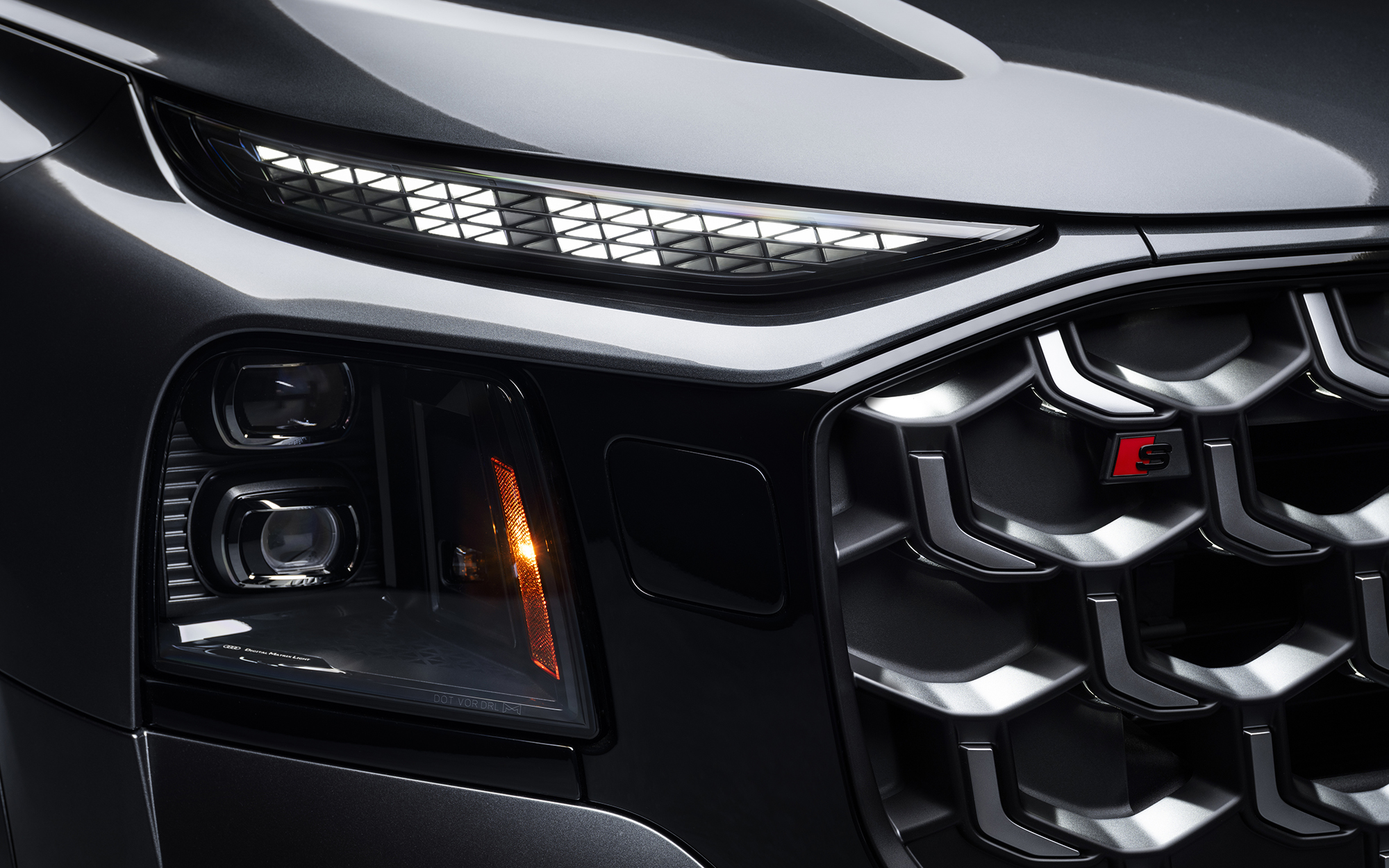
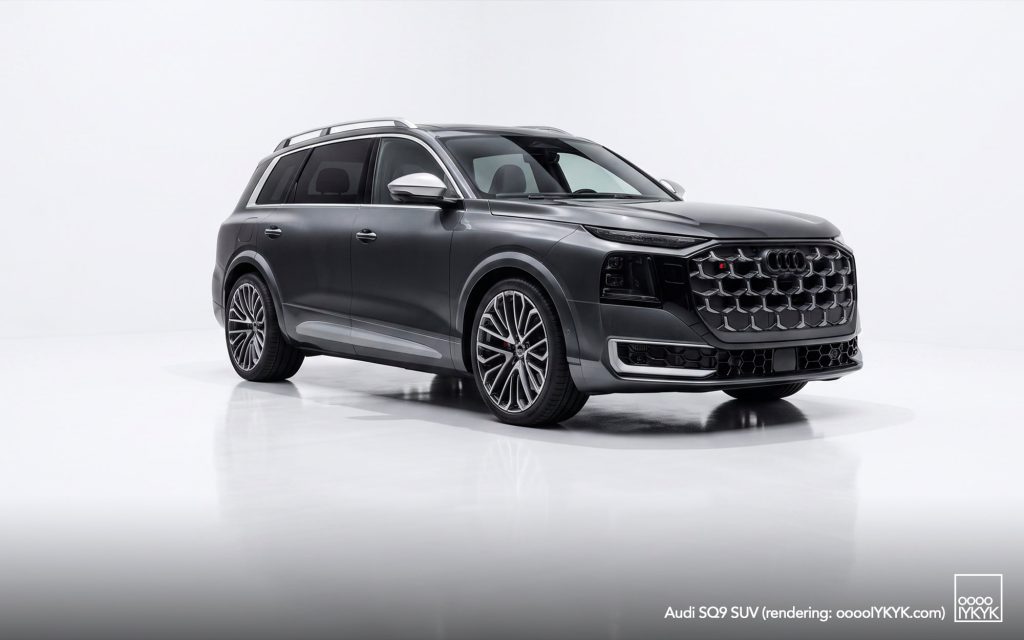
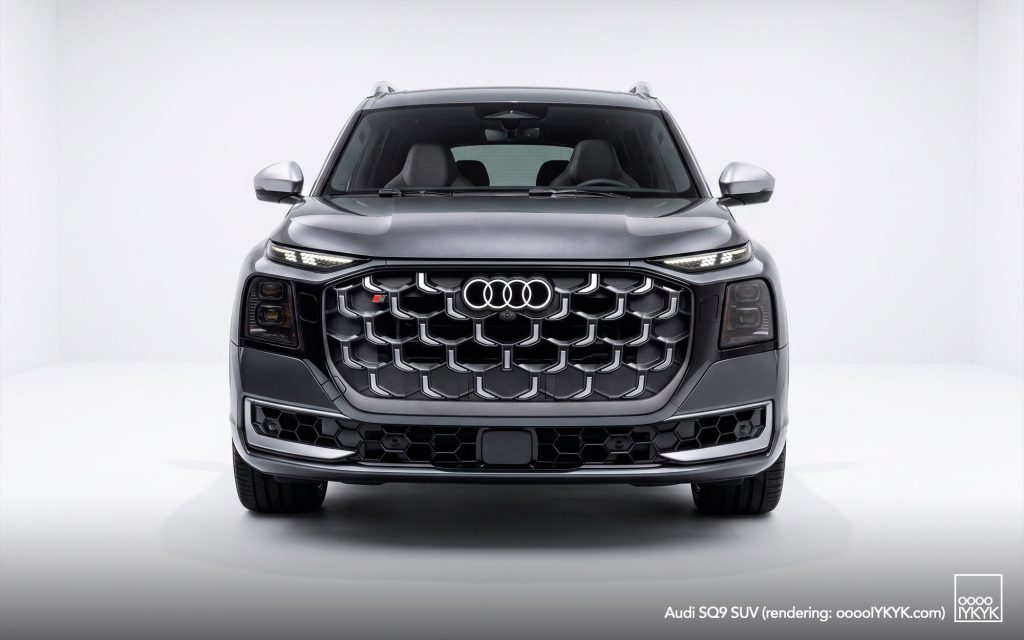
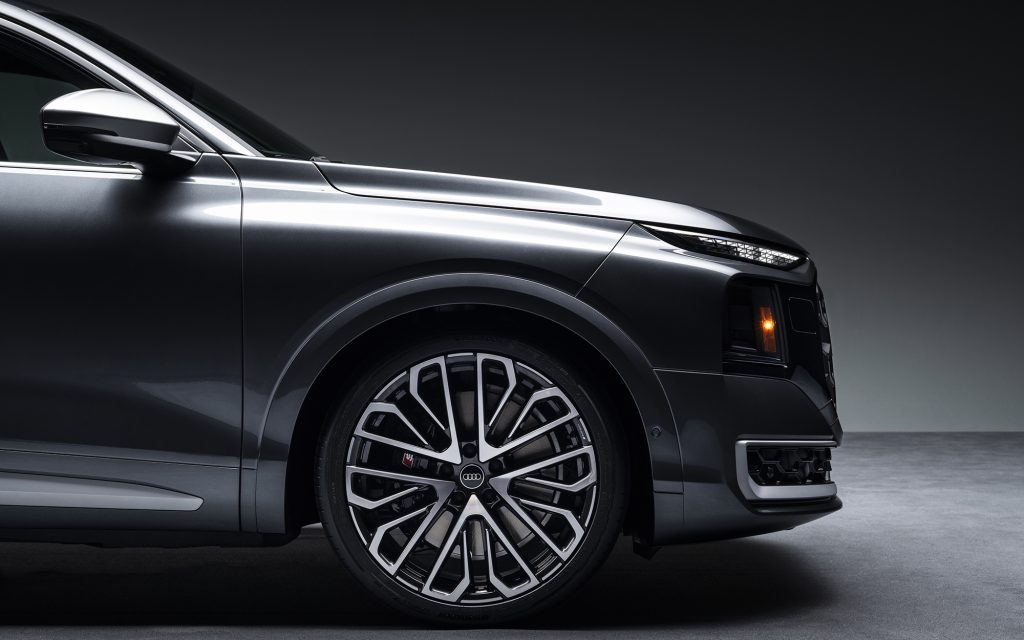
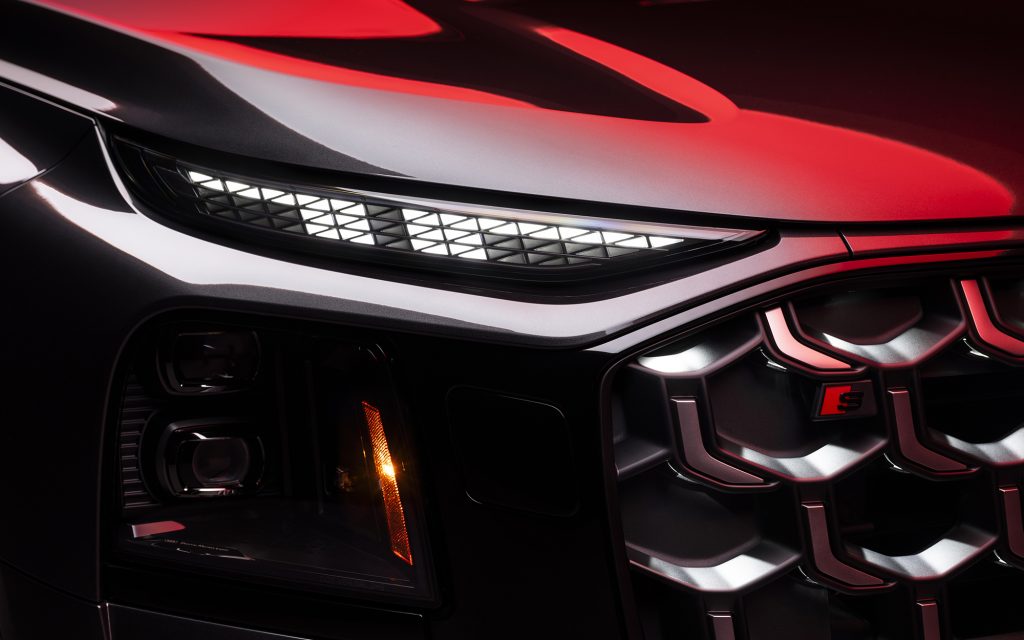
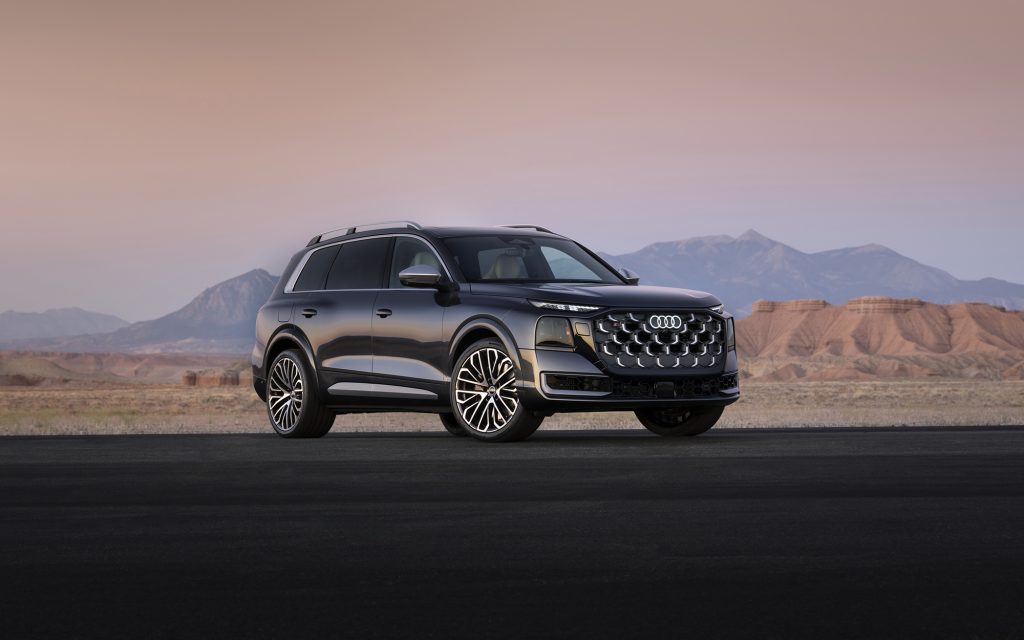
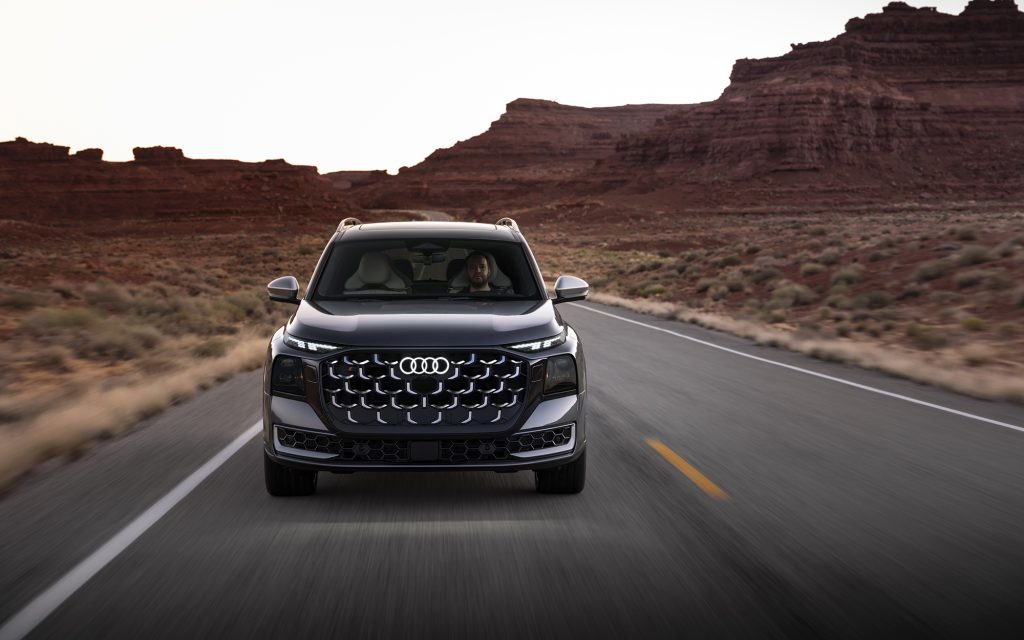
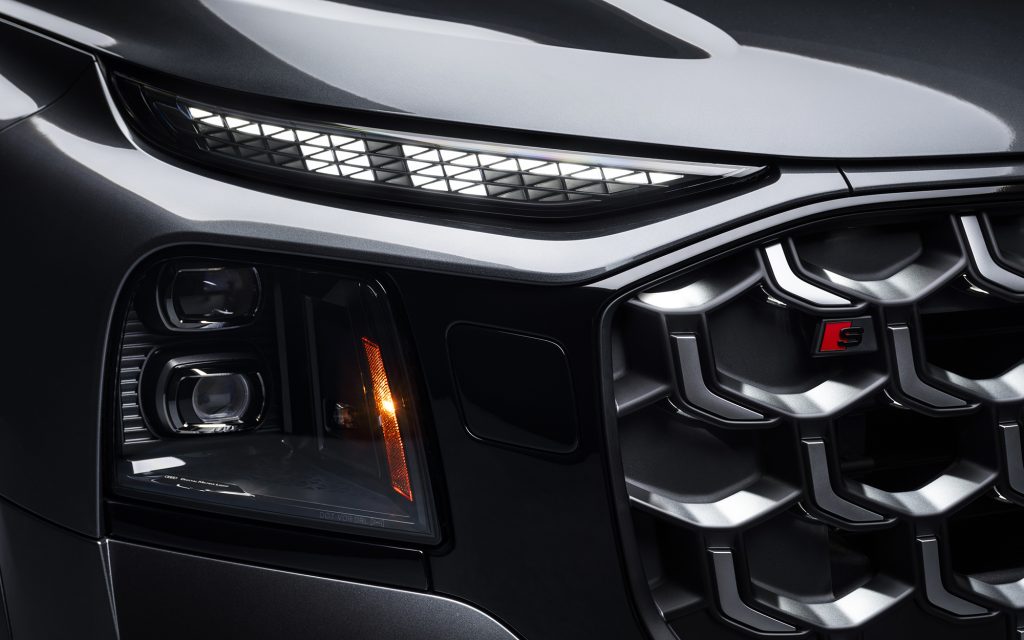
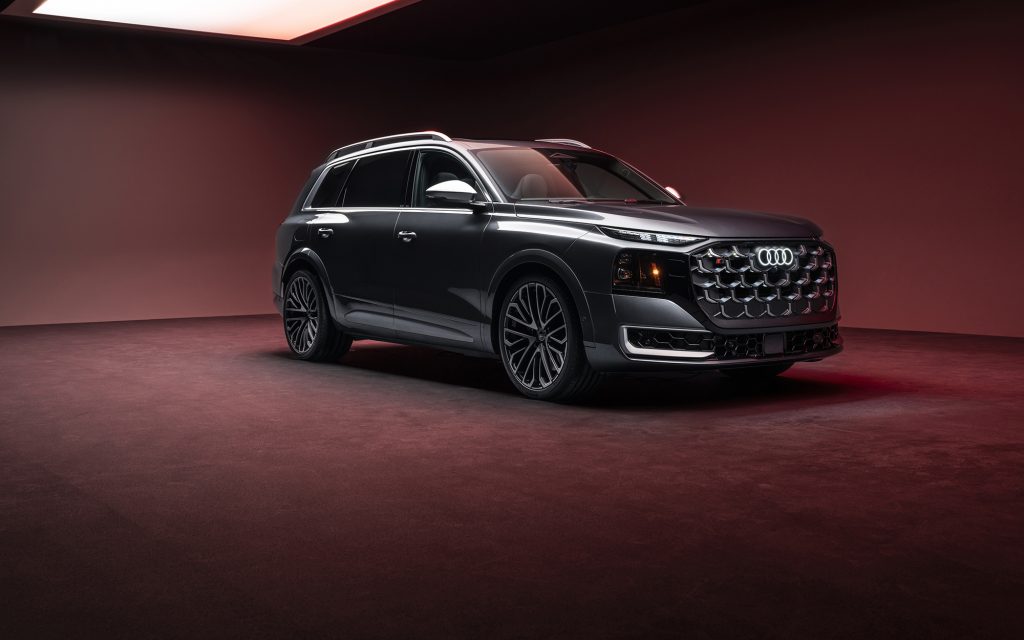
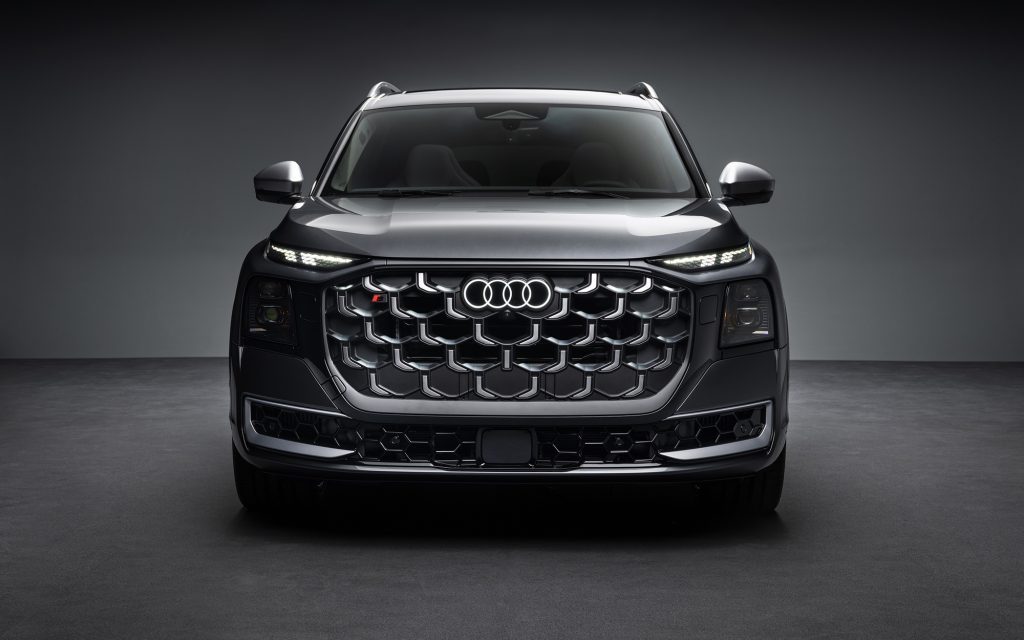
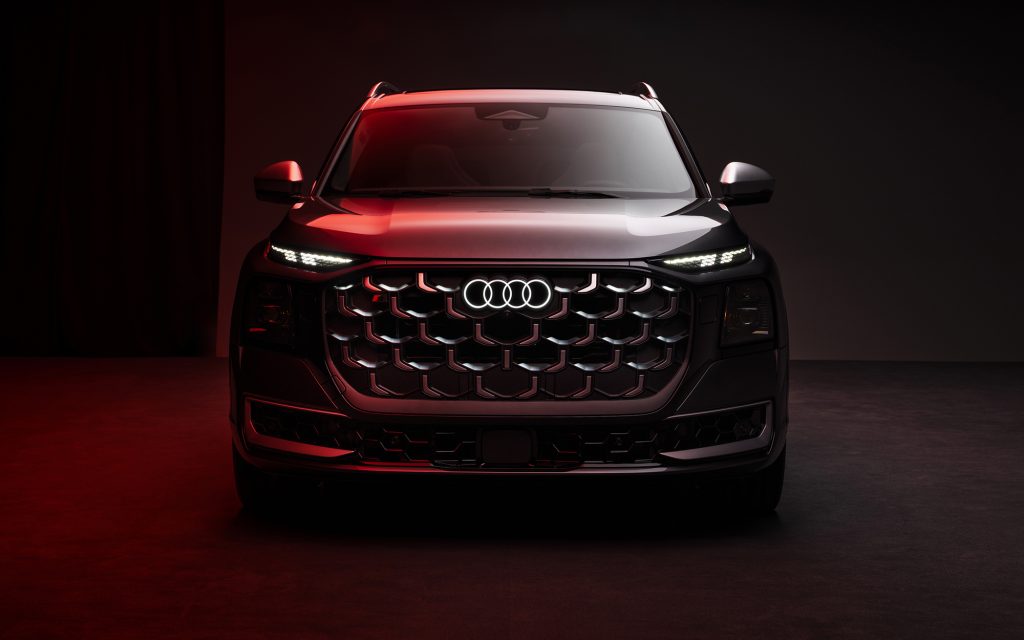
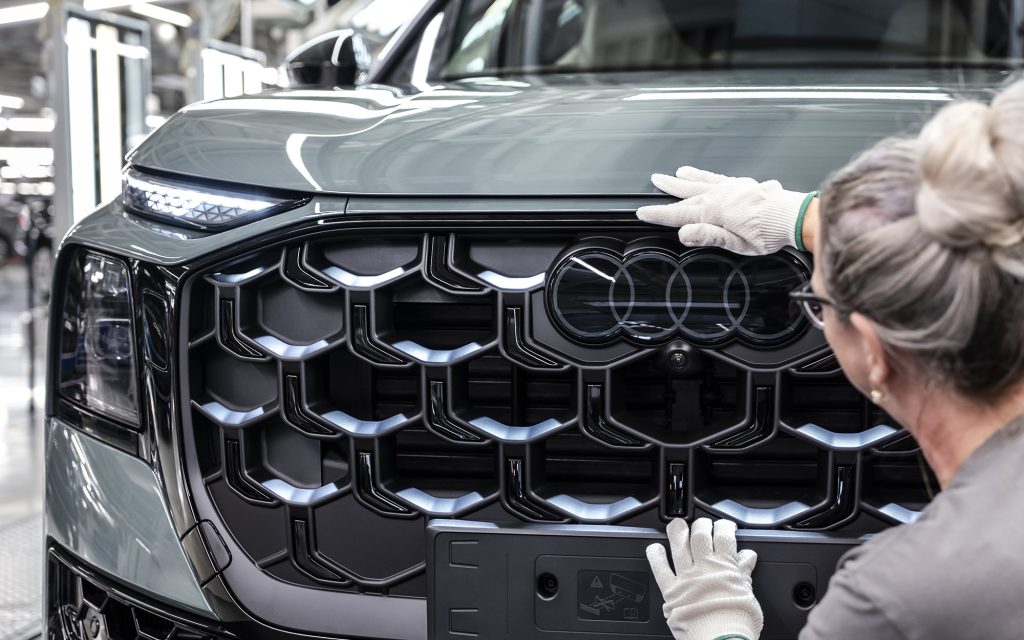
At the front, the Singleframe grille adopts a unique mesh pattern designed specifically for the SQ9. Larger lower air intakes increase airflow to the engine’s cooling system while also visually lowering the front fascia. Aluminum-look trim replaces many of the gloss black or body-colored components used on the standard Q9, reinforcing the understated performance character traditionally associated with Audi’s S models.
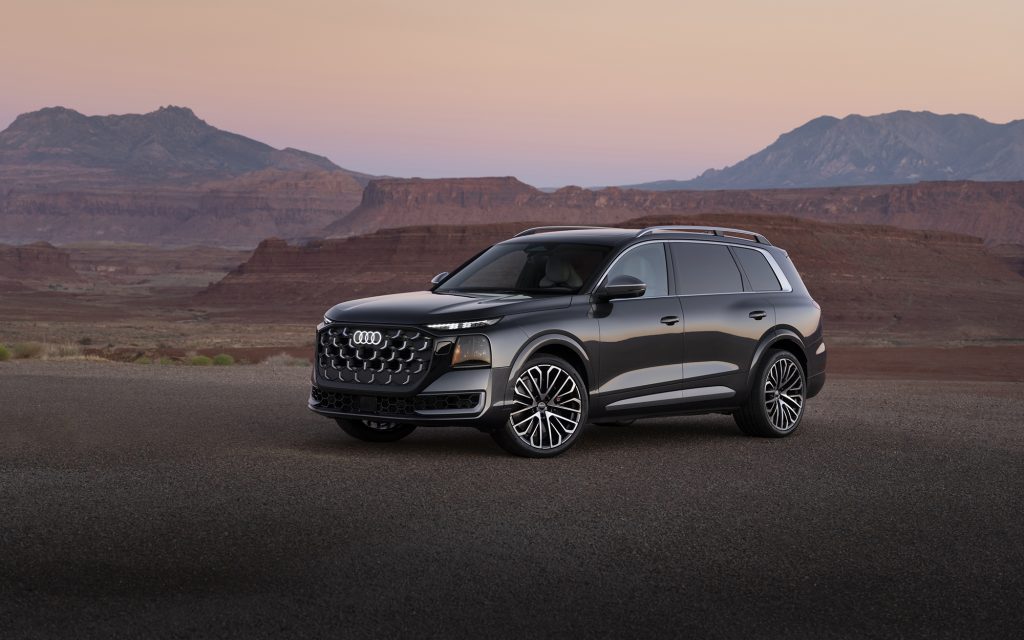
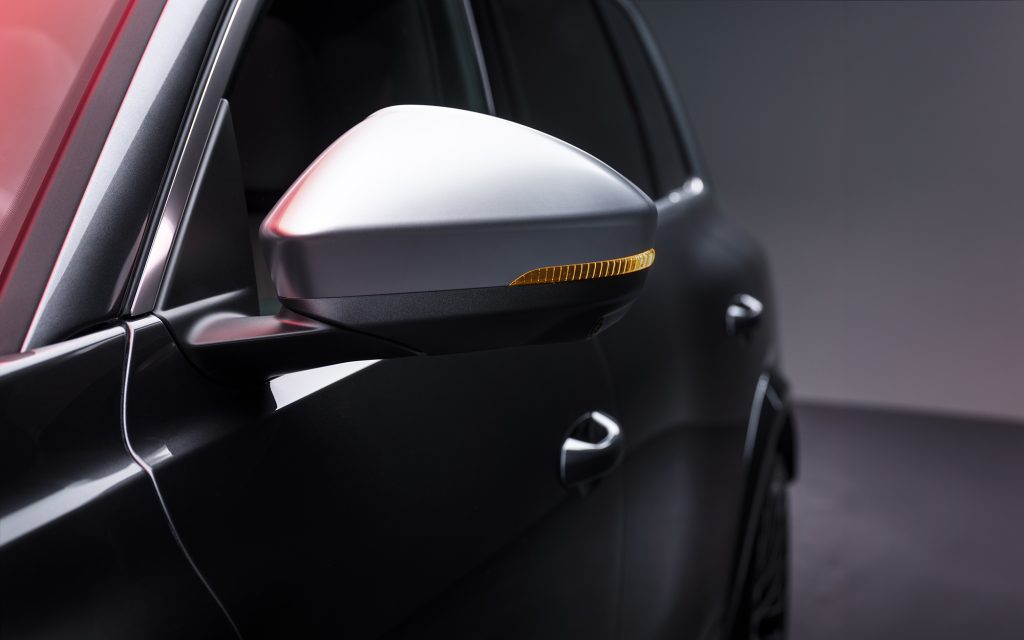
The hood, front fenders and greenhouse remain common with the Q9, preserving identical occupant packaging and crash structure. Along the sides, S-specific mirrors, distinctive wheel designs and larger tire packages provide the primary visual differentiation. The body itself avoids exaggerated character lines or unnecessary aerodynamic devices, allowing the SQ9 to retain much of the formal appearance established by the standard model.
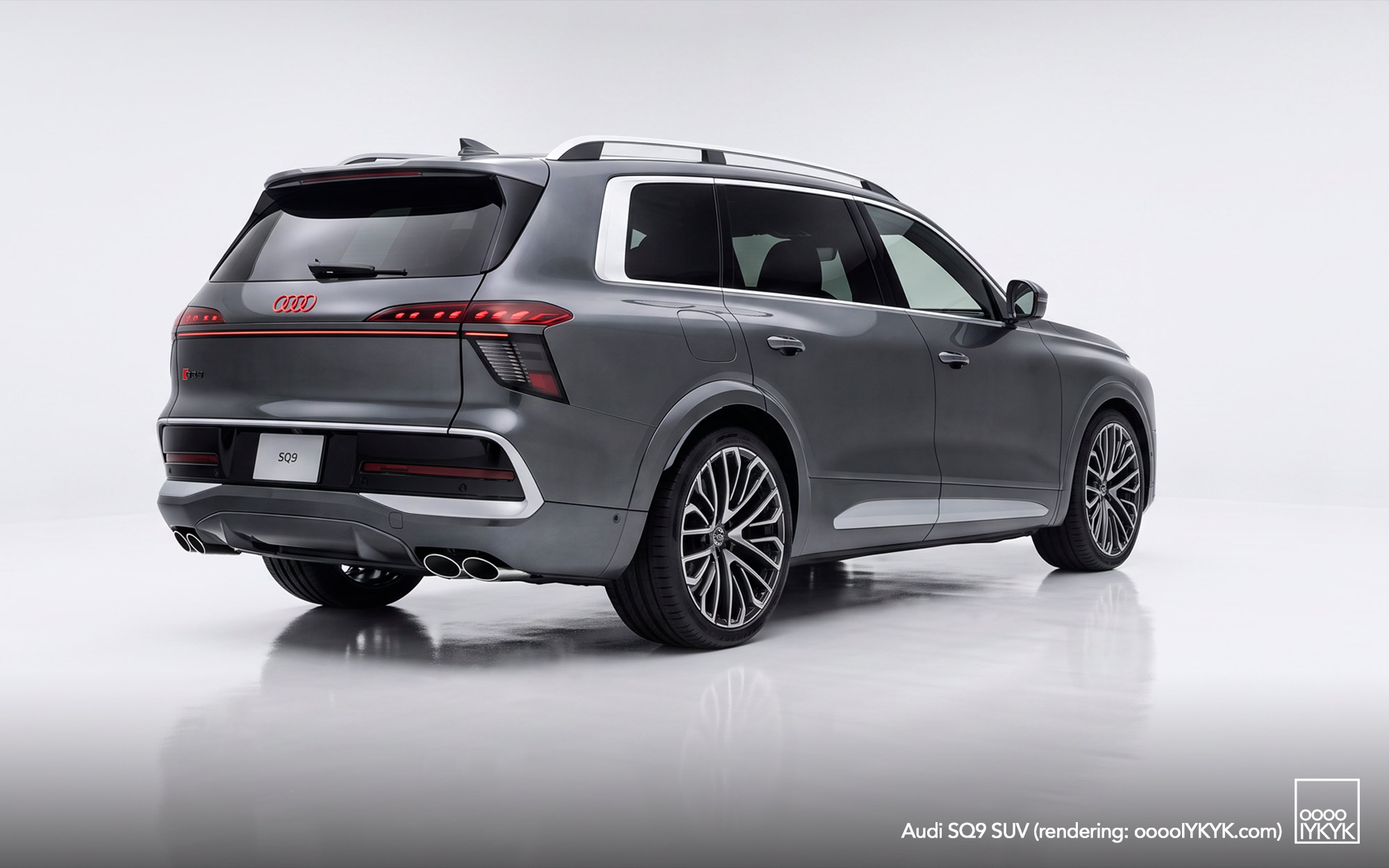
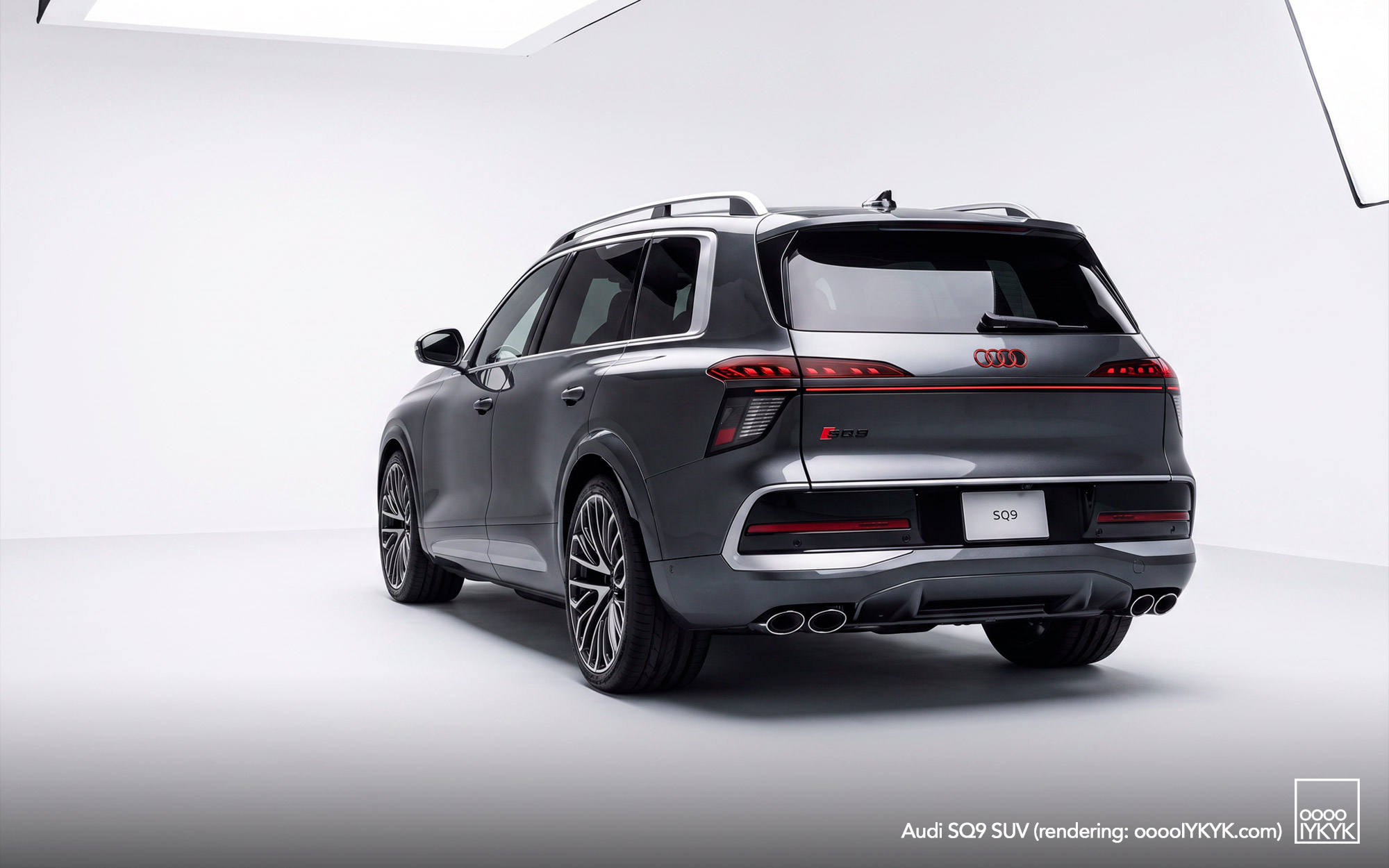
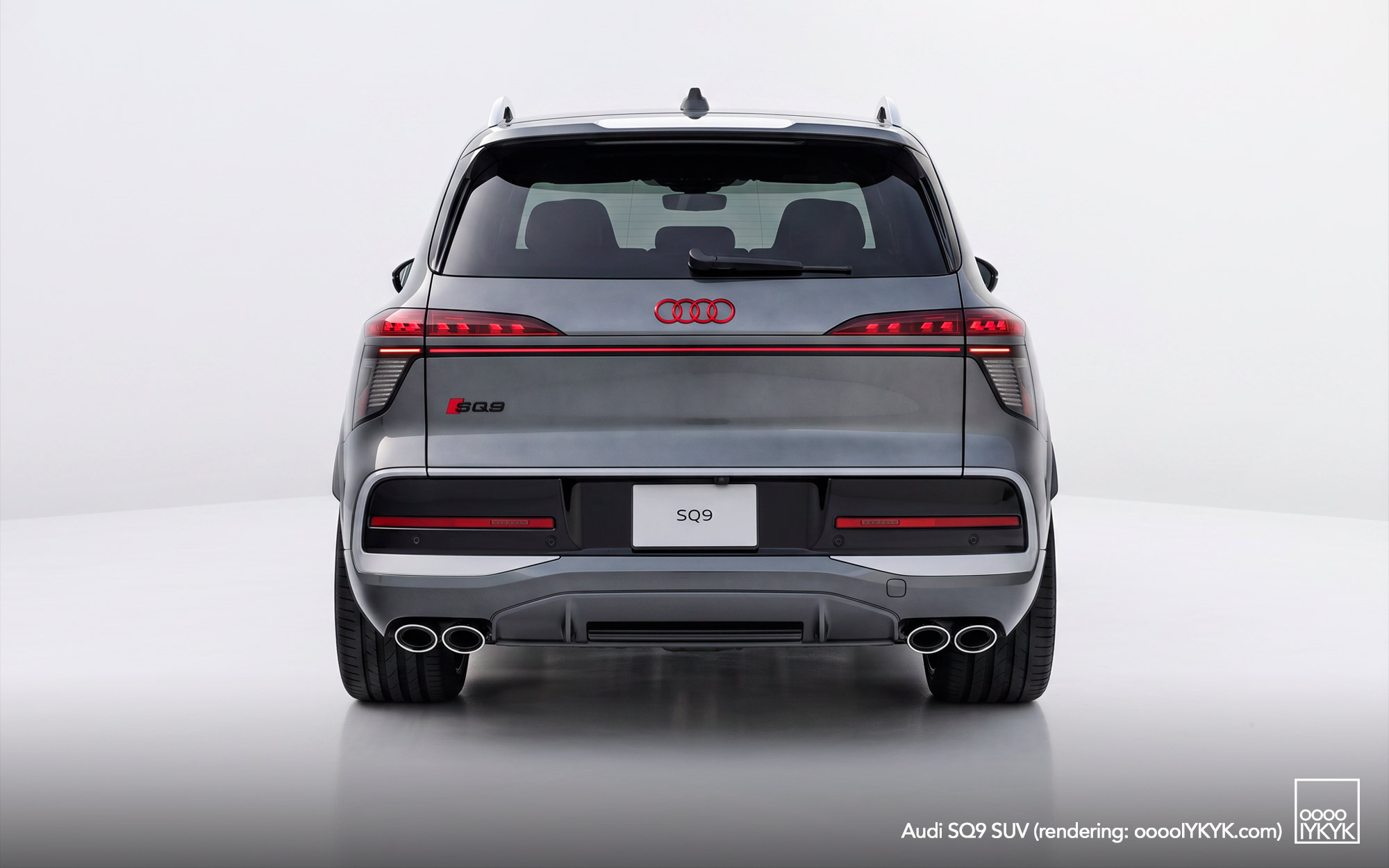
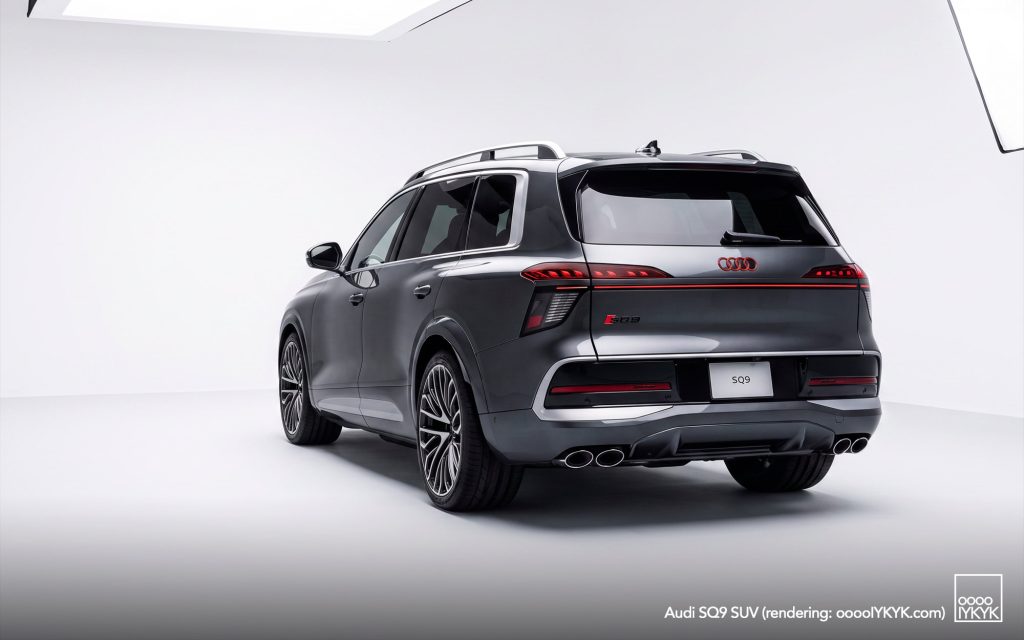
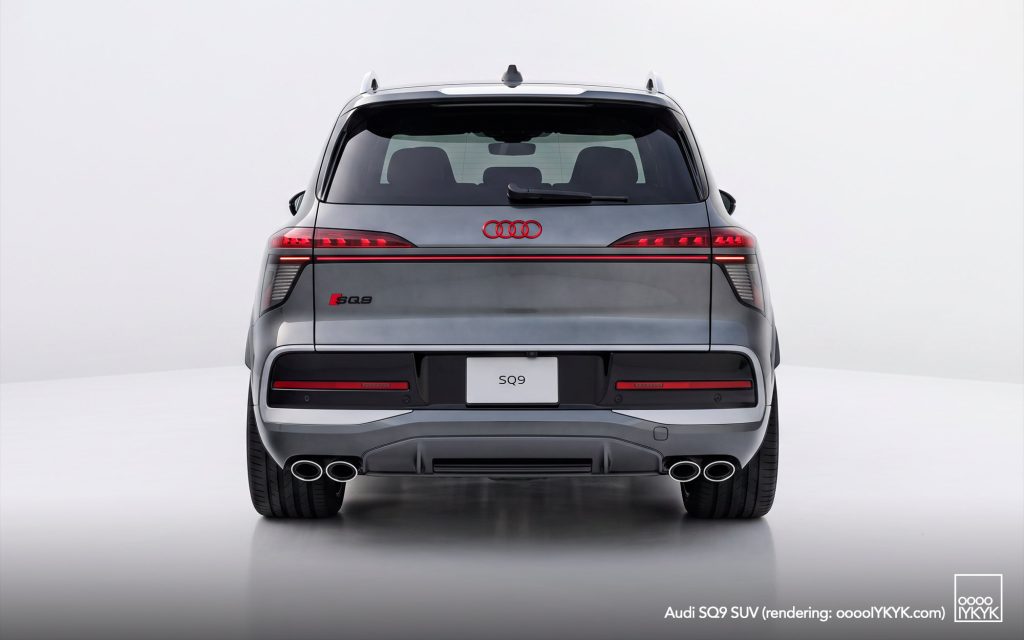
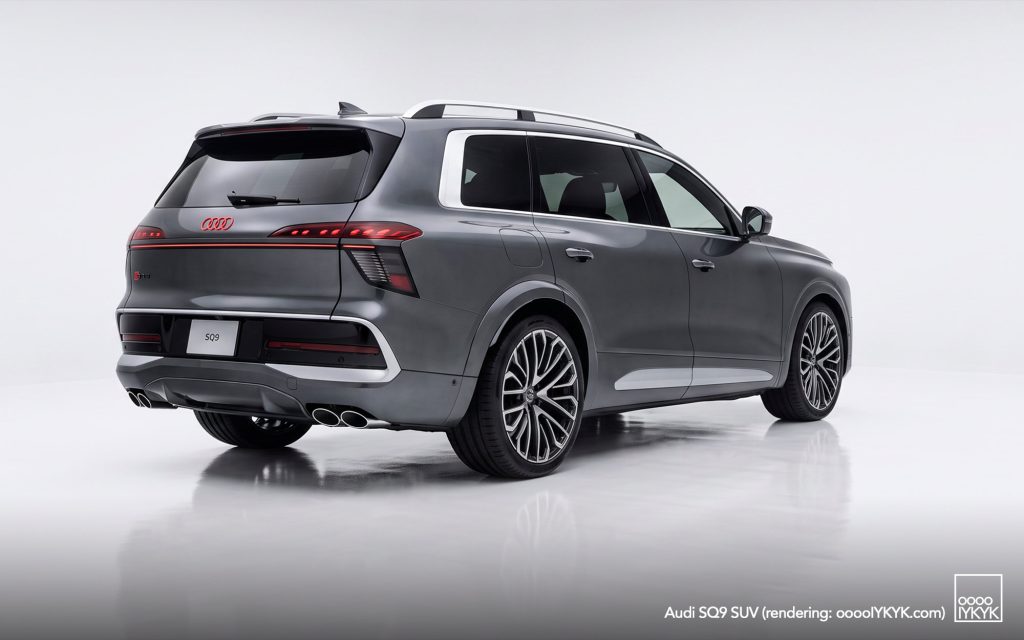
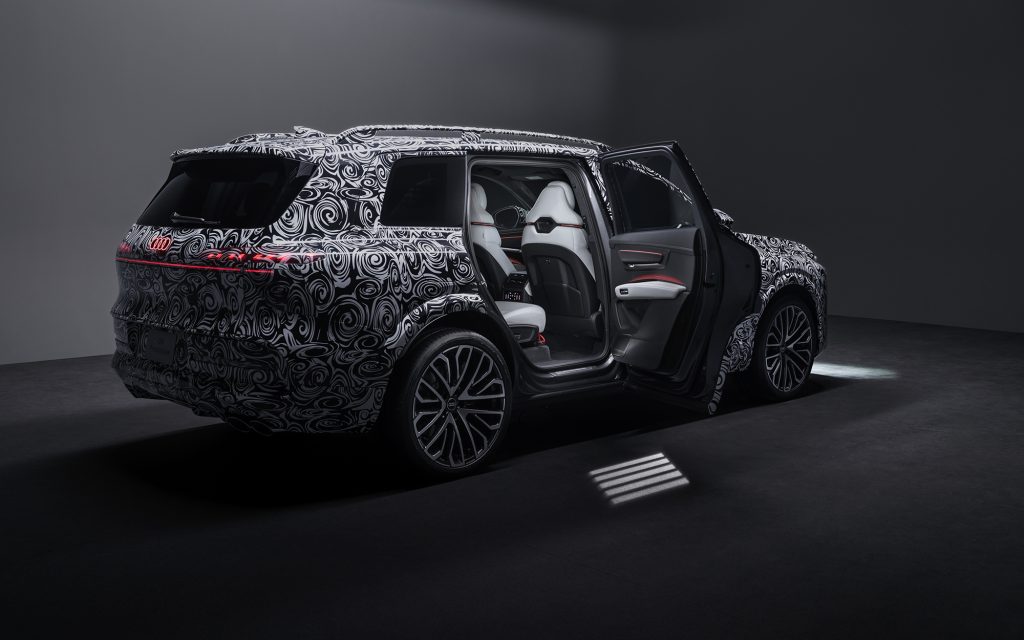
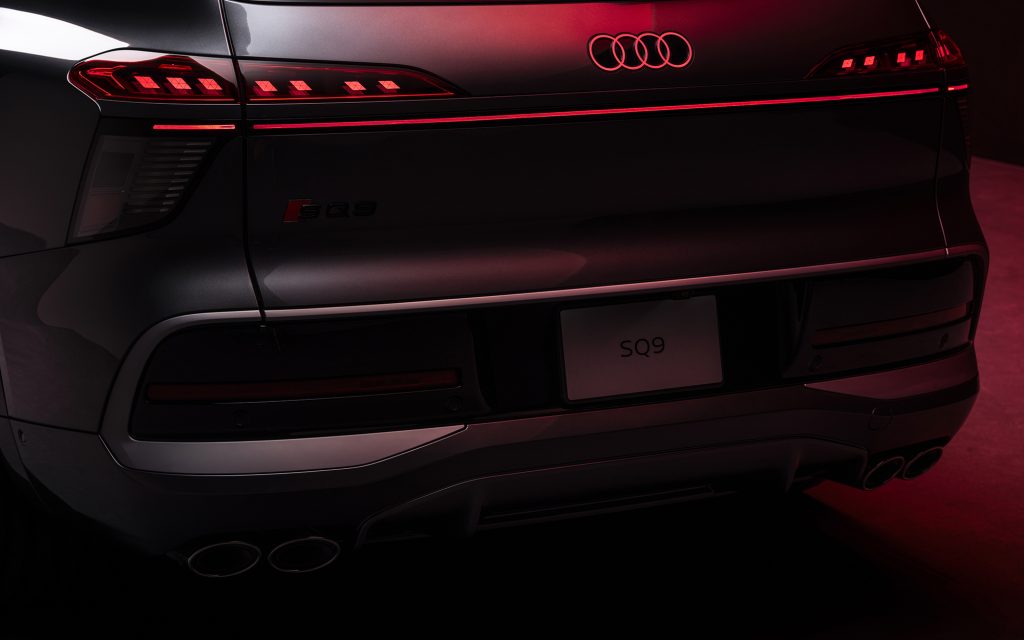
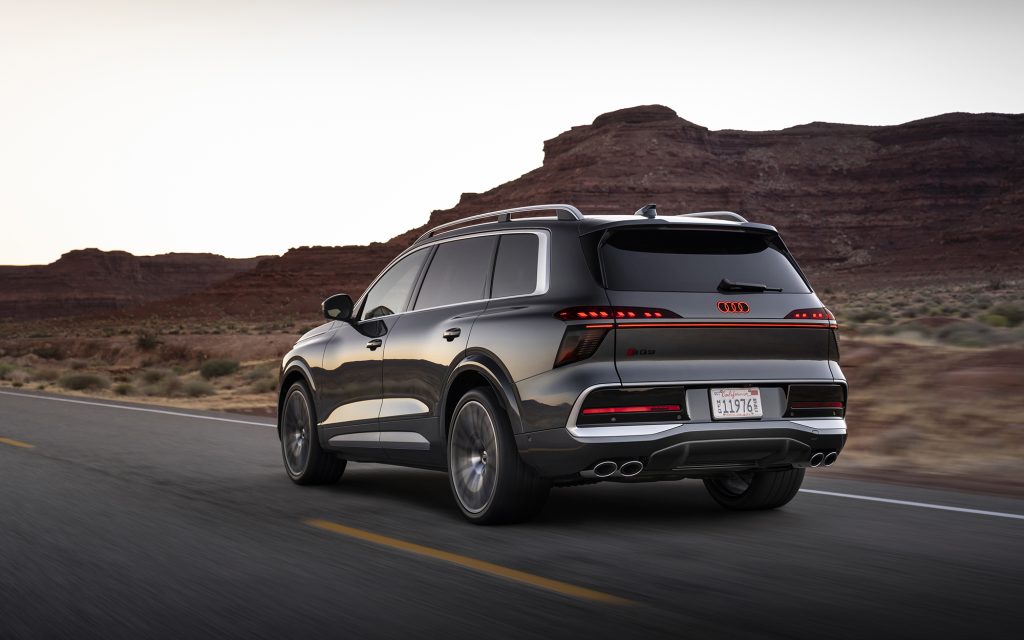
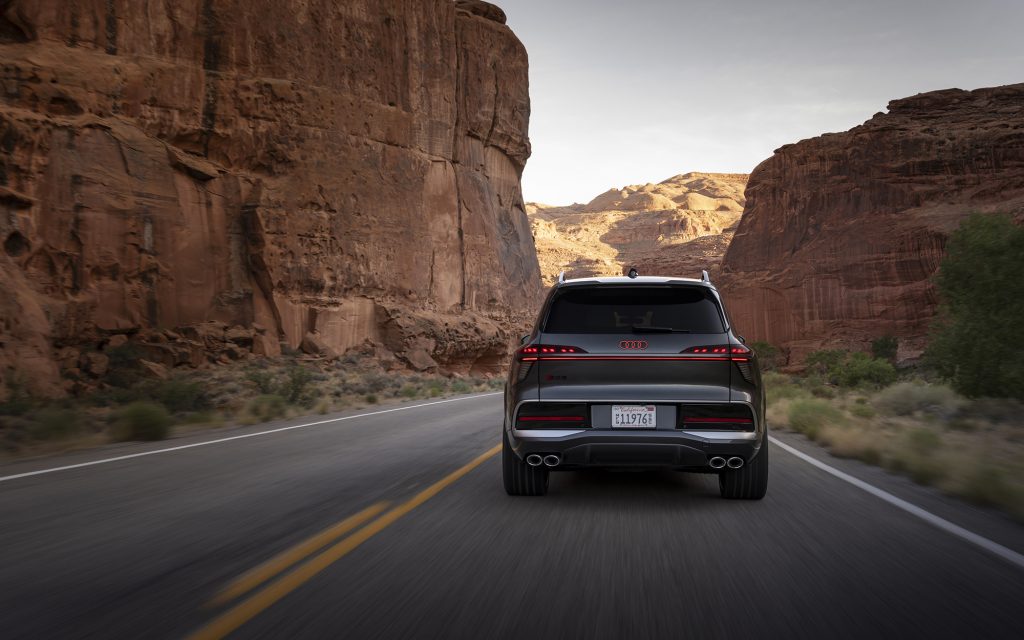
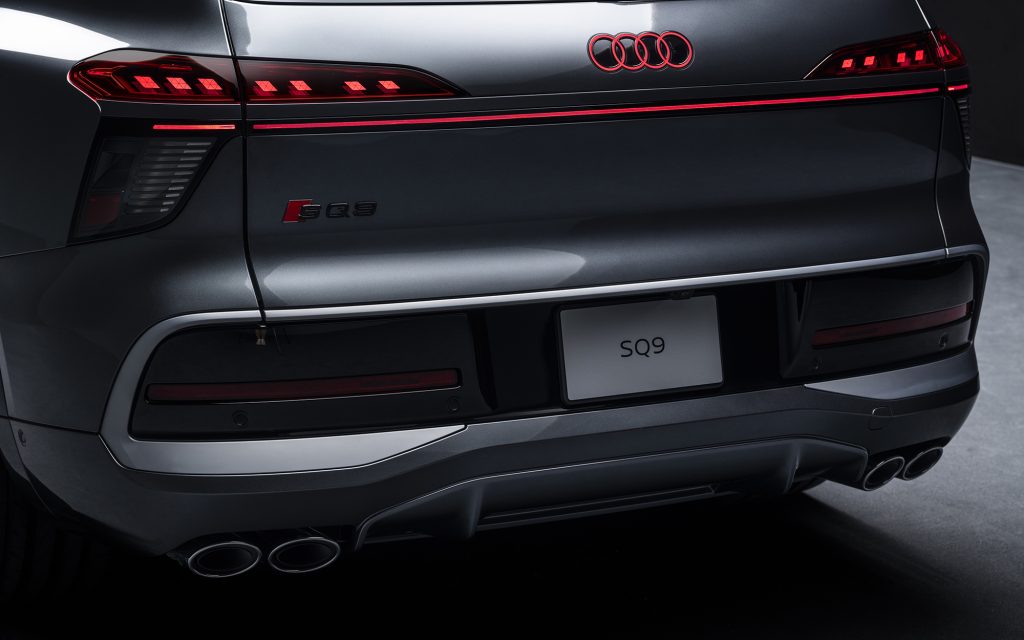
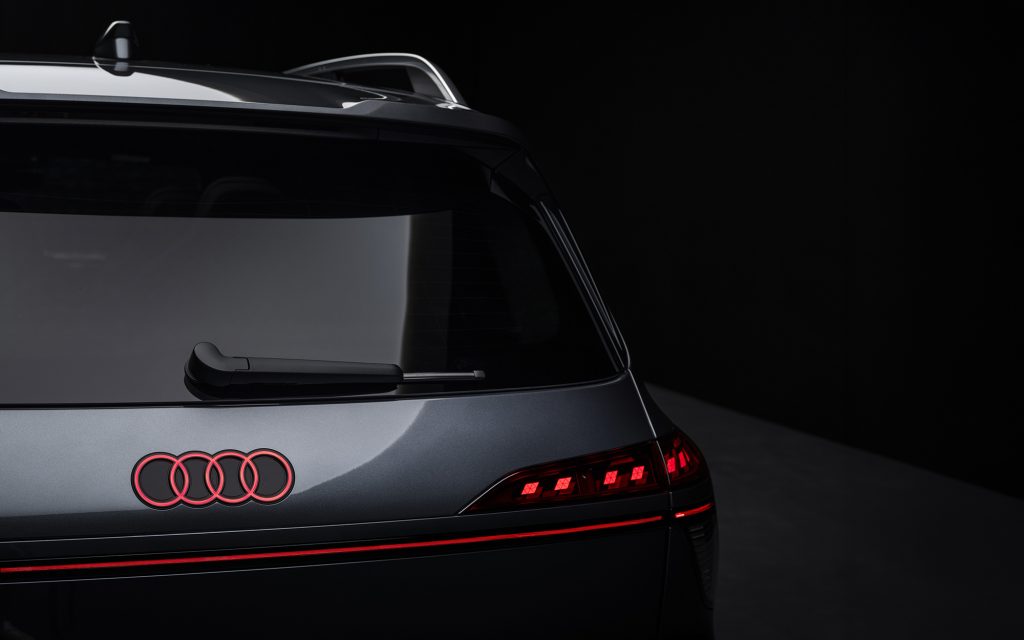
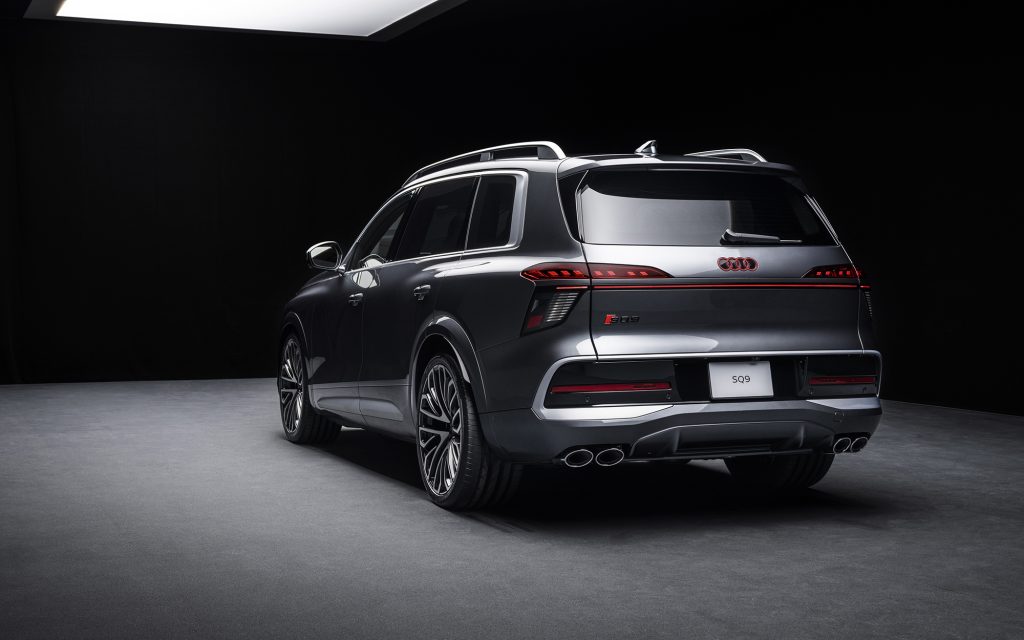
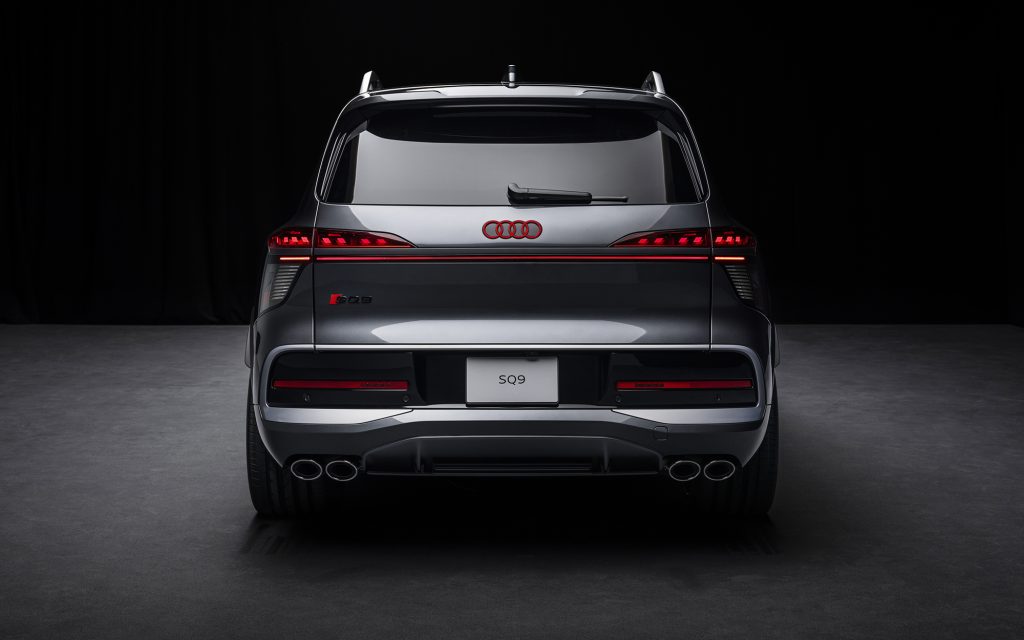
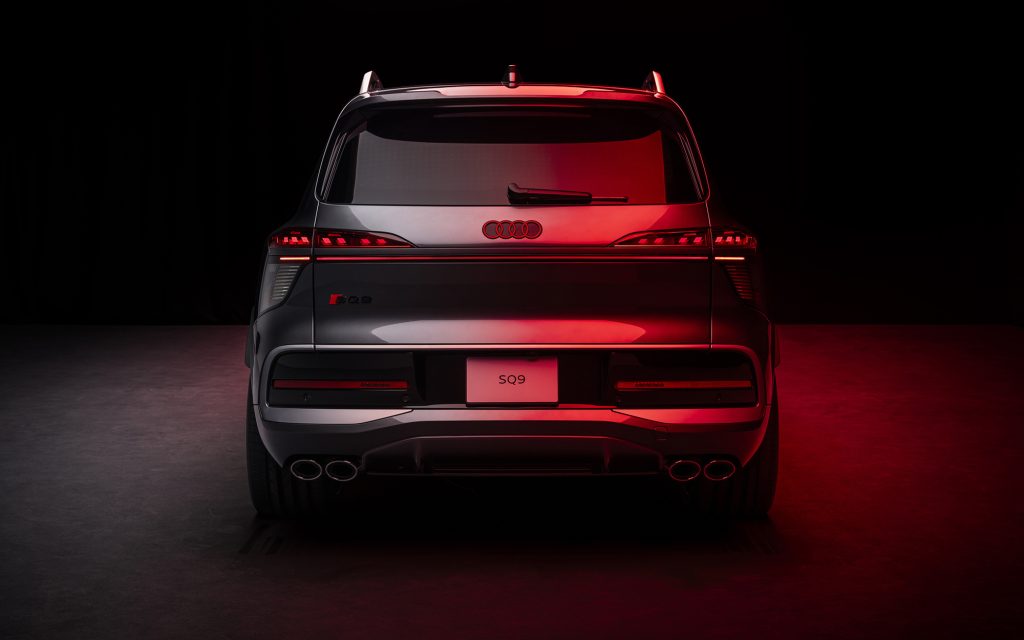
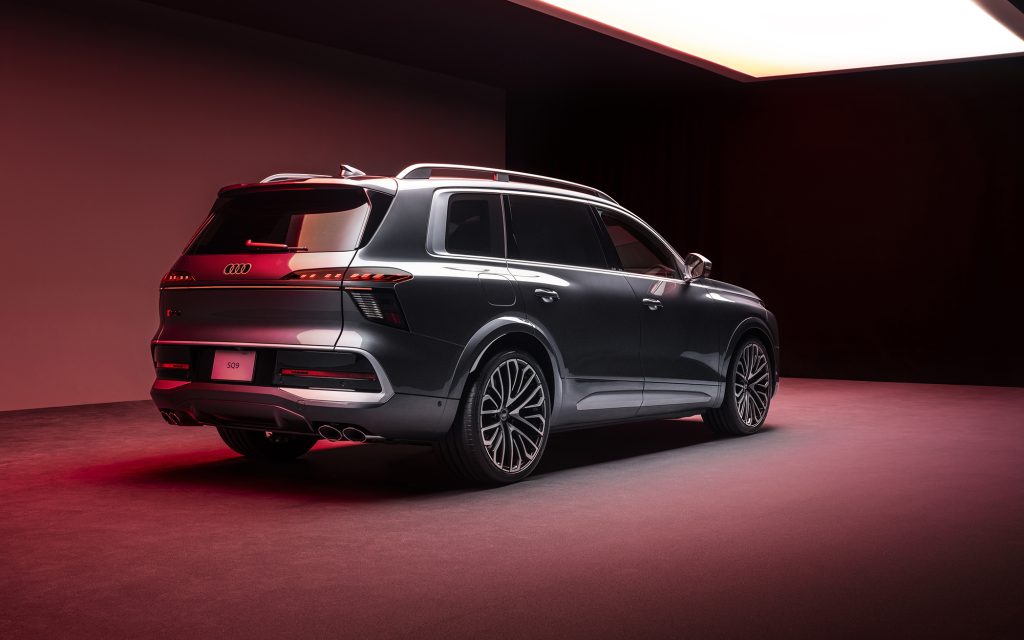
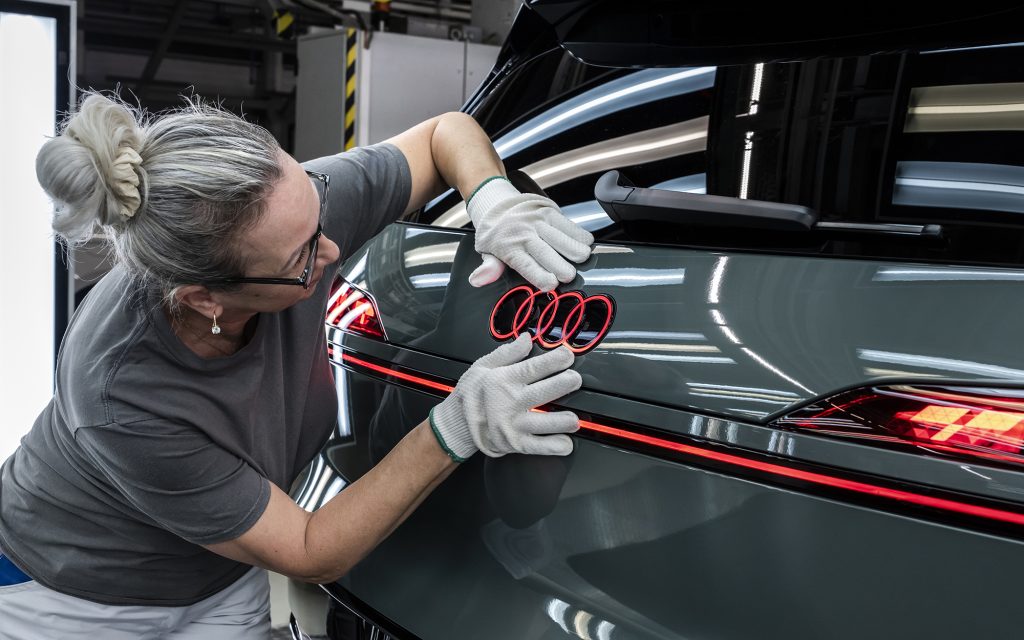
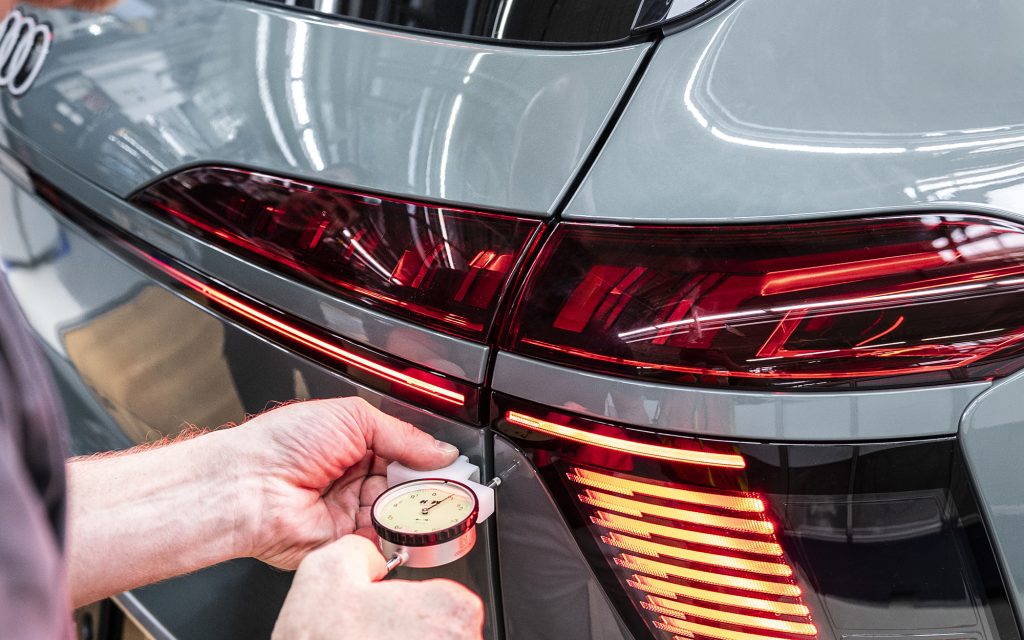
At the rear, the SQ9 receives a unique diffuser incorporating four oval exhaust outlets—a long-standing signature of Audi S models. A revised roof spoiler subtly alters airflow over the rear hatch while contributing to the vehicle’s more performance-oriented appearance. Digital OLED taillights remain standard and continue to span the width of the rear fascia through an illuminated light strip incorporating the four Audi rings.
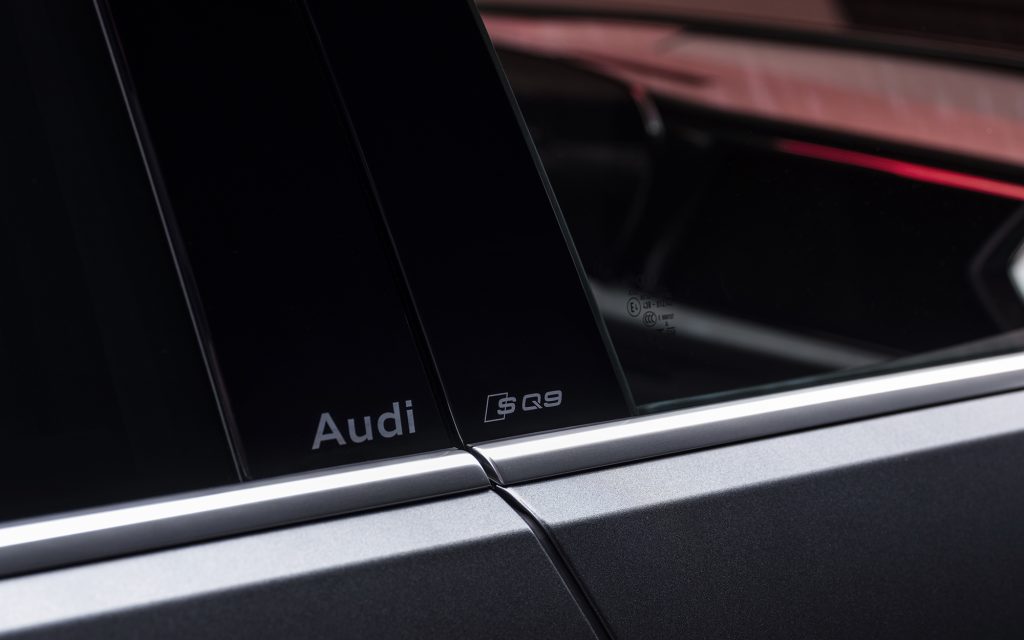
As with other contemporary Audi S models, exterior badging is deliberately restrained. S emblems appear within the grille and on the tailgate, while the overall design emphasizes proportion and engineering rather than visual excess.
DIMENSIONS
The SQ9 shares its underlying body structure with the Q9 and therefore retains identical principal exterior dimensions.
Overall length: 209.0 in (5,309 mm)
Overall width (including mirrors): 86.8 in (2,205 mm)
Body width (excluding mirrors): 79.1 in (2,010 mm)
Overall height: 71.4 in (U.S. specification)
Wheelbase: 123.5 in (3,138 mm)
Front track: 66.4 in (1,686 mm)
Rear track: 67.4 in (1,713 mm)
Front overhang: 40.2 in (1,020 mm)
Rear overhang: 45.3 in (1,151 mm)
Although exterior dimensions remain unchanged, the SQ9’s wider staggered wheel and tire packages produce a more substantial visual stance. The adaptive air suspension also allows the vehicle to vary ride height according to driving mode and operating conditions, resulting in a noticeably different appearance depending upon the selected chassis configuration.
The long 123.5-inch wheelbase was selected primarily to improve passenger accommodation rather than maximize cargo volume alone. Compared with previous Audi SUVs, the increased wheelbase allows greater separation between the front and second seating rows while preserving usable third-row legroom and maintaining balanced weight distribution between the axles.
PASSENGER COMPARTMENT
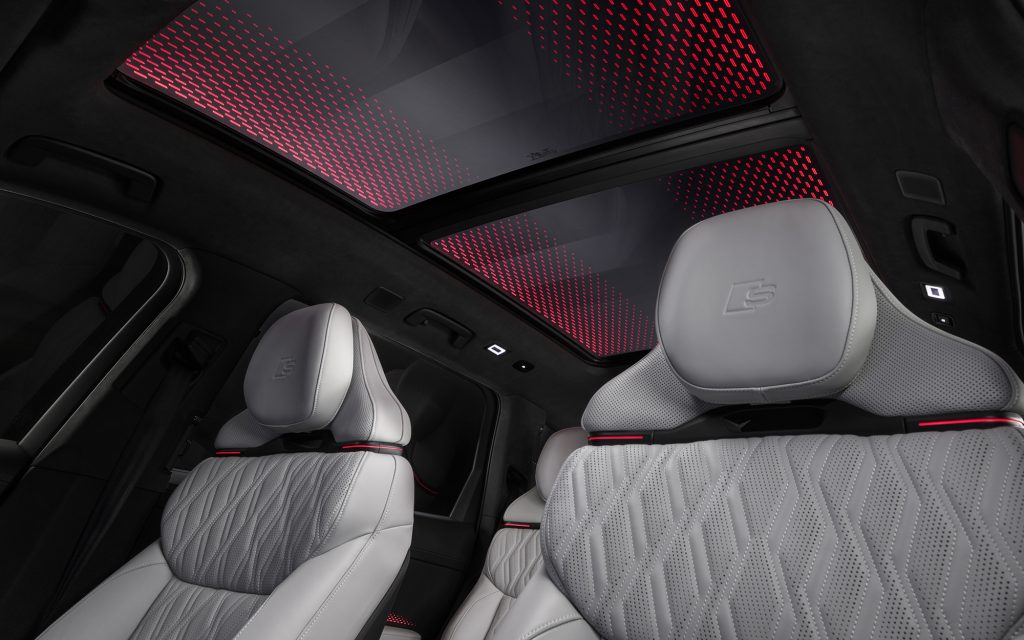
Passenger accommodation formed one of the primary design objectives during development of both the Q9 and SQ9. Rather than adapting an existing two-row SUV to accept occasional third-row seating, Audi engineered the body structure around three full seating rows from the beginning of the program.
The SQ9 therefore retains the same seven-passenger configuration introduced on the standard Q9.
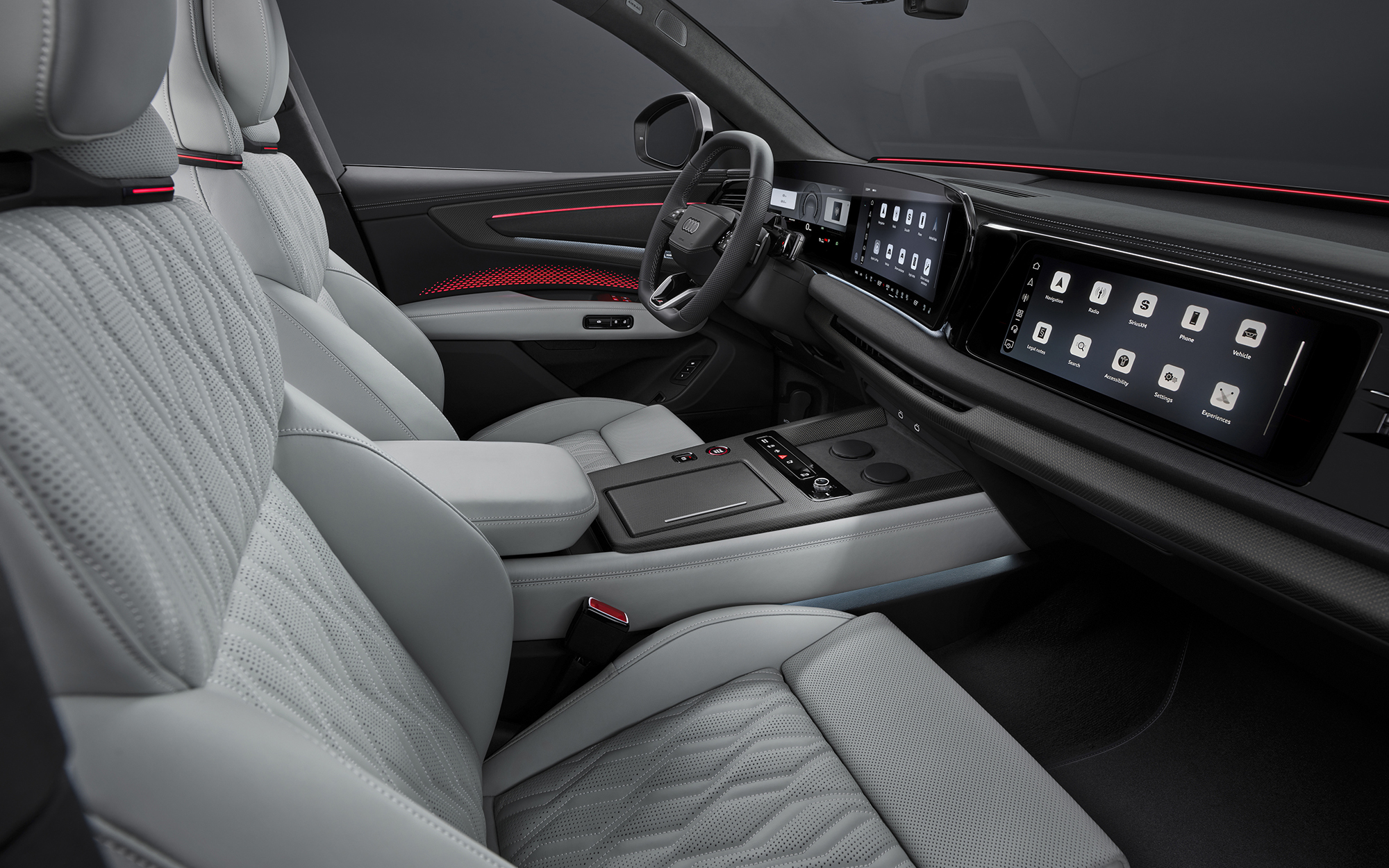
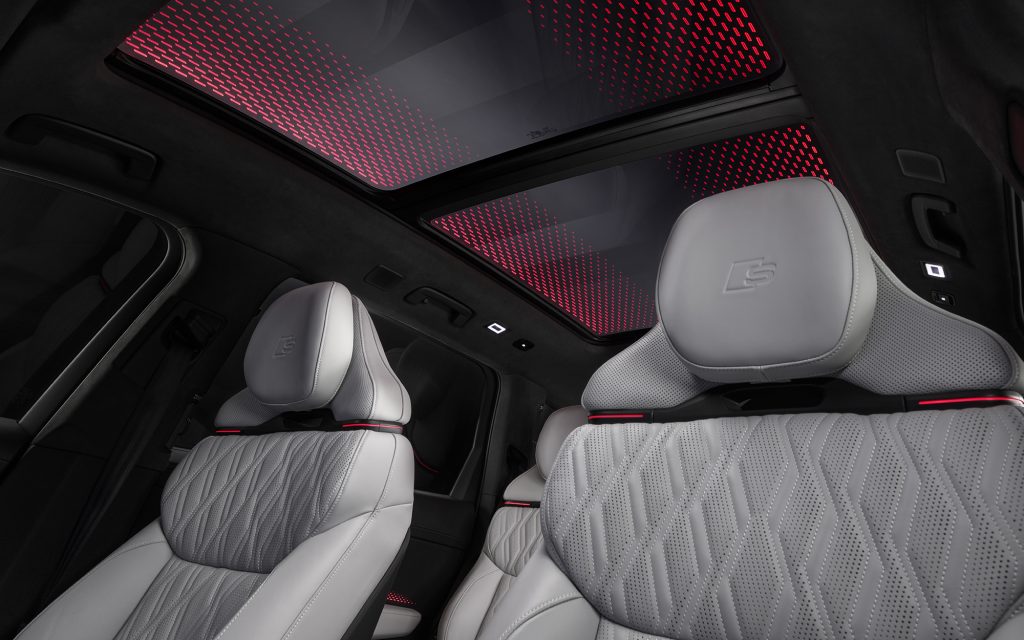
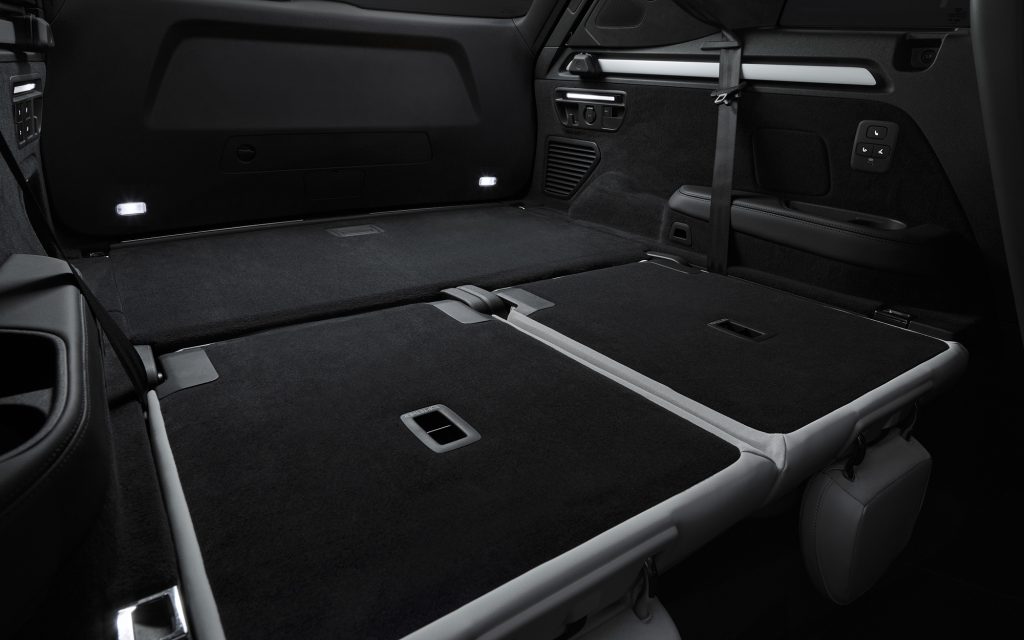
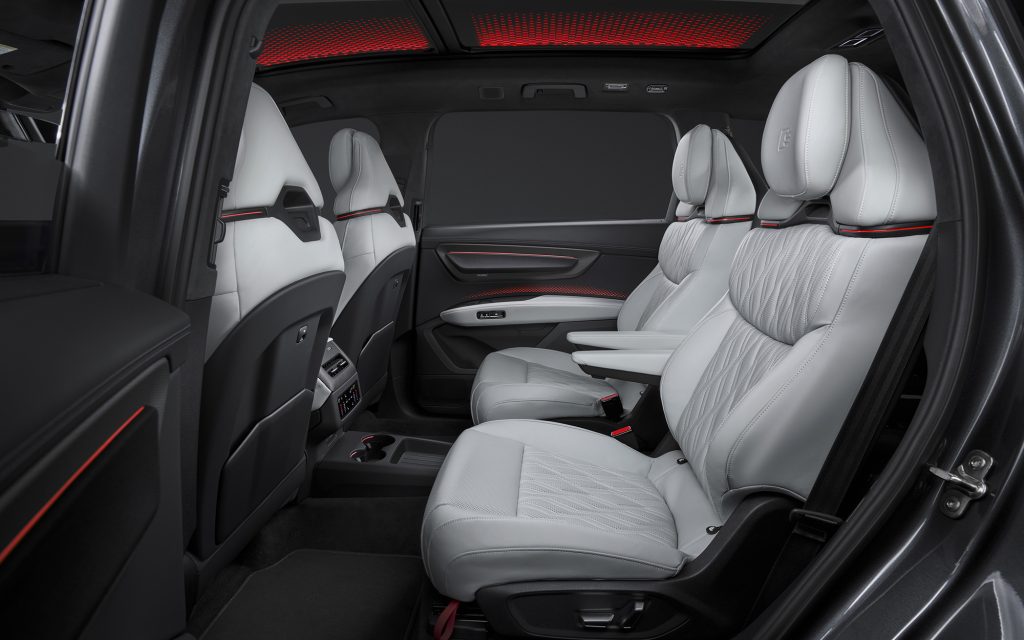
Second-row seating uses a 35/30/35 split configuration, allowing the center section to fold independently while preserving seating for four occupants. The outboard seats provide power fore-aft adjustment together with electrically adjustable backrests, allowing occupants to prioritize either legroom or cargo capacity according to individual requirements.
Power-assisted access to the third row is provided through the outer second-row seats. Activation may occur either through controls located within the rear door openings or via the MMI interface. Audi engineered the mechanism so that an unoccupied forward-facing child seat may remain installed while the seat moves forward, reducing the need to remove child restraints during everyday use.
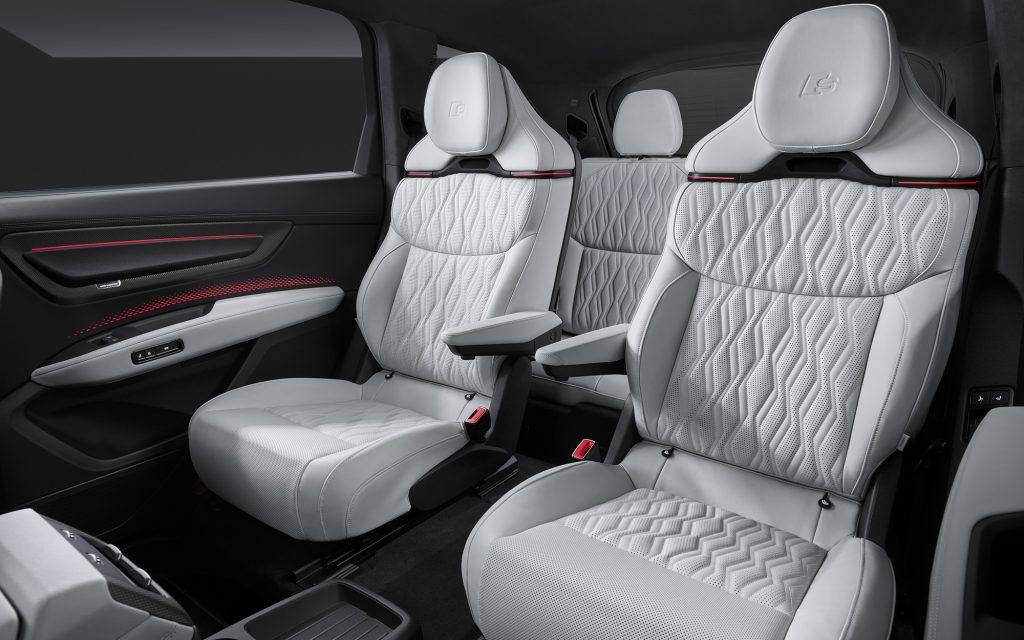
Buyers seeking greater second-row comfort may specify an available six-passenger configuration replacing the bench seat with two individual captain’s chairs. These power-adjustable seats provide additional lateral support together with available heating, transforming the second row into a more executive-oriented environment while improving access to the third row through the central aisle.
Unlike many competitors whose third-row accommodations are intended primarily for occasional use, Audi designed the SQ9’s rearmost seating with adult occupants in mind. The extended wheelbase and upright roof profile allow greater headroom and improved ingress compared with smaller three-row SUVs within the Audi range.
All second- and third-row seating positions incorporate LATCH-compatible child-seat mounting locations.
POWERTRAIN
At the heart of the SQ9 is Audi’s latest evolution of the 4.0 TFSI twin-turbocharged V8. Producing 591 horsepower and 590 lb-ft (800 Nm) of torque, it became the most powerful internal combustion engine offered in a production Audi SUV at the time of its introduction.
Although the engine shares its basic architecture with other members of Audi’s EA825 engine family, its application within the SQ9 differs considerably from installations found in previous S and RS models. Rather than pursuing maximum peak output alone, engineers calibrated the powertrain around effortless acceleration under heavy load, immediate low-speed response and sustained high-speed cruising suitable for a full-size luxury SUV capable of carrying seven occupants and towing substantial loads.
The result is an engine that develops enormous torque across a broad portion of the operating range rather than concentrating performance at high engine speeds. Maximum torque of 590 lb-ft is available well before maximum horsepower, allowing the SQ9 to accelerate with minimal transmission downshifts during normal driving while maintaining reserve power for passing or climbing steep grades.
Audi quotes a 0-60 mph time of 3.8 seconds, placing the SQ9 among the quickest production three-row SUVs available at launch. Despite weighing substantially more than Audi’s traditional S cars, the combination of abundant torque, optimized traction and rapid transmission calibration allows the SQ9 to deliver acceleration previously associated with dedicated high-performance sports sedans.
Unlike many competitors that emphasize aggressive exhaust character and theatrical engine calibration, Audi’s development philosophy favors refinement alongside performance. Engine sound remains purposeful without becoming intrusive during long-distance cruising, reflecting the SQ9’s dual role as both a flagship luxury vehicle and high-performance SUV.
THE 4.0 TFSI V8
Audi’s 4.0-liter TFSI V8 has become one of the company’s defining performance engines, serving in applications ranging from luxury sedans to grand touring cars and high-performance SUVs. For the SQ9, the engine continues to employ a 90-degree aluminum V8 architecture featuring direct fuel injection, dual overhead camshafts and four valves per cylinder.
One of the defining characteristics of the engine is its “hot inside V” configuration.
Rather than positioning the turbochargers outside the cylinder banks as on conventional V engines, Audi locates both turbochargers within the valley formed between the cylinder banks. Exhaust manifolds feed directly into the turbochargers through considerably shorter pathways than traditional layouts.
This configuration offers several engineering advantages.
The reduced exhaust path allows turbine speed to build more rapidly, improving throttle response and reducing turbocharger lag. Packaging also becomes more compact, permitting shorter intake plumbing while concentrating much of the engine’s thermal mass toward the center of the vehicle.
The arrangement simplifies integration within increasingly crowded engine compartments while contributing to more balanced weight distribution over the front axle.
High-pressure direct fuel injection enables precise control of combustion under varying operating conditions. Combined with advanced engine management software, the system allows the engine to produce substantial torque while meeting modern emissions requirements and maintaining acceptable fuel efficiency for its displacement and performance level.
Cooling requirements increase significantly in a vehicle of the SQ9’s size and capability. Engineers therefore developed an enlarged thermal management package capable of maintaining stable operating temperatures during sustained towing, repeated high-load acceleration and prolonged operation under elevated ambient temperatures.
Although Audi has not published complete technical specifications for the cooling and lubrication systems, the calibration reflects the engine’s intended operating environment. Unlike a sports coupe expected to deliver maximum performance over relatively short intervals, the SQ9 must repeatedly provide high output while carrying passengers, luggage and trailers over long distances.
‘
EIGHT-SPEED TIPTRONIC TRANSMISSION
Power is transmitted through an eight-speed Tiptronic automatic transmission developed specifically to complement the broad torque characteristics of the V8.
The transmission’s calibration differs substantially from that of the standard Q9. Shift programming prioritizes immediate response under aggressive acceleration while remaining exceptionally smooth during everyday driving.
Under light throttle, the transmission seeks higher gears quickly to reduce engine speed and improve refinement. During spirited driving, gear selection becomes significantly more aggressive, maintaining the engine within its strongest torque range while reducing unnecessary upshifts.
Manual control is available through steering-wheel-mounted aluminum shift paddles.
Unlike dual-clutch transmissions traditionally favored in smaller performance cars, the torque-converter-based Tiptronic provides smoother low-speed behavior while offering the durability required for the SQ9’s towing capability and overall vehicle mass.
Launch Control is integrated into the transmission software. When activated under appropriate conditions, the system coordinates engine output, transmission engagement, quattro torque distribution and stability-control intervention to deliver the quickest possible standing-start acceleration with repeatable consistency.
NEW GENERATION OF QUATTRO
The SQ9 introduces one of the most significant evolutions of Audi’s quattro philosophy in recent years.
For decades, permanent mechanical all-wheel drive formed the defining characteristic of Audi performance vehicles. Traditional quattro systems relied upon mechanical center differentials—most recently Torsen or self-locking center differentials—to divide torque continuously between the front and rear axles while responding mechanically to changing traction conditions.
The SQ9 adopts a fundamentally different architecture.
Instead of relying upon a passive mechanical center differential, Audi developed an electronically controlled electromechanical multi-plate clutch capable of continuously varying torque distribution between the front and rear axles according to driving conditions.
This change allows the drivetrain to behave differently from previous generations of quattro while preserving the permanent all-wheel-drive capability expected of an Audi flagship.
Rather than reacting only after wheel slip occurs, the system continuously predicts available traction using information supplied by steering angle, throttle position, brake pressure, wheel speed, yaw rate, lateral acceleration and numerous additional vehicle sensors.
Based upon these inputs, torque distribution may be altered proactively before wheel slip develops.
Audi describes the resulting system as rear biased because its calibration favors rear-axle torque delivery whenever conditions permit.
This represents an important philosophical shift.
Previous generations of quattro generally emphasized neutral behavior through relatively balanced torque distribution. The SQ9 instead deliberately allows the rear axle to contribute a greater proportion of propulsion during dynamic driving, producing steering characteristics more closely resembling a traditional rear-wheel-drive performance vehicle while preserving the security of permanent all-wheel drive.
The objective is not oversteer for its own sake. Instead, increasing rear-axle participation reduces the steering corrections often associated with heavily front-driven all-wheel-drive vehicles while allowing the SUV to rotate more naturally through corners.
REAR TORQUE DISTRIBUTION
Working alongside the center clutch is a newly developed electronically controlled rear differential.
Unlike conventional open differentials that simply divide torque equally between both rear wheels, the SQ9’s system continuously adjusts torque distribution across the rear axle.
When cornering, greater torque may be directed toward the outside rear wheel.
This creates a yaw moment that assists vehicle rotation, reducing the steering effort required to negotiate a corner while improving stability during acceleration.
Because the system functions proactively rather than reactively, torque distribution begins changing before significant wheel slip develops.
Audi integrates this rear differential with the center clutch and electronic stability systems through a unified chassis control strategy.
Rather than operating as independent components, the center clutch, rear differential, suspension, steering and braking systems continuously exchange information to determine the most appropriate vehicle response.
BRAKE TORQUE VECTORING
Mechanical torque distribution is supplemented by Audi’s brake torque vectoring system.
During cornering, slight braking force may be applied to the inside wheels.
Although the braking forces involved are relatively small, they create an additional yaw moment that encourages the vehicle to turn more readily into the corner.
Because brake torque vectoring works alongside the rear differential rather than replacing it, Audi can achieve more precise control over vehicle attitude while minimizing unnecessary brake intervention.
The result is steering behavior considerably more natural than previous generations of large Audi SUVs while maintaining the predictable stability expected during low-friction driving conditions.
ELECTRONIC CHASSIS INTEGRATION
Perhaps the most important engineering advancement within the SQ9 is not any single mechanical component but the degree to which those components operate together.
Historically, steering, suspension, differential, transmission and stability control systems functioned largely as separate modules communicating only limited information.
The SQ9 instead treats the vehicle as an integrated dynamic system.
Inputs from every major chassis component are processed simultaneously, allowing drivetrain torque, suspension damping, steering assistance and stability intervention to be coordinated rather than merely reacting independently.
This systems-based approach allows Audi engineers to tune overall vehicle behavior rather than calibrating individual components in isolation.
The result is a vehicle capable of behaving as a comfortable long-distance luxury SUV during routine driving while adopting markedly different dynamic characteristics when higher levels of performance are requested.
The transition between these operating states occurs continuously through Audi drive select, allowing the driver to tailor the SQ9’s responses without altering its underlying refinement.
TECHNICAL SIGNIFICANCE
From an engineering perspective, the SQ9’s drivetrain represents one of Audi’s most important mechanical developments since the introduction of the self-locking center differential nearly two decades earlier.
Although the V8 provides the headline performance figures, the more significant advancement lies beneath the bodywork. By replacing a traditional passive center differential with an actively controlled electromechanical system integrated with the rear differential, adaptive suspension and stability controls, Audi fundamentally changed the way torque is distributed throughout one of its performance vehicles.
The result is a drivetrain capable of delivering substantially different handling characteristics without abandoning the core principles that have defined quattro since its introduction: permanent all-wheel drive, predictable stability and the ability to maintain performance across a wide range of road and weather conditions.
ADAPTIVE AIR SUSPENSION
The SQ9 employs an adaptive air suspension system as standard equipment, replacing conventional steel springs with electronically controlled air springs at each wheel. While air suspension has become commonplace among premium SUVs, Audi’s implementation was developed to provide an unusually broad operating range, allowing the vehicle to function as both a comfortable luxury tourer and a capable high-performance SUV.
Each air spring works in conjunction with continuously variable adaptive dampers controlled through Audi drive select. Rather than operating with fixed damping rates, the suspension control unit continuously adjusts compression and rebound forces in response to vehicle speed, steering angle, throttle position, braking input, wheel travel and road conditions. The system reacts within milliseconds, allowing the suspension to remain compliant over uneven pavement while increasing body control during aggressive driving.
Ride height is similarly variable. At highway speeds, the body automatically lowers to reduce aerodynamic drag and improve high-speed stability by lowering the center of gravity. During spirited driving, the suspension adopts a lower, firmer stance to reduce pitch and body roll.
Conversely, additional ride height may be selected when traversing steep driveways, rough roads or snow-covered surfaces. The increased ground clearance improves approach and departure angles while helping protect the vehicle’s underbody from damage.
Unlike traditional fixed-rate suspensions that inevitably represent a compromise between comfort and handling, the adaptive air suspension allows the SQ9 to continuously alter its operating characteristics according to both driver preference and road conditions.
S SPORT ADAPTIVE AIR SUSPENSION
Although based upon the same underlying architecture as the Q9, the SQ9 receives a dedicated S Sport calibration developed specifically for its higher performance envelope.
Spring rates, damping algorithms and body-control strategies were revised to manage the increased output of the twin-turbocharged V8 while preserving the ride quality expected of Audi’s flagship SUV.
Particular attention was paid to controlling body roll during rapid changes in direction. Rather than relying solely upon stiffer suspension components, Audi optimized the interaction between the air springs, adaptive dampers and stability-control systems to reduce unwanted body movement without introducing excessive ride harshness.
This integrated approach allows the SQ9 to maintain unusually flat cornering behavior for a vehicle of its size while remaining comfortable during extended highway travel.
The suspension also plays an active role in launch control and hard acceleration. By carefully managing weight transfer between the axles, the system improves traction while helping the rear-biased quattro drivetrain deploy the engine’s substantial torque more effectively.
REAR-WHEEL STEERING
One of the SQ9’s most significant chassis technologies is standard all-wheel steering.
At lower vehicle speeds, the rear wheels turn in the opposite direction to the fronts by several degrees. This effectively shortens the wheelbase, reducing the turning circle and improving maneuverability in urban environments, parking structures and tight roads.
Given the SQ9’s overall length of more than 209 inches, rear-wheel steering contributes significantly to everyday usability. The vehicle requires fewer steering corrections during parking maneuvers while feeling noticeably smaller than its dimensions would otherwise suggest.
At higher speeds, the rear wheels steer in the same direction as the fronts. This creates the effect of a longer virtual wheelbase, increasing directional stability during lane changes, sweeping corners and highway cruising.
The transition between opposite-phase and same-phase steering occurs seamlessly under electronic control. Drivers are generally unaware of the system’s operation, instead experiencing greater agility at low speeds and improved composure at higher speeds.
Working alongside the rear-biased quattro system and adaptive suspension, rear-wheel steering forms an integral part of the SQ9’s overall chassis philosophy.
STEERING SYSTEM
The SQ9 utilizes an electromechanical rack-and-pinion steering system with speed-sensitive variable assistance.
Steering effort and response vary according to the selected Audi drive select mode. Comfort mode emphasizes lighter steering effort suitable for urban driving, while Dynamic mode increases steering weight and sharpens response to provide greater precision during spirited driving.
Although electrically assisted, Audi calibrated the steering to provide progressive build-up of effort and consistent response rather than artificially heavy weighting. Particular emphasis was placed on maintaining stability during high-speed cruising while minimizing unwanted steering corrections caused by road surface irregularities.
The rear-biased drivetrain calibration further reduces steering workload during corner exit by directing additional propulsion through the rear axle, allowing the front tires to devote a greater proportion of available grip to steering inputs.
BRAKING SYSTEM
Given the SQ9’s combination of vehicle mass and performance, braking capability represented a major engineering priority.
Large internally ventilated brake discs are fitted at all four corners, clamped by multi-piston fixed front calipers developed to provide consistent stopping performance under repeated heavy braking.
The braking system is closely integrated with the vehicle’s electronic chassis controls. Rather than functioning solely as a means of slowing the vehicle, the brakes also contribute to torque vectoring, stability management and launch control.
Brake pressure is continuously managed by the vehicle’s central dynamics controller, allowing precise intervention when assisting cornering behavior or maintaining vehicle stability under rapidly changing traction conditions.
Pedal feel was calibrated to remain consistent across a wide range of operating temperatures while minimizing fade during prolonged mountain descents or repeated high-speed stops.
WHEELS & TIRES
The SQ9 is equipped with staggered alloy wheel packages developed specifically for its chassis calibration.
Standard equipment consists of 22-inch wheels, while larger 23-inch forged or cast alloy designs are available depending upon market and equipment level.
The staggered tire configuration employs wider rear tires than those fitted to the front axle. This arrangement complements the rear-biased quattro system by increasing rear-axle traction during acceleration while maintaining responsive front-end turn-in.
High-performance summer tires maximize dry-road grip and steering precision, although all-season alternatives remain available for customers operating in regions requiring year-round versatility.
Wheel designs unique to the SQ9 emphasize brake cooling while maintaining the understated appearance traditionally associated with Audi’s S models.
LIGHTING TECHNOLOGY
Lighting represents one of the SQ9’s most technologically sophisticated systems.
Standard Digital Matrix LED headlights employ individually controllable light segments capable of adapting beam distribution continuously according to vehicle speed, steering input, traffic conditions and navigation data.
Unlike conventional adaptive headlights that merely swivel in response to steering angle, the Digital Matrix system actively shapes the light pattern projected onto the road ahead.
Approaching vehicles may be selectively shaded without reducing illumination elsewhere, allowing the driver to retain maximum forward visibility while preventing glare for other road users.
Additional lighting functions assist with lane positioning, construction zones and poor weather by projecting tailored illumination patterns appropriate to the driving environment.
DIGITAL OLED REAR LIGHTING
The rear lighting system incorporates second-generation curved Digital OLED technology spanning the width of the vehicle.
Organic light-emitting diode panels allow each taillight to generate highly detailed lighting signatures while consuming less energy than conventional LED assemblies.
Owners may select from multiple digital lighting signatures through the MMI interface, providing a degree of personalization without requiring physical hardware changes.
The system also incorporates communication lighting capable of displaying predefined warning graphics when the vehicle detects certain hazardous situations.
Unlike decorative lighting elements, these functions were developed to improve vehicle visibility and communicate information to surrounding traffic.
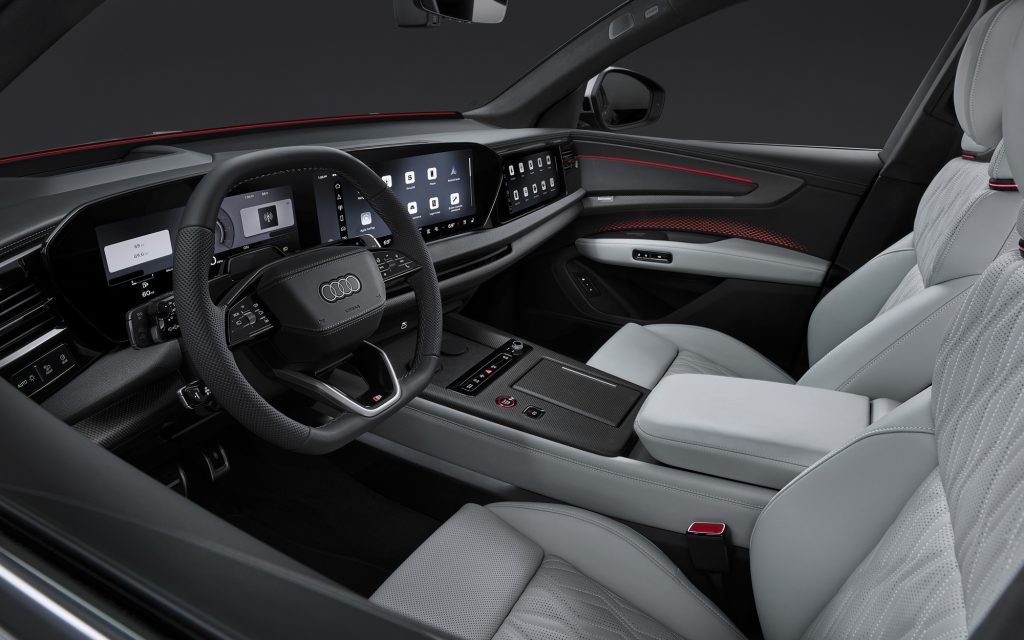
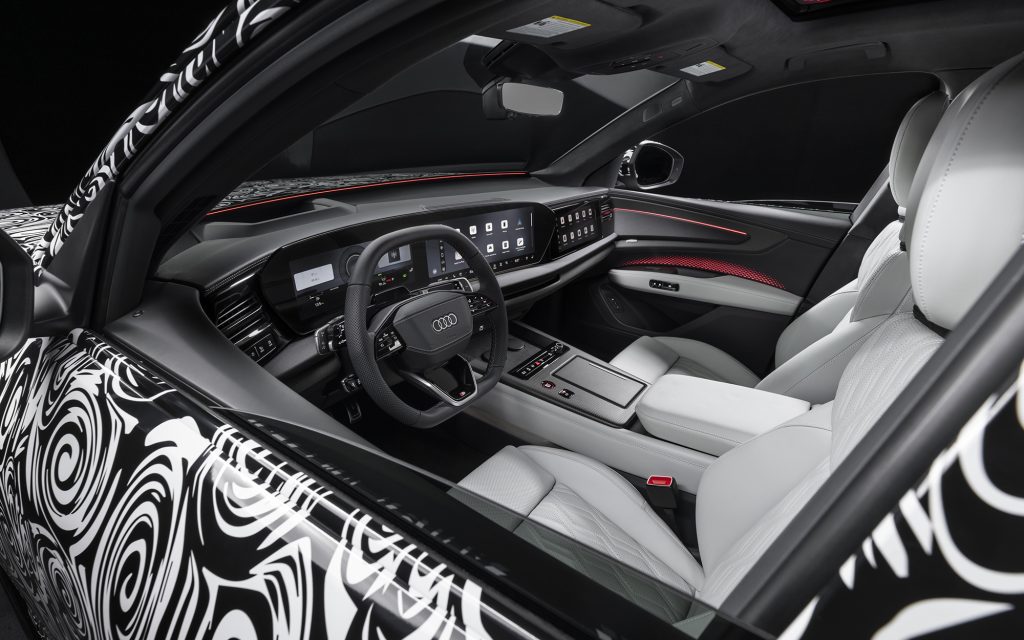
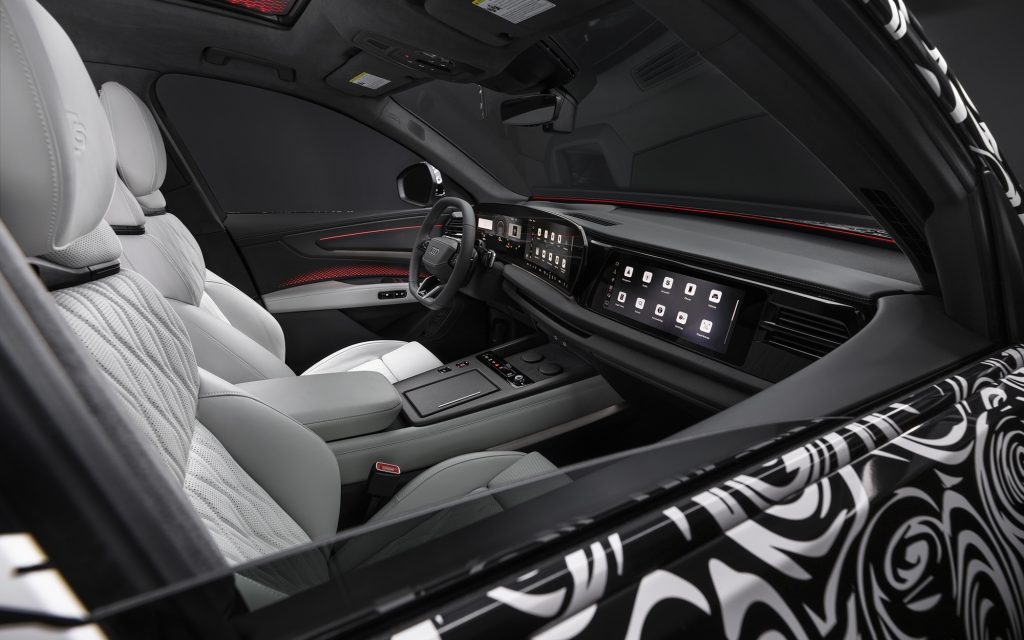
INTERIOR TECHNOLOGY
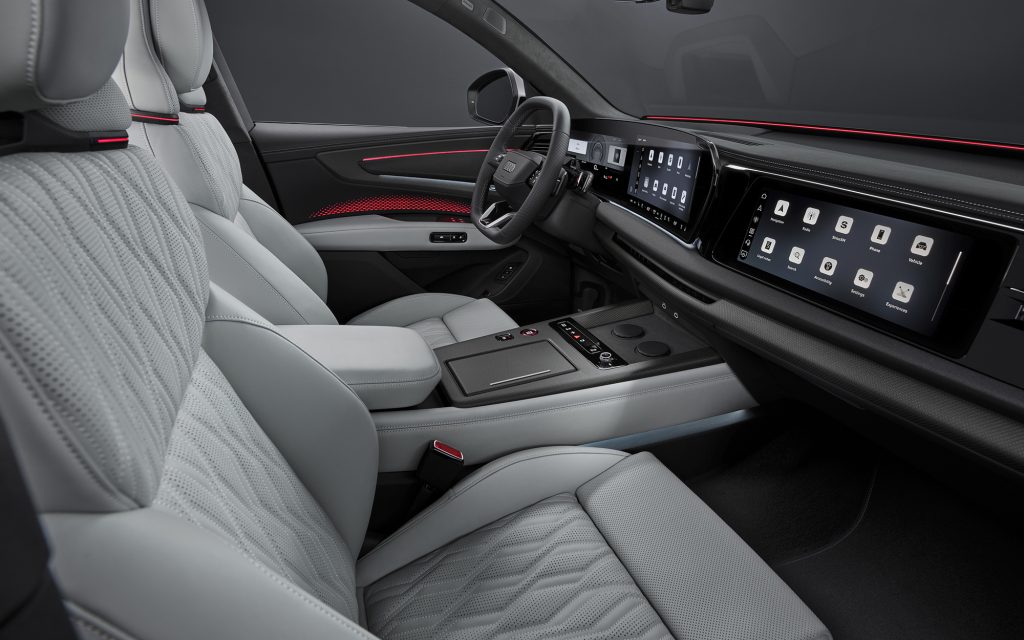
The SQ9 shares its digital architecture with the standard Q9.
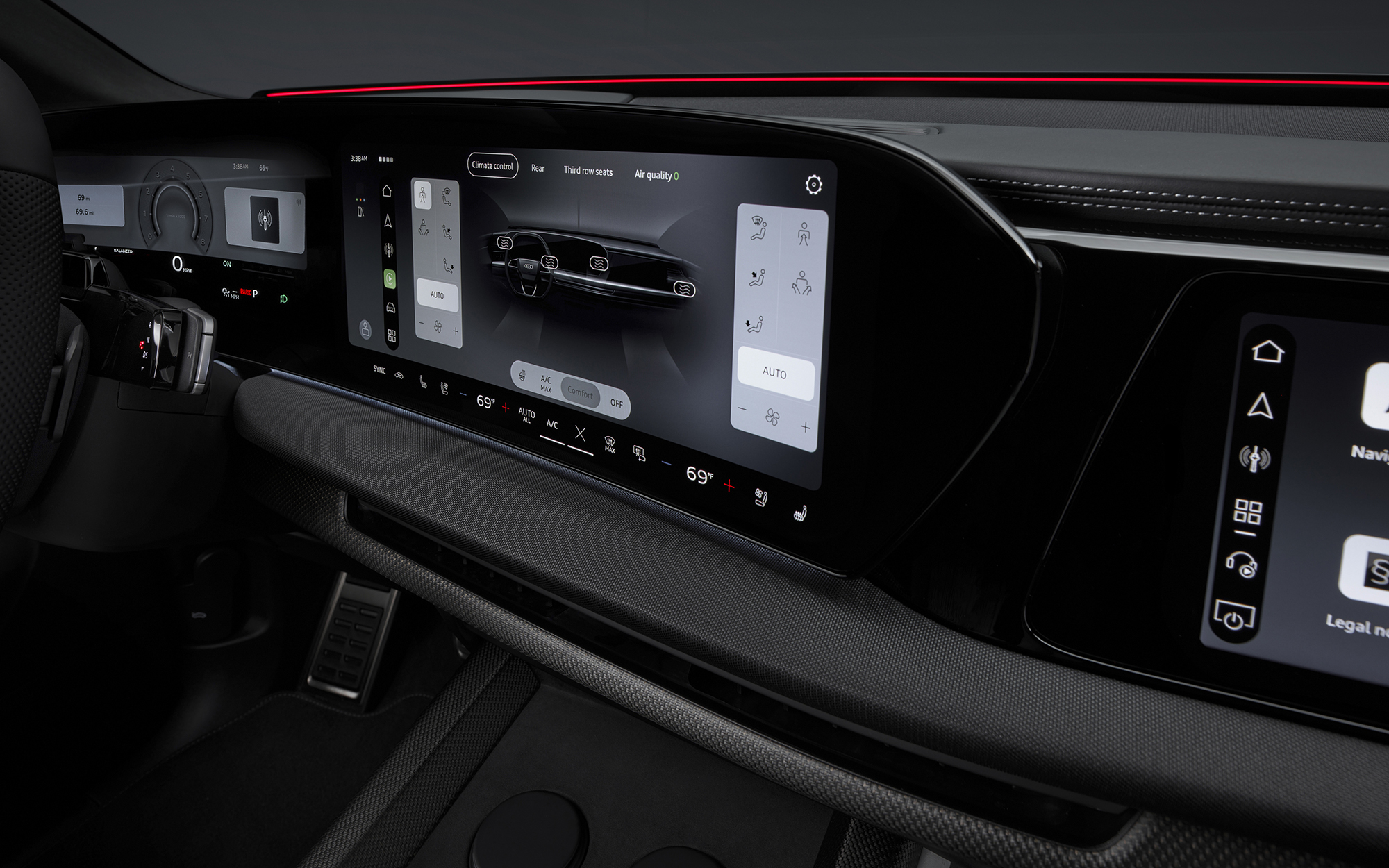
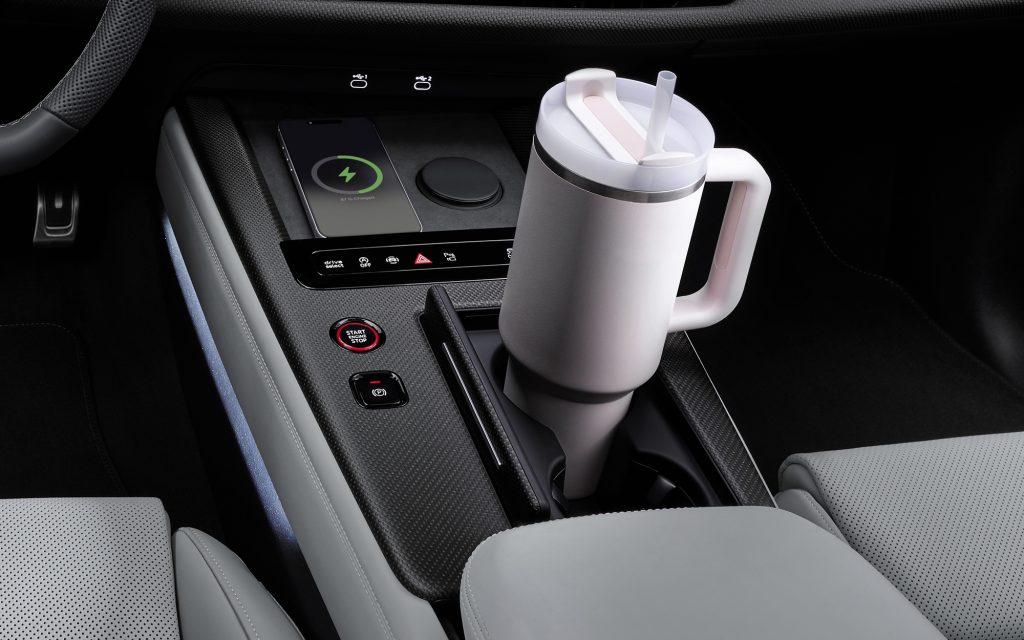
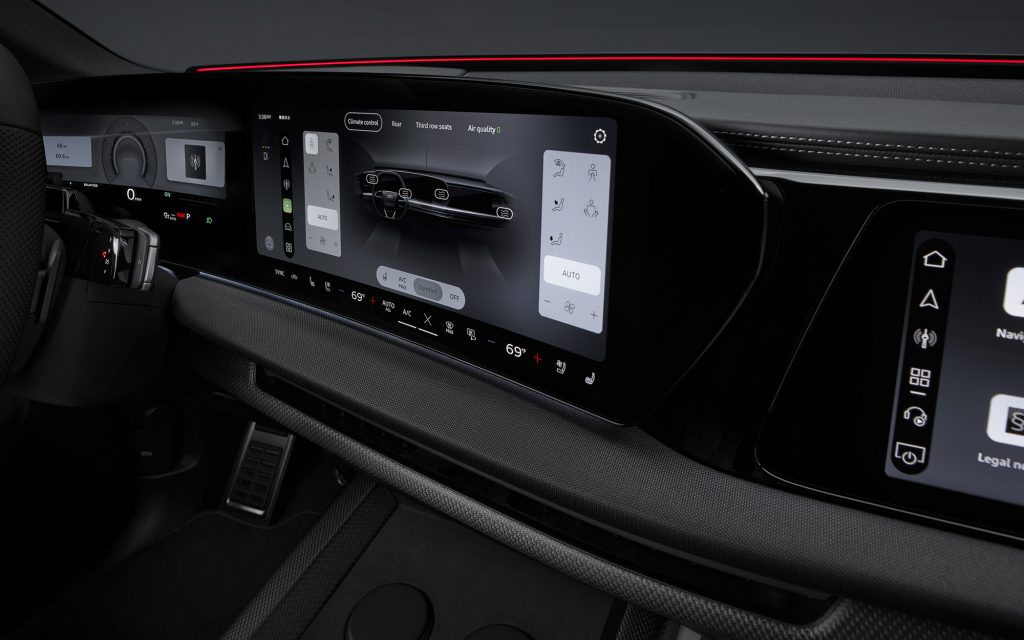
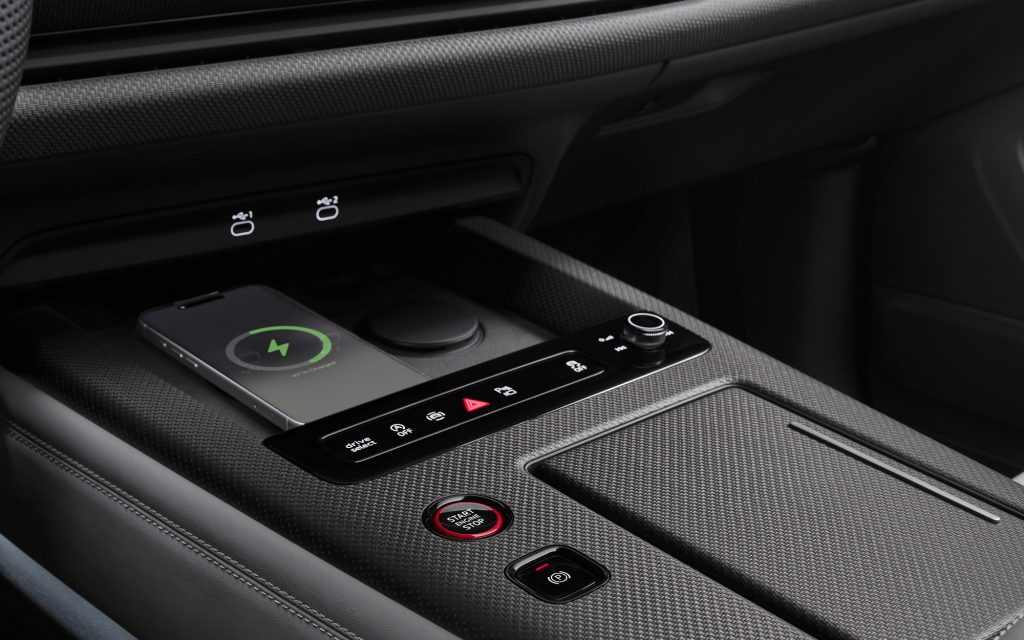
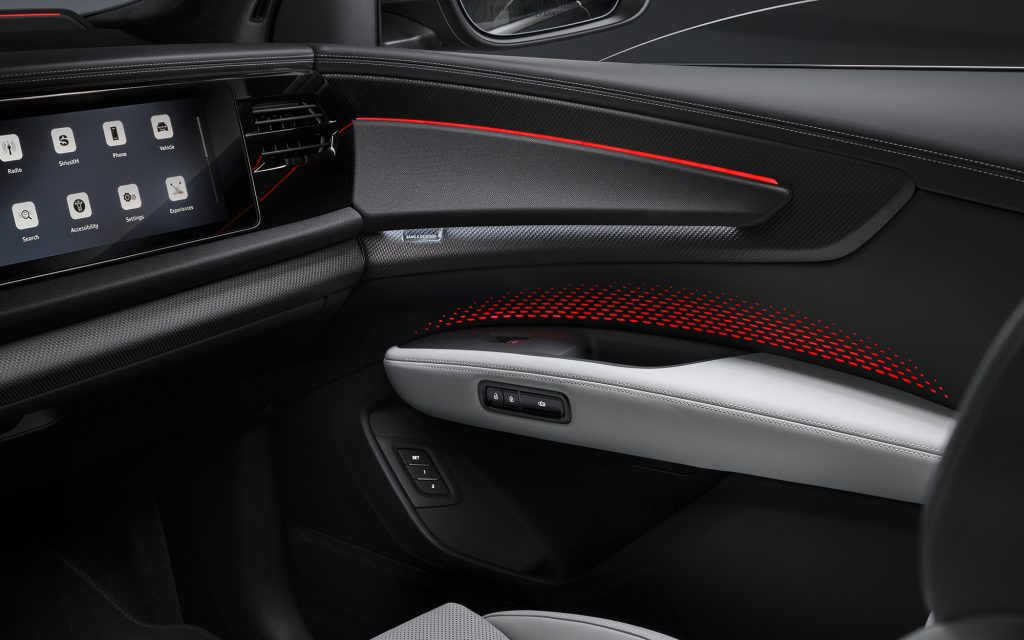
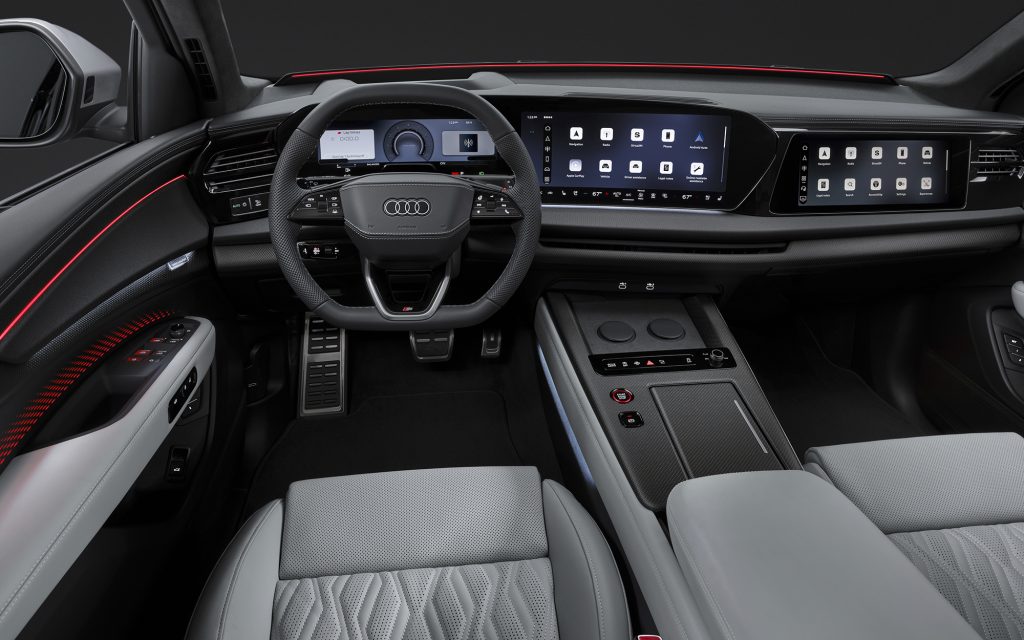
A curved panoramic display integrates the Audi virtual cockpit with the central MMI touchscreen, while an optional front passenger display provides access to navigation, entertainment and selected vehicle functions.
The operating system is built upon Android Automotive OS, allowing native integration of selected Google services while supporting over-the-air software updates throughout the vehicle’s life cycle.
Voice interaction is enhanced through natural-language recognition, enabling occupants to control navigation, climate settings and media functions using conversational commands.
Wireless Apple CarPlay and Android Auto are standard.
Unless otherwise noted, infotainment hardware and digital functionality are shared with the standard Q9.
DRIVER ASSISTANCE SYSTEMS
The SQ9 incorporates Audi’s most comprehensive suite of driver assistance technologies available at launch.
Adaptive Cruise Assist Plus combines adaptive cruise control with lane-centering capability to reduce driver workload during highway travel.
Traffic Jam Assist supports low-speed operation in congested conditions, while Emergency Assist monitors driver interaction and can safely bring the vehicle to a controlled stop should the driver become unresponsive.
Additional systems include:
- Lane Departure Warning
- Lane Change Assist
- Intersection Assist
- Front Cross Traffic Assist
- Rear Cross Traffic Assist
- Exit Warning
- Predictive Efficiency Assistant
- Traffic Sign Recognition
- 360-degree camera system
- Remote Park Assist Plus
Although these technologies provide significant assistance, responsibility for safe vehicle operation remains with the driver.
PRODUCTION
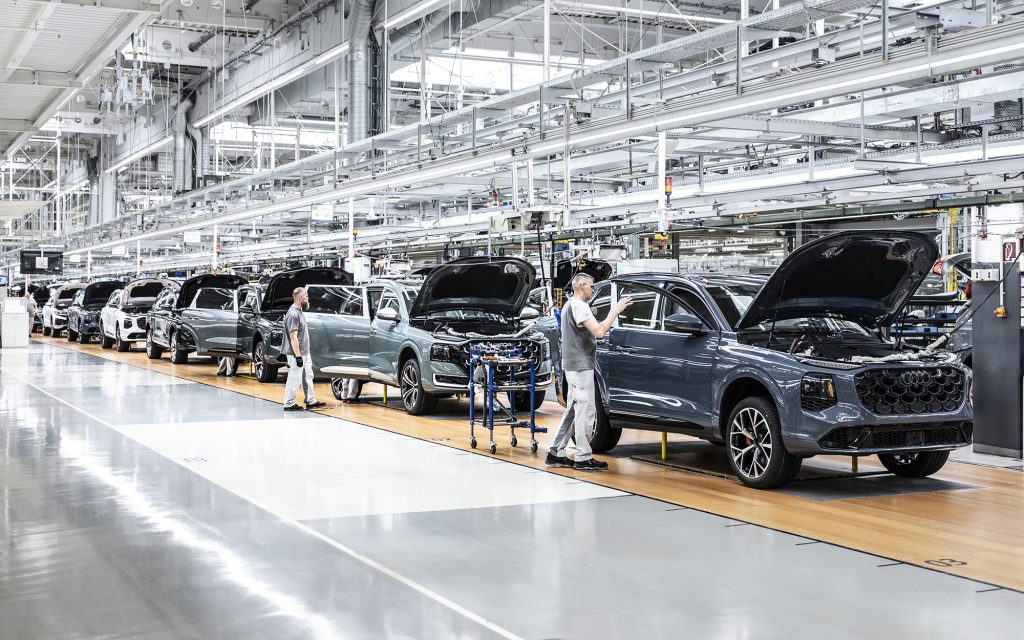
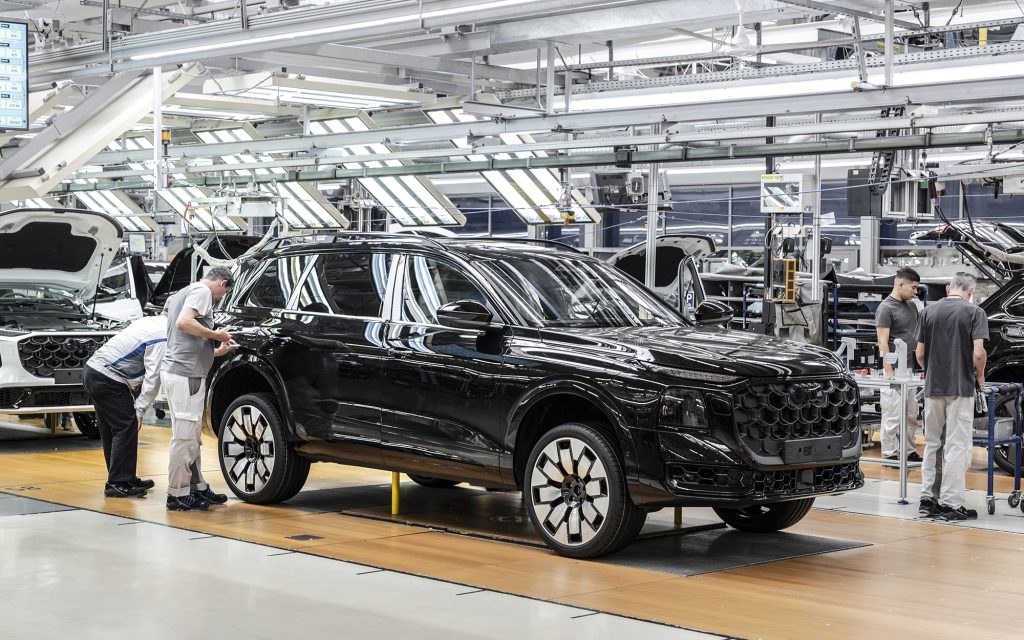
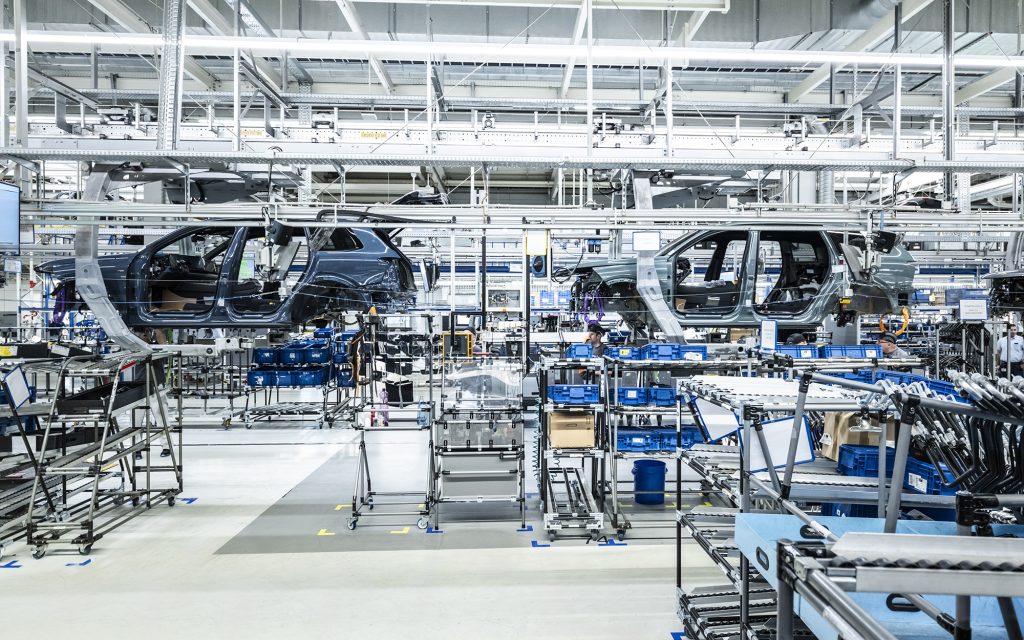
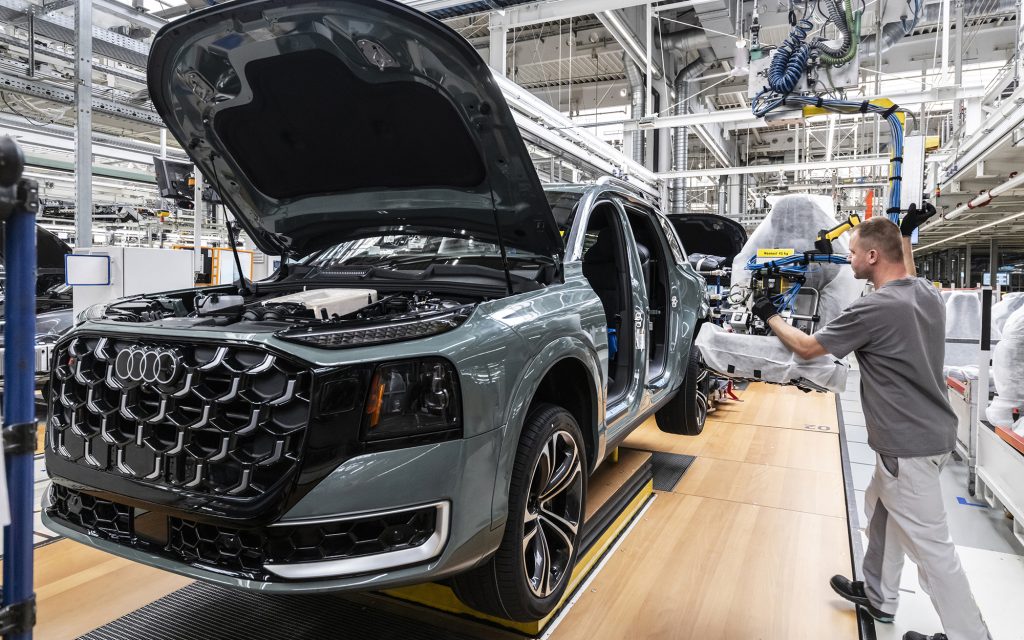
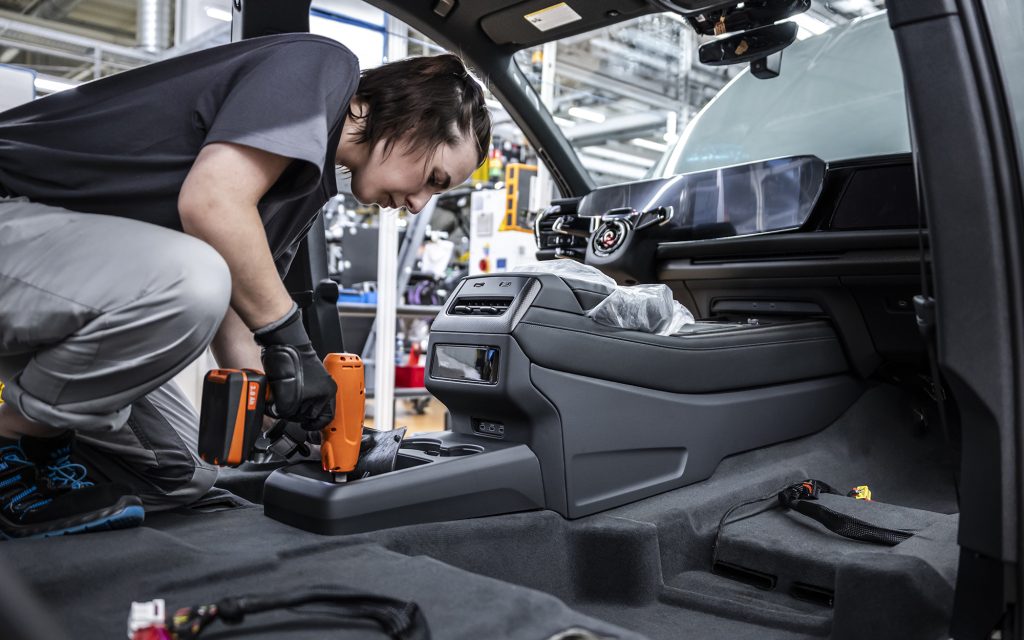
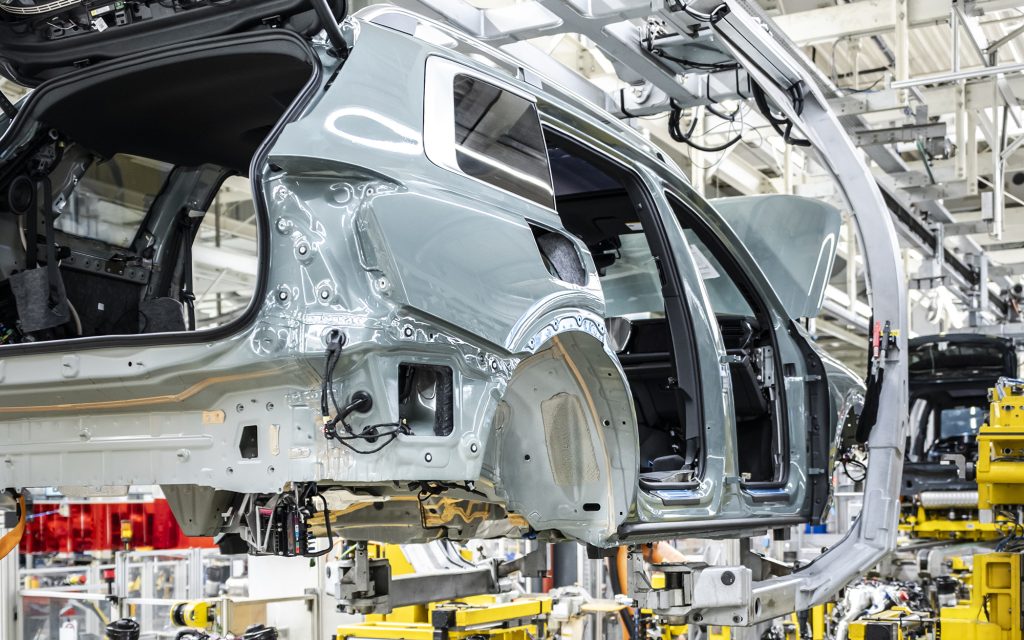
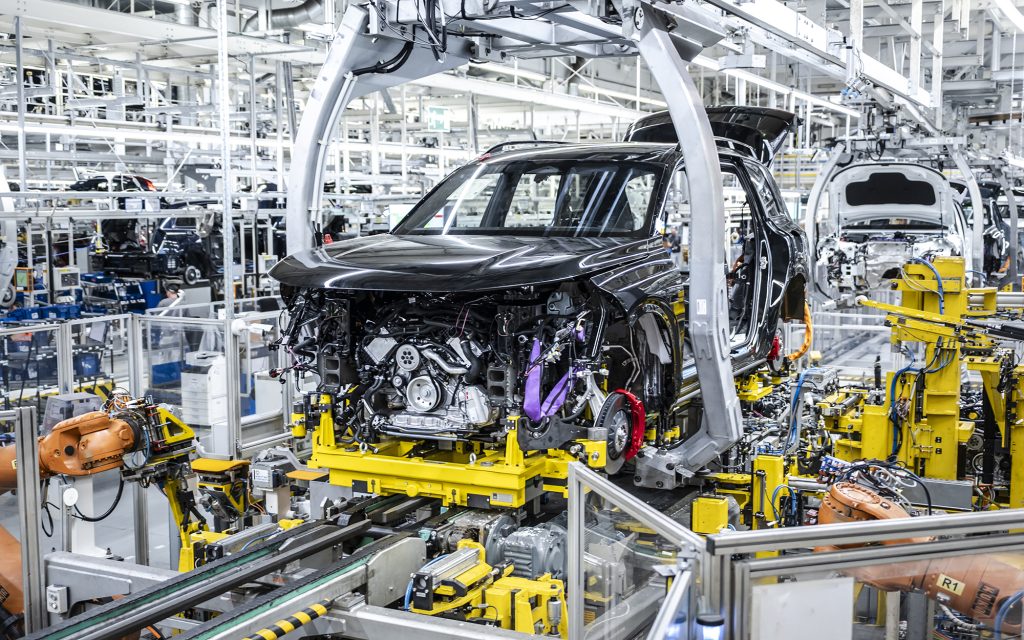
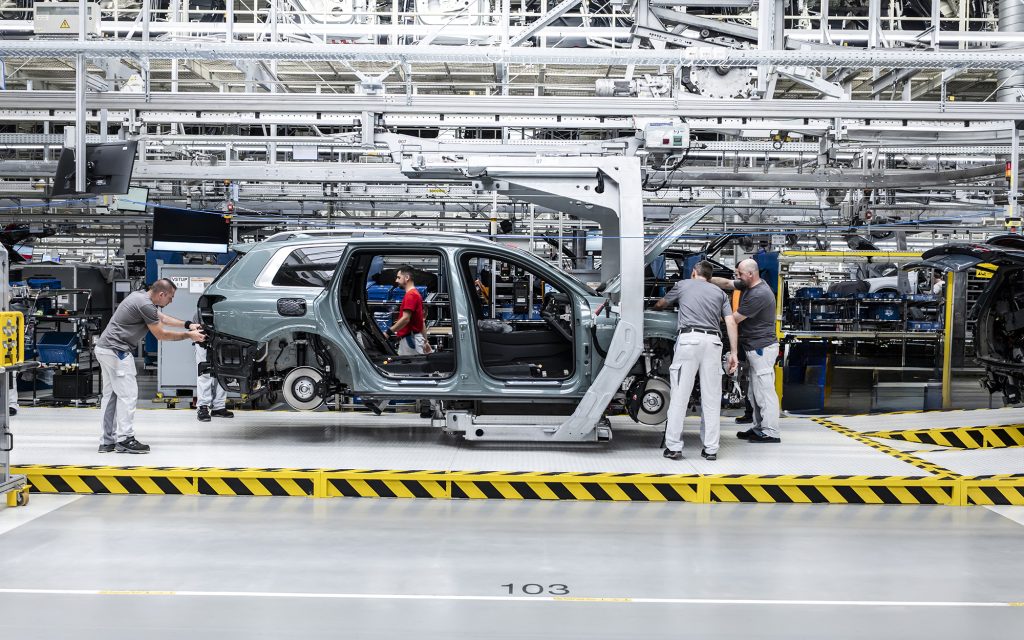
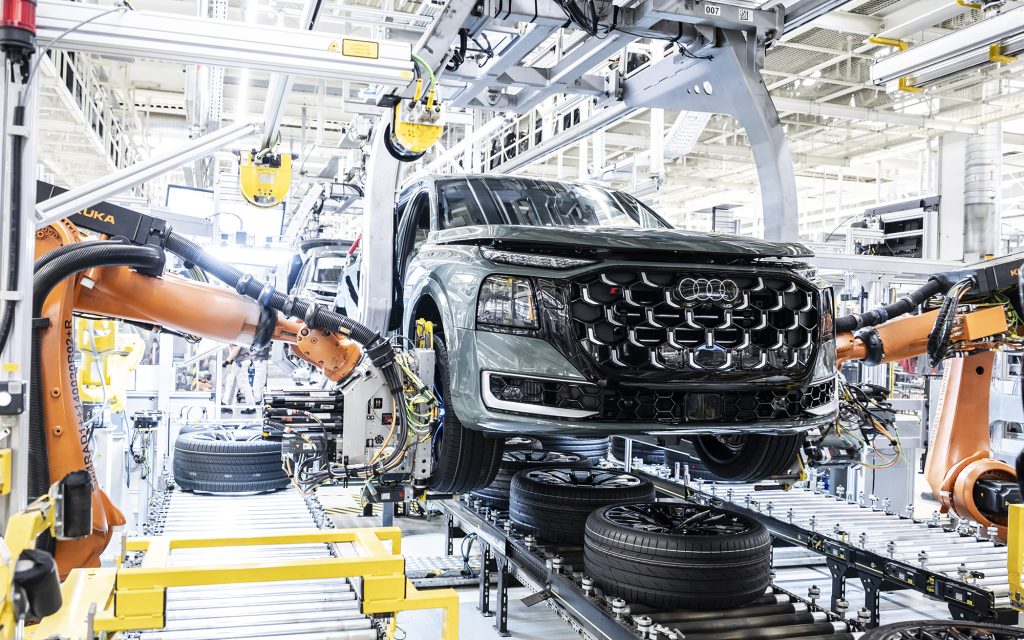
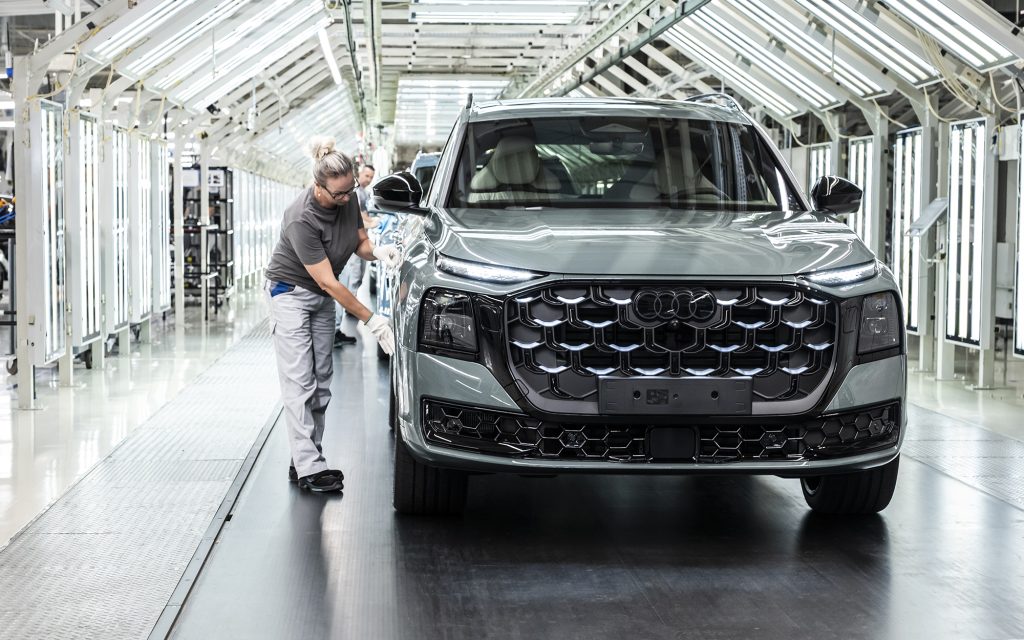
Production of the SQ9 takes place alongside the Q9 at Volkswagen Group’s Bratislava, Slovakia, manufacturing facility.
The plant has produced numerous premium SUVs for Volkswagen Group brands and was selected due to its extensive experience building longitudinal-engine all-wheel-drive vehicles.
The SQ9 entered production during the second half of 2026 ahead of deliveries beginning in North America during the fourth quarter of the year.
TECHNICAL SPECIFICATIONS
Model: Audi SQ9
Model year: 2027
Body style: Five-door full-size luxury SUV
Seating: Seven standard / six optional
Drive system: Permanent rear-biased quattro all-wheel drive
Engine: 4.0-liter twin-turbocharged TFSI V8
Horsepower: 591 hp
Torque: 590 lb-ft (800 Nm)
Transmission: Eight-speed Tiptronic automatic
0-60 mph: 3.8 seconds
Top speed: Electronically limited (market dependent)
Wheelbase: 123.5 in (3,138 mm)
Overall length: 209.0 in (5,309 mm)
Production: Bratislava, Slovakia
HISTORICAL SIGNIFICANCE
The SQ9 represents a significant milestone in Audi’s performance SUV lineage.
It is the first S model developed specifically for Audi’s full-size three-row SUV platform and established a new flagship position above both the SQ7 and SQ8. Rather than simply increasing engine output, Audi used the model to introduce an entirely new drivetrain philosophy centered around a rear-biased electromechanical quattro system. In doing so, the company departed from decades of reliance on passive mechanical center differentials in favor of predictive electronic torque management designed to improve agility without sacrificing the all-weather capability that has long defined quattro.
The model also demonstrates Audi’s continued commitment to high-performance internal-combustion engineering during a period of rapid industry electrification. While incorporating a software-defined electrical architecture, over-the-air updates and advanced driver assistance systems, the SQ9 remains powered by a twin-turbocharged V8 that delivers performance comparable to many dedicated sports cars while retaining the practicality expected of a luxury family SUV.
Viewed within the broader history of Audi Sport, the SQ9 illustrates the evolution of the S philosophy itself. Earlier S models emphasized discreet increases in performance over their standard counterparts. By contrast, the SQ9 combines extensive drivetrain redesign, integrated chassis electronics and predictive vehicle dynamics into a cohesive engineering package. As such, it represents one of the most technically sophisticated S models Audi had produced at the time of its introduction and establishes a new benchmark for the brand’s future performance SUVs.
ARCHIVE NOTES
The 2027 Audi SQ9 should not be viewed simply as a high-output derivative of the Q9. Although the two vehicles share their body structure, passenger compartment and much of their digital architecture, the SQ9 introduces significant mechanical changes beneath the surface. Its revised powertrain, rear-biased quattro system, dedicated chassis calibration and integrated vehicle dynamics systems reflect a broader shift in Audi engineering toward software-managed performance without abandoning the brand’s long-standing principles of refinement, stability and all-weather capability.
For Audi historians, the SQ9 marks both the arrival of the company’s first dedicated full-size S SUV and the beginning of a new generation of quattro technology. Future models may eclipse its performance figures, but the SQ9’s importance lies in the engineering direction it established—a transition from mechanically defined vehicle dynamics to predictive, electronically coordinated systems that would influence the next generation of Audi performance vehicles.