
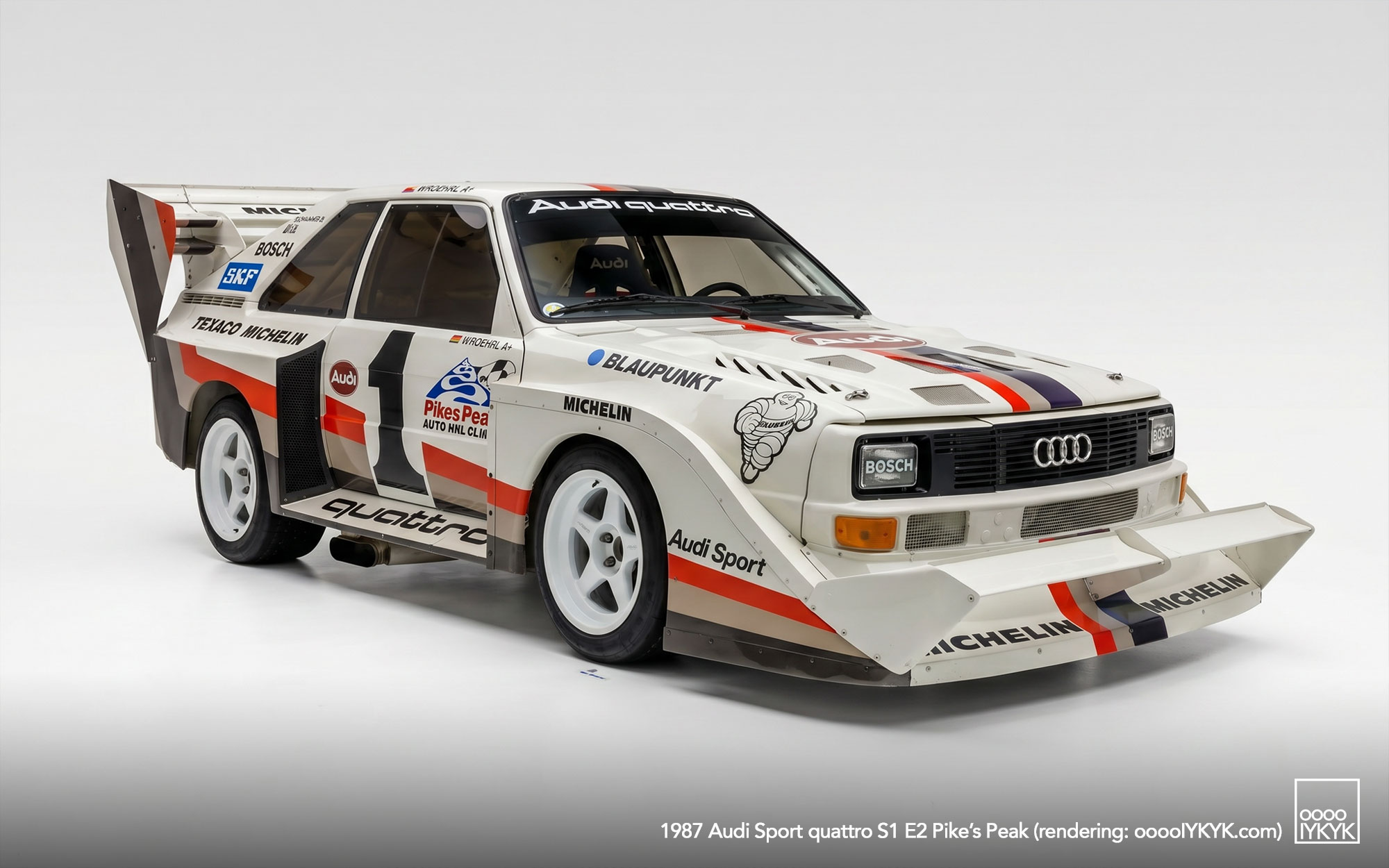

/Eras/Audi Sport Competition Cars R Era /R2/Sport quattro S1 E2 Pike’s Peak
MODEL DETAILS
What: Audi Sport quattro S1 E2 Pike’s Peak
Series: Pike’s Peak International Hillclimb (PPIHC)
Class: Open Rally (PPIHC), Group B (WRC)
Era: Audi Postwar , Audi Sport R Era
Model Family: Coupé
Market / Zone: USA
Season: 1987
Model / Generation Code(s): type 85 / R2
Chassis / Matrix: B2
Registration:
Chassis Number:
Driver: Walter Röhrl
Engine: Turbocharged inline five-cylinder, aluminum block
Displacement: 2,110 cc
Valvetrain: DOHC, 20 valves
Power: Approximately 440 kW (600 hp) officially; period estimates range from 750 hp to substantially higher*
Torque: Approximately 590 Nm (435 lb-ft) officially*
Turbocharger: KKK K28 turbocharger with circulating-air anti-lag system*
Transmission: 6-speed manual
Drive System: Permanent quattro all-wheel drive
Differentials: Three locking differentials*
Weight: Approximately 1,000 kg (2,205 lb)
Wheelbase: 2,220 mm (87.4 in)
Length: 4,240 mm (166.9 in)
Width: 1,860 mm (73.2 in)
Height: 1,344 mm (52.9 in)
Wheels: 16-inch competition wheels
Tires: Michelin competition tires
Chassis: Tubular space frame with steel and composite bodywork
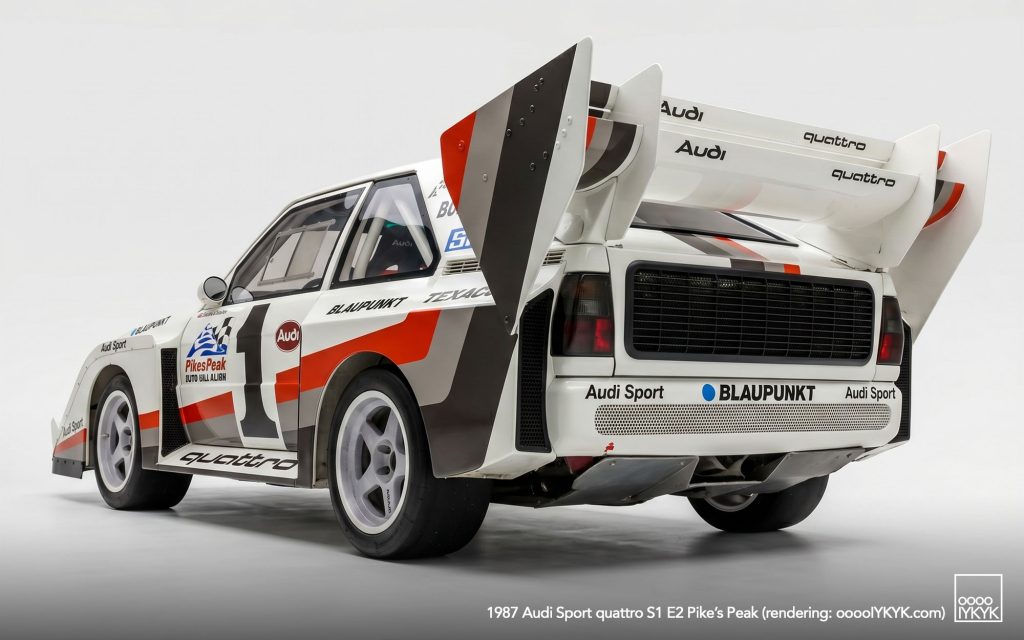
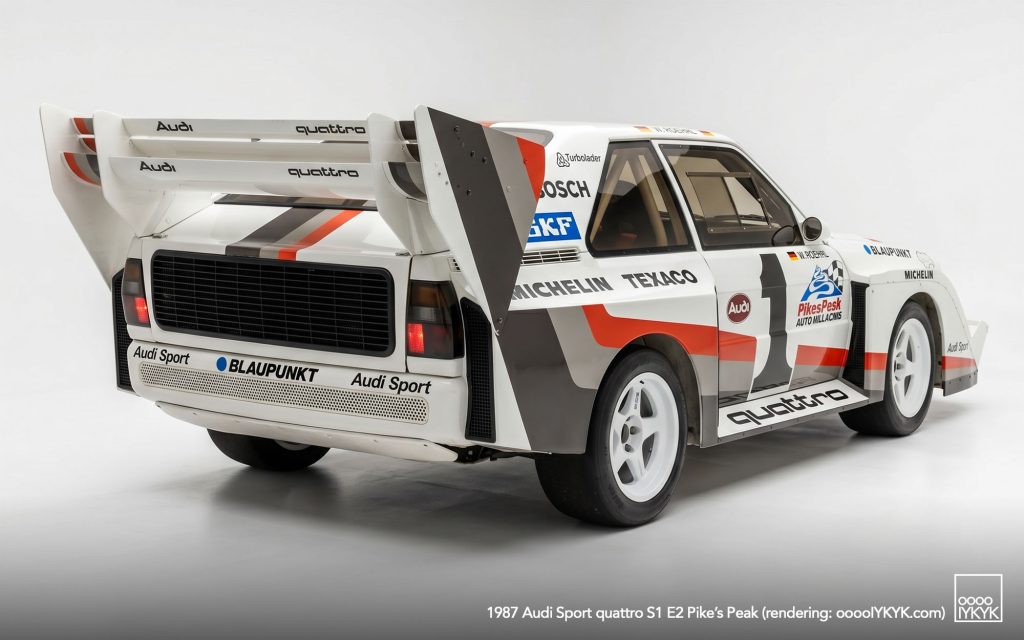
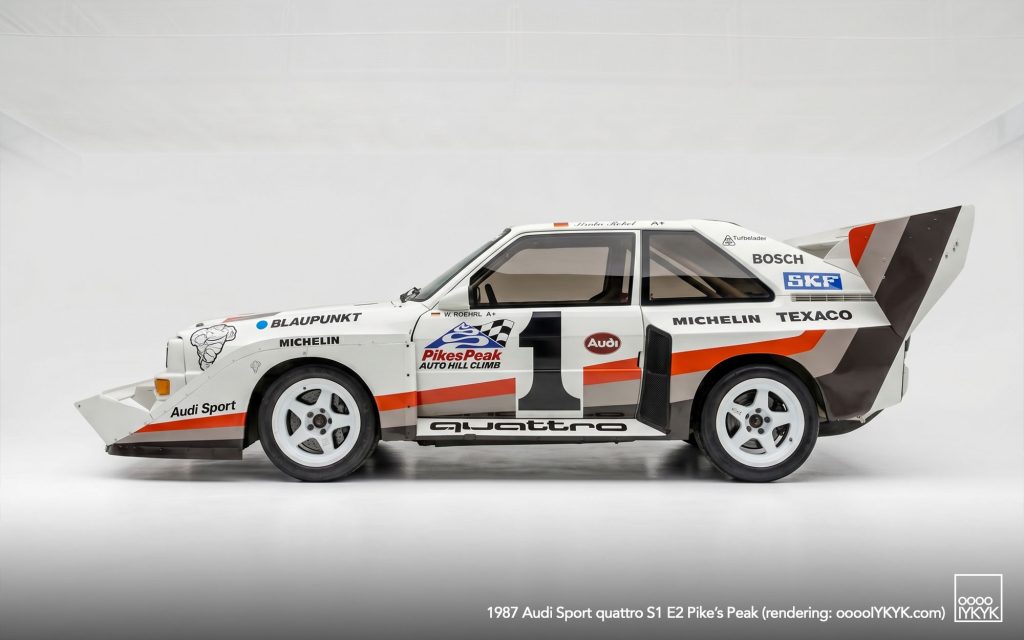
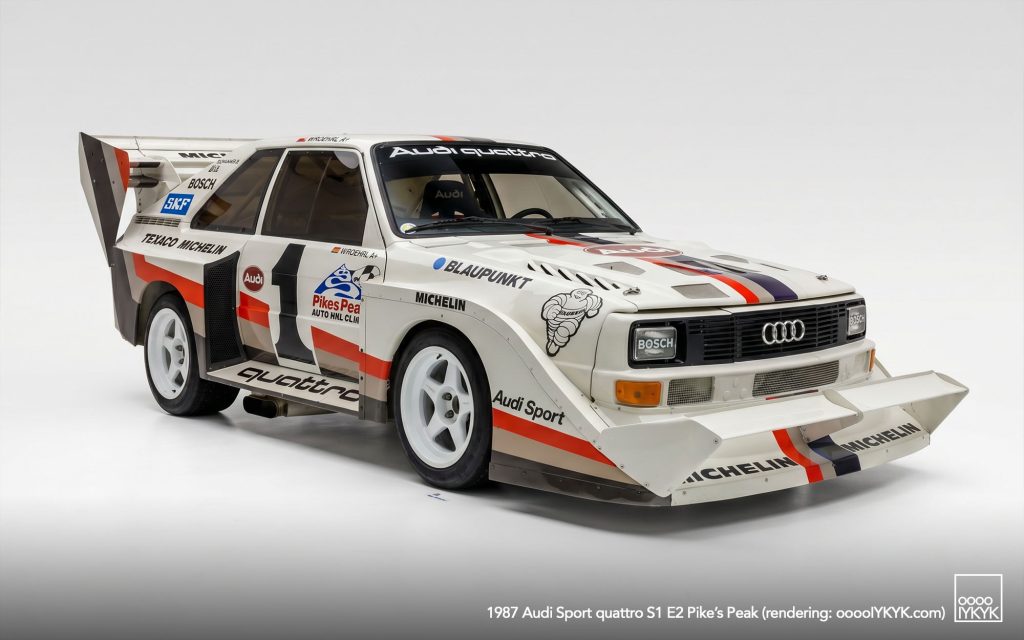
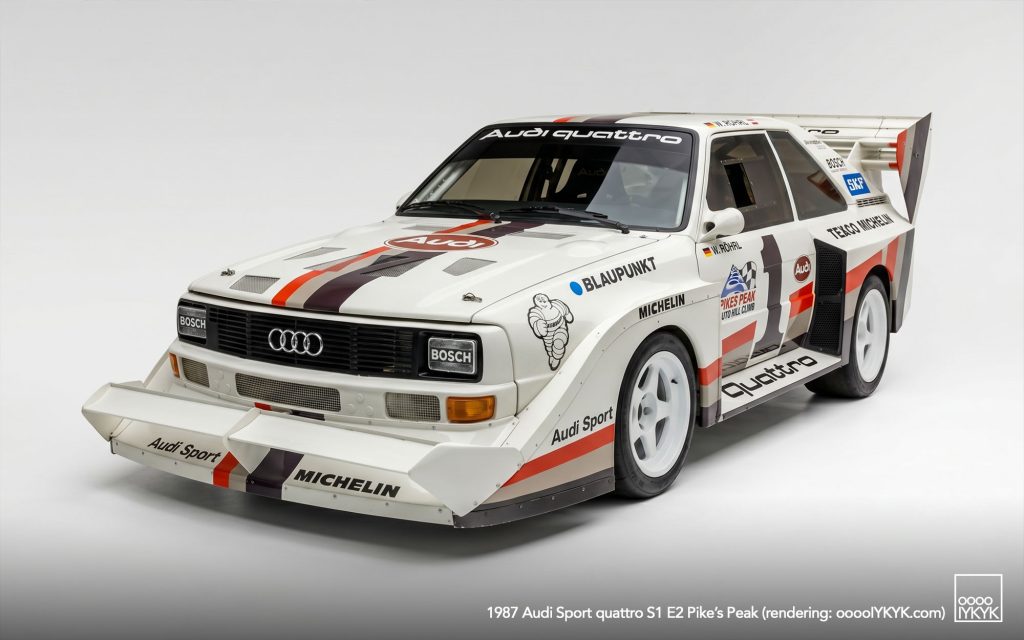
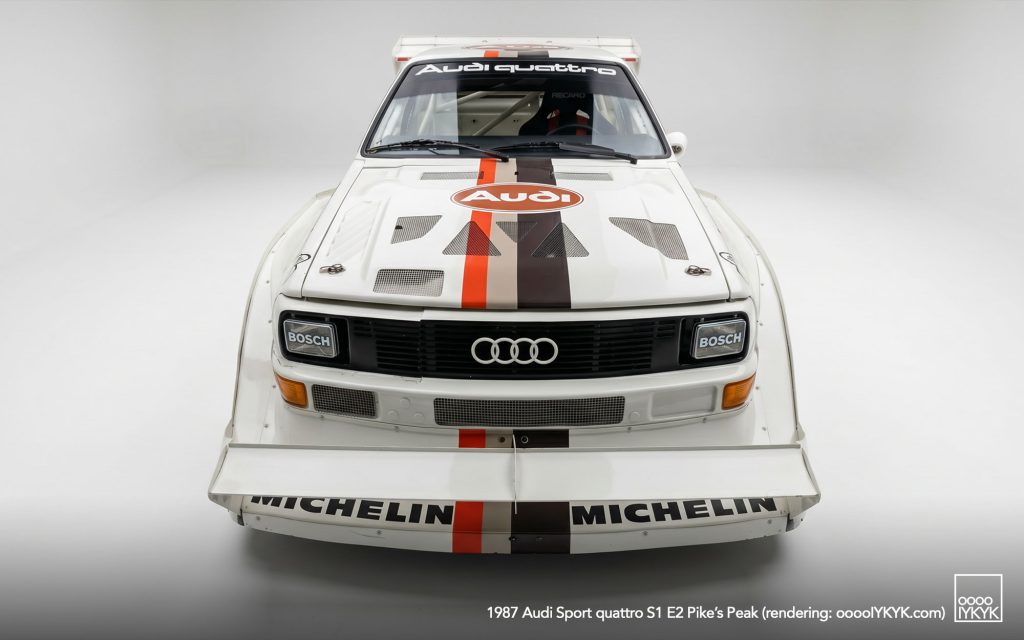
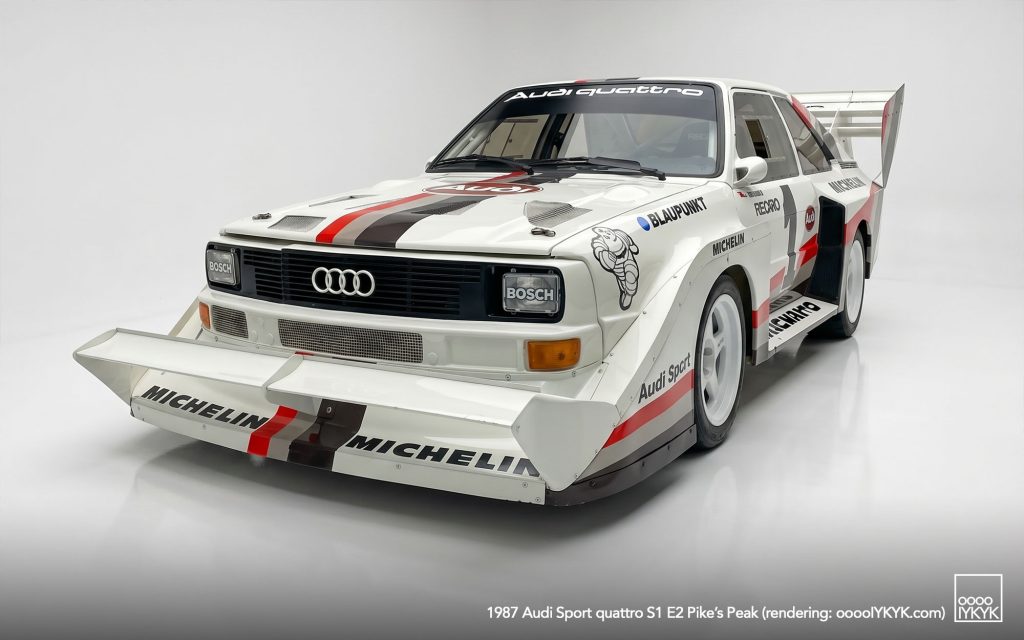
Aerodynamics: Dedicated Pikes Peak specification front wing, enlarged front spoiler, side air deflectors, and double-element rear wing
Result: 1st Overall
Winning Time: 10:47.85
Course Record: Yes
*Specifications marked with an asterisk reflect period Audi documentation, interviews, and contemporary reporting. Exact race-day power output remains debated. While Audi officially quoted approximately 600 hp, Walter Röhrl later stated the engine produced approximately 750 hp, and some estimates suggest considerably higher figures may have been available depending on boost settings. As with many Group B-era competition cars, exact race specifications varied according to setup and operating conditions.
RESULT
1987 Pikes Peak International Hill Climb
July 11, 1987
Driver: Walter Röhrl
Time: 10:47.85
Position: 1st Overall
Course Record: Yes
Historical Significance: First sub-11-minute run at Pikes Peak
Audi Pikes Peak Victories: Third consecutive overall victory (1985-1987)
OVERVIEW
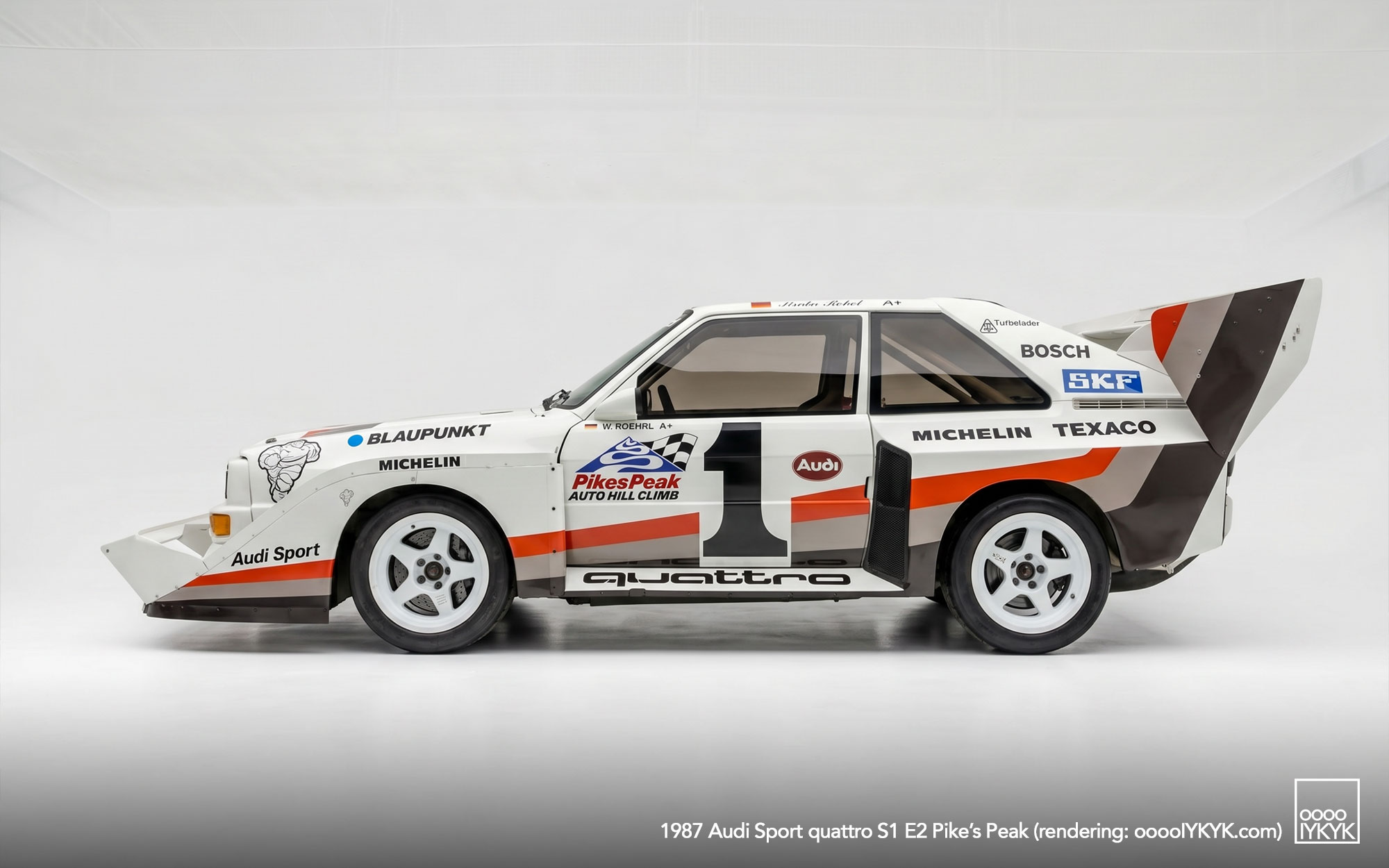
The 1987 Audi Sport quattro S1 E2 Pikes Peak represents the ultimate evolution of Audi’s Group B rally technology and the final chapter in the marque’s factory-backed domination of America’s Mountain.
Driven by Walter Röhrl, the heavily revised machine shattered the existing course record at the Pikes Peak International Hill Climb with a run of 10:47.85, becoming the first competitor in history to break the eleven-minute barrier on the 12.42-mile course.
The victory completed an Audi hat trick on Pikes Peak, following Michèle Mouton’s overall victory in 1985 and Bobby Unser’s record-setting win in 1986. It also marked Audi’s final appearance on the mountain before shifting its motorsport focus to circuit racing programs such as Trans-Am.
Widely regarded as one of the most extreme competition cars ever built, the 1987 Pikes Peak Sport quattro S1 E2 remains among the most iconic Audis of all time.
BACKGROUND
Following Bobby Unser’s victory in 1986, Audi Sport returned to Pikes Peak with unfinished business.
Although the 1986 Sport quattro S1 E2 had reclaimed the course record, Audi engineers believed significantly more performance remained. The cancellation of Group B rallying following the 1986 season freed Audi from World Rally Championship obligations and allowed the company to focus entirely on developing the ultimate Pikes Peak machine.
The result was not merely an updated version of the previous year’s Sport quattro S1 E2 but a heavily redesigned evolution created specifically for the unique demands of America’s Mountain.
The chassis itself originated as Bobby Unser’s 1986 winner, though by the time preparations for the 1987 event were complete, the car had undergone such extensive redevelopment that it effectively represented a new specification.
Walter Röhrl, who had originally been considered for the 1986 effort before Bobby Unser secured the drive, was finally given his opportunity to tackle the mountain.
THE CAR
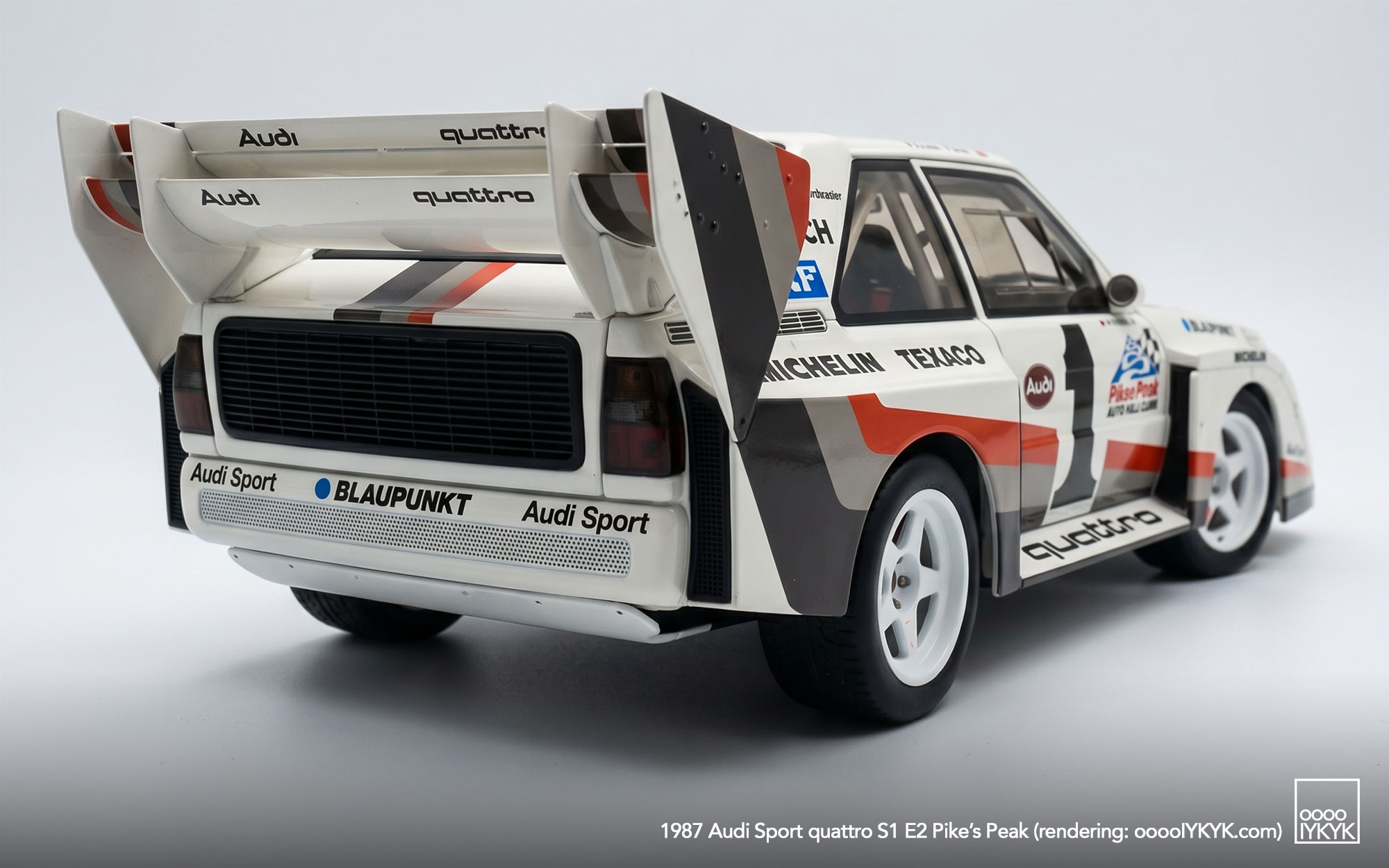
Although still based upon the Sport quattro S1 E2, the 1987 Pikes Peak car differed substantially from both its Group B predecessor and the machine Bobby Unser had driven the year before.
The most visible changes were aerodynamic.
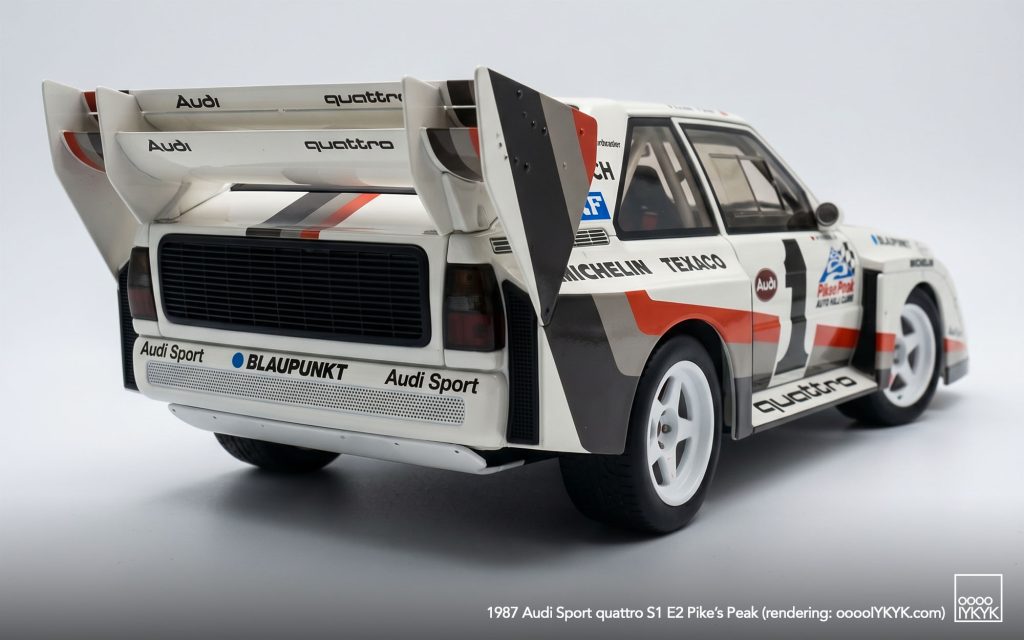
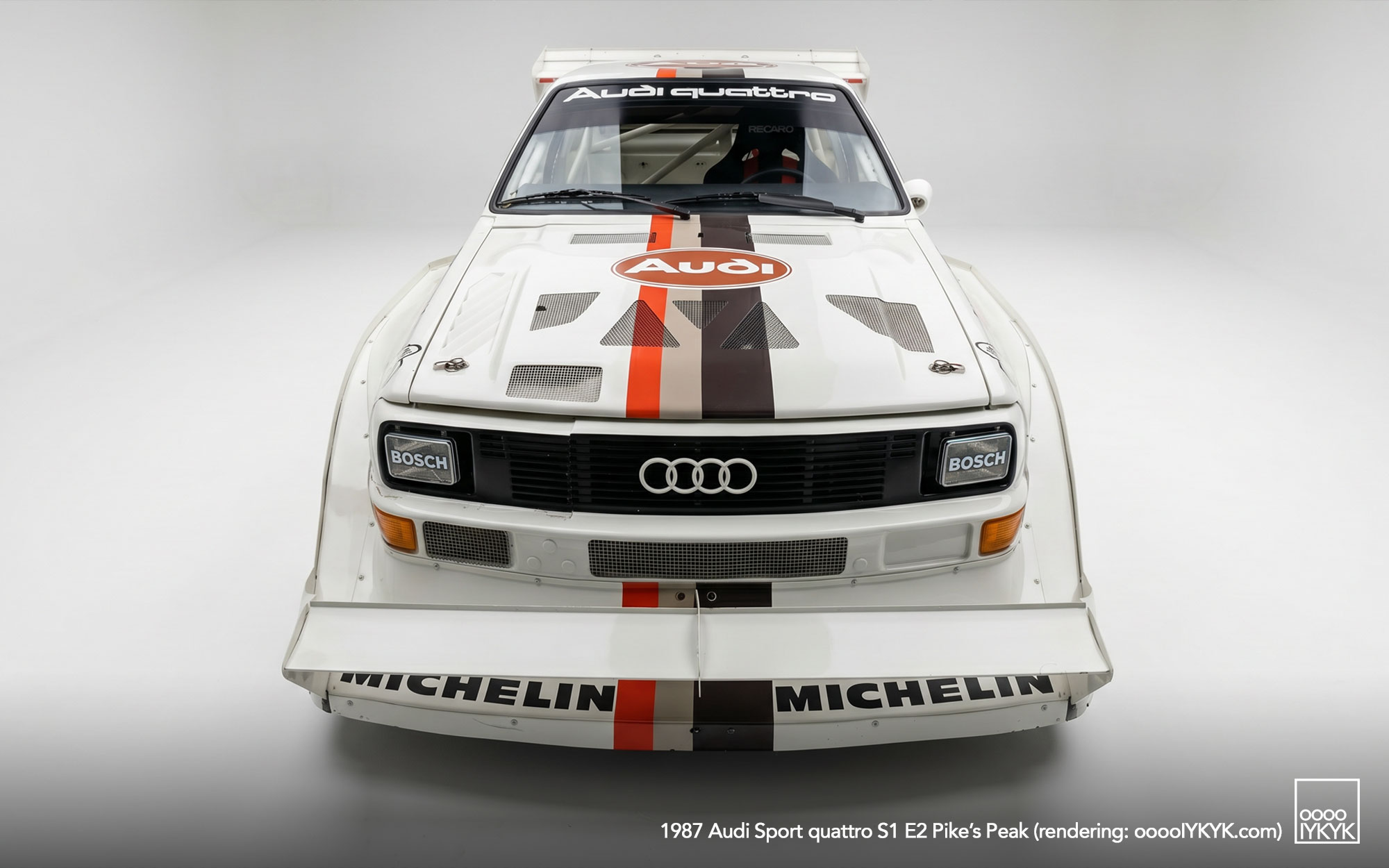
A massive front wing was mounted above the already substantial front spoiler, while an enormous double-element rear wing dominated the rear bodywork. Additional side-mounted aerodynamic fences and revised body panels further increased stability and downforce.
The goal was to maximize grip on a mountain where virtually every section of the course climbed uphill.
Mechanically, the car continued Audi Sport’s pursuit of power. The turbocharged 2.1-liter five-cylinder retained its aluminum block and 20-valve cylinder head but received further development to improve response and power delivery at altitude.
An anti-lag-style circulating-air system helped maintain turbocharger speed when the throttle was lifted, dramatically reducing lag and ensuring immediate response when power was reapplied.
Period Audi documentation listed output at approximately 440 kW (600 hp), though numerous contemporary accounts and later interviews suggest significantly higher figures may have been available. Walter Röhrl himself later stated that the engine produced approximately 750 hp, while some estimates have ranged even higher.
Whatever the exact figure, the Sport quattro delivered power in a fashion that bordered on violent.
Weight reduction also remained a priority. Converted into a single-seater and optimized specifically for the hill climb, the car weighed approximately 1,000 kilograms. The lightweight tubular space frame chassis was clothed in a combination of steel and composite body panels while a compact braking system further reduced mass.
The result was one of the most powerful and extreme all-wheel-drive competition cars ever built.
PREPARATION FOR PIKES PEAK
Audi Sport’s primary competition in 1987 came from Peugeot.
Having observed Audi’s success on the mountain, Peugeot arrived in Colorado with three factory-supported 205 Turbo 16 entries driven by Ari Vatanen, Shekhar Mehta, and Andrea Zanussi. Malcolm Wilson also entered a Ford RS200, creating one of the strongest fields assembled during the Group B era.
Bobby Unser, now retired from competition but still deeply invested in Audi’s success, remained involved behind the scenes.
Unser believed Röhrl’s traditional World Rally Championship style was not ideally suited to Pikes Peak. Rather than carrying smooth, flowing momentum through corners, Unser advocated a more aggressive approach that emphasized earlier rotation and harder acceleration on corner exit.
According to Unser, Röhrl quickly adapted.
The combination of Audi’s engineering development and Röhrl’s willingness to adjust his technique produced immediate results.
During practice, the Audi consistently demonstrated a pace advantage over the Peugeot entries, at times exceeding six seconds per mile.
The battle for the mountain appeared decided before race day arrived.
COMPETITION HISTORY
Pikes Peak International Hill Climb 1987
Driver: Walter Röhrl
Despite an electronic issue affecting the circulating-air system during qualifying, Röhrl remained the favorite entering race day.
The organizers elected to start competitors in reverse qualifying order, placing Röhrl immediately ahead of Ari Vatanen.
When the flag dropped on July 11, 1987, Röhrl delivered one of the most famous drives in hill climb history.
The German attacked the mountain with remarkable precision, balancing huge power slides on loose gravel while repeatedly reaching sixth gear on the fastest sections of the course. At one point the Audi was measured at approximately 196 km/h (122 mph) while climbing toward the summit.
As always at Pikes Peak, mistakes carried enormous consequences. Several corners bordered sheer drops with no guardrails, yet Röhrl attacked relentlessly.
After 156 corners and 19.99 kilometers of climbing, he crossed the finish line in 10:47.85.
The run shattered Bobby Unser’s 1986 record and made Röhrl the first driver in history to complete the course in less than eleven minutes.
Ari Vatanen finished second in his Peugeot 205 Turbo 16 with a time of 10:54.38.
Audi had completed its third consecutive overall victory and established a benchmark that immediately entered motorsport legend.
Reflecting on the achievement afterward, Röhrl remarked:
“All I can say is that it was great to take part. It was crazy, but often it is in fact the crazy things which are the best in life. It was the very pinnacle of what can be done with a rally car.”
LEGACY
The 1987 victory marked the conclusion of Audi’s Pikes Peak program.
Having won three consecutive overall victories and established a new course benchmark, Audi elected to shift its motorsport resources toward circuit racing. The company’s quattro technology would soon demonstrate its capabilities in Trans-Am competition with the Audi 200 quattro.
For Walter Röhrl, the victory remains one of the defining achievements of an extraordinary career. Although he had won world championships and countless rallies, Pikes Peak offered a unique challenge unlike anything else in motorsport.
The car itself survives today within Audi Tradition’s collection, preserved in its final 1987 specification.
More than any other Audi competition car, it represents the ultimate expression of the Group B era. Its combination of immense power, sophisticated all-wheel drive, advanced aerodynamics, and uncompromising purpose has made it one of the most recognizable and celebrated rally-derived race cars ever created.
NOTABLE DISTINCTION
The chassis used by Walter Röhrl in 1987 originated as Bobby Unser’s 1986 Pikes Peak winner.
Following the 1986 season, Audi Sport extensively redeveloped the car into a dedicated Pikes Peak machine with revised aerodynamics, increased power, reduced weight, and further chassis modifications.
As a result, the same chassis contributed to consecutive overall victories and course records in 1986 and 1987, first with Bobby Unser and then with Walter Röhrl.
SIGNIFICANCE
The 1987 Audi Sport quattro S1 E2 Pikes Peak was the final and most extreme evolution of Audi’s legendary Group B quattro program.
It delivered Audi’s third consecutive overall victory on America’s Mountain, became the first car to break the eleven-minute barrier at Pikes Peak, and remains one of the most iconic competition cars in Audi history.
For many enthusiasts, it represents the ultimate expression of quattro technology in the Group B era.
PHOTO GALLERY