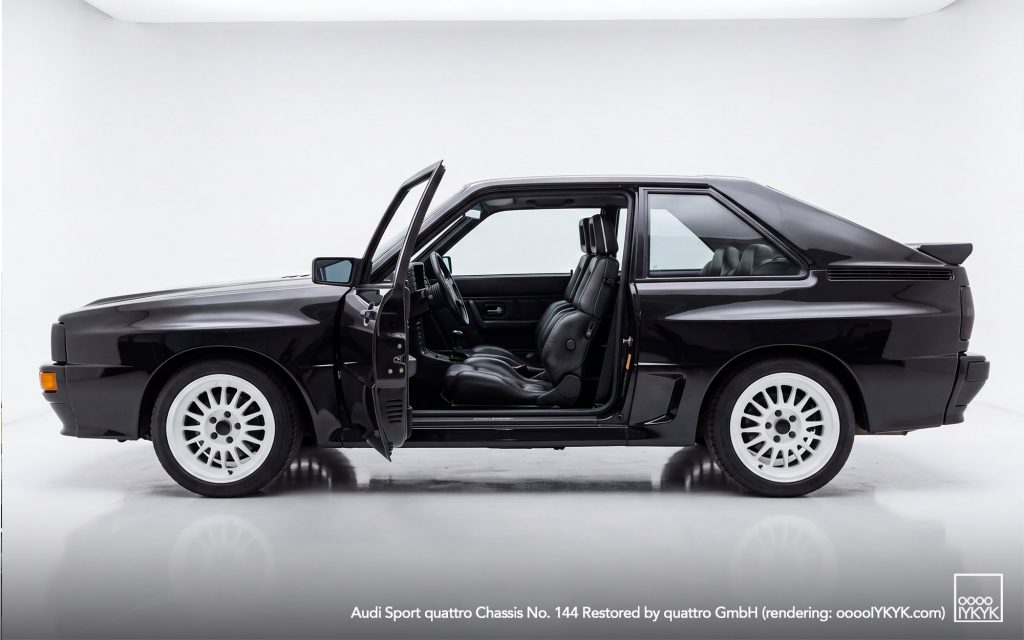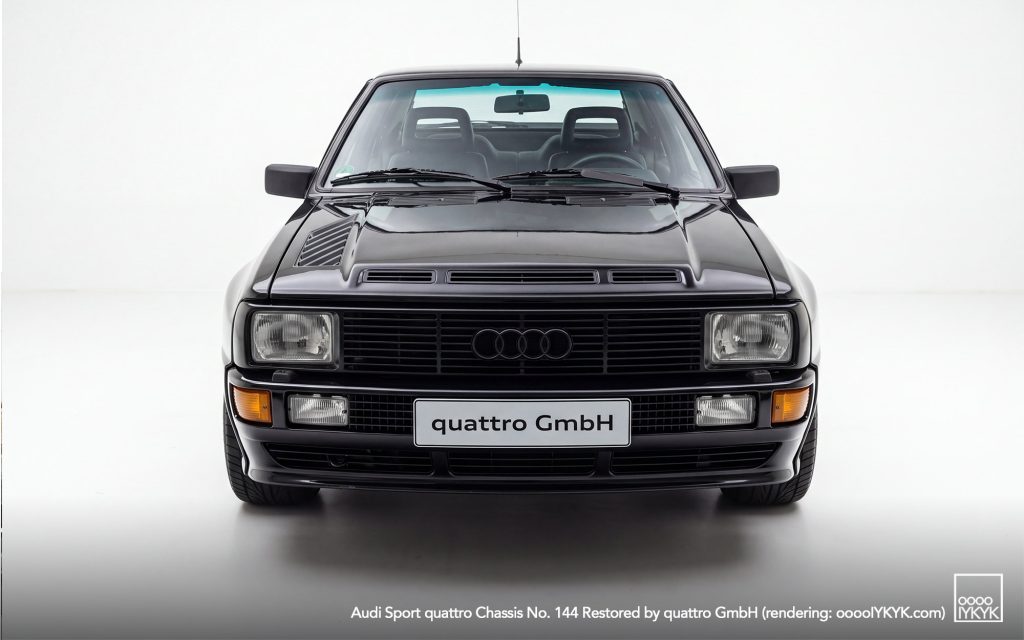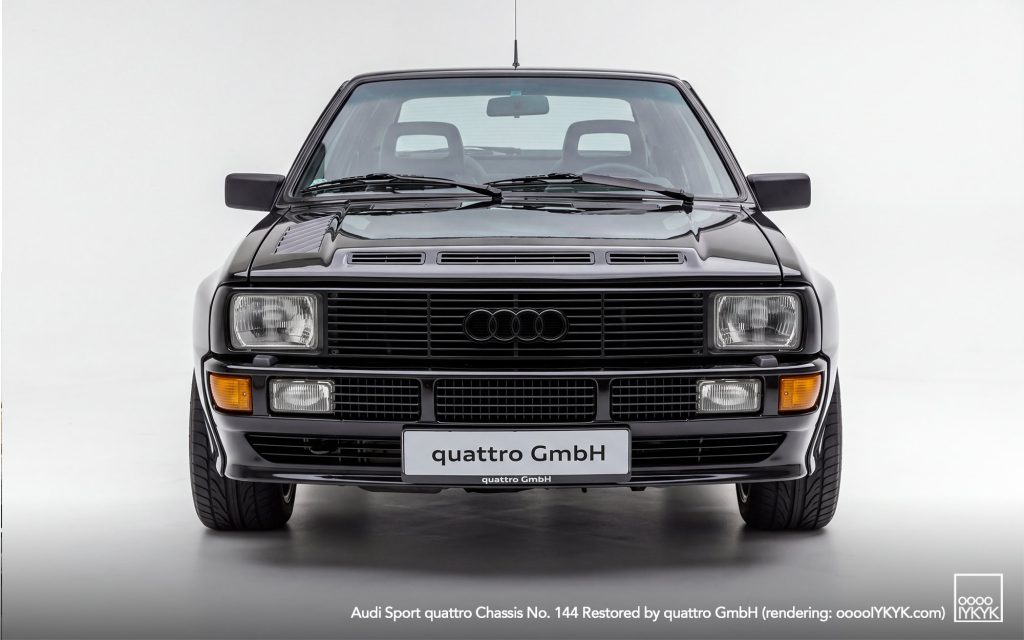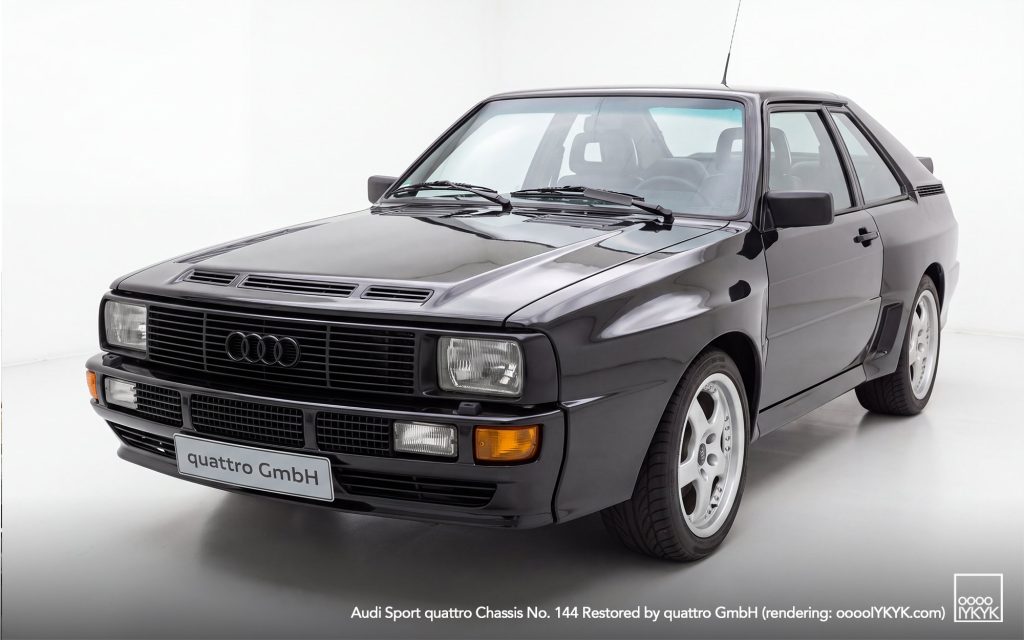

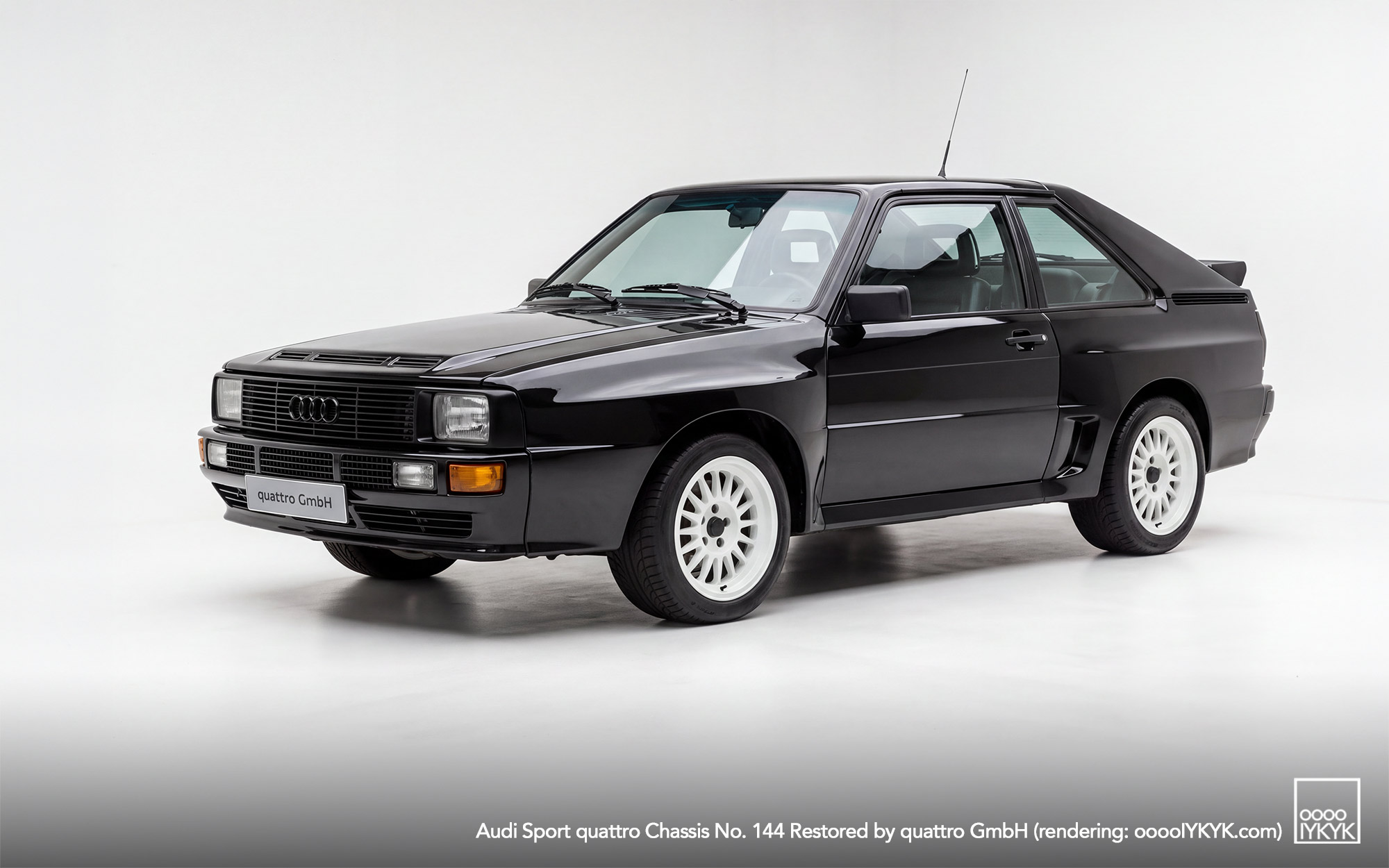

What: Sport quattro extensively rebuilt and modified by quattro GmbH
Informal Name: “Job 1”
Advertised Name: Audi Sport quattro “Factory Evo 2”
Model Family: Audi quattro
Model / Generation Code: B2 / type 85
Type Designation: 85KW2Q
Model Year: 1984
Rebuild Completed: June 30, 2000
Country: France
Number Produced: 1
Original Manufacturer: AUDI AG
Rebuilder: quattro GmbH
Location of Work: Neckarsulm, Germany
Chassis Number: WAUZZZ85ZEA905144
Sport quattro Sequence: No. 144
Original Exterior Color: Copenhagen Blue (kopenhagenblau; non-metallic uni; LY5B/Y5B; Audi)
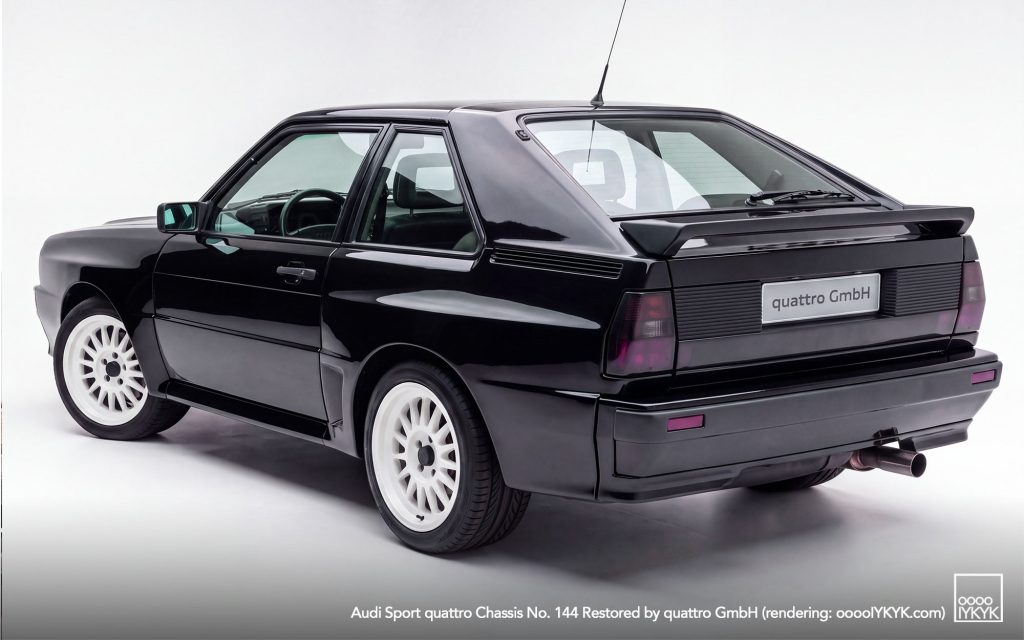
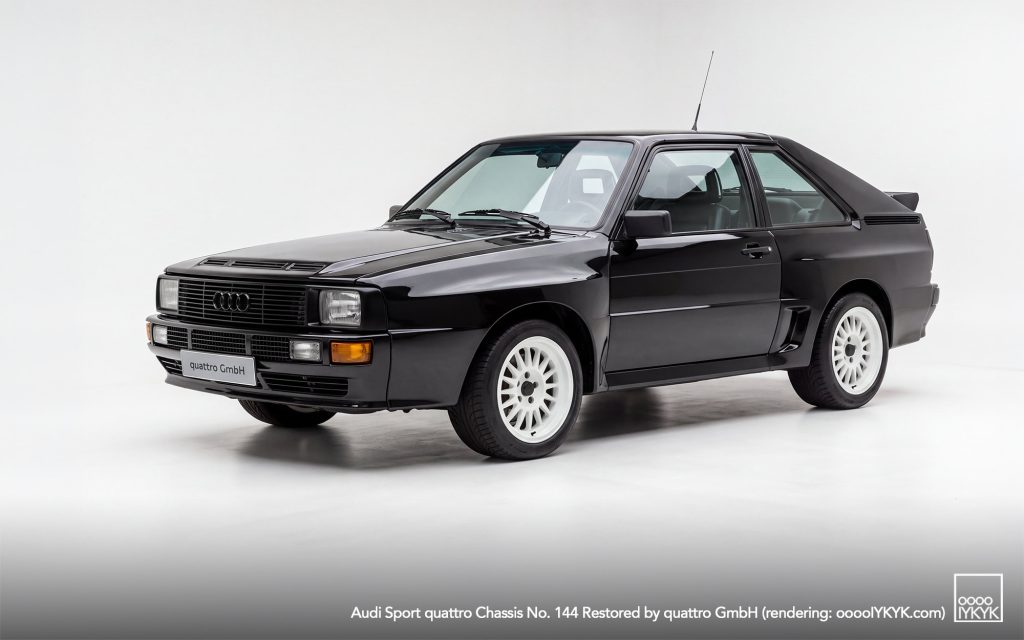
Rebuilt Exterior Color: Black
Original Interior Color: Brown
Rebuilt Interior: Black leather and Alcantara
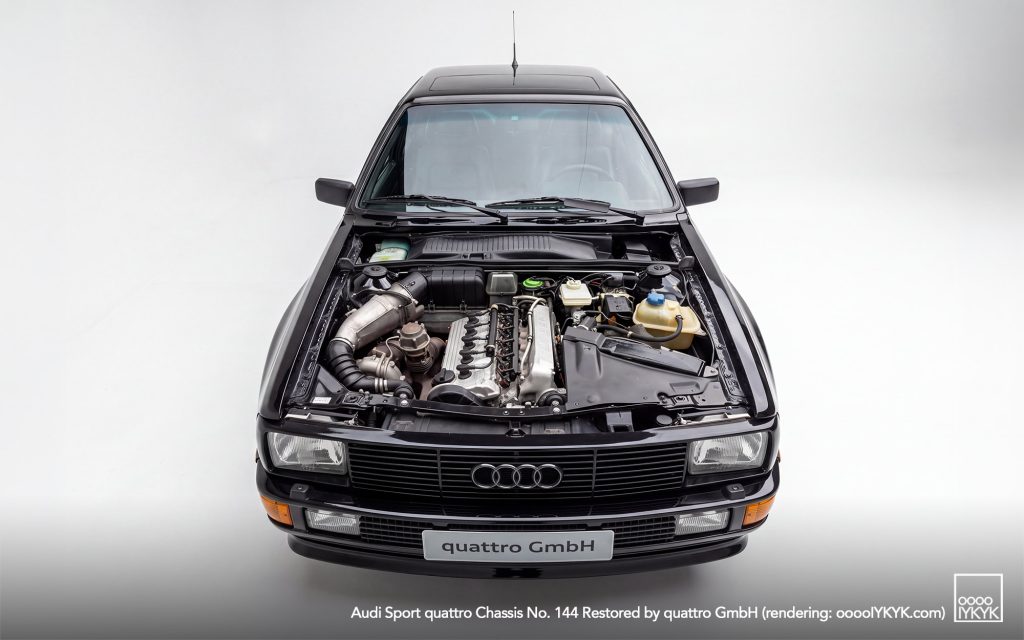
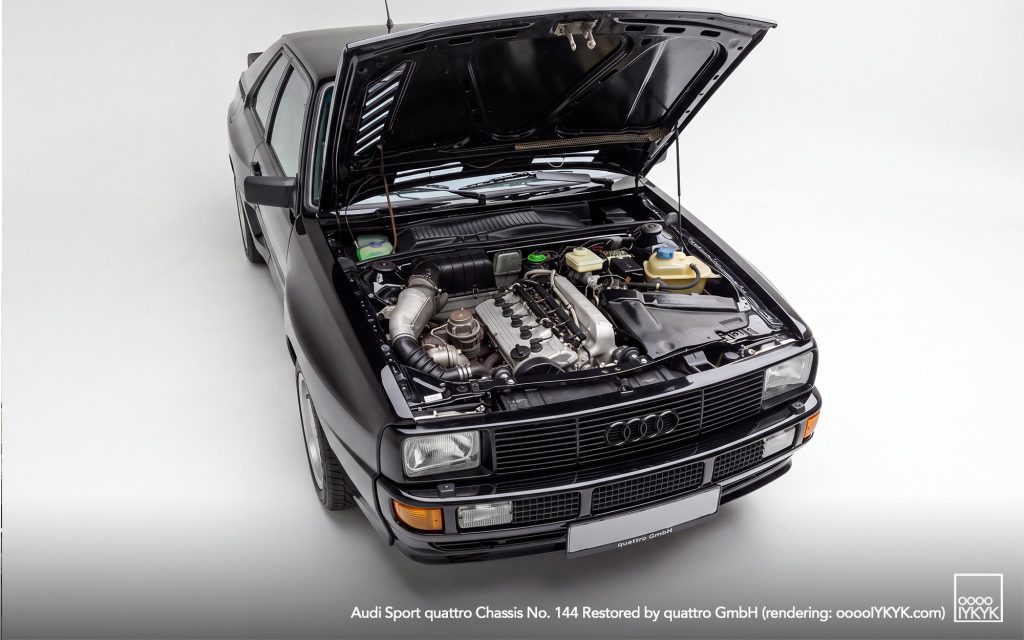
Engine: Turbocharged inline five-cylinder with cast-iron block
Power: Approximately 345 bhp (257 kW)
Transmission: Adapted replacement manual gearbox
Drive System: Permanent quattro all-wheel drive
Wheels: 17-inch wheels; documented stock-pattern Ronal-style set
Mileage Before Rebuild: Approximately 21,000 km (13,049 miles)
Documented Invoice Date: June 30, 2000
Documented Cost: DM 434,420 including VAT (€222,115.42)
French Individual-Type Approval: January 16, 2004
Decision Number: 005.60.04
Significance: A one-off Sport quattro reconstructed and extensively modernized by quattro GmbH for a prominent Middle Eastern client. Former quattro GmbH development chief Stephan Reil identified chassis No. 144 as the first of the subsidiary’s specialized restoration and upgrade commissions, making it an early example of the bespoke vehicle-engineering work later associated with Audi exclusive and Audi Sport GmbH.
OVERVIEW
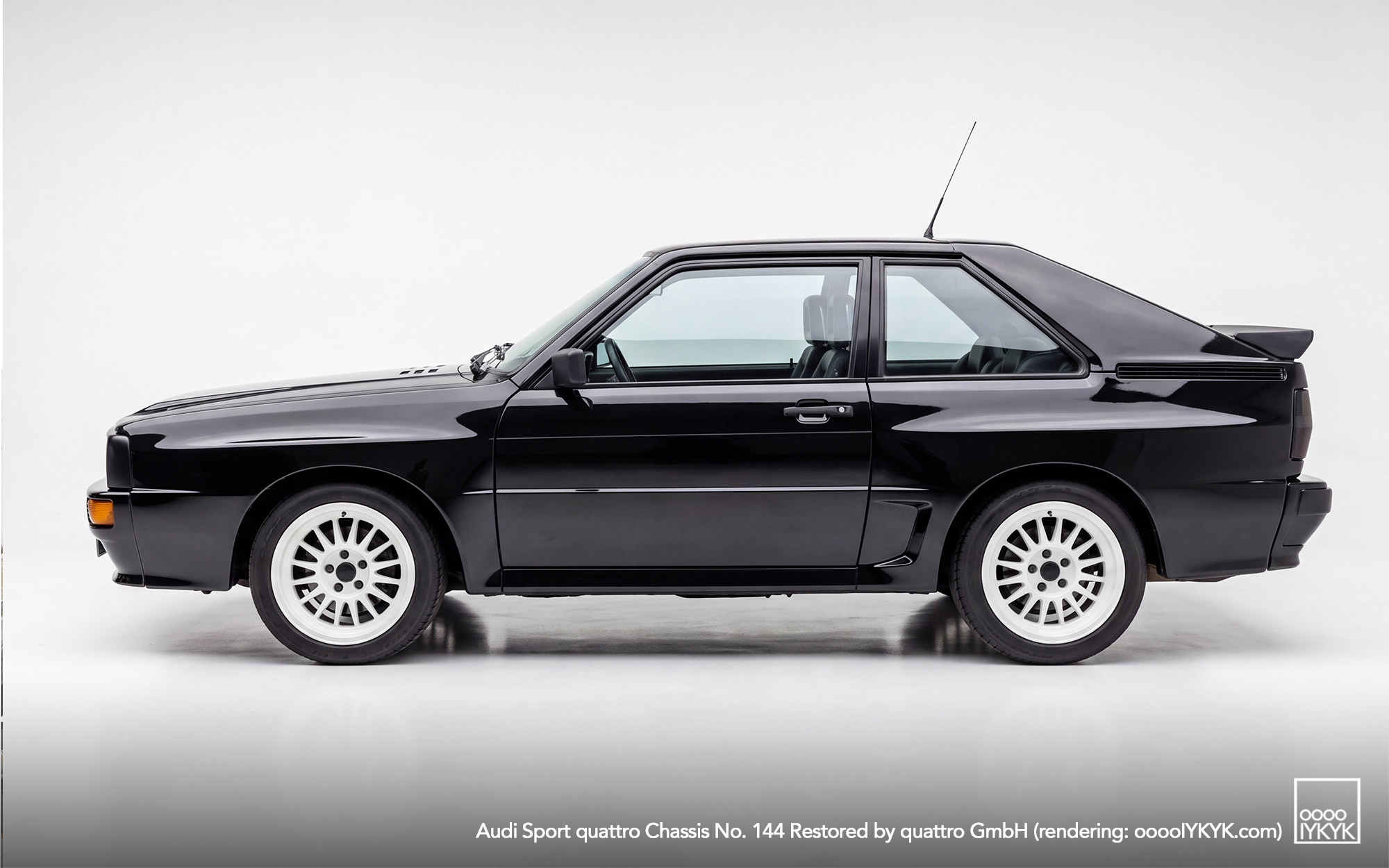
Audi Sport quattro chassis No. 144 is a one-off road car extensively reconstructed and modified by quattro GmbH for a prominent Middle Eastern client. Although based on a production 1984 Sport quattro, the car received substantial mechanical, chassis, exterior and interior changes intended to modernize its performance and usability while retaining the essential character of the original homologation model.
The project was described in its 2011 sales listing as the only factory-produced “Sport quattro Evo 2.” That was not an official Audi model designation, nor was the car a continuation of Audi Sport’s Group B development program. Its work was nevertheless performed by Audi’s own quattro GmbH subsidiary and documented through original invoices, engineering work, test-bench development and subsequent homologation.
Former quattro GmbH development chief Stephan Reil identified chassis No. 144 as “Job 1,” the first of the company’s specialized restoration and major-upgrade commissions. It should not be confused with quattro GmbH’s first activities overall, which began with accessories and branded merchandise following its establishment in 1983, or with its first complete production car, the Audi S6 plus introduced in 1996.
ORIGINAL CAR
Chassis No. 144 was one of approximately 214 Sport quattros constructed for competition homologation and road use. Contemporary research associated with the car indicated that approximately 164 were sold as road cars to private customers.
The car was originally painted Copenhagen Blue and registered in France. By the time it returned to Audi, it had accumulated approximately 21,000 kilometers (13,049 miles). Documentation suggests the body may also have required repair, although the precise circumstances and extent of any damage have not been confirmed.
The client’s identity was withheld at his request. Original paperwork addressed correspondence to the “Secretariat de Son Altesse,” or Secretariat of His Highness, and identified the customer as a prince.
QUATTRO GMBH COMMISSION
The surviving cost summary refers to an offer dated December 23, 1998, followed by additional expenditure approved after the client inspected the project on January 31, 2000. The final quattro GmbH invoice is dated June 30, 2000.
The invoice described the principal work as “Restauration Audi quattro Sport schwarz”—restoration of a black Audi Sport quattro. The base project cost DM 299,500, with a further DM 75,000 charged for additional work agreed after the January inspection.
The resulting subtotal was DM 374,500. With 16-percent value-added tax of DM 59,920, the invoice totaled DM 434,420, equivalent at the time to €222,115.42. Separate road-tax and third-party insurance charges brought the documented grand total to DM 439,114.90.
This was not a conventional restoration intended to return the car to its original specification. quattro GmbH rebuilt the Sport quattro as a comprehensively modernized one-off, repairing or recreating unavailable components while developing new systems around the client’s requirements.
ENGINE AND EXHAUST
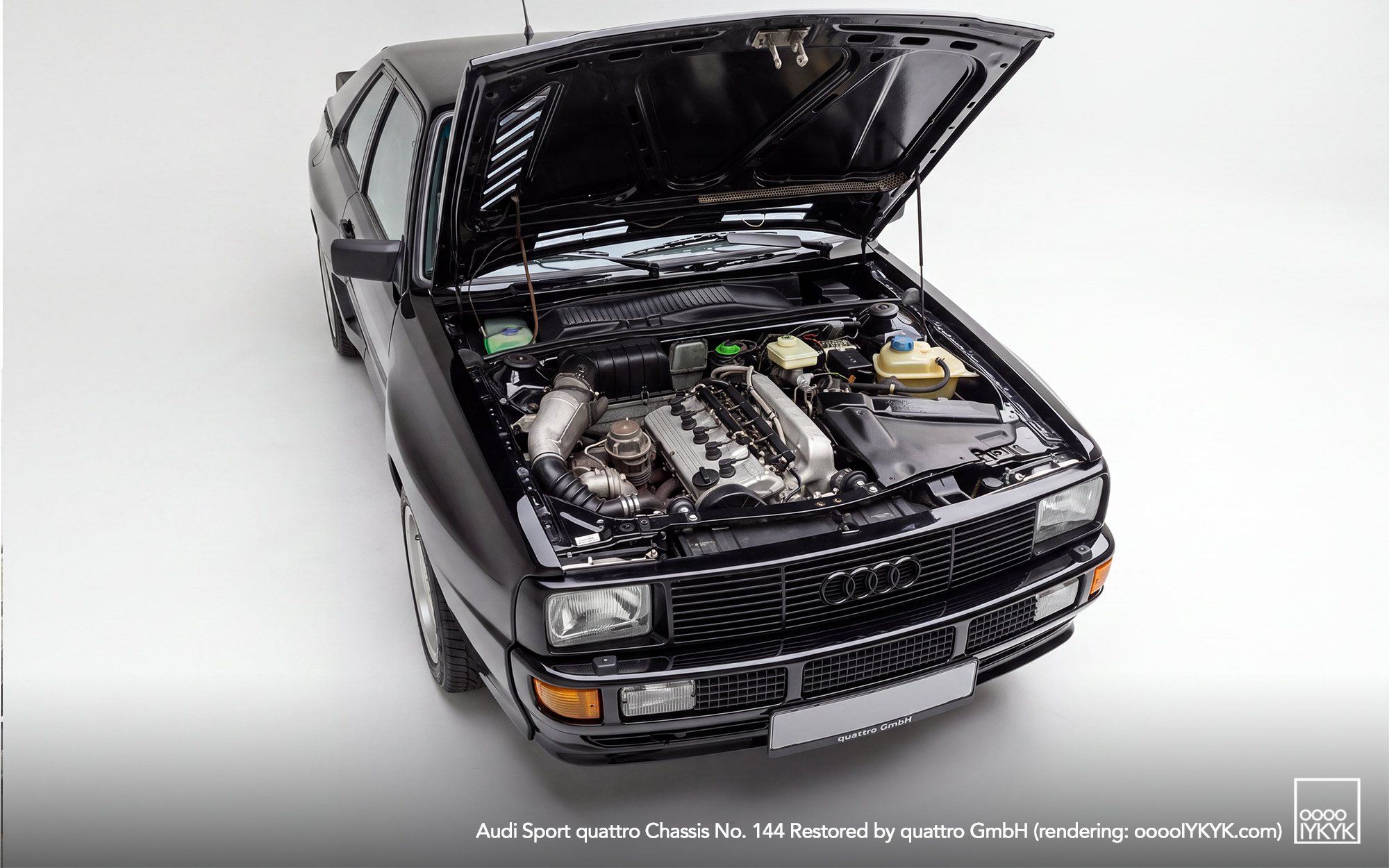
The original Sport quattro engine was overhauled and modified to produce approximately 345 bhp. The work included replacing the original aluminum cylinder block with a cast-iron block, installing a new turbocharger with altered geometry and revising the boost-pressure regulation.
quattro GmbH also tailored the engine’s power curve and modified the exhaust with a different final or secondary silencer. Reil later described the resulting exhaust note as “electrifying.”
The engine work accounted for DM 55,000 of the documented project cost.
TRANSMISSION AND STEERING
The drivetrain received a new gearbox with the adaptations required for installation in the Sport quattro. The gearbox work was invoiced at DM 15,000.
A new steering box was also installed and adapted to the car at a documented cost of DM 4,000.
Although the modifications substantially updated the car, the permanent quattro all-wheel-drive system and manual-transmission configuration remained central to its specification.
CHASSIS, WHEELS AND BRAKES
quattro GmbH developed and adapted a stiffer suspension for the car, including revised shock absorbers and calibration for 17-inch wheels. The cost summary explicitly lists both tires and rims within the DM 21,000 running-gear work.
According to Reil, quattro GmbH commissioned a very limited run of 17-inch wheels reproducing the appearance of the Sport quattro’s original Ronal design. The 2011 sale reportedly included unused road wheels and a separate set described as racing wheels.
The modular five-spoke wheels fitted when the car was advertised in 2011 do not appear in the quattro GmbH invoice and may have been installed later.
The brake system was extensively redeveloped to suit the larger wheels and increased performance. Work included new front and rear calipers and pistons, new front and rear discs, revised pads and a brake-force distributor adapted to work with the anti-lock braking system. These changes were invoiced at DM 18,000.
The 2011 seller described the brakes as being derived from the Audi RS 6. Because the quattro GmbH project was invoiced two years before the first RS 6 entered production, that description may refer to later work or components subsequently associated with the RS 6 rather than the original 2000 installation.
BODY AND EXTERIOR
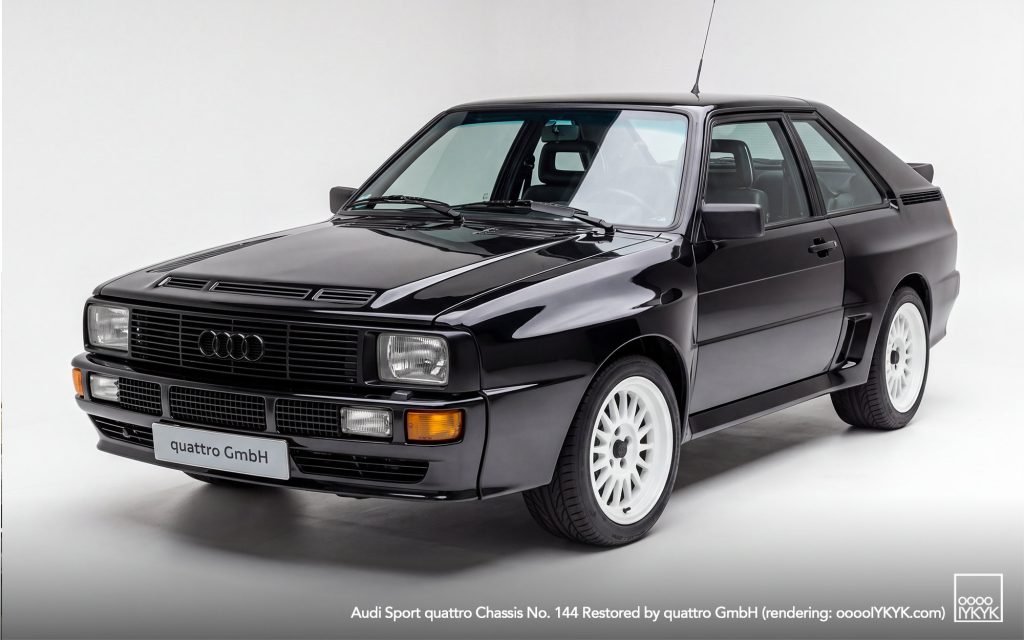
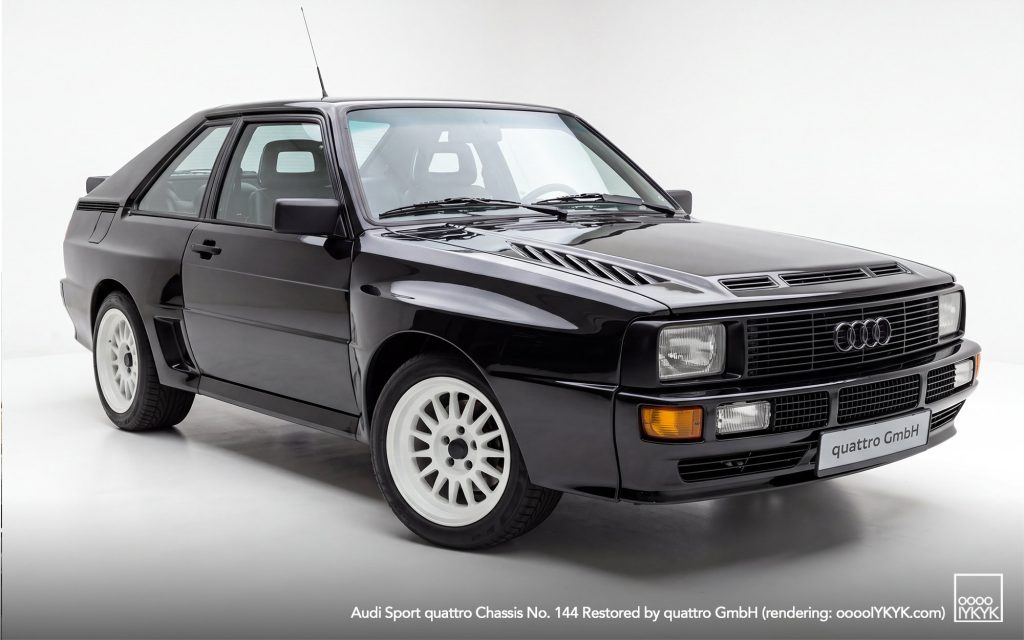
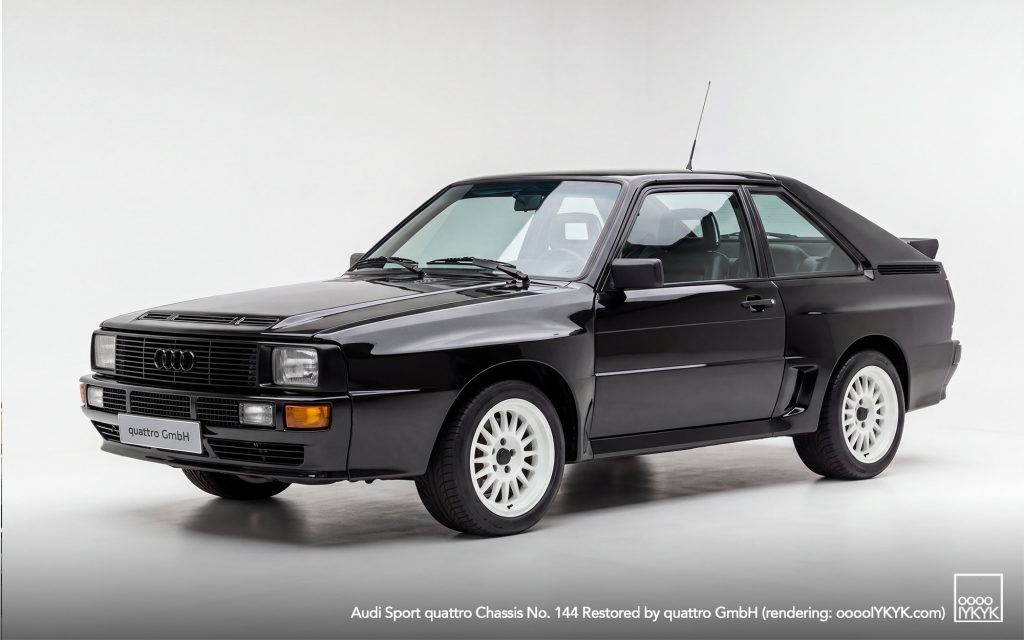
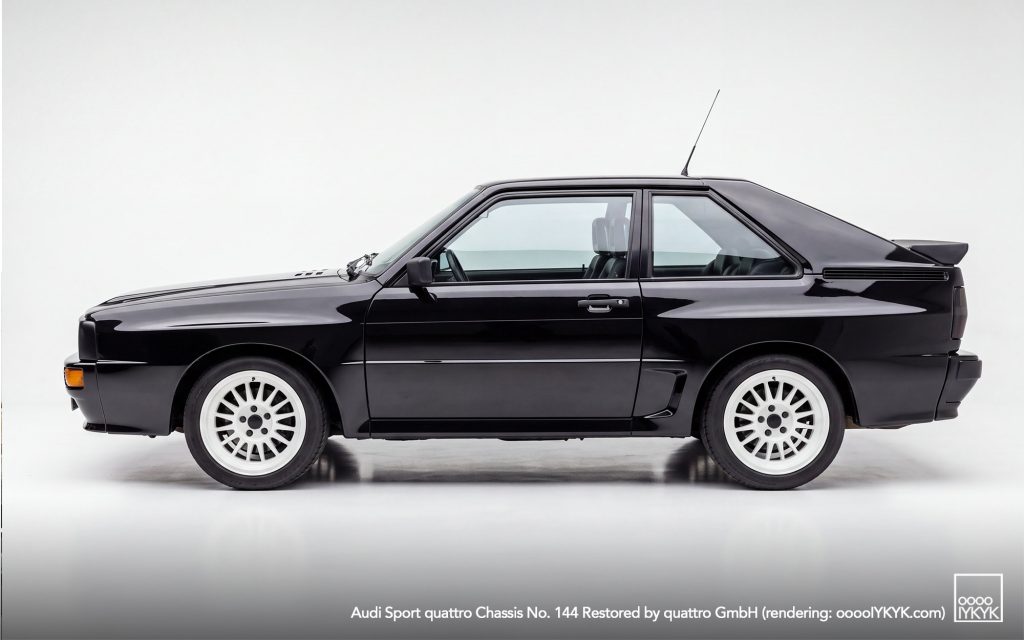
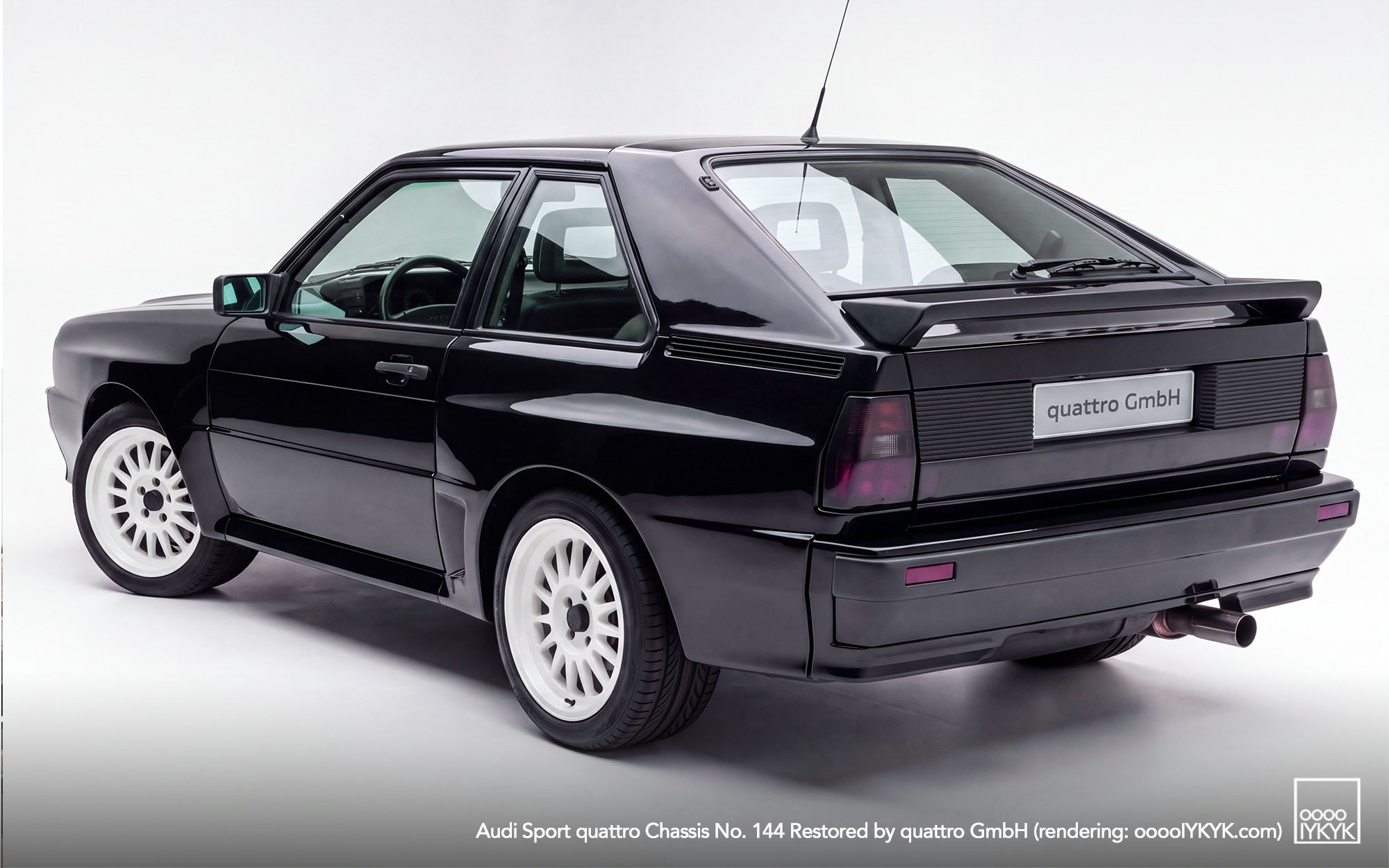
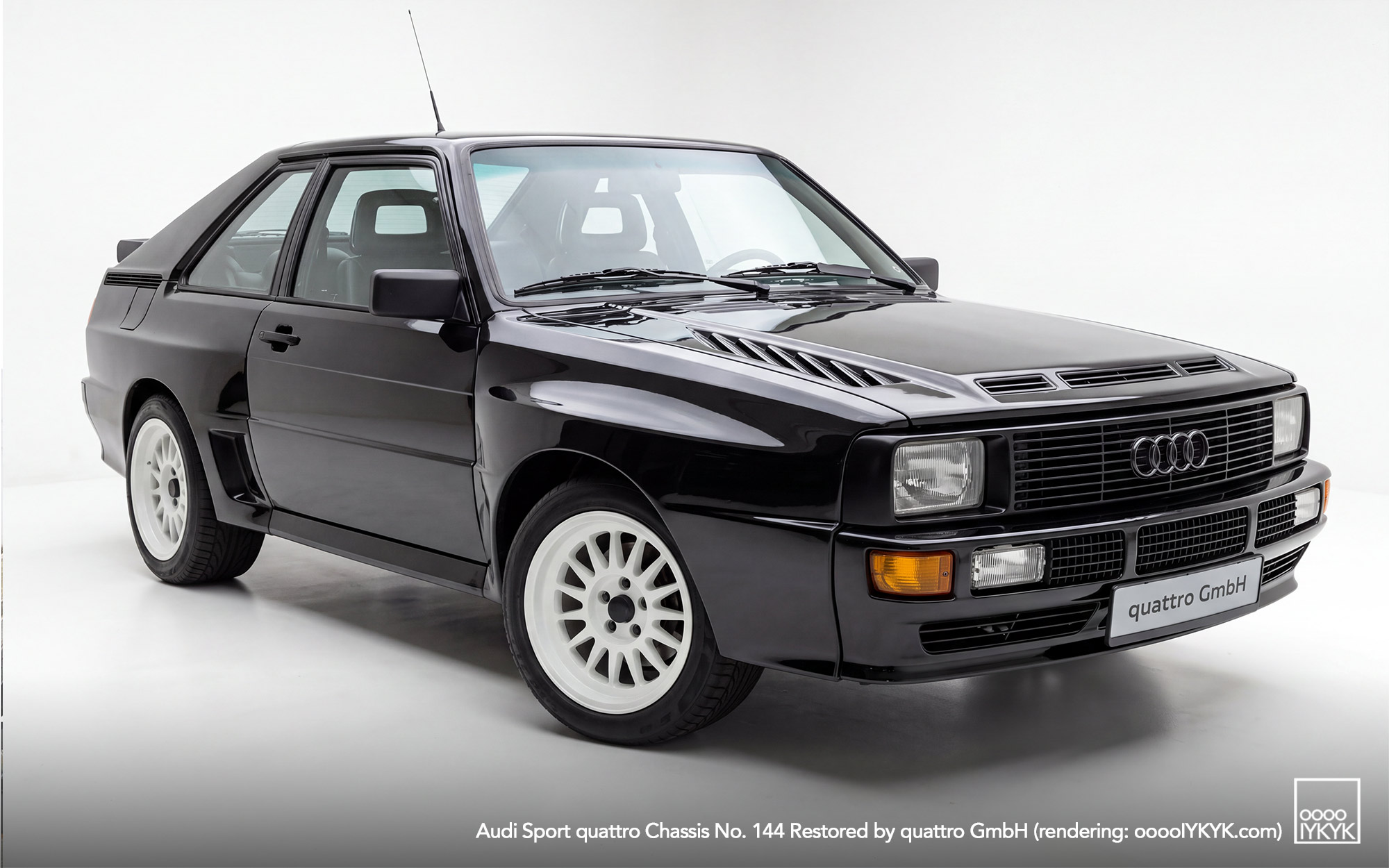
The body was repaired and refinished in black according to the client’s brief. Work covered the exterior and interior paint, sheet metal, fiberglass and carbon-fiber components, underbody and wheel arches.
Audi produced only two Sport quattros in black as part of the original production run. Those cars have long been associated with Ferdinand Piëch and Walter Röhrl. Chassis No. 144 was not one of those original black cars, but its quattro GmbH color change gave it a similar appearance.
Several functional changes distinguished the rebuilt car from a standard Sport quattro. A replacement hood incorporated additional ventilation louvers near the base of the windshield, while a roof-mounted antenna appears to have been added as part of the upgraded communications or audio equipment.
Additional driving lights were integrated into shortened cross-hatch grille sections using housings resembling those fitted to the original long-wheelbase quattro. The principal headlights were converted to H4 units with what the invoice described as “special rally internals.”
Body and paint work totaled DM 22,500, while the lighting conversion added DM 2,500.
INTERIOR
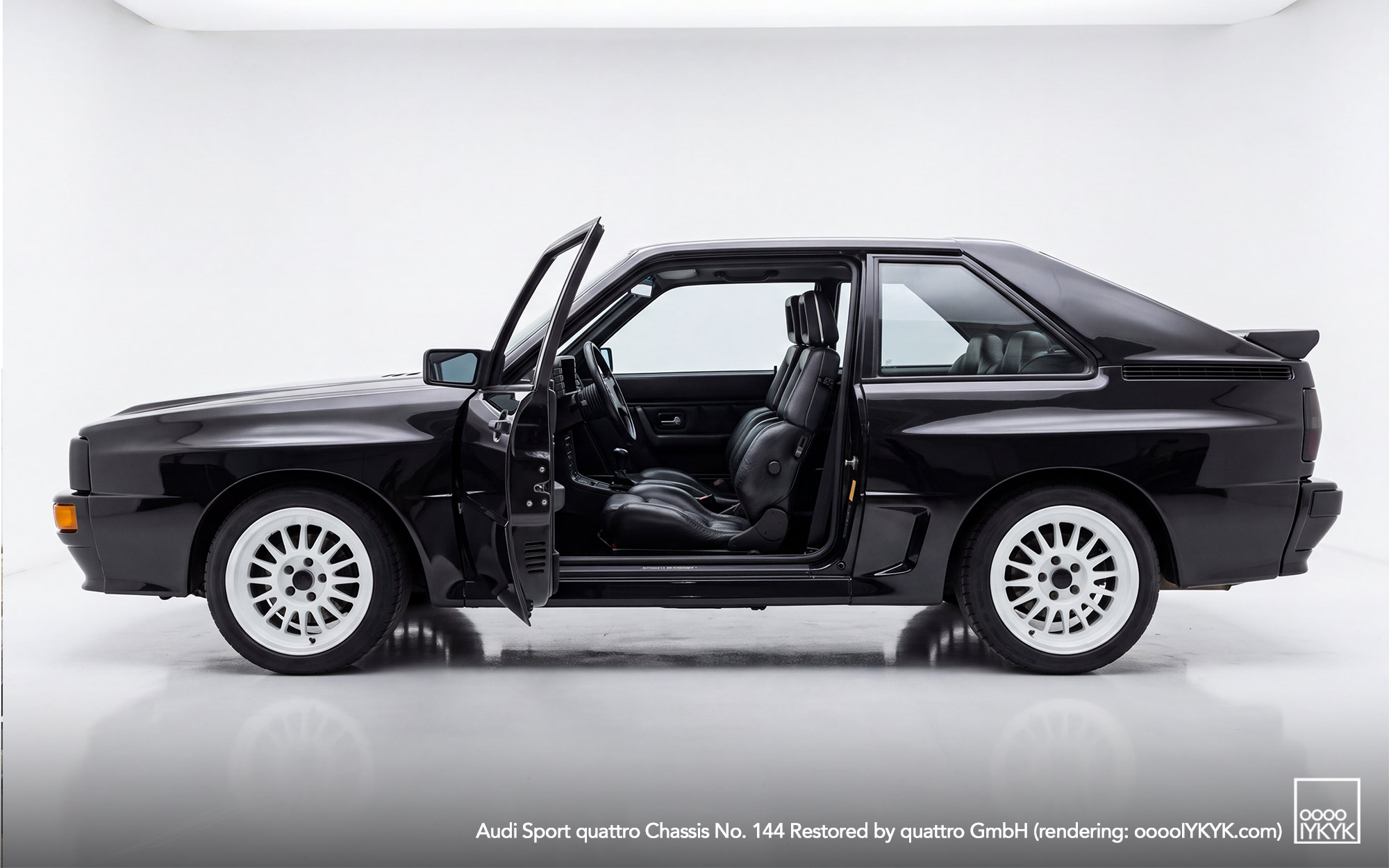
The original brown cabin was comprehensively rebuilt in black leather and Alcantara. quattro GmbH restored the original components, repaired underlying structures where necessary and optimized trim pieces to accept the new coverings.
The factory Recaro seats were retrimmed in black leather, while the diagonal upholstery pattern on the door panels was retained. The Sport quattro’s unique dashboard, including its three auxiliary instruments above the center console, was covered in stitched black leather.
The car also received Sabelt competition harnesses with homologated mounting points, an updated steering wheel and mobile-telephone equipment. Its original steering wheel was reportedly retained with the car.
An aftermarket-style silver radio head unit was visible when chassis No. 144 was advertised in 2011. The surviving invoice does not identify that particular unit, making it unclear whether it was fitted during the quattro GmbH reconstruction or added later.
The interior work accounted for DM 52,000 of the documented cost.
AIR CONDITIONING
quattro GmbH developed and adapted a manually controlled air-conditioning system for the car. The installation included a specialized cooling-unit compressor and associated cowling.
This was a substantial engineering project rather than the installation of a standard production-car system. It added DM 23,000 to the cost of the rebuild and likely reflected the climate in which the owner intended to use the car.
REPLACEMENT PARTS
The project required quattro GmbH to obtain new original parts where they remained available. When components could no longer be sourced or repaired, replacements were designed from original patterns and fabricated by hand.
This work was assigned a separate cost of DM 50,000 and demonstrates the extent to which the commission combined restoration with bespoke engineering.
TESTING AND HOMOLOGATION
The car underwent laboratory investigation, test-bench development and approximately 150 hours of workshop testing. The documented workshop and laboratory work cost DM 21,500.
A further DM 15,000 was allocated to regulatory testing and certification. The documentation lists approval work covering engine performance, exhaust emissions, noise, brakes, wheels and tires under the applicable European standards.
The car later received French individual-type approval on January 16, 2004. The approval identified it as an imported vehicle that did not conform to an established French type and recorded the commercial name as Audi Quattro, type 85KW2Q and chassis number WAUZZZ85ZEA905144.
SECOND CAR
According to information supplied to Fourtitude in 2011, the same client was sufficiently pleased with chassis No. 144 that he acquired another Sport quattro and commissioned quattro GmbH to duplicate the work.
That second car was subsequently rumored to have been destroyed. Its chassis identity, detailed specification and ultimate fate have not been publicly documented.
2011 SALE
Chassis No. 144 reappeared publicly in 2011 after being displayed at Techno-Classica Essen. Still carrying French registration and then located in Belgium, it was offered for €200,000.
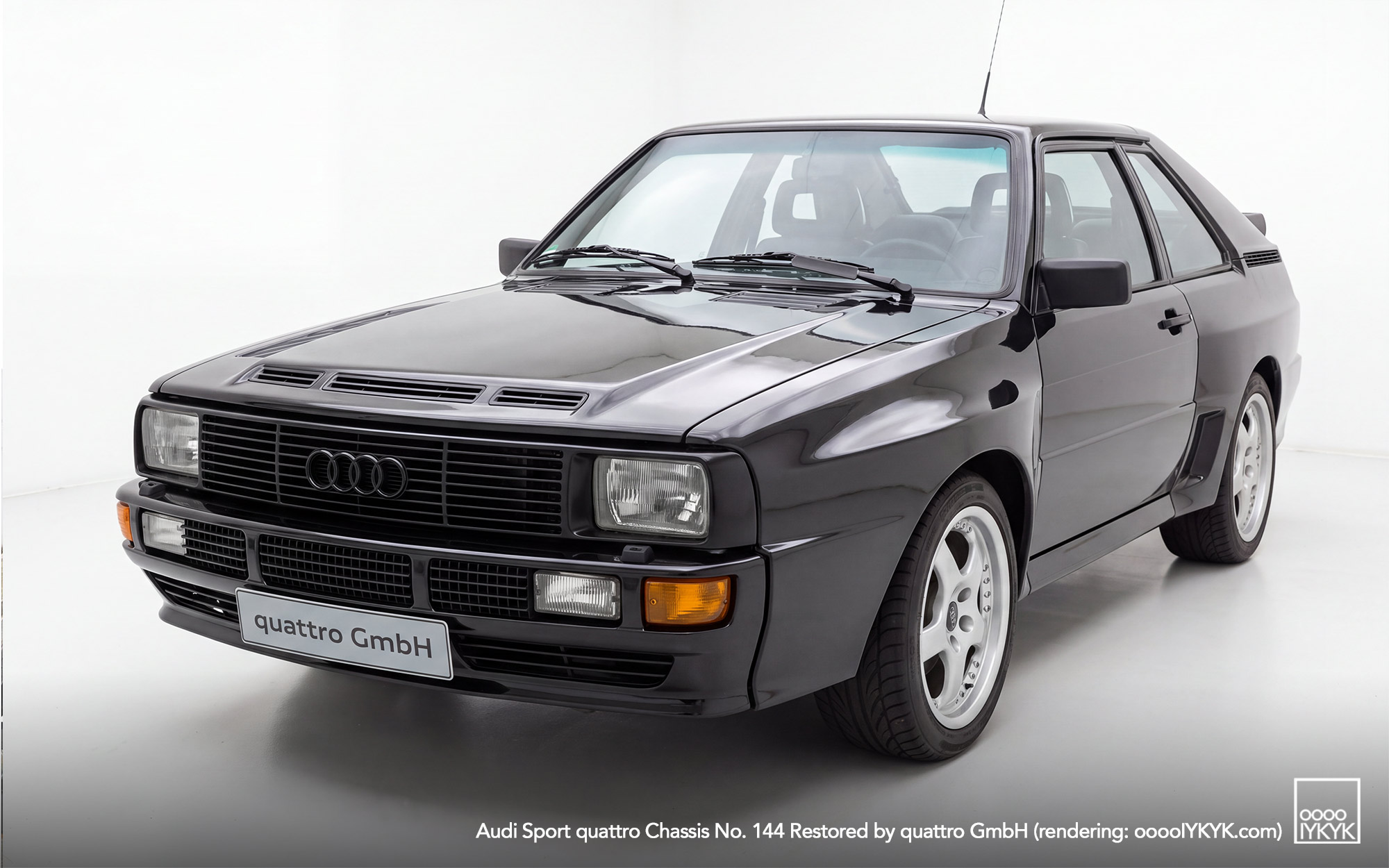
The advertisement described it as a “factory Evo 2,” emphasizing its quattro GmbH provenance and extensive mechanical upgrades. It was shown with modular five-spoke wheels, additional driving lights and an aftermarket-style audio head unit.
The sale also brought the original invoice, cost summary and French homologation paperwork into public view. Those documents confirmed the scale of the work and linked the modified car directly to quattro GmbH.
ARCHIVAL RENDERINGS
The associated archival renderings reconstruct chassis No. 144 following its quattro GmbH transformation rather than reproducing every later component visible in the 2011 advertisement.
The car is shown in black with its documented body changes, additional hood ventilation, roof antenna and integrated auxiliary lights. In the renderings it is fitted with 17-inch wheels using the original Sport quattro Ronal pattern. This reflects Reil’s description of the limited-production larger-diameter wheels developed to retain the appearance of the factory design.
Although the 2011 advertisement showed the car with aftermarket modular five-spoke wheels and a silver aftermarket-style radio head unit, neither specific design is identified in the surviving quattro GmbH invoice. They have therefore not been treated as definitive elements of the 2000 reconstruction.
DOCUMENTED MODIFICATION COSTS
| Area | Documented work | Cost |
|---|---|---|
| Engine | Rebuild, cast-iron block, new turbocharger, revised boost regulation, tailored power curve and modified exhaust | DM 55,000 |
| Steering | New and adapted steering box | DM 4,000 |
| Gearbox | New gearbox with installation adaptations | DM 15,000 |
| Air conditioning | Bespoke manual system, compressor and cowling | DM 23,000 |
| Front lighting | H4 units with special rally internals | DM 2,500 |
| Brakes | New calipers, pistons, discs, pads and ABS-compatible brake-force distribution | DM 18,000 |
| Running gear | Stiffened suspension, 17-inch wheel adaptation, tires and rims | DM 21,000 |
| Paint and body | Exterior and interior paint, composite and metal repair, underbody and wheel arches | DM 22,500 |
| Interior | Complete refit in leather and Alcantara with component restoration and repair | DM 52,000 |
| Replacement parts | Sourcing, recreating and hand-forming unavailable components | DM 50,000 |
| Homologation | Testing and certification for engine, exhaust, noise, brakes, wheels and tires | DM 15,000 |
| Workshop and testing | Laboratory investigation, test-bench running and 150 workshop hours | DM 21,500 |
| Additional work | Changes authorized after the client’s January 31, 2000 inspection | DM 75,000 |
| Total before VAT | DM 374,500 | |
| VAT | 16 percent | DM 59,920 |
| Invoice total | DM 434,420 / €222,115.42 |
SIGNIFICANCE
Sport quattro chassis No. 144 occupies an unusual position between Audi’s competition history, quattro GmbH’s bespoke work and the modern remaster movement.
It was not an Audi Sport competition prototype, a previously unknown Group B evolution or an official “Evo 2” production model. It was instead an extensively re-engineered road-going Sport quattro commissioned by a private client and executed by Audi’s own high-performance subsidiary.
The project anticipated the type of individualized engineering, restoration and component recreation now commonly associated with factory heritage programs and high-end remasters. Its documented quattro GmbH provenance makes it more than a modified Sport quattro and provides a rare view into a largely undocumented area of the subsidiary’s history.
As “Job 1,” it also represents an early expression of the bespoke capabilities that would later help define quattro GmbH and its successor, Audi Sport GmbH.
Interestingly, the car predates modern factory commissions of restorations as we see today at Porsche, Land Rover and other brands. Nevertheless, Audi’s own activities in this space remains exceptionally rare. This makes this particular Sport quattro both one-of-one and a highly unique demonstration of work not typically taken on by quattro GmbH.
PHOTO GALLERY