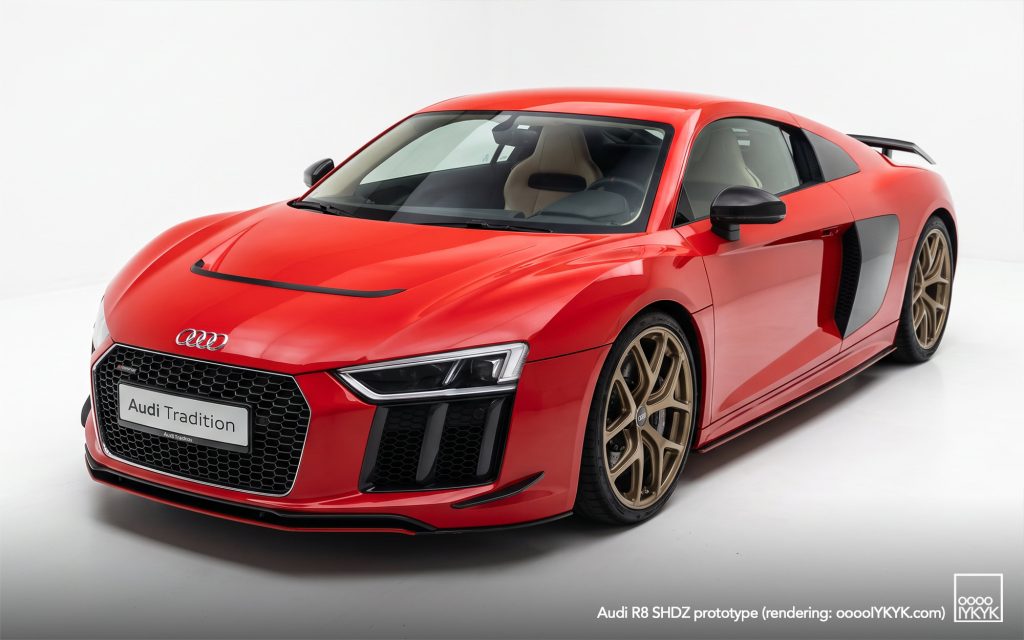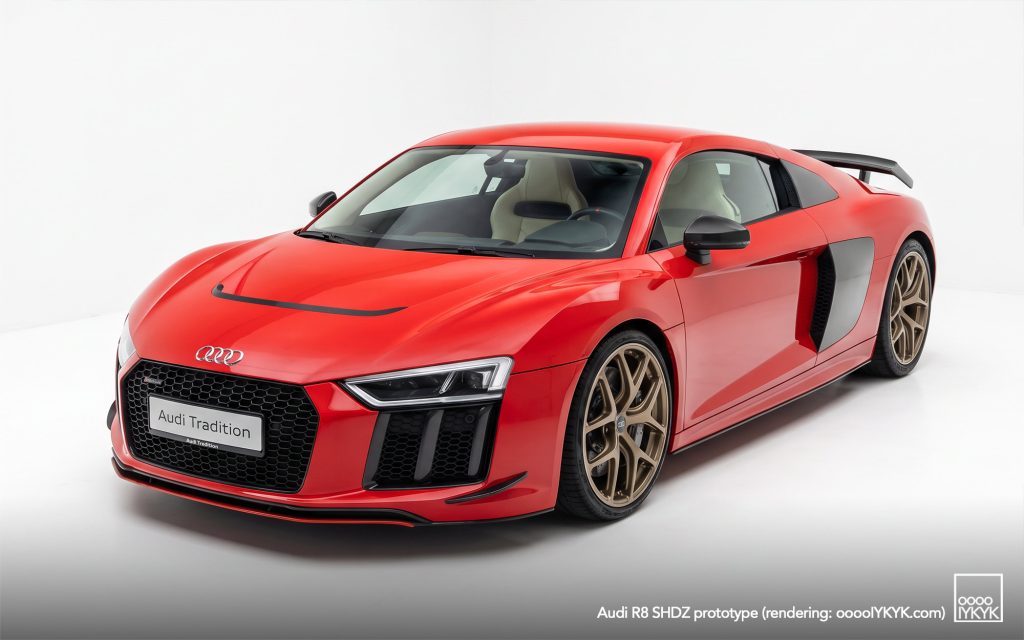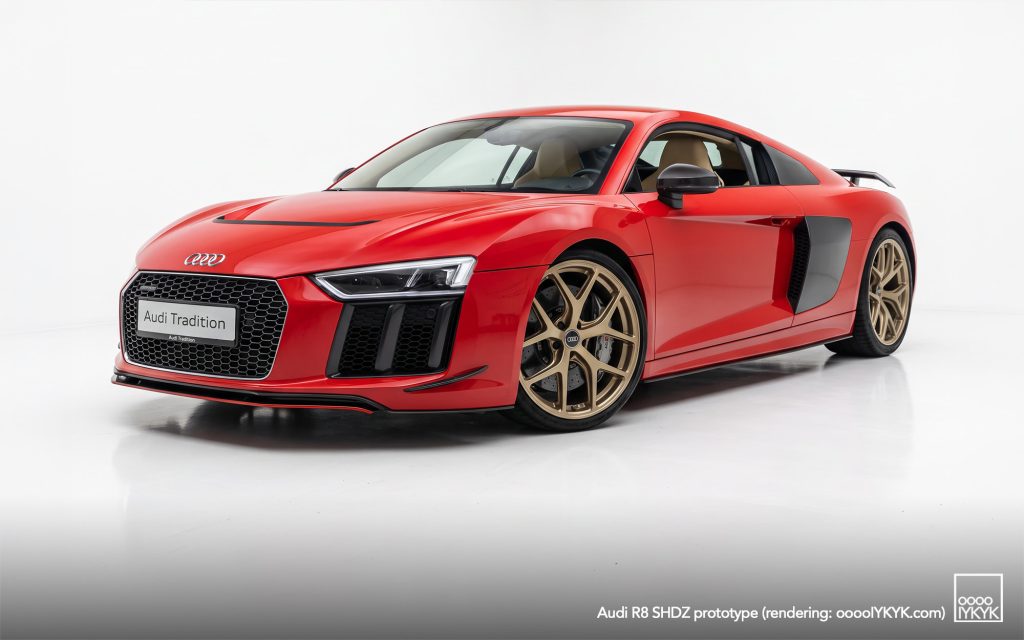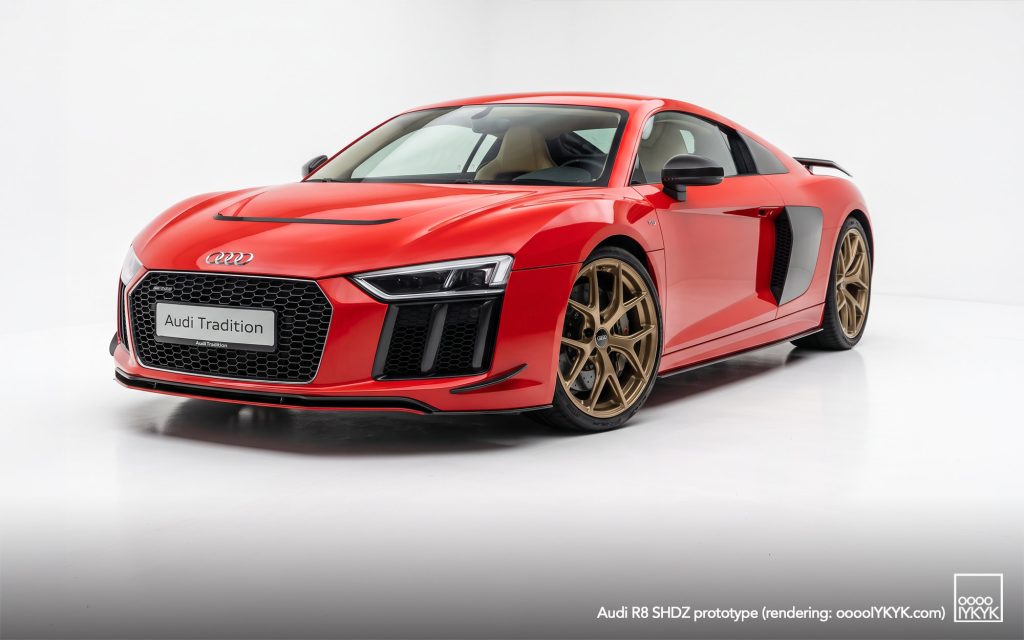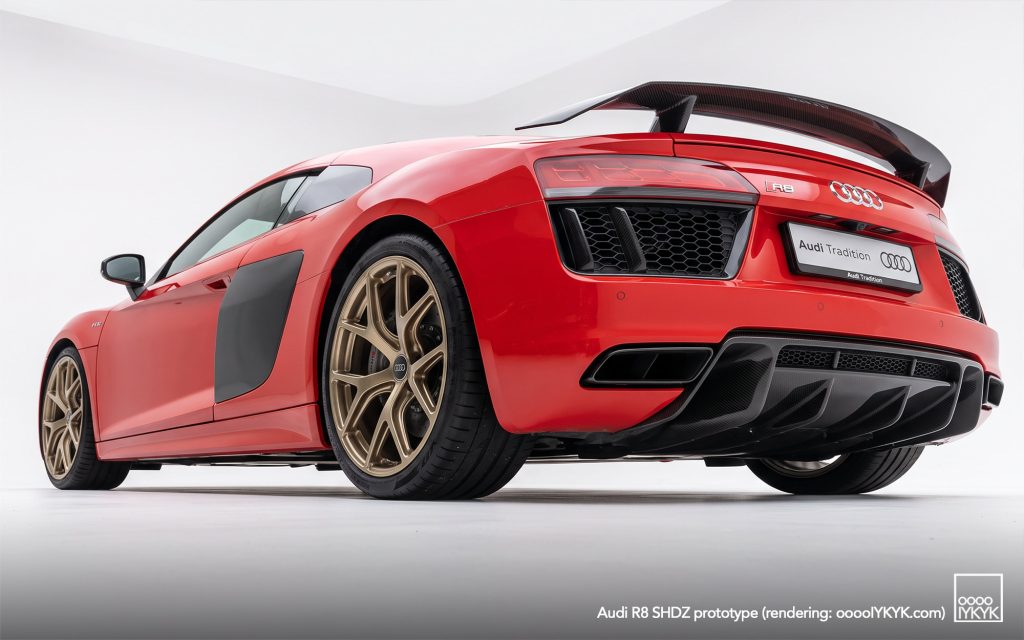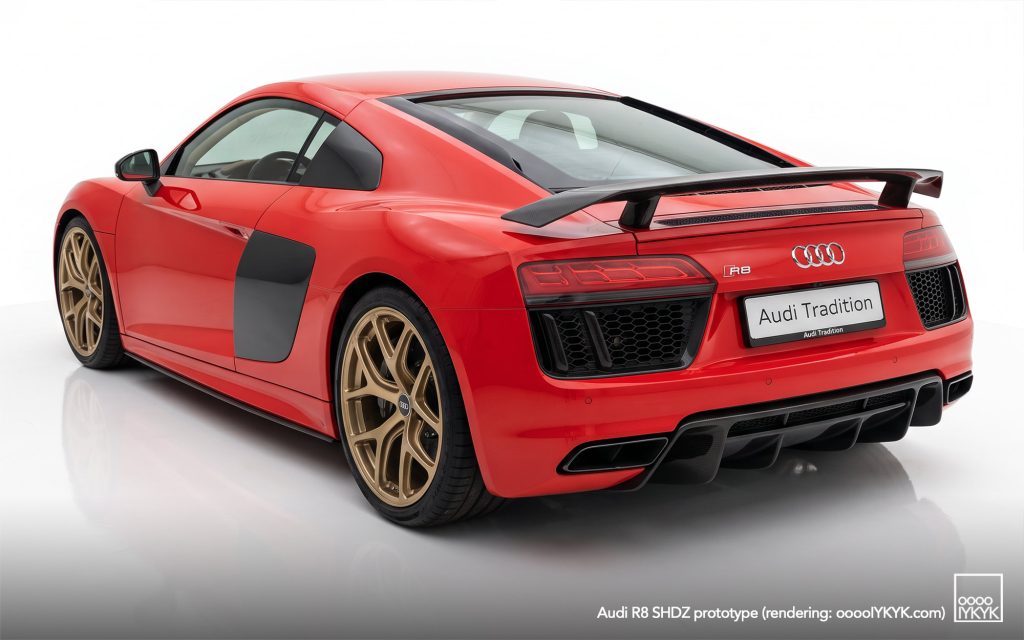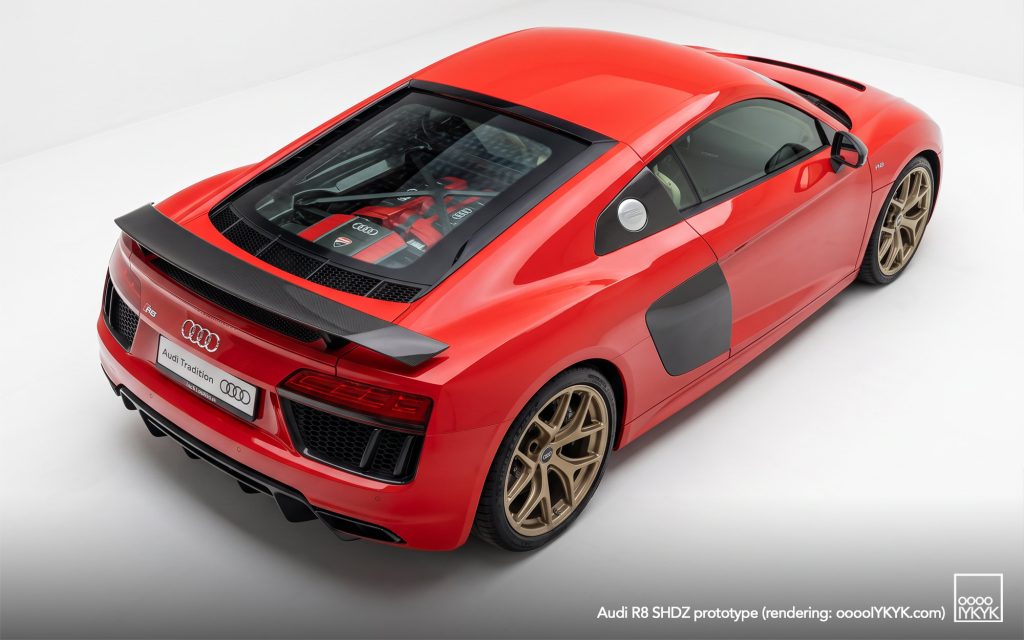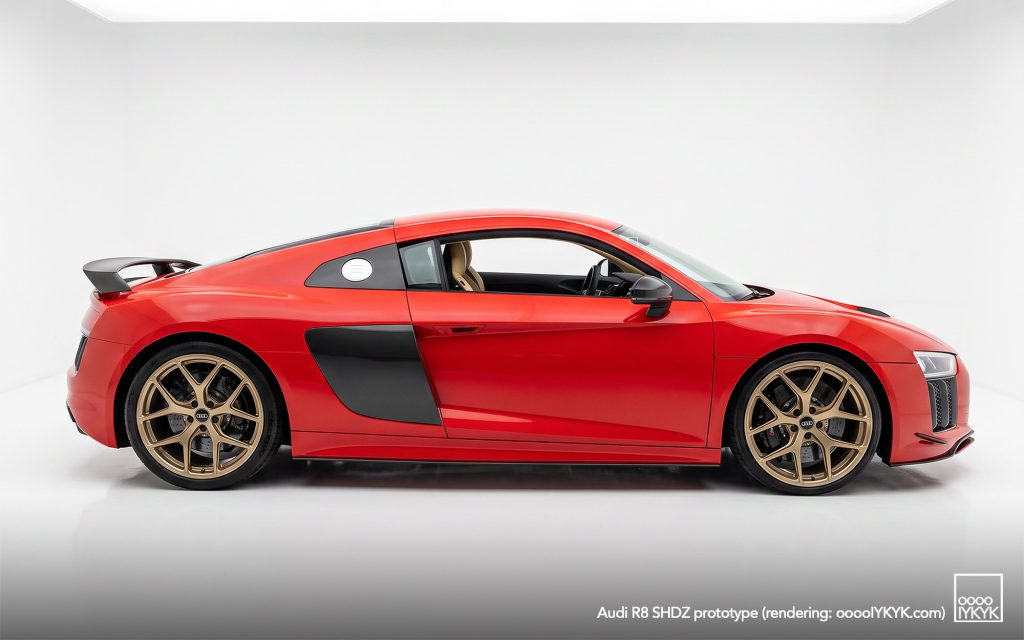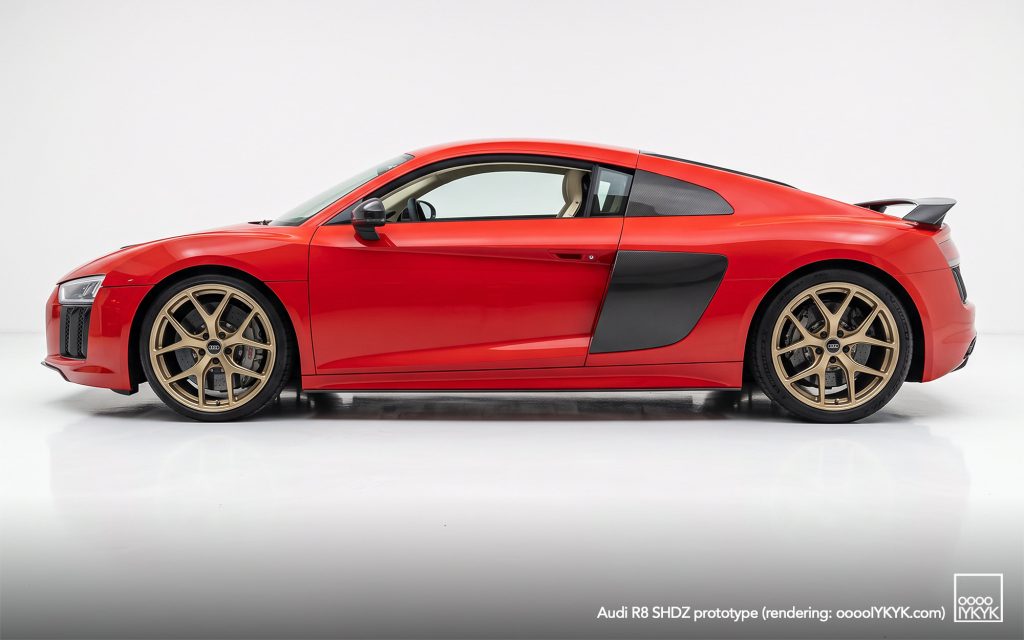

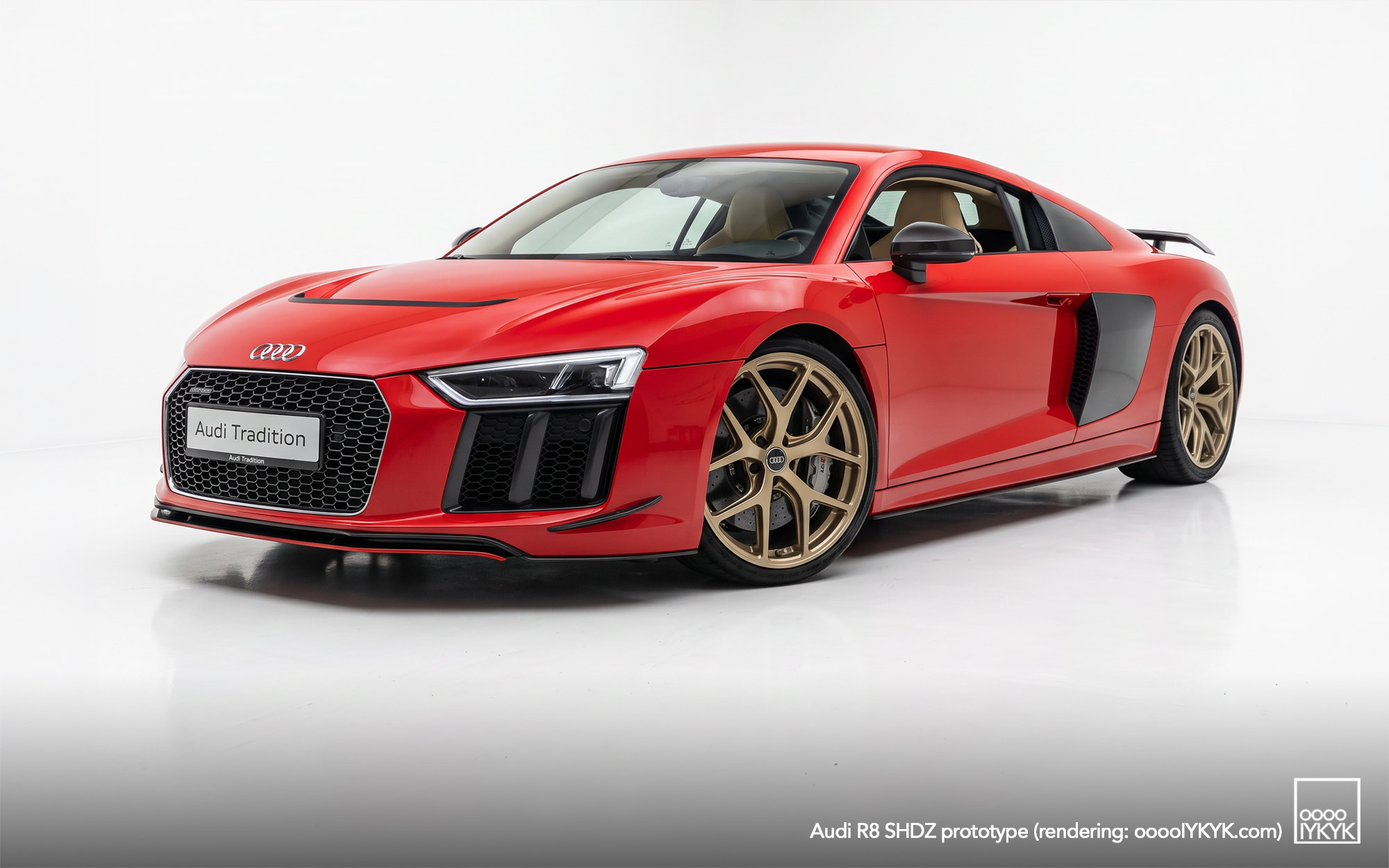

What: Audi R8 SHDZ Prototype
Model Family: R8
Model / Generation Code(s): type 4S
Chassis / Matrix: MSS
Production: Prototype (2014)
Assembly: Neuburg an der Donau, Germany (development vehicle)
Manufacturer: Audi AG / Audi Sport
Year: 2014
Debuted: N/A
Number Produced: unknown
Status: Believed to Be Maintained by Audi Tradition
Configuration: Mid-engine, quattro all-wheel drive
Body: Audi R8 with carbon fiber and aluminum components
Engine: Naturally aspirated 90-degree V8 with desmodromic valve control
Engine Type: Ducati Testastretta-derived desmodromic technology
Displacement: 4,793.6 cc
Power: 515 kW (700 hp) at 10,500 rpm
Torque: 580 Nm (428 lb-ft) at 6,750 rpm
Transmission: 7-speed tiptronic
Drivetrain: Permanent quattro all-wheel drive
0–100 km/h: 2.8 seconds
0–200 km/h: 8.75 seconds
Exterior Color: Dynamite Red
Status: Experimental prototype
OVERVIEW
The Audi R8 SHDZ was an experimental 2014 development project intended to explore the idea of a road-legal race car based on the first-generation Audi R8.
At the heart of the project was an entirely new naturally aspirated V8 designed to produce 515 kW (700 hp) at an extraordinary 10,500 rpm. Rather than developing the engine exclusively around existing Audi automotive technology, engineers looked elsewhere within the Volkswagen Group for inspiration: Ducati.
Key design parameters and components were based on the Ducati 1196R and its Testastretta engine, most notably its use of desmodromic valve control. The resulting 4.8-liter V8 was intended to combine Audi Sport engineering with concepts developed for one of Ducati’s highest-performance motorcycle engines.
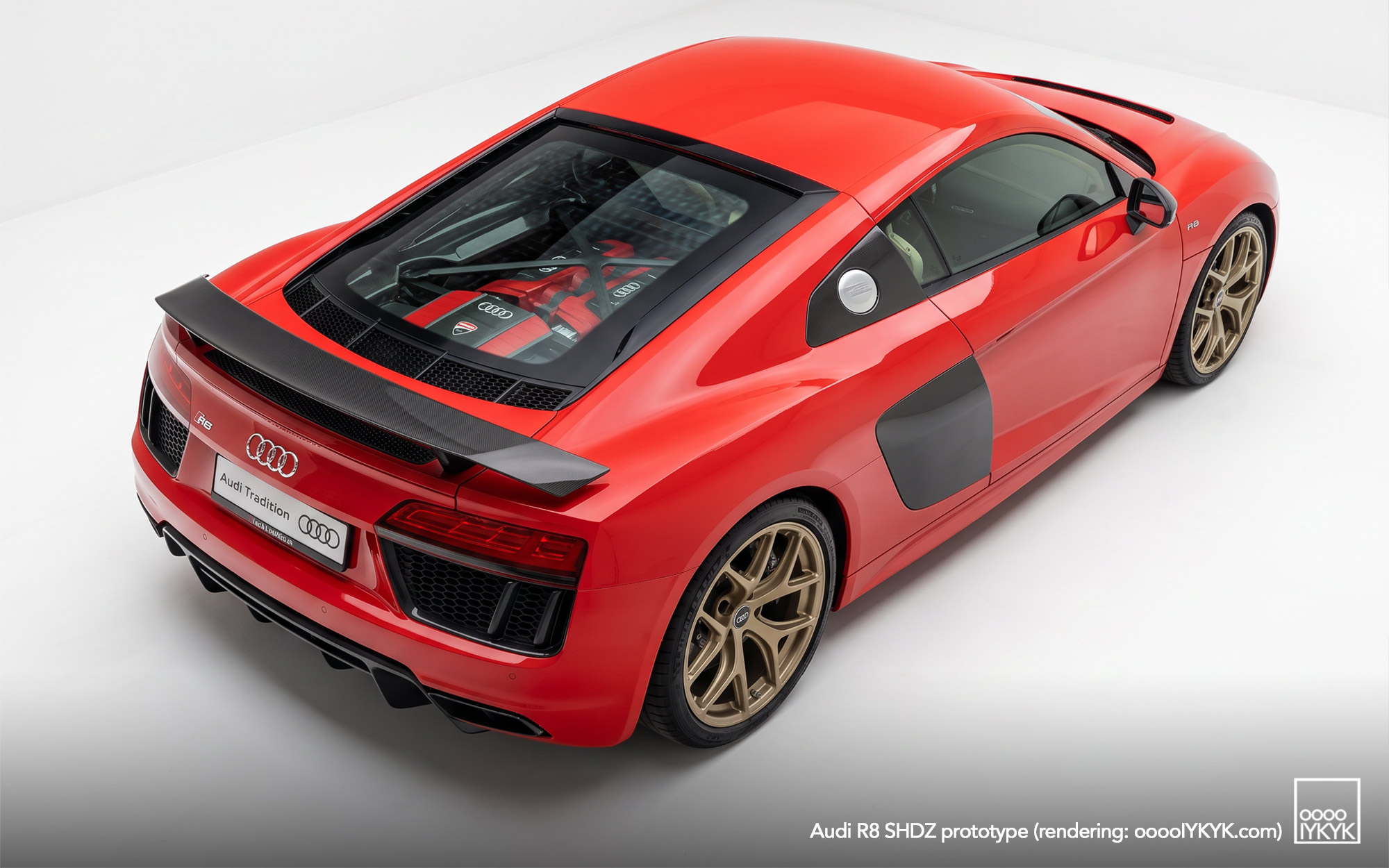
DESMODROMIC V8
SHDZ stands for Desmodromische Ventilsteuerung, or desmodromic valve control, the defining feature of the prototype’s engine.
Unlike a conventional valvetrain in which camshafts mechanically open the valves and springs close them, a desmodromic system mechanically controls both opening and closing. The technology has been particularly associated with Ducati and allows precise valve control at extremely high engine speeds.
Audi’s planned 90-degree V8 displaced 4,793.6 cc and employed an extremely short-stroke architecture with a large cylinder bore. Four desmodromically controlled valves were fitted per cylinder and operated by two variable overhead camshafts.
The result was a targeted 700 hp at 10,500 rpm, with maximum torque of 580 Nm arriving at 6,750 rpm.
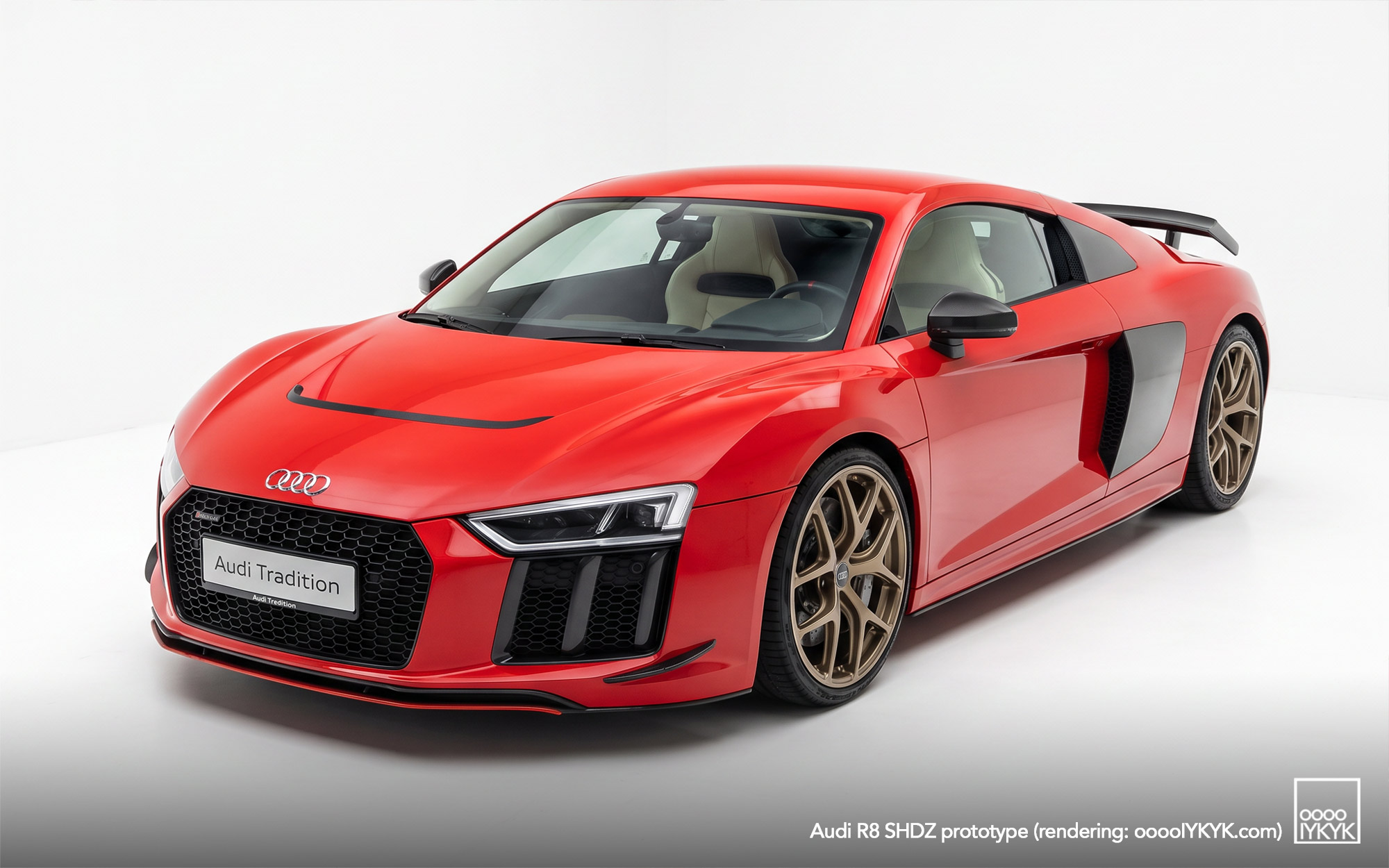
DUCATI CONNECTION
The SHDZ represents a particularly unusual piece of engineering cross-pollination between Audi and Ducati following Audi’s acquisition of the Italian motorcycle manufacturer in 2012.
Audi engineers based key design parameters for the experimental V8 on components from the Ducati 1196R. Rather than simply installing or combining existing motorcycle engines, however, Audi developed an entirely new 90-degree V8 incorporating Ducati-derived desmodromic concepts into an automotive powerplant.
A gear cascade positioned at the rear of the engine drove the camshafts, while a continuous PTO shaft powered ancillary components mounted at the front.
Other features included dry-sump lubrication, variable intake manifolds and a bespoke firing order developed by Audi Sport.
The result was effectively an Audi-designed, Ducati-influenced 4.8-liter V8 capable of operating at an engine speed more commonly associated with motorcycles and racing engines than road-going V8s.
R8 DEVELOPMENT
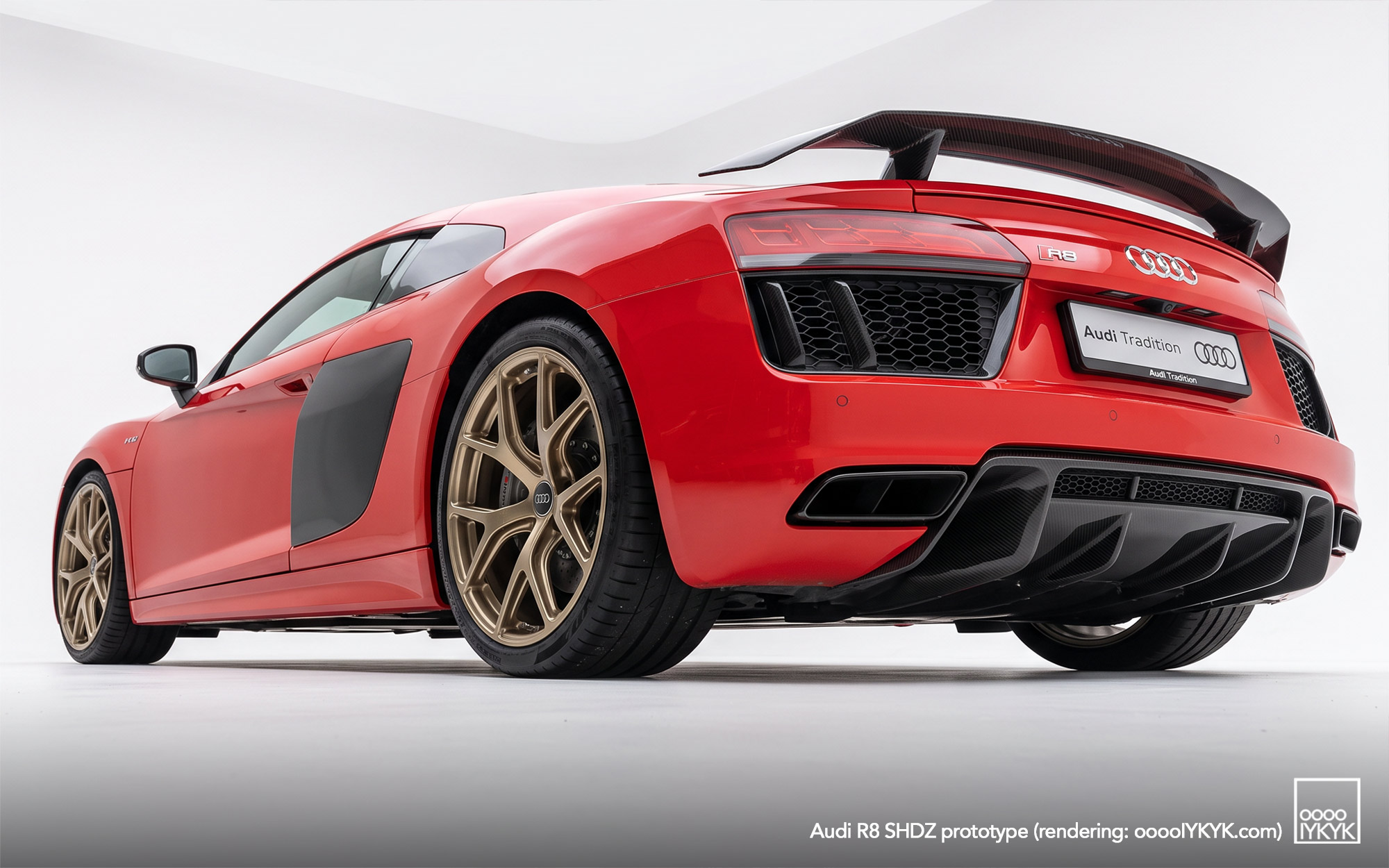
The engine was only one component of the SHDZ program. Audi modified the R8 extensively around the concept of creating a road-legal race car.
Air filters, the cooling system, exhaust manifold and catalytic-converter modules and the complete exhaust system were adapted specifically for the new engine.
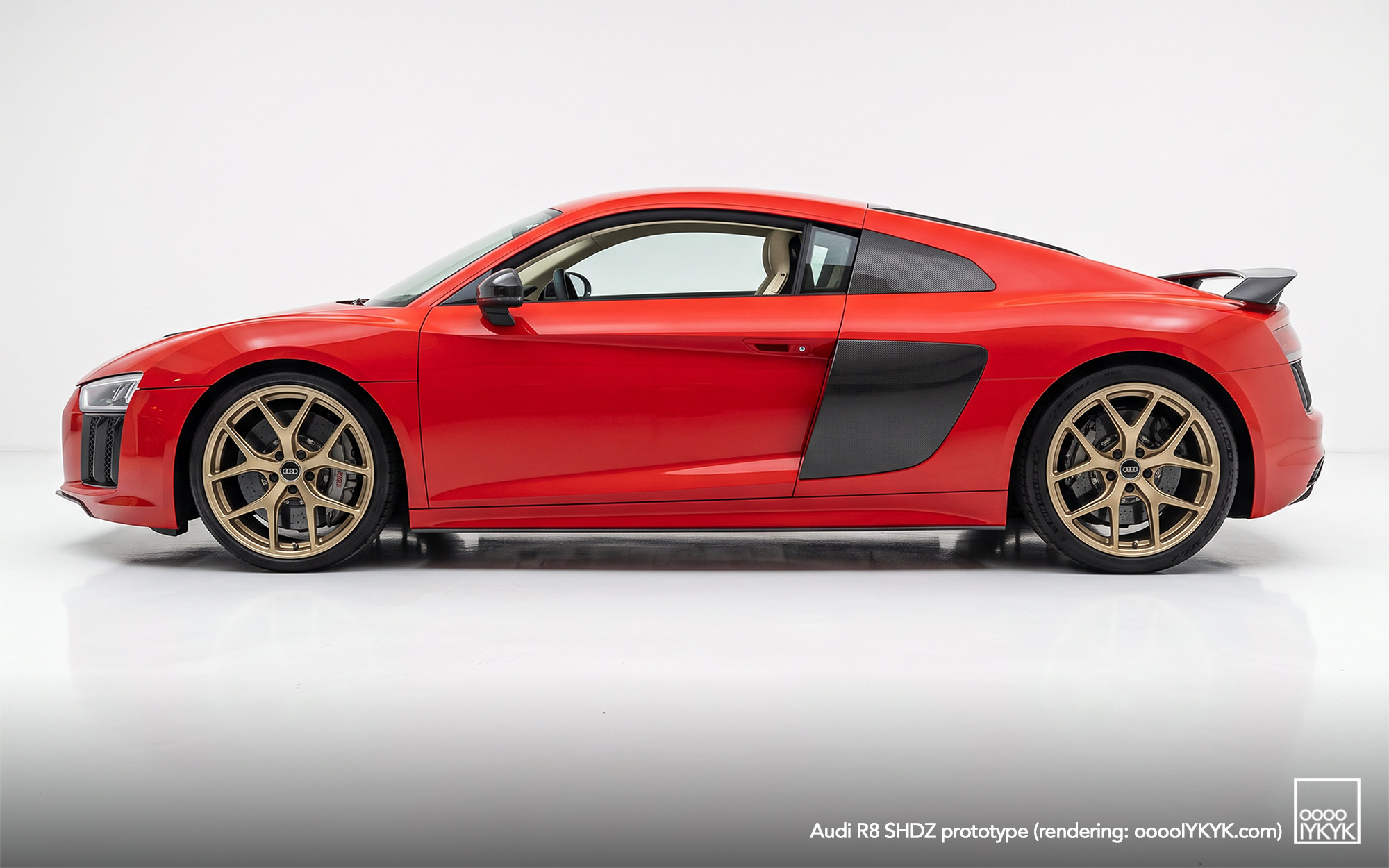
The Dynamite Red bodywork incorporated carbon fiber and aluminum components, while revised spoilers, front splitter elements and diffusers addressed the aerodynamic requirements of the higher-performance specification.
Audi also altered the final-drive ratio and pursued significant reductions in unsprung mass through specially developed magnesium wheels.
The front wheels weighed just 6.5 kg (14.3 lb) each. Despite measuring 20 inches, the rear wheels weighed between just 7.7 and 7.9 kg (17.0–17.4 lb), depending on design.
PERFORMANCE
Audi targeted performance well beyond that of the contemporary production R8.
The 4.8-liter V8 was specified at 700 hp at 10,500 rpm and 580 Nm at 6,750 rpm. Power was transmitted through a seven-speed tiptronic transmission and permanent quattro all-wheel drive.
Audi projected acceleration from 0–100 km/h (62 mph) in 2.8 seconds, while 200 km/h (124 mph) would arrive in just 8.75 seconds.
The combination is particularly notable because Audi wasn’t relying on turbocharging or hybrid assistance to achieve those figures. Instead, the SHDZ concept pursued power through displacement, airflow and exceptionally high engine speed.
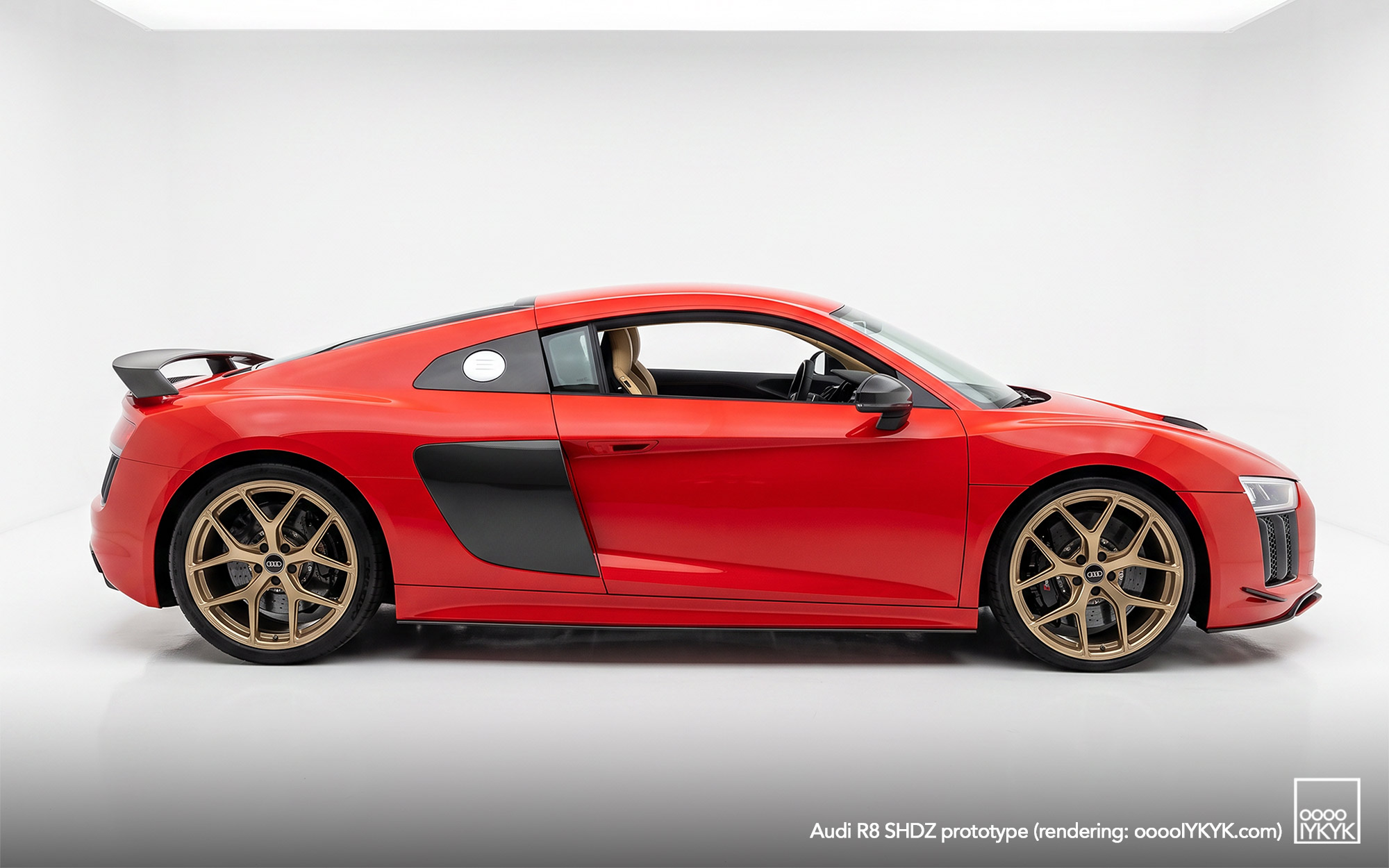
SHARED DNA
The R8 SHDZ represents one of the more unusual engineering connections within the Volkswagen Group.
Audi acquired Ducati through Lamborghini in 2012, placing the Italian motorcycle manufacturer within Audi’s corporate structure. Just two years later, the SHDZ project explored how one of Ducati’s defining technologies might be translated from a high-performance motorcycle engine into an Audi road-car application.
Ducati’s influence was fundamental to the engine concept, but the resulting V8 was not simply a pair of motorcycle engines joined together. Audi Sport developed a purpose-built 4.8-liter automotive V8 around the desmodromic principle, adding its own firing order, intake system, lubrication architecture and supporting systems.
It represents an intriguing reversal of the more familiar Shared DNA formula. Rather than Audi technology finding its way into another manufacturer’s vehicle, technology from another Audi Group marque was being used to explore what an extreme Audi R8 might become.
KNOWN HISTORY
2012 – Audi acquires Ducati through Lamborghini, bringing the Italian motorcycle manufacturer into the Audi Group.
2014 – Audi develops the R8 SHDZ as an experimental road-legal race-car concept based around an entirely new high-revving V8.
2014 – Key engine design parameters are derived from components used by the Ducati 1196R, with Audi developing a 4,793.6 cc 90-degree V8 employing four desmodromically controlled valves per cylinder.
2014 – The experimental engine targets 515 kW (700 hp) at 10,500 rpm and 580 Nm at 6,750 rpm. Projected performance includes 0–100 km/h in 2.8 seconds and 0–200 km/h in 8.75 seconds.
Development Program – The R8 receives modified cooling, intake and exhaust systems, revised aerodynamics, a different final-drive ratio and exceptionally lightweight magnesium wheels as part of the SHDZ development.
Production – The R8 SHDZ remains an experimental prototype and does not progress to series production. Some rumors suggest this is just a drivetrain prototype and that the setup was intended for a limited-run exclusive sportscar based on the R8 that was proposed and even had design finalized, though never made it into production.
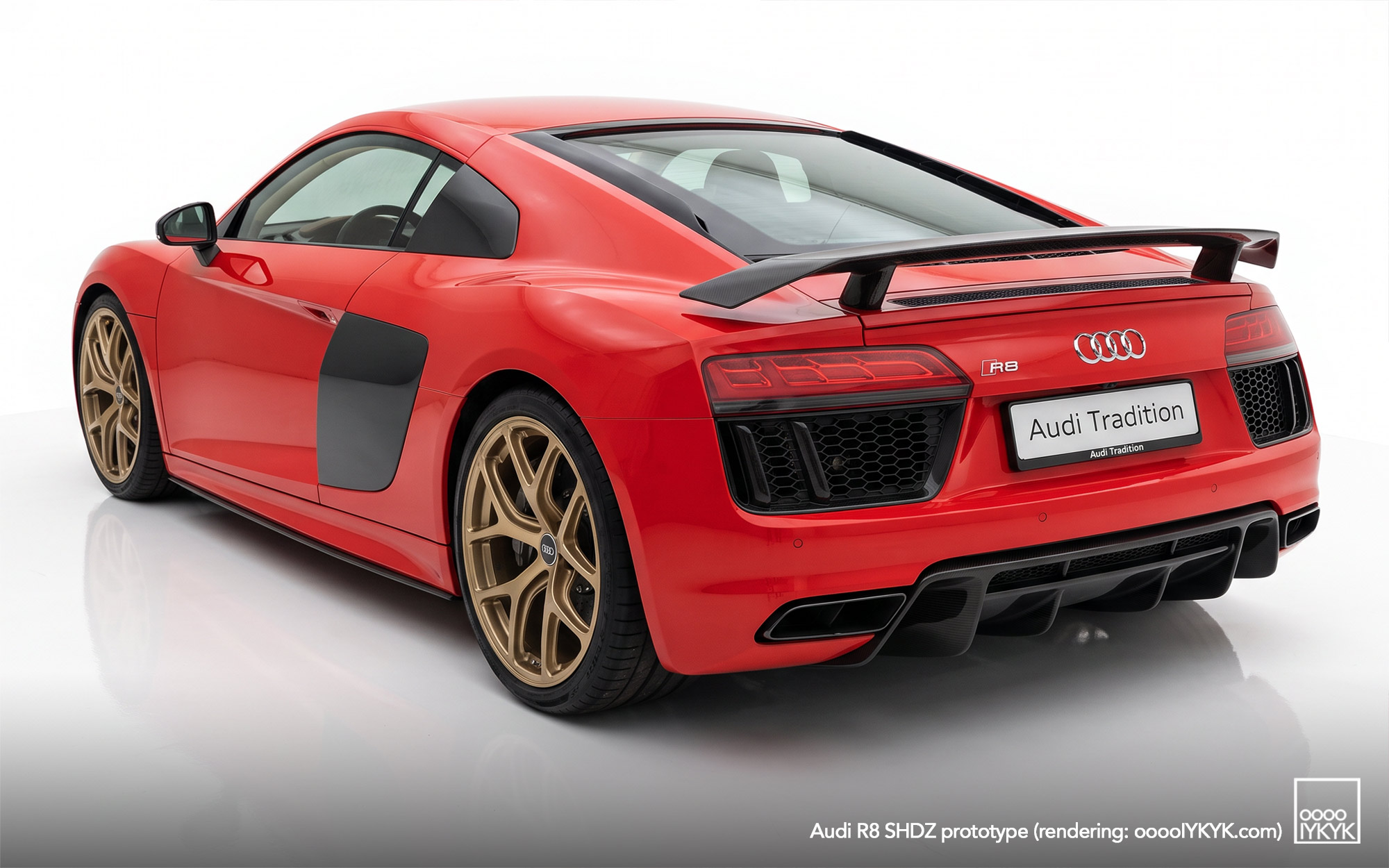
SIGNIFICANCE
The Audi R8 SHDZ offers a glimpse at an entirely different direction Audi could have taken with its mid-engine flagship.
Instead of turbocharging, electrification or simply extracting more performance from the production R8’s existing engine architecture, Audi Sport explored an exceptionally high-revving naturally aspirated V8 incorporating one of Ducati’s most distinctive engineering technologies.
The numbers remain remarkable even more than a decade later: 4.8 liters, 700 hp and a 10,500-rpm power peak, connected to quattro all-wheel drive in what Audi envisioned as a road-legal race car.
It is also an important artifact from the early years of Audi’s ownership of Ducati. The SHDZ wasn’t simply an R8 with Ducati branding or a conceptual exercise in corporate synergy. Engineers actually attempted to translate Ducati’s desmodromic valvetrain philosophy into an entirely new Audi V8.
Ultimately, Audi decided not to proceed with the project. Further rumors suggest the lack of low-end torque played a part in the decision-making in this case. Other R8 test mules featuring turbocharged V6 and even I5 configurations were also rejected for the same reason. That this car exists though at such a refined level of development – a bespoke engine rather than another unit already in production fitted to the R8 suggests the SHDZ drivetrain and the car meant to go with it were considerably far along in process by the time the decision not to produce was finalized.
Had it reached production, the R8 SHDZ would have been one of the most unusual engines ever fitted to a road-going Audi. Instead, it remains a fascinating technical dead end — and one of the most extreme R8 prototypes Audi ever developed.
PHOTO GALLERY