
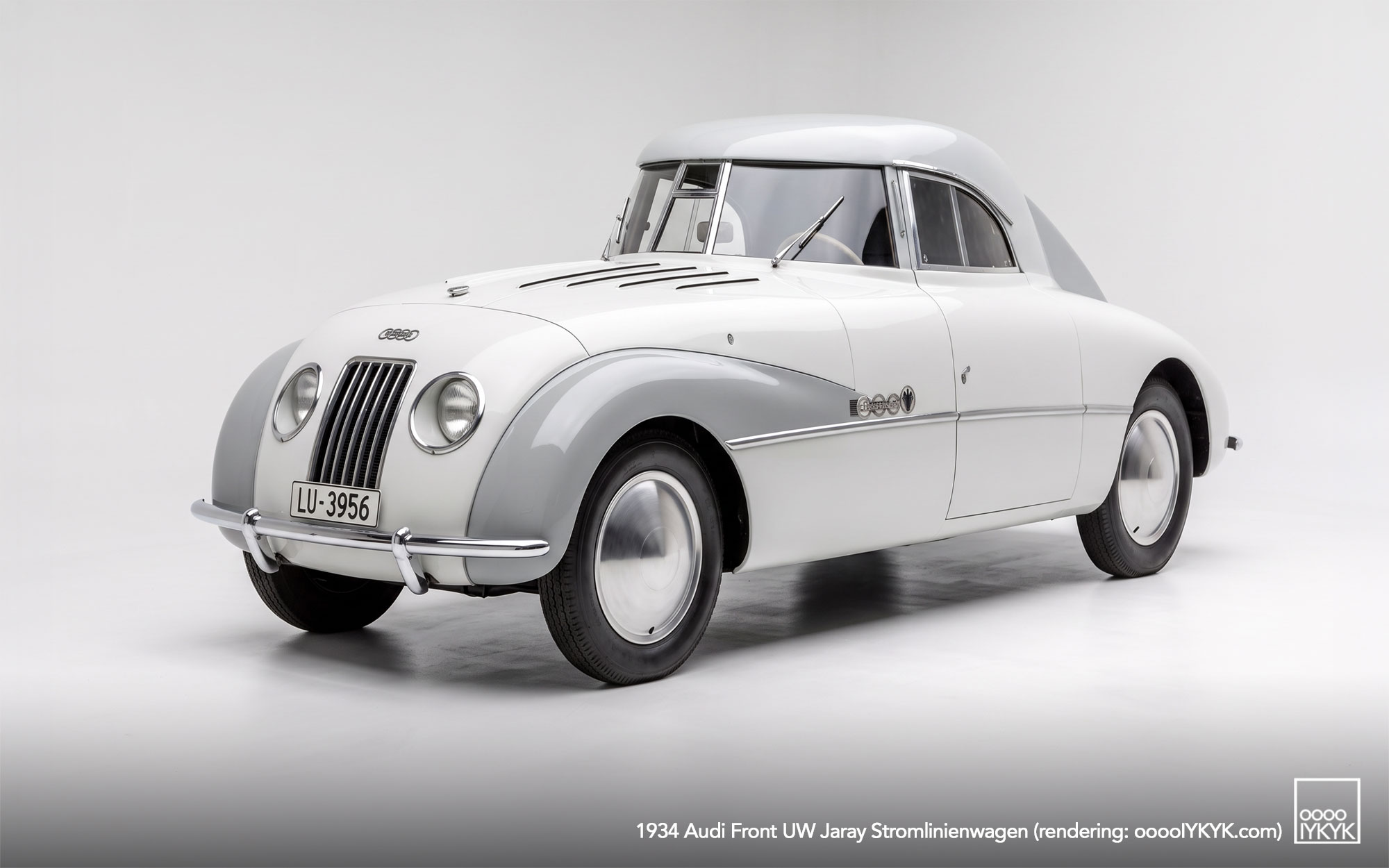

Model: Audi Front UW Jaray Stromlinienwagen
Year: 1934
Type: Aerodynamic experimental vehicle
Designer: Paul Jaray
Chassis: Audi Front UW 8/40 PS
Body: Huber & Brühwiler, Lucerne, Switzerland
Construction: Aluminum body over supporting wood structure
Engine: 1,950 cc inline six-cylinder
Power: 40 PS
Drivetrain: Front-wheel drive
Introduction: 1934 Geneva Motor Show, March 16–25
Registration: LU 3956
Status: Original vehicle no longer extant
BACKGROUND
More than a decade after Paul Jaray applied his aerodynamic principles to an early Audi chassis, he returned to the marque with a considerably more sophisticated streamlined automobile based on the Audi Front Type UW.
The underlying Audi was itself significant. Introduced in 1933, the Front UW combined a six-cylinder engine with front-wheel drive and a comparatively low chassis layout. For Jaray, newer low-slung chassis of this type offered a much better foundation for aerodynamic bodywork than the tall automobile architecture upon which his experiments of the early 1920s had been based.
At the end of 1933, Jaray’s AG für Verkehrspatente (AVP), the company established to develop and commercialize his aerodynamic patents, acquired an Audi Front chassis. Jaray used it as the basis for a new two-seat streamlined coupé intended to demonstrate how far his aerodynamic ideas had progressed.
Unlike the related 1923 Audi Jaray, the Front UW was therefore developed more than a decade into Jaray’s work on streamlined automobiles and combined his evolving aerodynamic principles with a substantially more modern chassis.
DESIGN AND CONSTRUCTION
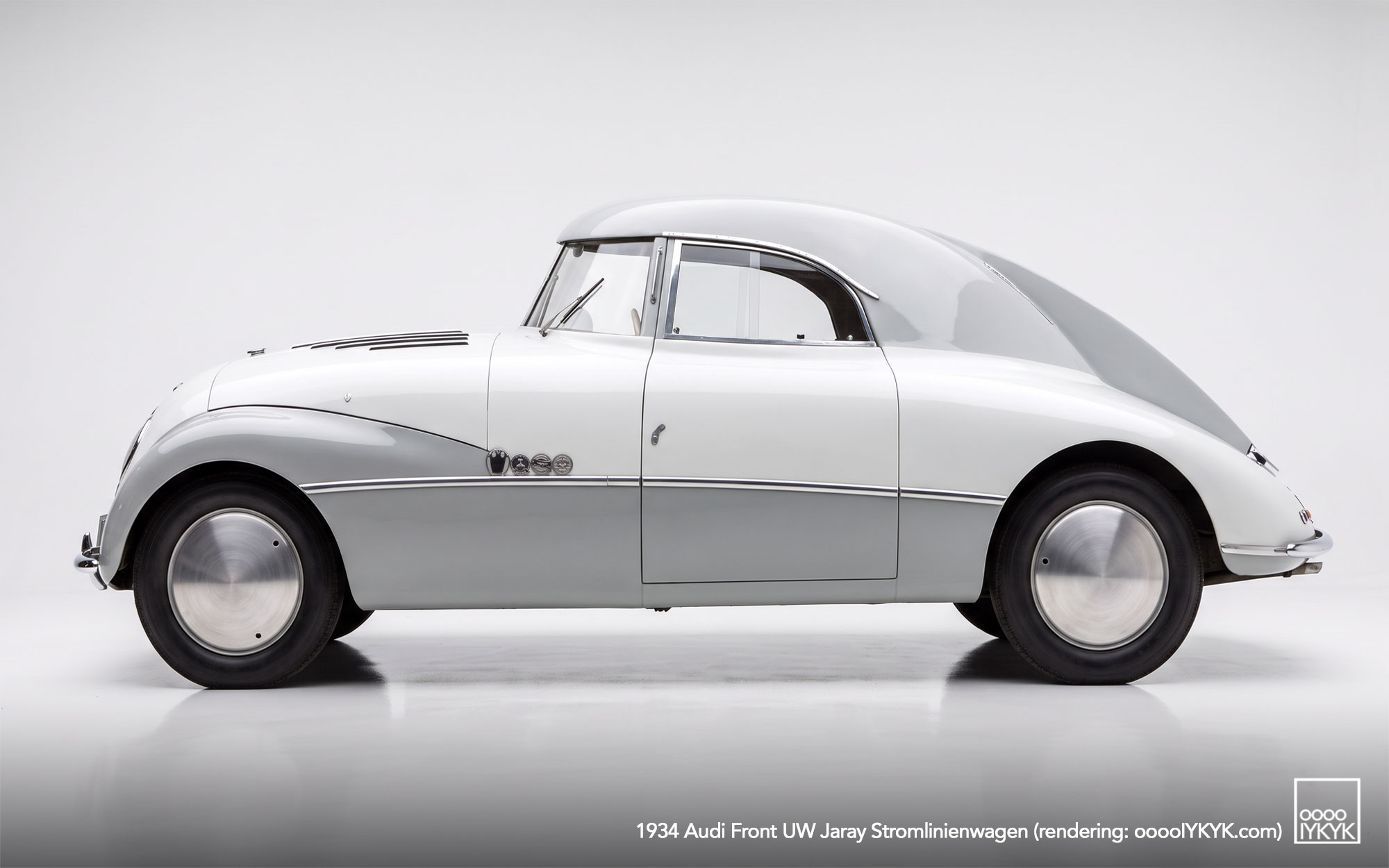
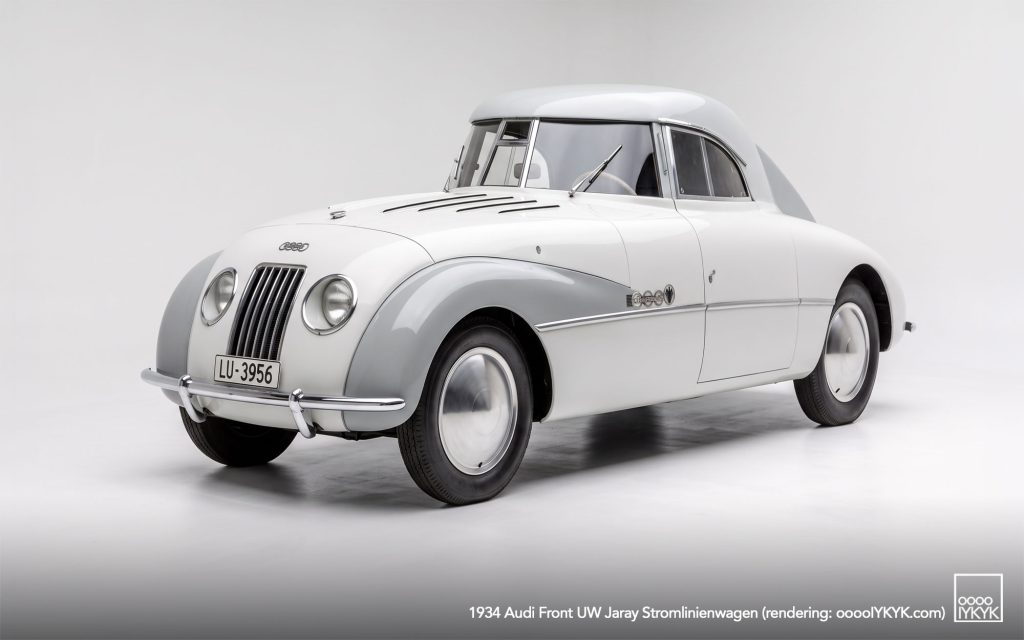
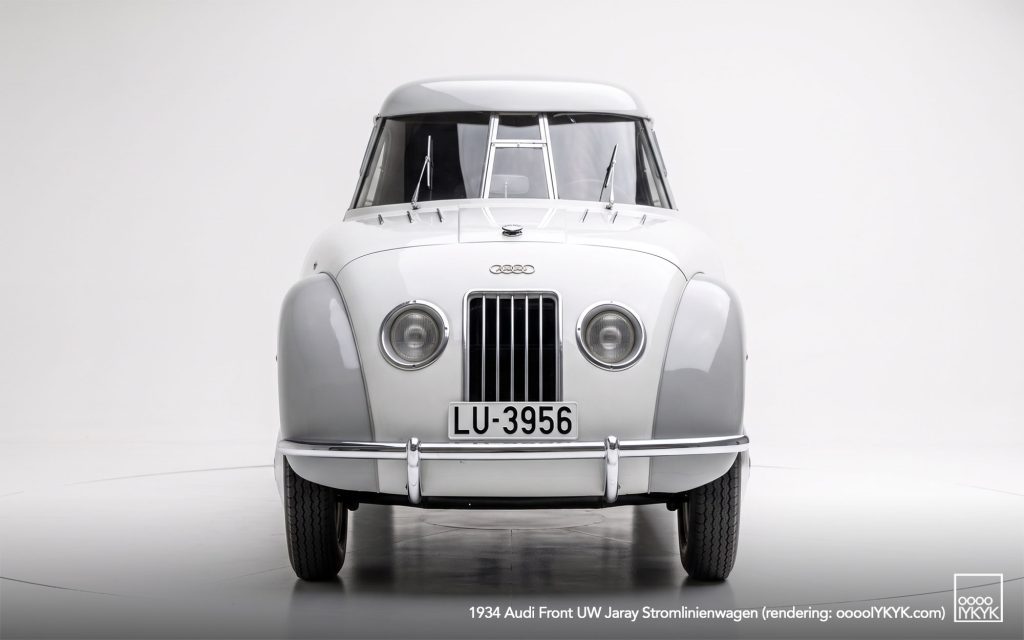
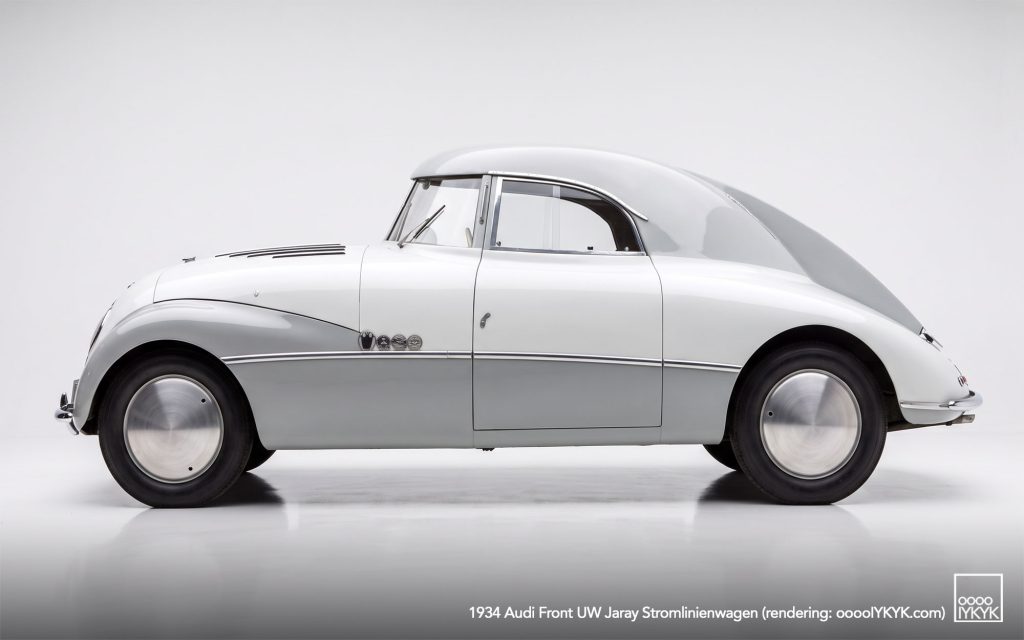
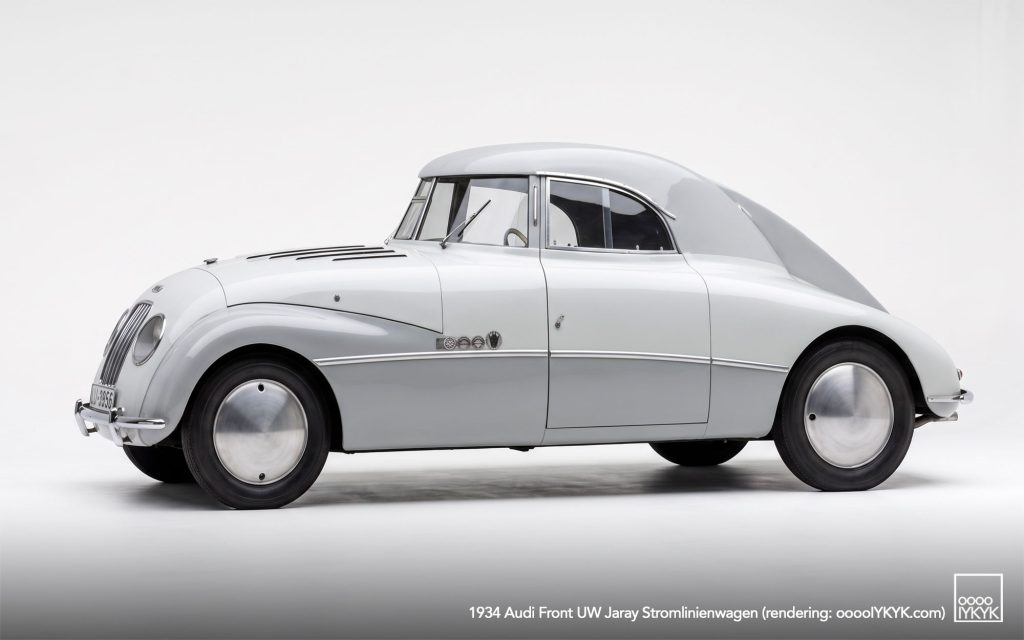
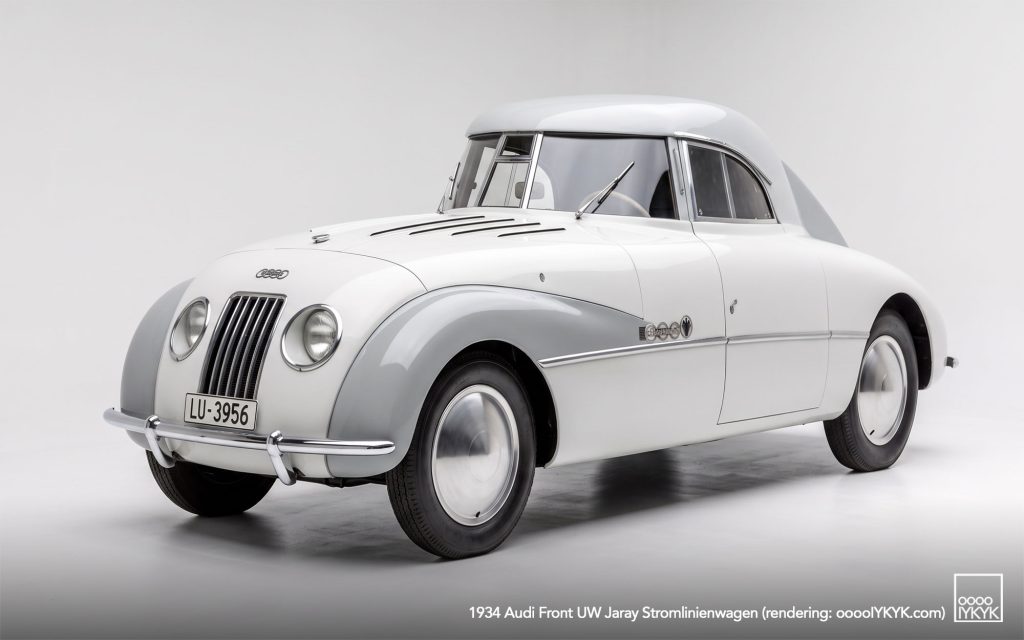
Jaray designed a two-seat coupé body that largely eliminated the separate visual elements characteristic of conventional automobiles of the period.
The body incorporated the fenders and spare wheels into its overall form, while a narrow passenger compartment rose from the broader lower body. A curved windshield helped transition airflow over the cabin and the body tapered toward the rear, terminating in a prominent vertical fin intended to contribute to directional stability.
The aluminum body was constructed by Huber & Brühwiler of Lucerne, Switzerland, over a supporting wooden structure.
Compared with Jaray’s tall and unusually proportioned aerodynamic experiments of the early 1920s, the Audi Front UW was significantly lower and more integrated. The relationship between its broad lower body and narrow upper passenger compartment remained recognizably Jaray, but the result was closer to a usable sporting automobile.
The car’s underlying front-wheel-drive architecture also helped enable the proportions. Without the need for a conventional longitudinal driveline extending to the rear wheels, the Audi Front offered Jaray a relatively low mechanical package around which to develop the body.
1934 GENEVA MOTOR SHOW
The completed Audi Front UW Jaray was publicly displayed at the Geneva Motor Show from March 16 to 25, 1934, on the stand of AG für Verkehrspatente.
The Audi was not an Audi factory concept in the modern sense. AVP had acquired the chassis and commissioned the streamlined automobile as a demonstration of Jaray’s aerodynamic ideas, with Huber & Brühwiler responsible for construction of the body.
Jaray was simultaneously applying his principles to other manufacturers. A streamlined automobile based on a Mercedes-Benz chassis was also shown in connection with his work during this period.
The Audi therefore continued the multi-marque nature of Jaray’s earlier aerodynamic experiments, but represented a much more mature interpretation of the principles he had been developing since the early 1920s.
AERODYNAMICS
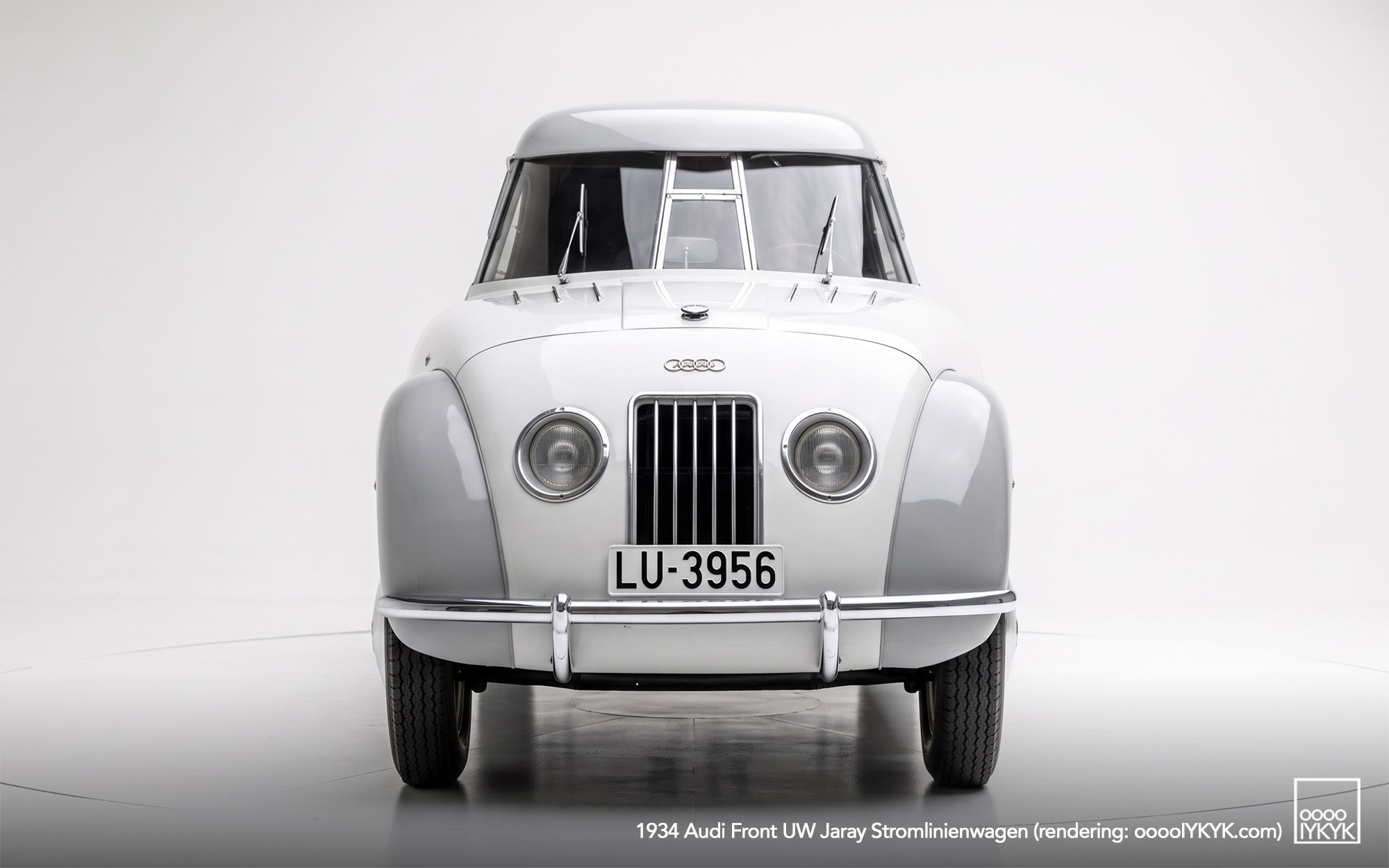
The Front UW Jaray was designed around reducing the aerodynamic disturbances created by the numerous exposed components of a conventional 1930s automobile.
Separate fenders, running boards, an upright radiator, exposed spare wheels and other appendages were largely absorbed into the body. Smooth surfaces and a tapered rear were intended to keep airflow attached to the vehicle while reducing turbulence and aerodynamic drag.
Published historical accounts attribute a drag coefficient of approximately Cd 0.30 to the car.
The streamlined body reportedly allowed the 40 PS Audi to reach approximately 135 km/h, compared with around 110 km/h for a conventional Audi Front UW. These figures demonstrate the principle Jaray was attempting to promote: improved aerodynamic efficiency could produce substantially greater performance without a corresponding increase in engine output.
The figures should be treated as reported historical values rather than results from modern testing of the original automobile.
APPEARANCE AND EVOLUTION
Surviving period photographs reveal that the Front UW Jaray did not retain a single appearance throughout its existence.
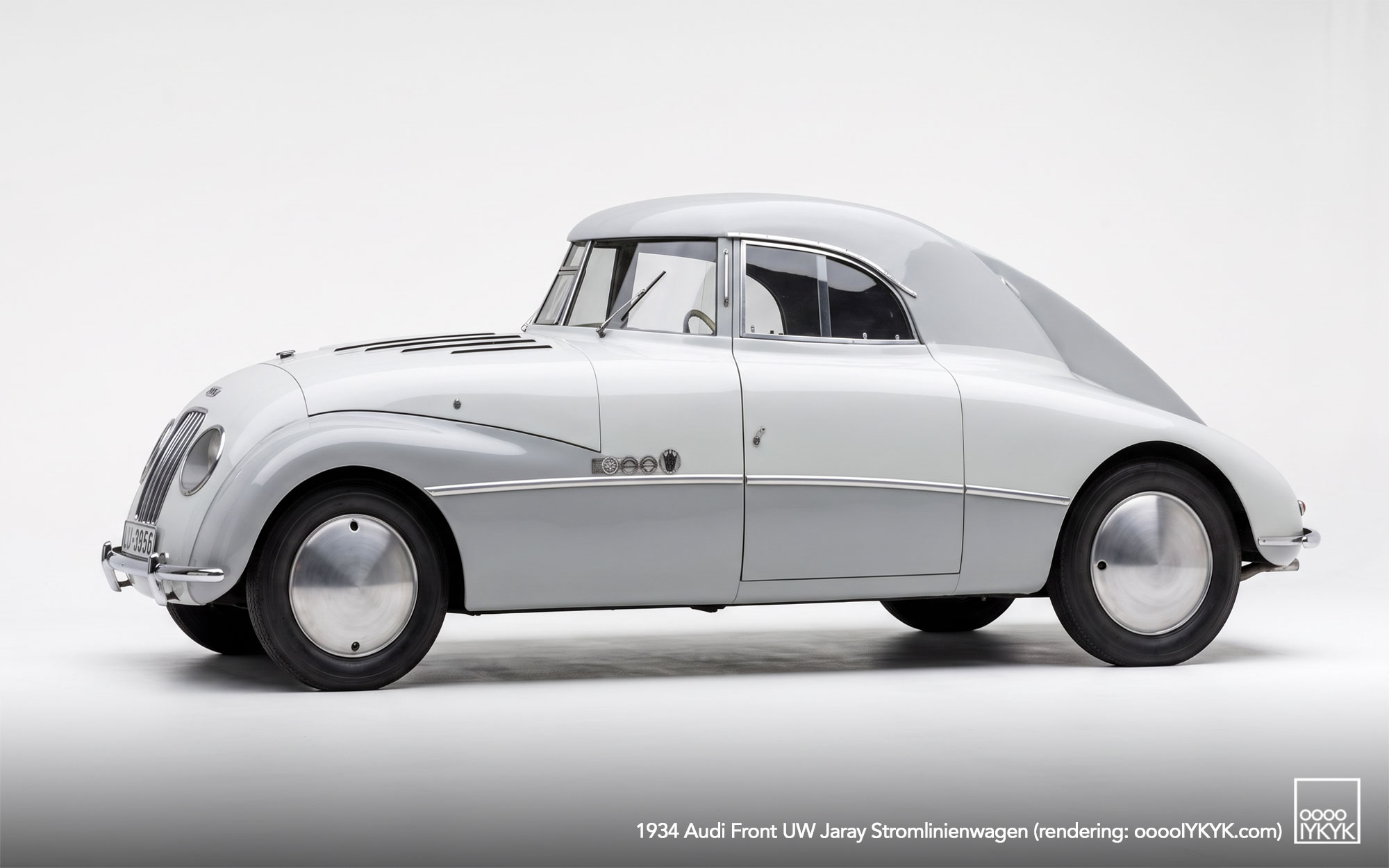
Early imagery shows the car in several subtly different configurations. Photographs document both light-colored and darker presentations, while wheel treatments vary between more conventional period hubcaps and smooth full wheel covers.
The latter covered a much greater portion of the wheel surface and were visually consistent with Jaray’s objective of reducing aerodynamic disturbance. Illustrations and later representations of the car frequently emphasize these smooth disc-style covers.
Other details visible in surviving photographs also changed over time.
This makes it difficult to define one appearance as the definitive 1934 specification without tying individual photographs to specific dates. The car should instead be understood as an experimental vehicle whose specification continued to evolve during its working life.
The 1934 Archive entry represents the car in its original AVP development and demonstration period rather than one narrowly defined visual configuration.
USE AFTER GENEVA
Following its Geneva appearance, Paul Jaray and fellow aerodynamicist Reinhard Freiherr von Koenig-Fachsenfeld used the Audi for promotional drives across Europe, demonstrating the practical benefits of streamlined automobile design.
The car was reportedly involved in an accident in Czechoslovakia in 1935 and subsequently repaired by Jawa. Available documentation does not establish which, if any, of the exterior changes visible in later photographs resulted from this repair.
The Audi continued to evolve after its initial demonstration period. In 1939 it passed into Paul Jaray’s personal ownership and remained in his use, undergoing further modifications and repainting.
That later phase of the vehicle’s history and its recognizably evolved appearance are documented separately in Audi Archives as the 1939 Audi Front UW Jaray – Paul Jaray Personal Car.
HISTORICAL SIGNIFICANCE
The 1934 Front UW Jaray represents a second and substantially more mature chapter in the relationship between Audi automobiles and Paul Jaray’s aerodynamic research.
Where the Jaray-bodied Audi of 1923 belonged to a group of early demonstrations intended to establish the fundamental potential of streamlined automobile bodies, the Front UW combined those ideas with a much more modern chassis and more than a decade of additional development.
The result remained unconventional, but demonstrated how aerodynamic thinking could be incorporated into an increasingly practical road automobile.
It also provides an important bridge between the pioneering aerodynamic experimentation of the early 1920s and the increasingly sophisticated aerodynamic research undertaken during the 1930s, when streamlined bodies became important not only to experimental road cars but also racing and record-breaking automobiles.
ORIGINAL VEHICLE
The original Front UW Jaray survived considerably longer than the 1923 Jaray-bodied Audi.
After entering Jaray’s personal ownership in 1939, it continued to serve as his private automobile into the 1950s. During this period it was modified and repainted several times.
Its existence ultimately ended following a carburetor fire. The original car does not survive.
A reconstruction of the Front UW Jaray was created by Audi United Kingdom in 2012. That vehicle differs in several details from known period configurations of the original and is documented separately in Audi Archives. The August Horch Museum identifies the modern car specifically as a 2012 Audi UK reconstruction.
PHOTO GALLERY
SOURCES
4Legend – Audi Front Type UW Jaray de 1934, un prototype de véhicule très aérodynamique
The Classic Car Trust – 1921: Paul Jaray and his Airships on Four Wheels
Coachbuild.com – Paul Jaray historical profile
Audi Tradition / Audi museum mobile – Windschnittig exhibition material
August Horch Museum – Windschnittig / Form vollendet exhibition material
AutoPioneer / AutoCult – 1934 Audi Front UW 8/40 PS Paul Jaray
La Vie de l’Auto – historical feature on the Audi Front UW Jaray
RESEARCH NOTES
- Jaray’s AG für Verkehrspatente acquired the Audi Front chassis at the end of 1933.
- The streamlined aluminum body was constructed by Huber & Brühwiler of Lucerne over a supporting wooden structure.
- The completed car was displayed on the AVP stand at the Geneva Motor Show from March 16 to 25, 1934.
- The vehicle was a one-off aerodynamic demonstrator rather than a documented Audi production proposal.
- Period photographs show the original automobile in multiple configurations, including variations in paint treatment, wheels and exterior details.
- Smooth full wheel covers appear in historical representations of the car, while other period photographs show more conventional chrome hubcaps. The exact chronology of these configurations has not yet been established.
- Registration LU 3956 appears repeatedly in historical imagery associated with the car.
- The car was reportedly damaged in Czechoslovakia in 1935 and repaired by Jawa, although available documentation does not establish whether particular subsequent styling changes resulted from that repair.
- Paul Jaray acquired the car personally in 1939. It was subsequently modified and repainted several times and remained in his use into the 1950s.
- The original automobile was eventually destroyed following a carburetor fire.
- A modern reconstruction was produced by Audi United Kingdom in 2012 and is treated as a separate Audi Archives entry. The August Horch Museum specifically attributes the reconstruction to Audi UK.
- The 1934 Front UW is sometimes confused with the earlier 1923 Audi Type C/Type K Jaray because both were one-off streamlined Audi-based automobiles designed according to Paul Jaray’s principles.
ARCHIVE STATUS
Original Vehicle: No longer extant
Construction: One-off
Introduction: Geneva Motor Show, March 16–25, 1934
Original Owner/Commissioning Entity: AG für Verkehrspatente (AVP)
Later Owner: Paul Jaray, from 1939
Original Registration: LU 3956
Fate: Destroyed following a carburetor fire, reportedly during the 1950s
Modern Reconstruction: Audi United Kingdom, 2012; documented separately in Audi Archives
Documentation Status: Period photographs and historical documentation survive; chronology of individual changes to the original car’s exterior remains incomplete