


/Eras/Audi Modern Era/Audi Q9/Audi Q9 SUV (PPC)
What: Audi Q9 SUV
Era: Audi Modern Era
What: Audi Q9 SUV
Era: Audi Modern Era
Model Years: 2027 – current
Introduced: July 2026
Market: EU
Internal designation:
Chassis / Matrix: PPC
Body style: Full-size SUV
Doors: Five
Production location: Bratislava, Slovakia
German launch model: Q9 TDI quattro, 220 kW
Starting price: €108,400
Engine(s):
- 3.0-liter V6 TDI MHEV plus (220 kW / 299 PS)
- 3.0-liter V6 TDI MHEV plus (180 kW / 245 PS)*
Transmission: Eight-speed tiptronic automatic
Drive system: Permanent quattro all-wheel drive
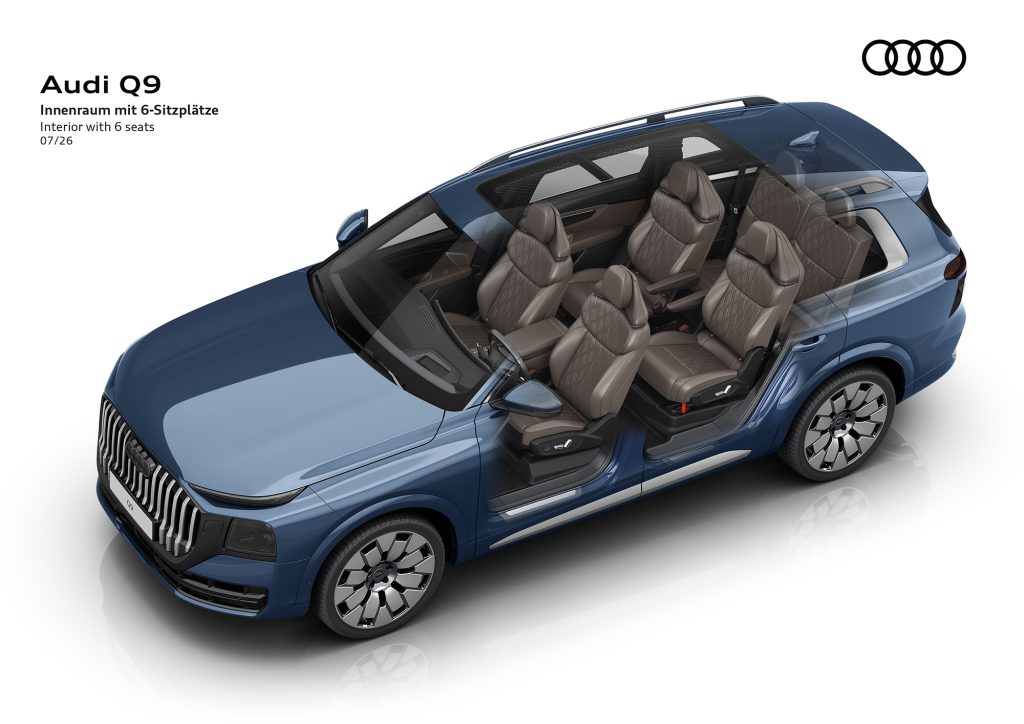
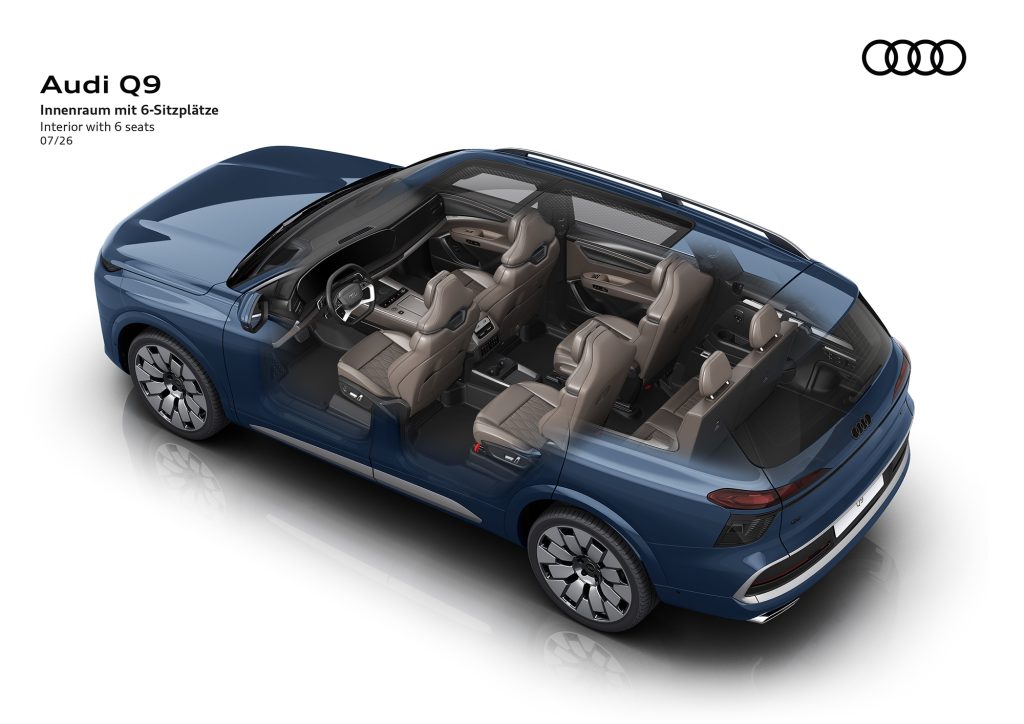
Seating: Seven standard; six optional
Wheelbase: 3,140 mm (123.6 in)
Length: 5,310 mm (209.1 in)
First customer deliveries: November 2026
German starting price: €108,400
*Available in selected European markets; not confirmed for Germany.
OVERVIEW
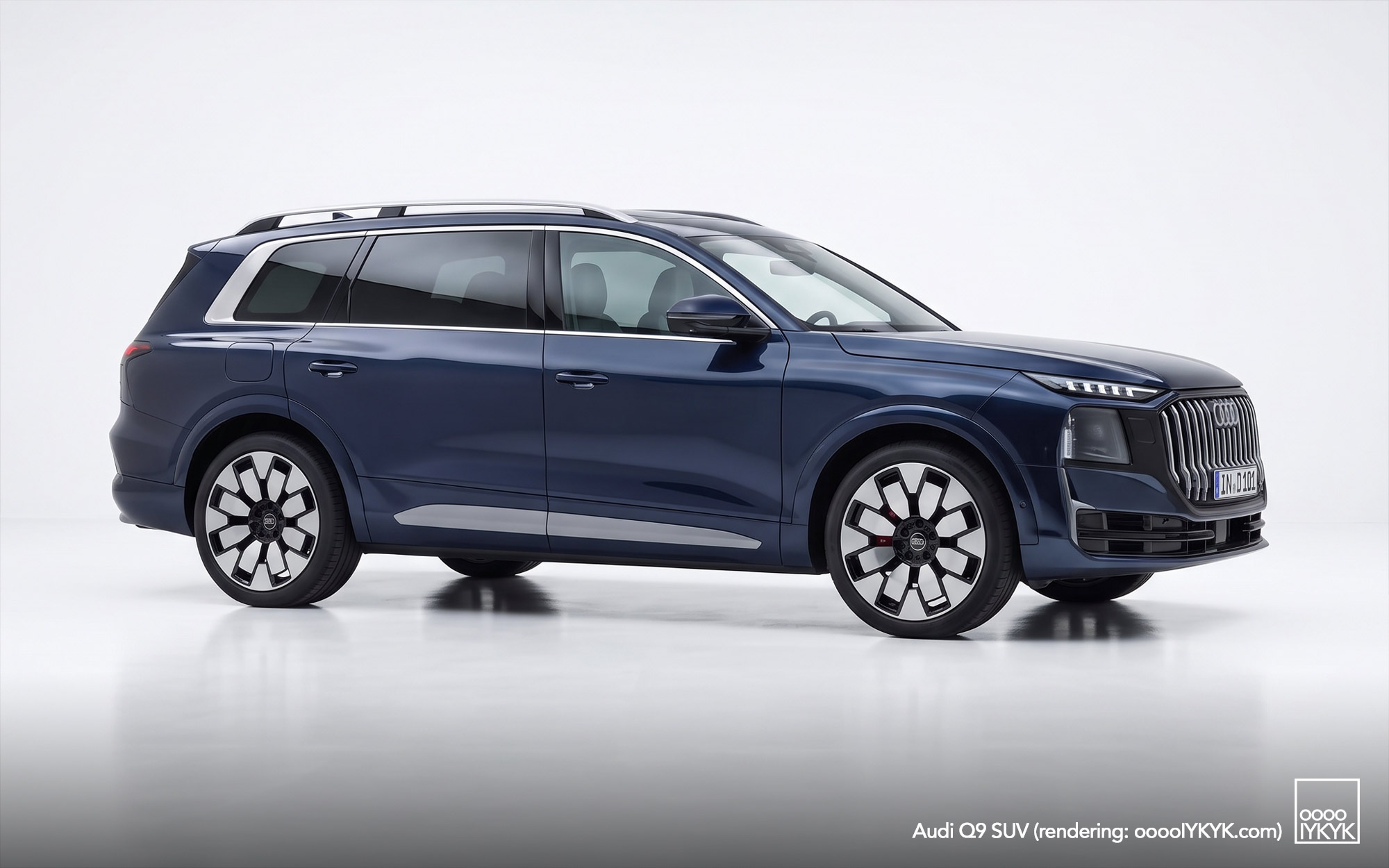
The Audi Q9 was introduced in 2026 as the company’s first full-size luxury SUV and the largest production vehicle in Audi history. Positioned above both the Q7 and Q8, it established a new flagship within Audi’s SUV portfolio while introducing the first production model to carry the number 9.
Rather than replacing an existing model, the Q9 expanded Audi’s lineup into a segment occupied by the largest luxury sport utility vehicles. Developed around three rows of seating, generous passenger accommodations and advanced digital technology, it reflected the growing importance of spacious interiors and long-distance comfort within the premium market.
The Q9 measured 5,310 mm (209.1 in) in length and rode on a 3,140 mm (123.6 in) wheelbase, making it substantially larger than the Q7. Seven-passenger seating was standard, while buyers could also specify an executive-oriented six-seat configuration featuring two individual second-row seats. The vehicle also introduced several new technologies to Audi production, including automatic power-operated doors, curved third-generation digital OLED rear lights and hands-free operation through Adaptive Driving Assistant Plus on approved highway sections.
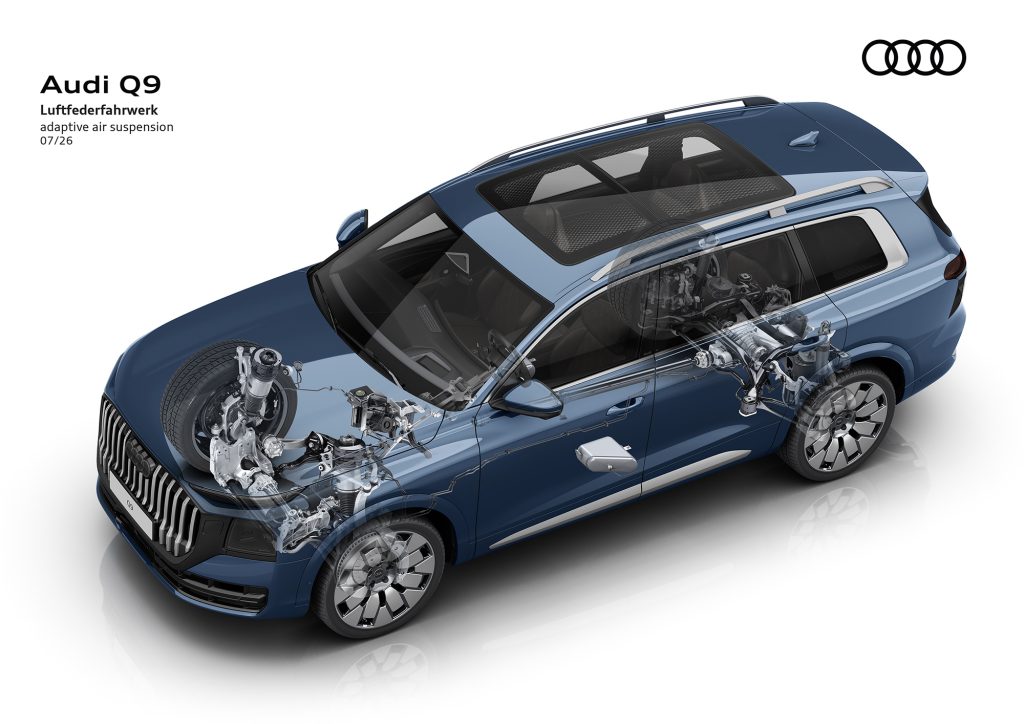
For the German market, the Q9 debuted with Audi’s latest 3.0-liter V6 TDI producing 220 kW (299 PS) and 630 Nm (465 lb-ft) of torque. The engine combined two-stage turbocharging, an electrically powered compressor and the company’s MHEV plus mild-hybrid system. An eight-speed tiptronic transmission, permanent quattro all-wheel drive and adaptive air suspension were standard equipment.
Orders for the German-market Q9 opened at the end of July 2026, with first customer deliveries scheduled for November. The Q9 TDI quattro carried a starting price of €108,400.
MODEL HISTORY
Audi entered the luxury SUV segment in 2005 with the first-generation Q7. Combining three rows of seating with longitudinal engines, permanent quattro all-wheel drive and premium appointments, the Q7 established Audi as a competitor in the growing market for large luxury SUVs.
The introduction of the Q8 in 2018 expanded the lineup in a different direction. Although positioned numerically above the Q7, the Q8 emphasized design and sporting character rather than passenger capacity. Its coupe-inspired roofline and two-row configuration distinguished it from the more family-oriented Q7.
The Q9 represented Audi’s next step rather than a replacement for either vehicle. Instead of further emphasizing sportiness, the new flagship focused on interior volume, passenger comfort and technological integration. Its larger dimensions allowed Audi to improve third-row accommodations, expand luggage capacity and offer interior features not previously available within the company’s SUV range.
Development also reflected changing customer expectations in the premium market. Increasingly, buyers viewed luxury SUVs not only as driver’s vehicles but also as family transport, executive transportation and mobile living spaces. Audi therefore designed the Q9 around flexibility, digital connectivity and long-distance refinement while preserving the engineering principles that had long defined the brand.
The Q9 also marked an evolution in Audi’s model nomenclature. It became the first production Audi to use the number 9, creating a distinct flagship position above both the Q7 and Q8 while establishing room for future high-end derivatives such as the SQ9.
MARKET POSITION
Within Audi’s portfolio, the Q9 serves as the company’s flagship SUV and largest combustion-powered passenger vehicle.
Rather than replacing the Q7, the Q9 complements it by offering greater interior volume, more passenger space and a broader range of luxury appointments. Likewise, while the Q8 continues to emphasize a lower, sport-oriented design, the Q9 prioritizes practicality without sacrificing premium design or technology.
The standard seven-seat configuration addresses buyers seeking maximum passenger capacity, while the optional six-seat layout transforms the second row into a more executive environment with individual electrically adjustable seats separated by a center aisle. This flexibility allows the Q9 to serve multiple roles, from family transportation to chauffeur-driven executive travel.
The Q9 also reflects a broader shift within the luxury market. Traditional measures of prestige—engine displacement, top speed and exterior dimensions—remain important, but buyers increasingly place equal value on digital technology, interior comfort and everyday usability. Audi responded by combining its established strengths in powertrain engineering and quattro all-wheel drive with a greater emphasis on cabin refinement, intelligent lighting, advanced driver assistance and connected digital systems.
In Germany, the Q9 entered the market with a starting price of €108,400, placing it above both the Q7 and Q8 as the most expensive standard Audi SUV offered at launch.
EXTERIOR DESIGN
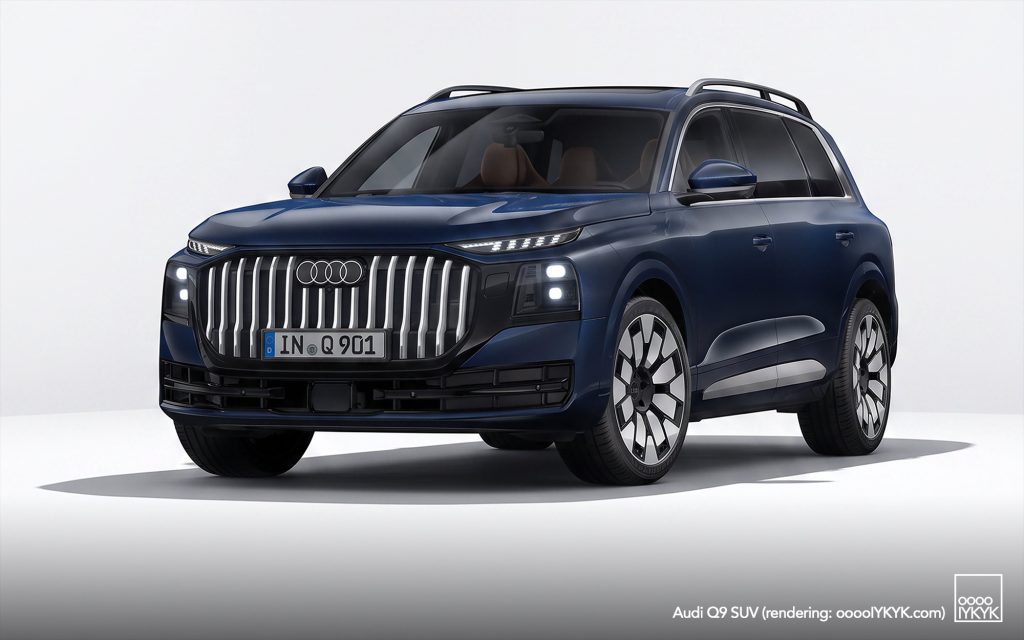
The Q9 adopts a formal, upright design intended to communicate presence rather than outright sportiness. Its proportions emphasize passenger space and practicality while maintaining a clean, contemporary appearance consistent with Audi’s latest design language.
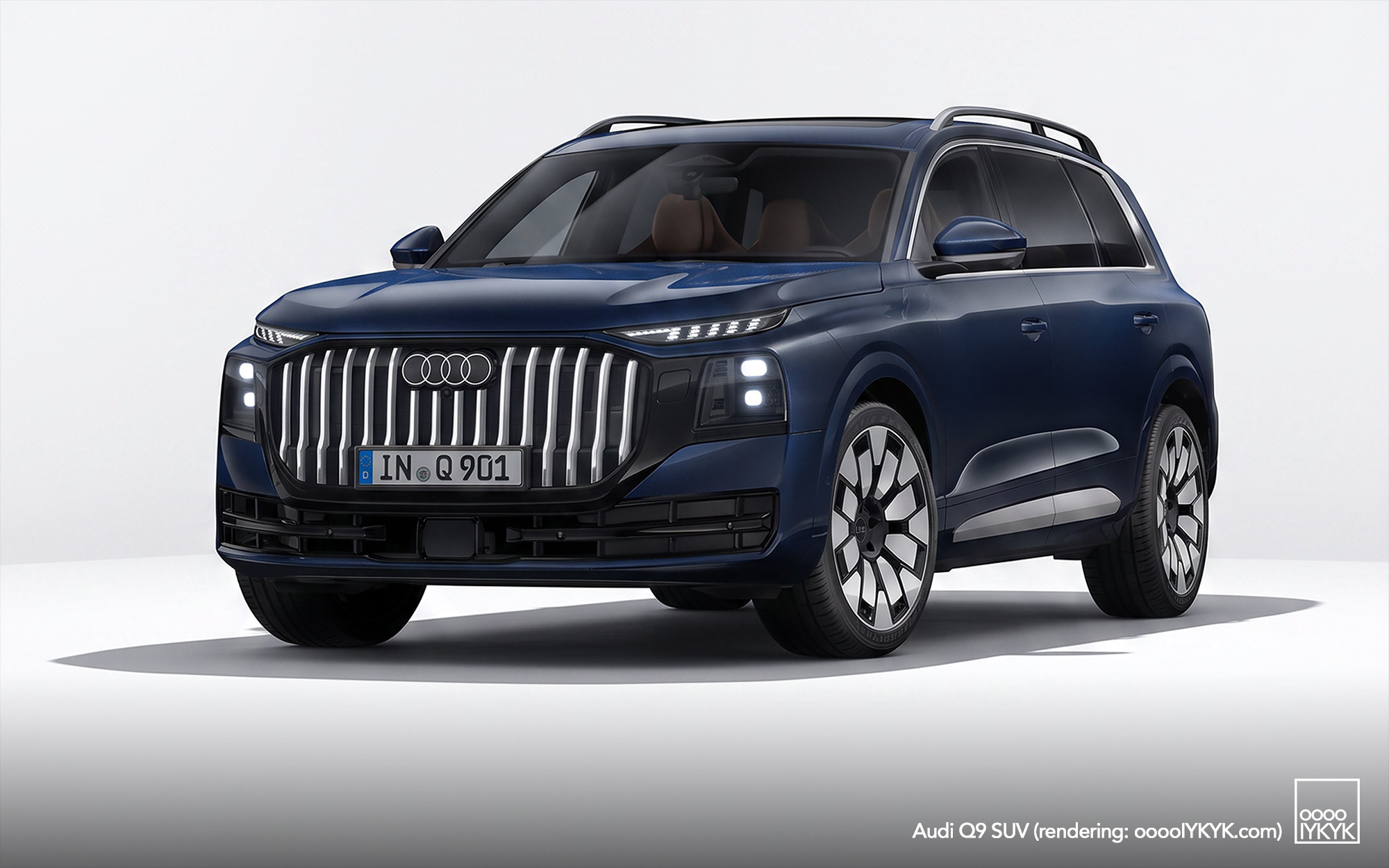
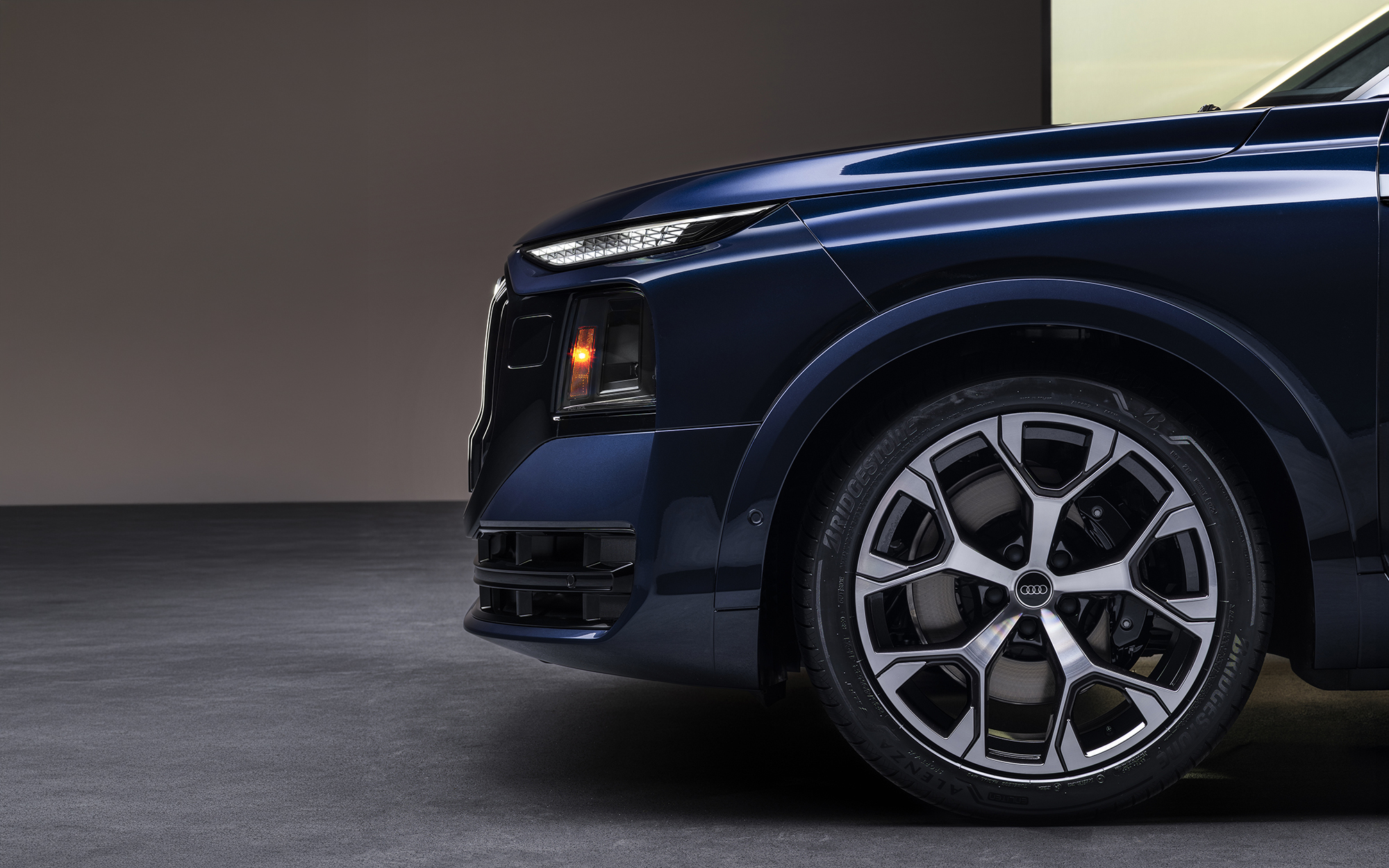
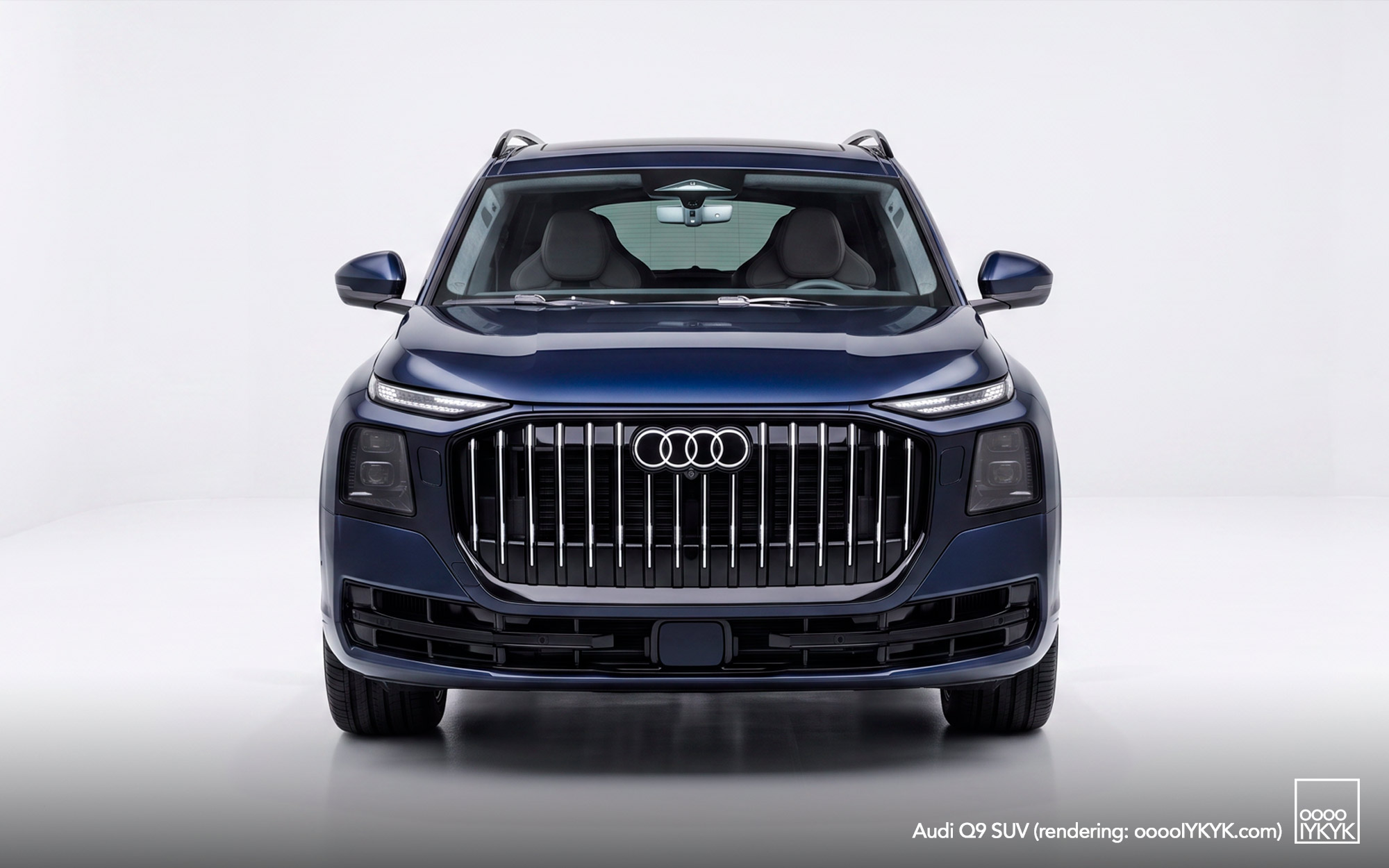
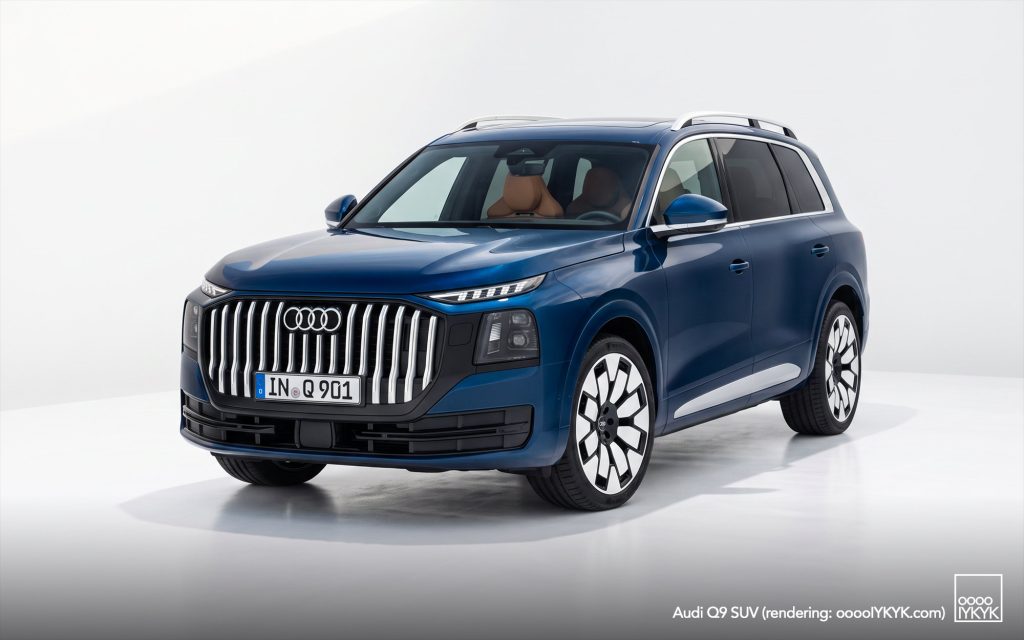
The front fascia is dominated by a large Singleframe grille integrated into a gloss-black front mask that visually connects the headlights. Rather than relying on numerous decorative openings or contrasting trim elements, Audi uses broad uninterrupted surfaces to emphasize the vehicle’s scale. An illuminated Singleframe grille is available, extending the Q9’s visual identity after dark.
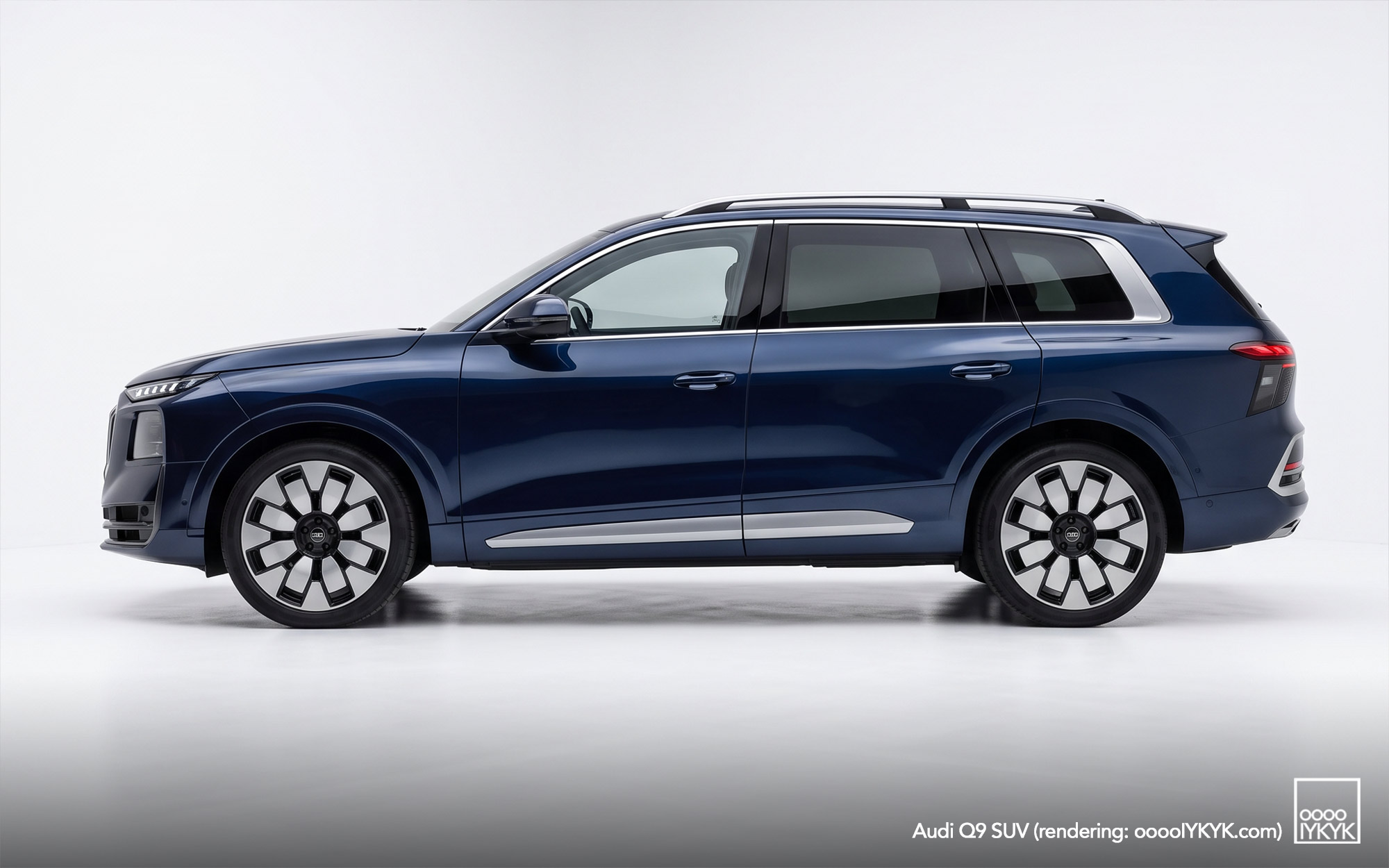
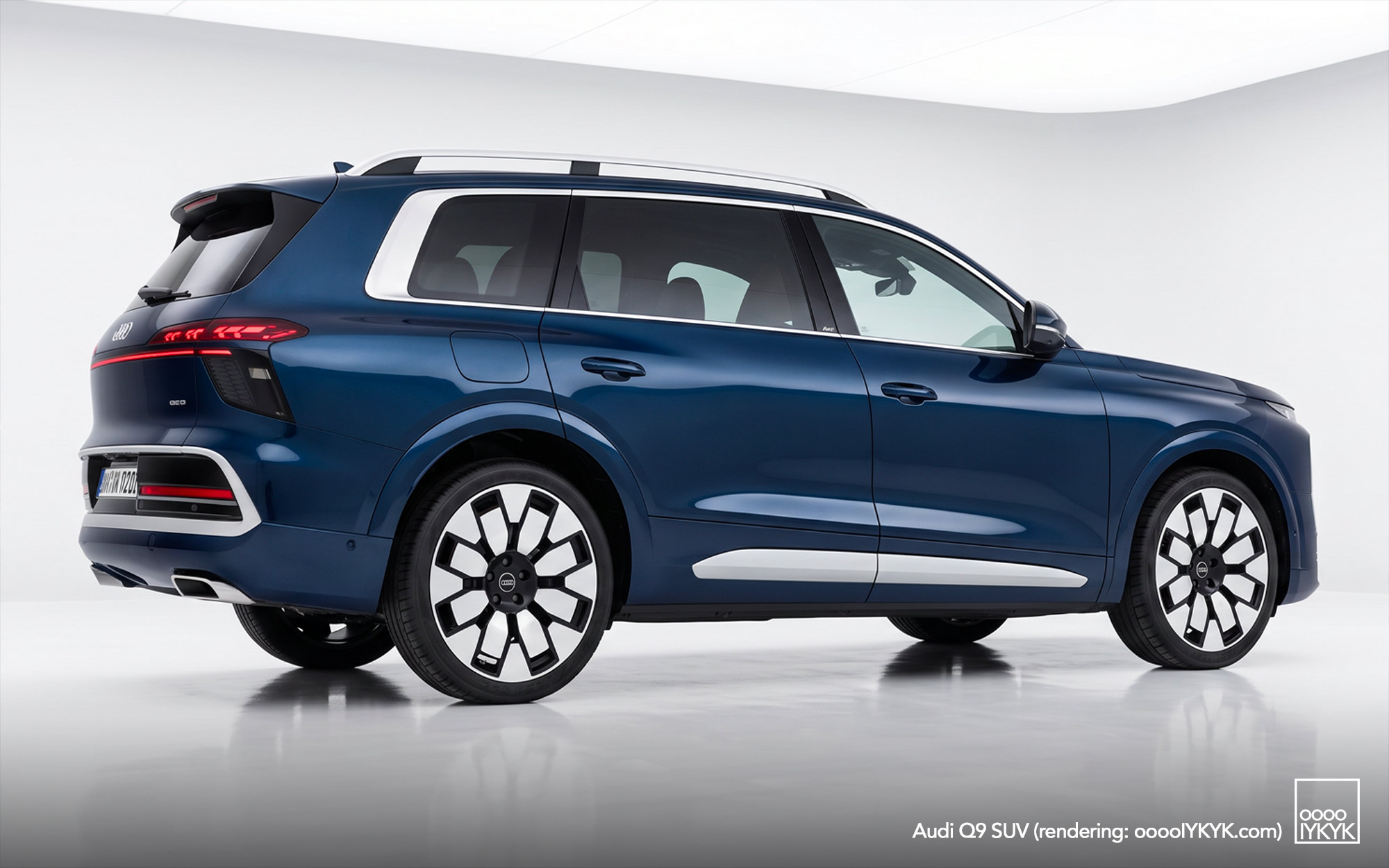
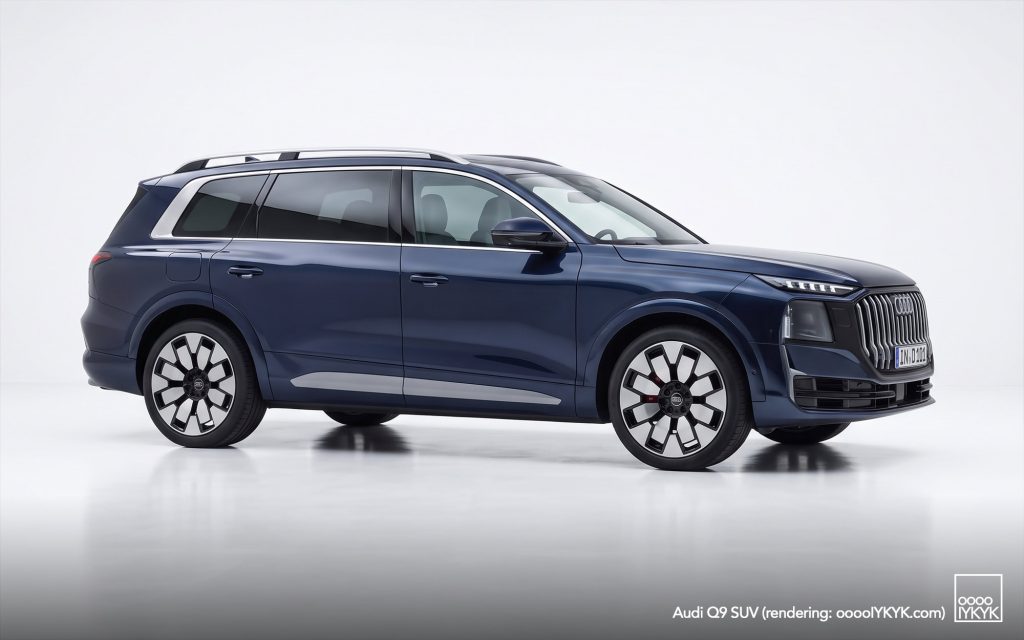
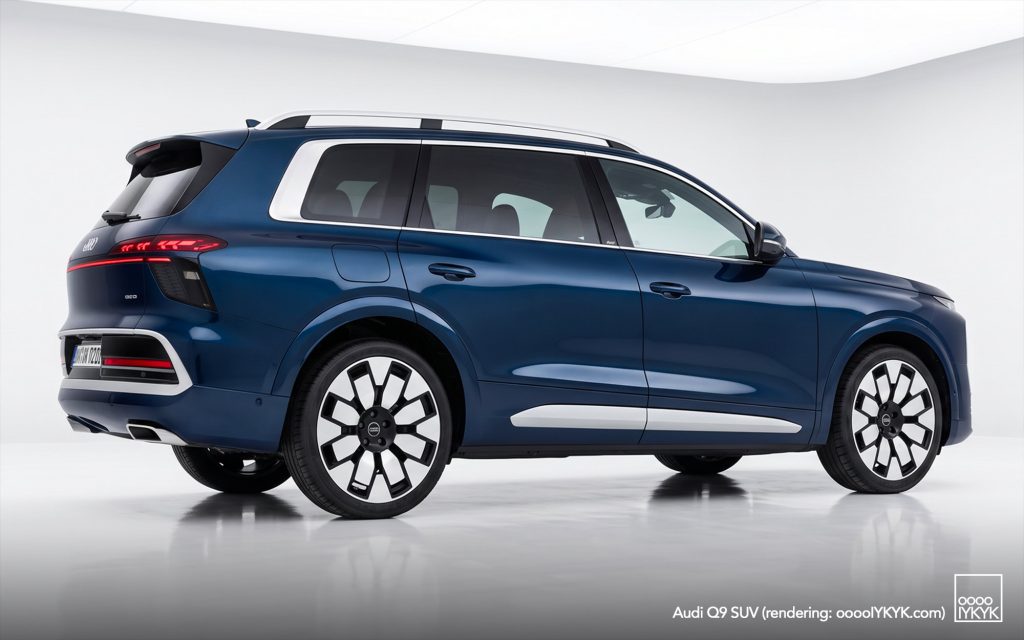
In profile, the Q9’s long wheelbase, upright roofline and generous rear doors immediately distinguish it from the Q8. The nearly horizontal roof preserves third-row headroom while the extended rear overhang provides luggage capacity behind the final seating row. Strong shoulder lines and restrained surfacing reinforce the vehicle’s substantial dimensions without appearing unnecessarily aggressive.
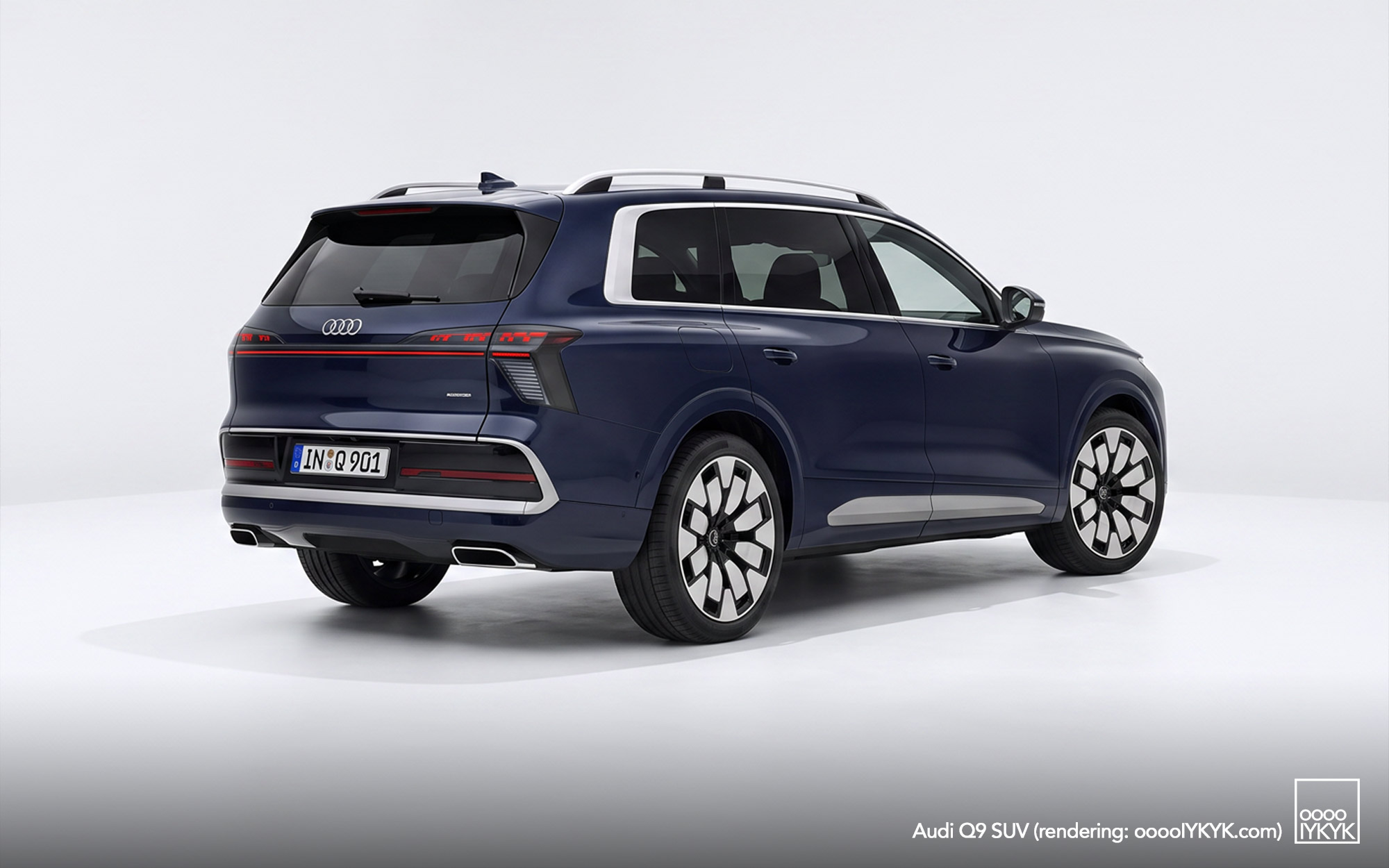
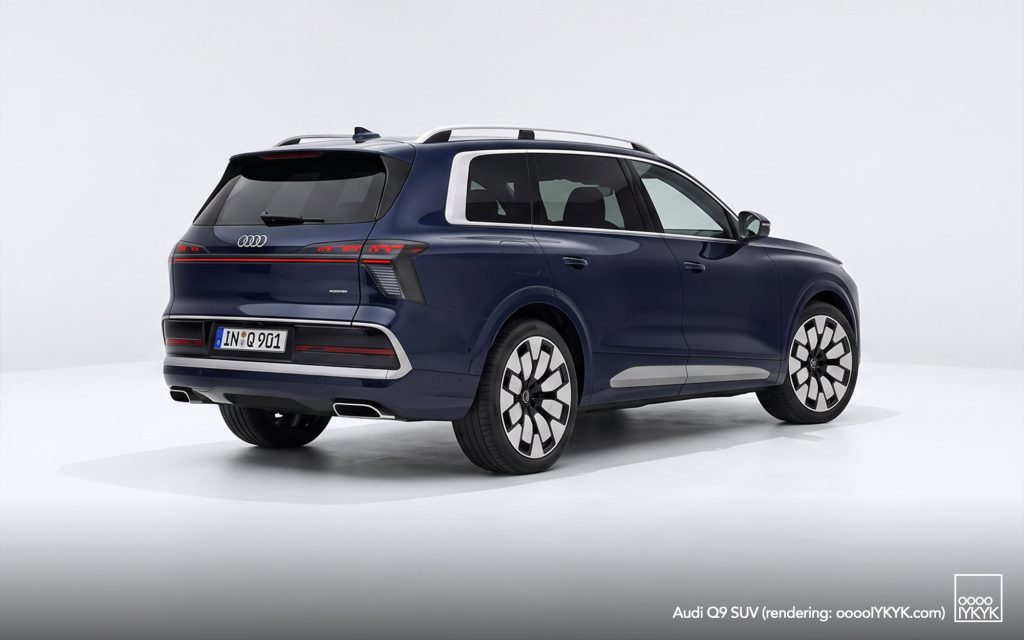
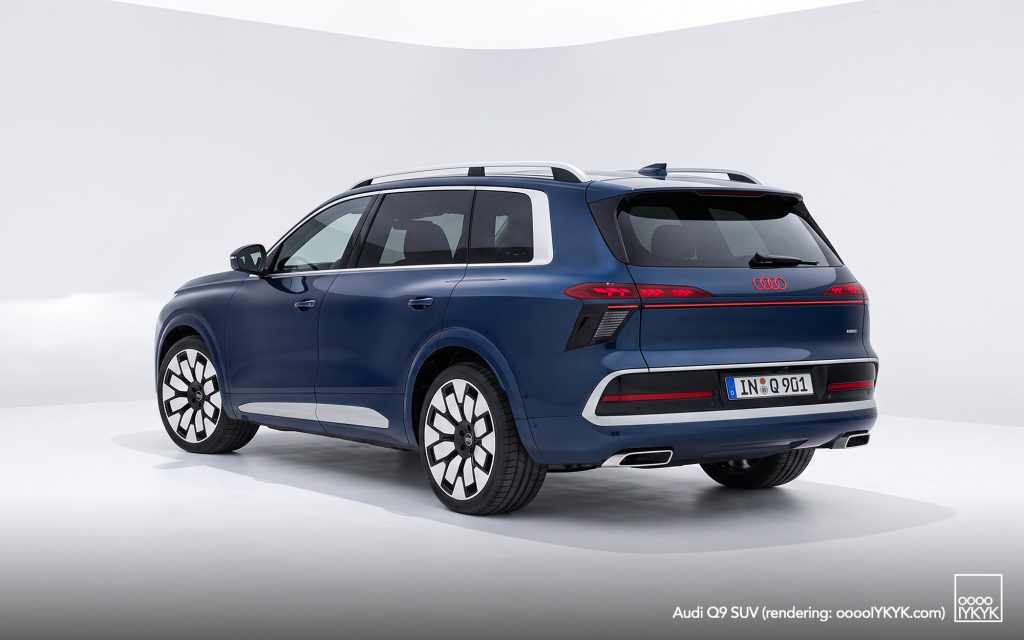
The rear design continues this emphasis on width and simplicity. Relocating the license plate to the bumper allows the tailgate to be dominated by a continuous lighting graphic incorporating third-generation digital OLED rear lamps, illuminated Audi rings and a full-width rear light strip. The resulting composition emphasizes both the width of the vehicle and its flagship status.
Overall dimensions measure:
- Length: 5,310 mm (209.1 in)
- Width: 2,210 mm (87.0 in)*
- Height: 1,810 mm (71.3 in)
- Wheelbase: 3,140 mm (123.6 in)
*Audi’s launch material does not specify whether the published width includes the exterior mirrors.
Two exterior design themes are available.
The standard Advanced specification emphasizes elegance through vertical grille elements and restrained lower-body detailing. The optional S line adopts a more performance-oriented appearance with a revised Singleframe treatment, more aggressive lower fascias and sportier exterior accents while retaining the same underlying body structure.
Audi offers wheel diameters ranging from 20 to 23 inches. Tire packages for the 22- and 23-inch wheels incorporate acoustic foam inserts designed to reduce road noise transmitted into the passenger compartment. The launch material does not publish individual wheel designs, widths or tire dimensions.
Exterior paint availability was not fully detailed within the initial German press information. Audi confirmed multiple production colors together with Audi exclusive personalization, though the complete paint catalog was reserved for the market-specific ordering guide.
PASSENGER COMPARTMENT
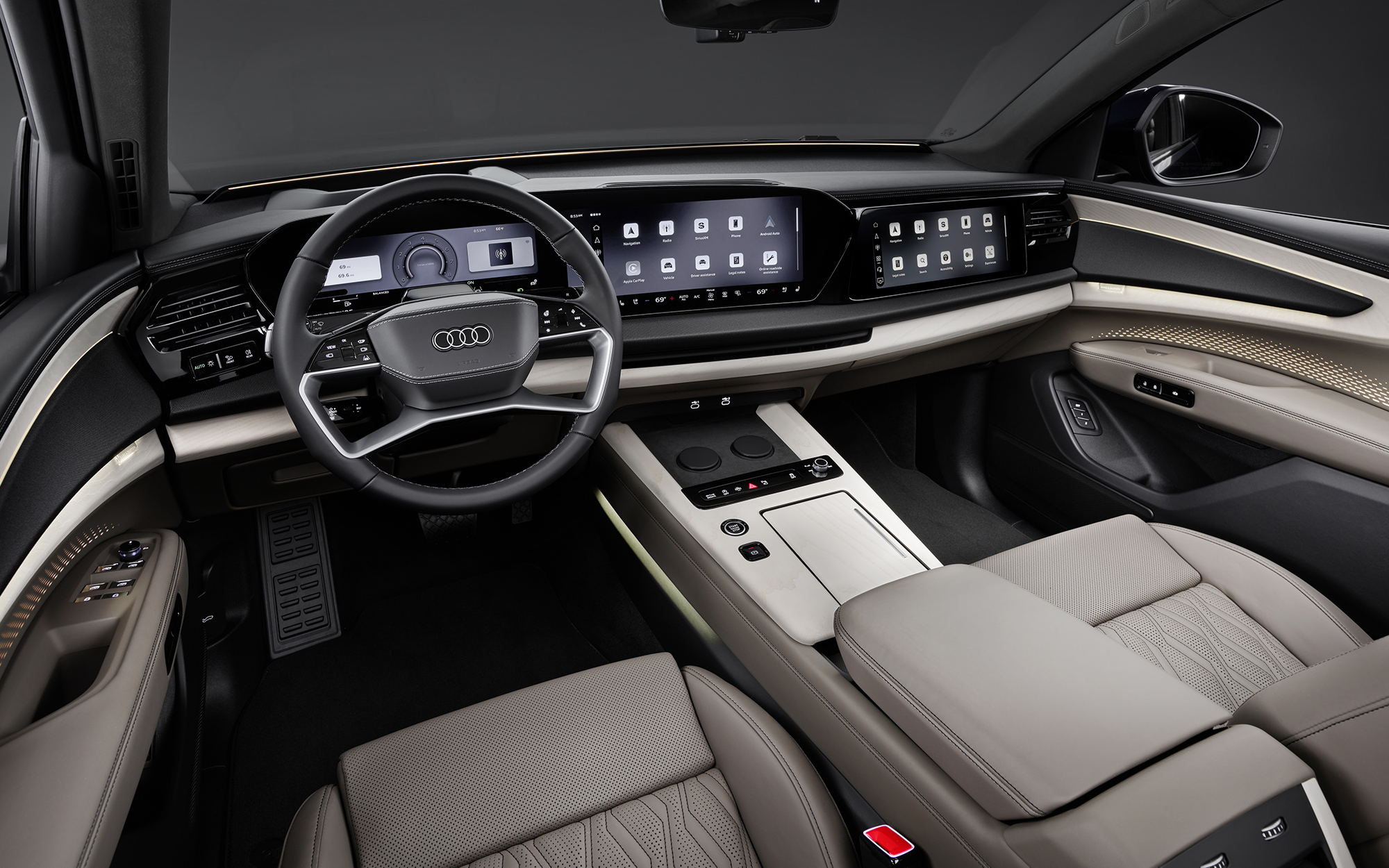
The Q9’s interior was developed around passenger comfort, flexibility and ease of access rather than simply maximizing seating capacity. Audi designed the cabin from the outset as a true three-row environment, with particular attention given to second- and third-row usability.
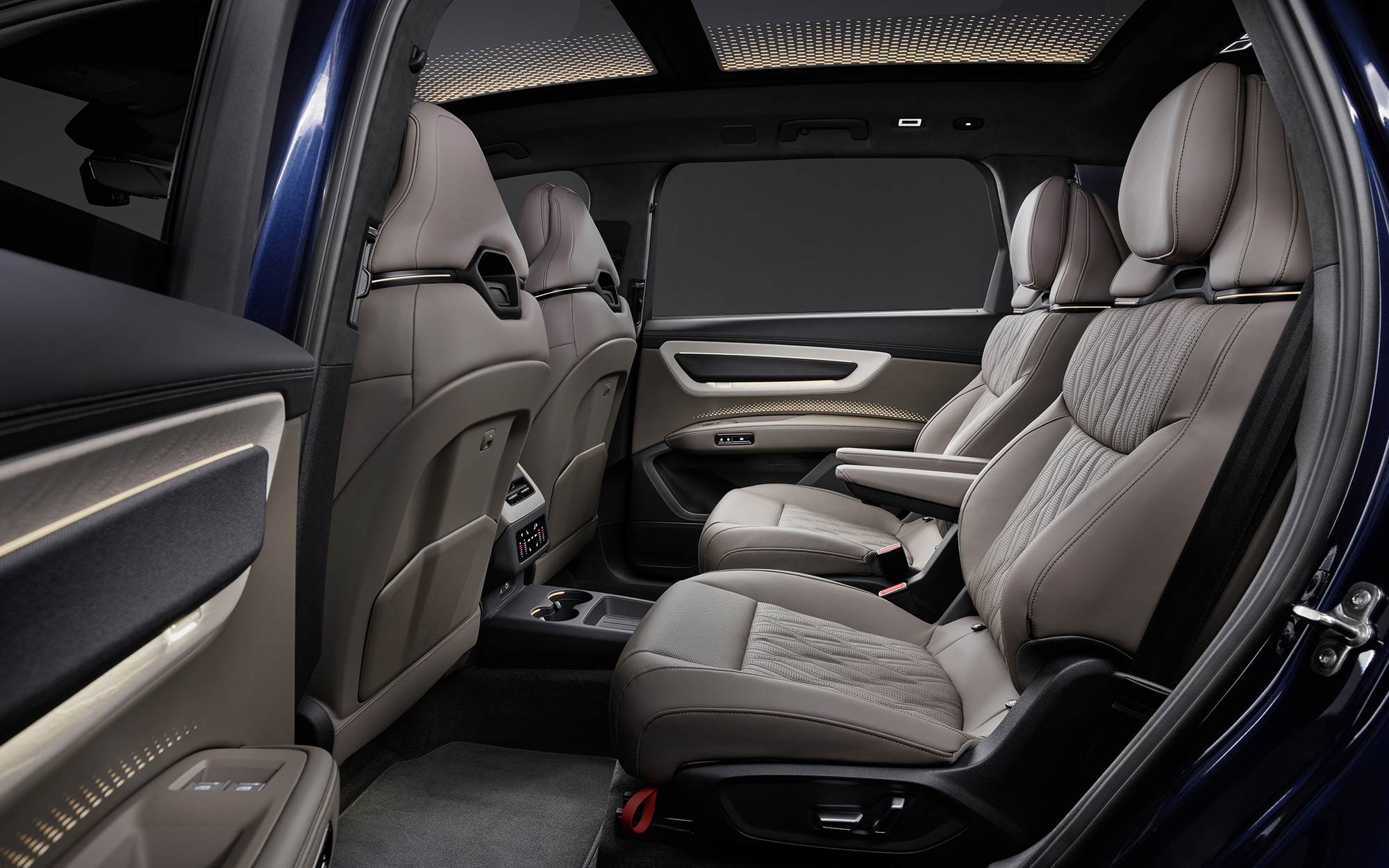
Seven-passenger seating is standard. The second row uses a 35:30:35 split bench with three Isofix child-seat mounting positions and electrically adjustable fore-aft movement. The outer seats incorporate an electrically assisted comfort-entry function that slides and tilts the seat forward to improve access to the third row without requiring removal of an installed child seat.
An optional six-seat configuration replaces the second-row bench with two individual electrically adjustable captain’s chairs. This arrangement creates a more spacious executive environment while providing easier passage to the third row through the center of the cabin.
The third-row seats fold electrically and independently, with controls located both within the passenger compartment and inside the luggage area. Audi designed the rear-most seats to accommodate adult passengers rather than serving solely as occasional seating.
The dashboard continues Audi’s clean horizontal design philosophy while minimizing the visual prominence of physical controls. Electrically adjustable air vents are integrated into the dashboard and controlled through the MMI interface, allowing the instrument panel to maintain uninterrupted horizontal lines across its width.
Interior materials emphasize tactile quality over glossy surfaces. Available upholstery includes wool-based textiles incorporating alpaca fiber, Dinamica microfiber, leather combinations and Fine Nappa leather. Decorative trim choices include natural ash, natural lime wood and carbon-fiber weave, while newly introduced interior colors include Tamarind Brown, Natural Beige and Stone Beige. Additional personalization is available through Audi exclusive.
A panoramic glass roof measuring more than 1.5 square meters is standard equipment, making it the largest panoramic roof fitted to an Audi production vehicle at launch. An optional version features nine individually switchable transparency zones that allow selected sections of the glass to become opaque without requiring a conventional sunshade. The highest specification incorporates 84 LEDs capable of displaying one of 30 ambient lighting colors across the roof surface.
The Q9 also becomes the first Audi production model available with automatic power-operated doors. Each door can be opened and closed electrically through multiple interior controls or remotely using the myAudi application. Integrated sensors continuously monitor the door’s path and can halt movement when an obstacle is detected. The system also works with Exit Warning, preventing or interrupting door movement when another road user is approaching from behind.
Storage was designed around everyday family use. The redesigned center console provides generous enclosed storage together with an available dual Qi2.2 wireless charging pad. USB-C charging outputs of up to 60 watts in the front row, 100 watts in the second row and 45 watts in the third row allow passengers throughout the cabin to power larger electronic devices.
The luggage compartment incorporates an aluminum rail system with adjustable anchors and sliding hooks for securing cargo. Controls within the cargo area allow the second- and third-row seatbacks to be folded electrically. Audi did not publish official luggage-capacity figures in the launch material, reserving those specifications for later technical documentation.
DIGITAL COCKPIT
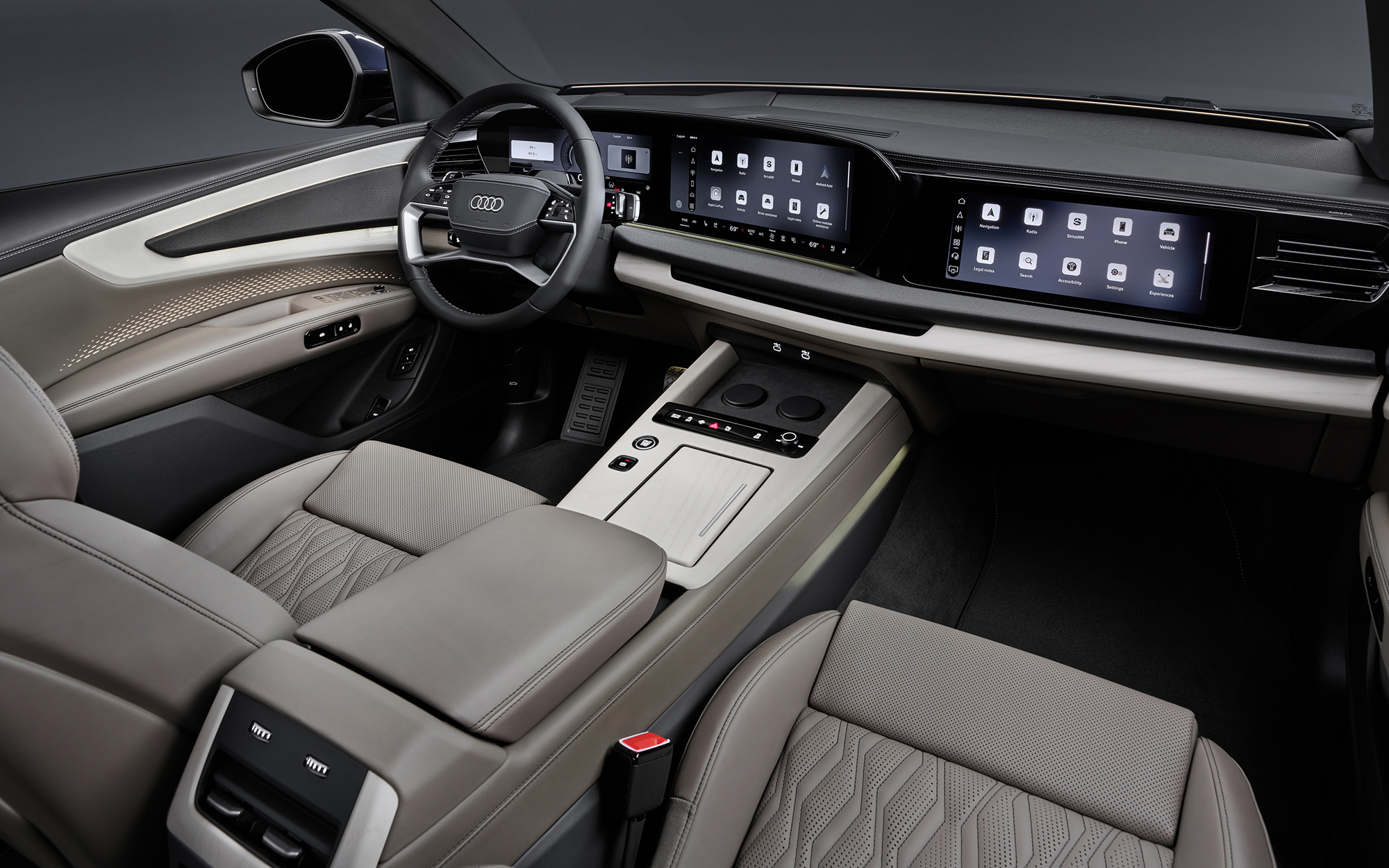
The Q9 introduces Audi’s latest generation of digital cockpit technology, integrating instrumentation, infotainment, connectivity and vehicle controls into a unified operating environment. Rather than treating individual displays as separate systems, Audi designed the cockpit around a continuous digital experience shared by the driver and front passenger.
At the center of the system is the MMI panoramic display, consisting of an 11.9-inch Audi virtual cockpit and a 14.5-inch central touchscreen housed beneath a single curved glass surface. The displays are angled toward the driver while maintaining a horizontal dashboard architecture that visually connects the instrument panel with the rest of the cabin.
A separate 10.9-inch front passenger display is available. Integrated into the dashboard without disrupting its overall design, the screen allows the passenger to access navigation, media and selected vehicle functions independently of the driver’s display. A dynamic privacy mode prevents the driver from viewing passenger content while the vehicle is in motion.
Audi continues to reduce the number of physical controls within the Q9. Climate settings, vehicle functions and numerous comfort features are managed through the MMI interface, while electrically adjustable air vents can also be positioned digitally.
MMI PANORAMIC DISPLAY
The MMI panoramic display combines the driver’s instrument cluster and central infotainment display beneath a single curved glass panel designed to reduce reflections while improving readability.
The 11.9-inch Audi virtual cockpit presents configurable driving information directly ahead of the driver, while the adjacent 14.5-inch touchscreen provides access to navigation, communication, entertainment and vehicle settings.
The display layout reflects Audi’s continued emphasis on horizontal architecture, visually extending the dashboard rather than creating separate screen elements.
FRONT PASSENGER DISPLAY
An available 10.9-inch touchscreen provides the front passenger with independent access to selected vehicle functions.
Applications available through the passenger display include navigation, media playback and the Audi Application Store. Privacy technology limits visibility from the driver’s seating position while the vehicle is moving, reducing distraction without restricting passenger use.
When not in use, the display visually blends into the surrounding dashboard trim.
ANDROID AUTOMOTIVE OS
The Q9 is built around Android Automotive OS, allowing the operating system to function independently of a connected smartphone.
Navigation, voice recognition and media services operate directly through the vehicle, while software updates can be delivered over the air as Audi expands functionality during the model’s lifecycle.
Unlike Android Auto, Android Automotive is integrated into the vehicle itself rather than mirroring a mobile device.
AUDI APPLICATION STORE
The Audi Application Store allows compatible applications to be installed directly onto the vehicle.
Because the applications operate natively within the Q9’s infotainment system, many services remain available without requiring a paired smartphone.
Available applications vary by market and may expand through future software updates.
AUDI ASSISTANT
Audi assistant serves as the Q9’s primary voice-operated interface.
Using natural language processing, the system allows occupants to control navigation, climate settings, media playback and selected vehicle functions using conversational speech rather than predefined command phrases.
The assistant also provides contextual information about vehicle functions and responds to general information requests.
CHATGPT INTEGRATION
The Q9 incorporates ChatGPT as part of Audi assistant, expanding the range of conversational interactions available to occupants.
In addition to conventional vehicle commands, users can request general information, explanations and other knowledge-based responses through natural language conversation.
ChatGPT complements rather than replaces Audi’s native voice-control functions. Vehicle-specific commands continue to be managed through Audi assistant while broader conversational requests are processed using ChatGPT integration.
CONNECTIVITY
The Q9 supports extensive online connectivity through integrated vehicle services.
Navigation, application downloads, cloud-based services and software updates operate through the vehicle’s native internet connection. Compatibility with smartphone integration remains available where supported.
Audi also enables remote vehicle access through the myAudi application, allowing selected comfort and convenience functions to be controlled remotely.
DEVICE CHARGING
The Q9 provides charging capability for electronic devices throughout all three seating rows.
An available dual wireless charging tray supports two Qi2.2-compatible smartphones simultaneously.
USB-C charging outputs are rated at:
- Front row: up to 60 watts
- Second row: up to 100 watts
- Third row: up to 45 watts
These outputs provide sufficient power to charge larger mobile devices, including many notebook computers, while traveling.
FACTORY-INTEGRATED DASHCAM
A factory-integrated dashcam is available for the Q9.
Unlike aftermarket camera systems, the integrated unit is incorporated into the vehicle’s electrical architecture and infotainment system. Recorded footage can be managed through the MMI interface while maintaining the clean appearance of the windshield area.
Availability and recording functions vary according to market regulations.
AUDIO AND INTERIOR ENVIRONMENT
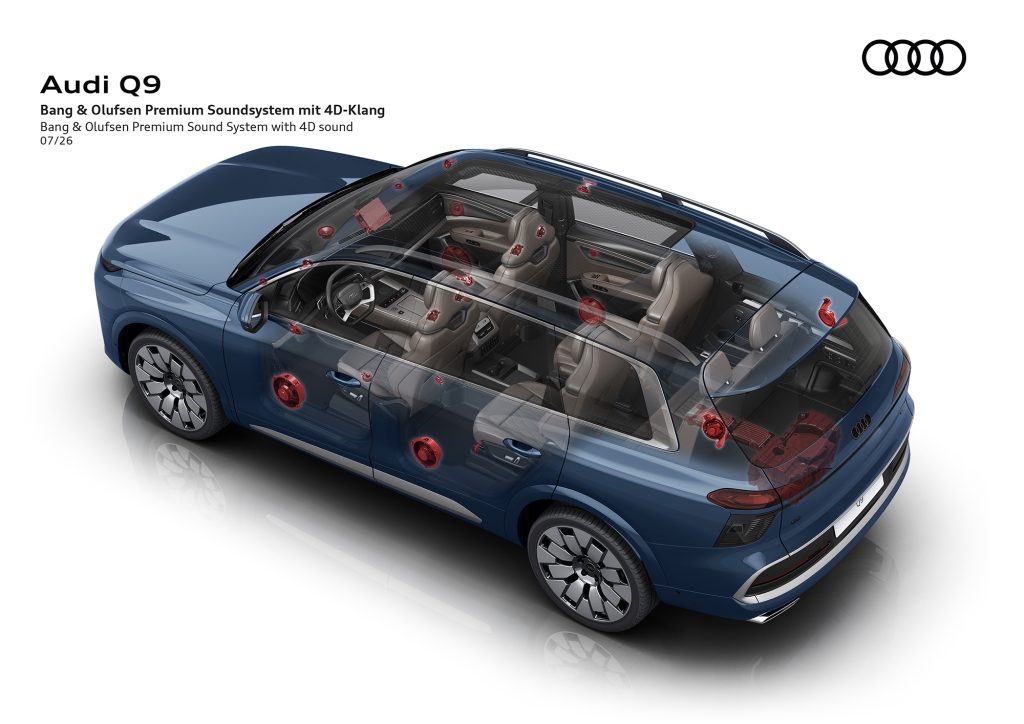
Audi developed the Q9’s interior as more than a passenger compartment, describing it as a living space intended for long-distance travel, executive transportation and everyday family use. Beyond traditional seating comfort, the vehicle integrates sound, lighting and tactile feedback into a coordinated cabin environment.
The optional Bang & Olufsen Premium Sound System with 4D Sound serves as the centerpiece of this approach, combining multiple loudspeakers with seat-mounted actuators, advanced digital signal processing and configurable ambient lighting. Rather than functioning as isolated features, these systems communicate with one another to create a more immersive experience for occupants.
The interaction between audio, lighting and seating reflects Audi’s broader move toward integrated cabin technologies, where comfort systems increasingly operate together instead of independently.
LIGHTING TECHNOLOGY
Lighting is one of the defining technologies of the Q9 and represents one of Audi’s most comprehensive implementations of digital lighting to date. Rather than functioning solely as illumination, the Q9’s lighting systems contribute to communication, driver assistance and vehicle identity. Multiple lighting technologies work together to improve visibility while providing information to occupants and other road users.
The Q9 introduces Audi’s latest Digital Matrix LED headlights together with third-generation curved digital OLED rear lights. Combined with numerous projection functions and adaptive lighting features, the system allows the vehicle to communicate changing road conditions, assistance-system warnings and vehicle status in ways that extend well beyond conventional lighting.
Unlike earlier generations of adaptive lighting, the Q9 integrates many of these functions with its driver-assistance systems, allowing information from cameras, radar sensors and navigation data to influence how the lighting responds to changing driving conditions.
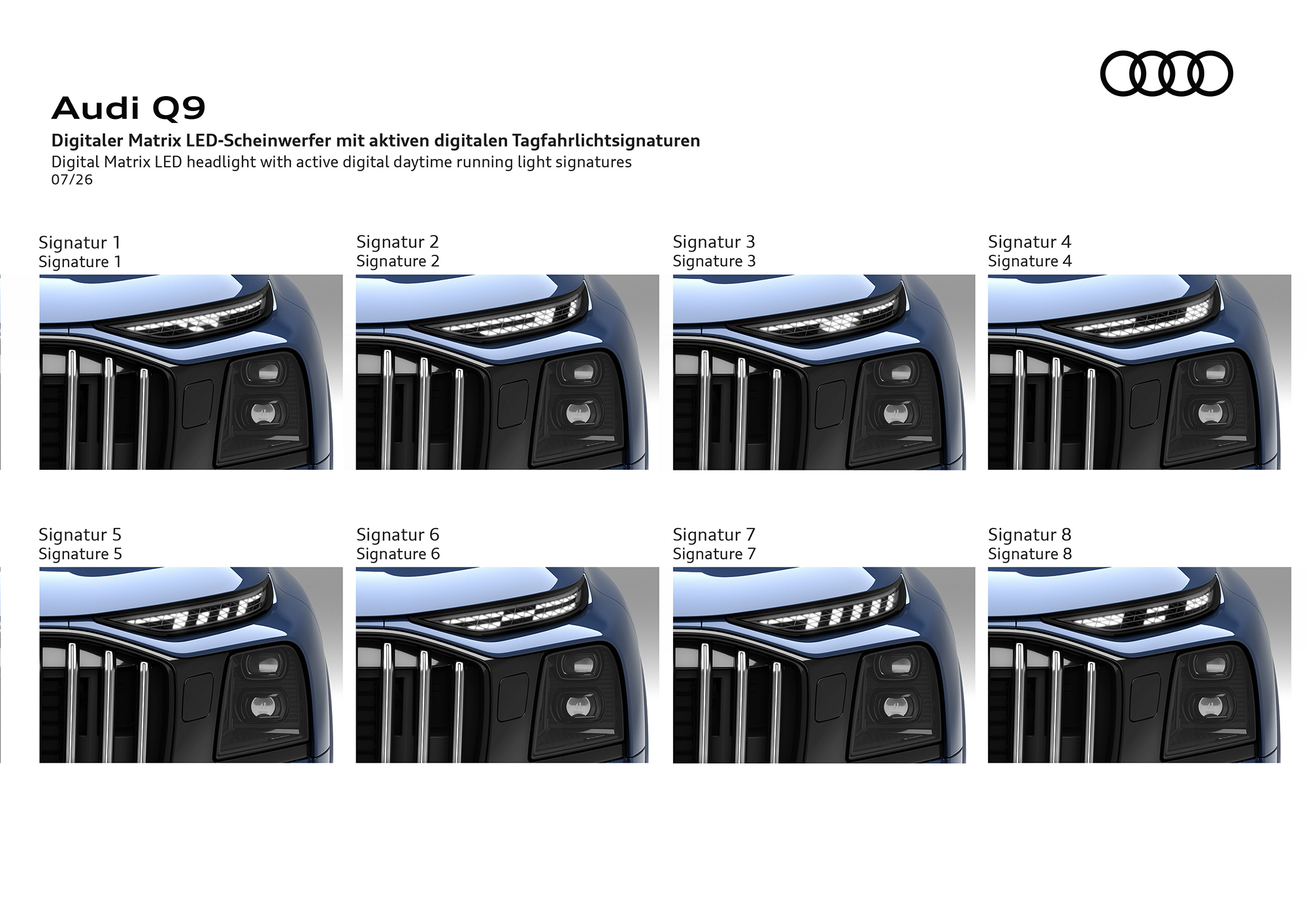
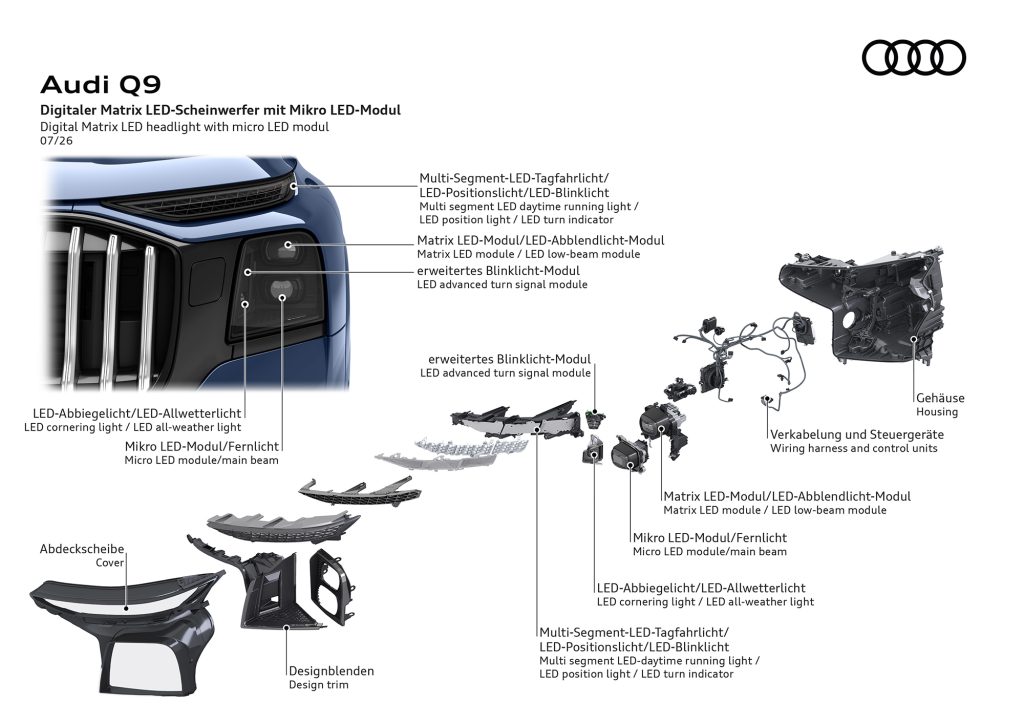
DIGITAL MATRIX LED HEADLIGHTS
The Q9 is equipped with Audi’s latest Digital Matrix LED headlight technology.
Each headlamp contains numerous individually controlled light sources capable of selectively illuminating portions of the road while masking areas occupied by oncoming or preceding traffic. This allows high-beam illumination to remain active over a much larger portion of the roadway without creating glare for other drivers.
The headlights continuously adapt their light distribution using information from the vehicle’s forward-facing cameras, navigation system and driver-assistance sensors. Illumination patterns change according to speed, steering angle, weather conditions and road type.
Beyond improving nighttime visibility, the Digital Matrix LED system forms the foundation for several of the Q9’s projection-based safety features.
ORIENTATION LIGHT
The orientation light assists the driver when traveling through road construction or areas with temporary lane markings.
When narrow lanes are detected, the headlights project visual guidance directly onto the pavement, helping the driver judge the vehicle’s position within the available lane width.
This function supplements the driver’s view without replacing normal lane markings or steering input.
PROJECTED LANE-CHANGE WARNING
When the blind-spot monitoring system detects another vehicle occupying an adjacent lane, the Digital Matrix LED headlights can project a warning symbol onto the roadway ahead.
Unlike a conventional warning light inside the cabin, the projection appears within the driver’s forward field of view, reducing the need to shift attention away from the road.
The projection works in conjunction with Audi’s Lane Change Assist and Exit Warning systems.
CONSTRUCTION-ZONE LIGHTING
Temporary construction zones often feature reduced lane widths and altered traffic patterns that differ from permanent road markings.
The Q9’s lighting system recognizes these conditions and adjusts its beam distribution to better define the available lane while reducing unnecessary illumination outside the construction corridor.
This function complements the orientation light by helping the driver maintain vehicle placement through restricted sections of roadway.
PEDESTRIAN MARKING LIGHT
The Digital Matrix LED headlights can visually highlight pedestrians located near the vehicle’s projected path.
Rather than simply increasing brightness, the system directs additional emphasis toward the pedestrian, making them more noticeable to the driver during nighttime operation.
The feature operates as a supplemental warning and does not replace the driver’s responsibility to monitor the roadway.
ICE-WARNING PROJECTION
When outside temperature and environmental conditions suggest an increased risk of ice, the Q9 can project an ice warning symbol onto the road surface ahead of the vehicle.
Presenting the warning within the driver’s normal field of vision reduces the need to divert attention toward the instrument cluster.
The projected warning supplements existing temperature and traction notifications provided through the vehicle’s displays.
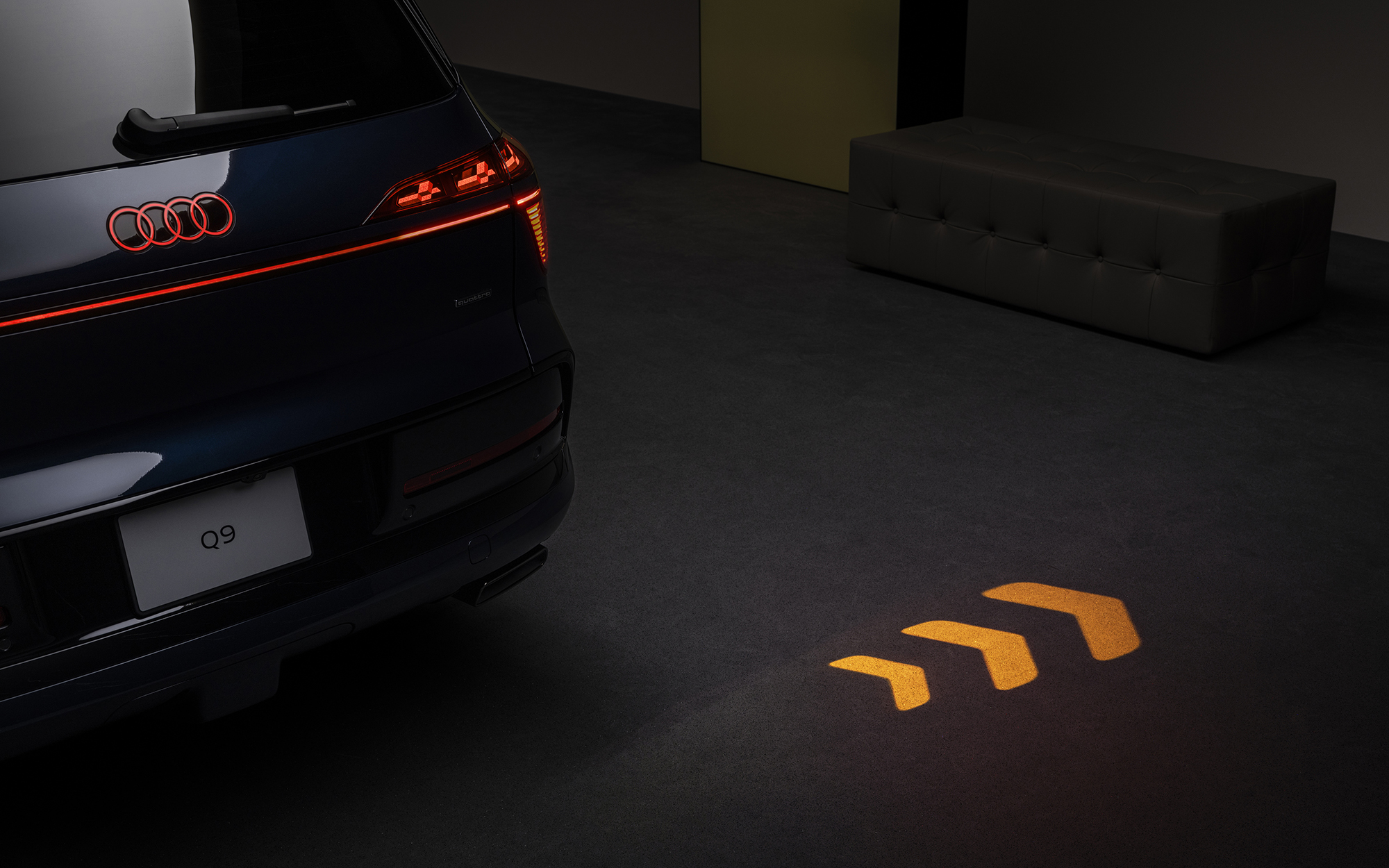
ADVANCED TURN SIGNALS
The Q9 expands Audi’s use of projected lighting by incorporating turn-signal animations designed to improve communication with other road users.
The lighting system produces more clearly defined directional indications while maintaining Audi’s characteristic dynamic turn-signal sequence.
Together with the Digital Matrix LED headlights and rear OLED lighting, the turn signals contribute to a more recognizable nighttime appearance.
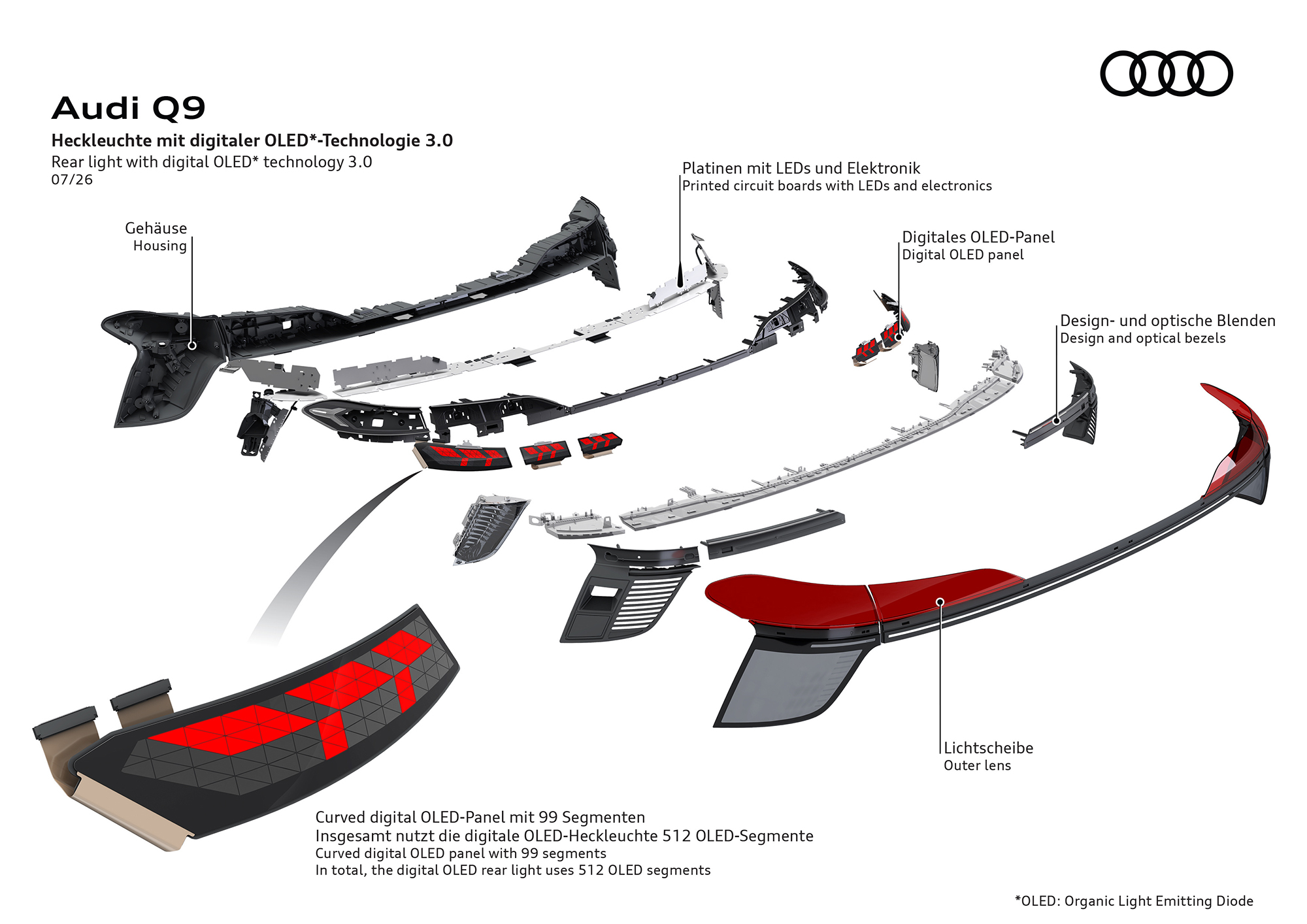
THIRD-GENERATION DIGITAL OLED REAR LIGHTS
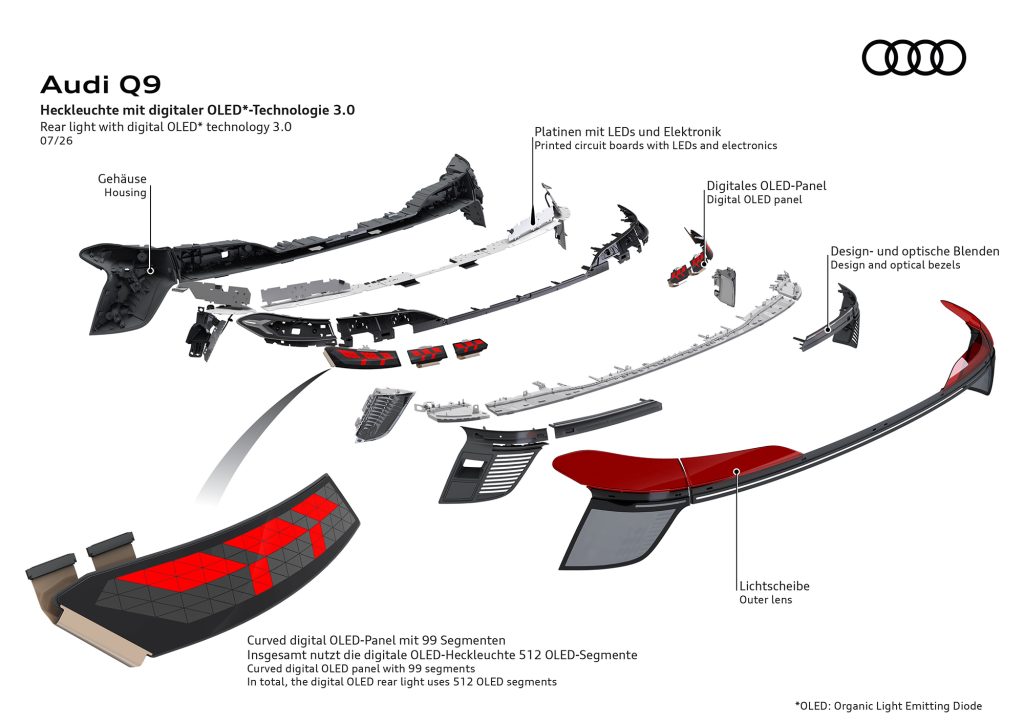
The Q9 introduces Audi’s third generation of digital OLED rear lighting.
Unlike conventional LED light bars, OLED technology generates light directly from organic light-emitting layers, allowing exceptionally uniform illumination without individual point light sources.
The curved construction of the Q9’s rear lamps allows the lighting elements to wrap farther around the rear corners of the vehicle while maintaining a continuous illuminated appearance across the tailgate.
The result is improved visibility from multiple viewing angles together with greater flexibility for digital lighting functions.
CURVED OLED TECHNOLOGY
Each rear lamp uses curved OLED panels shaped to follow the contours of the vehicle rather than relying on flat lighting elements.
The curved construction contributes to both styling and functionality by increasing the visible illuminated surface while improving integration with the rear bodywork.
Audi also uses the expanded surface area to support more complex lighting animations and communication functions.
OLED SEGMENTATION
The Q9’s rear lighting consists of hundreds of individually controlled OLED segments distributed across both rear lamp assemblies.
Audi states that the complete system contains 512 individually addressable segments.
This high level of segmentation allows the rear lighting to display numerous signatures, warning graphics and dynamic animations without requiring separate lighting elements.
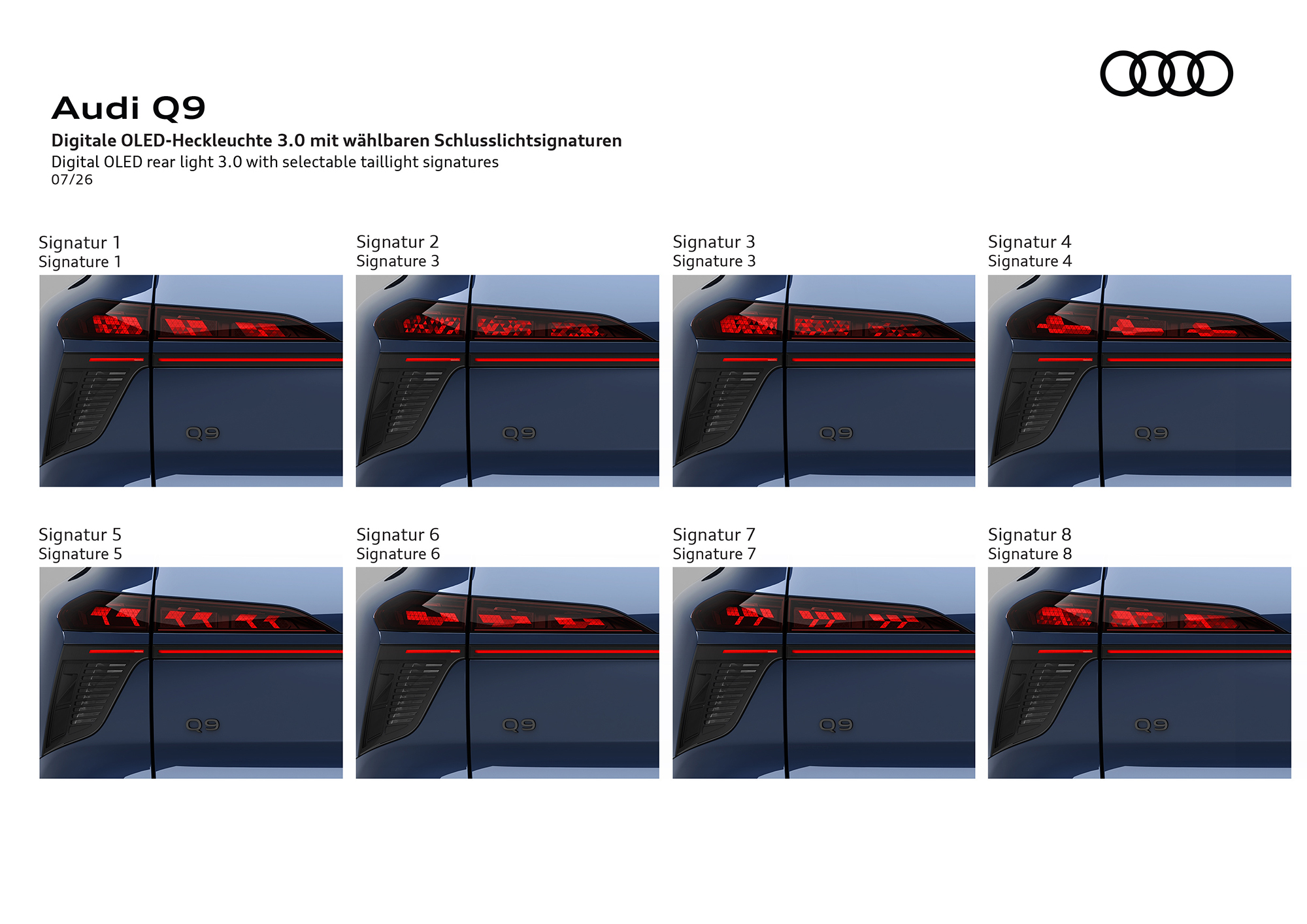
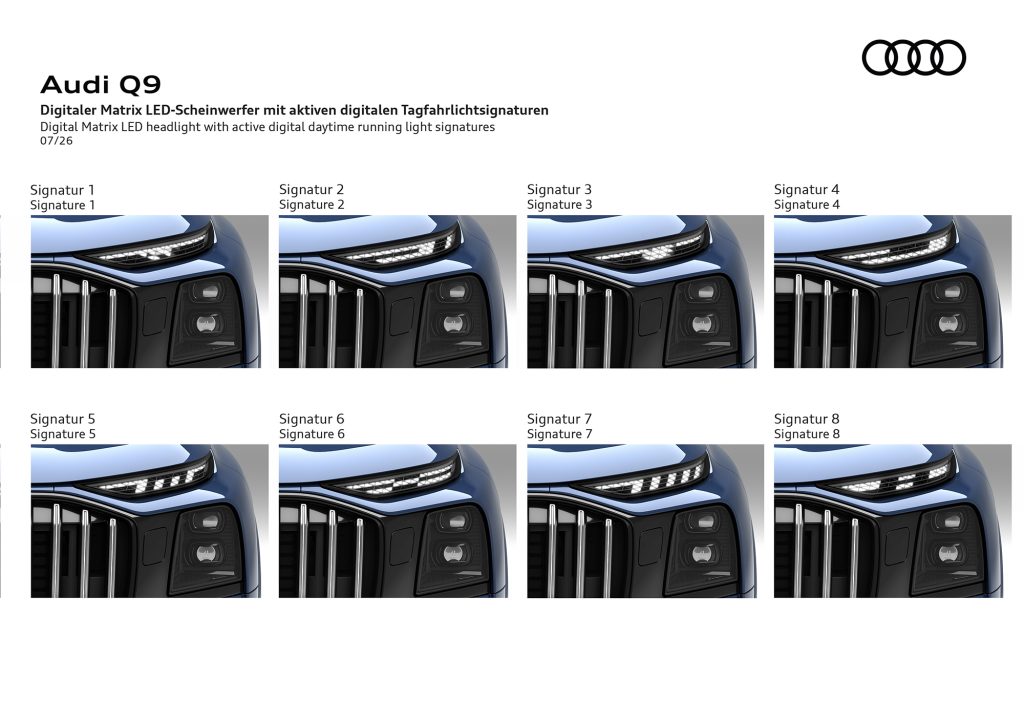
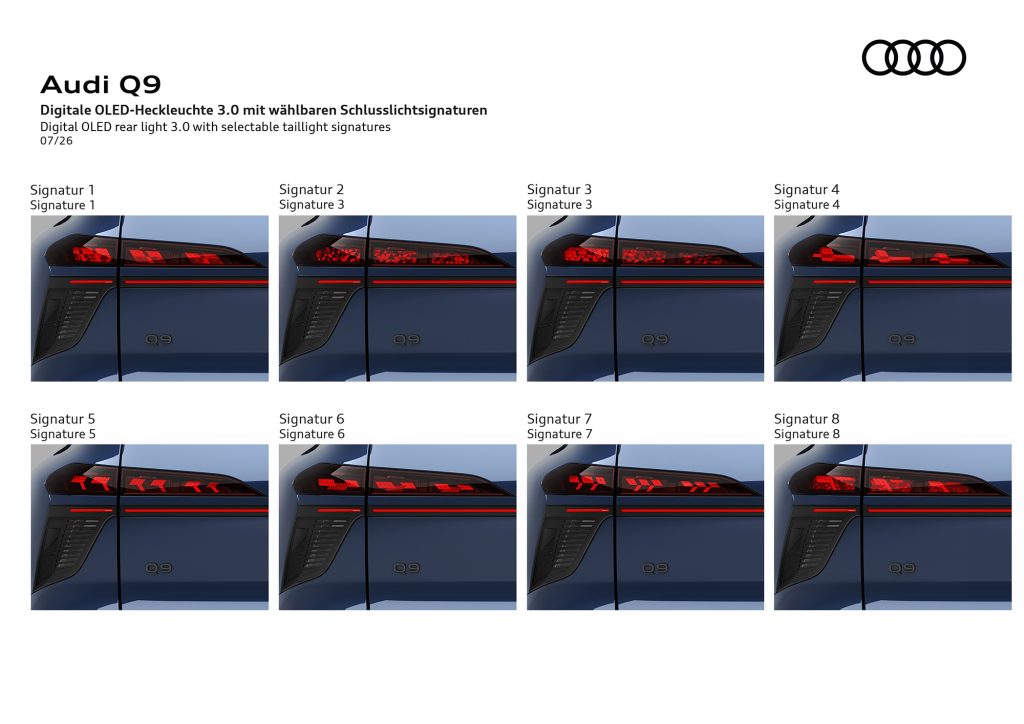
DIGITAL LIGHT SIGNATURES
Drivers can select from multiple daytime running light and rear-light signatures through the MMI.
Each signature changes the appearance of both the front and rear lighting while preserving the vehicle’s recognizable Audi identity.
The selected signature remains stored within the vehicle and can be changed without requiring hardware modifications.
PARTIALLY ACTIVE DIGITAL SIGNATURES
The Q9 introduces partially active digital signatures that subtly animate portions of the OLED lighting while the vehicle is in operation.
Rather than remaining completely static, selected lighting elements respond with carefully controlled movement, giving the rear lighting a more dynamic appearance without distracting surrounding traffic.
Audi describes these animations as an extension of the vehicle’s visual identity rather than decorative lighting effects.
COMMUNICATION LIGHT
The communication light allows the rear lighting system to display additional warning information to surrounding traffic.
When appropriate, portions of the OLED segments illuminate in specific patterns to indicate hazards or vehicle status.
The system works alongside existing brake lights, hazard flashers and warning indicators rather than replacing legally required lighting functions.
DOOR PROJECTION LIGHTING
Available projection lighting integrated into the doors illuminates the ground beside the vehicle when entering or exiting.
Beyond improving visibility in low-light conditions, the system enhances passenger convenience by clearly defining the stepping area adjacent to the vehicle.
Depending on specification, the projection can also display Audi graphics or welcome animations.
LIGHTING PHILOSOPHY
Since the introduction of LED daytime running lights in the early 2000s, lighting has become one of Audi’s defining areas of technological development. The Q9 continues that progression by treating lighting as an active communication system rather than a passive source of illumination.
Through the integration of Digital Matrix LED headlights, projection technology, third-generation curved OLED rear lamps and configurable digital signatures, the Q9 demonstrates Audi’s continued emphasis on using light to improve safety, provide information and establish a distinctive visual identity.
POWERTRAIN
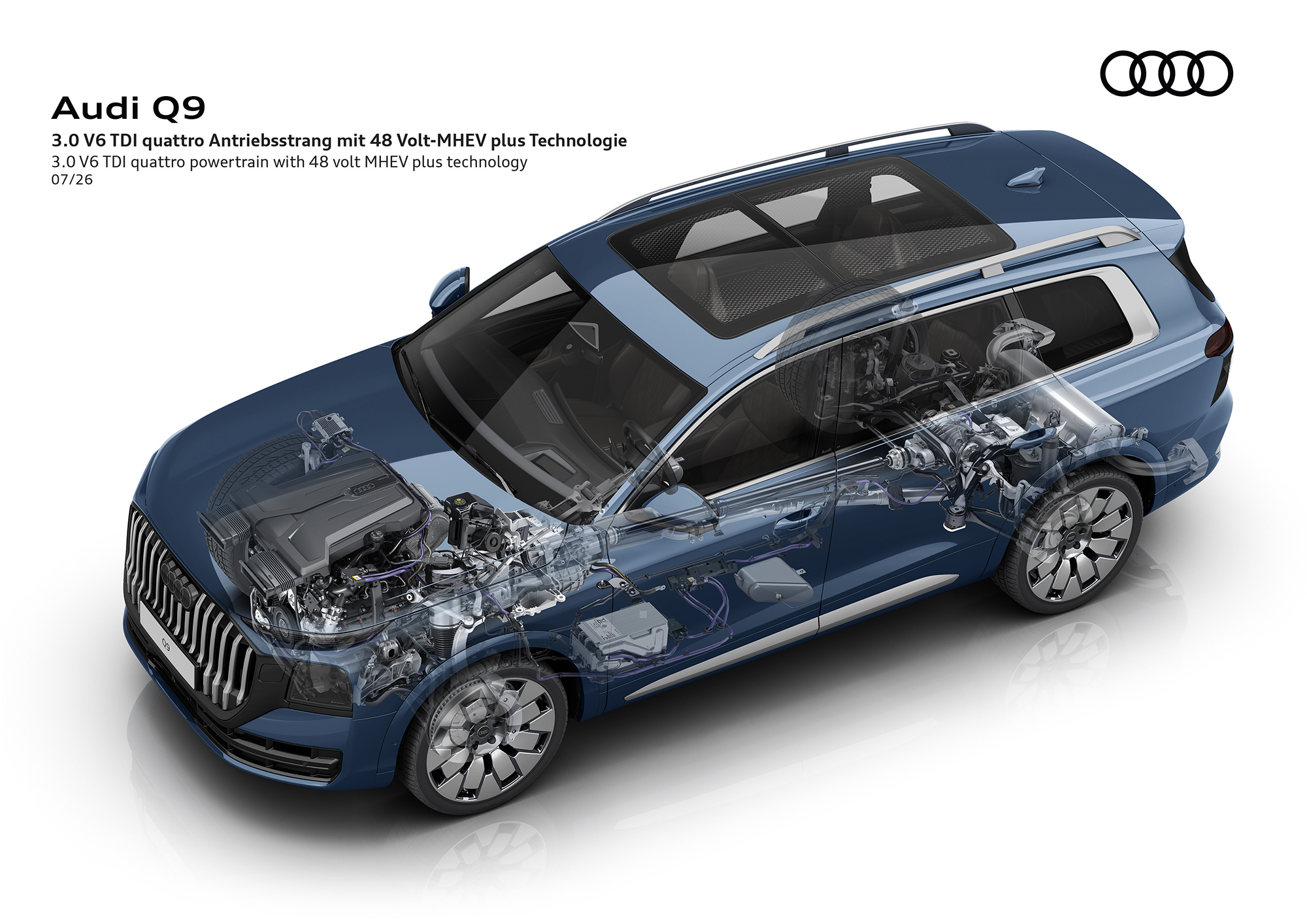
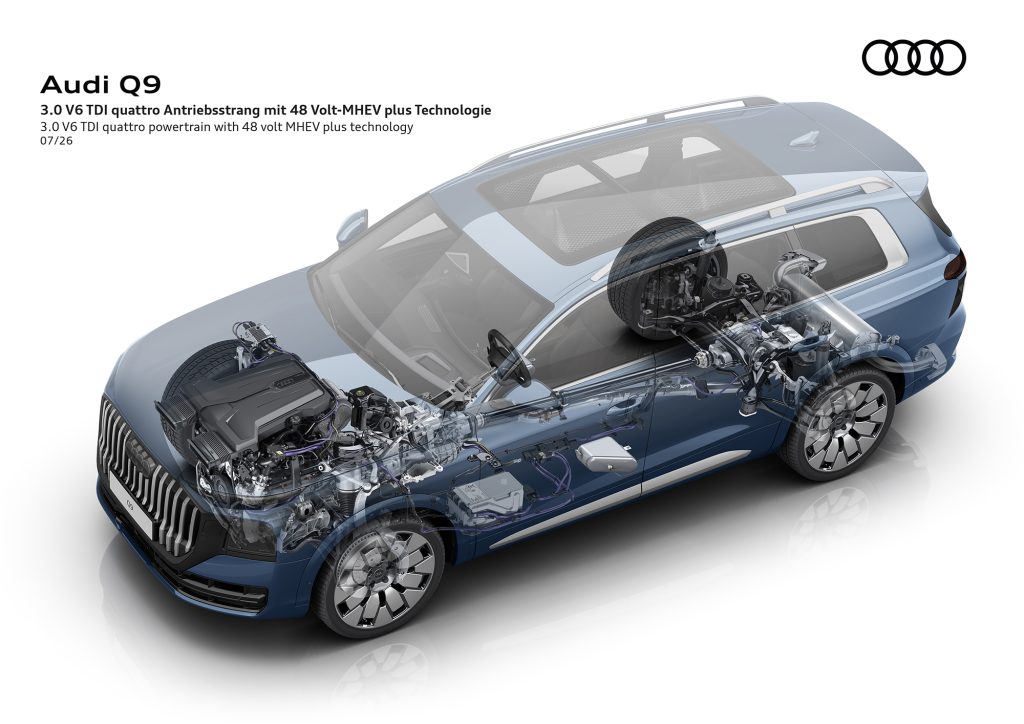
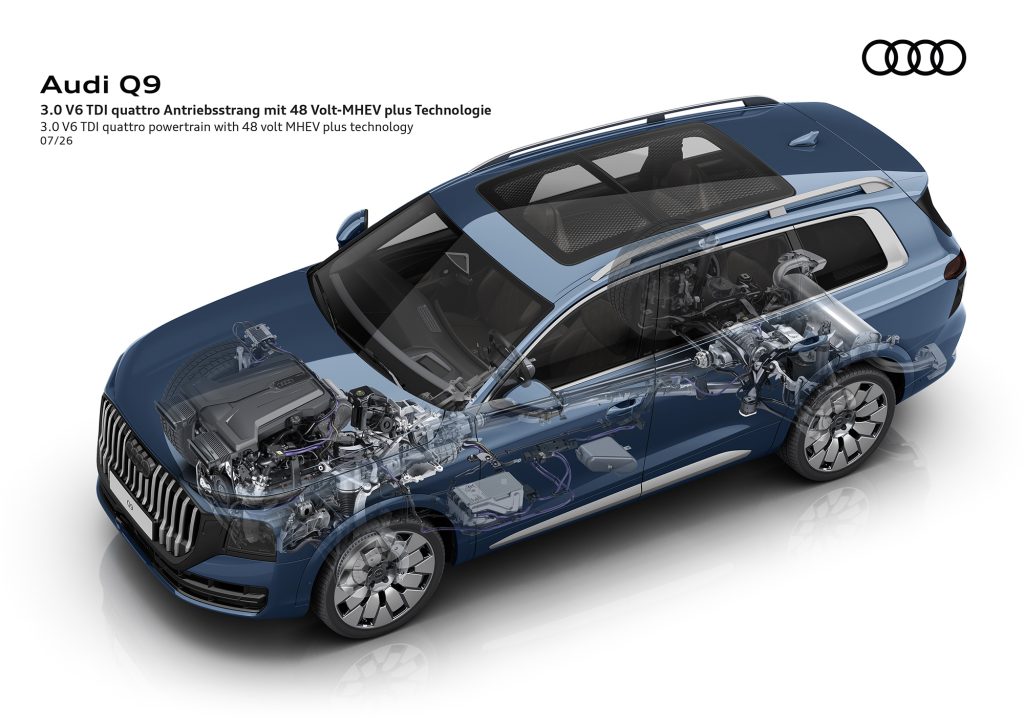
The German-market Audi Q9 is introduced with Audi’s latest generation 3.0-liter V6 TDI, an engine developed to deliver the low-speed torque, refinement and long-distance efficiency expected of a full-size luxury SUV. Rather than relying on engine displacement alone, Audi combines advanced turbocharging, electrification and energy recuperation to improve both responsiveness and fuel economy while meeting increasingly stringent emissions standards.
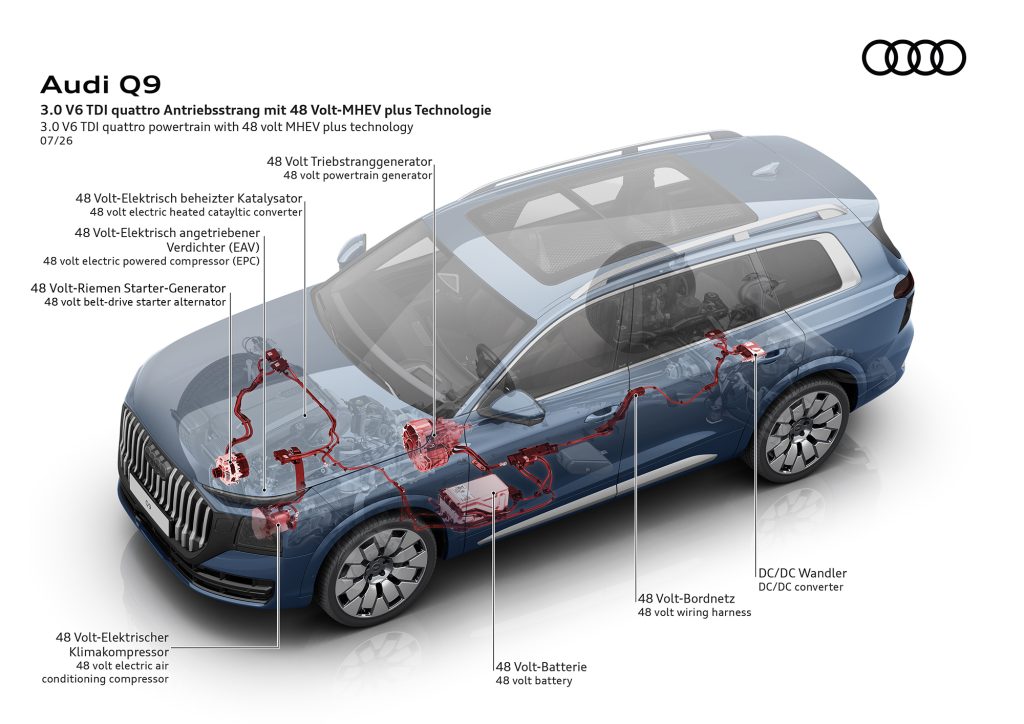
The Q9’s powertrain integrates several systems that operate together rather than independently. Two-stage turbocharging provides boost across a broad engine-speed range, while an electrically powered compressor improves throttle response before exhaust gas flow is sufficient to drive the turbochargers. The MHEV plus system contributes additional propulsion, enables energy recuperation and allows limited electric driving under suitable conditions.
Power is transmitted through an eight-speed tiptronic automatic transmission to Audi’s permanent quattro all-wheel-drive system. Adaptive air suspension is standard, allowing the powertrain and chassis to operate as an integrated system capable of adapting to changing road conditions and driver preferences.
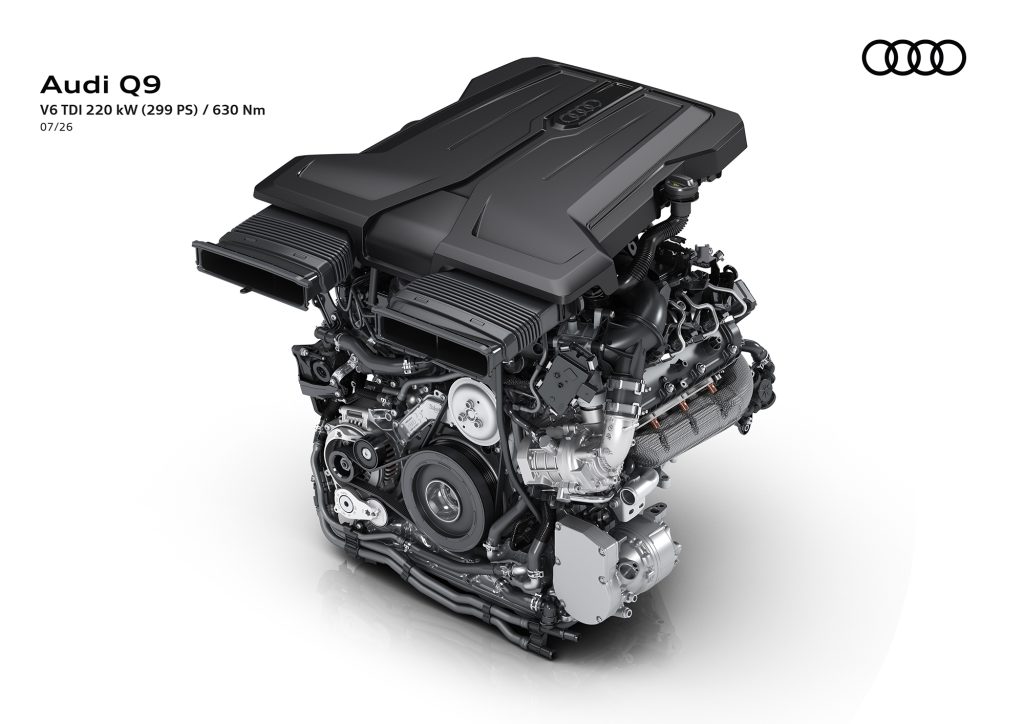
3.0-LITER V6 TDI
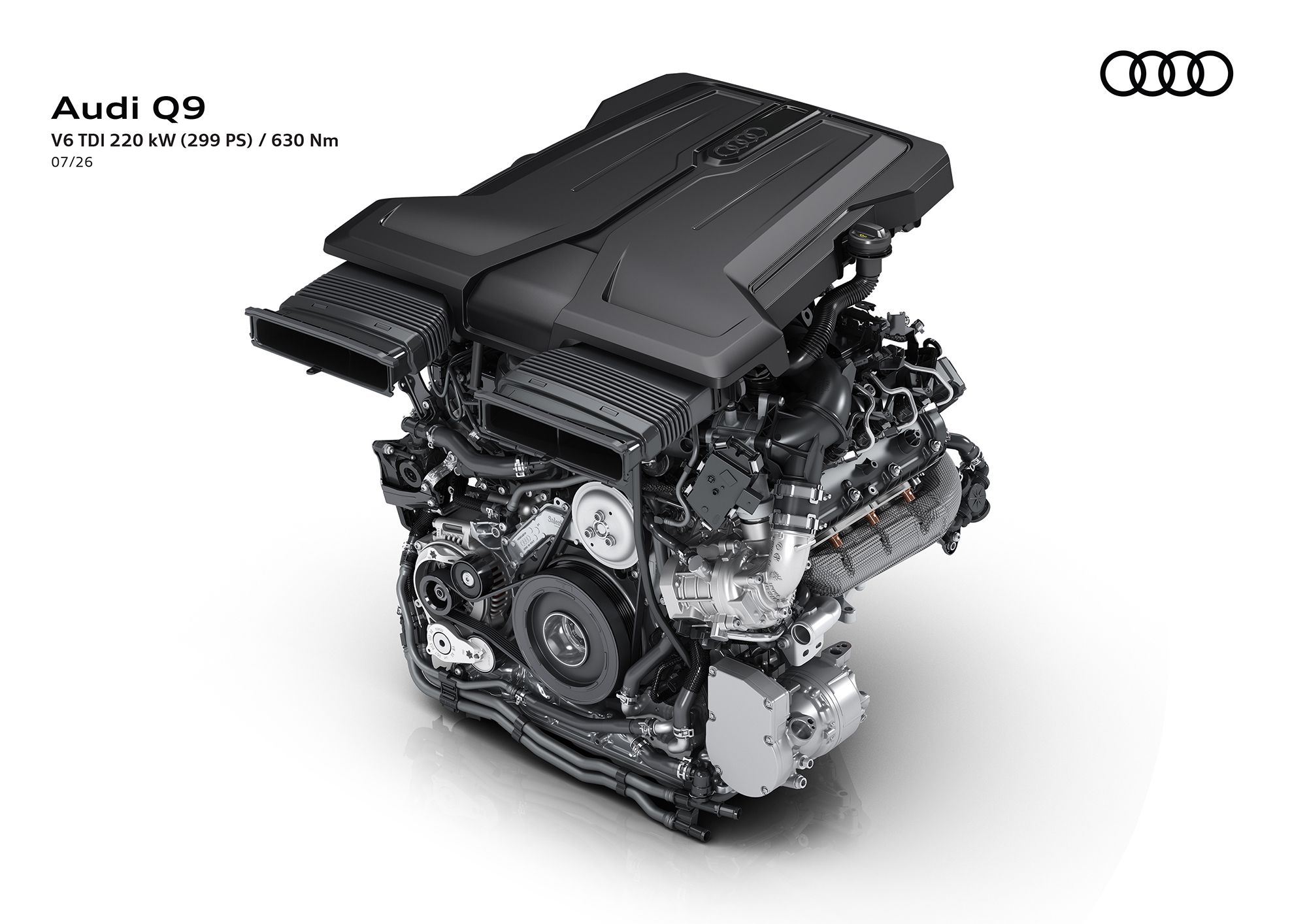
The German launch model is powered by a 3.0-liter turbocharged V6 diesel producing 220 kW (299 PS) and 630 Nm (465 lb-ft) of torque.
Audi also announced a lower-output version producing 180 kW (245 PS) and 500 Nm (369 lb-ft) for selected European markets. The German launch material does not confirm availability of this version within Germany.
The V6 TDI emphasizes effortless torque delivery rather than high engine speed. Peak torque is available across a broad operating range, allowing the Q9 to accelerate smoothly while carrying passengers, cargo or trailers with minimal engine effort.
The engine also serves as the foundation for Audi’s latest electrified diesel architecture through integration with the MHEV plus system.
ENGINE ARCHITECTURE
The launch material identifies the Q9’s powerplant as Audi’s latest 3.0-liter V6 TDI but does not publish its internal engine designation.
The engine uses a 90-degree V configuration with six cylinders, turbocharging and high-pressure common-rail direct fuel injection. Aluminum construction contributes to reduced weight while maintaining the structural rigidity required for high combustion pressures associated with modern diesel engines.
Audi continues to refine combustion efficiency through advanced thermal management, electronically controlled fuel delivery and emissions aftertreatment. While these systems operate largely without driver intervention, they play an important role in meeting European emissions regulations without compromising performance or refinement.
TWO-STAGE TURBOCHARGING
The Q9 employs sequential two-stage turbocharging to provide consistent boost pressure across a wide engine-speed range.
At lower engine speeds, the smaller turbocharger responds rapidly to exhaust flow, improving throttle response and reducing perceived turbo lag. As engine load and speed increase, the larger turbocharger progressively assumes a greater share of the airflow, maintaining boost pressure at higher engine speeds.
This staged arrangement enables the engine to deliver strong low-speed torque without sacrificing high-load performance, an important characteristic for a large luxury SUV expected to perform equally well during city driving, motorway cruising and towing.
ELECTRICALLY POWERED COMPRESSOR
Working alongside the turbocharging system is an electrically powered compressor (EPC), one of the defining technologies of Audi’s latest V6 diesel.
Unlike an exhaust-driven turbocharger, the EPC is powered electrically and can generate boost pressure before sufficient exhaust gas is available to accelerate the turbochargers.
The compressor develops up to 7.5 kW of peak output with a continuous operating capacity of 3.5 kW. Audi states that maximum absolute boost pressure of 3.6 bar can be achieved in approximately 1.2 seconds.
By reducing the delay normally associated with turbocharged engines, the EPC improves throttle response during initial acceleration and low-speed operation while allowing the larger turbocharger to prioritize sustained performance once exhaust energy increases.
MHEV PLUS
The Q9 introduces Audi’s latest MHEV plus mild-hybrid system for the V6 TDI.
Unlike earlier mild-hybrid systems that primarily supported engine restarting and energy recuperation, MHEV plus contributes directly to propulsion under suitable driving conditions. The system can provide up to 18 kW (24 PS) of additional drive power while also recovering energy during braking and deceleration.
A belt alternator starter performs engine starting duties while the powertrain generator assists with propulsion and recuperation.
Audi also allows limited electric driving during low-load situations such as parking maneuvers, slow-moving traffic and coasting, reducing fuel consumption while improving refinement.
LITHIUM IRON PHOSPHATE BATTERY
Electrical energy for the MHEV plus system is stored within a lithium iron phosphate (LFP) battery.
Audi selected LFP chemistry for its durability, thermal stability and ability to tolerate repeated charging and discharging cycles associated with mild-hybrid operation.
The battery stores energy recovered during deceleration and supplies electrical power to both the powertrain generator and electrically powered compressor as operating conditions require.
ENERGY RECUPERATION
The Q9 continuously recovers kinetic energy that would otherwise be lost during braking and deceleration.
Recovered energy is stored within the hybrid battery and later reused to assist propulsion or operate electrically driven systems.
The transition between propulsion, recuperation and conventional braking is managed automatically without requiring driver input.
EIGHT-SPEED TIPTRONIC
Power is transmitted through an eight-speed tiptronic automatic transmission.
The transmission provides closely spaced lower gears to improve initial acceleration while taller upper ratios reduce engine speed during highway cruising, contributing to lower fuel consumption and improved acoustic comfort.
Shift operation is electronically coordinated with the engine management system, hybrid components and quattro drivetrain to optimize both performance and efficiency.
DRIVETRAIN
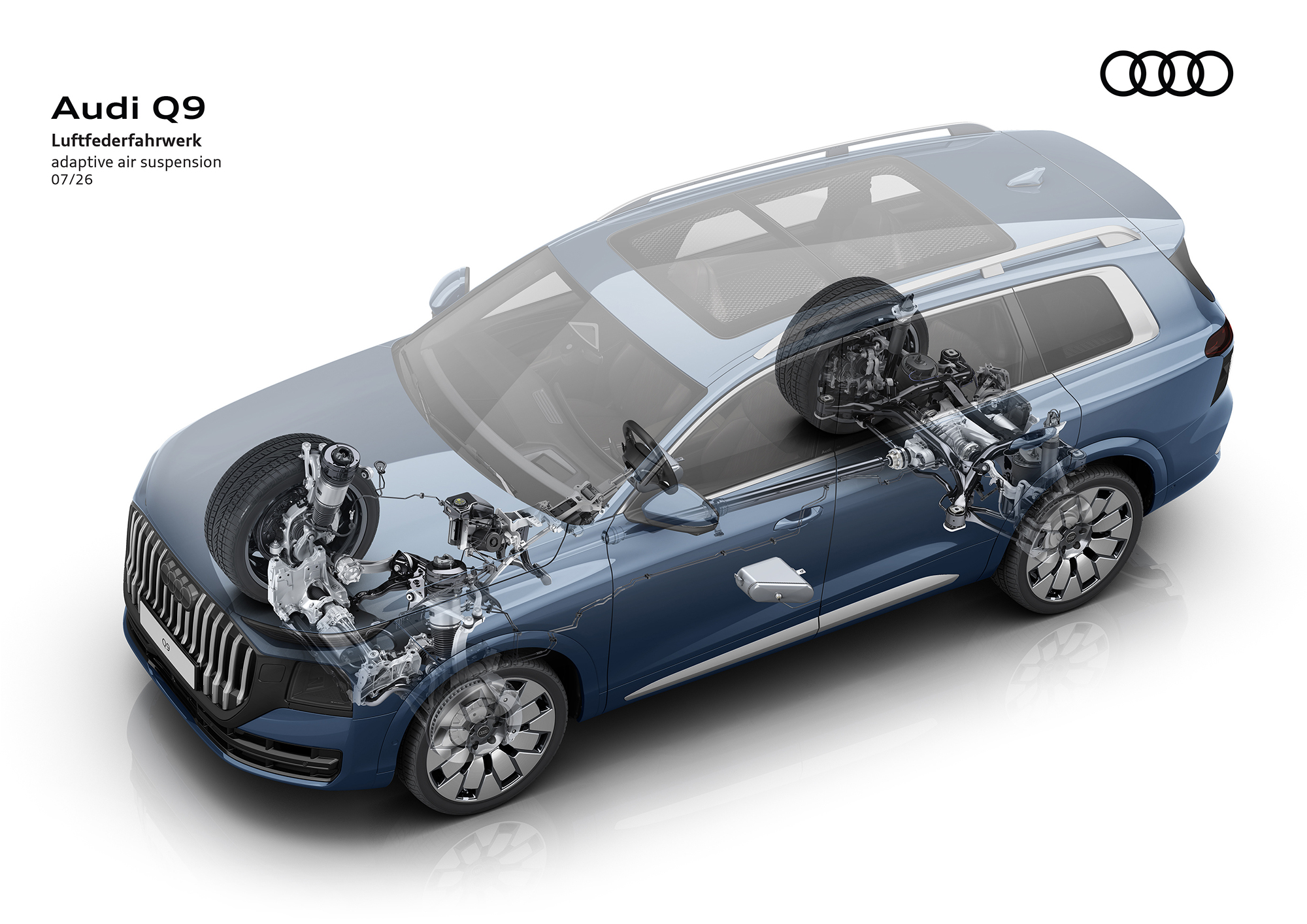
The Q9 employs Audi’s permanent quattro all-wheel-drive system as standard equipment.
Unlike systems that primarily operate in front- or rear-wheel drive before engaging the opposite axle, permanent quattro continuously distributes engine torque to both axles. This provides consistent traction under changing weather and road conditions while contributing to the stable handling characteristics traditionally associated with Audi’s longitudinal-engine vehicles.
The German launch material identifies the system simply as permanent quattro all-wheel drive and does not publish additional technical information regarding the center differential or nominal torque distribution.
PERMANENT QUATTRO
Permanent quattro forms the foundation of the Q9’s drivetrain.
By continuously supplying torque to both axles, the system improves traction during acceleration, enhances stability on low-friction surfaces and contributes to predictable vehicle behavior during changing road conditions.
Its integration with the transmission, stability-control system and adaptive air suspension allows torque delivery to complement the vehicle’s broader chassis-control strategy.
TORQUE DISTRIBUTION
Audi does not publish the nominal front-to-rear torque split for the Q9.
Likewise, the launch material does not identify the center differential design or specify how torque is redistributed under changing traction conditions.
Until official technical documentation becomes available, these characteristics should remain unspecified within the archive.
CHASSIS
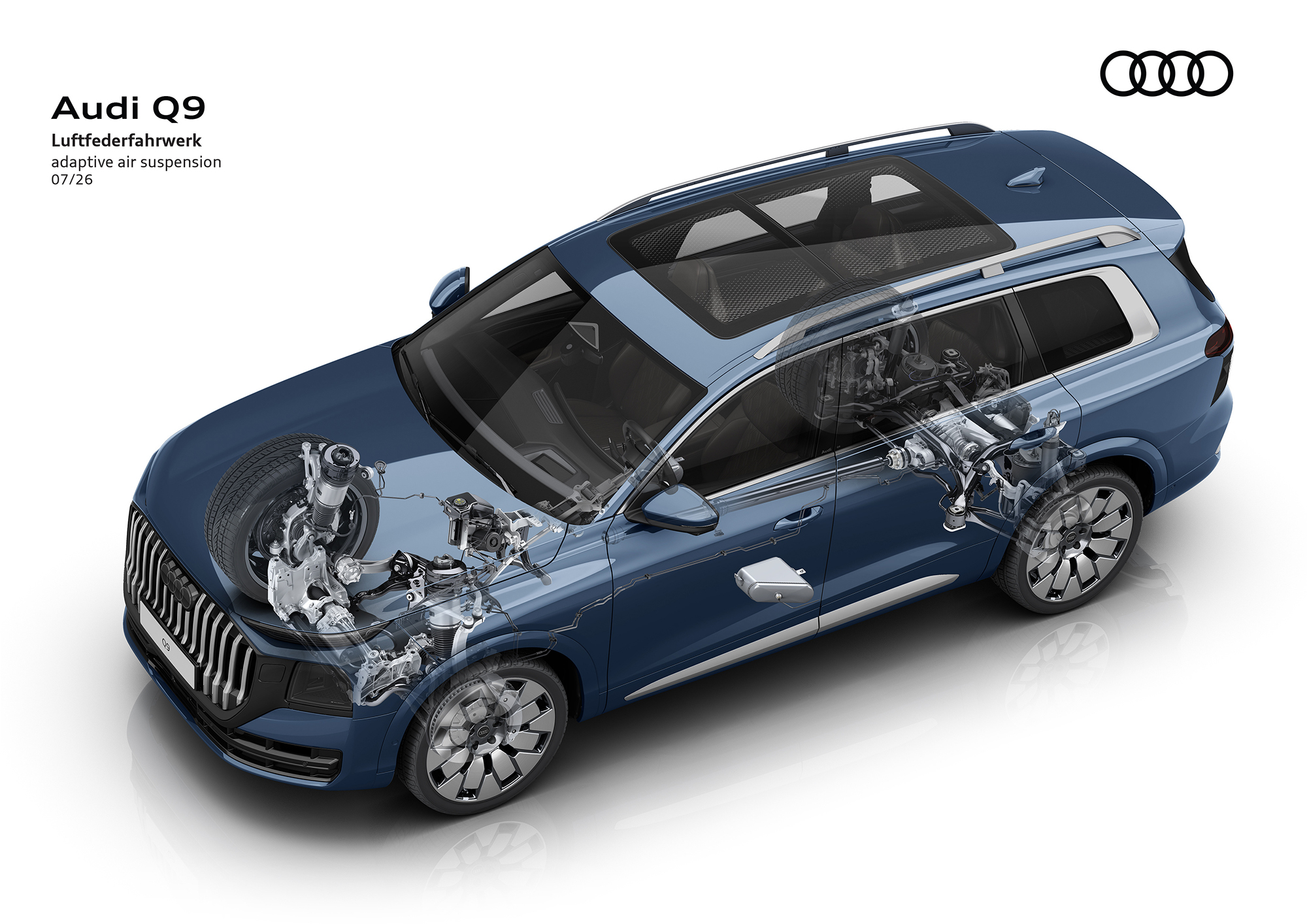
The Q9’s chassis combines adaptive suspension, all-wheel steering and electronically coordinated vehicle dynamics to balance comfort with stability.
Although developed primarily as a luxury SUV, the chassis places considerable emphasis on maintaining consistent body control despite the vehicle’s size. Air suspension, progressive steering and multiple drive modes allow the Q9 to adapt its ride and handling characteristics according to driving conditions and driver preference.
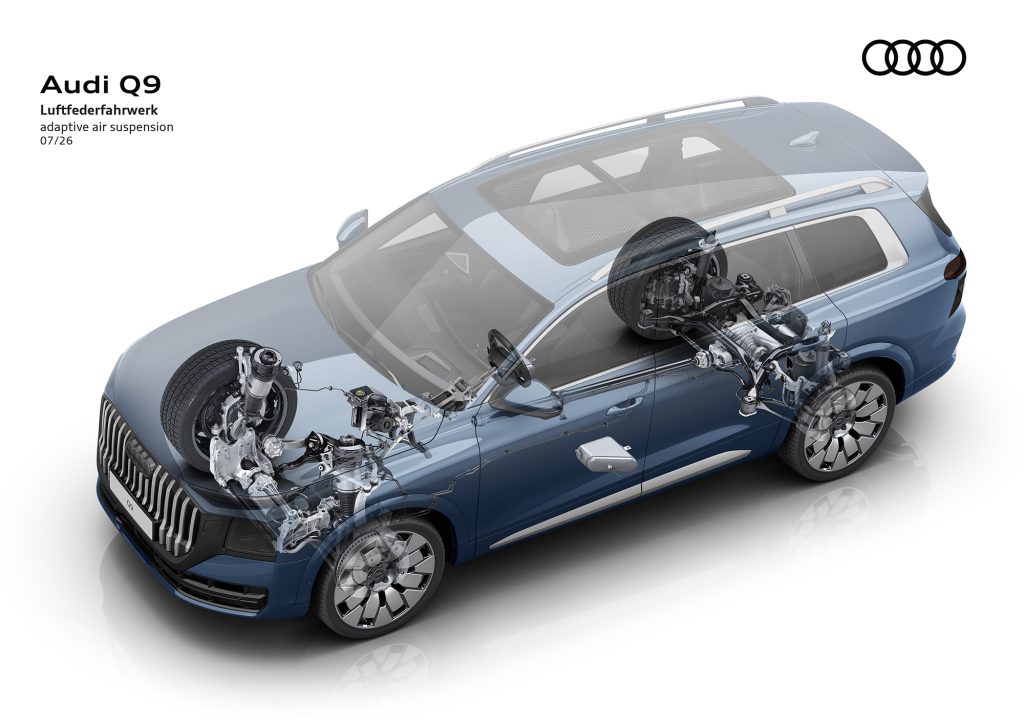
ADAPTIVE AIR SUSPENSION
Adaptive air suspension is standard on the Q9.
Electronically controlled air springs automatically adjust ride height and spring characteristics in response to vehicle speed, load and the selected Audi drive select mode.
The system contributes to passenger comfort while maintaining consistent ride height regardless of occupancy or cargo weight.
ADAPTIVE AIR SUSPENSION SPORT
An optional adaptive air suspension sport system provides a wider operating range together with more dynamic suspension calibration.
Compared with the standard system, the sport version emphasizes body control while retaining the ability to vary ride height according to operating conditions.
Total suspension travel across the available ride-height settings is approximately 90 mm.
ALL-WHEEL STEERING
Available all-wheel steering turns the rear wheels by up to five degrees.
At lower speeds the rear wheels steer opposite the front wheels, reducing the turning circle and improving maneuverability in confined spaces.
At higher speeds the rear wheels steer in the same direction as the front wheels, increasing directional stability during lane changes and high-speed driving.
PROGRESSIVE STEERING
Progressive steering varies the steering ratio according to steering angle.
Small steering inputs around center promote stable highway driving, while larger steering inputs reduce the amount of steering-wheel movement required during tighter maneuvers.
The result is a steering system that balances stability with ease of maneuvering.
AUDI DRIVE SELECT
Audi drive select allows the driver to tailor multiple vehicle characteristics through selectable driving modes.
Depending on the chosen mode, the system adjusts parameters including:
- Powertrain response
- Transmission shift strategy
- Steering assistance
- Suspension characteristics
- Ride height
- Hybrid operation
These systems work together to provide distinct driving characteristics without requiring manual adjustment of individual components.
BRAKING SYSTEM
The Q9 employs ventilated disc brakes at all four wheels.
Front brakes measure 400 mm in diameter and use composite brake discs with six-piston fixed calipers. Rear brakes measure 350 mm and also utilize ventilated discs.
Standard brake calipers are finished in gray, while red calipers are available as an option.
The braking system is electronically integrated with the MHEV plus energy recuperation system, allowing regenerative braking and conventional hydraulic braking to operate together according to driving conditions.
DRIVER ASSISTANCE
The Audi Q9 incorporates the company’s most comprehensive suite of driver-assistance systems available at launch, combining cameras, radar sensors, ultrasonic sensors and digital mapping to support the driver during highway travel, urban driving, parking and trailer operation.
Rather than functioning as isolated technologies, many of the Q9’s assistance systems communicate with one another. Information gathered by the vehicle’s sensor network influences steering assistance, adaptive cruise control, lighting functions, parking assistance and the operation of the automatic doors. This integrated approach reflects Audi’s continued development of advanced driver assistance while remaining within the framework of SAE Level 2 automation.
SENSOR ARCHITECTURE
The Q9 continuously monitors its surroundings using a combination of forward- and rear-facing cameras, radar sensors and ultrasonic sensors positioned throughout the vehicle.
Information from these sensors is processed alongside navigation data and vehicle-speed information to support the operation of driver-assistance, parking and safety systems.
Because multiple systems rely on the same sensor network, information gathered for one function can also improve the performance of others, allowing the vehicle to respond more intelligently to changing driving conditions.
ADAPTIVE DRIVING ASSISTANT PLUS
Adaptive Driving Assistant Plus represents Audi’s most advanced highway-driving assistance system available for the Q9.
When operating on approved motorway sections, the system combines adaptive cruise control with lane-centering assistance to manage acceleration, braking and steering simultaneously.
Audi also introduces hands-free operation under approved conditions. At speeds of up to 130 km/h (81 mph), the driver may remove both hands from the steering wheel while the system remains active, provided continuous supervision of the roadway is maintained.
The driver must remain attentive and prepared to immediately resume control whenever requested by the vehicle.
ASSISTED LANE CHANGES
When the driver requests a lane change using the turn signal, Adaptive Driving Assistant Plus can assist with steering into the adjacent lane after confirming that the maneuver can be completed safely.
The system evaluates surrounding traffic using radar and camera data before initiating the maneuver.
Responsibility for monitoring traffic conditions remains with the driver.
DRIVER MONITORING
An interior camera continuously evaluates driver attentiveness while assistance systems are active.
If reduced attention is detected, the vehicle provides progressively stronger visual, audible and tactile warnings requesting that the driver resume active supervision.
The monitoring system forms an essential part of the Q9’s hands-free driving capability.
EMERGENCY ASSIST
If the driver fails to respond to repeated warnings while Adaptive Driving Assistant Plus is engaged, Emergency Assist initiates a controlled response.
The system attempts to regain the driver’s attention before gradually reducing vehicle speed and bringing the Q9 to a controlled stop when necessary.
Hazard warning lights are activated during the maneuver to alert surrounding traffic.
STEERING TO SHOULDER
Where road markings and surrounding conditions permit, Emergency Assist can guide the Q9 toward the shoulder before stopping.
This function is intended to reduce the likelihood of the vehicle coming to rest within an active traffic lane.
Availability depends upon roadway design, lane markings and local regulations.
AUTOMATIC EMERGENCY BRAKING
The front collision mitigation system monitors vehicles, pedestrians and cyclists ahead of the Q9.
When a potential collision is identified, the system first warns the driver before applying automatic braking if necessary to reduce collision severity or, where possible, avoid impact altogether.
LANE DEPARTURE WARNING
Lane Departure Warning monitors lane markings and alerts the driver if the vehicle begins to drift unintentionally from its lane.
Depending on driving conditions, corrective steering input may also be provided to assist the driver in returning the vehicle toward the center of the lane.
LANE CHANGE ASSIST
Lane Change Assist monitors adjacent lanes using rear-mounted radar sensors.
When another vehicle occupies the driver’s blind spot or is approaching rapidly from behind, the system provides a visual warning before a lane change is initiated.
This information also supports the projected lane-change warning displayed by the Digital Matrix LED headlights.
EXIT WARNING
Exit Warning monitors approaching traffic after the vehicle has stopped.
If another vehicle, cyclist or pedestrian is approaching from behind, the system warns occupants before a door is opened.
On vehicles equipped with automatic doors, Exit Warning can also prevent or interrupt door movement until it is safe to exit.
REAR CROSS-TRAFFIC ASSIST
When reversing, Rear Cross-Traffic Assist monitors traffic approaching from either side.
Visual and audible warnings help alert the driver to vehicles that may not yet be visible through the rear window or mirrors.
PARK ASSIST
The Q9 supports multiple parking-assistance functions using its integrated sensor network.
A 360-degree camera system provides a comprehensive view of the area surrounding the vehicle, while automated parking functions assist with steering during suitable parking maneuvers.
Parking guidance is displayed through the MMI and Audi virtual cockpit.
TRAILER ASSISTANCE
Recognizing the Q9’s role as a luxury SUV expected to tow large trailers, Audi incorporates several trailer-specific assistance systems.
Trailer Maneuvering Assist supports low-speed reversing by automatically controlling steering inputs while the driver manages throttle and braking.
Trailer Stability Control helps detect trailer sway and applies corrective braking when necessary to improve stability.
An integrated trailer brake controller coordinates braking performance between the vehicle and trailer where compatible equipment is installed.
PRODUCTION
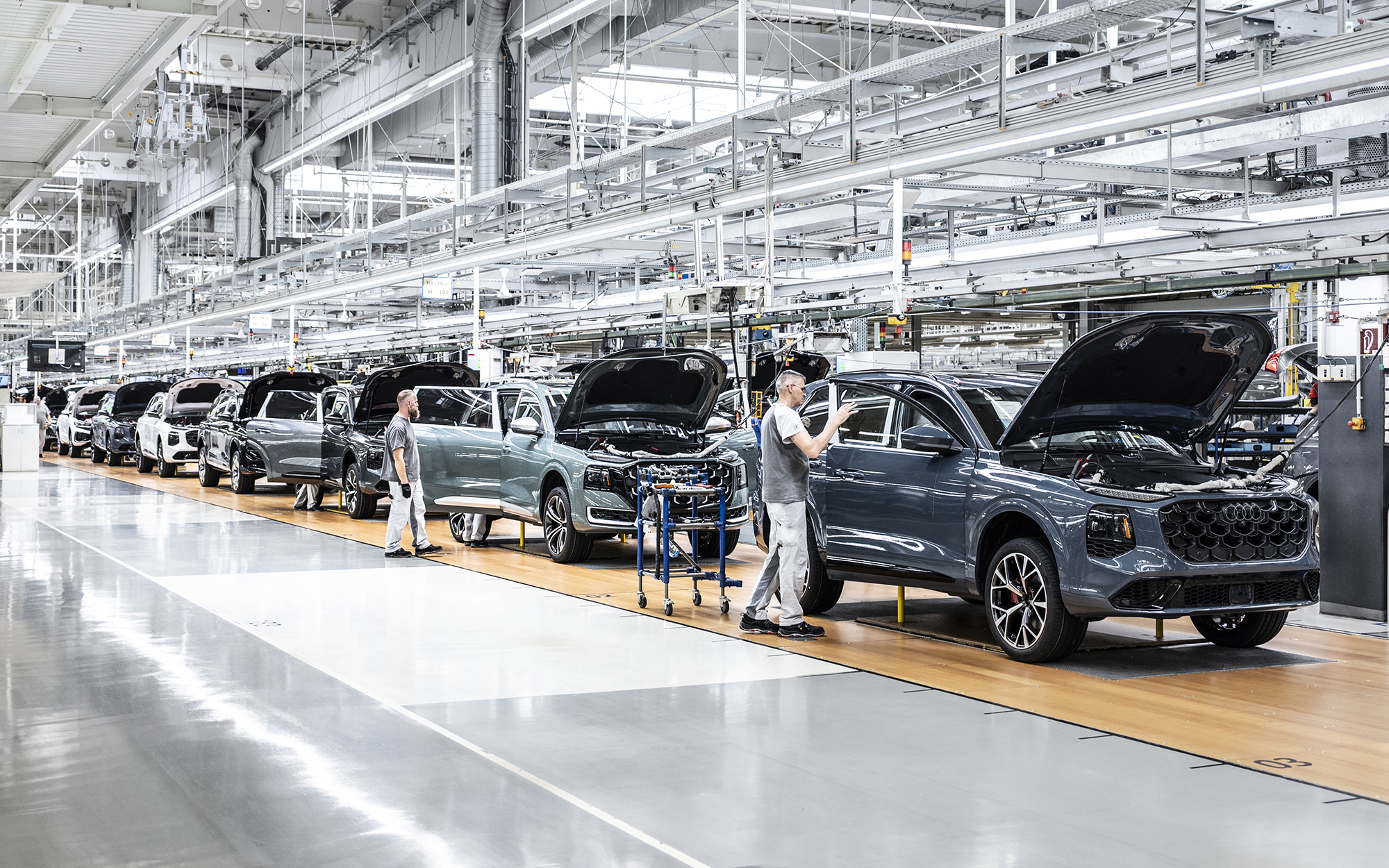
The Audi Q9 is manufactured at the Volkswagen Group plant in Bratislava, Slovakia.
The facility has produced several of the group’s largest premium SUVs and possesses extensive experience with longitudinal powertrains, all-wheel-drive systems and luxury vehicle assembly.
German order books opened at the end of July 2026.
Customer deliveries were scheduled to begin in November 2026 with the 220 kW (299 PS) Q9 TDI quattro serving as the initial launch model.
The Q9 entered the German market with a starting price of €108,400.
Audi also announced a lower-output 180 kW (245 PS) V6 TDI for selected European markets, although its availability in Germany was not confirmed within the launch documentation.
TECHNICAL SPECIFICATIONS
MODEL
Model: Audi Q9 TDI quattro
Market: Germany
Body style: Five-door full-size luxury SUV
Assembly: Bratislava, Slovakia
ENGINE
Configuration: 3.0-liter turbocharged V6 TDI
Maximum output: 220 kW (299 PS)
Maximum torque: 630 Nm (465 lb-ft)
Fuel system: Common-rail direct injection
Turbocharging: Sequential two-stage turbocharging
Electrically powered compressor: Standard
MHEV plus: Standard
TRANSMISSION
Type: Eight-speed tiptronic automatic
Drive system: Permanent quattro all-wheel drive
CHASSIS
Front brakes: 400 mm ventilated composite discs with six-piston fixed calipers
Rear brakes: 350 mm ventilated discs
Standard suspension: Adaptive air suspension
Optional suspension: Adaptive air suspension sport
Rear-wheel steering: Optional
Maximum rear steering angle: Five degrees
WHEELS
Available diameters: 20–23 inches
Acoustic tire foam: Standard on 22- and 23-inch tire packages
DIMENSIONS
Length: 5,310 mm (209.1 in)
Width: 2,210 mm (87.0 in)*
Height: 1,810 mm (71.3 in)
Wheelbase: 3,140 mm (123.6 in)
*Audi does not specify whether the published width includes exterior mirrors.
PERFORMANCE
Audi did not publish official acceleration or maximum-speed figures within the German launch material.
FUEL CONSUMPTION (WLTP)
Combined fuel consumption: 8.0–7.4 l/100 km
Combined CO₂ emissions: 209–194 g/km
CO₂ class: G
MARKET
Orders open: End of July 2026
First customer deliveries: November 2026
German starting price: €108,400
HISTORICAL SIGNIFICANCE
The Q9 represents an important milestone in Audi’s continuing evolution of the luxury SUV. It is the company’s first production model to use the number 9, establishing a new flagship position above the Q7 and Q8 while expanding Audi’s presence within the full-size luxury SUV segment.
Beyond its dimensions, the Q9 demonstrates a broader shift in Audi’s interpretation of a flagship vehicle. Earlier flagship models often emphasized engine performance, quattro technology or lightweight construction as defining characteristics. While those engineering principles remain central to the Q9, equal emphasis is now placed on passenger experience through digital technology, interior flexibility, lighting innovation and integrated comfort systems.
The Q9 also introduces several technologies to Audi production, including automatic power-operated doors, hands-free highway driving through Adaptive Driving Assistant Plus, third-generation curved digital OLED rear lighting and one of the company’s most advanced implementations of Digital Matrix LED headlights. Rather than existing as isolated features, these systems operate together to improve safety, communication and passenger comfort.
From an engineering perspective, the German-market Q9 also demonstrates Audi’s continued commitment to advanced diesel technology. By combining the latest generation V6 TDI with two-stage turbocharging, an electrically powered compressor and MHEV plus electrification, Audi continues to refine the diesel engine for long-distance efficiency and immediate responsiveness rather than replacing it outright.
As introduced in 2026, the Q9 establishes a new direction for Audi’s largest passenger vehicles, combining traditional mechanical engineering with increasingly sophisticated digital systems in a platform designed equally for family transportation, executive travel and extended-distance touring.
GALLERY
ARCHIVE NOTES
This archive documents the German-market Audi Q9 as introduced in July 2026.
Several technical details had not yet been published by Audi at the time of launch and have therefore been intentionally omitted rather than inferred from related models.
Areas for future expansion include:
- Complete exterior paint catalog
- Audi exclusive paint availability
- Wheel designs and tire specifications
- Detailed cargo-capacity figures
- Official towing capacities
- Acceleration and top-speed data
- Vehicle weight and axle-load specifications
- Fuel-tank and AdBlue capacities
- Complete suspension geometry
- Internal engine and platform designations where officially confirmed
- Long-term production changes and model-year revisions
Future revisions should continue to distinguish between officially published Audi documentation and subsequently confirmed technical information, preserving the archive as a factual reference rather than a compilation of assumptions or market speculation.