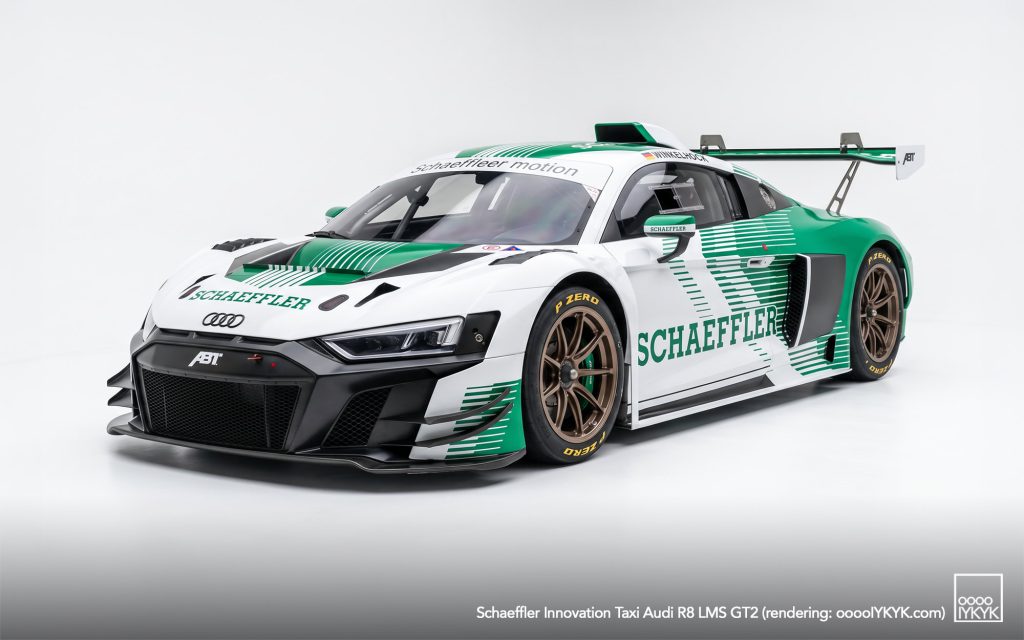

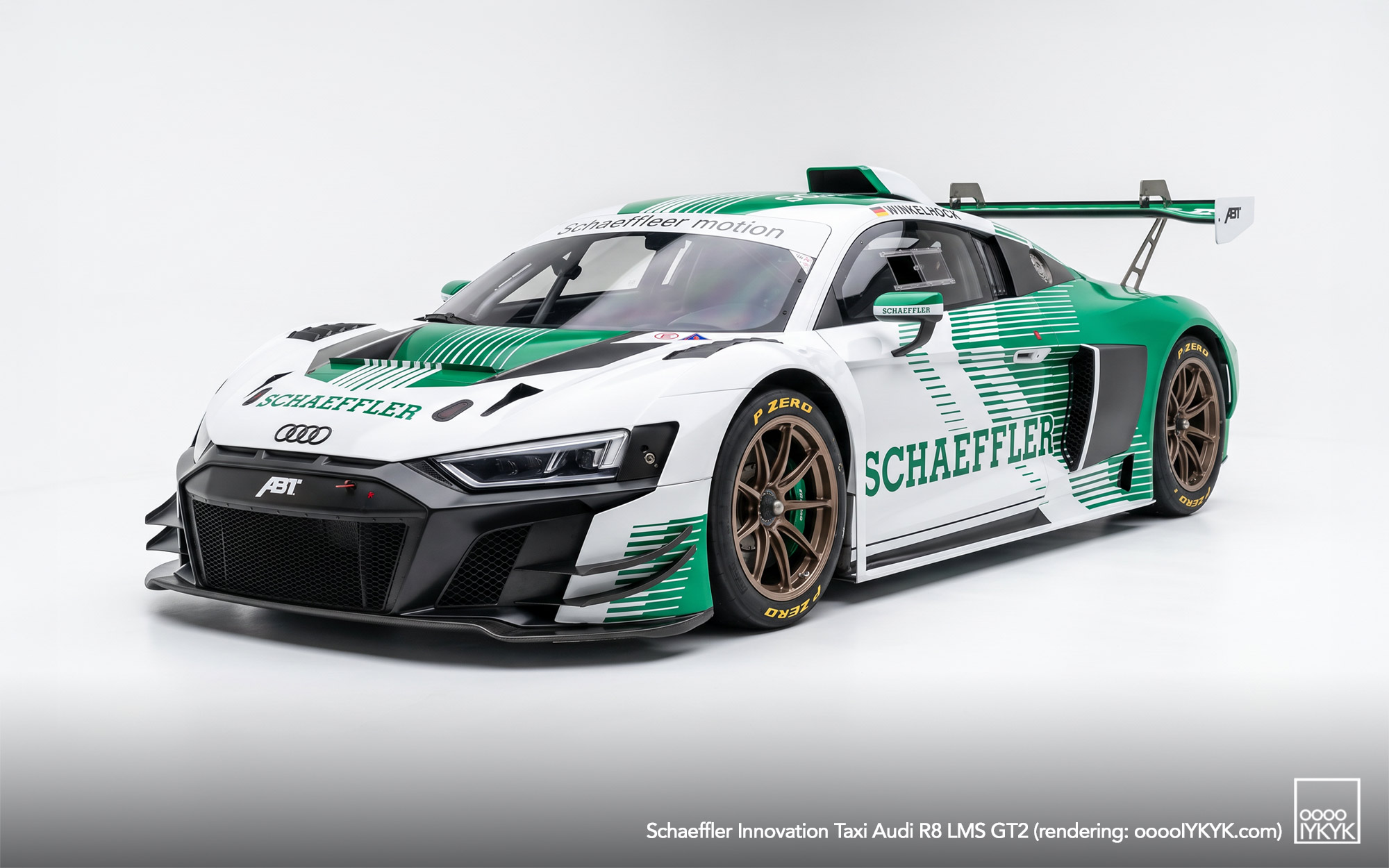

What: Schaeffler Innovation Taxi (Audi R8 LMS GT2)
Model Family: R8
Model / Generation Code(s): R8 LMS GT2 (type 4S)
Production: Technology demonstrator / DTM race taxi
Year: 2023, 2024, 2025, 2026
Debuted: 2023 DTM season
Number Produced: 1 known Innovation Taxi
Base Vehicle: Audi R8 LMS GT2
Manufacturer: Audi Sport customer racing / modified by Schaeffler
Class: Experimental technology demonstrator / race taxi
Body Style: 2-door GT race car
Layout: Mid-engine, rear-wheel drive
Engine: 5.2-liter naturally aspirated 90-degree V10
Power Output: 470 kW (640 hp) at 8,000 rpm
Torque: More than 550 Nm (406 lb-ft) at 6,250 rpm
Transmission: 7-speed S tronic dual-clutch transmission
Dry Weight: 1,350 kg (2,976 lb) in standard R8 LMS GT2 specification
RELATED
Race Cars: Audi R8 LMS GT2, Audi R8 LMS GT3, Audi R8 LMS GT4
Technology: Steer-by-wire, variable steering angle, rear-wheel steering, wet lamella brake, synthetic fuels
People: Markus Winkelhock, Mike Rockenfeller
Organizations: Schaeffler, Audi Sport customer racing, DTM
BACKGROUND
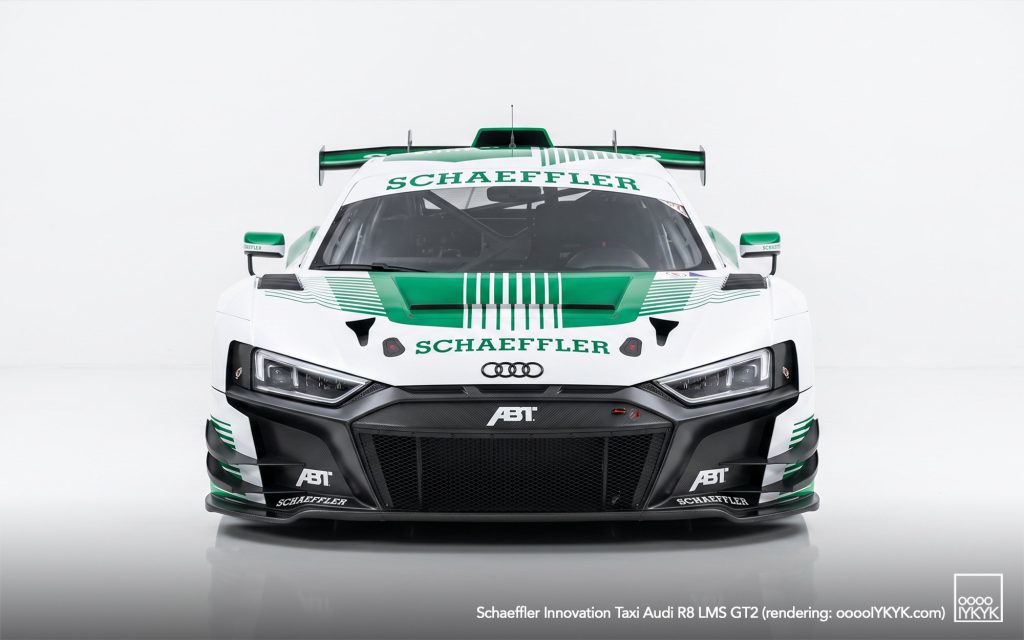
The Schaeffler Innovation Taxi is an Audi R8 LMS GT2 converted into a rolling development laboratory and demonstration vehicle for experimental automotive technologies. Introduced for the 2023 DTM season, the car serves simultaneously as a working DTM race taxi and a test platform intended to subject Schaeffler technologies to the considerably more demanding environment of a racetrack.
Its choice as a development platform is significant. Introduced by Audi Sport in 2019, the R8 LMS GT2 was the most powerful customer racing model Audi had produced, combining a 470 kW (640 hp) naturally aspirated 5.2-liter V10 with a dry homologation weight of 1,350 kg. Audi developed the GT2 specifically around high longitudinal performance while deliberately limiting aerodynamic and lateral performance relative to a GT3 car.
The resulting combination of production-derived architecture, substantial performance and purpose-built racing safety equipment provided Schaeffler with an unusually capable platform for developing technologies potentially destined for future production vehicles.
AUDI R8 LMS GT2
The Innovation Taxi retains the fundamental architecture of the Audi R8 LMS GT2. Its 5.2-liter naturally aspirated V10 is longitudinally mounted ahead of the rear axle and produces 640 hp at 8,000 rpm and more than 550 Nm at 6,250 rpm. Power is delivered exclusively to the rear wheels through a seven-speed S tronic dual-clutch transmission and mechanical limited-slip differential.
The underlying chassis combines Audi’s aluminum and CFRP Audi Space Frame with a steel roll cage and CFRP bodywork. Unlike the production R8 Coupé, the GT2’s basic chassis geometry was derived from the R8 Spyder, combined with roof structures derived from the Coupé and a lightweight CFRP hardtop. The result is one of the more visually distinctive members of the R8 racing family.
In standard form, the R8 LMS GT2 uses double-wishbone suspension front and rear, 18-inch forged aluminum wheels and hydraulic steel brakes measuring 380 mm at the front and 355 mm at the rear. The complete car measures 4,568 mm long, 1,995 mm wide and 1,280 mm high on a 2,649-mm wheelbase.
INNOVATION TAXI PROGRAM
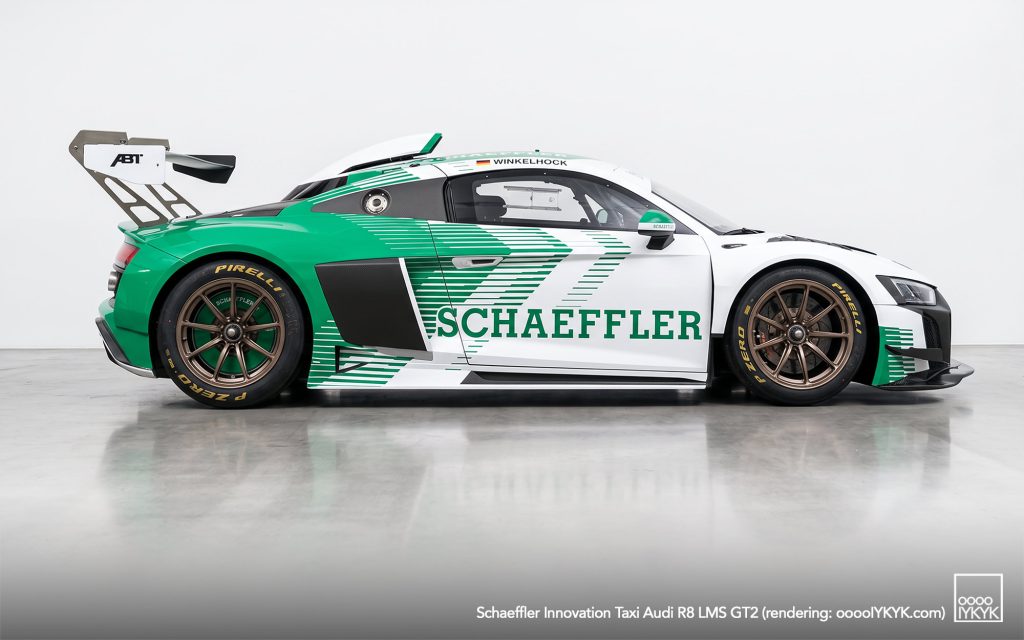
Schaeffler introduced the Innovation Taxi during the 2023 DTM season as part of its role as the series’ innovation partner. Rather than constructing a conventional concept car, the company chose an approved GT2 racing car capable of operating during actual DTM weekends.
The car is driven by experienced racing drivers and used to give guests high-speed passenger rides while simultaneously demonstrating Schaeffler technology. Drivers have included longtime Audi racers Markus Winkelhock and Mike Rockenfeller. Winkelhock has extensive history with Audi in GT racing and the DTM, while Rockenfeller won the 2013 DTM drivers’ championship aboard a Schaeffler-liveried Audi RS 5 DTM.
The program also continues a longstanding relationship between Schaeffler and Audi motorsport. Schaeffler was a prominent Audi Sport partner during the manufacturer’s factory DTM era, making the R8 LMS GT2 a natural basis for the company’s later technology demonstrator.
STEER-BY-WIRE
Among the Innovation Taxi’s most significant modifications is Schaeffler’s steer-by-wire system.
Steer-by-wire eliminates the conventional mechanical connection between the steering wheel and steering rack. Driver inputs are instead detected electronically and translated into commands at the steering system, allowing software to determine how steering-wheel movement corresponds with movement of the front wheels.
Schaeffler has used the R8 to test the technology under racetrack conditions while collecting both vehicle data and feedback from its professional drivers.
The system also makes variable steering ratios possible without the limitations imposed by a conventional steering column. During testing at Hockenheim, Markus Winkelhock demonstrated a configuration in which approximately 90 degrees of steering-wheel movement was sufficient to negotiate the circuit’s hairpin, rather than the roughly 180 degrees normally required.
That flexibility has potential applications far beyond racing, including reduced steering movement during parking and low-speed maneuvering.
REAR-WHEEL STEERING
The Innovation Taxi subsequently became the first touring car Schaeffler equipped with its rear-wheel-steering technology.
Unlike steer-by-wire, rear-wheel steering was already established in production applications, including several Audi models. Installing the system in the R8 LMS GT2 allowed Schaeffler to evaluate its behavior under the much higher dynamic loads encountered on a racetrack.
The system demonstrated the Innovation Taxi’s broader purpose: technologies could move in either direction between production development and motorsport rather than following the traditional model of racing technology being developed exclusively for competition before reaching road cars.
JOYSTICK STEERING DEVELOPMENT
Schaeffler took the steer-by-wire concept considerably further in 2025 when Markus Winkelhock drove an Audi R8 production-based test vehicle at Hockenheim without a conventional steering wheel.
Instead, the car was controlled using two joysticks.
Although the joystick-controlled R8 was a separate development vehicle rather than the Innovation Taxi itself, Schaeffler identified the Innovation Taxi as a possible future platform for the technology. The experiment demonstrated one of the fundamental possibilities created by eliminating the physical steering column: the driver’s control interface no longer necessarily needs to take the form of a traditional steering wheel.
SYNTHETIC FUEL
Beginning with the 2023 DTM weekend at the Lausitzring, the Innovation Taxi has also operated using synthetic fuel, or eFuel.
Schaeffler uses the R8 to demonstrate the potential compatibility of synthetic fuels with existing internal-combustion technology. That application is particularly notable given the GT2’s engine. Audi’s 5.2-liter V10 was closely related to the production R8 engine and retained production dry-sump lubrication, with Audi Sport extracting its 640 hp primarily through revised engine-management software and the GT2’s roof-mounted ram-air intake.
The engine is paired with the seven-speed S tronic transmission originally proven by Audi Sport in GT4 competition.
WET LAMELLA BRAKE
For the Nürburgring DTM weekend in August 2026, Schaeffler introduced one of the Innovation Taxi’s most substantial experiments yet: a wet lamella braking system installed at the rear wheels.
Instead of an exposed steel rotor and conventional brake pads, the system operates according to a principle similar to a wet multi-plate clutch. Inside an enclosed housing is a stack of steel and friction-lined discs operating in oil. During braking, the discs are compressed together to generate friction and convert the car’s kinetic energy into heat.
Because the friction surfaces are contained within the sealed, oil-cooled assembly, particulate matter generated during braking cannot escape into the atmosphere as brake dust. The enclosure also isolates the friction surfaces from water and other external contaminants, eliminating corrosion and helping maintain consistent friction characteristics.
Schaeffler also says the system operates virtually silently and is being developed with the objective of eliminating conventional brake maintenance intervals.
The R8 LMS GT2 originally used conventional steel brakes with 380 x 35-mm front rotors and 355 x 32-mm rear rotors together with nine-stage racing ABS. The replacement of the rear system therefore represents a significant departure from the Audi Sport configuration.
THERMAL MANAGEMENT
The principal engineering challenge created by the wet brake is heat.
A conventional racing brake dissipates considerable thermal energy directly into the surrounding air. Enclosing the friction surfaces eliminates that cooling mechanism, an especially difficult problem when the system is being tested in a 640-hp GT2 race car.
For the Innovation Taxi, Schaeffler developed a dedicated cooling system incorporating hydraulic pressure and suction pumps together with multiple heat exchangers. The company uses track testing to study the relationship between oil flow, brake temperature, friction stability, drag, wear and braking performance.
The extreme thermal demands of the R8 are intentional. Data gathered under racing conditions can be used to determine how much cooling and lubrication would actually be necessary in the much less severe operating environment of a production vehicle.
FUTURE ELECTRIC AXLES
Despite being tested in a V10-powered Audi racing car, the wet lamella brake is being developed primarily with electric vehicles in mind.
Regenerative braking means an EV’s electric motors can perform a large percentage of everyday deceleration without using its mechanical brakes. Conventional friction brakes nevertheless remain necessary for harder stops, emergency braking and situations where regenerative braking is unavailable or insufficient.
That reduced use creates its own problems. Conventional steel brake rotors can corrode when used infrequently, while brake particulate emissions remain an issue whenever friction braking is required.
Schaeffler’s development goal is therefore a highly integrated electric axle incorporating the wet brake, actuator and oil/cooling circuit within a single system. The concept could reduce unsprung mass, eliminate brake-dust emissions, improve packaging flexibility and work naturally with future brake-by-wire vehicle architectures.
Schaeffler has already constructed a functional production-vehicle concept incorporating the wet brake, while the Innovation Taxi provides the harsher environment needed for accelerated development testing.
SIGNIFICANCE
The Schaeffler Innovation Taxi occupies an unusual position in the history of the Audi R8.
It was not developed by Audi as a factory prototype, nor is there any confirmed connection between the technologies Schaeffler is testing and a future Audi production program. Instead, the car represents the continuing development life of an Audi Sport customer racing chassis after the end of R8 road-car production and Audi’s factory GT racing programs.
The underlying R8 LMS GT2 itself was a relatively unusual Audi. Presented in 2019, it sat at the top of Audi Sport customer racing’s four-model program and was designed to deliver greater engine power and top speed than either the GT3 or GT4 R8 while remaining approachable for gentleman drivers. Audi priced the GT2 at €338,000 plus VAT, with production beginning at the end of 2019.
In Schaeffler’s hands, that same combination of relatively low weight, extreme performance, production-derived architecture and motorsport safety equipment has given the R8 LMS GT2 another purpose.
Rather than developing the R8 itself, the Innovation Taxi uses one of Audi Sport’s final V10 racing cars to develop technologies intended for vehicles that may bear little mechanical resemblance to it.
REFERENCES
- Schaeffler – Innovation Taxi
- Schaeffler – Wet Lamella Brake
- Schaeffler – Clean, Quiet and Durable: Schaeffler Tests New Braking Technology in the DTM Innovation Taxi at the Nürburgring, August 2026
- Audi Sport customer racing – Audi R8 LMS GT2 Motorsport Information, February 2020
PHOTO GALLERY