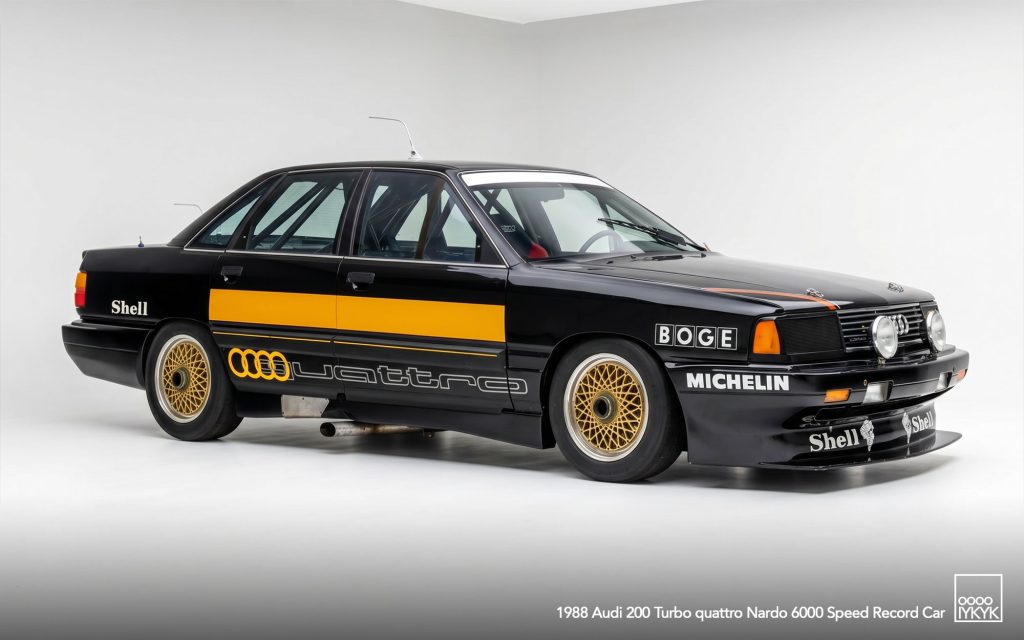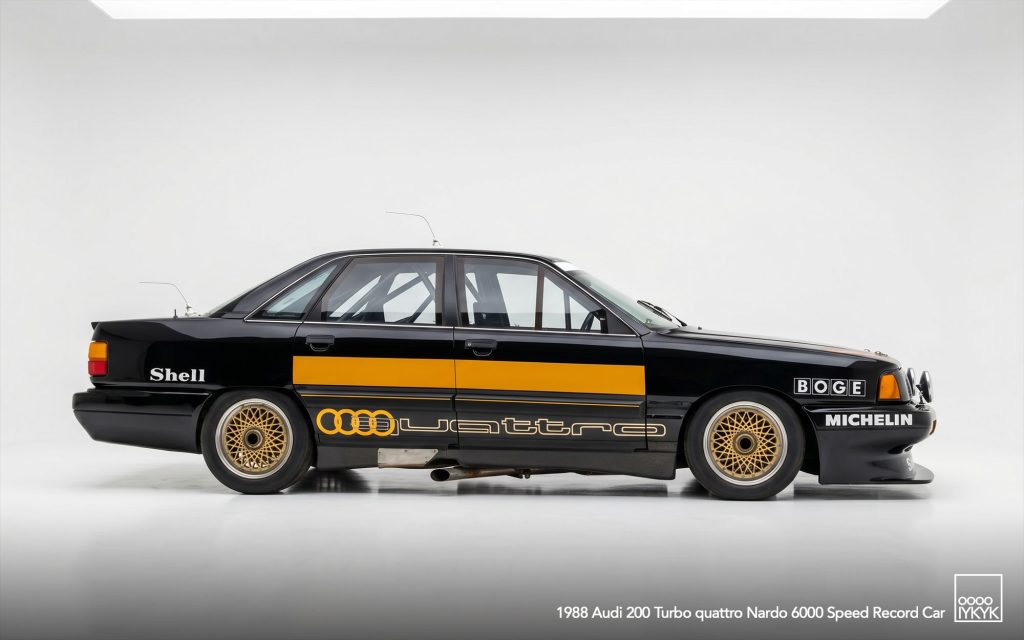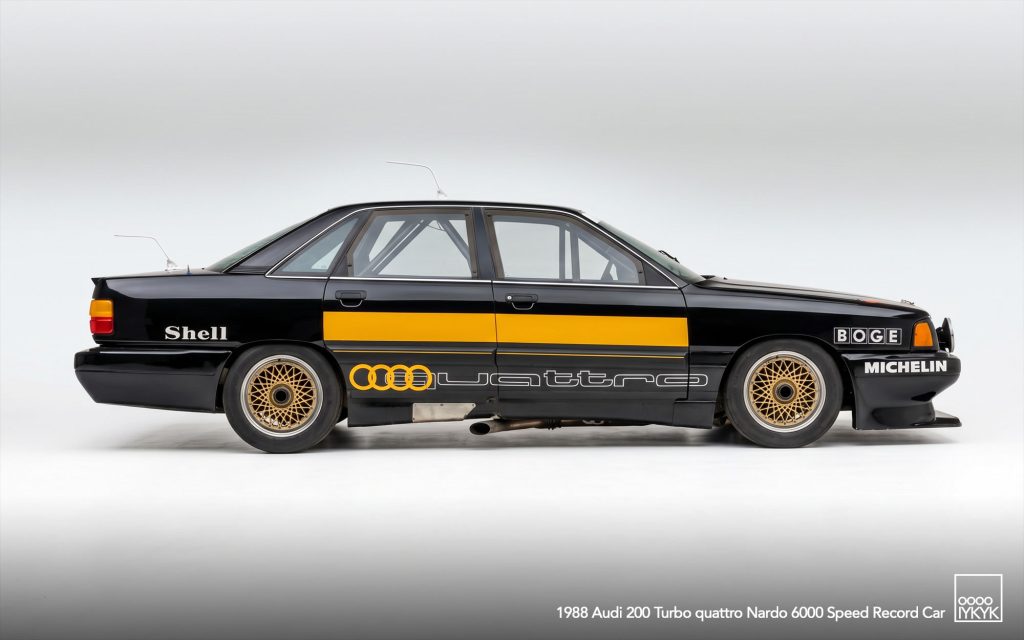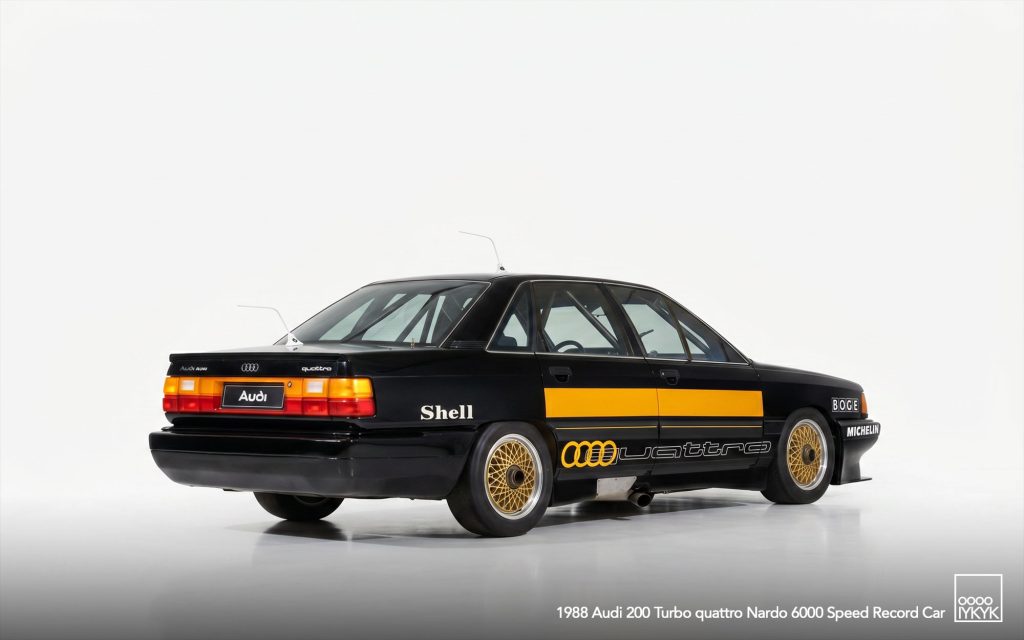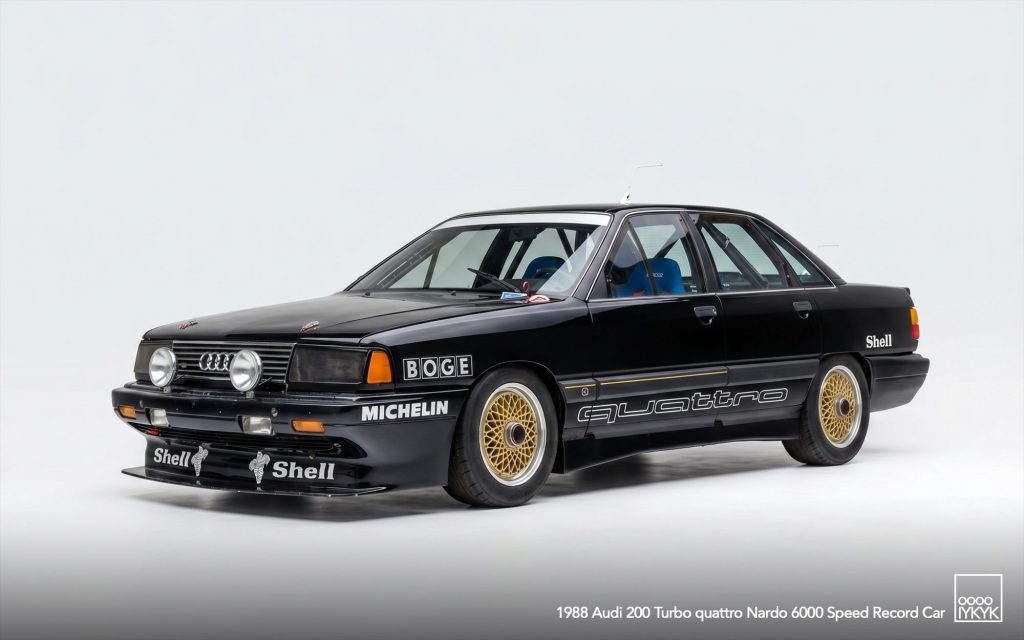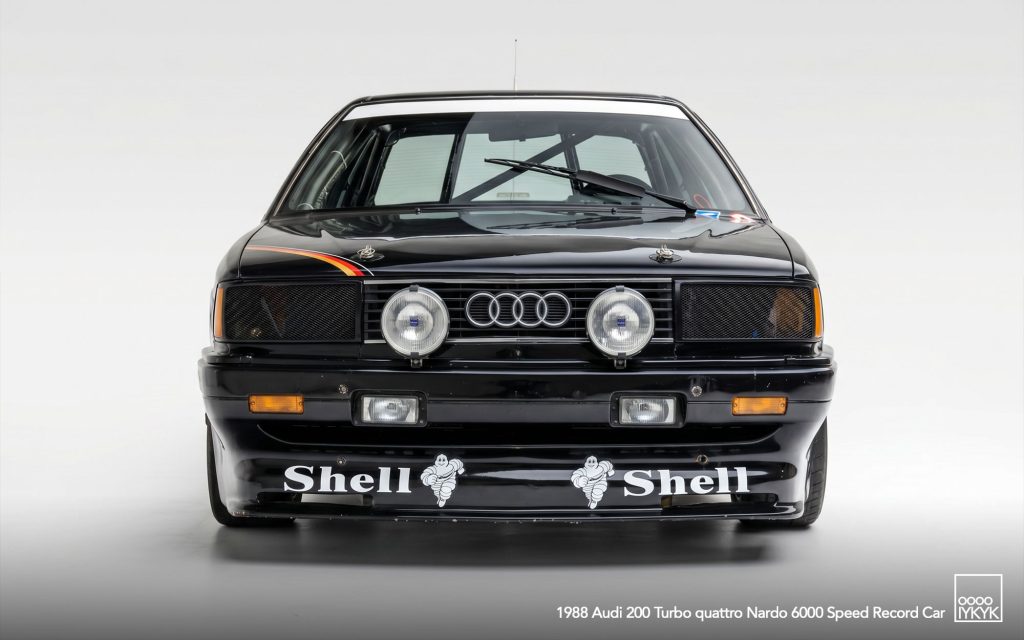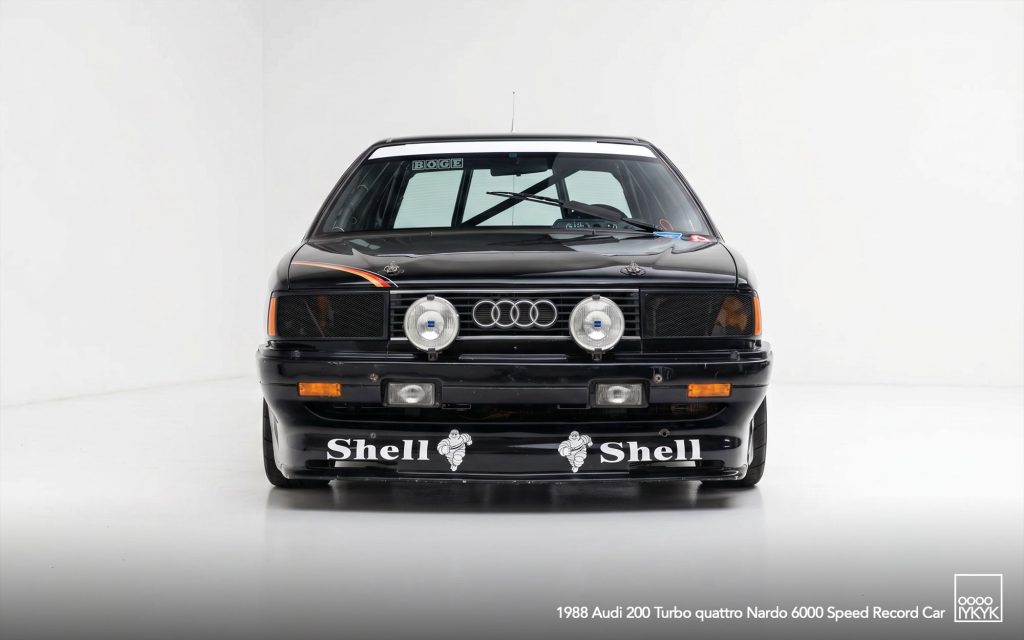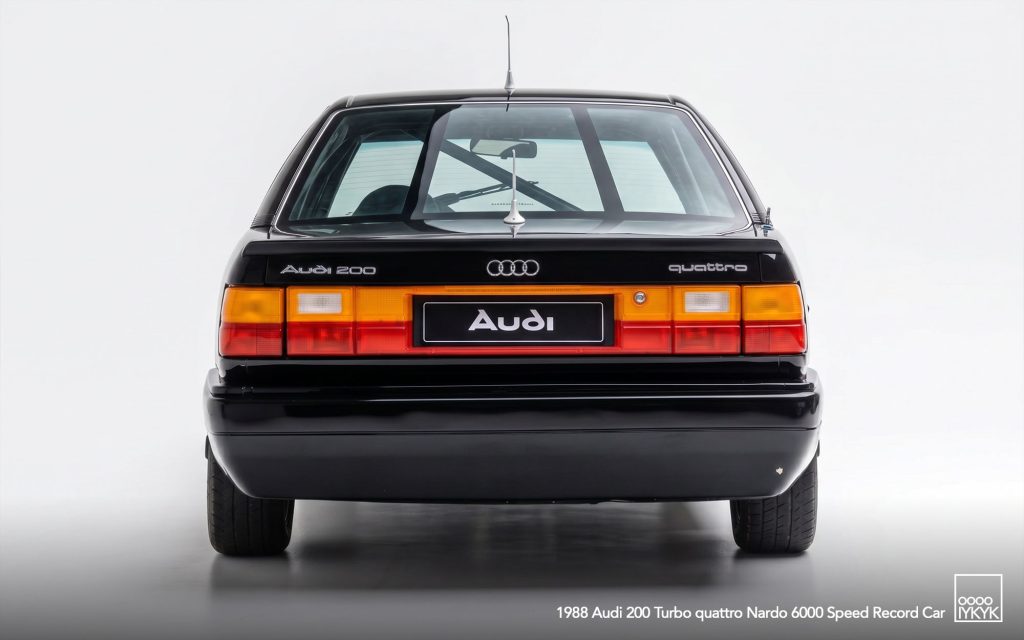
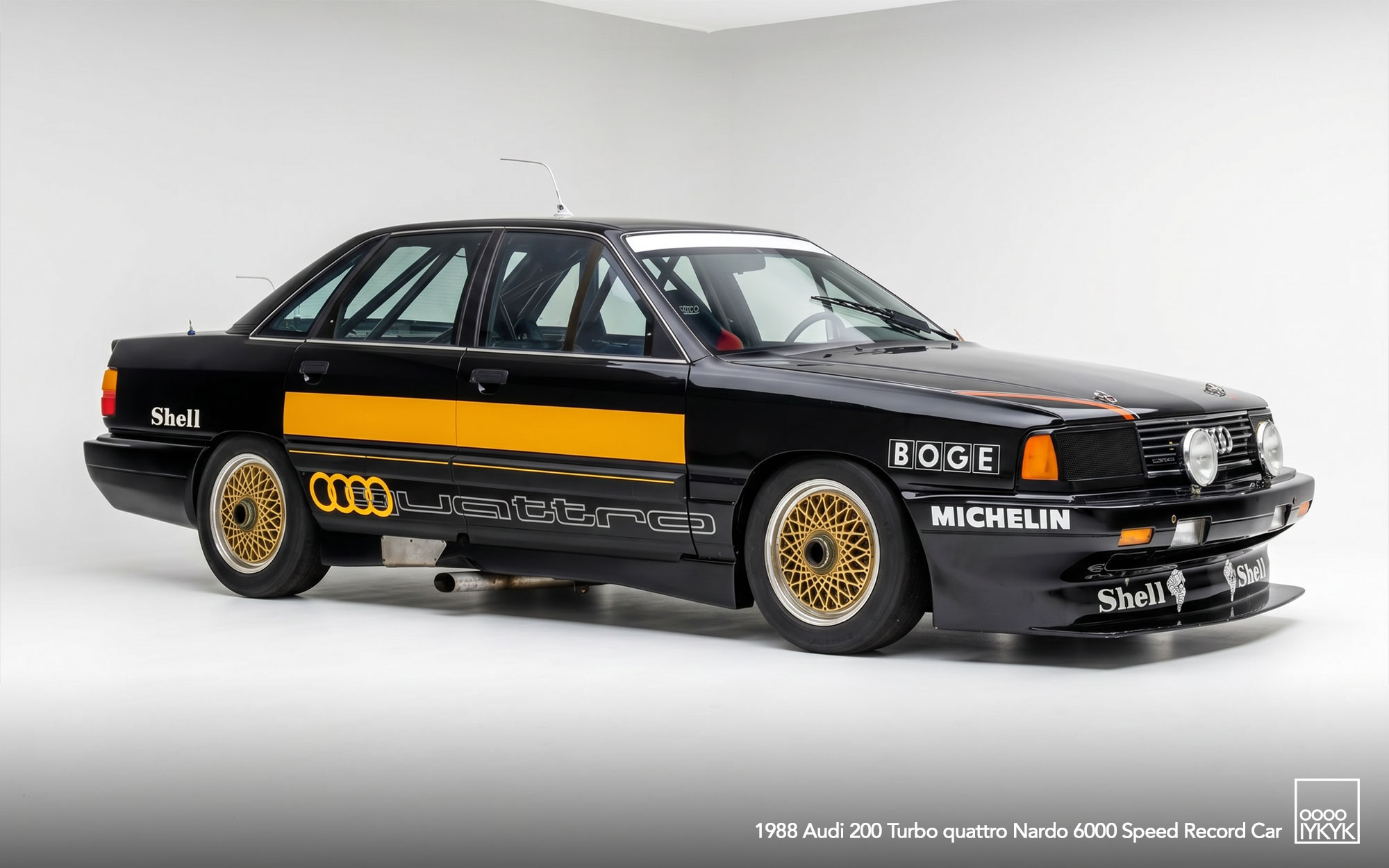

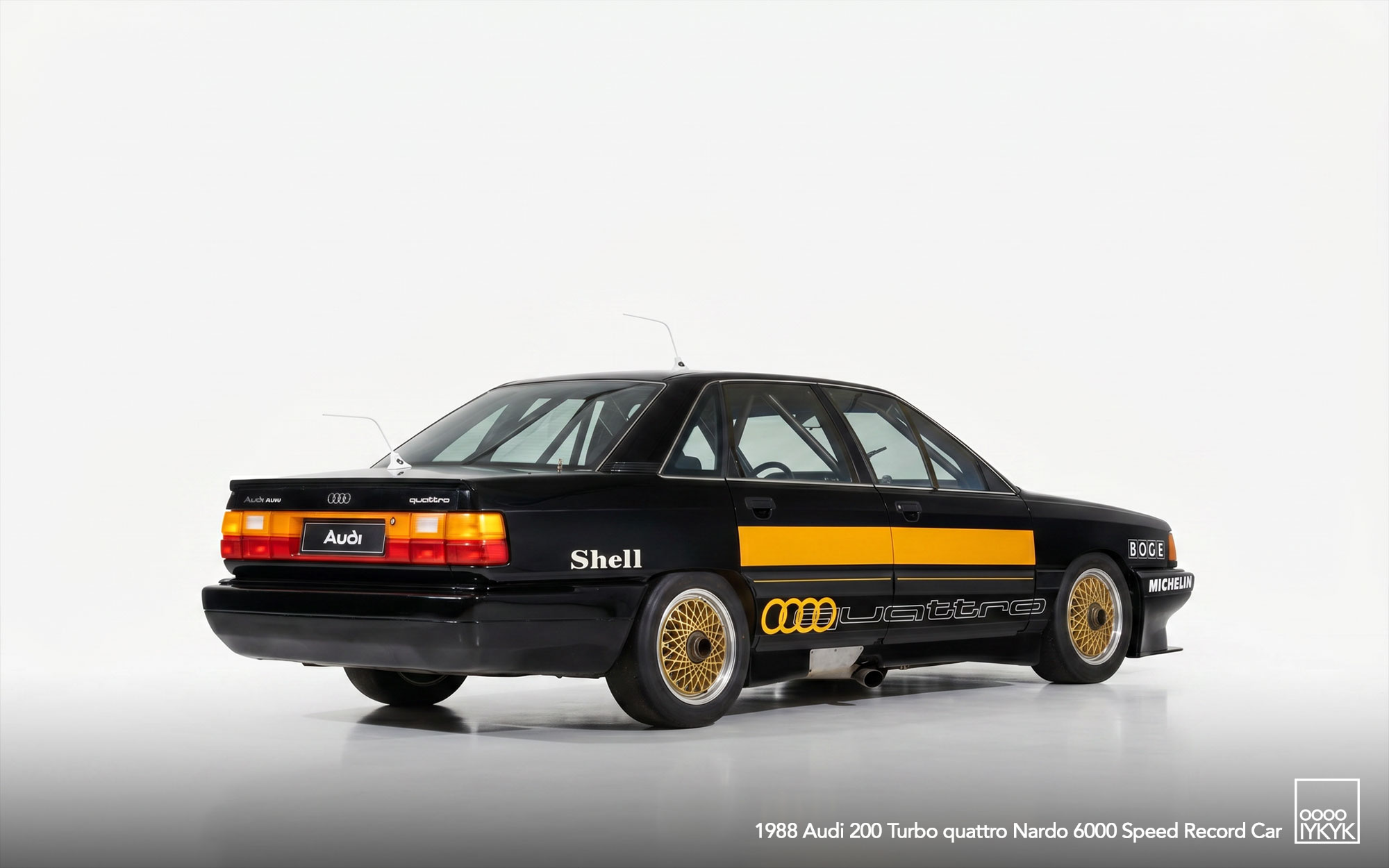
What: Audi 200 Turbo quattro ‘Nardo’
Series: none
Era: Audi postwar
Model Family: 200
Market / Zone: EU
Season: 1988
Model / Generation Code(s): type 44
Chassis / Matrix: C3
TECHNICAL DETAILS
Body Style(s): 4-door sedan
Drivetrain Configuration: Longitudinal front engine, all-wheel drive
Engine(s): Modified 2.2 L turbocharged 25-valve inline-5
Power: 650 hp (478 kW) @ 6,200 rpm
Torque: Unknown
Compression Ratio: 7.5:1
Boost Pressure: 2.9 bar
Maximum RPM: Unknown
Transmission(s): Reinforced 5-speed manual
Wheelbase: Unknown
Length: Unknown
Width: Unknown
Height: Unknown
Kerb Weight: Unknown
TEAM DETAILS
Team: Audi Sport
Project Director: Richard van Basshuysen (Head of Development, Ingolstadt and Neckarsulm)
Vehicle Construction: Wulf Leitermann (Vehicle Construction Manager, Neckarsulm)
Engine Development: Dr. Werner Laurenz (Head of Engine Testing, Audi Sport)
OTHER DETAILS
Predecessor: 1986 Audi 5000 CS quattro “Talladega” Speed Record Prototype
Successor: N/A
Road Car Equivalent: Audi 200 Turbo quattro (Type 44)
Homologations: N/A
SUMMARY
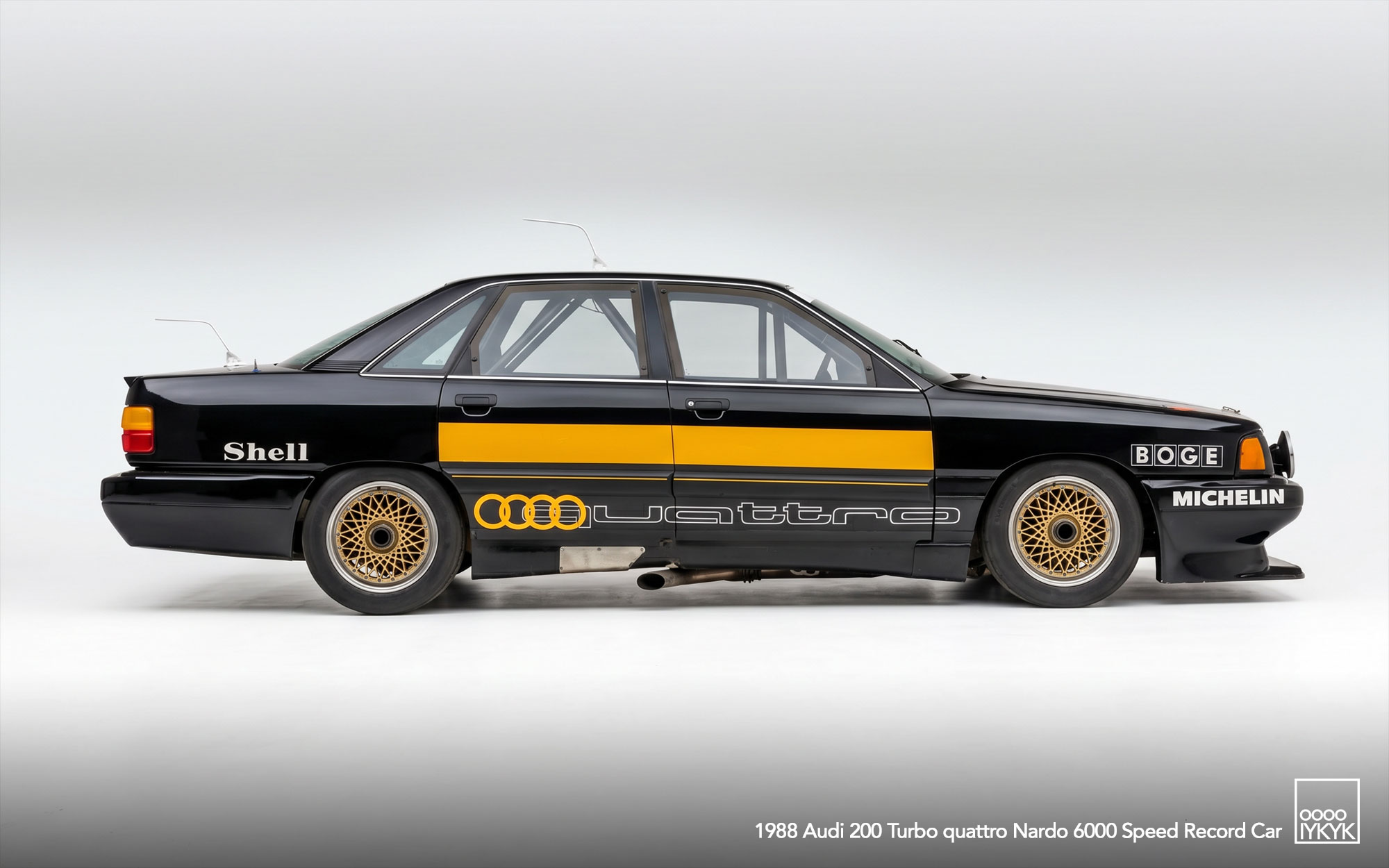
The 1988 Audi 200 Turbo quattro “Nardò 6000” was a unique factory-built speed record prototype developed by Audi to demonstrate the ultimate capability of its turbocharged five-cylinder engine, new five-valve cylinder head technology and quattro all-wheel-drive system under sustained high-speed conditions. Conceived under the direction of Audi CEO Dr. Ferdinand Piëch, three specially prepared Audi 200 quattro sedans were constructed to challenge long-standing speed records at the Nardò Ring in southern Italy between 1-4 April 1988.
The program successfully established new 500-mile and 1,000-kilometre world speed records while validating Audi’s latest engine technology under continuous operation. Chassis N6000/1, the first of the three cars built, later passed from Audi to record driver Dr. Siegfried “Sigi” Brunn before entering private ownership. At the time of writing, it remains the only known surviving example of the Nardò speed record program and was sold by Bonhams at Les Grandes Marques du Monde à Paris on 3 February 2022 for €235,750 including premium.
DEVELOPMENT
Following its dominance in World Rally Championship competition with quattro, Audi sought a new engineering challenge that would further demonstrate the capability of its permanent all-wheel-drive system. The objective extended beyond outright speed. Audi intended to prove that quattro could withstand continuous operation under extreme loads on dry asphalt while simultaneously showcasing its new low-emissions, turbocharged five-valve-per-cylinder engine technology.
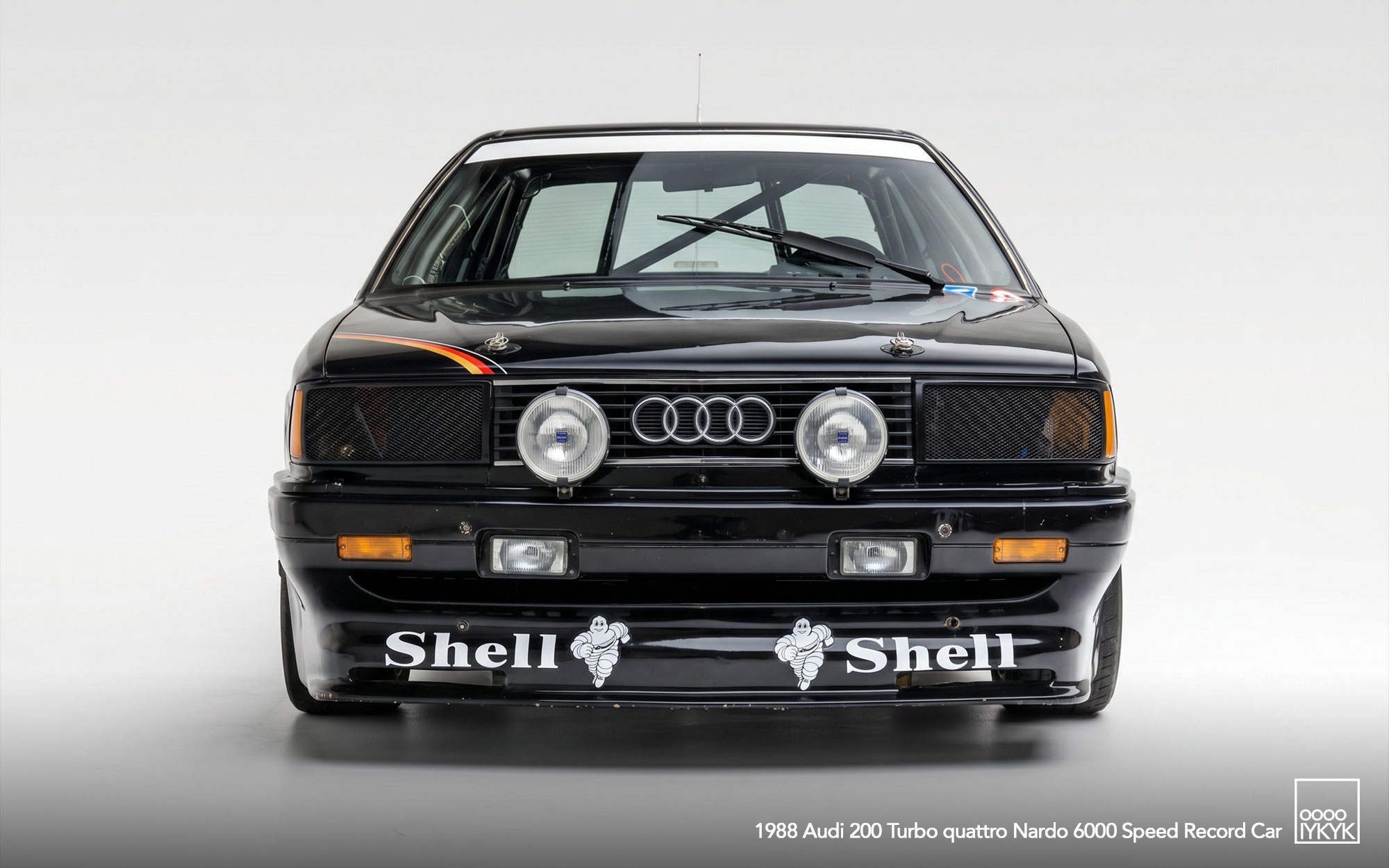
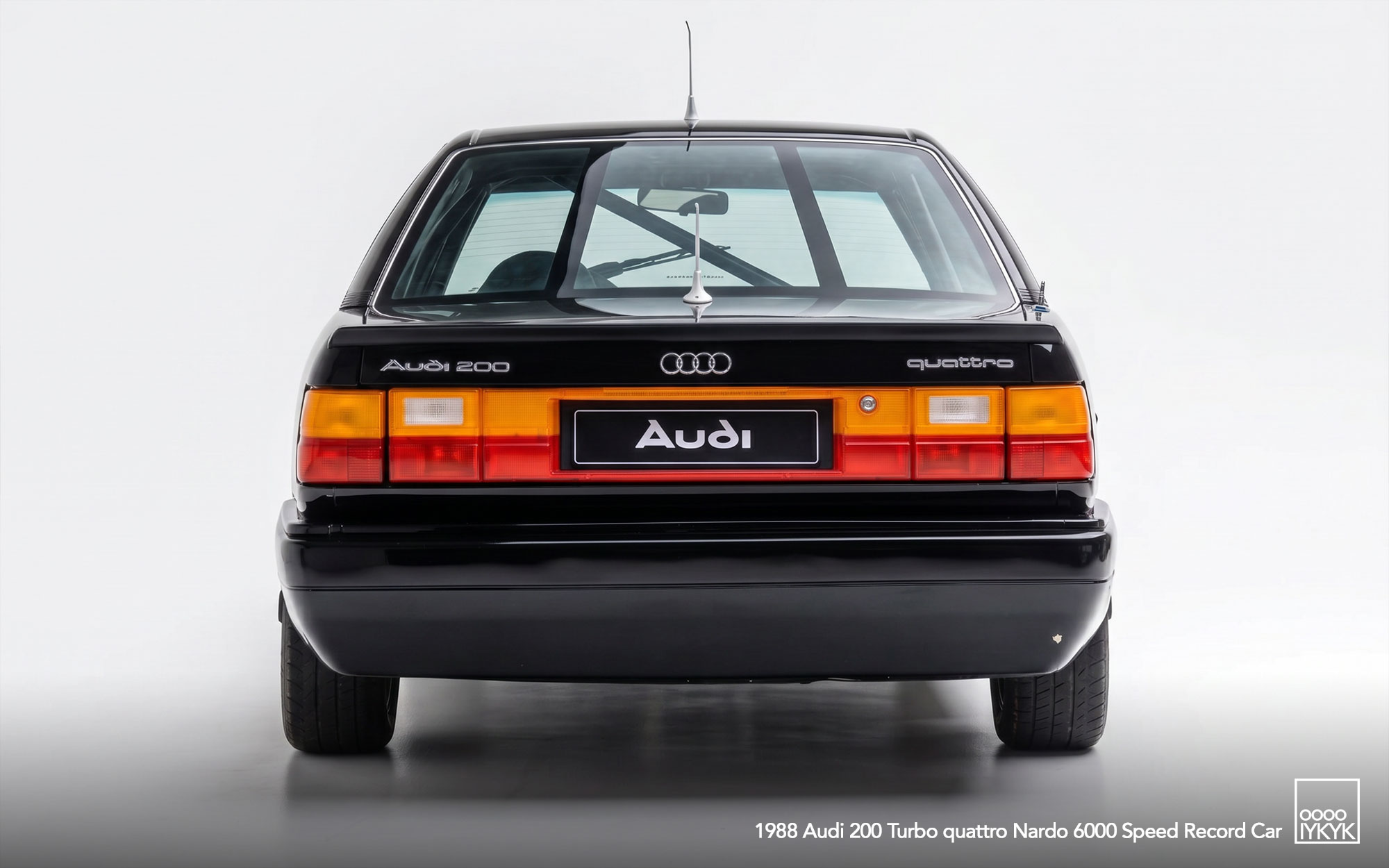
The project, initiated by Dr. Ferdinand Piëch, centered around three specially prepared, essentially identical Audi 200 quattro sedans. Extensive aerodynamic and lightweight modifications included Kevlar front and rear body panels, aluminum doors and roof, plastic side windows, magnesium wheels and engine components, an integrated safety cage and aerodynamic refinements that reduced the drag coefficient to 0.27 Cd.
Power came from a specially developed 2.2-liter turbocharged 25-valve inline-five producing 650 horsepower (478 kW) at 6,200 rpm, with a compression ratio of 7.5:1 and 2.9 bar of boost pressure. The engine featured water-cooled turbocharging, a catalytic converter and Audi’s then-new five-valve cylinder head technology designed to improve performance, increase torque, reduce fuel consumption and lower exhaust emissions while operating on unleaded fuel.
NARDO RECORD RUNS
Audi selected the 12.65-kilometre Nardò Ring in southern Italy for the record program, targeting the long-standing 500-mile and 1,000-kilometre speed records established by the Mercedes-Benz C111 in 1978.
The record attempt took place between 1-4 April 1988 under the direction of Richard van Basshuysen. A team of endurance specialists, primarily drawn from German motorsport, shared driving duties, including Dr. Siegfried Brunn, Ernst Franzmair, Günther Gebhard, Walter Lechner, Olaf Manthey, Walter Mertes, Hellmut Mundas, Dieter Sauren, Dieter Schäfer, Rudolf Seher, Angelo Pallavicini and E. Günter Steckkönig Franmayer. Technical support came from Michelin, Shell, Boge and Emitec.
The cars were heavily optimized for endurance running. A 340-litre safety fuel tank minimized the number of pit stops, while an aerospace-style rapid refueling system reduced fuel stops to approximately 25 seconds. A built-in pneumatic jacking system, center-lock magnesium wheels operated with pneumatic tools, telemetry, radio communication and an advanced tire pressure monitoring system further enhanced reliability and efficiency during the record attempt.
The program successfully established two new FIA-recognized world speed records:
- 500 miles: 324.509 km/h average
- 1,000 kilometres: 326.403 km/h average
Peak speeds approaching 400 km/h were reportedly recorded during the four-day program. While Audi remained on pace to challenge additional records, including the 30,000-kilometre mark, the attempt was ultimately halted after a puncture resulted in a serious accident involving chassis N6000/2.
LEGACY
Following completion of the Nardò program, Audi released all three record cars into private ownership rather than retaining them.
Chassis N6000/1 was acquired directly from Audi by record driver Dr. Siegfried “Sigi” Brunn, often referred to as “Germany’s fastest dentist.” The car later underwent restoration by Brunn Racing in 2009 before being sold to a private collector.
According to Bonhams, the remaining two Nardò record cars have since been destroyed, leaving chassis N6000/1 as the sole surviving example of Audi’s 1988 speed record program. Offered by Bonhams at Les Grandes Marques du Monde à Paris on 3 February 2022, the unique works prototype sold for €235,750 including premium. At the time of the auction, the car had reportedly not been run since the 1990s, making its survival one of the most remarkable stories among Audi’s factory engineering prototypes.
‘
RELATED LINKS
PHOTO GALLERY