
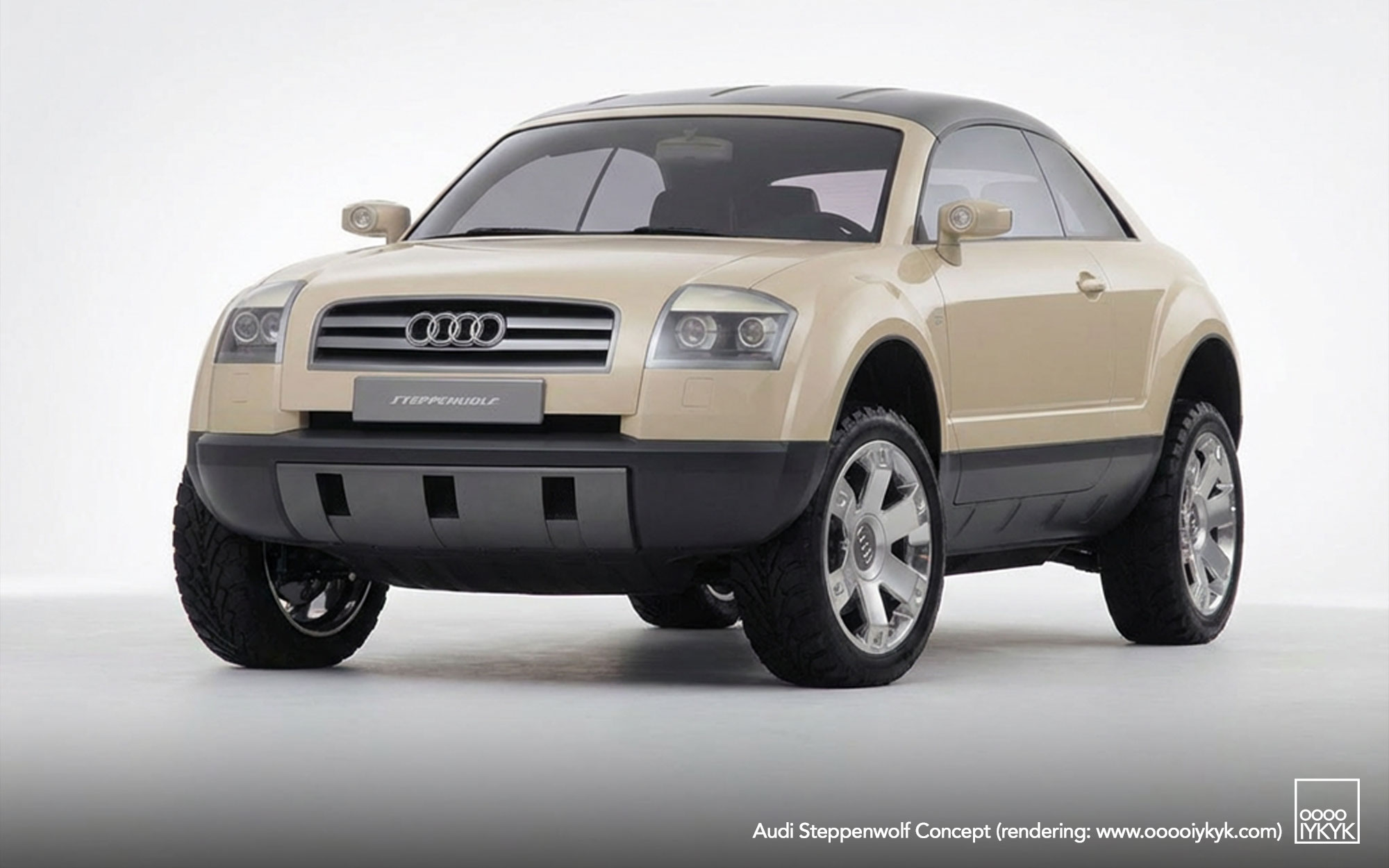

What: Audi Steppenwolf Concept, a.k.a. “Project Steppenwolf”
Model Family: A3 / TT platform concept
Model / Generation Code(s): PQ34
Production: One-off concept vehicle
Year: 2000
Debuted: 2000 Paris Motor Show, 2001 Detroit Auto Show
Number Produced: 1
Assembly: Ingolstadt, Germany
Class: Compact crossover concept car
Body style: 3-door crossover coupe
Layout: Front-engine, all-wheel drive
Engine: 3.2-liter naturally aspirated VR6
Power output: approx. 165 kW (225 hp)
Key Features: Adjustable air suspension with multiple ride-height settings, removable hardtop roof panel, widened wheel arches, off-road tires, and early exploration of Audi’s compact crossover concept combining TT-style design with SUV capability.
RELATED
Concept Cars: Audi Cross Coupé quattro concept, Audi TT Safari Concept
Road Cars: Audi A3 (8L), Audi TT Mk1 (type 8N), Audi Q3
Race Cars:
HISTORY AND DEVELOPMENT
The Audi Steppenwolf Concept, internally referred to as “Project Steppenwolf,” was unveiled by Audi at the 2000 Paris Motor Show then again for North America at the 2001 North American International Auto Show in Detroit as an experimental all-terrain vehicle designed to explore the limits of compact all-wheel-drive performance. Developed by Audi engineers as a study in versatility, the concept sought to combine the dynamics of a compact sports car with the capability of a serious off-road vehicle. Audi described the vehicle as an “all-around vehicle,” designed to perform equally well in high-speed road driving and rough terrain environments.
The project also served as a technological demonstration of Audi’s engineering philosophy of Vorsprung durch Technik, showcasing a blend of advanced drivetrain technology, adaptive suspension systems, and contemporary design language. Engineers set themselves the challenge of creating a compact vehicle capable of mastering extreme terrain while retaining the driving precision expected from an Audi road car. According to Audi, the Steppenwolf was intended to feel “equally at home in the outback as on the highway.”
Central to the concept was Audi’s quattro permanent all-wheel-drive system, which distributed power between the front and rear axles through an electronically controlled Haldex center differential. Additional electronic aids such as the Electronic Differential Lock (EDL) and Electronic Stability Program (ESP) were integrated to maintain control under demanding driving conditions. The concept also featured a free-revving 3.2-liter V6 engine producing 225 horsepower (165 kW), capable of accelerating the vehicle from 0–62 mph (100 km/h) in under eight seconds with a top speed exceeding 144 mph (230 km/h).
One of the most innovative elements of the Steppenwolf was its four-level adjustable air suspension, derived from technology introduced on the Audi allroad quattro. The system allowed the vehicle’s ground clearance to vary by 2.4 inches (60 mm) depending on terrain conditions. At its highest setting, the vehicle could achieve 8.8 inches (223 mm) of ground clearance, providing genuine off-road capability while still allowing a low center of gravity for high-speed road driving.
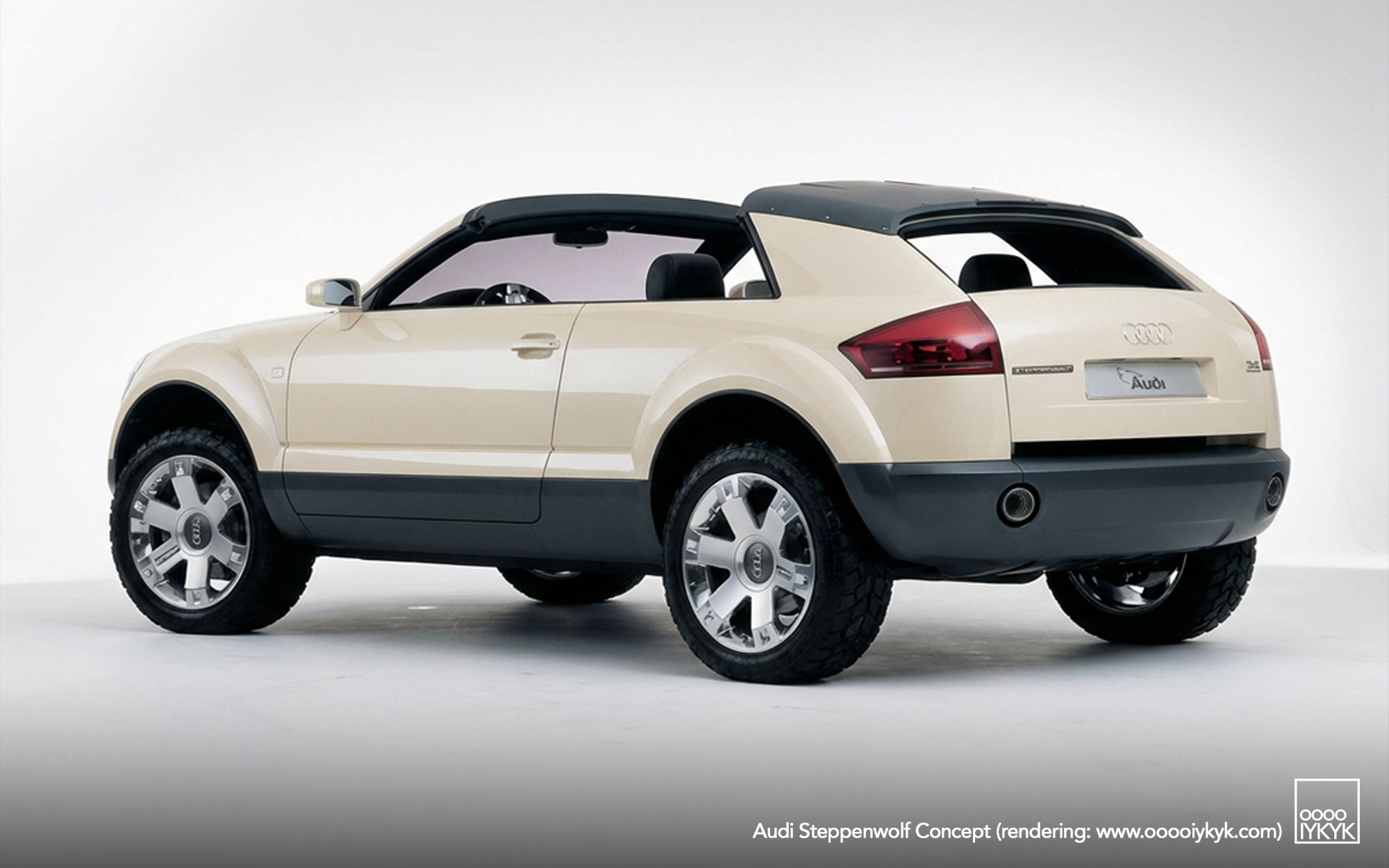
The vehicle was built on the same platform architecture used by the Audi A3, but Audi designers gave the concept a much more rugged and muscular character. Measuring 4.79 meters (188.6 inches) long, the Steppenwolf was notably larger and more aggressive than the compact vehicles from which its architecture was derived. Wide wheel arches, large 19-inch wheels with specially developed 225/50R19 tires, and distinctive Audi design cues such as the four-ring grille and pronounced shoulder lines reinforced the vehicle’s adventurous identity.
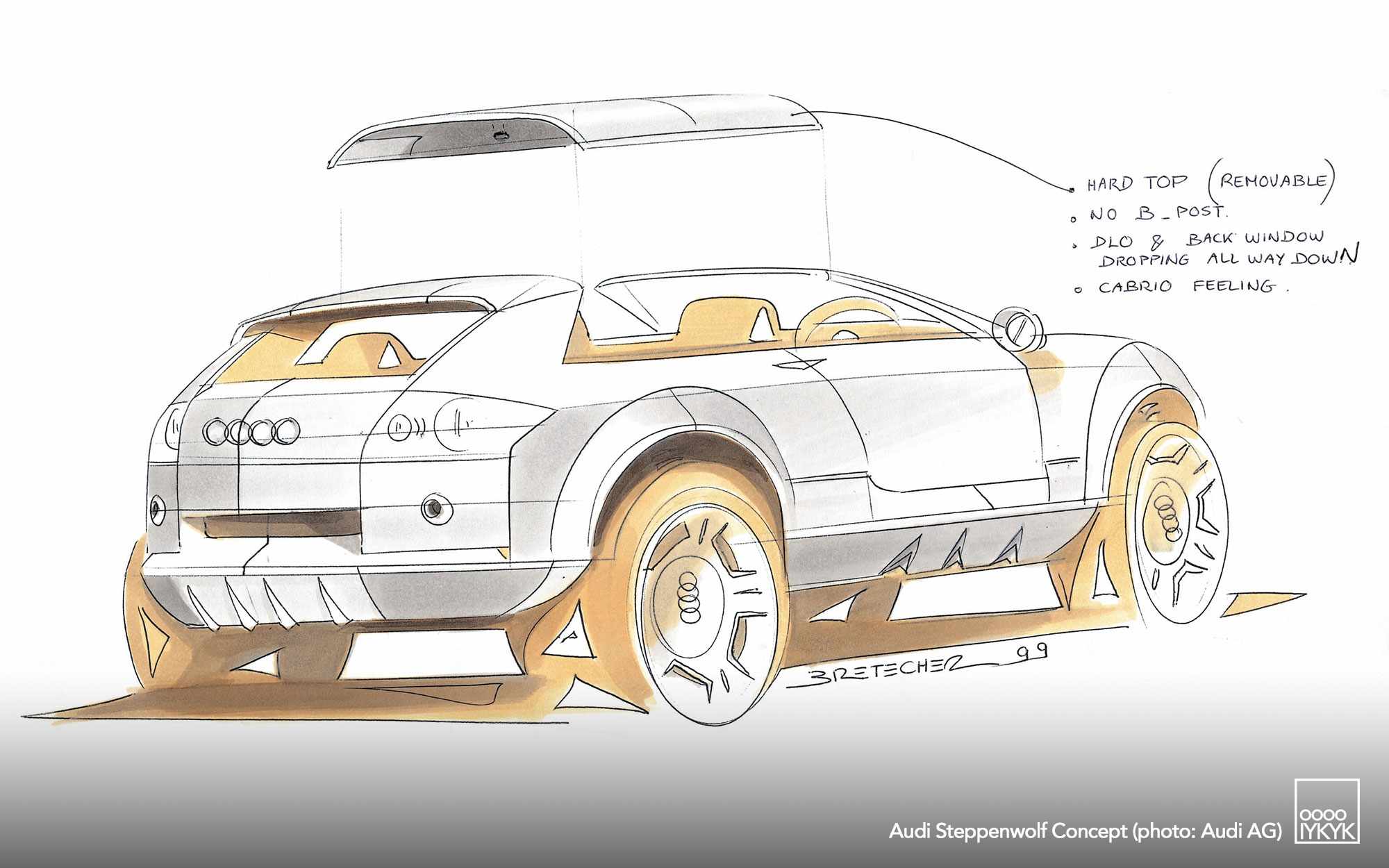
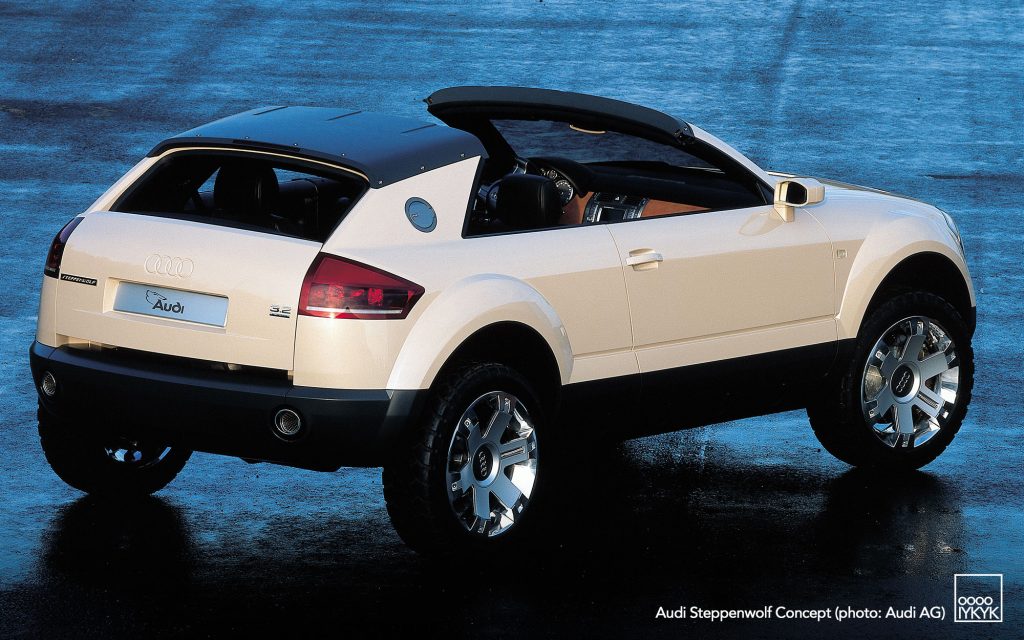
A removable roof structure further emphasized the vehicle’s dual-purpose concept. The Steppenwolf could be driven with either a carbon-fiber hardtop or a detachable soft top, allowing occupants to experience open-air driving in off-road environments. The roof design also maintained high torsional rigidity, ensuring the vehicle retained structural integrity even under demanding terrain conditions.
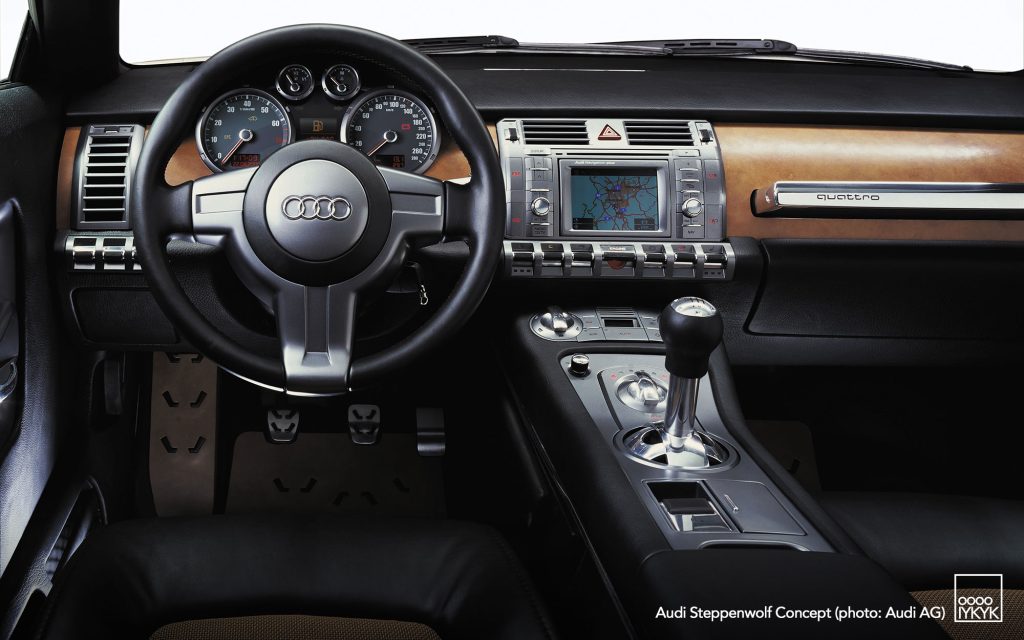
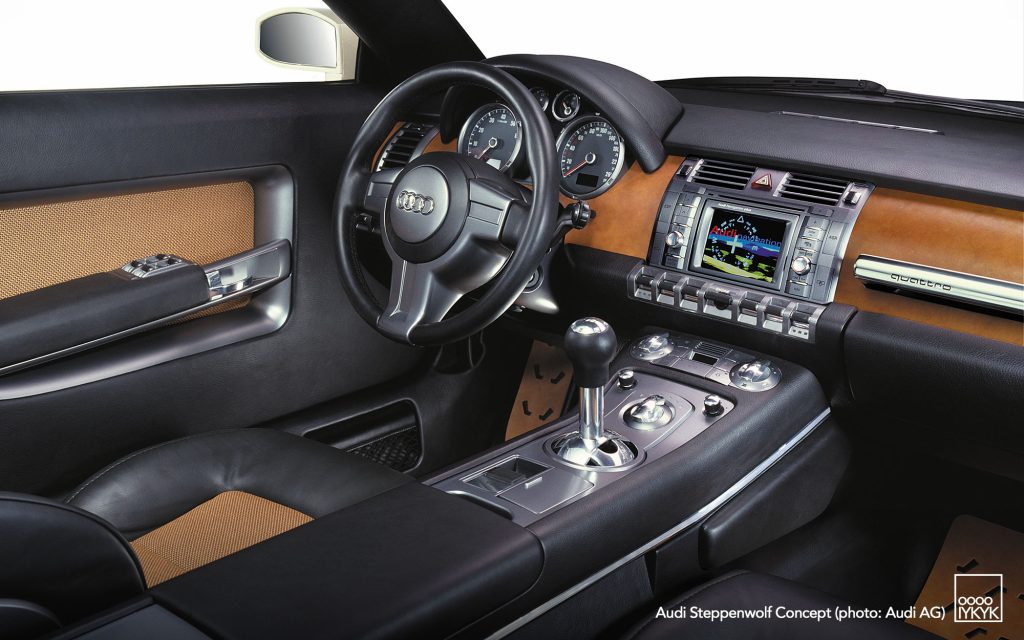
Inside, the concept reflected Audi’s focus on functional design and durability. The cabin featured analog instrumentation with yellow-on-black displays, rugged materials designed for outdoor use, and practical storage solutions intended for expedition-style travel. Audi engineers even included removable seat-back storage pockets, numerous cargo compartments, and a large rear luggage area capable of carrying bulky equipment such as sports gear or bicycles.
Although the Steppenwolf remained a concept study, it foreshadowed Audi’s later exploration of the compact crossover and sport-activity vehicle segment, demonstrating how the brand’s quattro technology and sports-car engineering philosophy could be applied to vehicles designed for adventure beyond paved roads.
DESIGN AND EXTERIOR
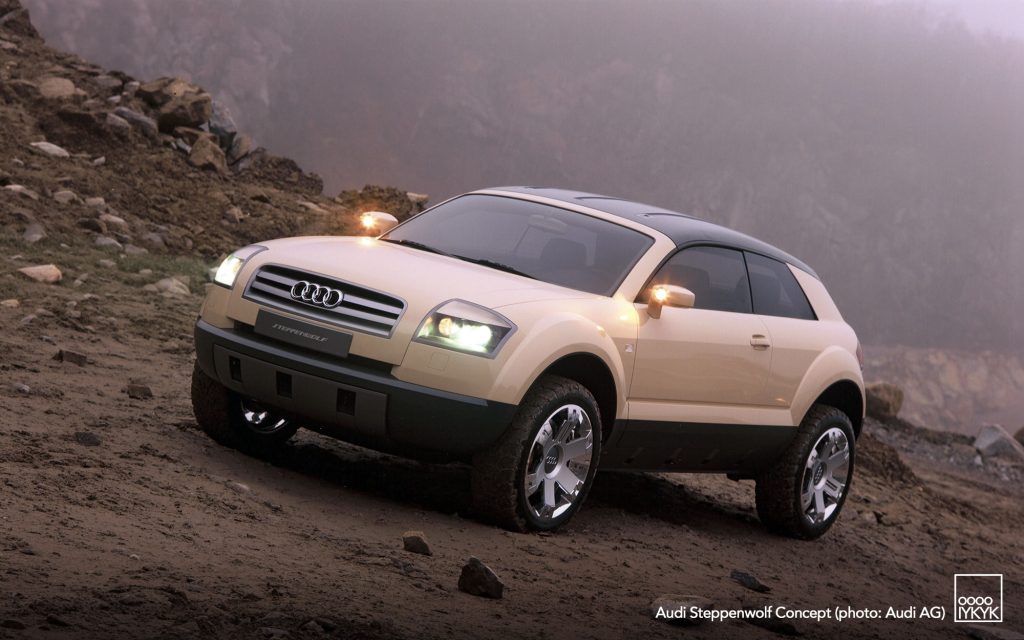
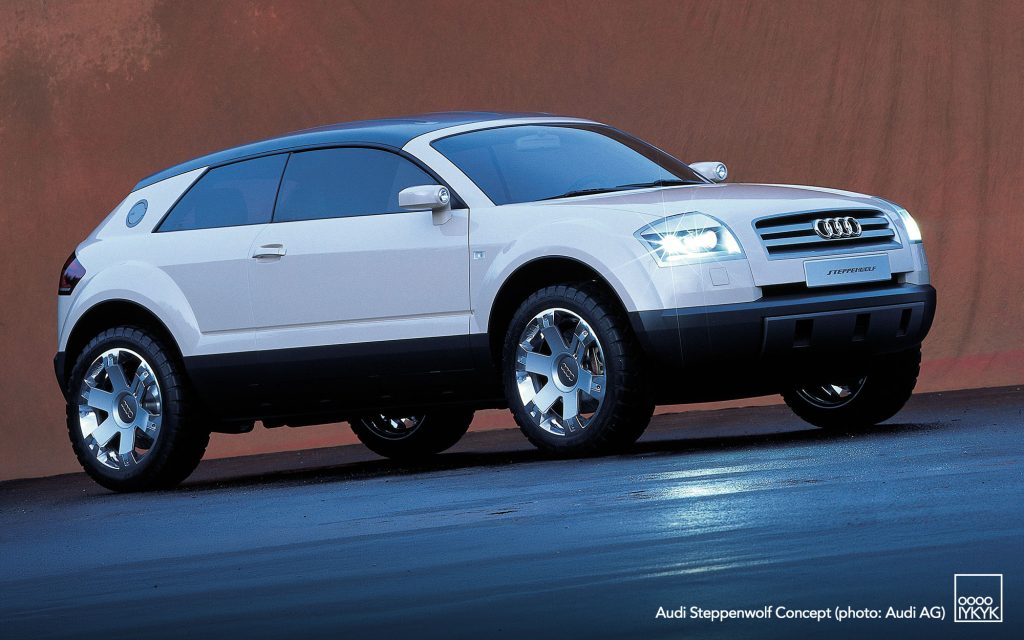
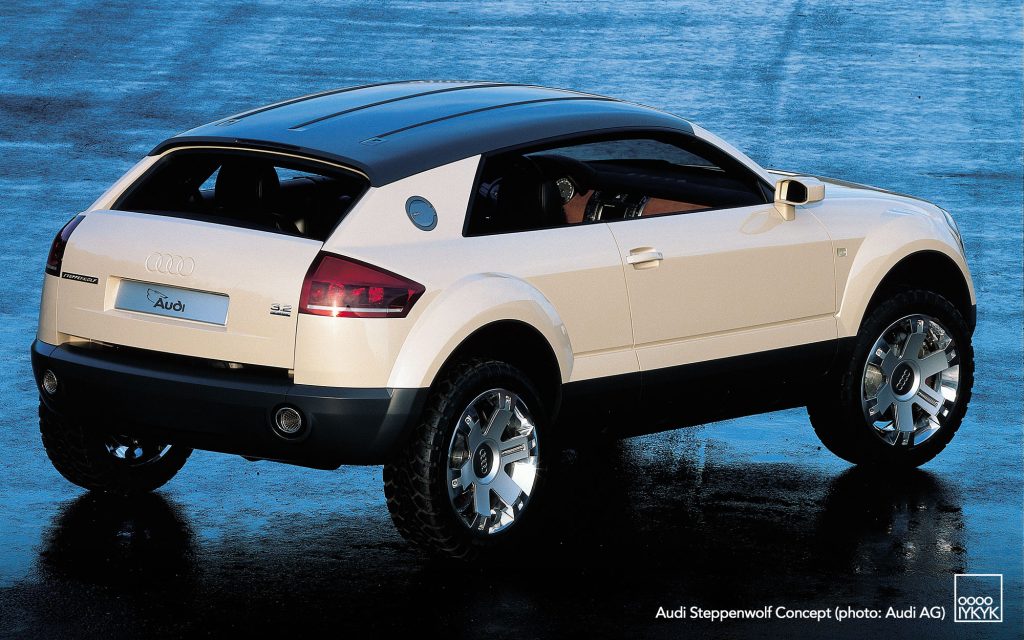
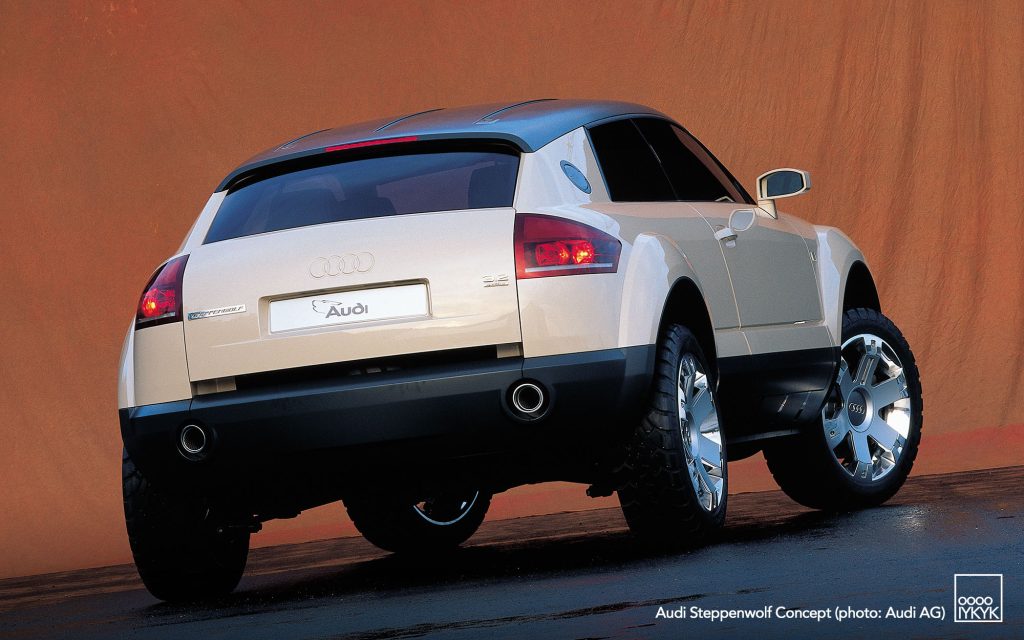
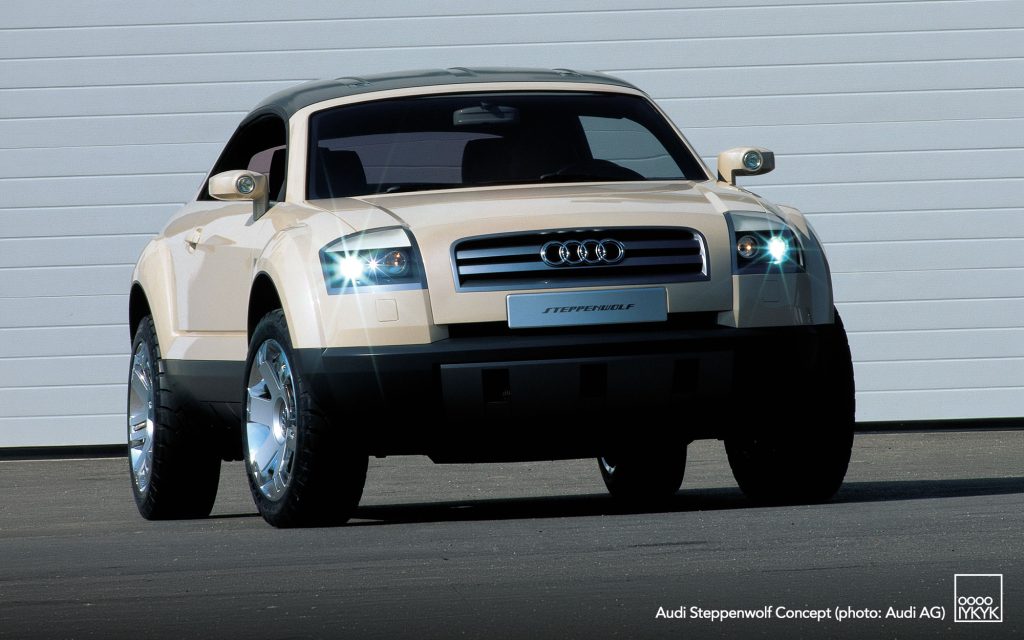
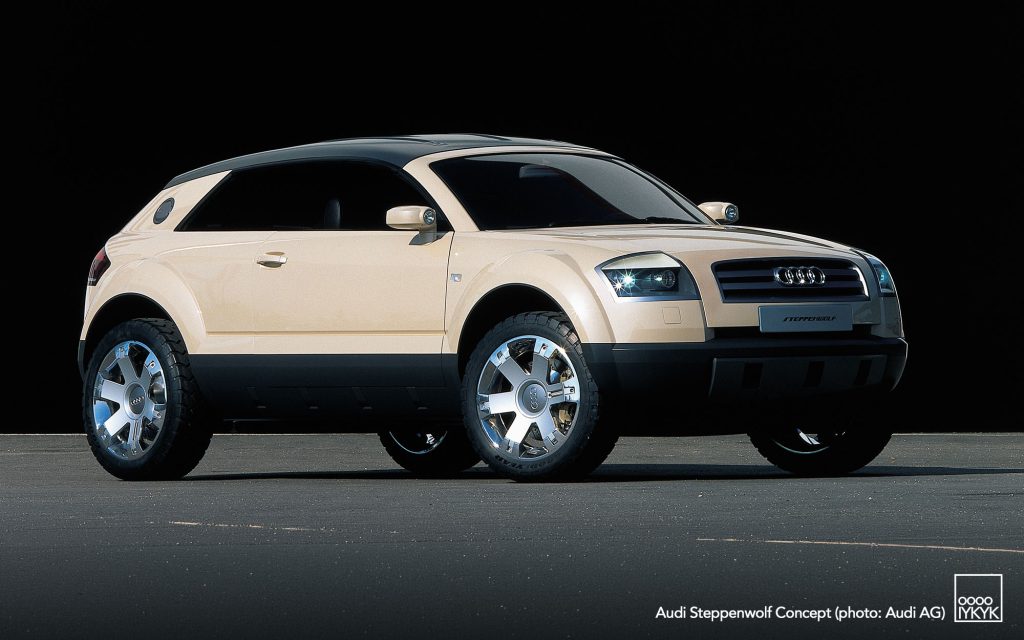
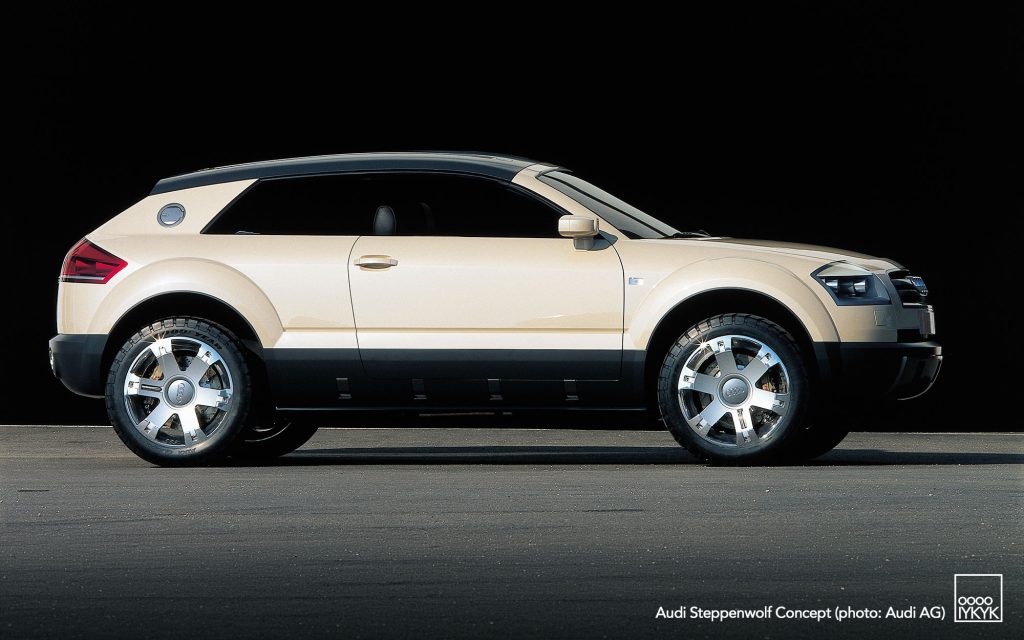
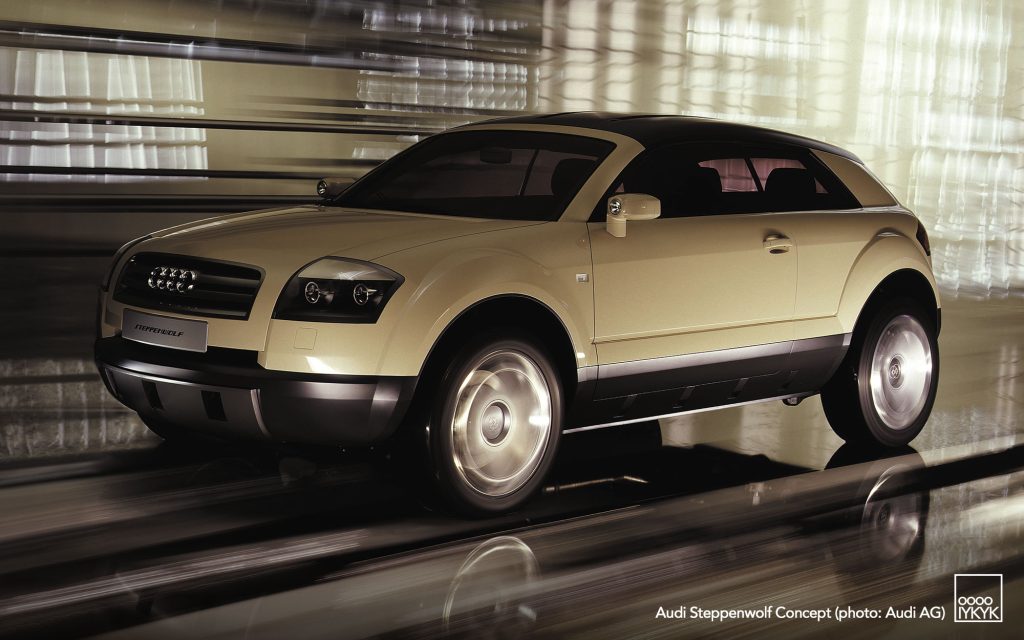
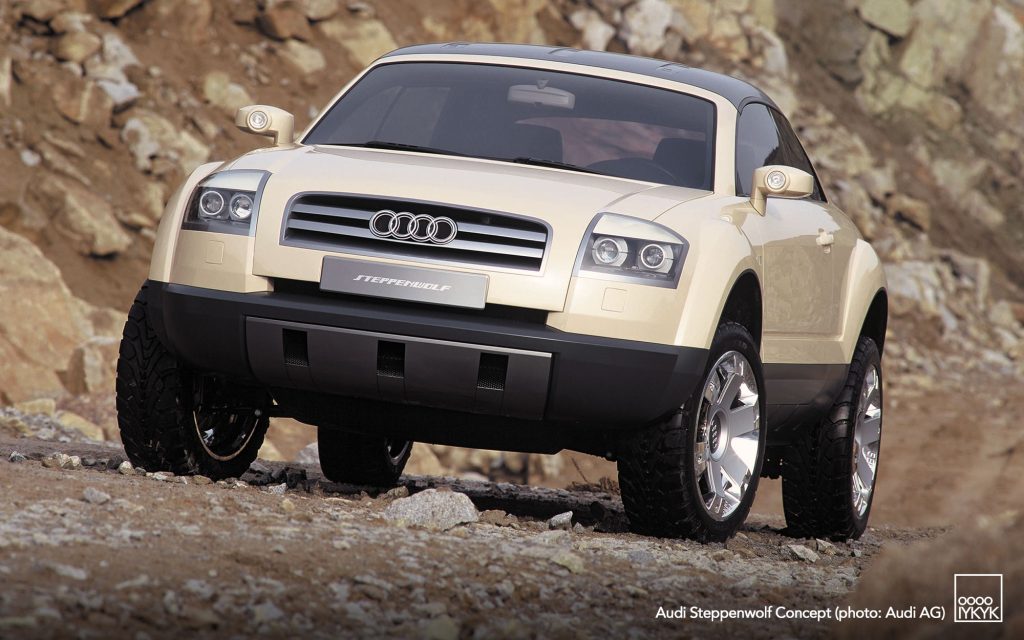
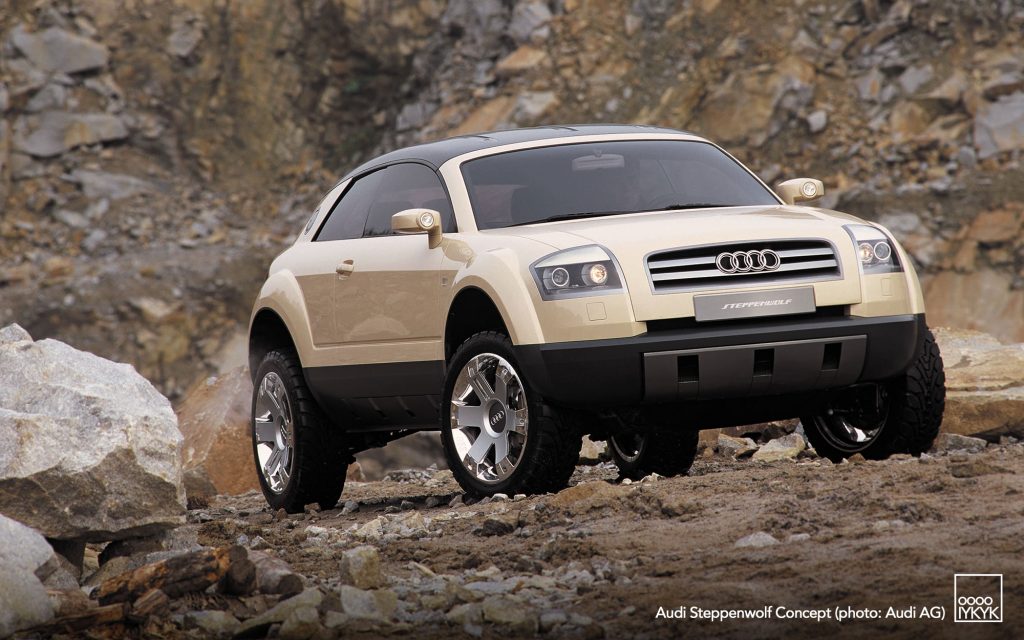
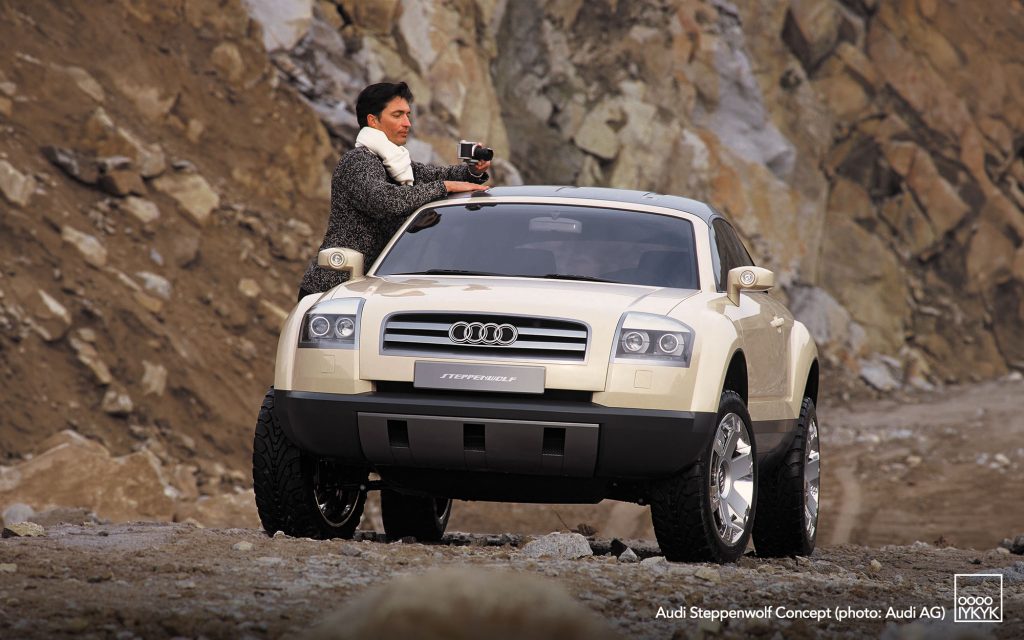
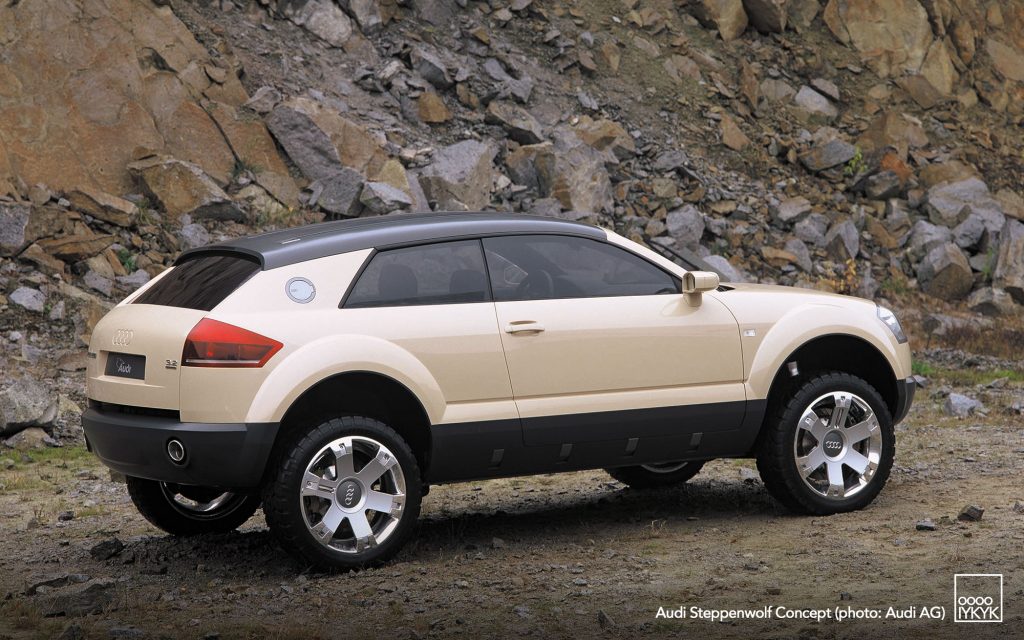
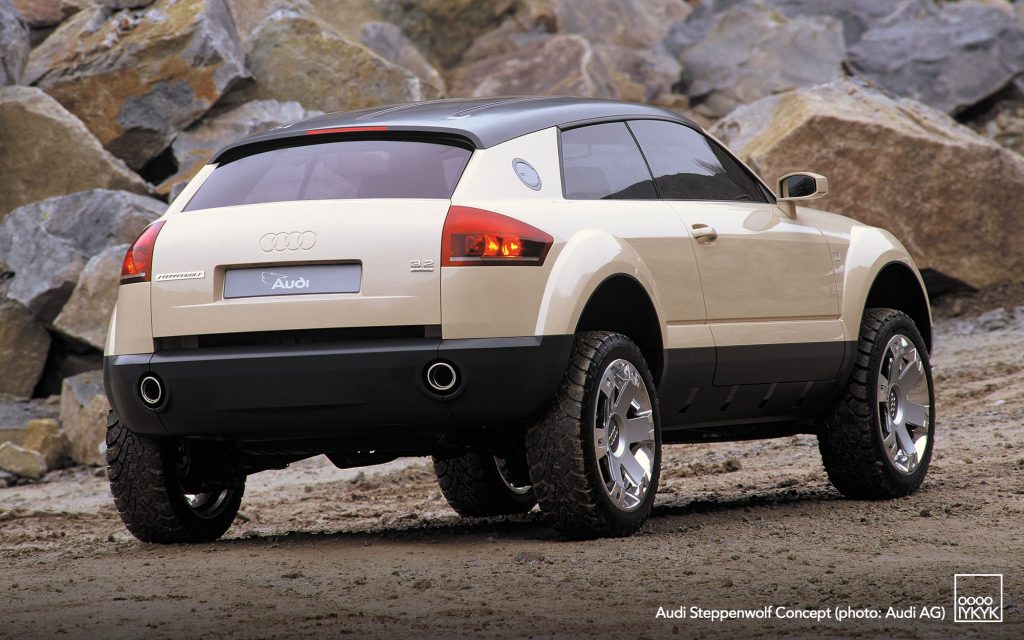
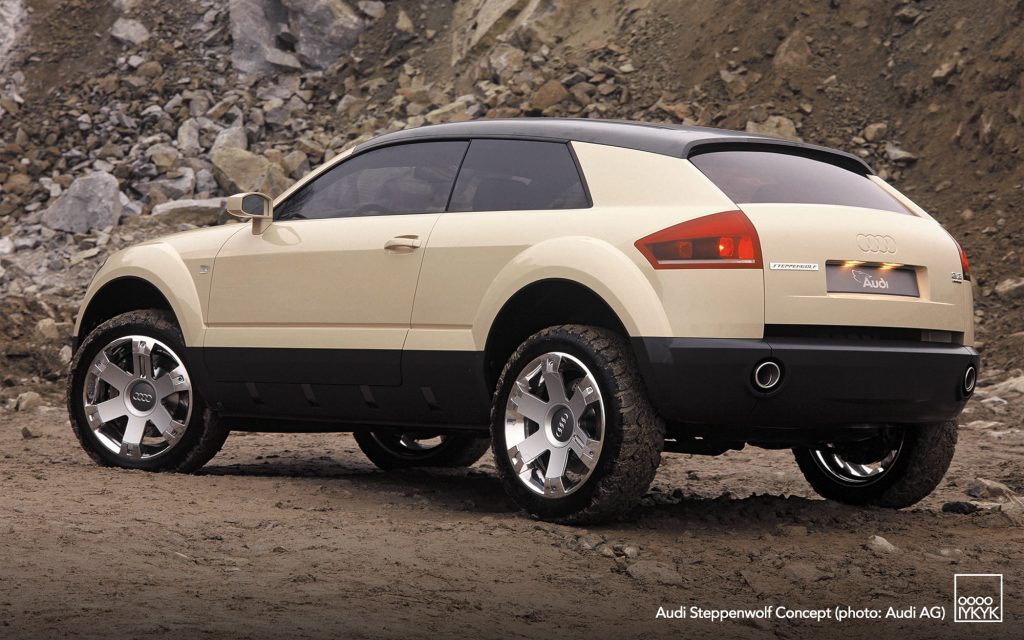
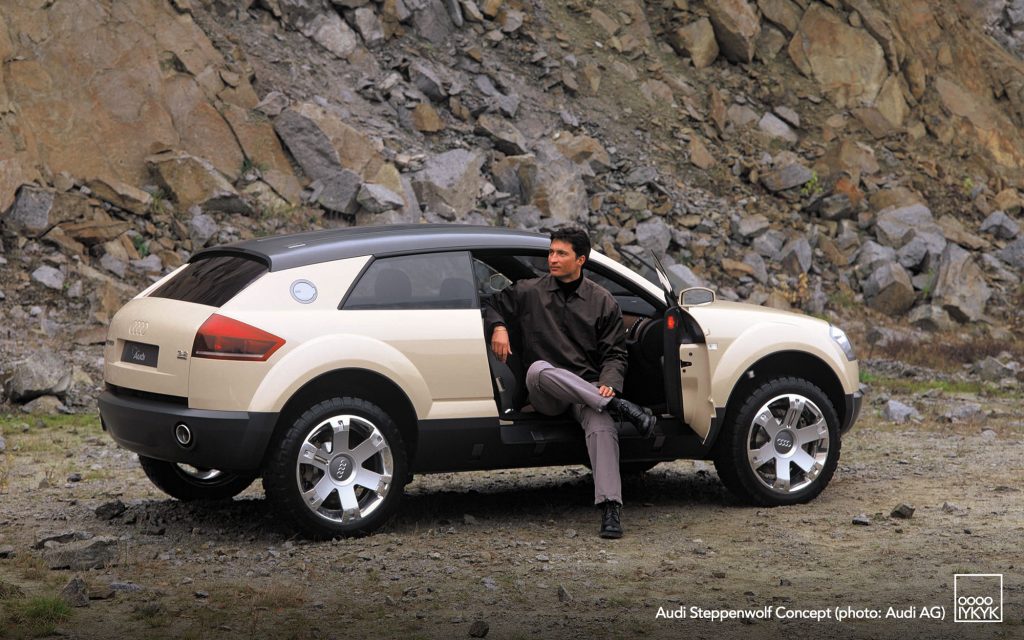
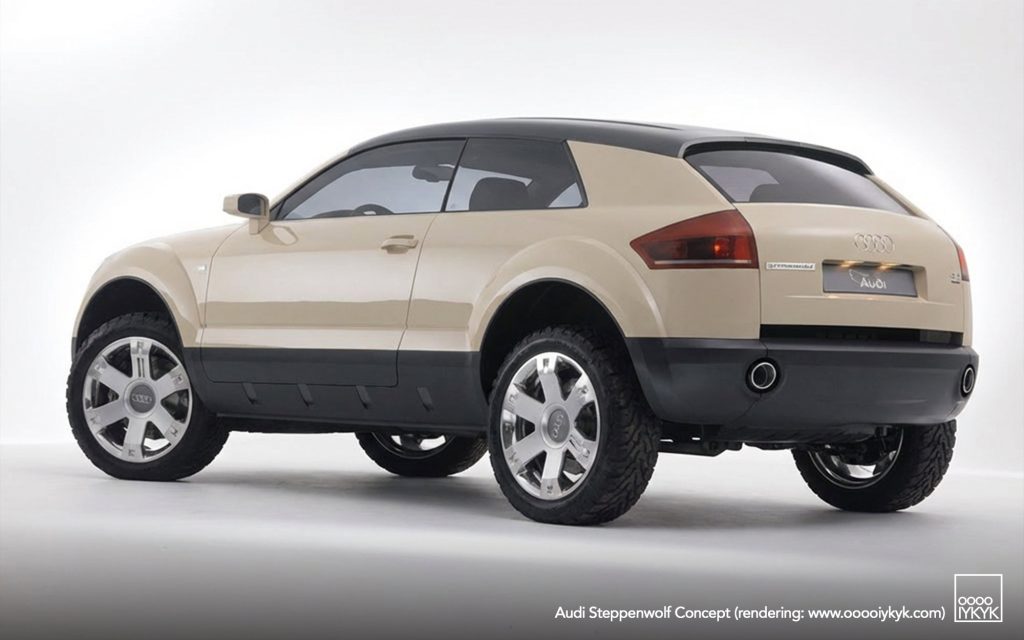
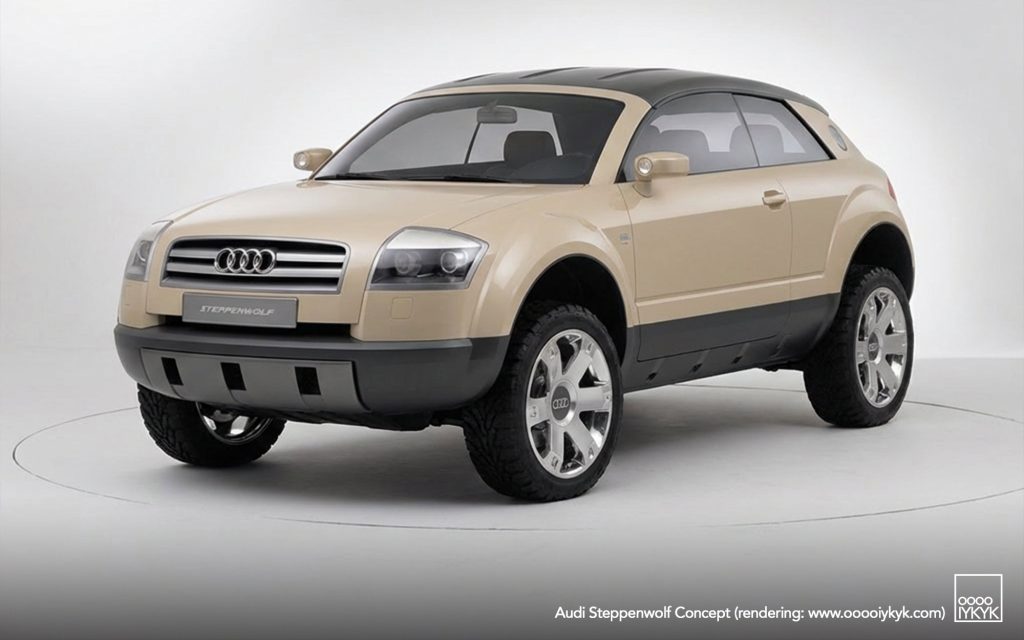
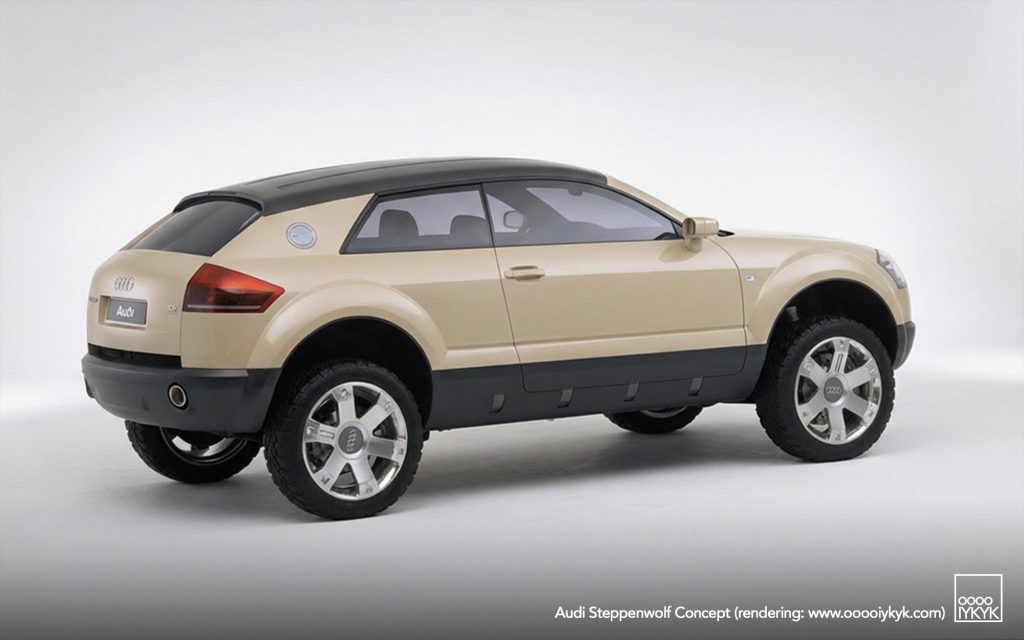
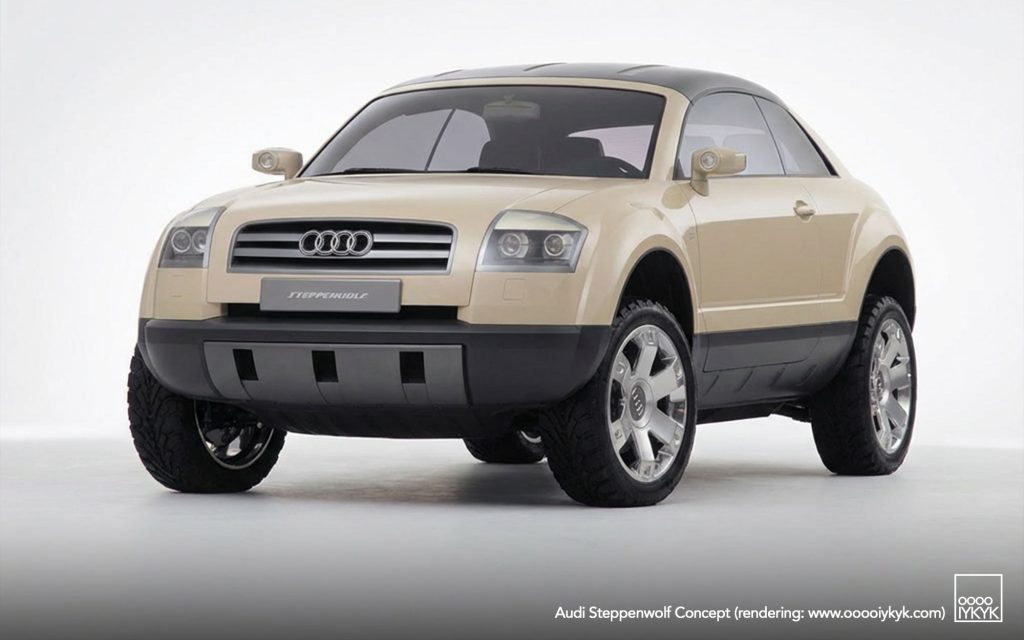
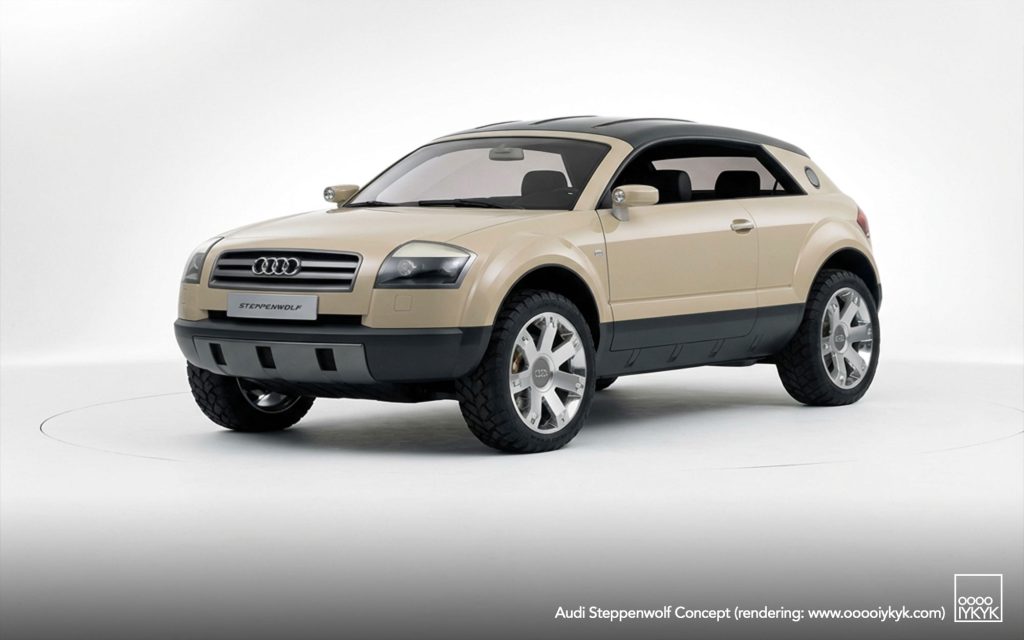
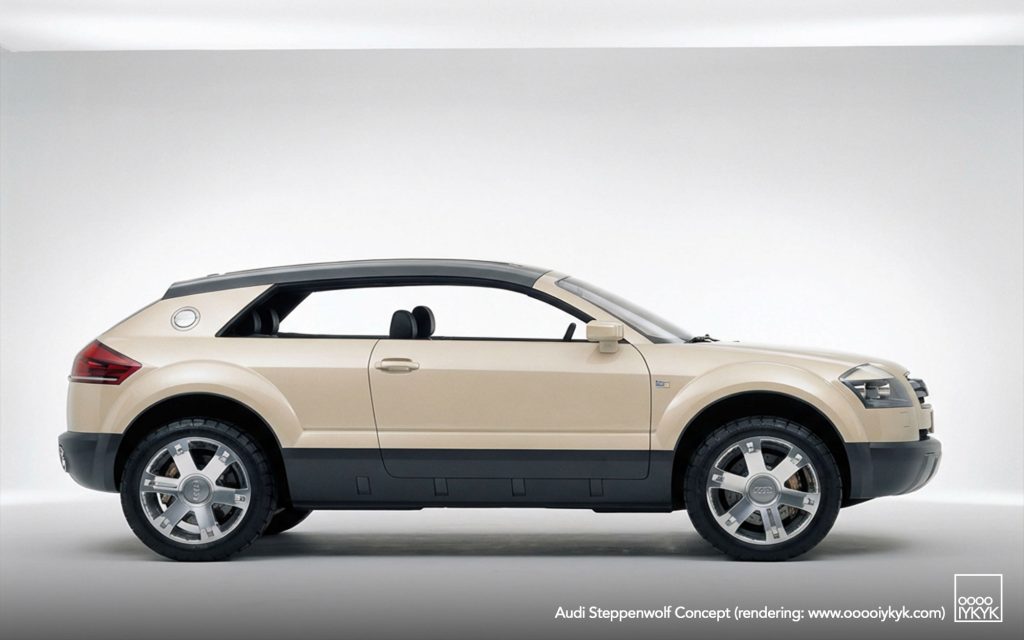
The exterior design of Project Steppenwolf was conceived as a reinterpretation of Audi’s contemporary design language adapted for an all-terrain vehicle. Although based on the compact platform architecture of the Audi A3, Audi’s designers intentionally gave the vehicle a far more muscular presence. The body measured approximately 4.79 meters (188.6 inches) in length, with broad proportions, prominent wheel arches and a high waistline that communicated both strength and capability.
The design featured wide, sculpted surfaces and clearly defined character lines intended to balance visual tension with structural clarity. Audi described the form language as a synthesis in which “function and form become one,” avoiding unnecessary stylistic elements while emphasizing purposeful engineering.
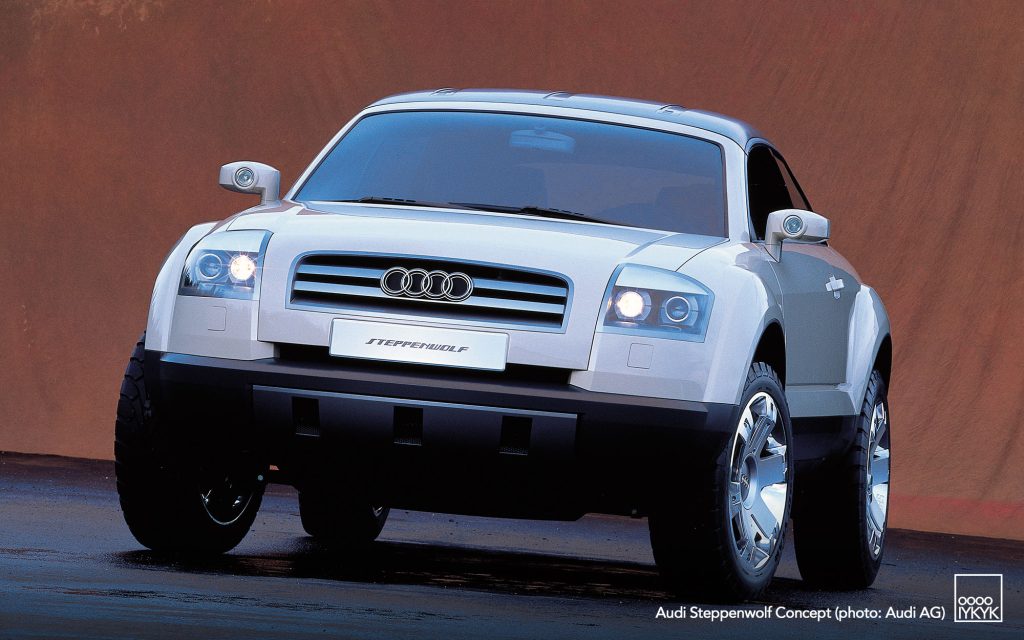
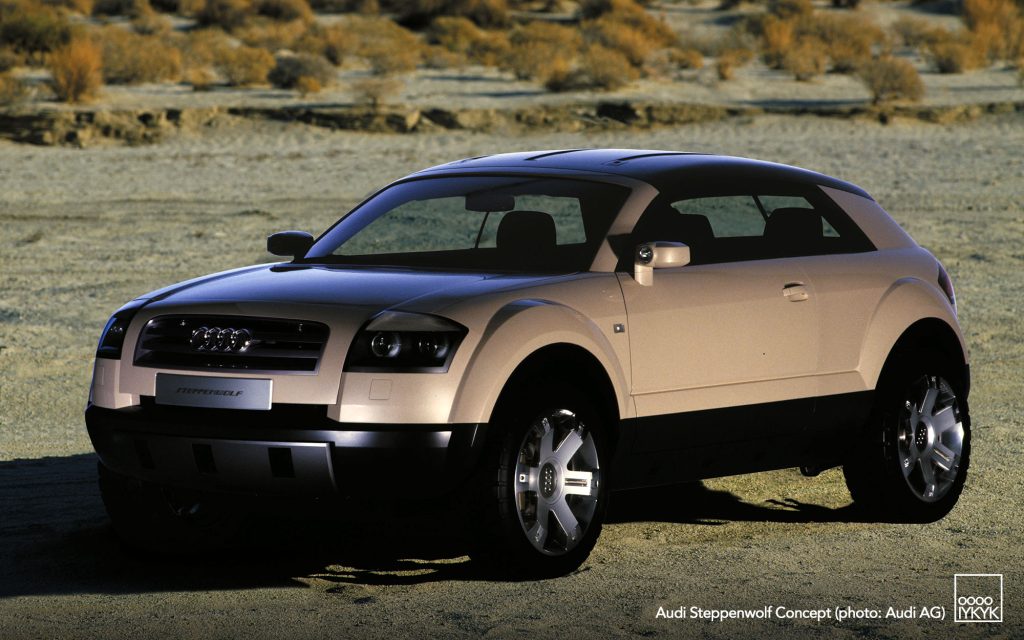
Distinctive design cues immediately identified the vehicle as part of the Audi family. The front fascia incorporated the traditional four-ring grille, while the sharply defined wheel arches echoed Audi’s long-standing motorsport heritage. The vehicle rode on 19-inch alloy wheels fitted with specially developed 225/50 R19 tires, designed to deliver balanced performance both on-road and off-road.
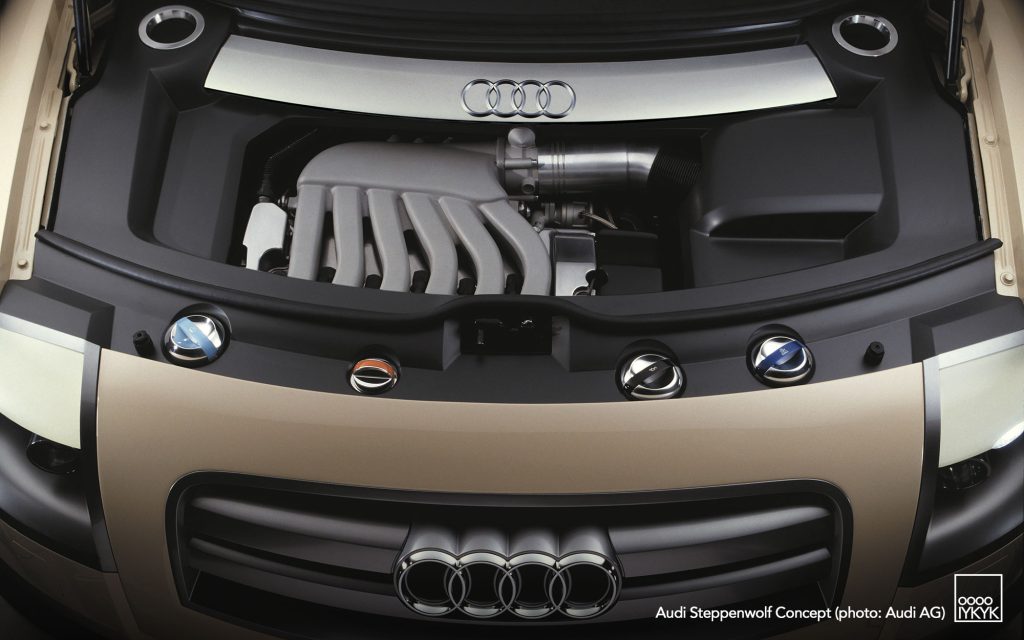
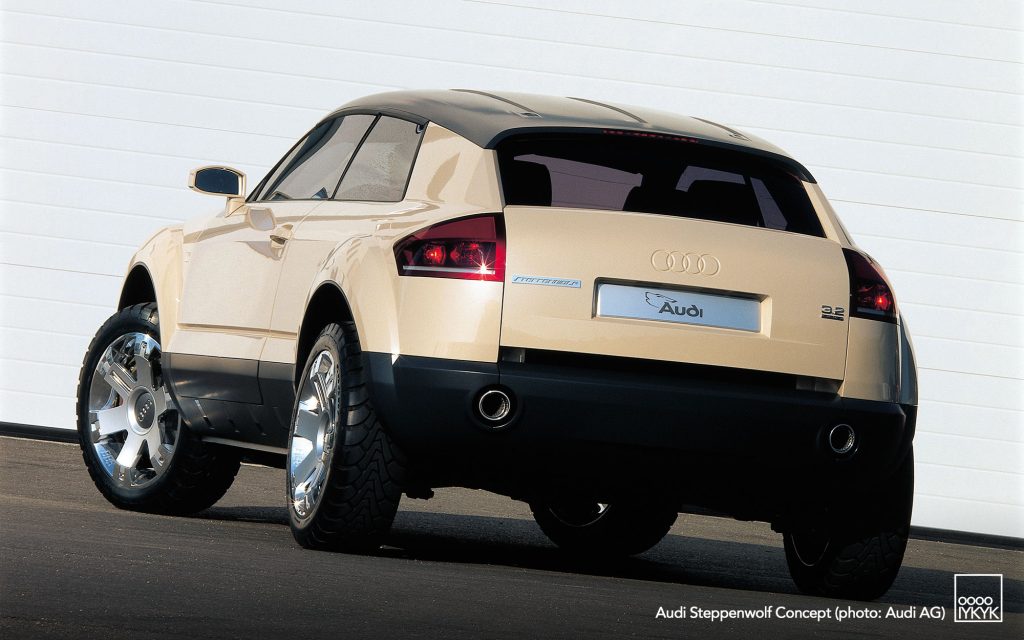
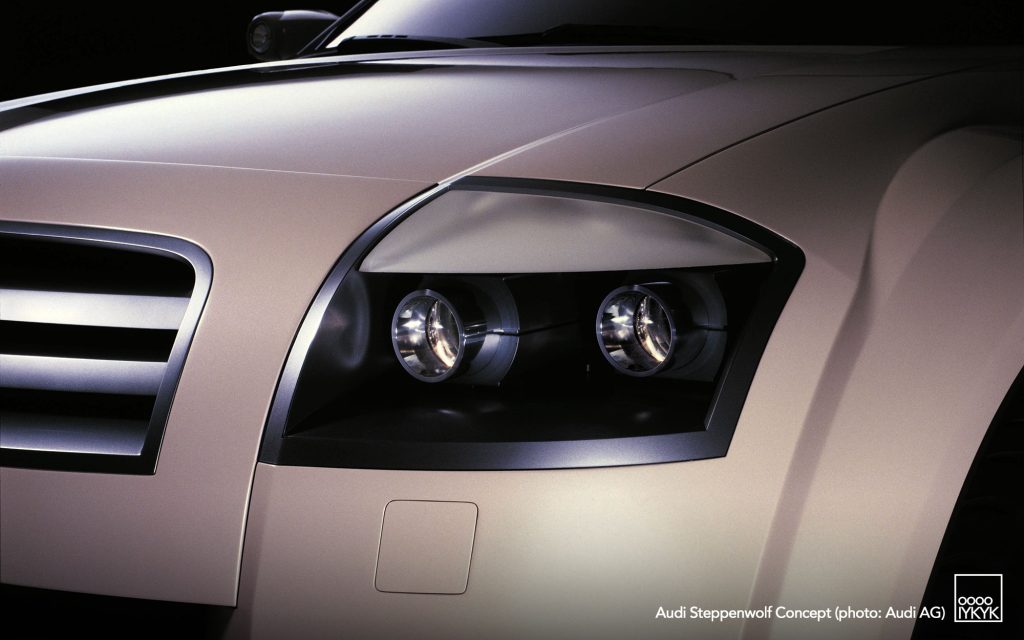
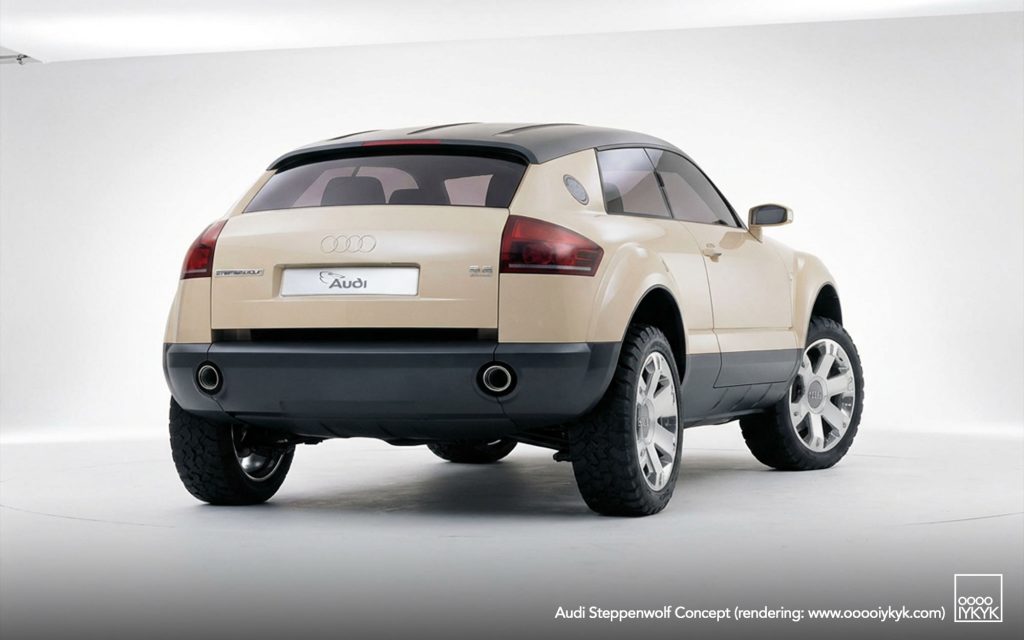
Additional exterior features reinforced the vehicle’s adventurous character. These included rugged protective bumpers finished in body color, contrasting dark roof panels and integrated off-road lighting elements. Audi designers also integrated unconventional details such as front indicators blended into the headlamp assemblies and visible engine components beneath the hood to emphasize the vehicle’s technical character.
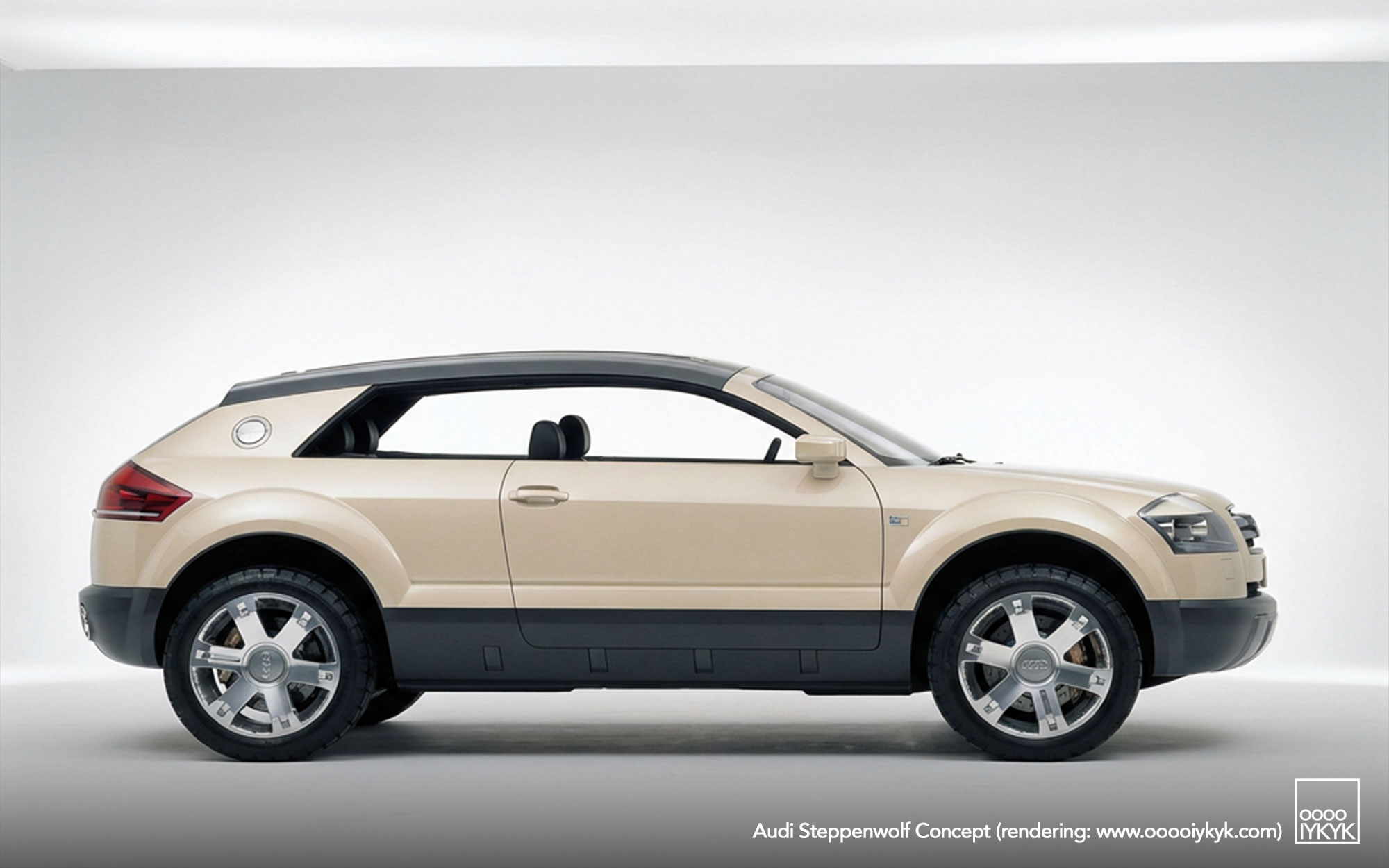
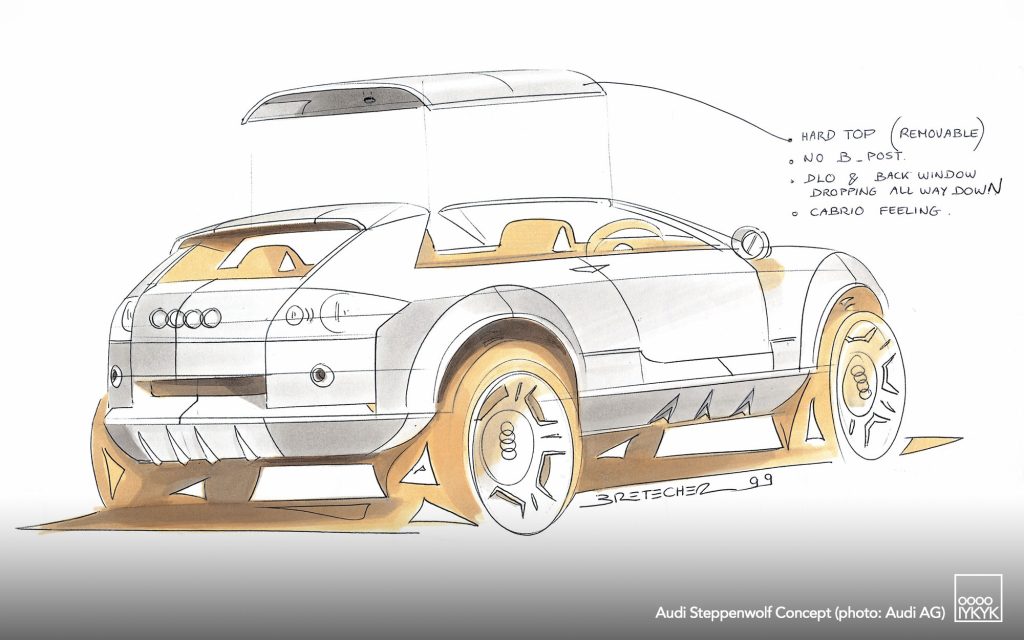
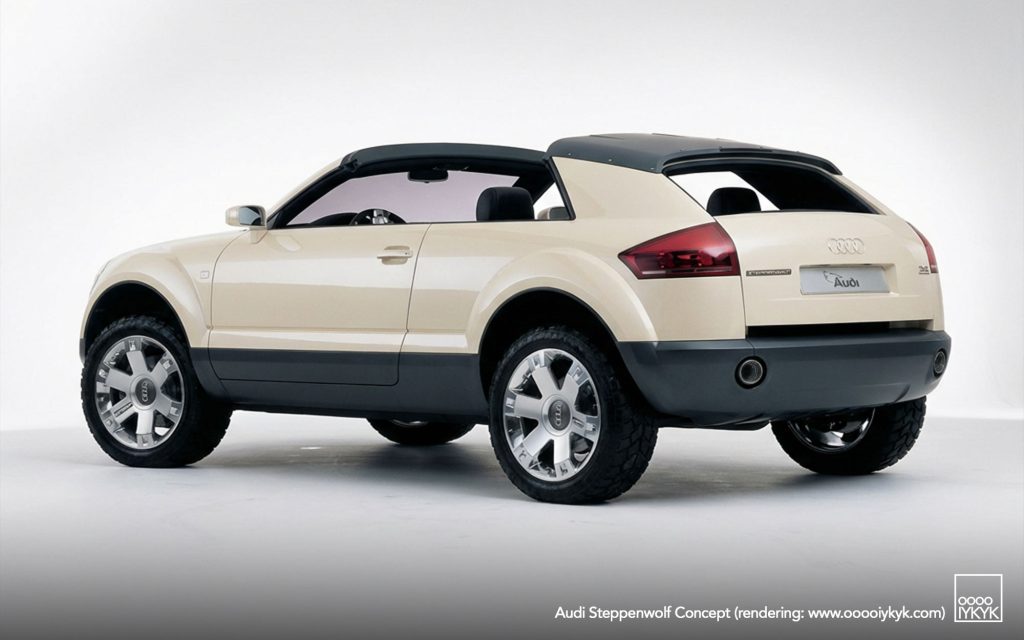
A key design feature was the removable roof system. The concept was equipped with a carbon-fiber hardtop that could be detached and replaced with a soft top, allowing the vehicle to be driven in an open configuration. With the roof removed, occupants could enjoy an unobstructed view between the windshield frame and rear bodywork while maintaining the structural rigidity required for off-road driving.
CHASSIS AND SUSPENSION
The Steppenwolf concept placed particular emphasis on chassis versatility, combining Audi’s quattro drivetrain with a sophisticated adjustable suspension system. Central to the vehicle’s capability was a four-level adjustable air suspension, a system derived from the technology introduced on the Audi allroad quattro.
This suspension allowed the vehicle’s ride height to be adjusted across a 2.4-inch (60 mm) range, enabling the vehicle to adapt to a wide variety of driving conditions. At its highest setting, the Steppenwolf achieved 8.8 inches (223 mm) of ground clearance, giving it genuine off-road capability while still allowing the body to lower for improved aerodynamics and handling at speed.
The air suspension system could operate in both automatic and manual modes. In automatic mode, the system adjusted ride height according to vehicle speed, lowering the body during highway driving to improve stability and raising it again when speeds decreased. Manual control allowed the driver to select any of the available ride heights via a rotary control located on the center console.
The chassis employed MacPherson strut suspension at the front axle and a longitudinal double-wishbone design at the rear, both optimized for compact packaging and suspension articulation. Precision rack-and-pinion steering and Brembo braking components were also incorporated, with the brake system visibly highlighted through perforated brake discs and branded calipers.
Audi engineers also developed an innovative electro-hydraulic parking brake system. Instead of a conventional mechanical handbrake, the system used electronically controlled hydraulic activation of the rear brake discs. This allowed the hydraulic circuits of the foot-operated braking system to remain isolated when the parking brake was engaged.
INTERIOR AND EQUIPMENT
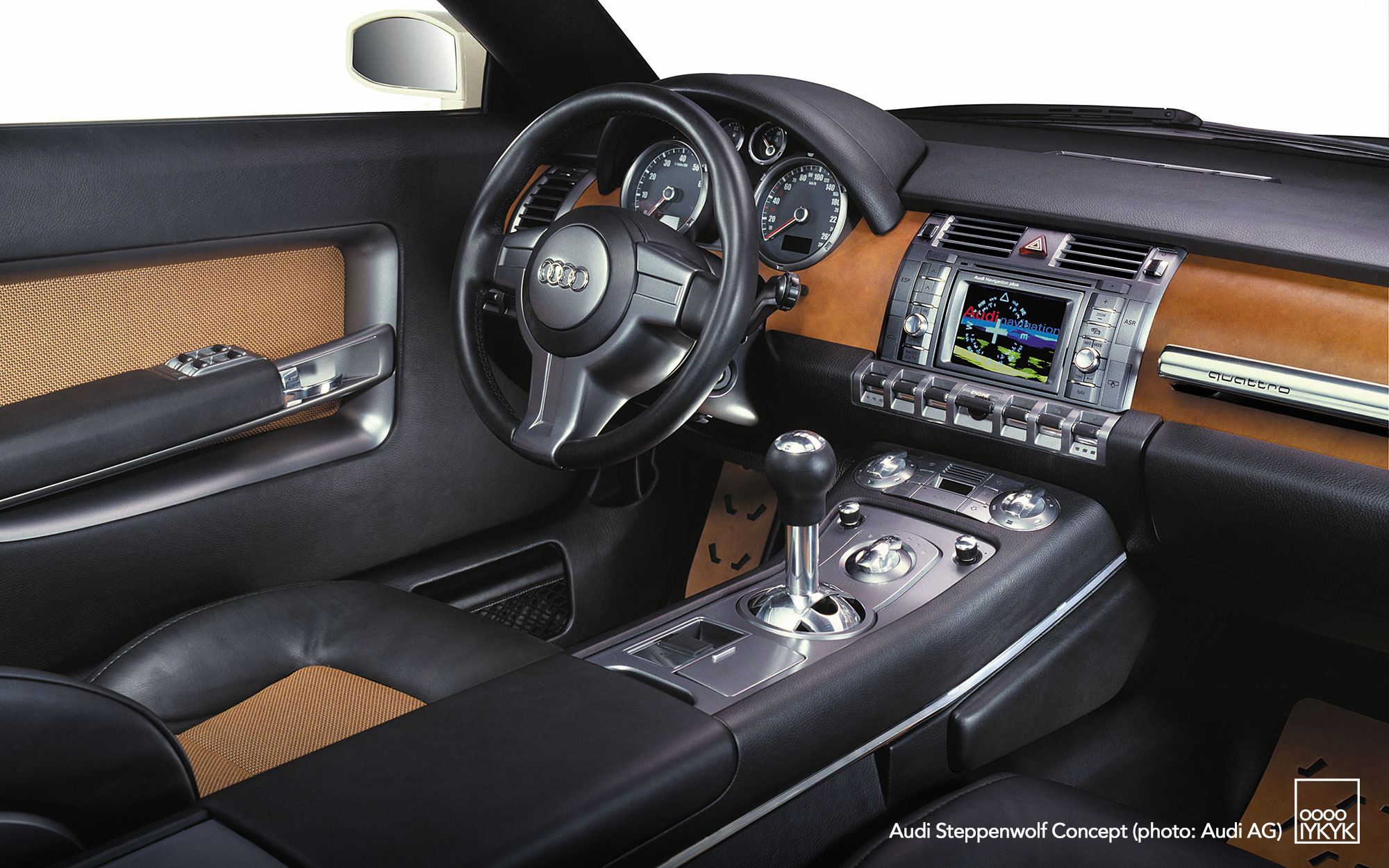
The interior of Project Steppenwolf was designed to reflect both the ruggedness of an off-road vehicle and the functional clarity typical of Audi interiors. Audi emphasized durable materials, straightforward ergonomics and high legibility for instrumentation, ensuring that the driver could maintain full control even in demanding conditions.
Instrumentation consisted primarily of analog gauges with yellow-on-black displays, designed to maximize readability while reducing visual distraction. Ambient lighting illuminated key control areas such as the center console and footwells, creating what Audi described as an “aircraft cockpit” atmosphere when driving at night.
The steering wheel was a three-spoke sport design trimmed in leather, paired with a specially developed gear selector and robust rocker switches on the center console. The driver could also operate the air suspension height adjustment through a rotary control integrated into the console layout.
Interior materials combined practicality with premium elements. Surfaces such as the instrument panel were trimmed in durable leather finishes, while thick protective floor coverings and reinforced surfaces were designed to withstand dirt and moisture encountered during off-road driving.
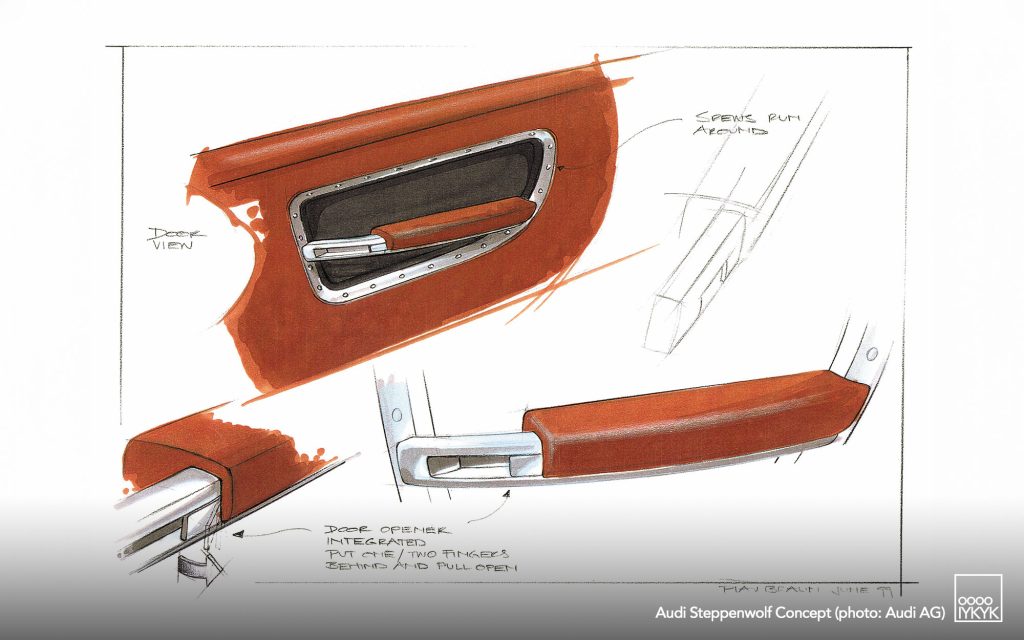
Practical storage was also a key design consideration. Numerous compartments were integrated throughout the cabin, including storage nets in the door panels and removable seat-back pockets intended for use during outdoor excursions. The rear luggage area could be accessed through a rear window hatch and was capable of carrying larger items such as sports equipment or bicycles.
Additional equipment included an integrated Navigation System Plus with LCD display, a BOSE audio system with CD player and nine speakers, and a refrigerated center console storage compartment designed to keep beverages cool during long journeys.
LEGACY AND INFLUENCE
Although the Audi Steppenwolf never entered production, the concept served as an early exploration of Audi’s future direction in the crossover and sport-utility segment. At the time of its debut in 2000, Audi’s SUV lineup had not yet been established, with the Audi allroad quattro representing the brand’s only significant venture into all-terrain vehicles.
Project Steppenwolf demonstrated how Audi’s quattro technology, adjustable air suspension and compact platform engineering could be adapted to create a vehicle capable of both dynamic road performance and genuine off-road capability.
In hindsight, the concept can be seen as an early precursor to Audi’s later Q-series lineup, particularly compact performance-oriented crossovers such as the Audi Q3 and Audi Q5, which would emerge in the following decade. While the Steppenwolf itself remained a design study, it reflected Audi’s growing interest at the turn of the millennium in combining sports-car dynamics with multi-terrain versatility — a philosophy that would later become central to the brand’s global product strategy.
PHOTO GALLERY
PRESS RELEASE DETROIT 2001
Source: Audi AG
Audi presents”Project Steppenwolf”
The all-around vehicle
DETROIT, MI – At the 2001 North American International Auto Show (January 10-22) Audi will display a concept vehicle for on-road and demanding off-road use. Following the successful launch of the Audi allroad quattro, this concept vehicle now shows how the Audi development engineers visualize a highperformance all-around vehicle for the compact class. And it embodies a study which represents the consistent evolution of contemporary Audi design.
But that’s not all:”Project Steppenwolf” – as this three-door, four-seater is known – also provides evidence of the kind of”Vorsprung durch Technik” (Advancement through Technology) which has long since become synonymous with the name Audi.
This study for the compact class also makes use of Audi’s quattro expertise and experience with the height-adjustable air suspension. The engineers had set themselves the following goal: “Project Steppenwolf” should be able to master rough terrain in extreme conditions just as effortlessly as high-speed driving. It should feel equally at home in the outback as on the highway.
Engine
A free-revving 3.2-liter V6 engine developing 225 hp ( 165 kW) accelerates “Project Steppenwolf’ from Oto 62 mph ( I 00 km/h) in under eight seconds. It top speed is well over l 45 mph (230 km/h). Its peak torque of 235 lbs.ft (320 m) is available across a wide speed range. The manual six-speed gearbox turns thi strength into a guarantee of excellent pulling power in every speed range.
The quattro pcm1anent four-wheel drive system ensures maximum traction and excellent directional tability in all conditions and in all types of terrain. The electronically controlled Haldex center differential distributes power between the front and rear wheel . If the front wheels slip, part of the torque is put to the road smoothly via the rear wheels as required.
In addition, the Electronic Differential Lock (EDL) distributes torque between the wheels on one axle. And the Electronic Stability Program (ESP) helps the driver to remain in control if confronted with potentially critical driving situations at the limit.
Running gear
With its precise rack-and-pinion steering, “Project Steppenwolf’ can be guided across rough terrain as accurately as it can through fast double bends on the ideal line.
The Brembo brake system is clearly visible in the wheels: large, perforated discs and the characteristic red lettering on the calipers with eight pistons point to the system’s excellent efficiency.
Audi development engineers have come up with an innovative solution for the parking brake, which acts on the rear brake discs. An electronically controlled electro hydraulic system performs the function of the conventional, manually activated handbrake. This enables the lines to the rear brake calipers to be activated via hydraulic valves in such a way that the hydraulic circuit of the footoperated brake is decoupled.
When the driver presses the button for the parking brake in the cockpit, an 80 bar hydraulic pump takes command of the rear brake calipers. A non-return valve blocks the return flow, the rear brakes lock. If the driver presses the control button again, the rear brakes and the foot-operated brake are connected again.
To prevent operating erors, the control electronics only allow the parking brake to be activated and deactivated when the ignition is on and the vehicle stationary.
The front axle of this four-wheel-drive vehicle has McPherson strut suspension with forged wishbone, cast steel swivel bearings and specially matched axle geometry. The anti-roll bar is connected directly to the suspension strut. The rear suspension uses a longitudinal double-wishbone axle – an extremely space-saving construction which is partially responsible for the particular space efficiency of
“Project Steppenwolf.”
A special feature on “Project Steppenwolf’ is its 4-level air suspension which sets it apart from all potential competitors. This groundbreaking system was first presented and introduced in series production on the allroad quattro. Now this technology can be found for the first time on a compact vehicle, qualifying it as an all-around vehicle in a class of its own.
The air suspension at front and rear permits a variable ground clearance across a range of 2.4 inches (60 mm) in total. The running gear of “Project Steppenwolf’ is thus able to produce an extremely low center of gravity and optimum aerodynamics on asphalt just as effectively as ample ground clearance on rough terrain.
Compared with an A3, for example, “Project Steppenwolf’ offers 4.0 inches (102 mm) more ground clearance in the highest position -which is 8.8 inches (223 mm) off the ground -and an additional l. 7 inches (42 mm) in the lowest position.
As on the allroad quattro,”Project Steppenwolf’ has two control strategy for the air suspension, an automatic and a manual mode. Automatic control i dependent on the vehicle’s speed. At speeds of 50 and 80 mph (80 and 130 km/h) the system. Jowers the body in two .80 inches (20 mm) stages from the nonual to the low level. Correspondingly the body is raised again to the nominal level when peed is reduced.
By contrast, the high level – .80 inches (20 mm) above the normal level – has to be elected manually. Once again, however, the vehicle leaves this position automatically if the speedometer indicates more than ca. 20 mph (35 km/h). All other high levels can also be selected manually at the control panel in the cockpit. Provided no safety-critical speeds are exceeded, “Project Steppenwolf’ remains at the level selected.
The 4-level air suspension not only ensures the appropriate degree of ground clearance, it also has the effect of a load-compensating ride height control system. The level selected is maintained at all times, regardless of the load the vehicle is carrying or even if it is towing a trailer.
The air suspension of “Project Steppenwolf” has another advantage – a talent for which the Audi allroad quattro’s system has already been praised on numerous occasions: it offers what is, not only for off-road vehicles, a unique synthesis of ride comfort on the roughest surfaces together with minimum body movement when cornering at high speed. An excellent basis for ample driving pleasure.
Exterior design
Audi development engineers decided on the floor pan with transversally installed front engine as the technical basis for this new model, the same platform used on the Audi A3 and Audi TT. Its length of 13.81 ft. (4.21 meters) and its status as a fully fledged four-seater consequently also reveal”Project Steppenwolf’ as a representative of the compact class – despite the fact that the visibly wider track and crouched aggressiveness of the body, which is 6.0 ft. ( l.83 meters) wide and 4.79 ft. (I .46 meters) high, speak a totally different language.
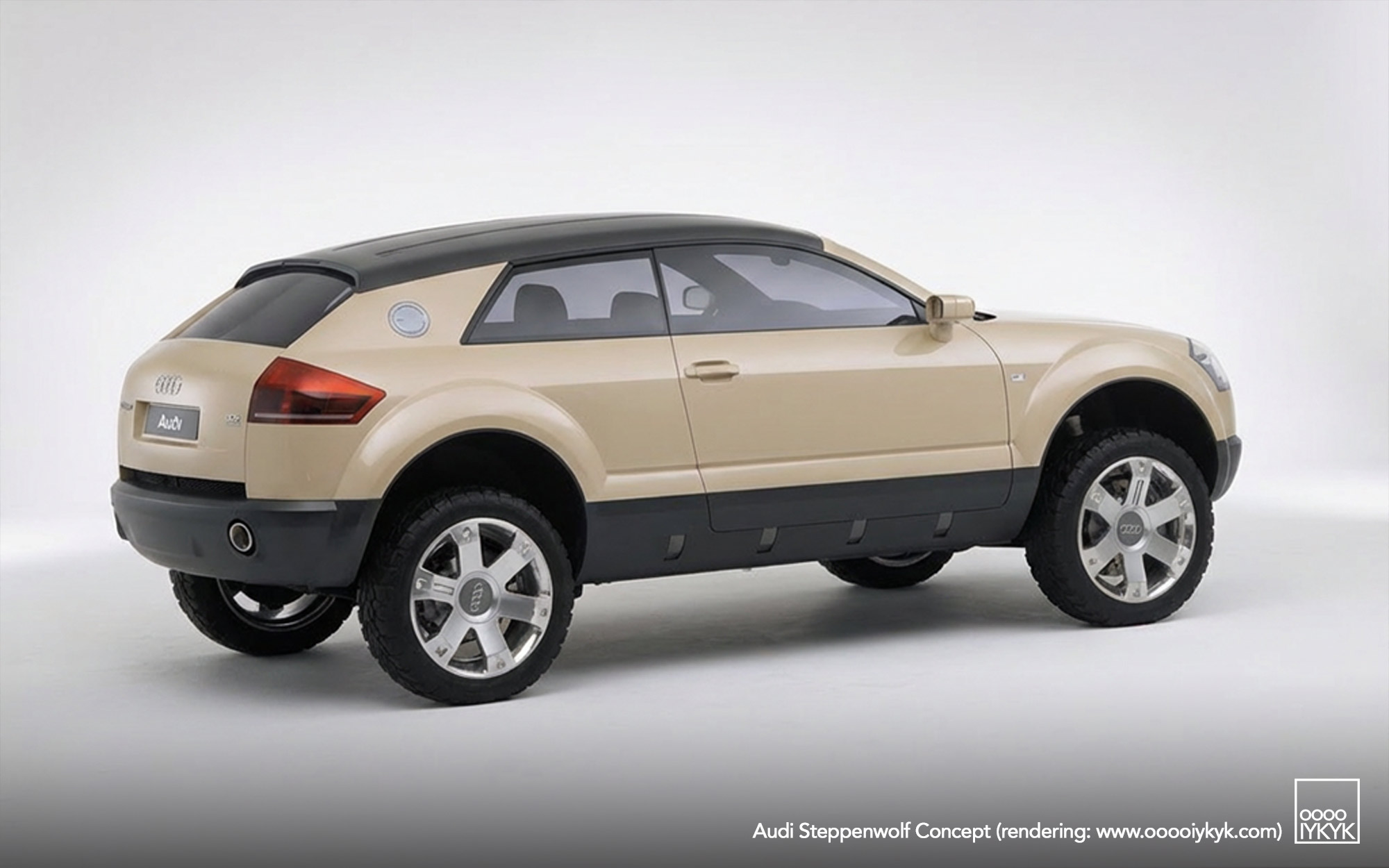
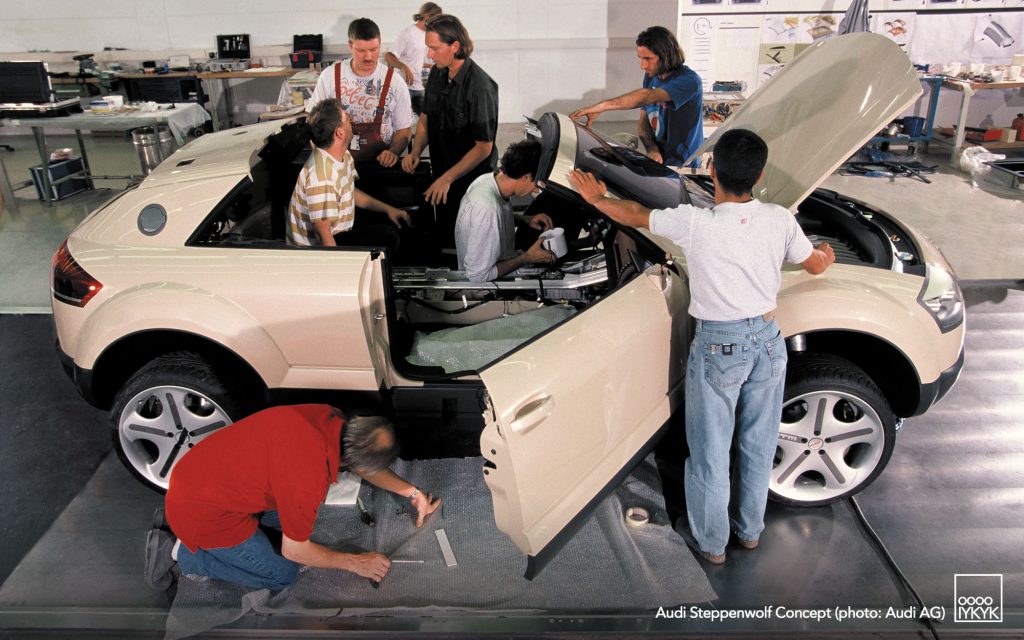
The strikingly flared wheel arches and powerfully dimensioned side sills, the high waistline and the flat curve of the roof sculpt the car’s powerful stature. The contrast between the dark roof and sand-colored body accentuate this dynamic yet elegantly stretched silhouette still further.
“Project Steppenwolf’ makes no secret of its fondness for adventure away from the beaten track. Powerfully contoured bumpers, painted dark gray to contrast with the body color, demonstrate its off-road destiny just as clearly as the spotlights in the door mirrors. The enormous 19-inch six-star wheels with reinforced transitions between wheel spider and rim are a visual indication of extreme robustness and functionality.
The tread pattern of the specially developed 225/50Rl 9 tires also reflects the versatility of “Project Steppenwolf’: a tread that is equally well-suited to off-road and on-road driving.
“Project Steppenwolf’ can be fitted with either a carbon-fiber hardtop or a detachable soft top. And it can be driven with the top down: all occupants can then enjoy maximum headroom between the windscreen and tail end. The stable frame is only retained between the C-posts, above the tailgate, in order to sustain the body’s high torsional rigidity off-road too.
The soft top for “Project Steppenwolf’ is made of sealed textile fabric and, as on many off-road cars, is fitted by hand. The driver just has to attach two posts above the side windows and snap on the soft top.
The design of “Project Steppenwolf’ is completely new, but every line, every detail shows it to be a member of the Audi model family. The flat radiator grille with the four rings, the sporty, slim silhouette and the high waistline together with the narrow roof area have become almost traditional identifying features of the brand. And the striking wheel arches immediately call to mind the TT, currently the most typical representative of the Audi line.
The Audi designers have succeeded in interpreting familiar lines in a new and unusual way, without departing from the Audi design language. Unusual solution such as the design of the front indicators are harmoniously integrated into the light unit.
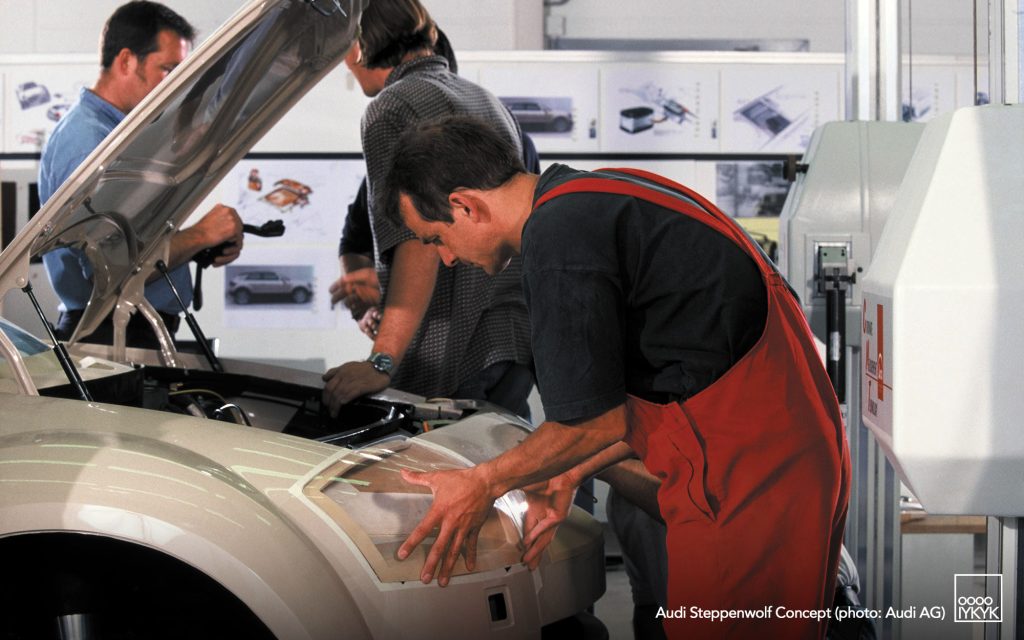
Surprising solutions can also be found under the hood, where the Audi designers’ striving for form has once again set clearly visible standards. The six intake pipes of the transverse six-cylinder engine are in brushed metal with a matte finish: a clear, visual indication of this power unit’s potential.
A “service bridge” located laterally in front of the engine contains all the important openings for topping up oil, coolant and washer fluid, side by side. This engine design combines the design of a classic racing-car inner life and an Audi engine compartment of the future.
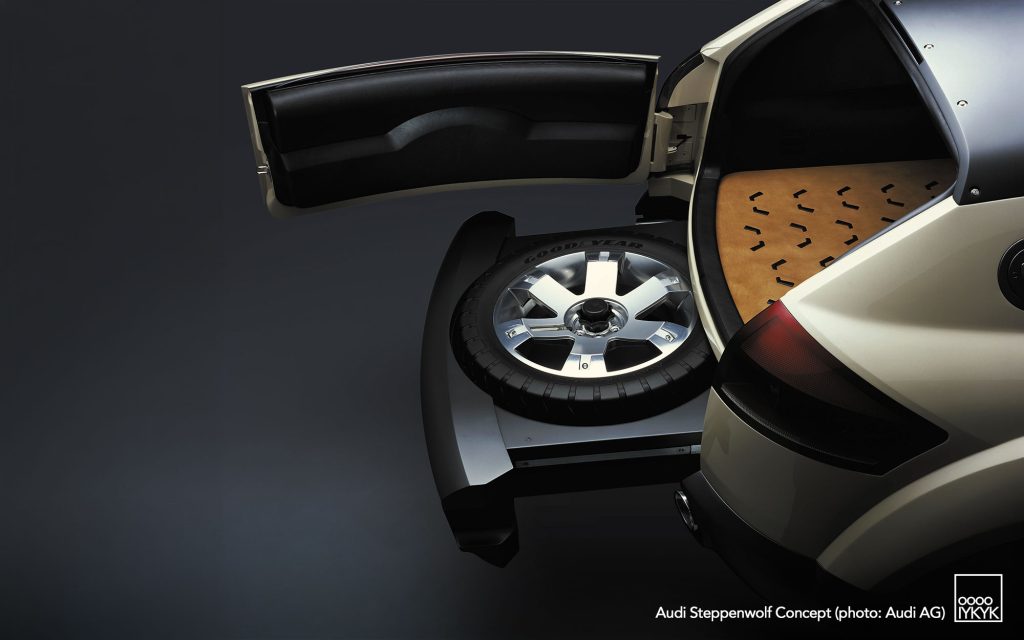
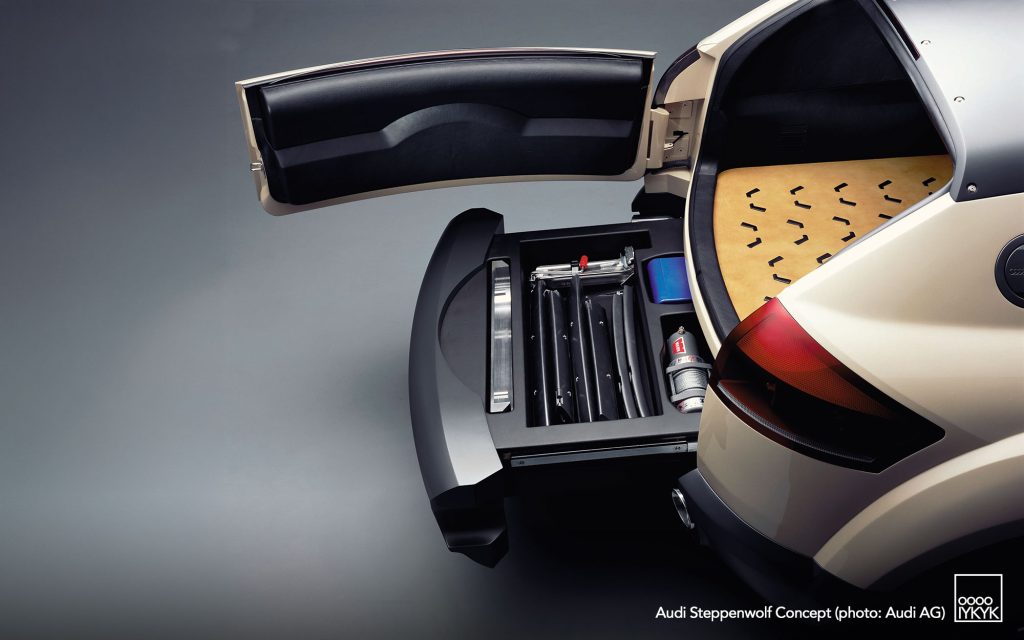
Another special feature can be found at the back of the Audi design study: a drawer under the luggage compartment edge houses the spare wheel. However, if necessary this moving compartment can also be used with a second insert – in this case “Project Steppenwolf’ would then carry the Tire Mobility System repair kit with 12-volt compressor and tire sealing compound instead of the spare wheel.
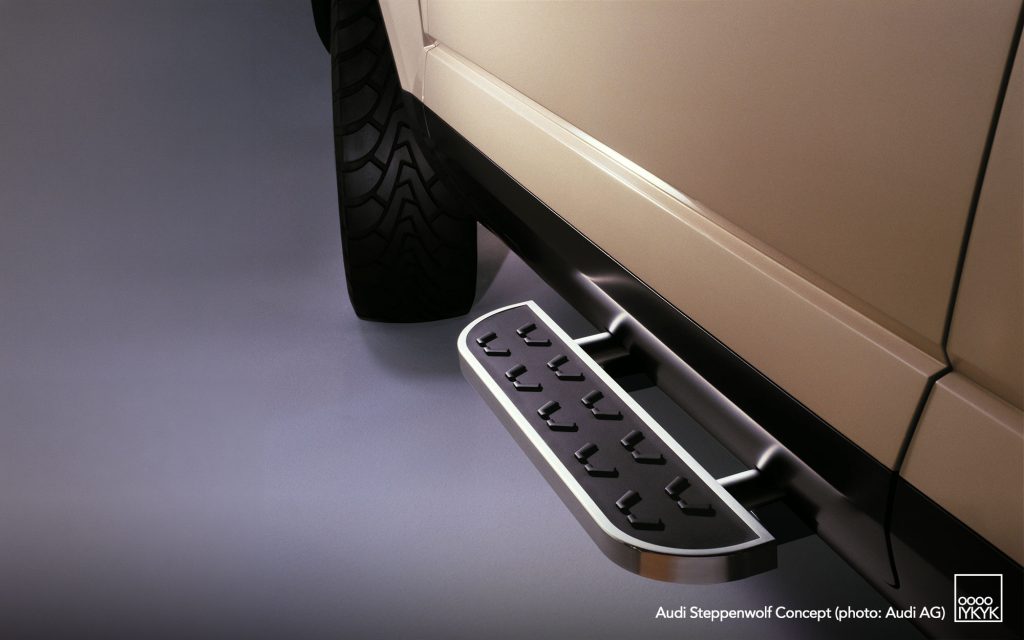
The alternative drawer insert provides space for the optional winch which is engaged with an adapter and can be activated underneath the radiator grille. There is also room in the rear drawer for two running boards which can be attached below the side doors: these provide a useful climbing aid which can be used, for example, to secure luggage to the roof when the air suspension is raised.
Anyone taking a step back will recognize the characteristics of the new Audi design in the overall form of the body: wide, clearly contoured lines and large, pure surfaces combine to produce an architecture in which calm and tension are equally present. No superfluous swage lines or curves upset this visual clarity. Function and form become one.
Interior
The impression conveyed by the interior is also dominated by clear functionality and extreme robustness. All important information is easily legible on huge, round analog instruments with white dials and red needles on a dark background. Predominantly smooth surfaces and the metallic surround on displays and control elements convey the same tidy atmosphere of a cockpit.
But sobriety is not the only dominant feature: the generous use of “shoe sole leather” on the instrument panel creates an elegant yet pragmatic ambience.
There are even cognac beige leather inserts in the footwell, with a black rubber recessed texture to give them a non-slip surface. It is of course no coincidence that the texture matches the striking tread pattern of the tires.
A unique combination of materials which lends a discreet elegance to the interior. An elegance which is in no way detrimental to function and durability: the centimeter-thick sole leather on the floor is sturdy enough for everyday wear and tear, and sufficiently resistant to dirt and moisture.
High side sills and the mighty, continuous center tunnel surround the driver and passengers, producing anatomically correct niches with excellent lateral support. The eats with their pronounced contours are low and mounted on flat consoles so that the occupants assume an almost sports-car-like position, with their legs stretched out. One aspect which is unusual for a coupe is that “Project Steppenwolf” offers not only the driver and front passenger, but also the two rearseat passengers excellent seat comfort with plenty of room for legs and upper body.
Rear passengers will be treated to first-class comfort as soon as they climb aboard. The door cut-outs extend a long way back to provide a large opening, and the front seats of “Project Steppenwolf” are fitted with the “Easy Entry” mechanism which has already proved a success on the A3. This allows them to be moved right forward, returning to their original position when the backrest is folded back again.
The voluminous luggage compartment is also untypical of n coupe. It can be loaded up easily through the side-hinged tailgate which has a window that can be lowered. The rear seats can of course be folded forward individually or together so that the entire area behind the front seats can be used to a accommodate bulk sports equipment or even bicycles, for example.
When the low-beam headlights are switched on, the inside of the center console is Illuminatcd in a soft red. The footwell is well-lit when getting in or out of the car. The electronics dim the lighting to a minimum whilst driving to prevent distracting reflections in the front windows. Together with the typical Audi red instrument lighting, this illumination creates the atmosphere of an aircraft cockpit inside “Project Steppenwolf,” especially in the dark.
The driver’s right band only has to reach a short distance from the easy-grip threespoke leather-rimmed sports steering wheel to the specially designed gear lever. with its matte metal surface and the open gearshift mechanism, it too provides its own individual touch, as indeed do the large rocker switches with wide rubber textured strips on the center console. The starter button, protected by its own separate flap, is located at the center of the rocker switch panel. The large, ergonomic rotary switch for the 4-level air suspension on “Project Steppenwolf’ is al o in the center console.
The driver will find the right switch immediately, even in the dark, even wearing gloves; operation of the controls never produces any unwelcome surprises.
Equipment
The navigation system Plus with large LCD monitor is perfectly integrated into the smooth center console. The presence of this instrument in the off-roader’ cockpit would appear to make even more sense than in other vehicles; it makes the driver’s work easier and leaves him free to concentrate on his most important task. The OPS aerial of the navigation system is integrated out of sight in the rear roll bar.
The large center console is not only highly functional, it also houses a cooler box. This is ideal for keeping drinks in, and will by no means only come in handy if embarking on a trek across the desert.
There is no lack of storage space in “Project Steppenwolf’ for all those everyday item needed in the car. Besides a large glove box, there are particularly practical storage compartments in the high side sills which secure their contents with a net. This will put an end to maps, etc. falling out of the door pockets when the doors arc opened.
Generous seat pockets attached to the back of the front seats can be removed: the most important items can thus be stowed here and taken out of the car if an offroad expedition is continued on foot, for example.
Something which has come to be expected in an Audi can also be found in “Project Steppenwolf”: a BOSE® sound system with CD player. A total of nine speakers produce a listening experience which will satisfy even the most sophisticated of demands.
“Project Steppenwolf’ is an all-around vehicle. Just like its legendary ancestors, the Audi quattro and Sport quattro, it offers the technology of a rally sports car – on both asphalt and gravel tracks. It unites the indisputable authenticity of a driving machine with the advanced elegance of Audi design. A car that extends horizons, whose potential allows experiences beyond the realms of apparent possibility. A precision tool for the way through even uncertain terrain.
BOSE® is a registered trademark of Bose Corporation. Covered by patent rights issued and/or pending.