

/Eras/Audi Sport Competition Cars R Era /Audi R7 (1993-1998)
MODEL DETAILS
What: Audi A4 quattro Super Touring
Series: BTCC
Class: FIA Class 2 / Super Touring
Era: Audi Modern Era
Model Family: A4
Market / Zone: AUS, DE, IT, UK, BE, ES, ZA
Season: 1996
Model / Generation Code(s): type 8D, R7
Chassis / Matrix: B5
SUMMARY
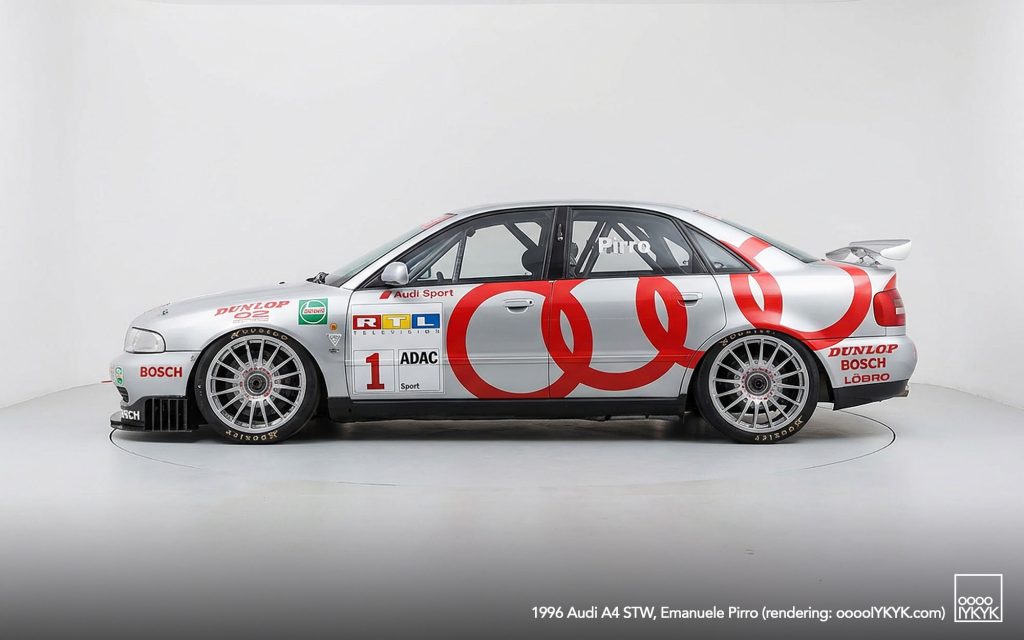
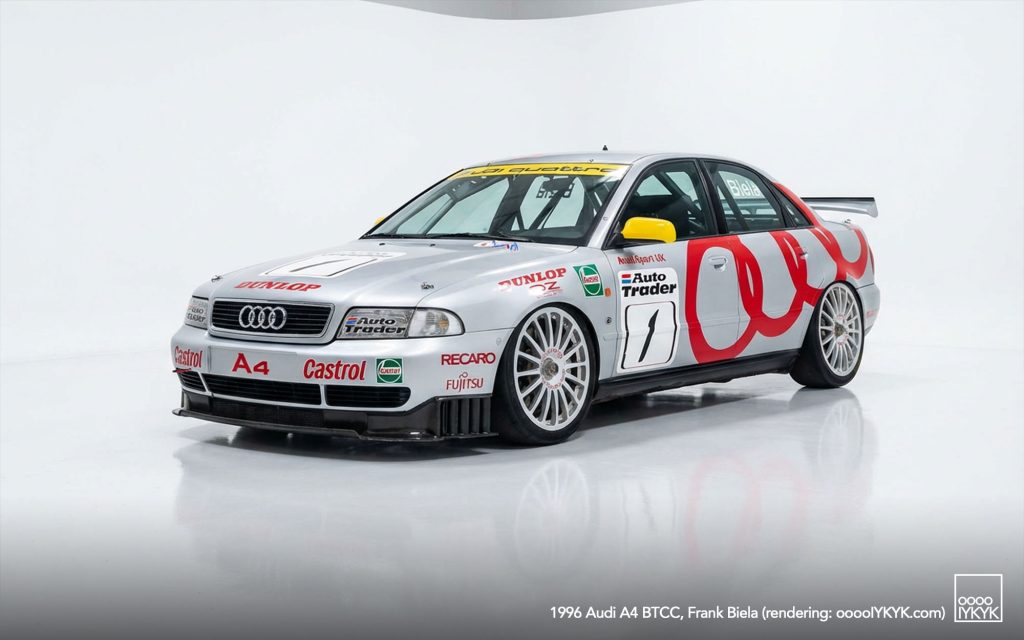
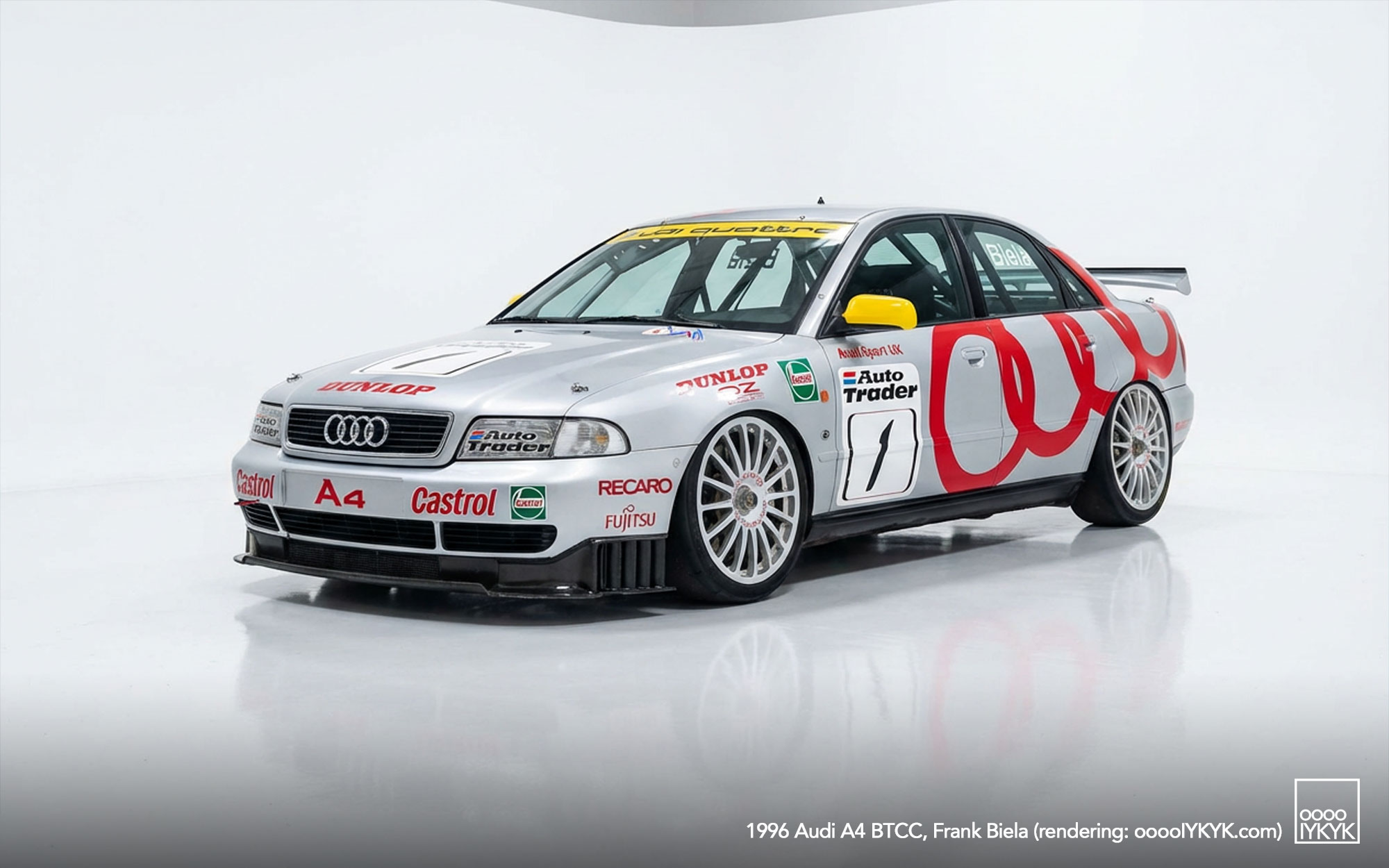
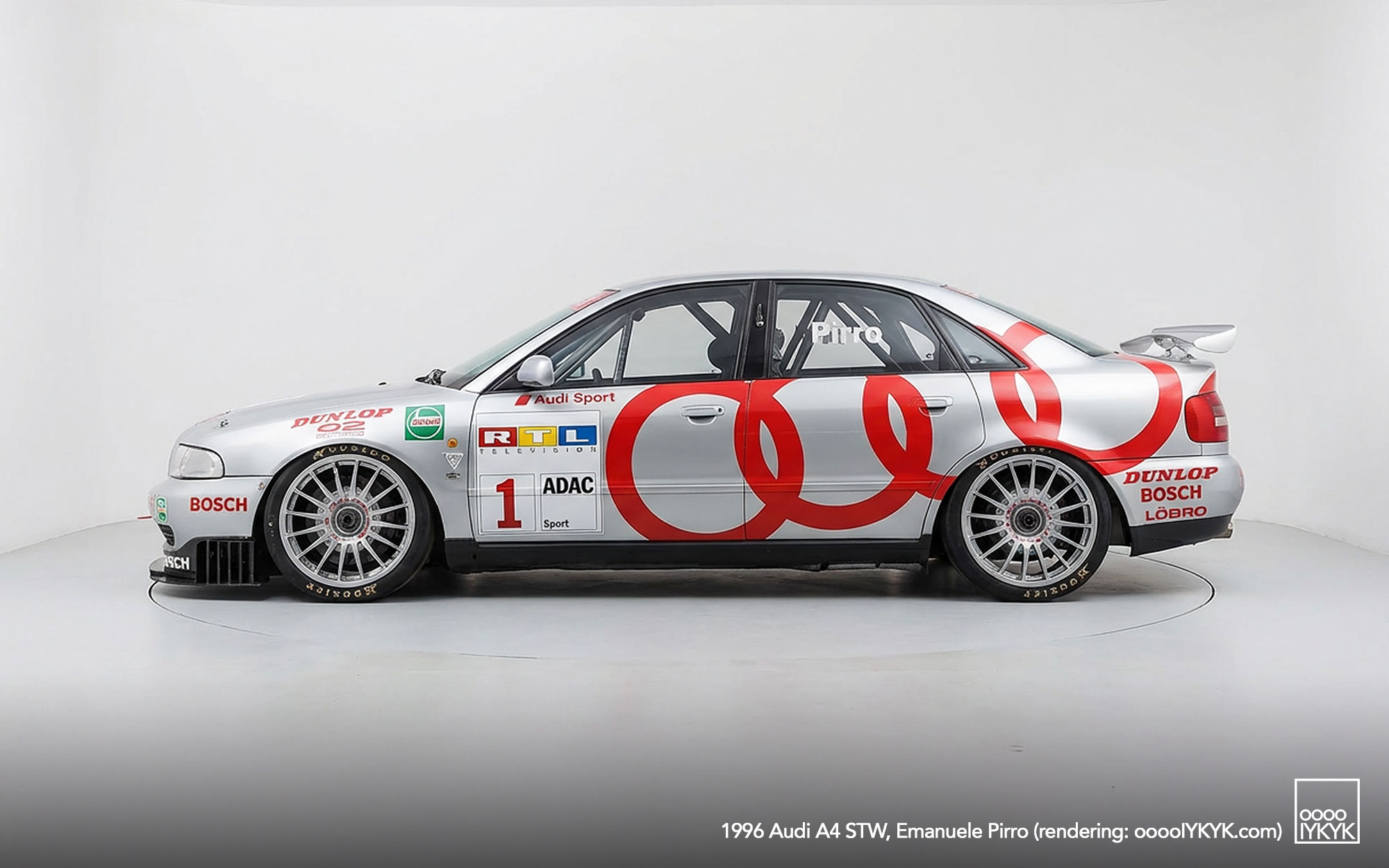
The Audi A4 quattro Super Touring, also known as the Audi A4 STW, is a racing version of the first-generation Audi A4 (B5) developed for the FIA Class 2 / Super Touring regulations. Introduced in 1995 and campaigned internationally through the late 1990s, the A4 quattro became one of the most successful touring cars of its era. Its dominant performance during the 1996 season, in which Audi captured touring car championships in seven countries across three continents, established the model as a landmark in the history of touring car racing and showcased the competitive advantage of Audi’s quattro all-wheel-drive system.
BACKGROUND AND DEVELOPMENT
The A4 Super Touring programme was initiated by Audi Motorsport Director Dr. Wolfgang Ullrich, who sought to expand Audi’s international presence beyond its existing entries in Germany and Italy. Using the newly introduced Audi A4 (B5) as the foundation, Audi engineers developed a fully homologated Class 2 touring car that emphasized aerodynamics, chassis sophistication, and the exploitation of quattro drive—then permitted under the Super Touring rule set.
The first competitive outings occurred in 1995 within the German Touring Car Cup (STW), where the model immediately demonstrated its potential. The 1996 season marked Audi’s full-scale international expansion, supported by national Audi importers in multiple markets.
TECHNICAL SPECIFICATIONS
The Audi A4 quattro Super Touring conformed to FIA Class 2 regulations, which mandated production-based chassis, strict weight limits, and two-litre naturally aspirated engines.
Key technical features included:
- Engine: 2.0-litre inline-four, naturally aspirated
- Output: approximately 285 hp
- Drivetrain: permanent quattro all-wheel drive, a major competitive advantage
- Chassis: seam-welded, reinforced monocoque derived from the A4 B5 platform
- Suspension: bespoke racing suspension with adjustable geometry
- Transmission: sequential racing gearbox
- Weight: regulated minimum mass with balance applied through ballast
The quattro system’s superior traction—especially in wet or mixed conditions—became the defining feature of the A4 STW, enabling earlier throttle application and greater stability than rear- or front-wheel-drive competitors.
1996: THE YEAR OF INTERNATIONAL DOMINANCE
The 1996 season stands as one of the most dominant years ever recorded in touring car racing. Audi entered the A4 quattro STW into major and emerging national series around the world, resulting in championship titles in:
- United Kingdom – British Touring Car Championship (BTCC)
- Champion: Frank Biela
- Germany – Super Touring Championship (STW)
- Champion: Emanuele Pirro
- Italy – Campionato Italiano Superturismo
- Champion: Dindo Capello
- Spain – Campeonato de España de Turismos
- Belgium – Belgian Procar Championship
- Australia – Australian Super Touring Championship
- South Africa – South African Touring Car Championship
Audi Tradition describes the 1996 season as an “overwhelming triumph” for quattro technology, noting that championships on three continents demonstrated the system’s universal competitive advantage.
No other touring car in the Super Touring era matched this level of cross-series dominance.
REGULATORY RESPONSE AND SUBSEQUENT SEASONS
The success of the quattro system led to concerns within several national sanctioning bodies that Audi’s advantages were insurmountable. Beginning in 1997, weight penalties were imposed on Audi entries, reducing their competitiveness. Despite this, the A4 remained a front-running car in many markets.
By 1998, four-wheel drive was banned outright from Super Touring regulations, forcing Audi to compete with two-wheel-drive versions of the A4. Without its signature drivetrain advantage, the car was no longer dominant.
Even so, the A4 quattro programme produced additional notable successes:
- 1999 German STW Championship – won by Christian Abt (Abt Sportsline)
- 1999 Swedish Touring Car Championship (STCC) – won by young driver Mattias Ekström, later a DTM champion and Audi factory star
The A4 Super Touring continued to appear in international series, including the 2001 FIA European Super Touring Car Championship, where drivers Roberto Colciago and Max Pigoli competed for AGS Motorsport. Colciago later won back-to-back STCC titles in 2001 and 2002 with Kristoffersson Motorsport.
END OF THE SUPER TOURING ERA
The early 2000s saw the end of the FIA Class 2 rule set. Rising costs and technological escalation led the FIA to replace Super Touring with the less complex Super 2000 (S2000) regulations. With this change, the A4 Super Touring’s official factory-backed competitive life effectively ended.
LEGACY
The 1996 Audi A4 quattro Super Touring is widely considered a legend of touring car racing. Its unparalleled multi-series dominance forced regulatory changes, established quattro as a benchmark for traction and handling, and cemented Audi’s reputation as a world-class touring car manufacturer. To this day, the A4 STW is remembered as the car that dominated so thoroughly that its defining technology ultimately had to be banned—a distinction shared only by a handful of motorsport greats.
PHOTO GALLERY