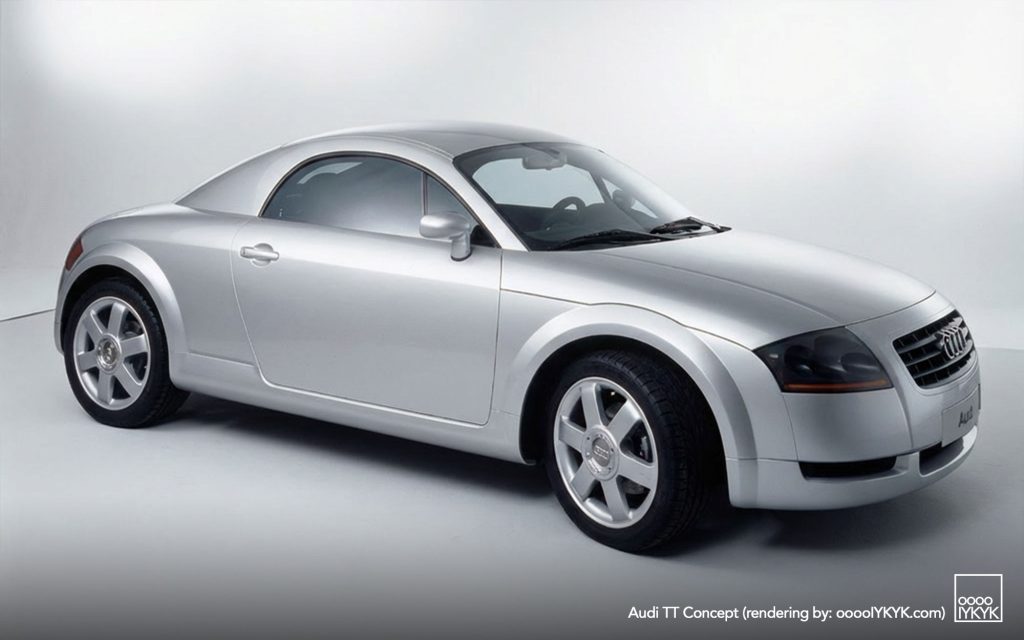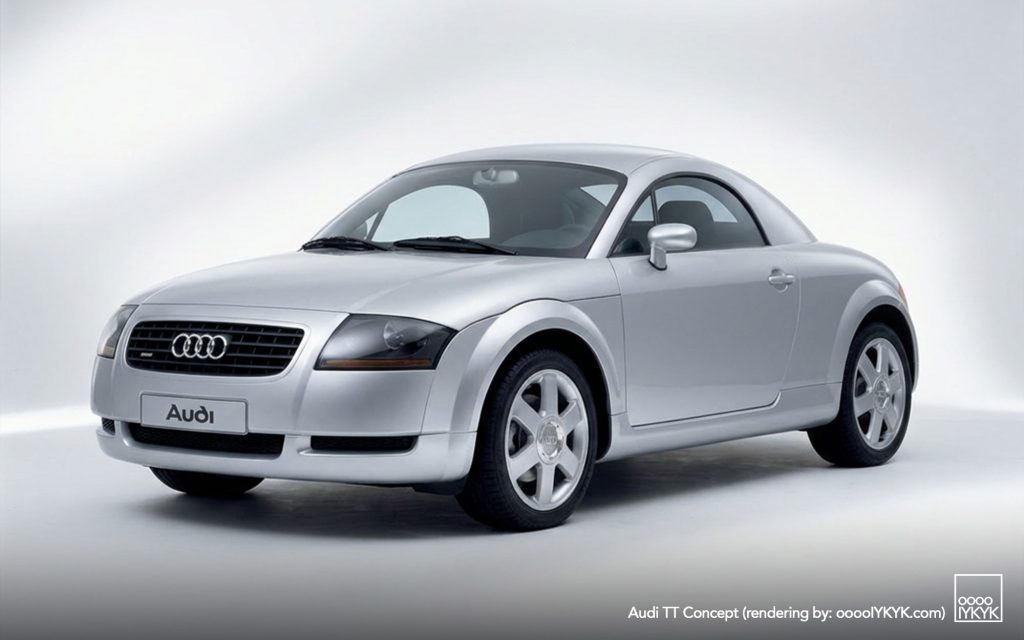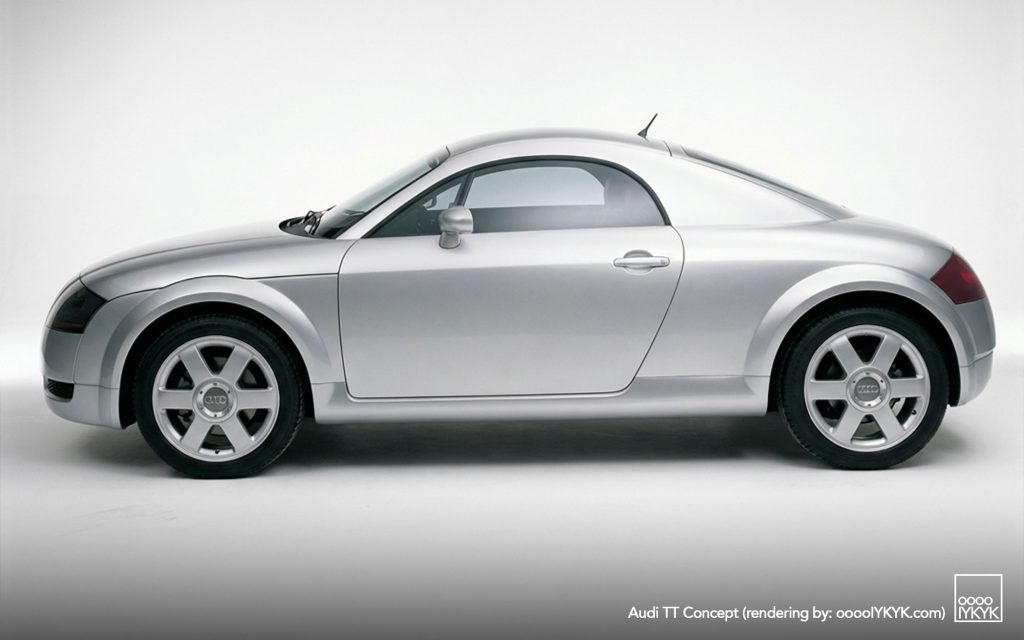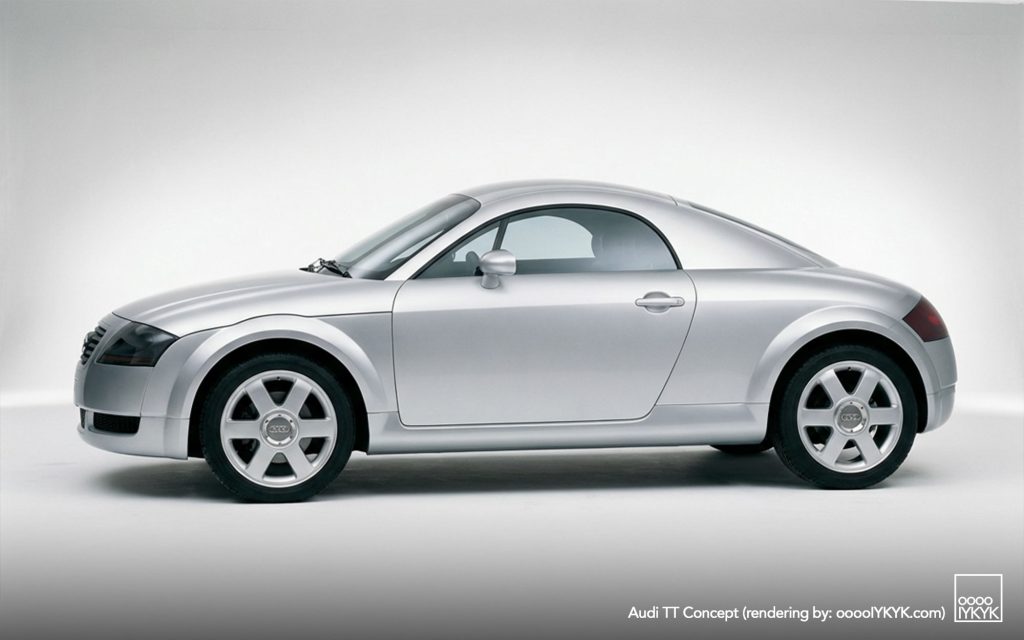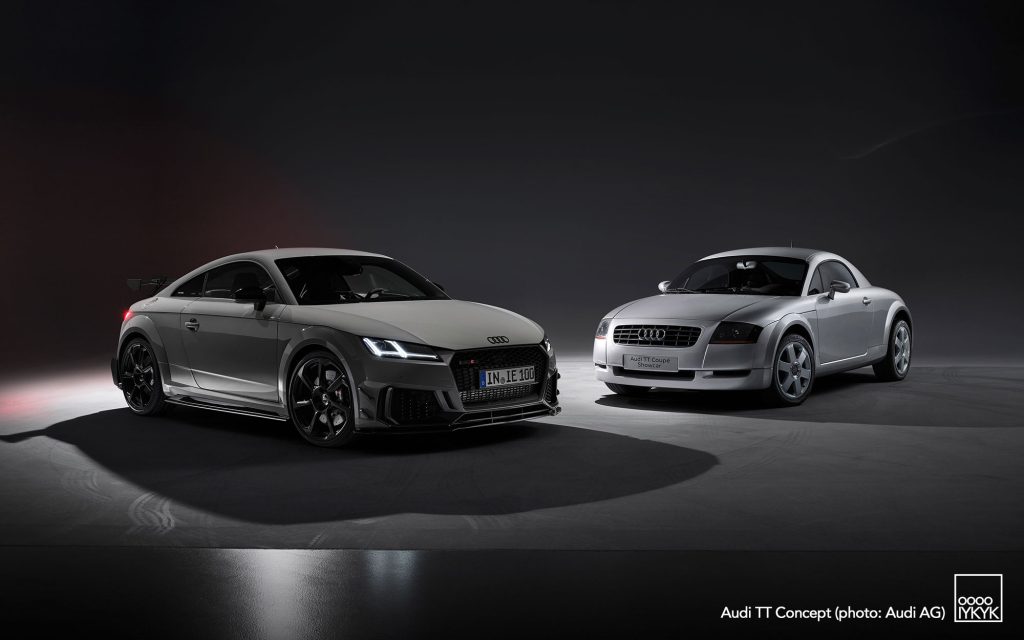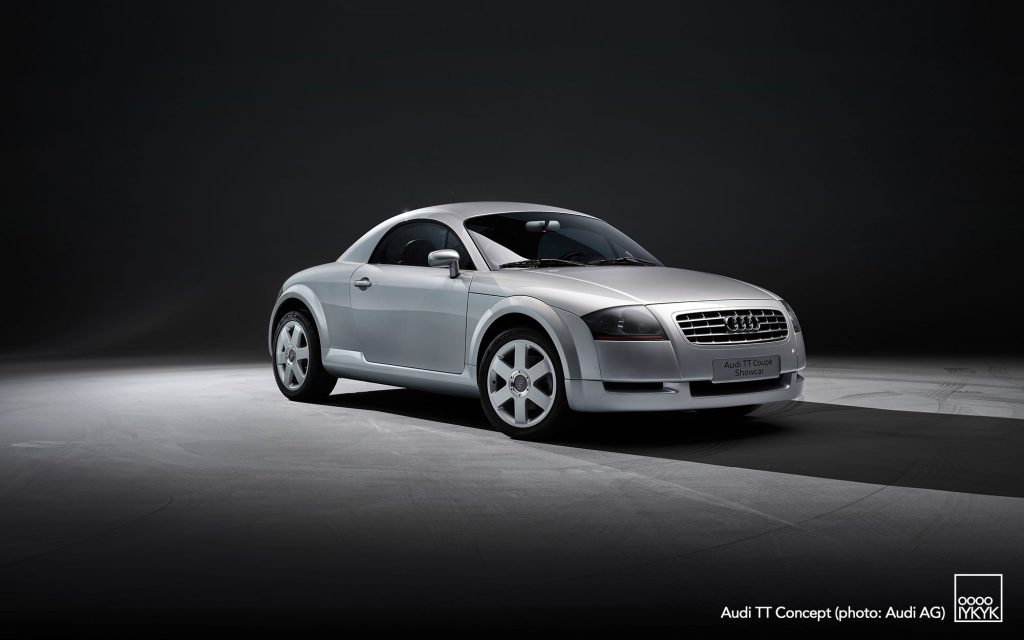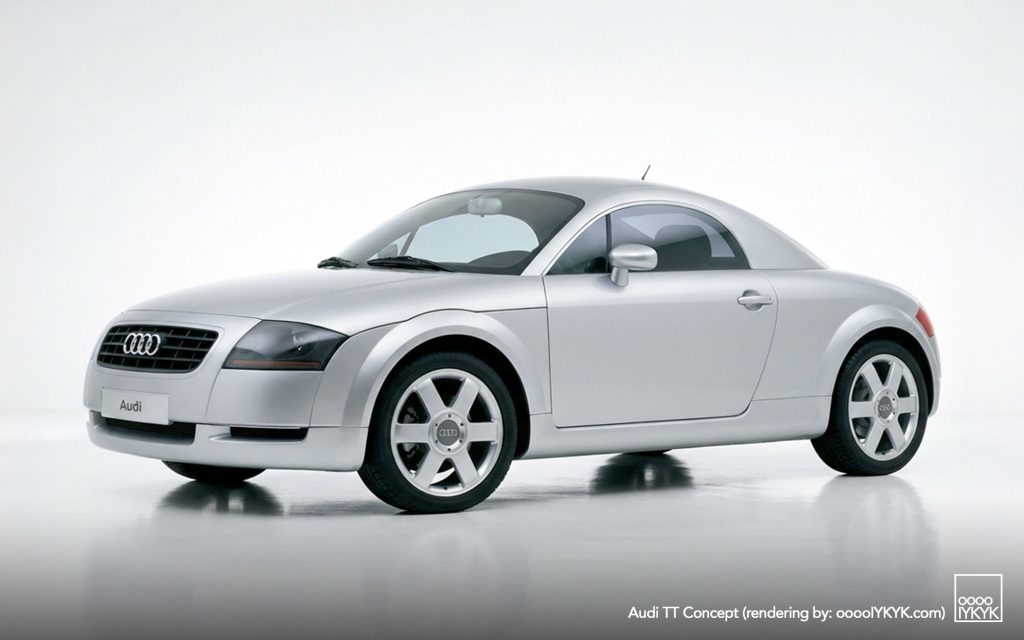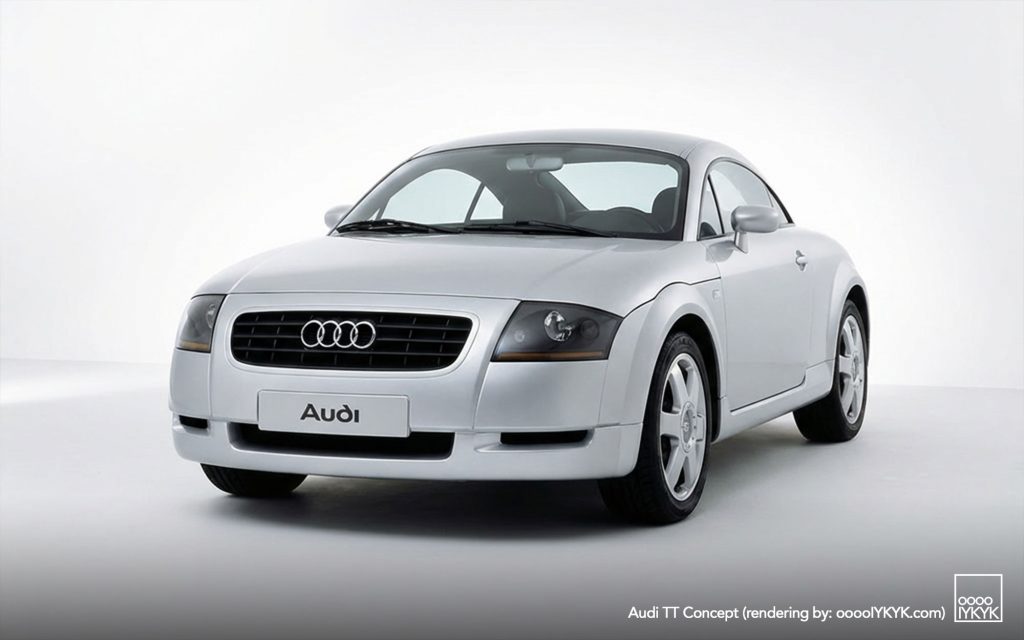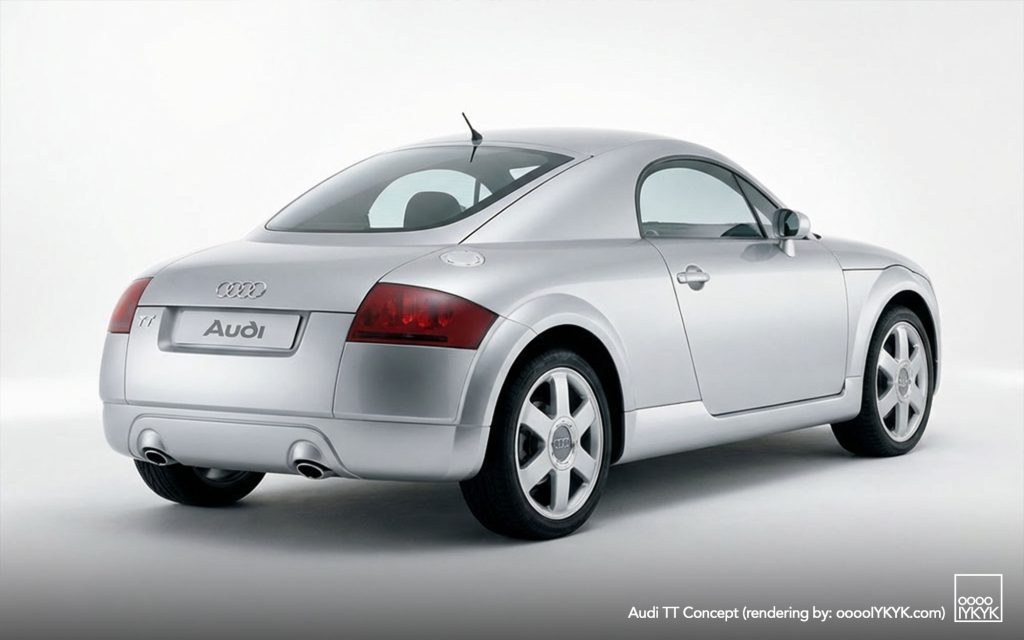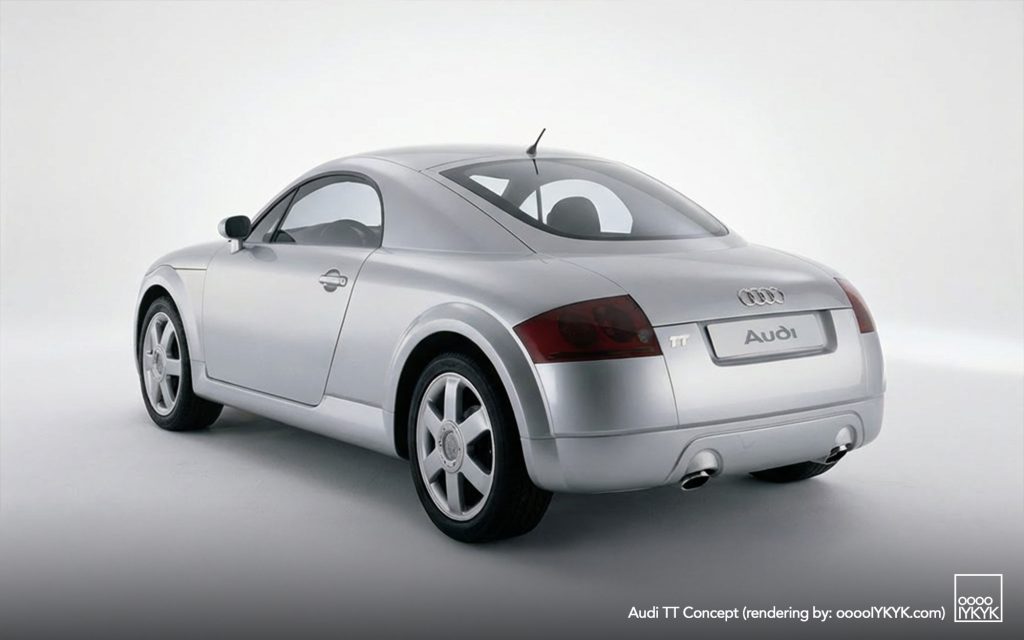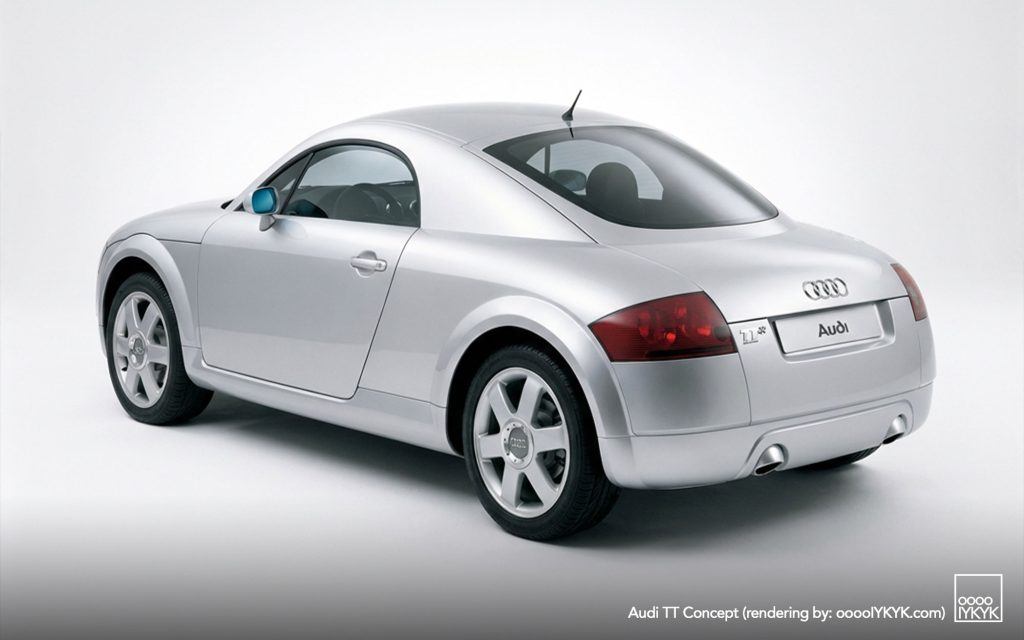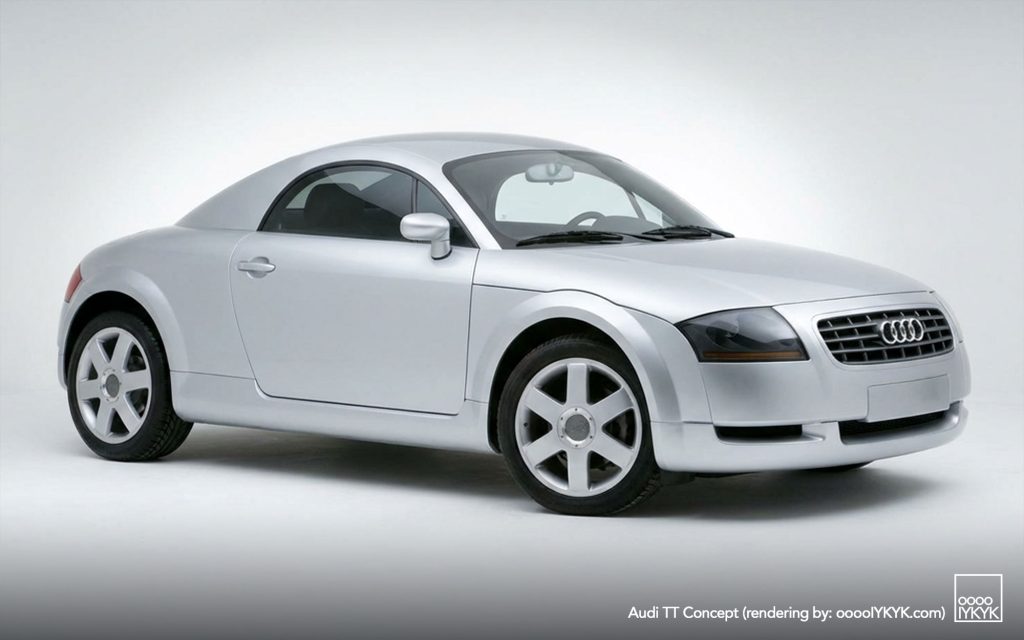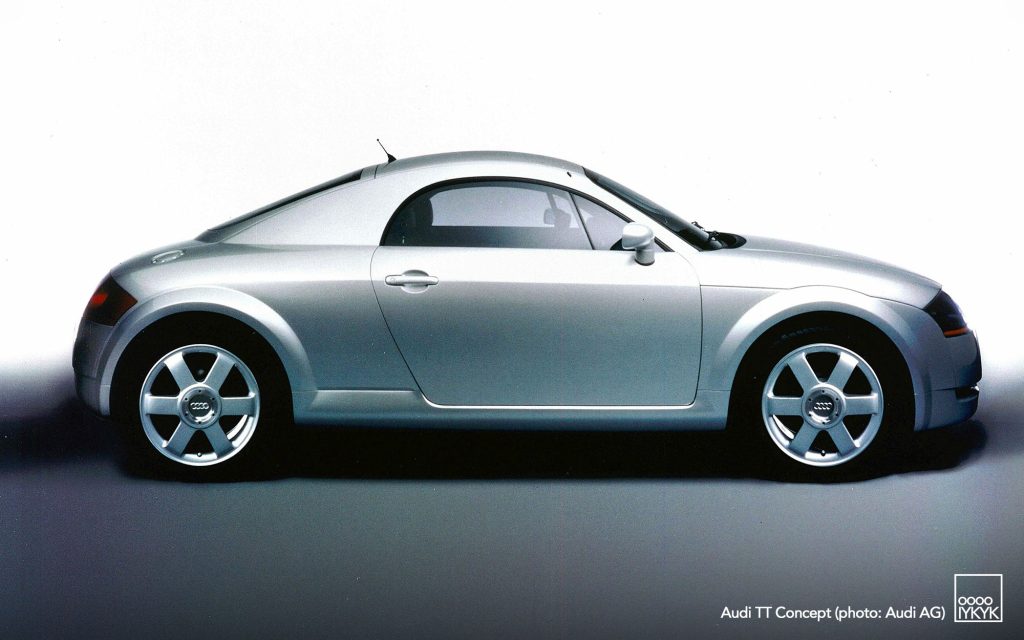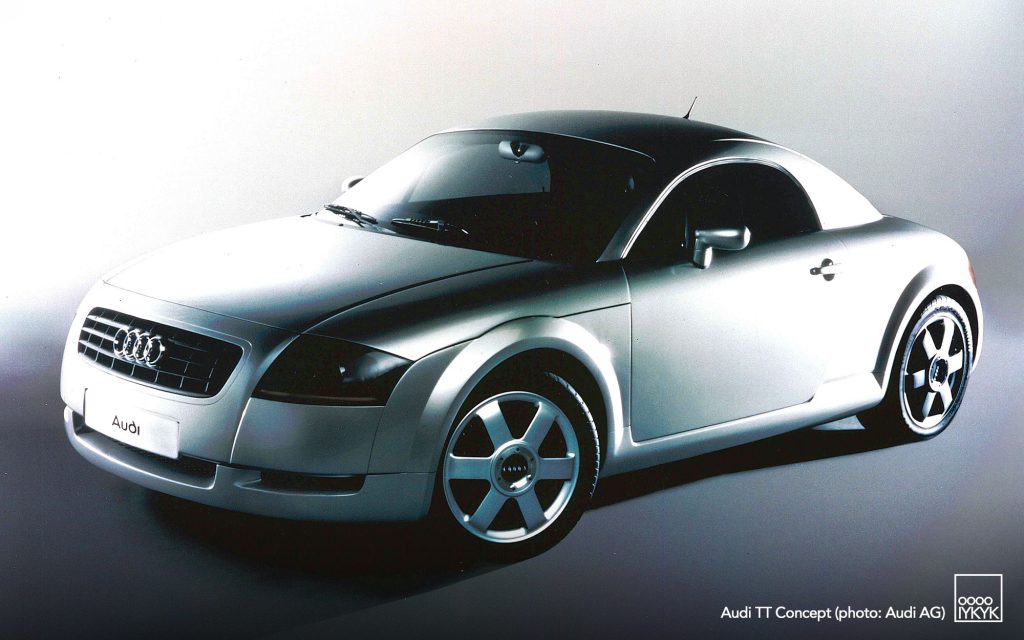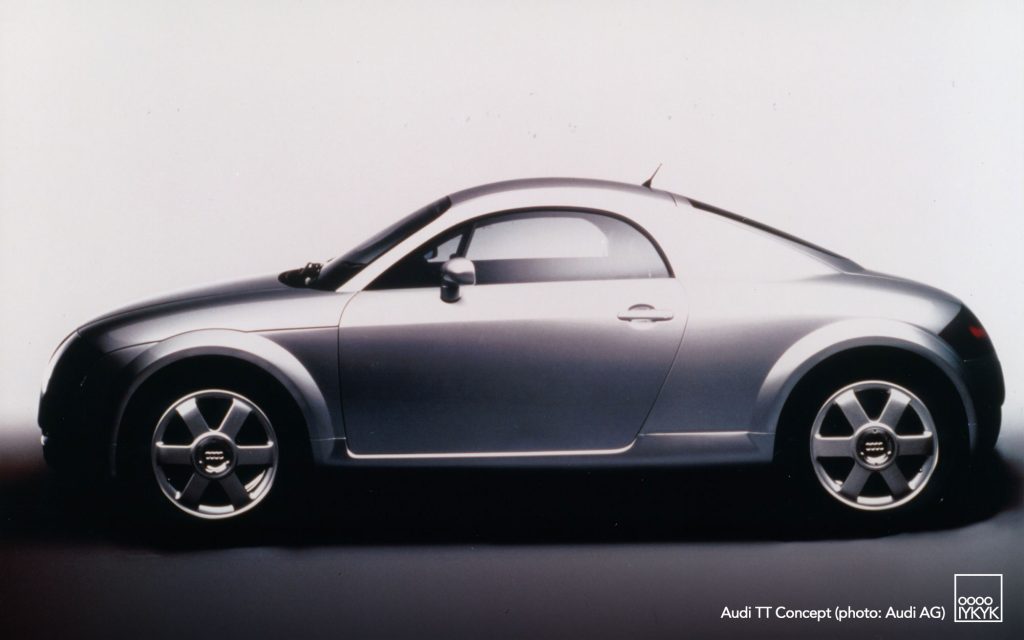
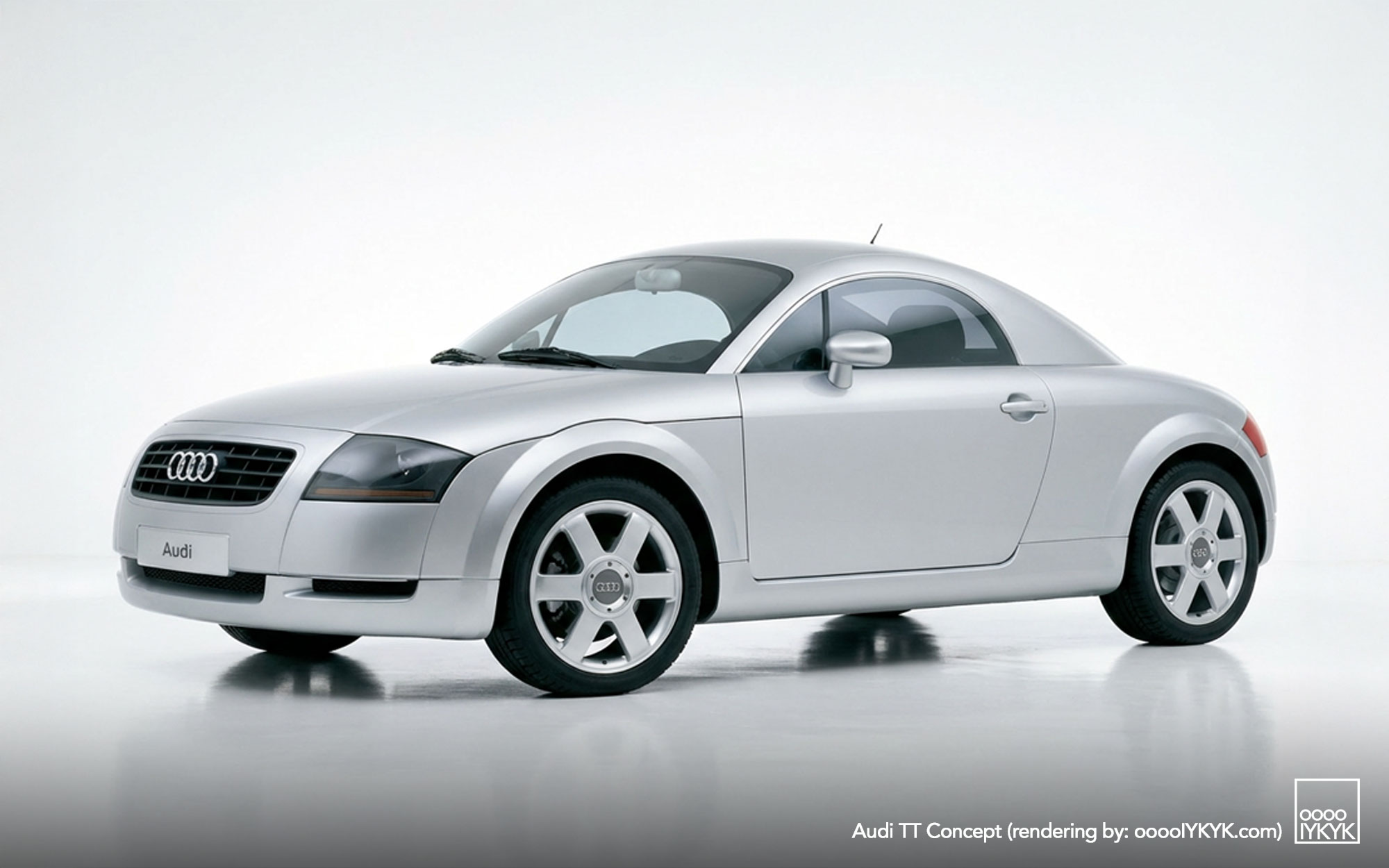

What: 1995 Audi TT Coupé Concept
Era: Audi Modern Era
Model Family: TT
Model / Generation Code(s): Type 8N (pre-production derivative)
Production: Concept (precursor to production model)
Year: 1995
Status: Audi Tradition Collection
Debut: 1995 Frankfurt IAA
Number Produced: 1
Assembly: Audi Design Studio, Ingolstadt / Italdesign, Italy
Class: Compact sports car concept
Body style: 2-door 2+2 coupe
Layout: Front-engine, front-wheel drive (quattro-compatible architecture)
Platform / Architecture: Volkswagen Group A-platform (pre-production basis for A3/Golf IV architecture)
Engine: Inline-4, turbocharged, DOHC, 5 valves per cylinder
Displacement: 1.8 liters
Power output: ~110 kW (148 hp)
Transmission: 5-speed manual (concept specification)
Drivetrain: Front-wheel drive (concept), quattro all-wheel drive proposed
Top speed (projected): ~225 km/h (139 mph)
CHASSIS AND CONSTRUCTION
Body structure: Steel unibody with selective aluminum panels
Aluminum components: Hood, doors, rear lid, front fenders
Suspension (front): MacPherson strut (production-based architecture)
Suspension (rear): Torsion beam / multi-link (conceptual production basis)
Brakes: Ventilated disc brakes (production-based system)
Steering: Rack-and-pinion, power-assisted
DIMENSIONS
Length: ~4,000 mm (157.5 in)
Width: ~1,760 mm (69.3 in)
Height: ~1,350 mm (53.1 in)
Wheelbase: ~2,420 mm (95.3 in)
DESIGN TEAM & ATTRIBUTION
Design leadership: Peter Schreyer
Exterior design (primary): Freeman Thomas
Design direction / concept development: J Mays
Interior design: Romulus Rost
Concept development / surfacing refinement: Martin Longmore
Production adaptation (later): Torsten Wenzel and Audi series development teams
OVERVIEW
The Audi TT concept emerged at a moment of transformation within Audi Design. Following the impact of the Audi Avus quattro, the brand was actively redefining its identity—placing equal emphasis on design and engineering.
DESIGN HISTORY & ORIGINS
The Audi TT concept did not emerge from a conventional product planning cycle. Instead, it was the result of an unusually organic and, at times, clandestine design process—one driven more by instinct and internal belief than by market research or formal approval structures.
At its core was a simple but ambitious idea: create a compact sports car that captured the emotional appeal of historic classics while remaining attainable and grounded in Audi’s existing engineering architecture.
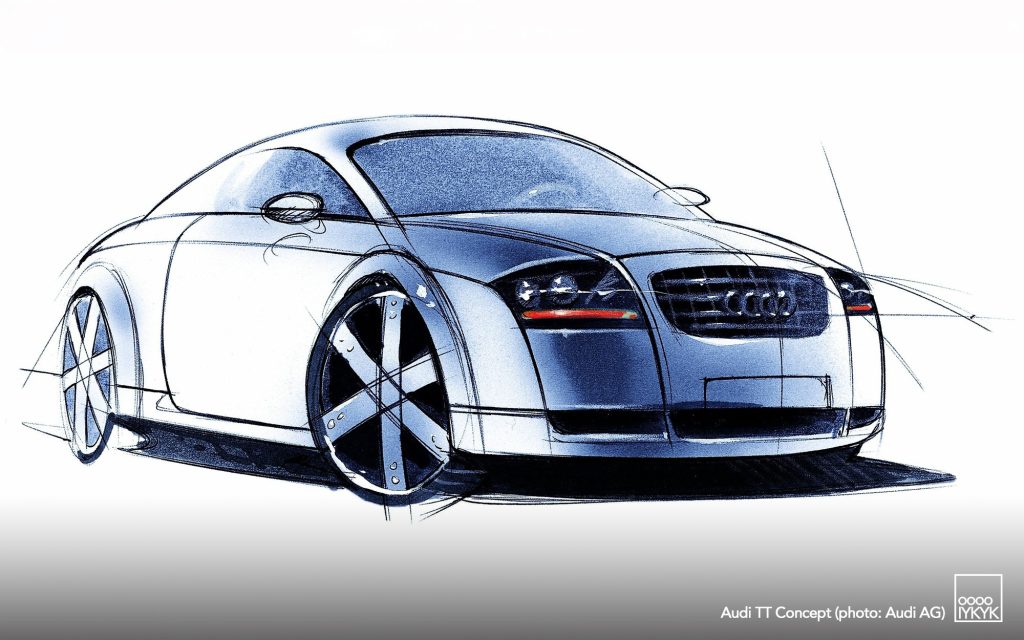
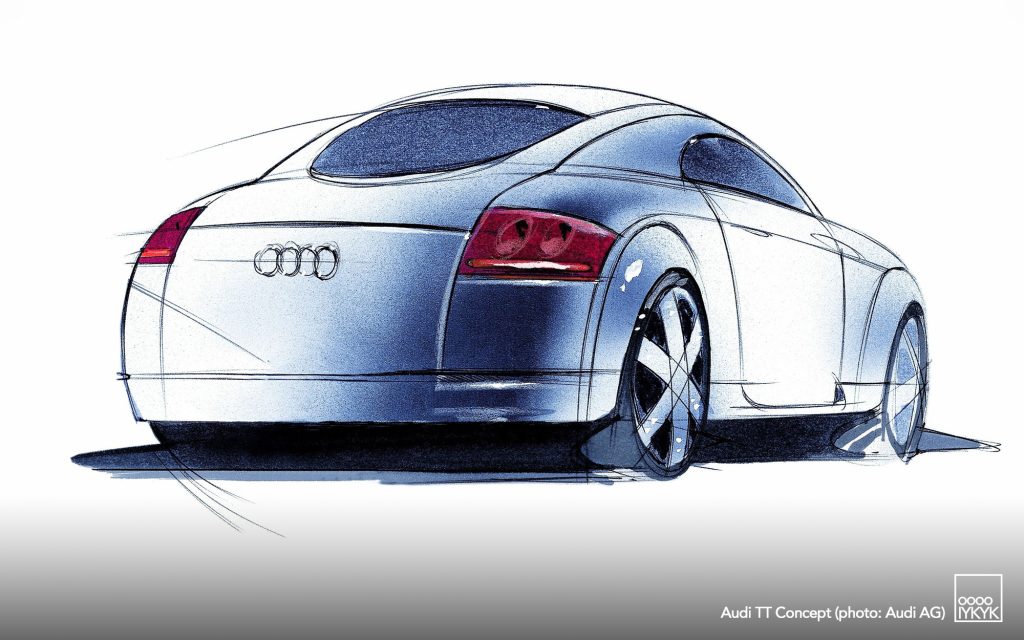
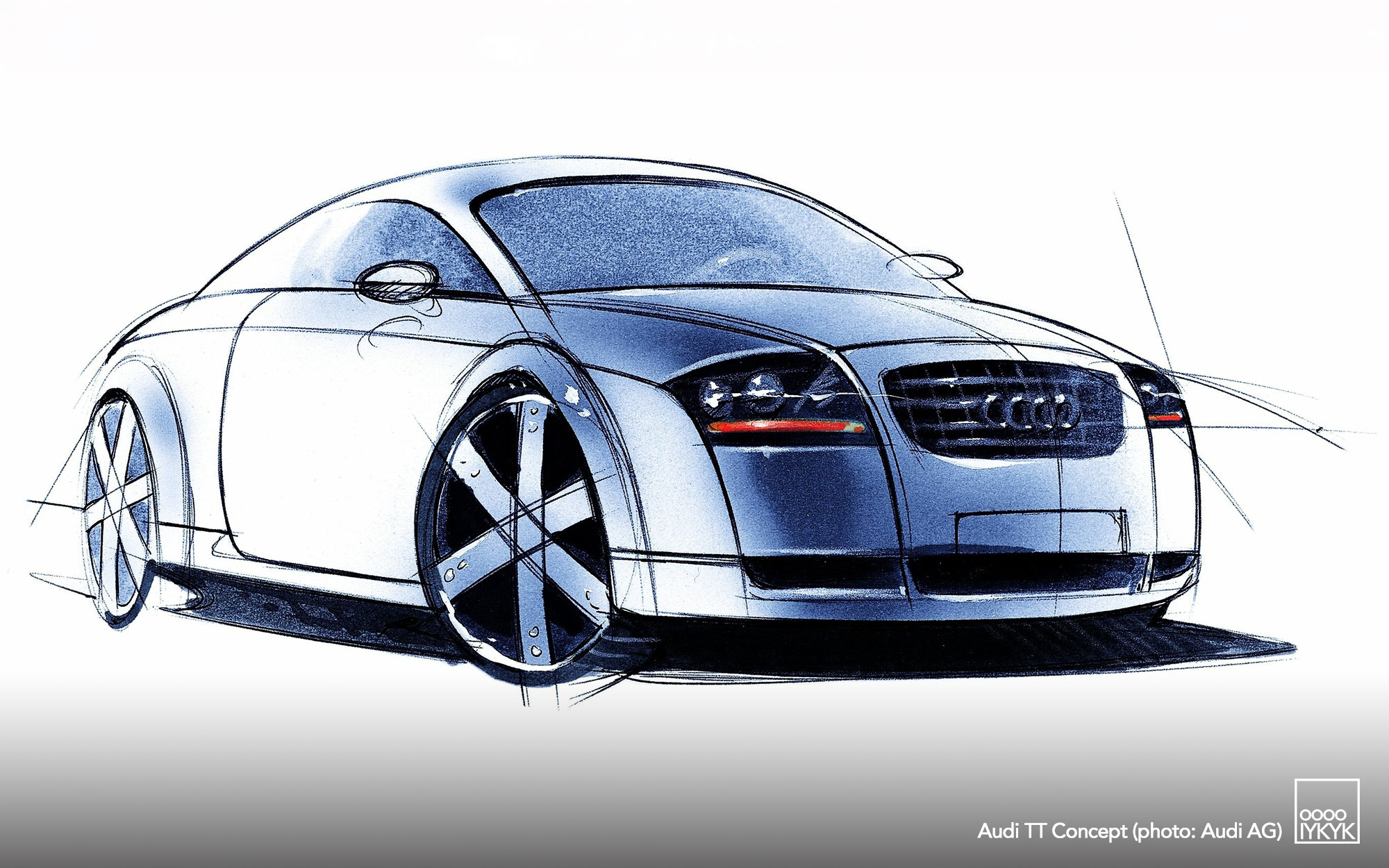
The earliest sketches were produced by Freeman Thomas shortly after his move from California to Ingolstadt. Thomas had been recruited by J Mays, with whom he had previously collaborated at the Volkswagen Design Center in Simi Valley. Both shared a common educational background at the ArtCenter College of Design and a design philosophy rooted in clarity, proportion and emotional resonance.
What began as exploratory sketches quickly gained momentum. According to period accounts, the concept’s fundamental shape—defined by its rounded volumes and clean silhouette—was present from the very first drawings. This immediate coherence would become one of the TT’s defining traits.
THE “CONSPIRACY PHASE”
Unlike most concept programs, the TT developed in relative secrecy. The small team of designers and engineers operated almost independently, refining the idea outside of traditional corporate structures.
Working environments were unconventional:
- Early sketches were completed outside formal studio spaces
- Development work continued in off-site facilities near Ingolstadt
- The core concept was finalized in roughly one week
- A full prototype followed in approximately seven months
This phase has often been described internally as a “conspiracy”—a group of like-minded creatives aligned around a shared vision, moving quickly before institutional resistance could slow progress.
Crucially, the project gained support from Audi leadership at the right moment. Once presented to management, the clarity of the concept eliminated the need for extensive justification. The design effectively sold itself.
FREEMAN THOMAS: SILHOUETTE AS IDENTITY
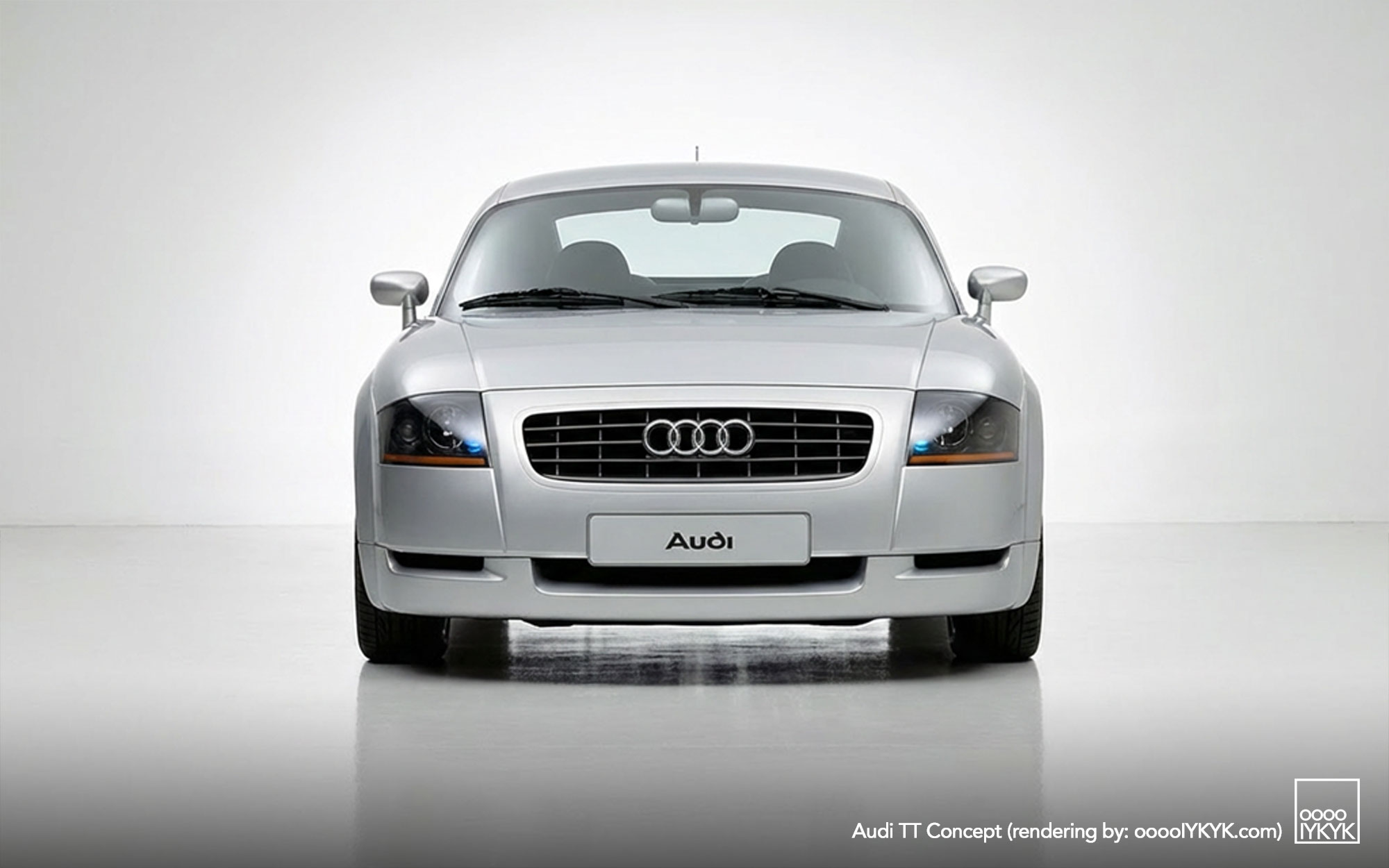
Freeman Thomas’ contribution to the TT cannot be overstated. As the primary exterior designer, he established the fundamental philosophy that would define the car: silhouette first.
Rather than relying on surface complexity or aggressive detailing, Thomas focused on creating a form that would be instantly recognizable in profile. This approach drew inspiration from:
- The purity of early Porsche sports cars
- The functional minimalism of Bauhaus design
- The rounded forms of Auto Union pre-war racecars
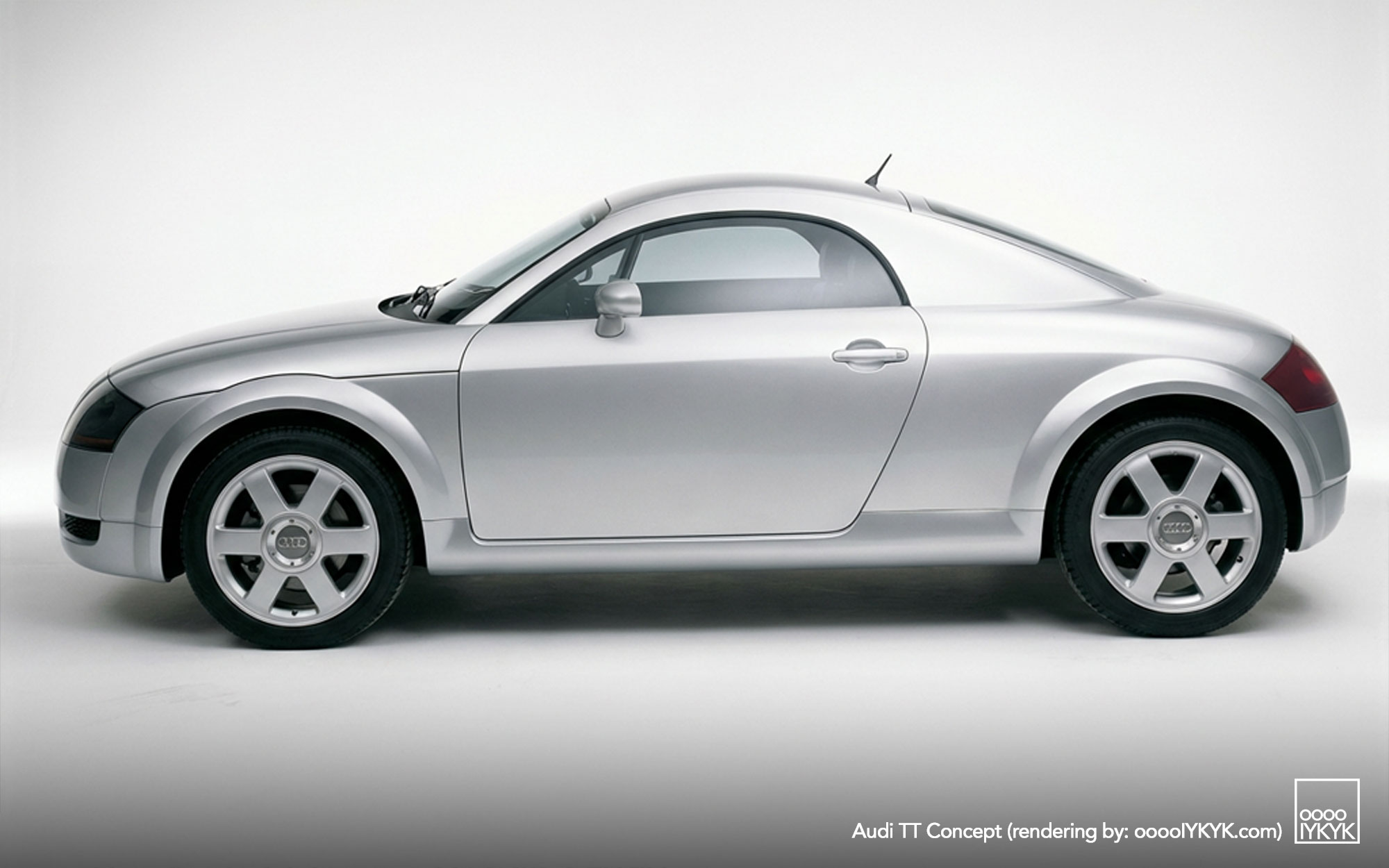
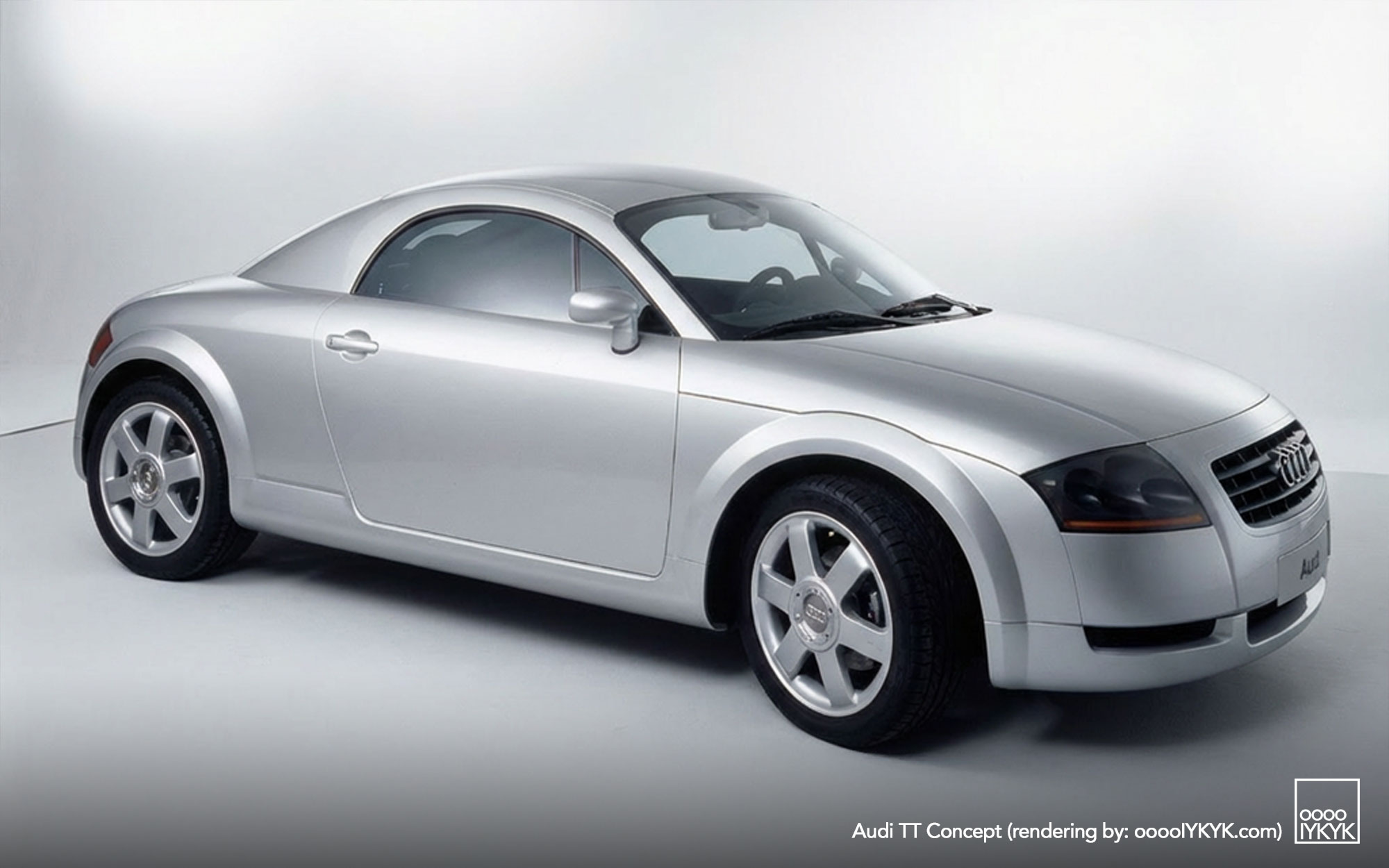
The TT’s defining shape—arched roofline, short overhangs and symmetrical front and rear volumes—was intentionally reductive. Every line was scrutinized, and anything deemed unnecessary was removed.
Thomas later described the goal as creating something “obviously German,” expressed not through ornamentation but through proportion, restraint and precision.
From its earliest sketches, the TT displayed an unusual level of completeness. The final concept remained remarkably faithful to these initial drawings, underscoring the strength of the original idea.
J MAYS & CONCEPT ADVOCACY
J Mays played a critical role in recognizing and advancing the TT concept internally. Having worked closely with Thomas previously, Mays identified the design’s potential early and helped present it to Audi leadership.
His influence ensured:
- Preservation of the design’s minimalism
- Alignment with Audi’s evolving brand direction
- Protection of the concept from excessive modification
Mays’ advocacy was instrumental in moving the project forward quickly, bypassing the lengthy validation processes typical of new vehicle programs.
PETER SCHREYER & DESIGN PHILOSOPHY
Under Peter Schreyer’s leadership, Audi Design embraced a philosophy of reduction—removing unnecessary elements to reveal essential form.
The TT became the clearest expression of this approach:
- “Less is more” as a governing principle
- Elimination of visual clutter
- Integration of function into form
Schreyer’s willingness to allow the team creative freedom was critical. Rather than imposing constraints, he enabled the designers to pursue a pure and cohesive vision.
MARTIN LONGMORE & CONCEPT REALIZATION
While Freeman Thomas defined the concept, Martin Longmore’s role was central to its execution.
As a contract designer working within the program, Longmore contributed during the transition from sketch to physical form. His work focused on:
- Surface development and refinement
- Translating design intent into manufacturable geometry
- Supporting clay modeling and full-scale realization
This phase is often overlooked but was important. The TT’s success depended not only on its initial idea, but on the precision with which that idea was executed.
Longmore’s involvement reinforces the collaborative nature of the project—echoing period descriptions of the TT as “a car with several proud fathers.”
FORM LANGUAGE & DESIGN TEAMS
The TT concept is defined by a strict adherence to geometric clarity and reduction.
Circular Motif
The circle became the unifying design element, appearing in:
- Wheel arches
- Fuel cap
- Air vents
- Instrument cluster
- Gearshift surround
Bauhaus Influence
Every element served a purpose. Decoration was eliminated in favor of function-driven design.
Auto Union Heritage
Rounded forms referenced pre-war Silver Arrows, linking the TT to Audi’s historical identity.
Surface Treatment
The body appeared as a single, cohesive volume—free of unnecessary lines or segmentation.
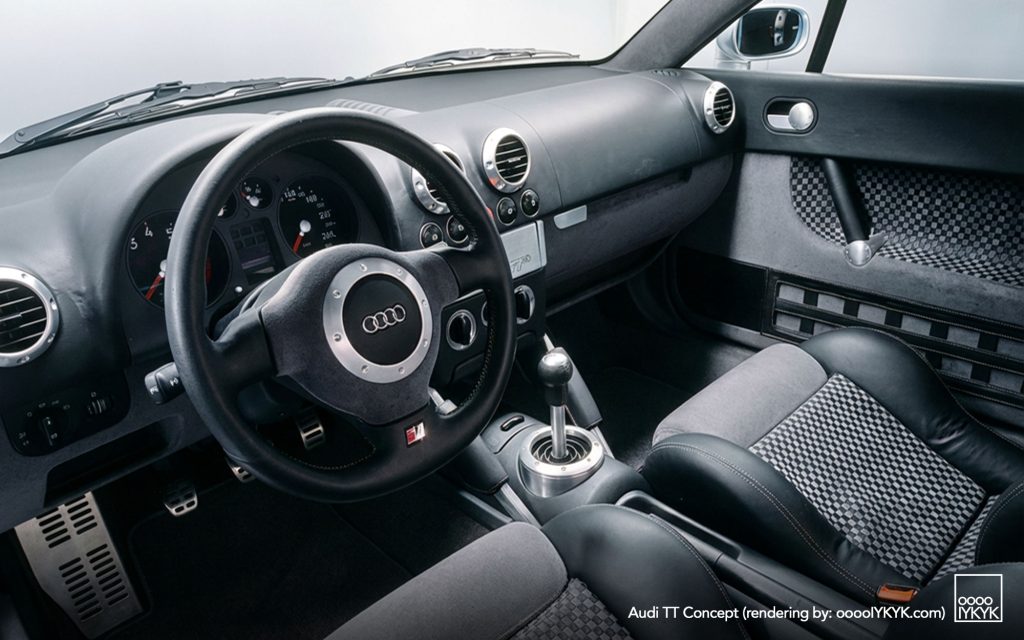
INTERIOR DESIGN & EXECUTION
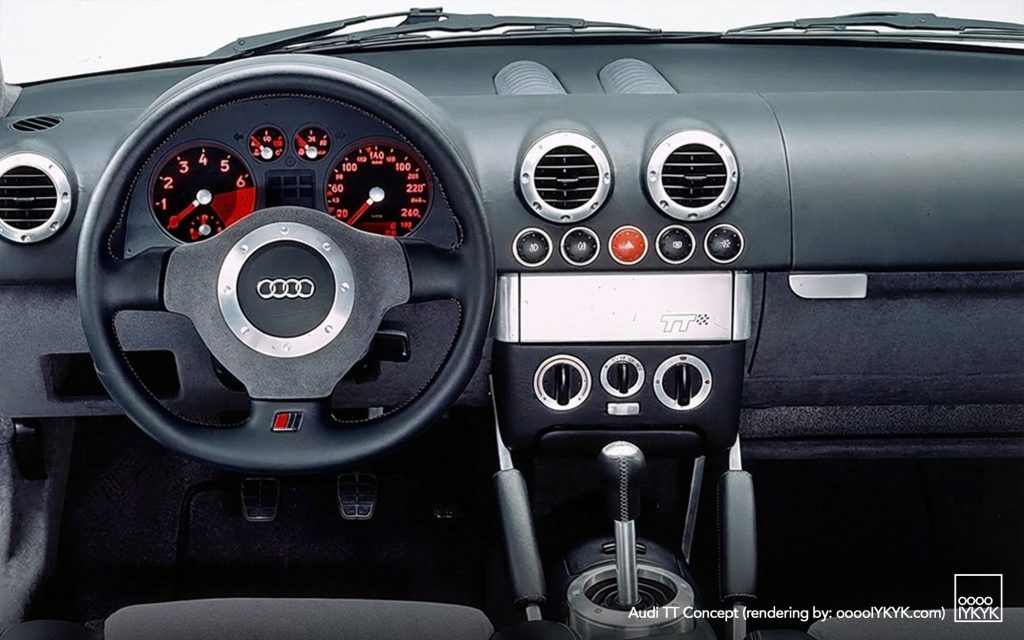
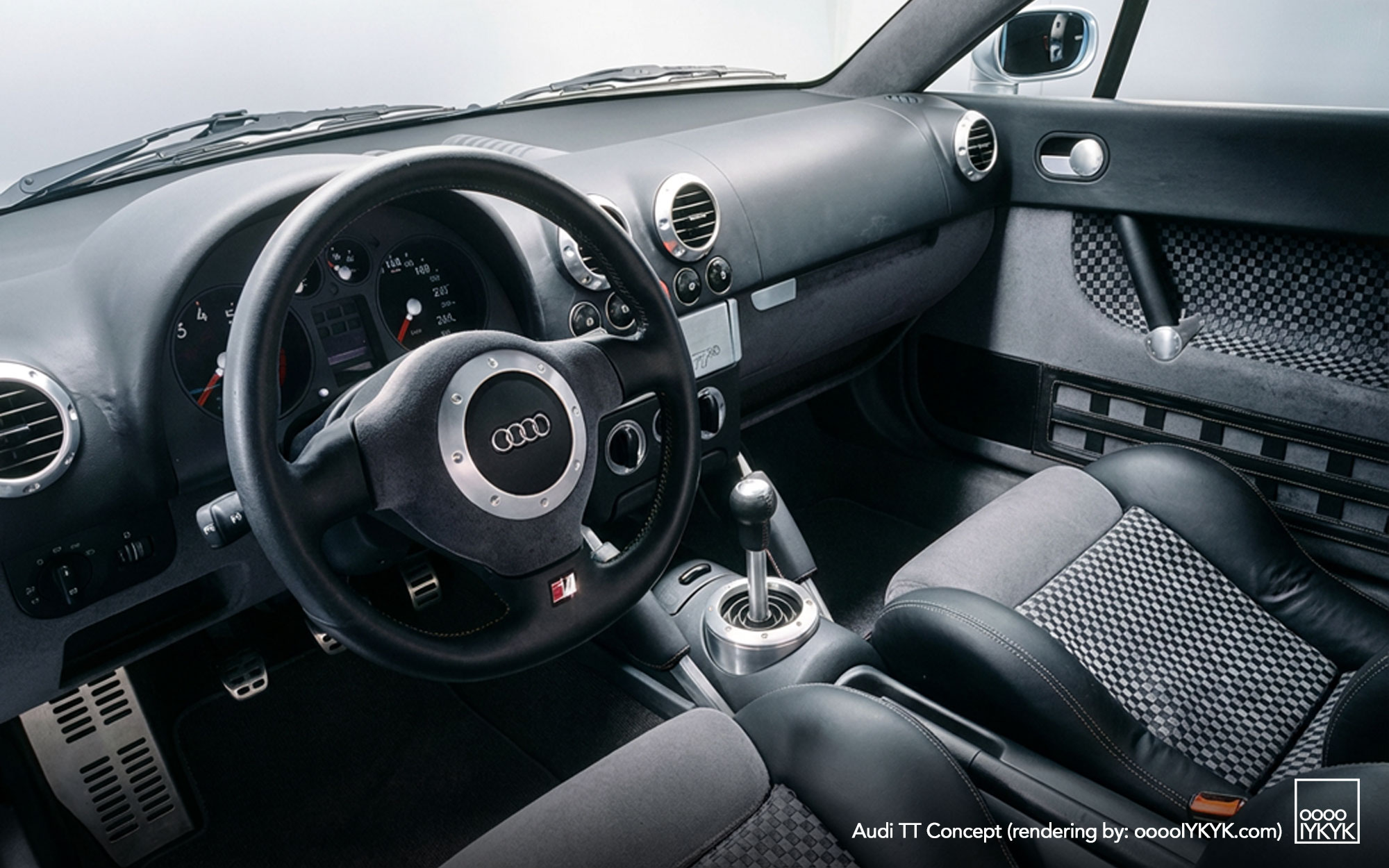
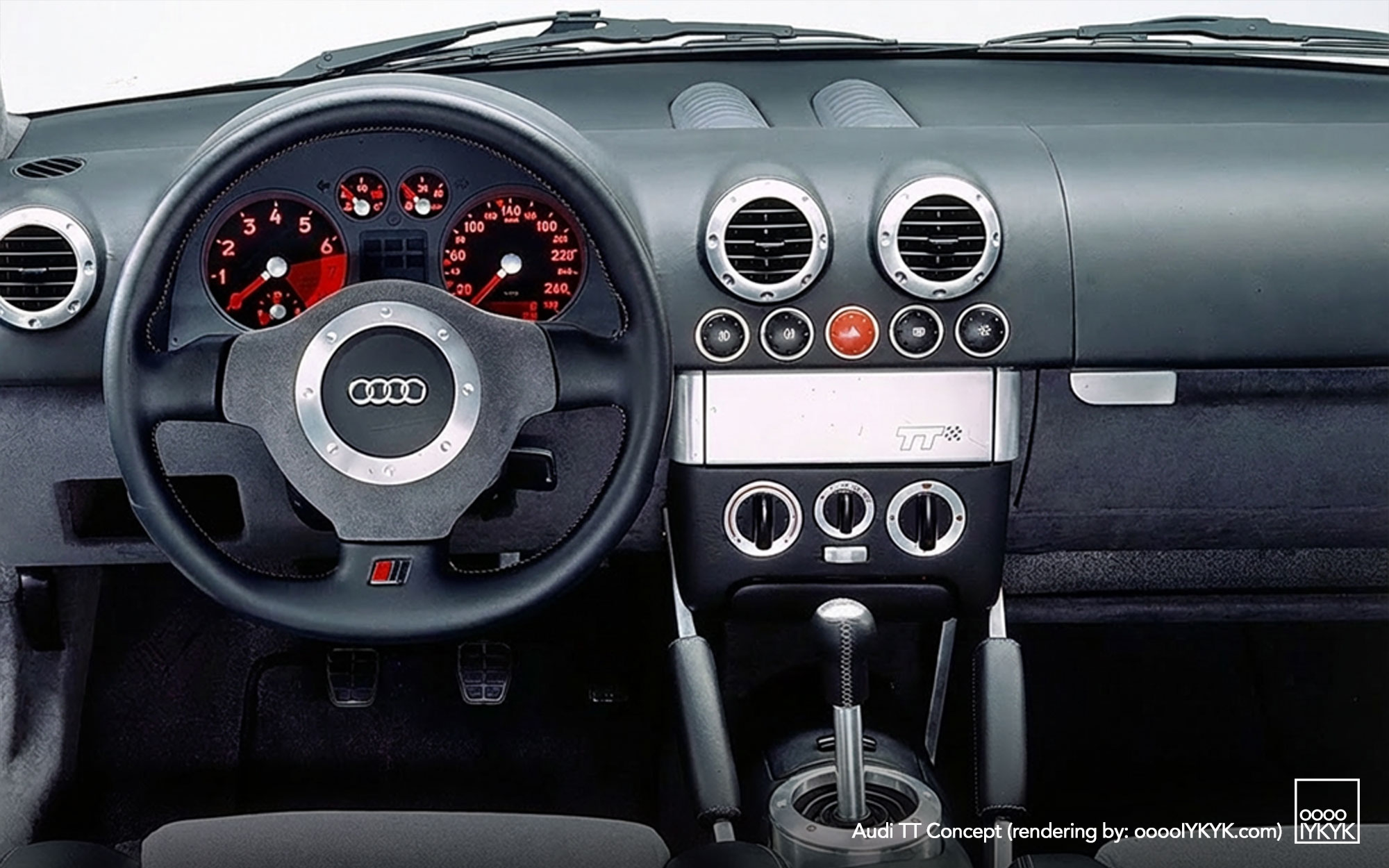
The interior mirrored the exterior’s philosophy of reduction while introducing a tactile, mechanical quality.
Key elements included:
- Circular air vents inspired by jet engines
- Exposed aluminum detailing and fasteners
- Driver-focused cockpit layout
- Minimalist control integration
The guiding principle—“as much as necessary and as little as possible”—was consistently applied.
Functional components were elevated to design features, reinforcing the connection between engineering and aesthetics.
ENGINEERING & PRODUCTION FEASIBILITY
A defining aspect of the TT concept was its grounding in production reality.
Rather than developing bespoke systems, Audi utilized:
- Existing Volkswagen Group platform architecture
- Proven turbocharged 1.8L engine technology
- Established suspension and drivetrain components
This strategy allowed the concept to bypass many traditional barriers to production. As a result, the transition from concept to the 1998 production Audi TT required minimal design changes.
NAME & HERITAGE
The “TT” designation references the Isle of Man Tourist Trophy, reflecting Audi’s historical ties through NSU and DKW.
It also aligns with earlier NSU models bearing the TT nameplate, reinforcing continuity within the brand’s lineage.
A secondary interpretation—“Technology & Tradition”—captures the concept’s balance between forward-thinking design and historical inspiration.
INTERPRETATION
The Audi TT concept represents a rare convergence of design purity, engineering feasibility and organizational alignment.
Its significance lies not only in its form, but in its process:
- A small, empowered design team
- Rapid development without dilution
- Strong leadership support
- Immediate public validation
Freeman Thomas may have established the vision, but the TT’s realization required the combined efforts of Mays, Schreyer, Longmore and a broader team working in precise alignment.
The result was a concept that moved to production with unprecedented fidelity—establishing the TT not just as a successful model, but as a defining moment in Audi’s modern design history.
DESIGN DIFFERENCES FROM PRODUCTION TT COUPÉ (MK1, FROM 1998)
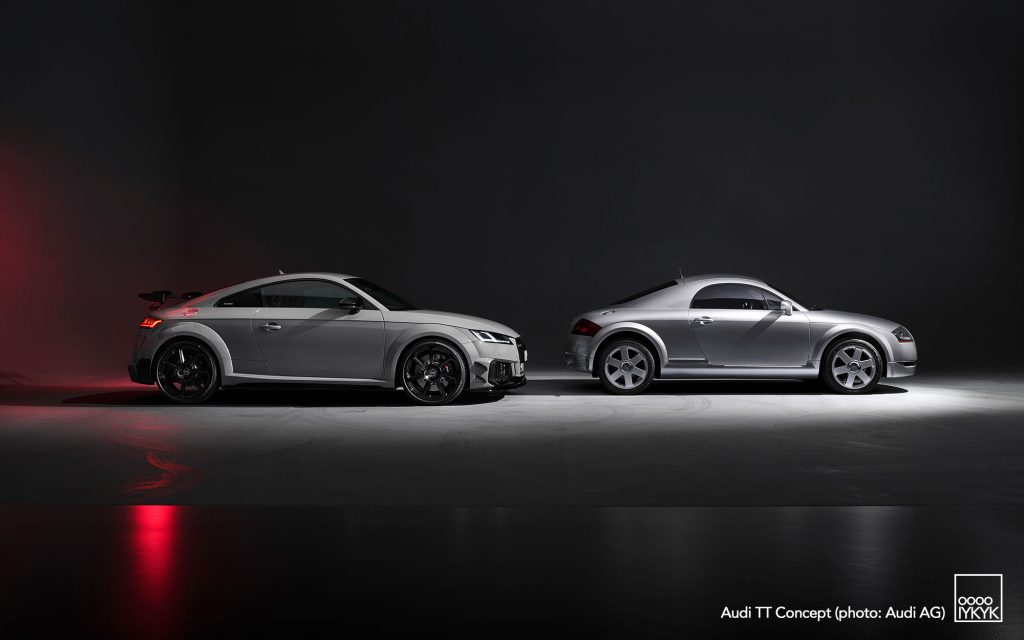
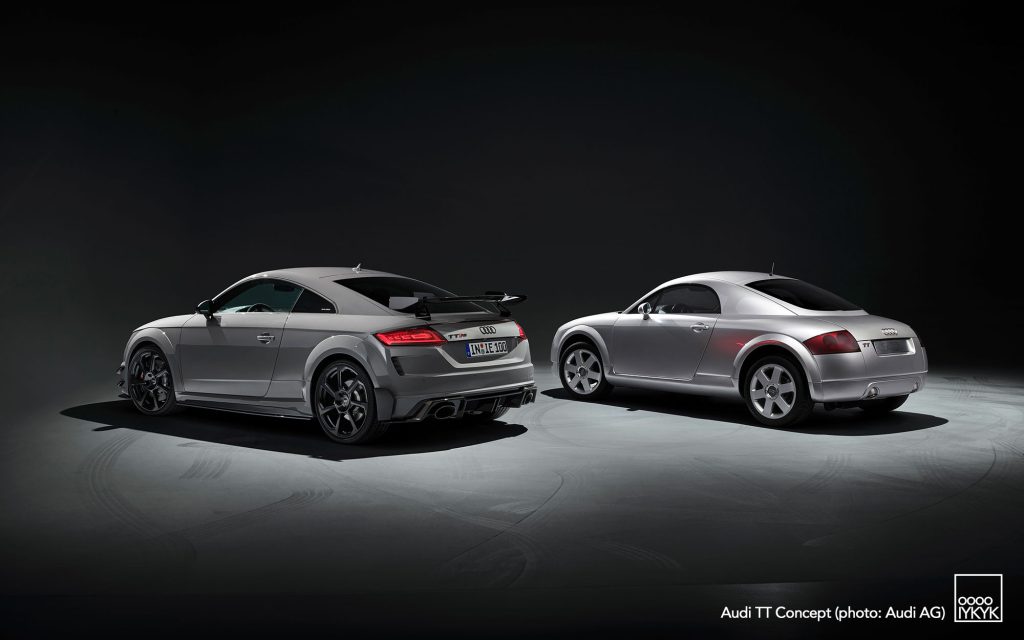
The transition from the 1995 concept to the 1998 production Audi TT is widely regarded as one of the most faithful in automotive history. However, a series of targeted refinements were required to meet regulatory, packaging and manufacturing requirements. These changes were executed with notable restraint, preserving the concept’s core silhouette and design philosophy.
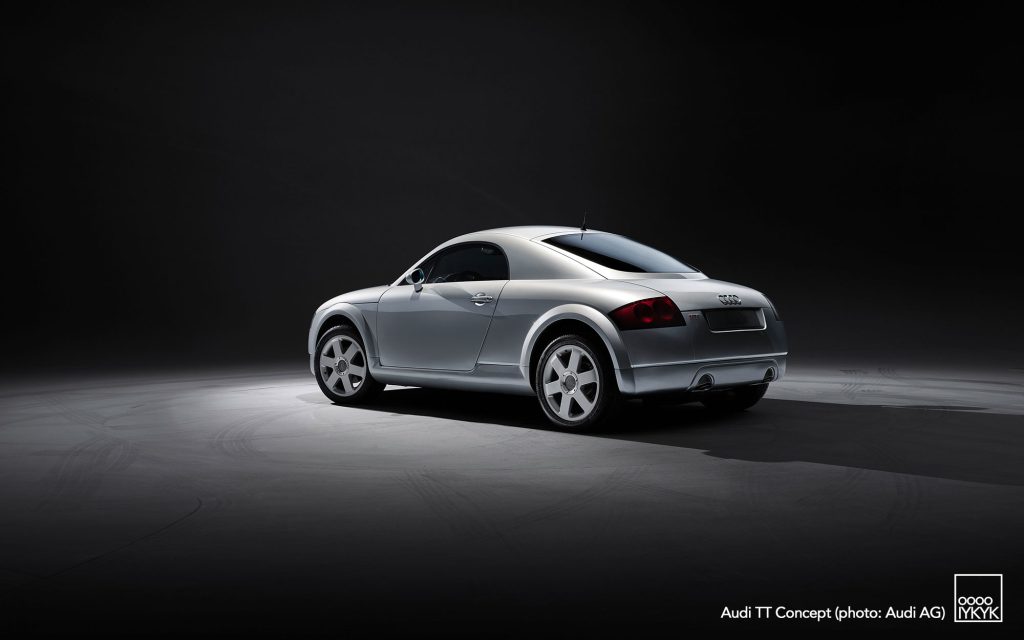
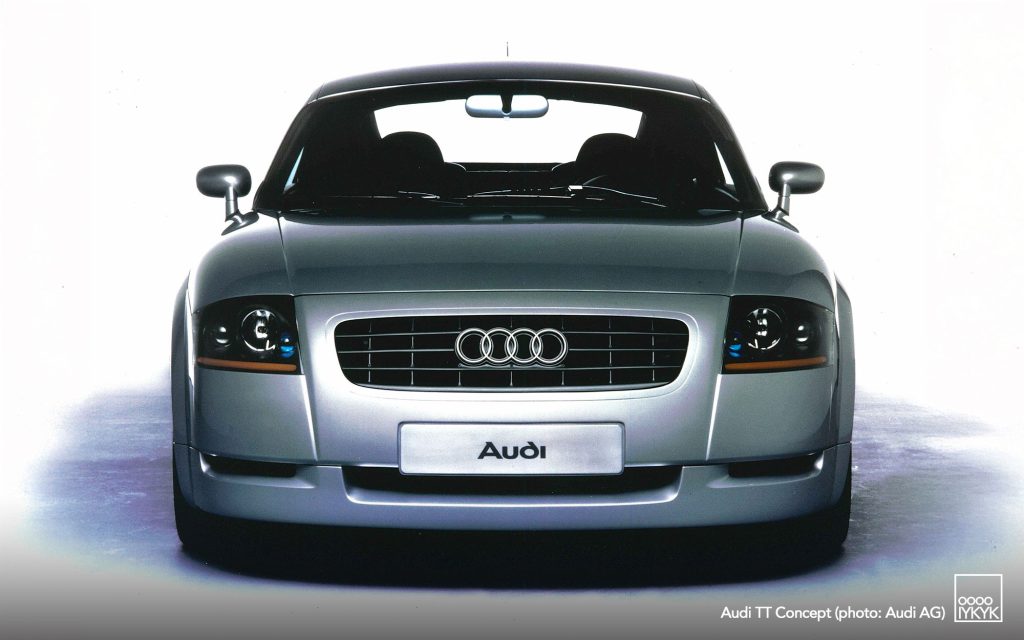
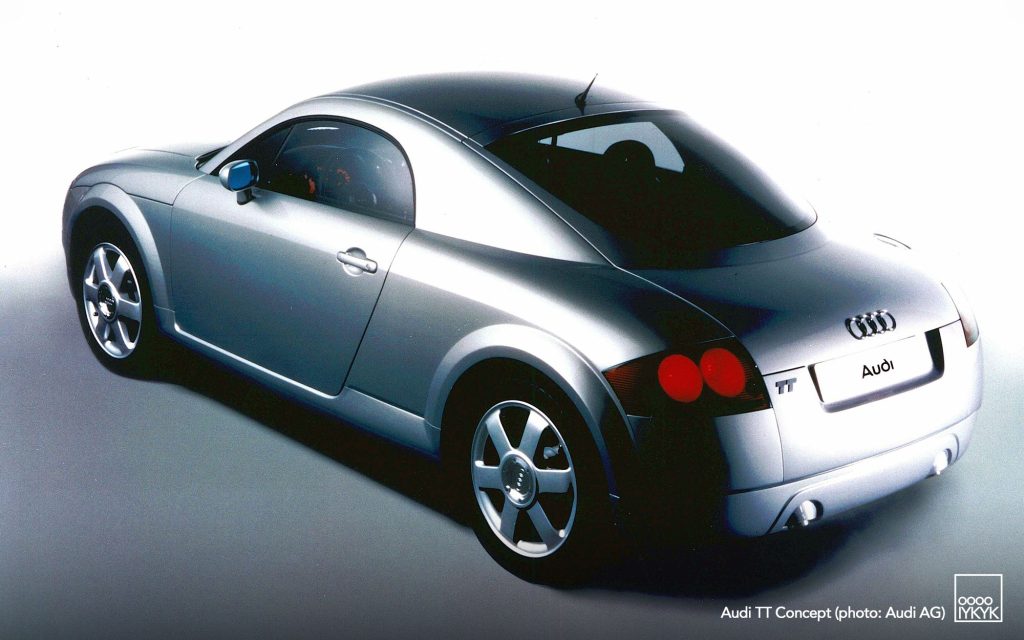
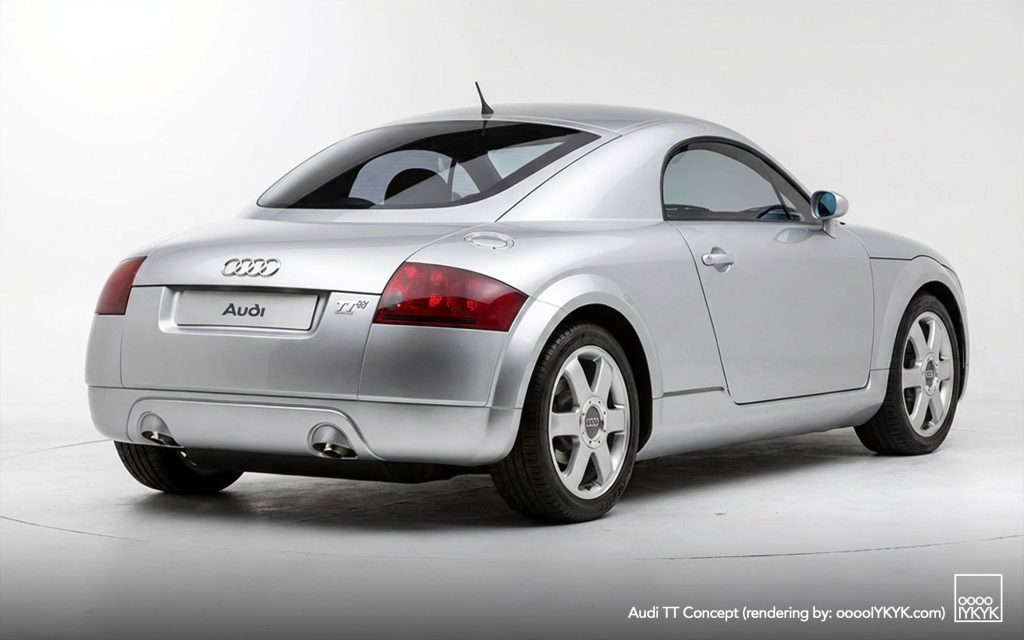
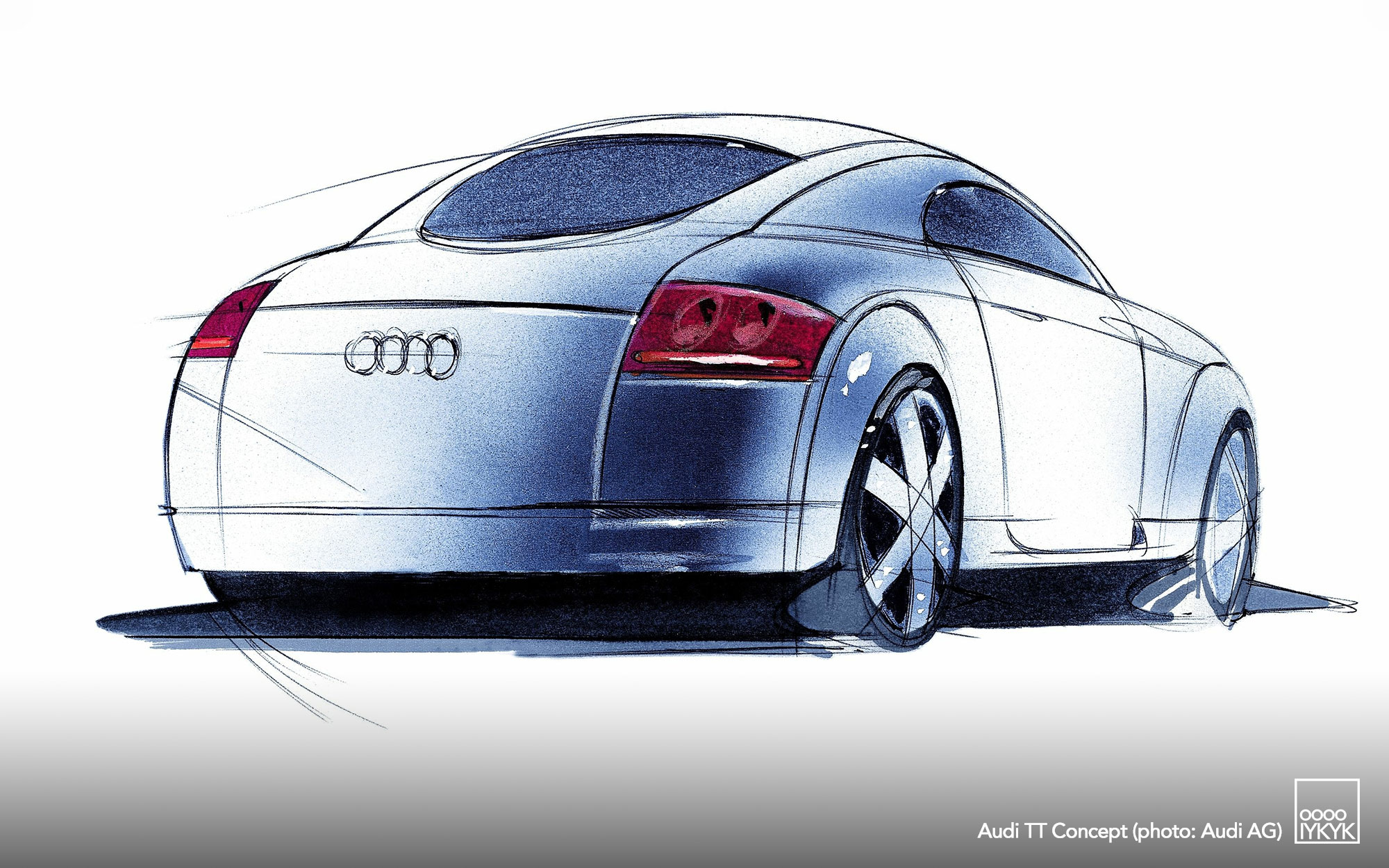
The most visible adjustment came in the greenhouse, where the production car adopted a rear side window. This extended the cabin visually and improved visibility and practicality, slightly altering the concept’s tighter, more compact side profile. Additional refinements to the roofline and rear hatch were made to accommodate structural and sealing requirements, though the overall arc and proportions remained intact.
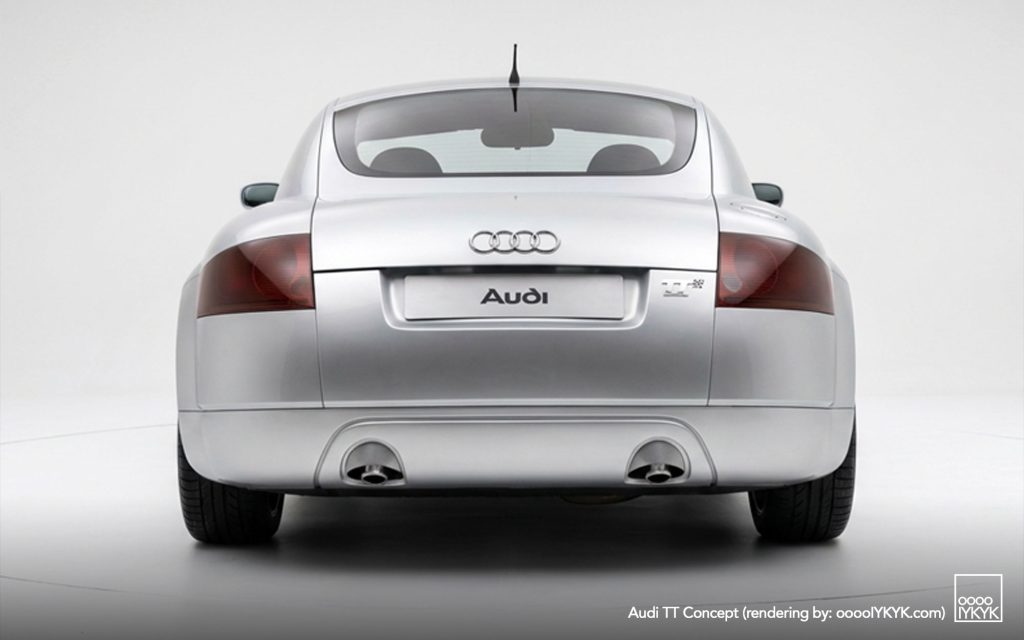
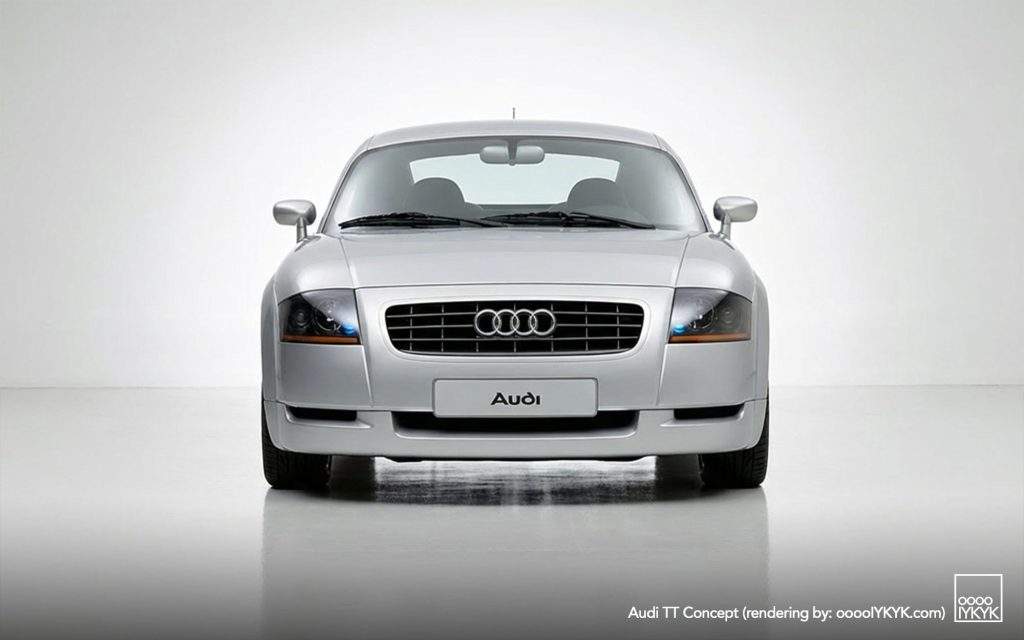
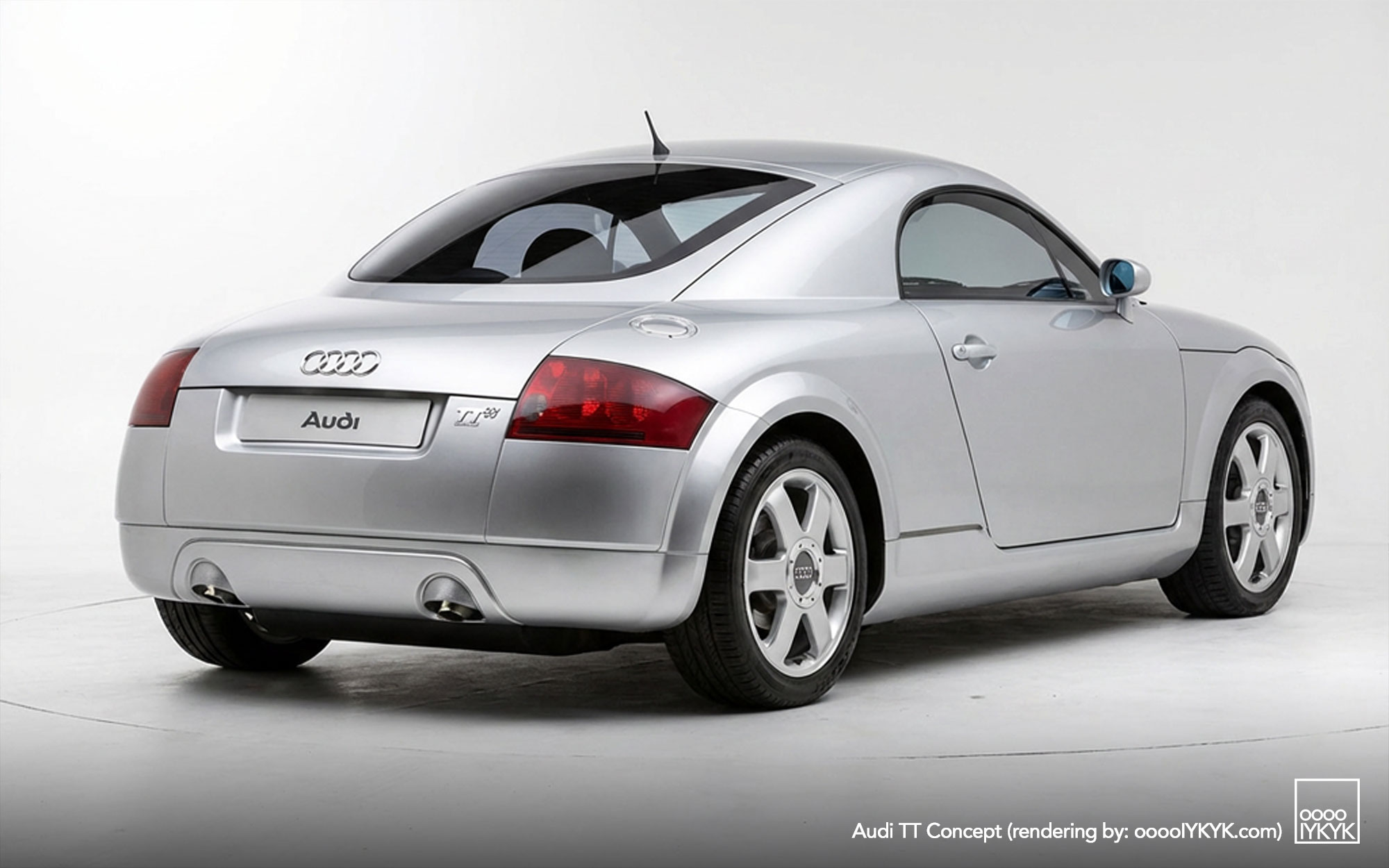
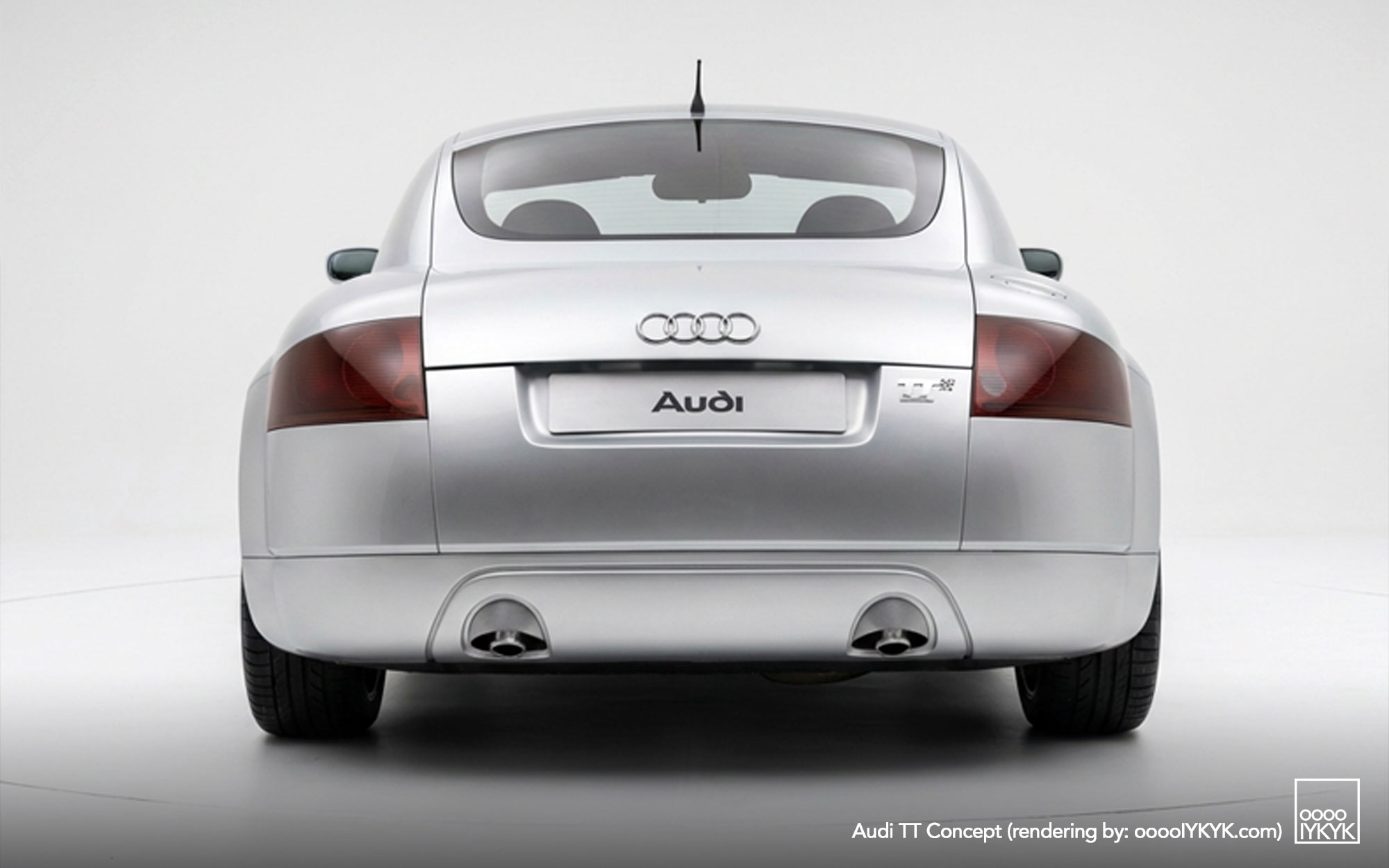
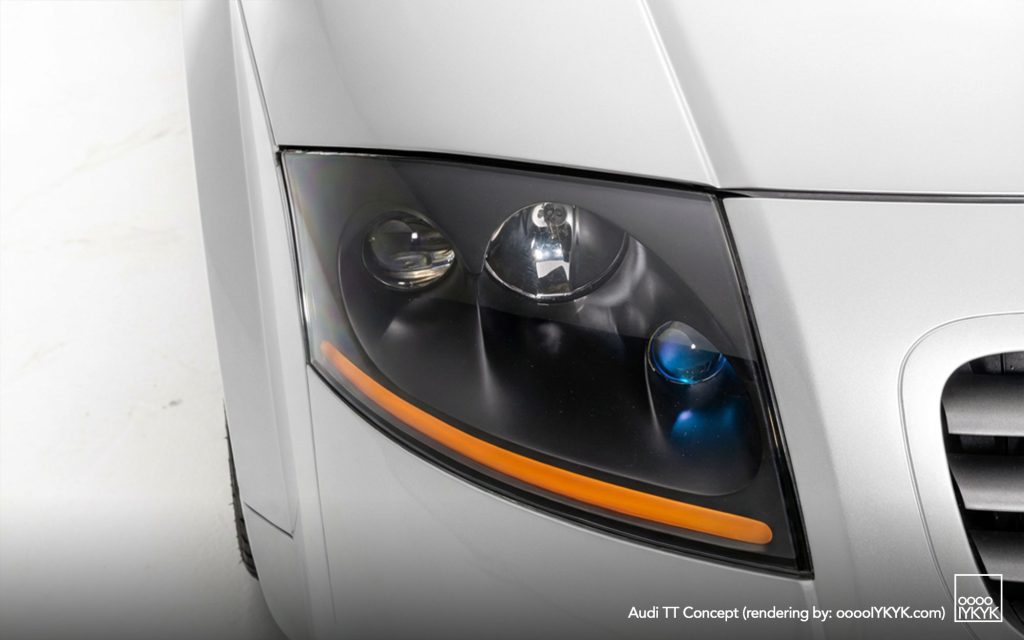
At the front and rear, Audi introduced subtle bumper integration and necessary panel gaps, replacing the concept’s near-seamless surfacing. Lighting elements and rearview mirrors were also adapted into production-ready housings, while wheels and tires were standardized for real-world use – the production car’s so-called “Avus” style wheels were subtly changed notably near the center hub where the spokes come together. The concept car’s downturned exhaust tips were changed for more a more conventional rear-exit design. Despite these changes, the body retained its “single-piece” appearance.
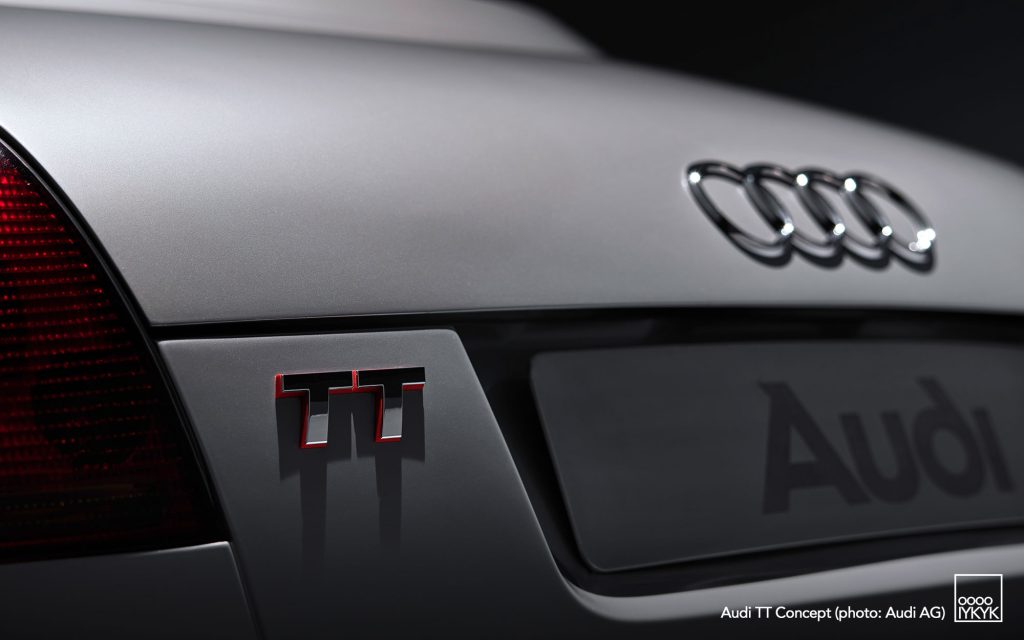
Bading was another point of change. Early PR photos show a “TT” badge at the rear that combined a checkered flag motif much like the NSU TT from which it got its name. More recent press photos show a red-edged silver “TT” badge without the checkered flag.
Inside, the production TT closely mirrored the concept. The circular motifs, aluminum detailing and minimalist layout carried over with minimal deviation, though additional controls, safety systems and more durable materials were incorporated. The checker-pattern seating unique to the TT Coupé never saw production in the TT, though similar checker patterns did appear in other production offerings. Other changes can be seen in minor design details such as the checkered flag “TT” logo on the radio faceplate and the longer shifter with shorter bellows style shift boot that made the manual transmission even more pronounced in the concept.
Key differences include:
- Addition of rear side window for visibility and packaging
- Subtle front and rear bumper definition for compliance
- Introduction of panel gaps and production shut lines
- Revised lighting units for road legality
- Standardized wheel and tire sizing
- Minor roofline and hatch adjustments for structure and sealing
- Interior adapted for durability and added functionality
A later post-launch change further distinguished the production car. Early stability concerns led Audi to introduce a rear spoiler, a feature absent from the concept’s clean design.
Even with these modifications, the production TT remained remarkably true to the original vision—retaining its defining geometry, proportion and Bauhaus-driven reduction with uncommon fidelity.
PHOTO GALLERY