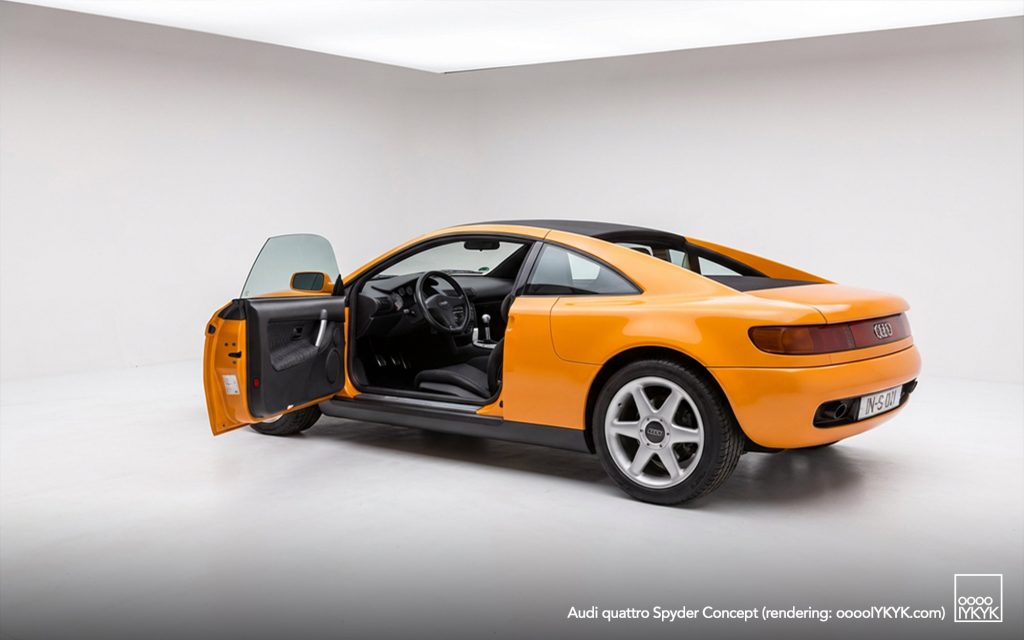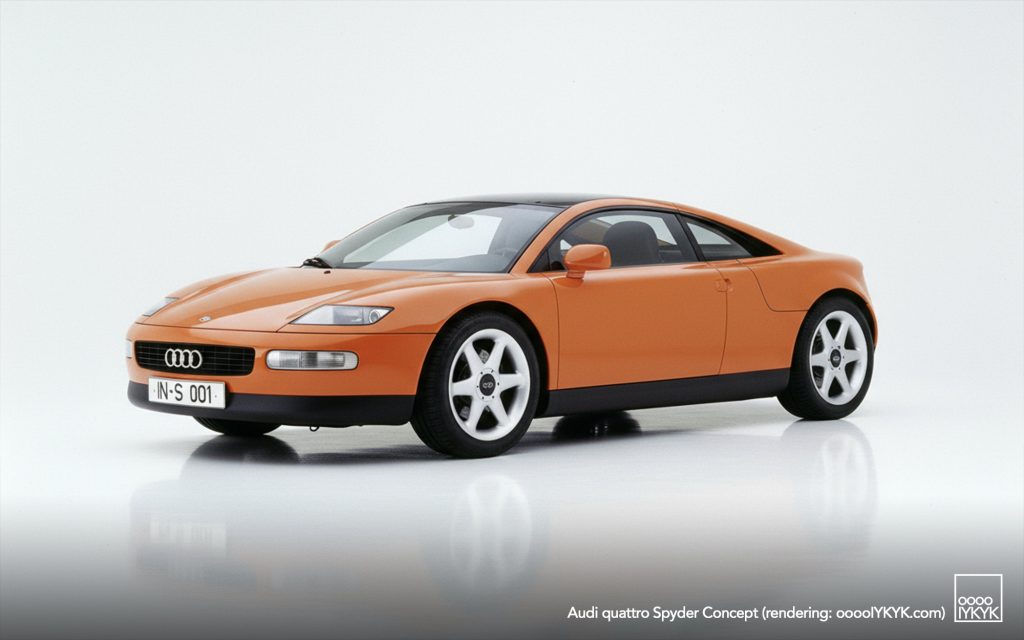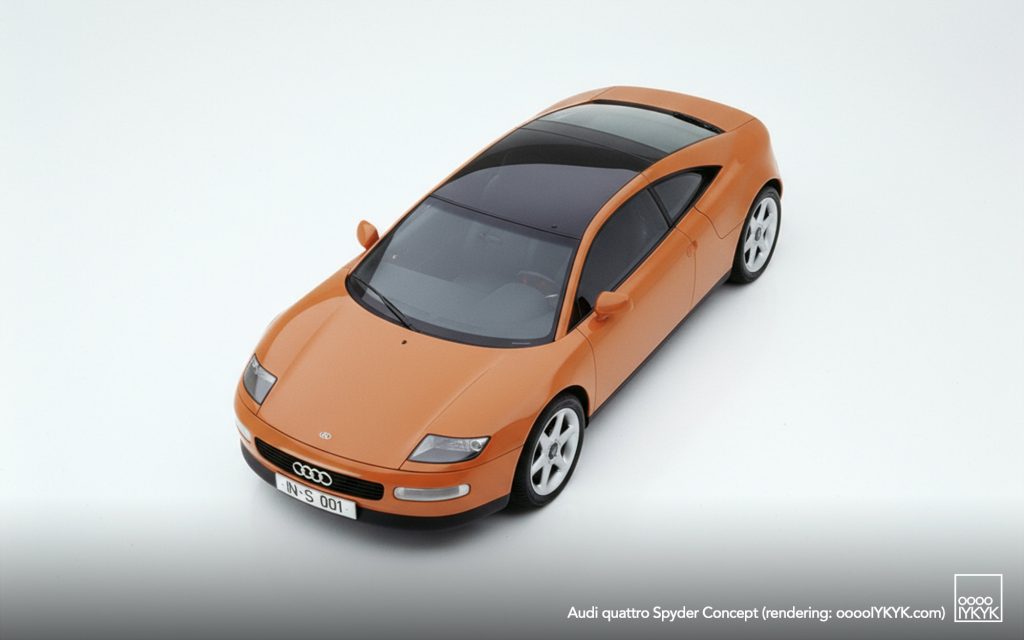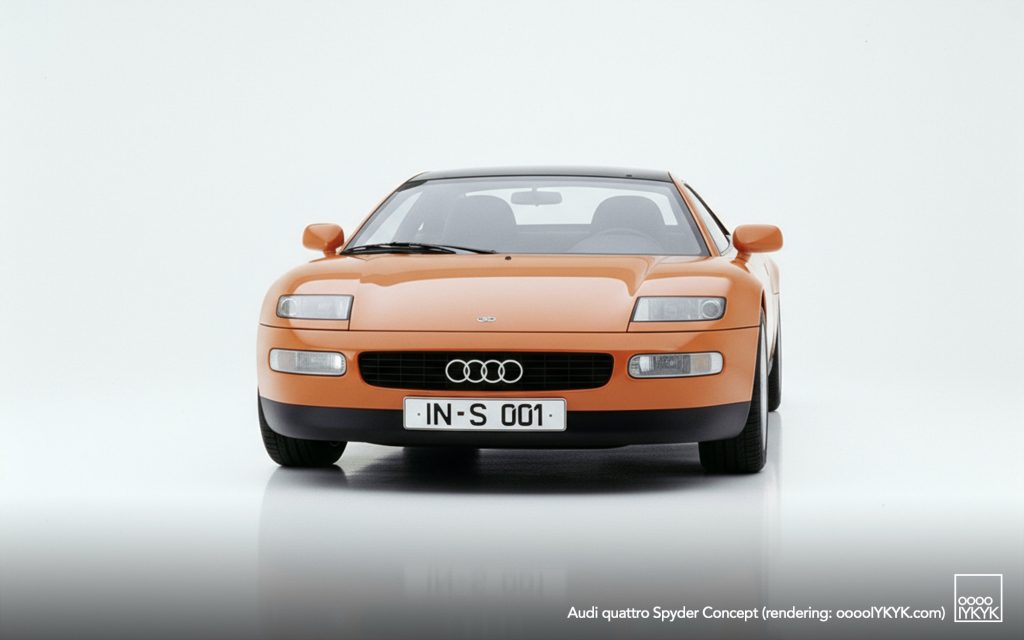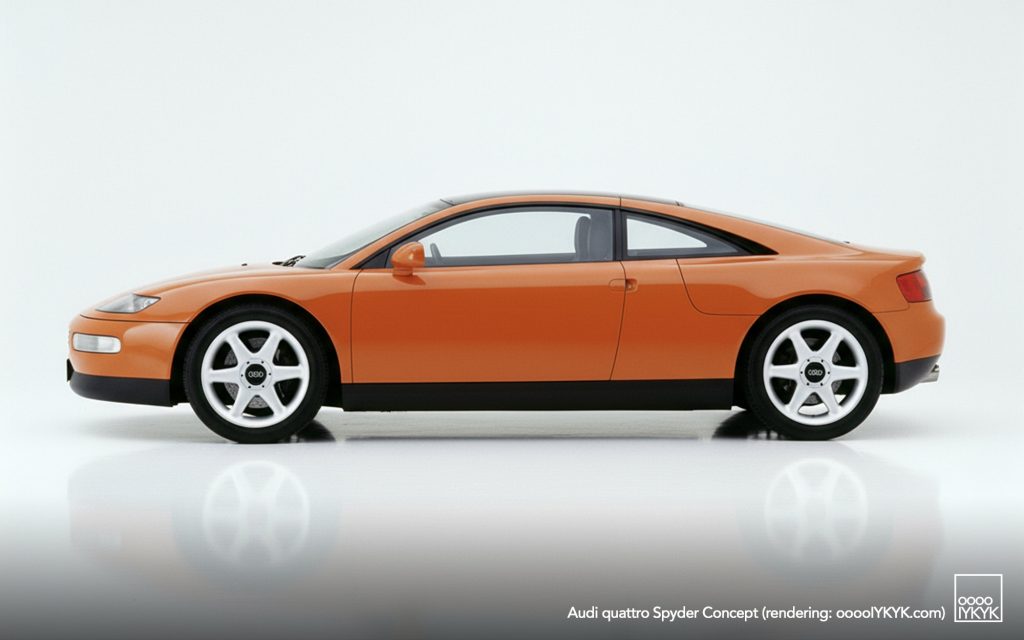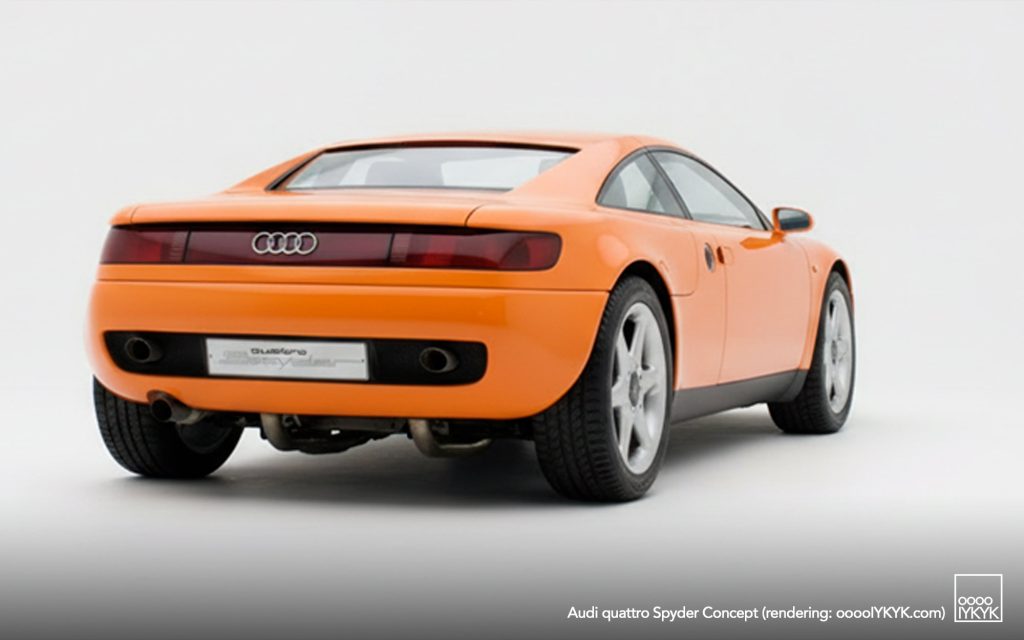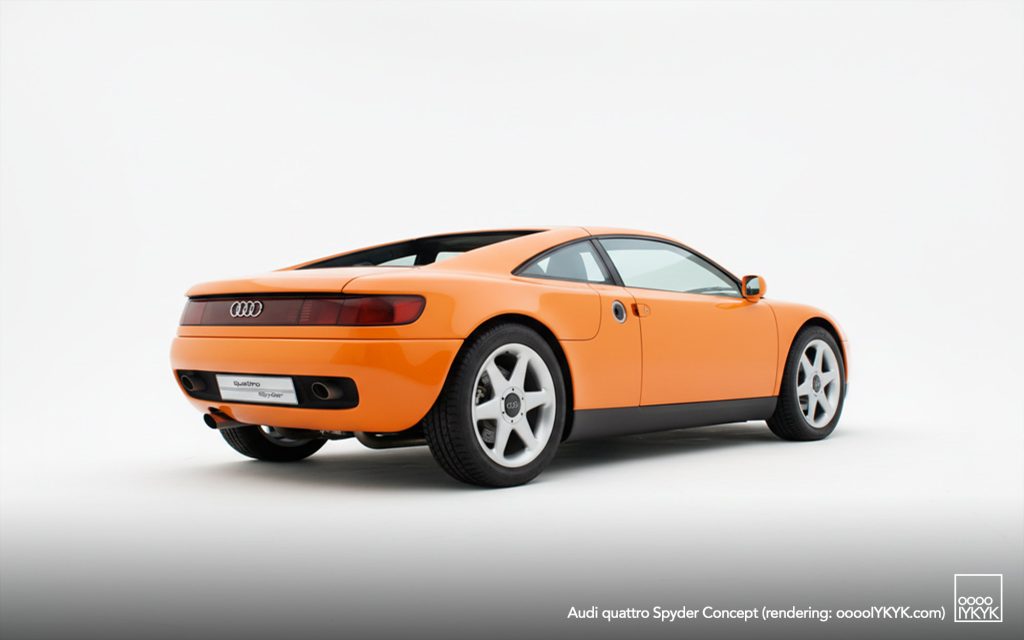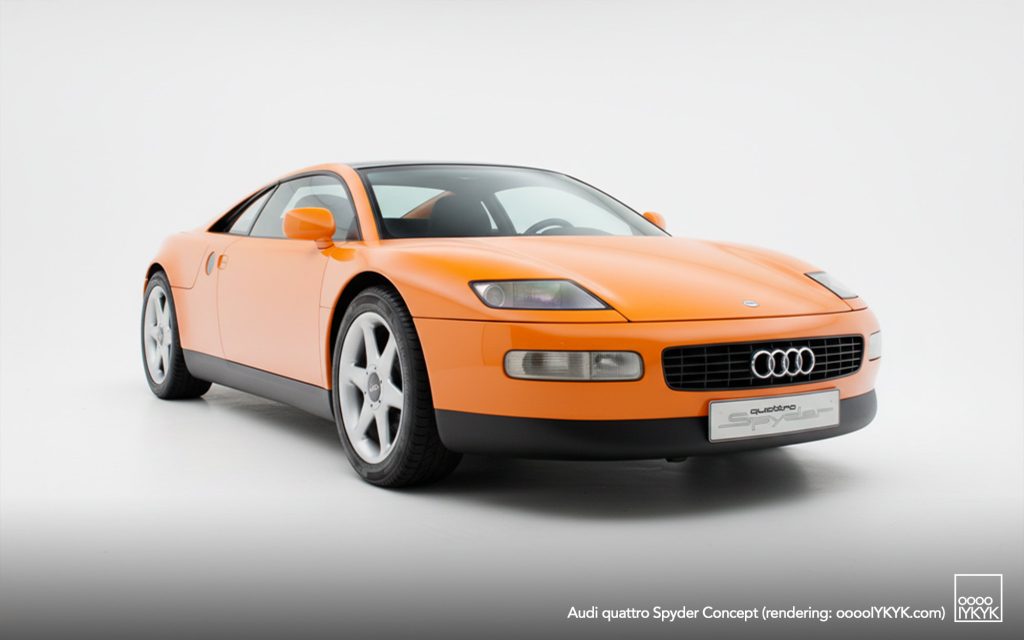

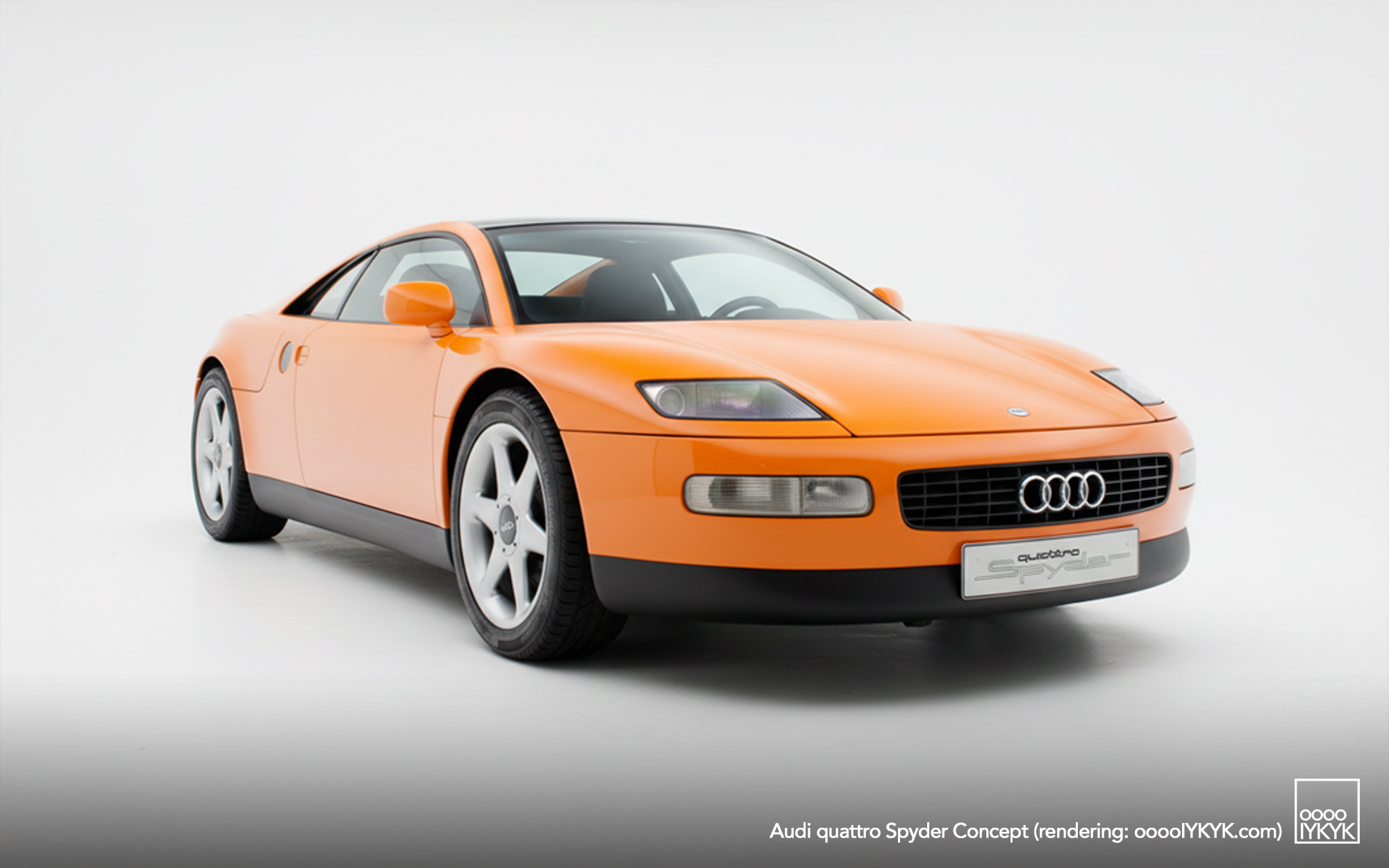

What: Audi quattro Spyder Concept (design study, mid-engine sports car)
Year: 1991
Era: Audi Postwar
Model Family:
Market / Zones: Global concept (IAA debut)
Debut: 1991 Frankfurt Motor Show (IAA), September 12, 1991
Number Produced: 1 (confirmed surviving example in Audi Tradition collection)
Chassis / Matrix: Aluminum spaceframe ASF) with tubular structure
Designer: Peter Schreyer
TECHNICAL DETAILS
Body Style(s): Two-door targa-style coupe (removable glass roof)
Drivetrain Configuration: Mid-engine, all-wheel drive
Engine(s): 2.8L V6 (Audi 100-derived)
Output: 128 kW (174 hp), 245 Nm
Transmission(s): 5-speed manual
All-Wheel Drive Type: Torsen-based permanent quattro
Chassis: Aluminum tubular frame with aluminum body
Suspension: Double wishbone front, multi-link rear
Weight: Approx. 1,100 kg
Acceleration: 0–100 km/h: < 6.0 seconds
Top Speed: ~250 km/h
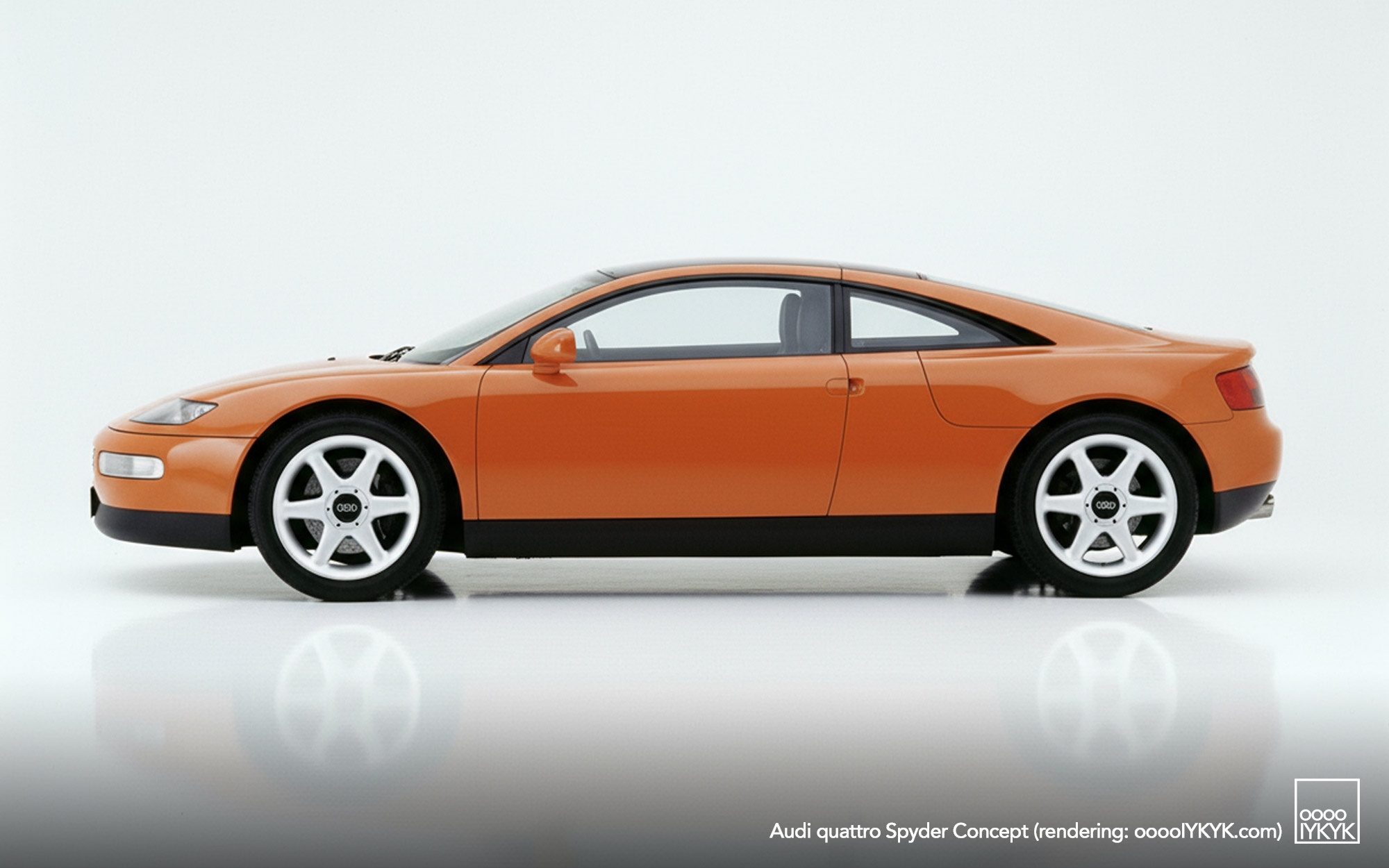
HISTORICAL CONTEXT
The quattro Spyder emerged at a pivotal moment for Audi as it explored lightweight construction and brand repositioning beyond sedans and touring cars. Developed from around 1990, the project aimed to demonstrate aluminum as a viable structural material while packaging Audi’s quattro system in a mid-engine sports car format.
Introduced at the 1991 Frankfurt Motor Show, the Spyder was presented as a fully functional prototype, not merely a static design exercise. Audi explicitly positioned it as a study capable of series production without fundamental changes, while targeting a relatively accessible price point for a mid-engine sports car.
Debuting the same year as the Audi Avus quattro, the quattro Spyder was considerably different in execution. Whereas the Avus with its W12 engine and exotic polished aluminum skin harked the otherworldly pre-war Auto Union Silver arrows, the quattro Spyder aimed to show a more production-ready vehicle using the firm’s then-new 2.8-liter V6.
Public response at Frankfurt was immediate and strong, with reports of potential buyers attempting to place orders shortly after its debut (as reflected in period coverage within the supplied materials).
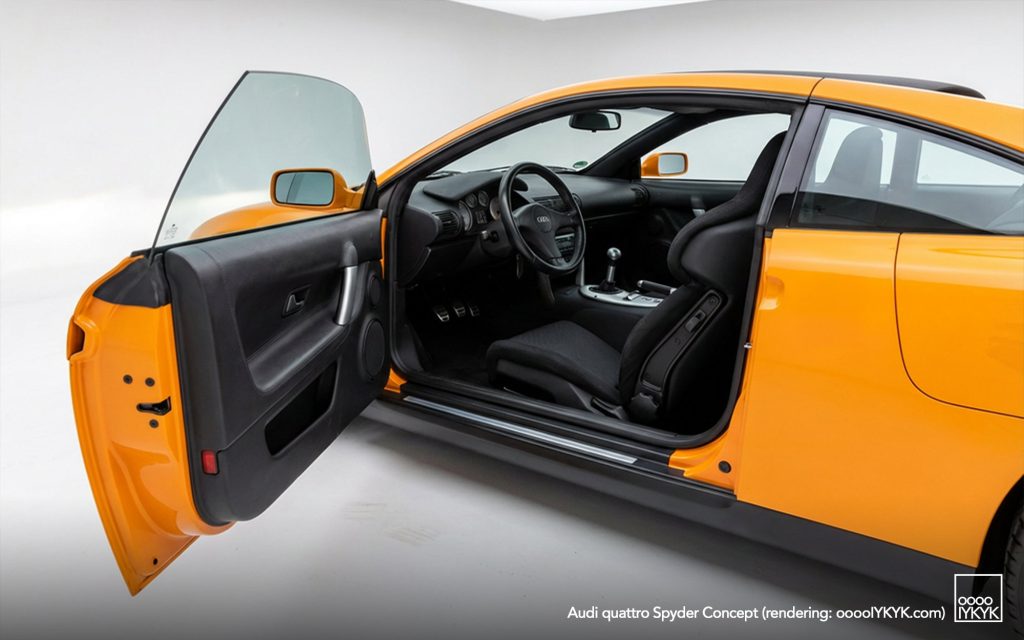
DESIGN & CONTEXT
The Spyder combined soft, organic surfacing with compact proportions, measuring approximately 4,215 mm in length and just 1,173 mm in height.
Key design features included:
- Removable glass roof panel stored over the engine
- Fully retractable side and rear windows
- Exposed aluminum elements in the interior
- Minimalist cockpit with analog instrumentation
The design emphasized lightness, openness, and usability, framing the car as both an emotional sports car and a rational engineering statement.
ENGINEERING & TECHNICAL OVERVIEW
The quattro Spyder was notable for combining three defining elements:
- Mid-engine layout
- Permanent quattro all-wheel drive
- All-aluminum construction
The drivetrain utilized a transverse-mounted 2.8-liter V6 positioned behind the cabin, paired with a 5-speed manual transmission. Power was distributed via a Torsen center differential to both axles.
Audi emphasized that the car used existing production components where possible, reinforcing its feasibility as a production vehicle.
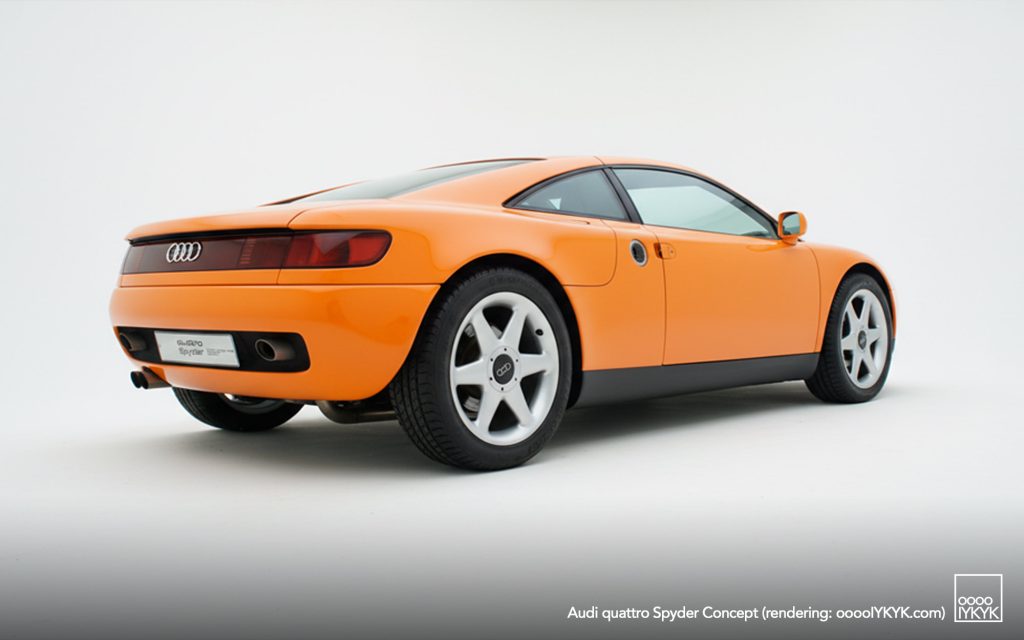
PRODUCTION INTENT & CANCELLATION
Audi internally explored limited production (period sources suggest ~1,500 units), but the project was ultimately canceled despite strong demand signals.
Key constraints included:
- Cost of aluminum construction at scale
- Internal prioritization of other models
- Brand positioning considerations
The Spyder nonetheless became a reference point for future Audi aluminum architecture (ASF) and performance identity.
SURVIVING VEHICLE
The Fidji Orange prototype is the only confirmed surviving car and resides within the Audi Tradition collection, forming the strongest evidence that the program produced a single fully realized prototype.
PHOTO GALLERY