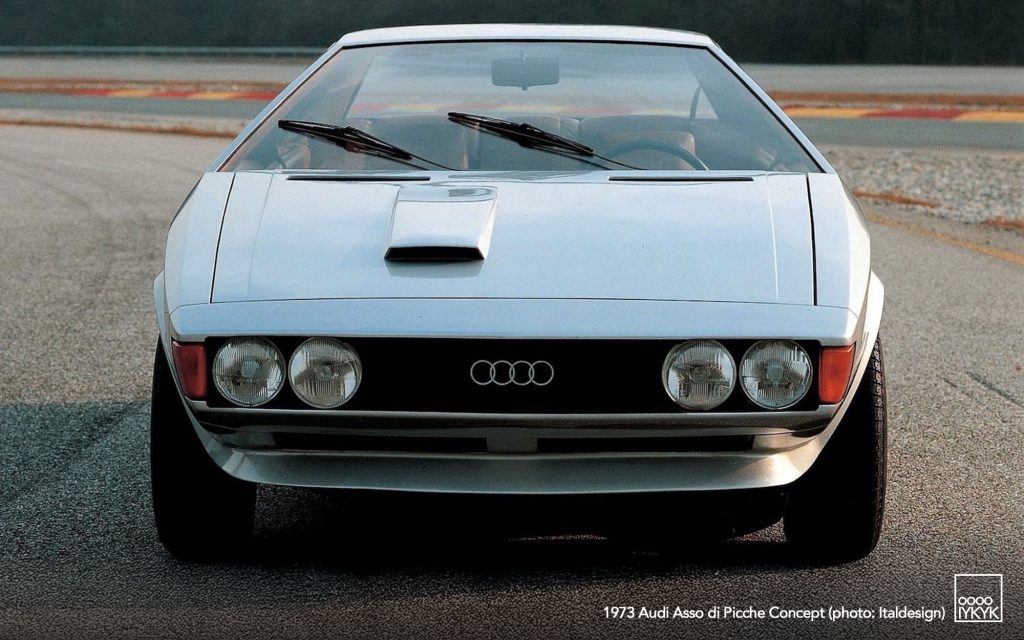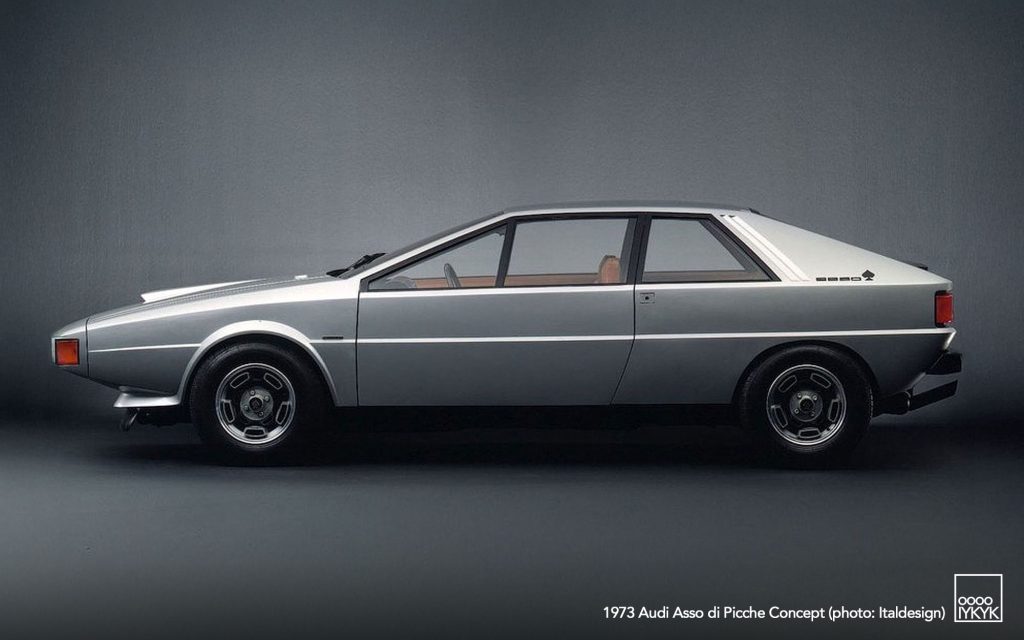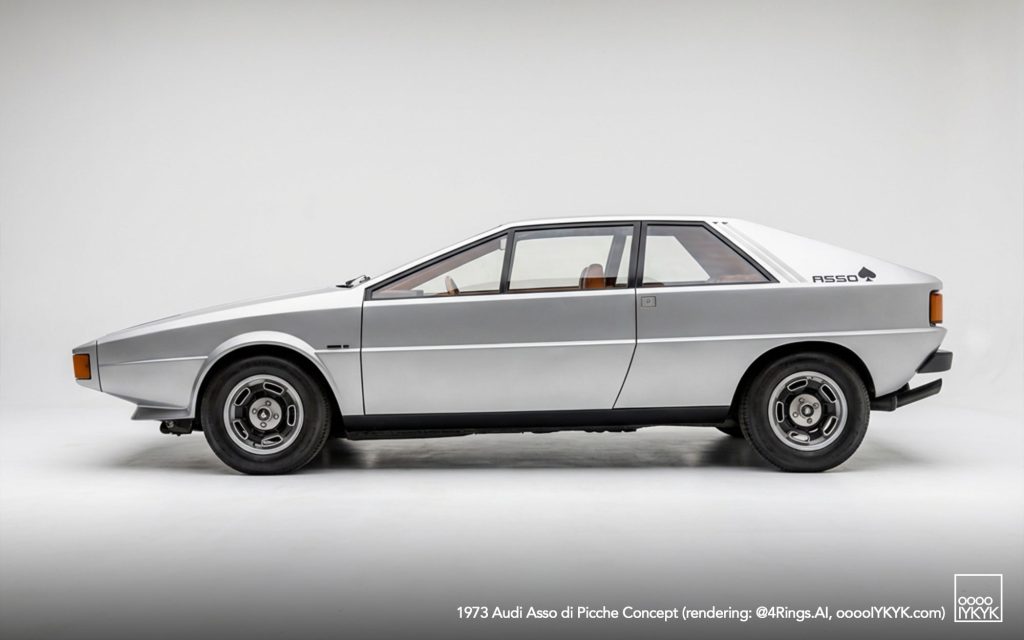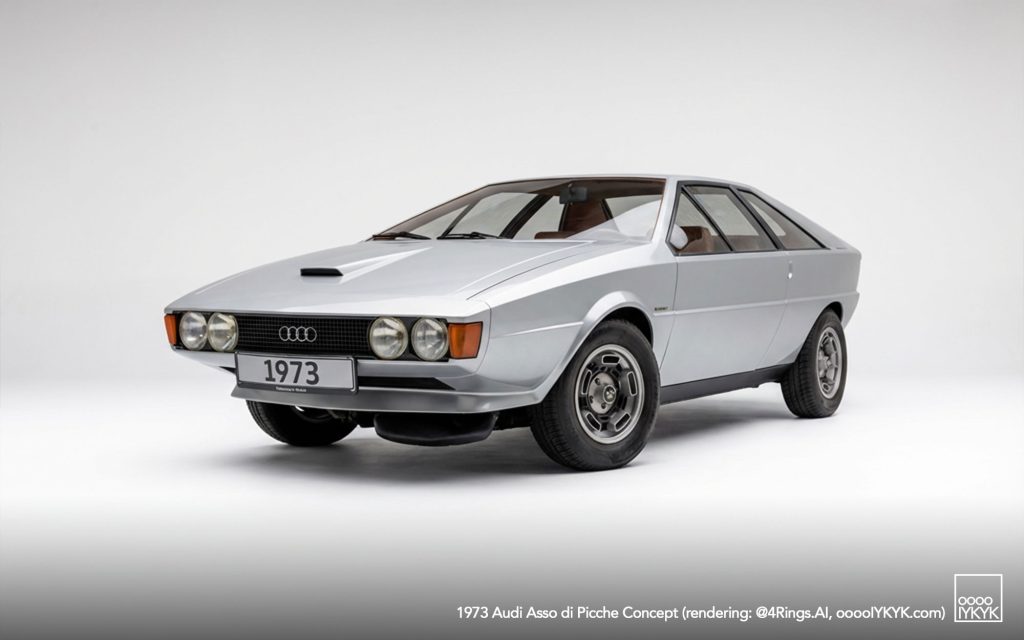


What: Audi Asso di Picche Concept
Model Family: 80 (B1, type 80)
Debuted: 1973 Frankfurt IAA
Year: 1973
Registration Plate: N/A
Status: Italdesign collection
Number Produced: 1
Model / Generation Code(s): type 80
Chassis / Matrix: B1
Engine: 1.5-liter inline-four gasoline engine
Transmission: 4-speed manual
Drivetrain: Front-wheel drive
Power: 101 hp (74 kW)
Weight: unknown
Acceleration (0-100 km / 62 mph: unknown
Length: 4,110 mm
Width: 1,650 mm
Height: 1,210 mm
Wheelbase: 2,480 mm
Body style: 2-door Coupé
Exterior Paint Color: unknown silver
Wheels: 4×100 custom
RELATED
Concept Cars: BMW Asso di Quadri (1976), Isuzu Asso di Fiori (1979)
Prototypes: Audi A0 Coupé (1973/1975)
Road Cars: N/A
Race Cars: N/A
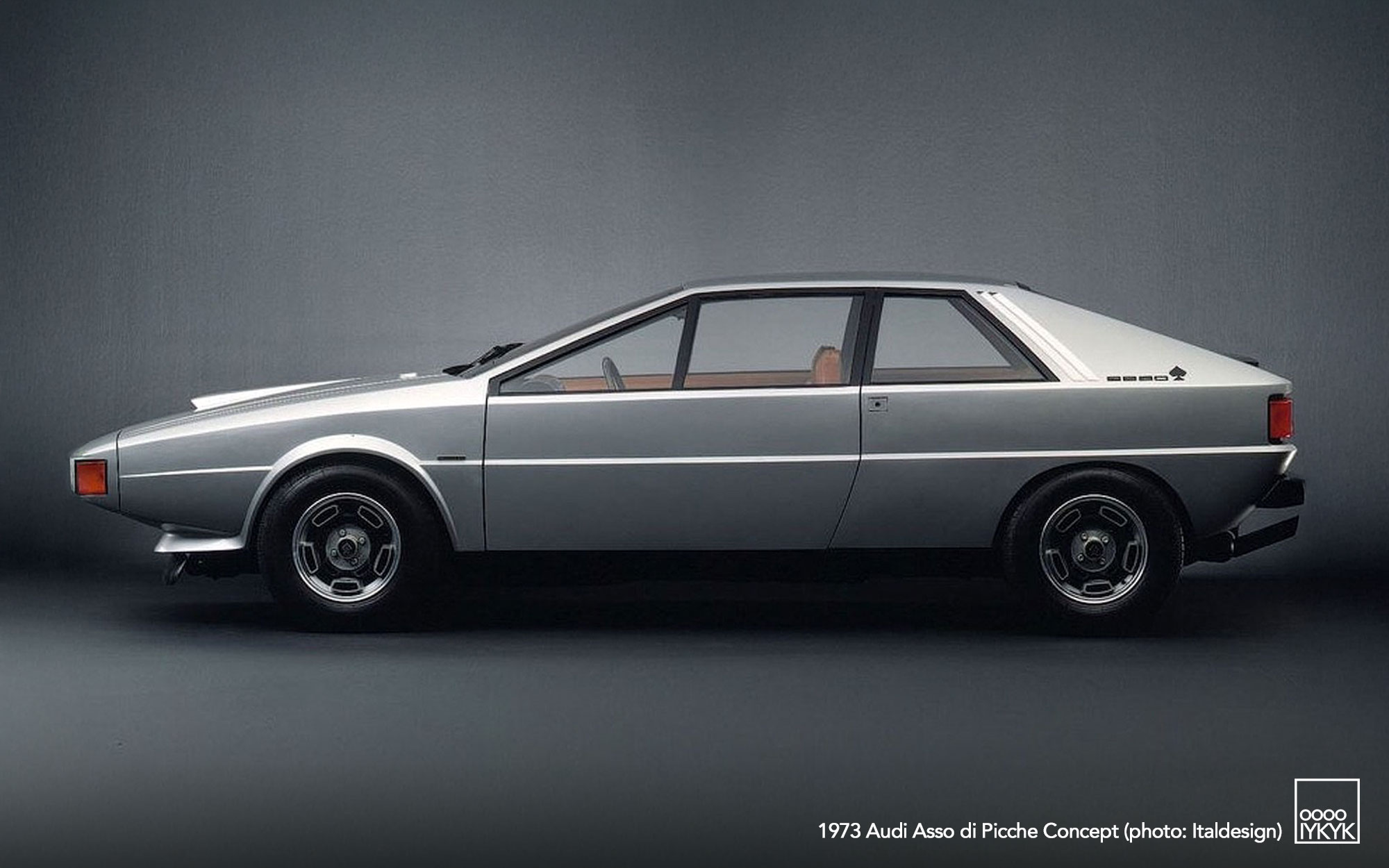
SUMMARY
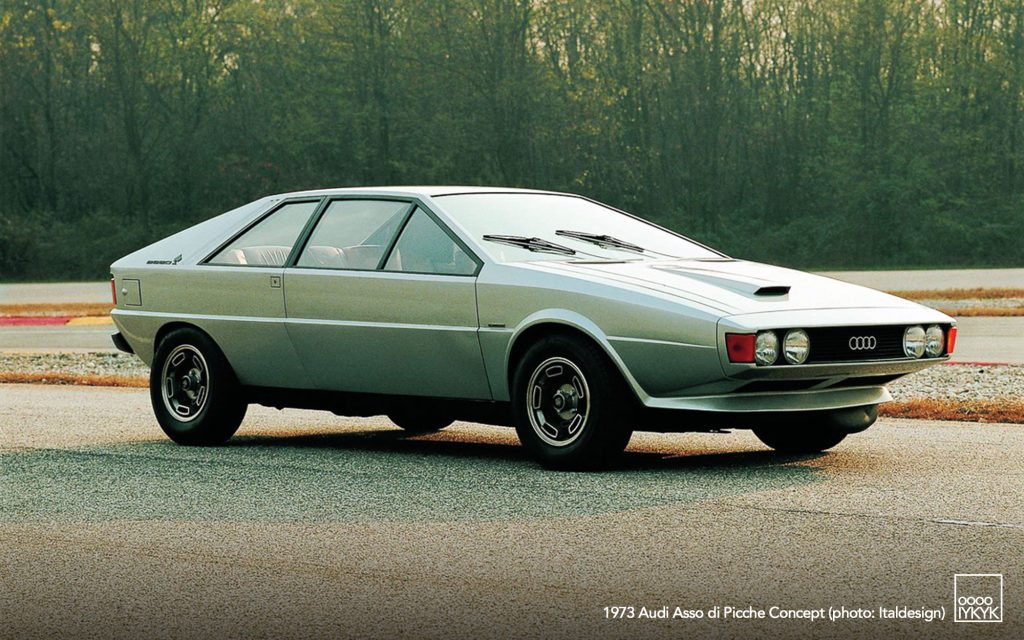
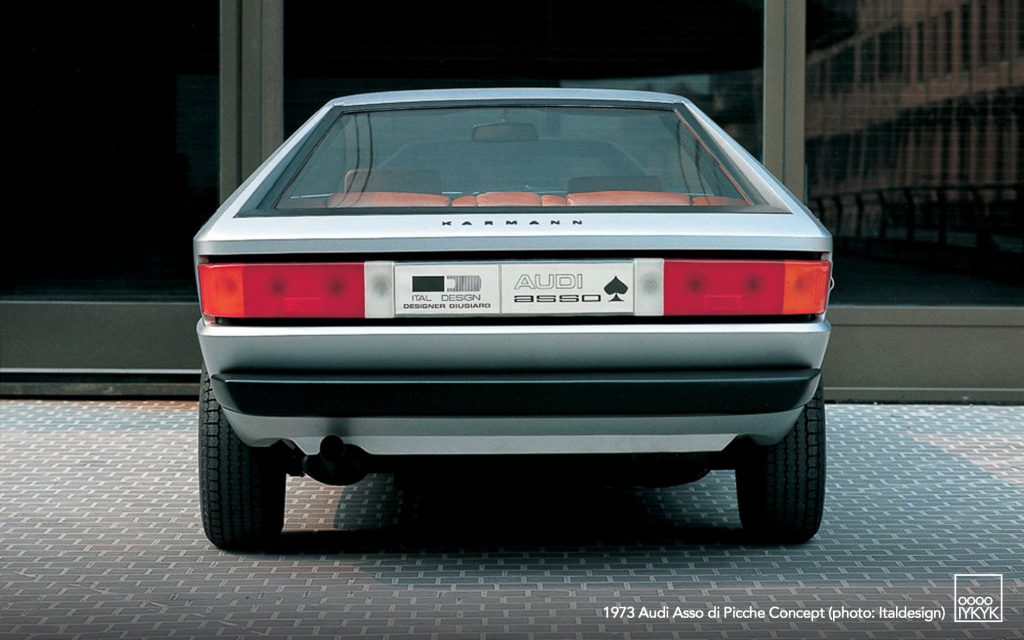
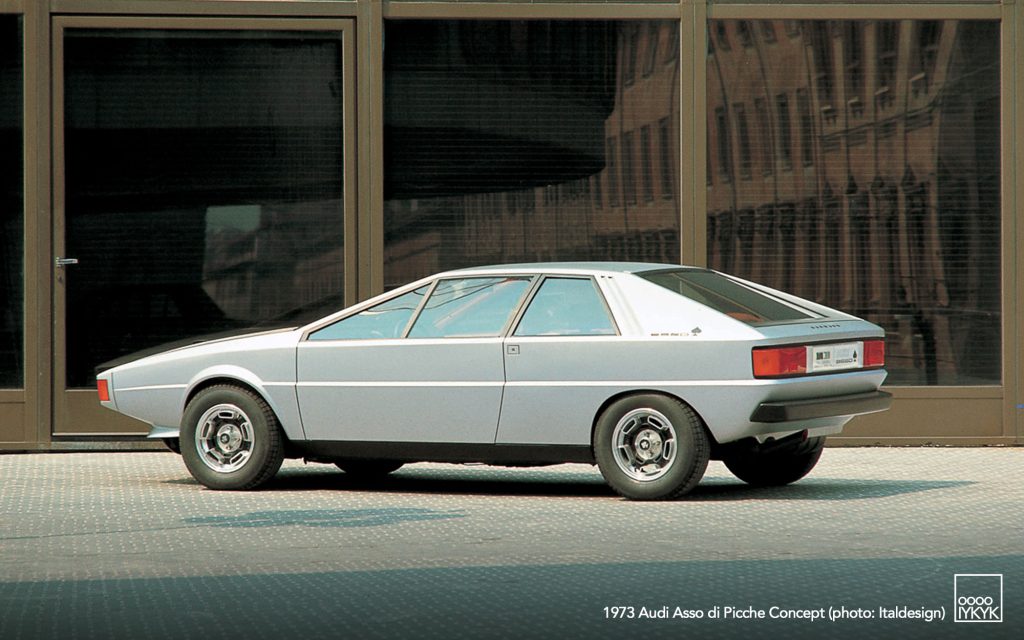
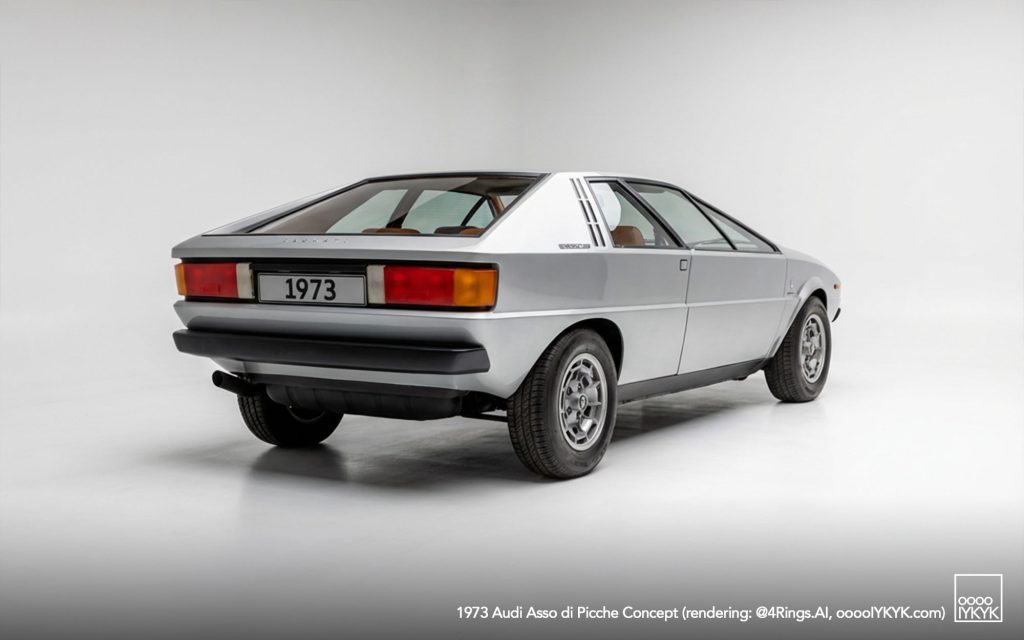
The Audi Asso di Picche is a 1973 concept car developed by Italdesign under the direction of Giorgetto Giugiaro, with construction undertaken by Karmann. Conceived as a four-seat sports coupé based on the mechanical layout of the Audi 80 (B1), the project was intended to demonstrate the feasibility of a limited-series production model rather than to serve as a purely experimental show car.
Although the Asso di Picche carried Audi branding and utilized Audi mechanical components from the 80 (B1), it was not commissioned directly by Audi. Instead, it functioned as a design and engineering proposal initiated at Karmann’s request, serving as a rolling showcase of Italdesign’s emerging geometric design language and Karmann’s production capabilities.
The name Asso di Picche translates from Italian as Ace of Spades.
BACKGROUND
In the early 1970s, automotive design was undergoing a marked shift away from the organic forms of the 1950s and 1960s toward sharper, more geometric shapes. This transition was being led in large part by Italian design studios, particularly Italdesign, which Giugiaro had founded in 1968 after previous tenures at Bertone and Ghia.
At the same time, the Volkswagen Group was in the process of reinventing itself beyond the Beetle. Italdesign was deeply involved in this transformation, having been contracted to design several key models, including the Volkswagen Golf Mk1, Scirocco Mk1, and Passat B1. Parallel to these production programs, Italdesign continued to produce radical concept vehicles—most notably the 1972 Maserati Boomerang—that explored advanced forms and packaging solutions.
Against this backdrop, Wilhelm Karmann sought to collaborate with Italdesign on a project that could plausibly be manufactured in small numbers. The resulting concept was based on the Audi 80 platform, which itself underpinned several Volkswagen Group products, making it a logical technical foundation.
DESIGN & DEVELOPMENT
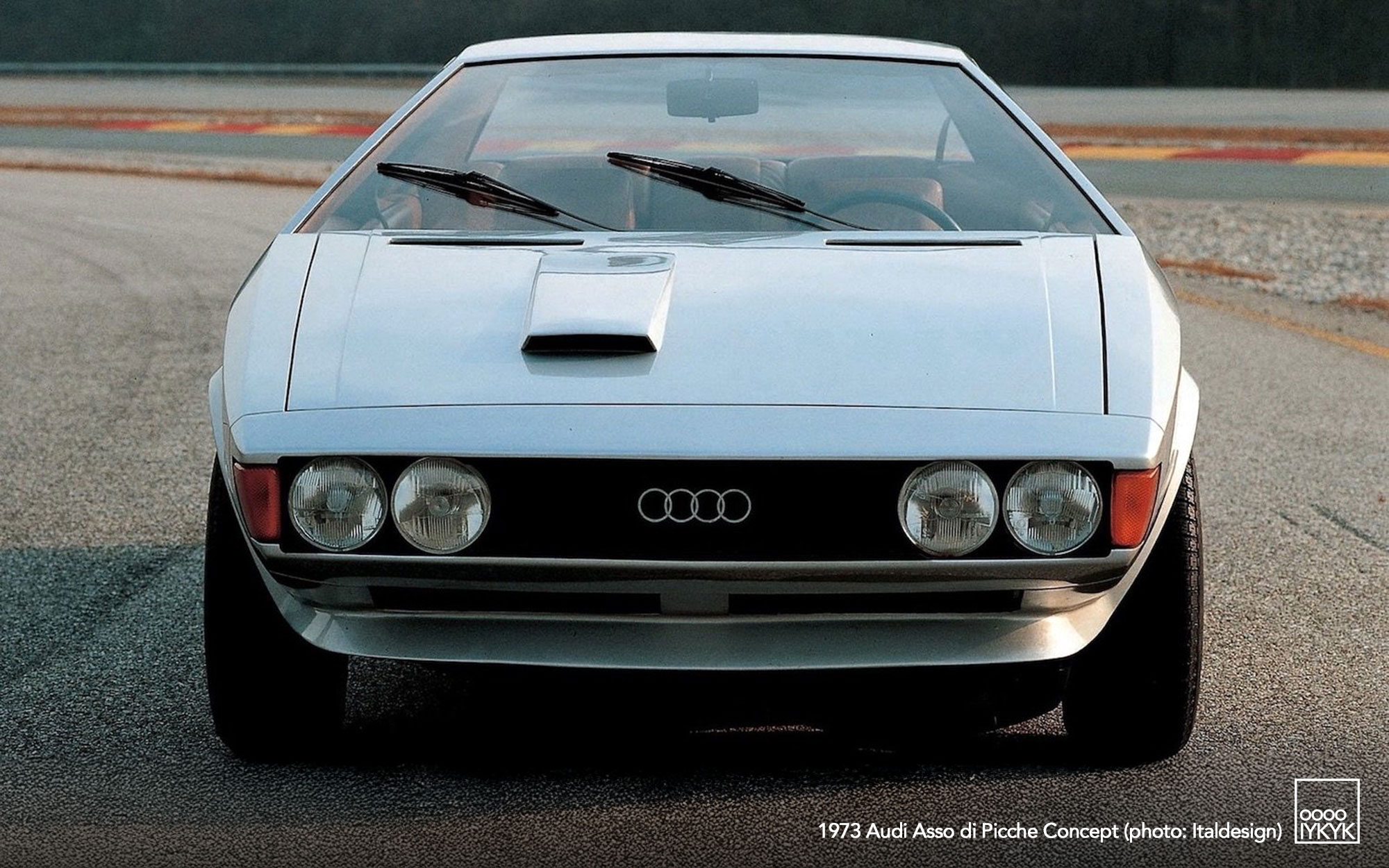
The Asso di Picche was developed using the chassis and mechanical components of the Audi 80 (B1), including its front-engine, front-wheel-drive layout. Compared with the Audi 80 sedan, the concept featured a shortened rear overhang and an extended front overhang, giving the car a more dramatic and forward-leaning stance.
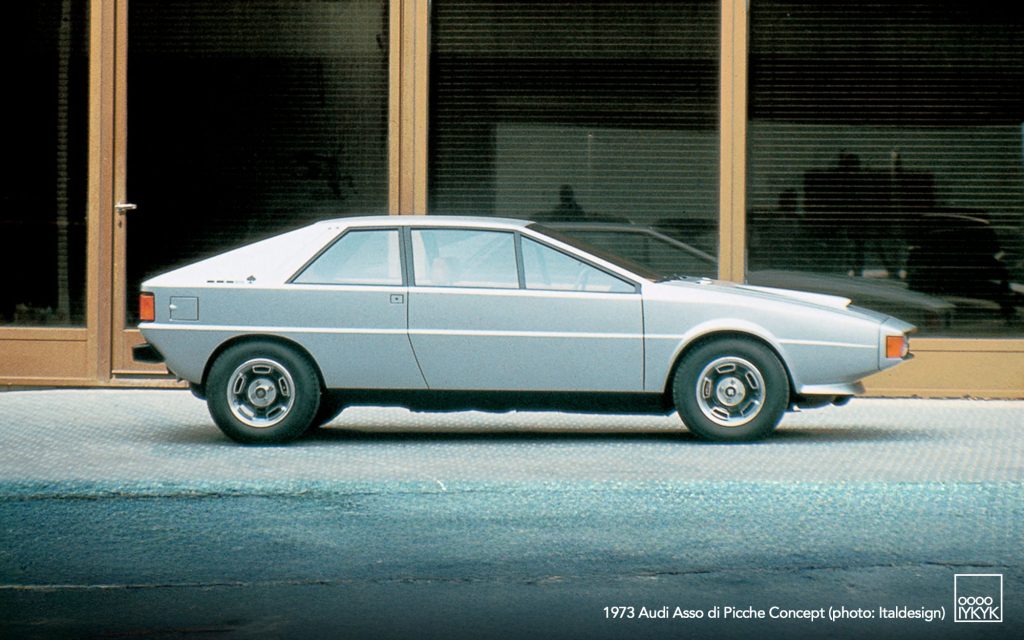
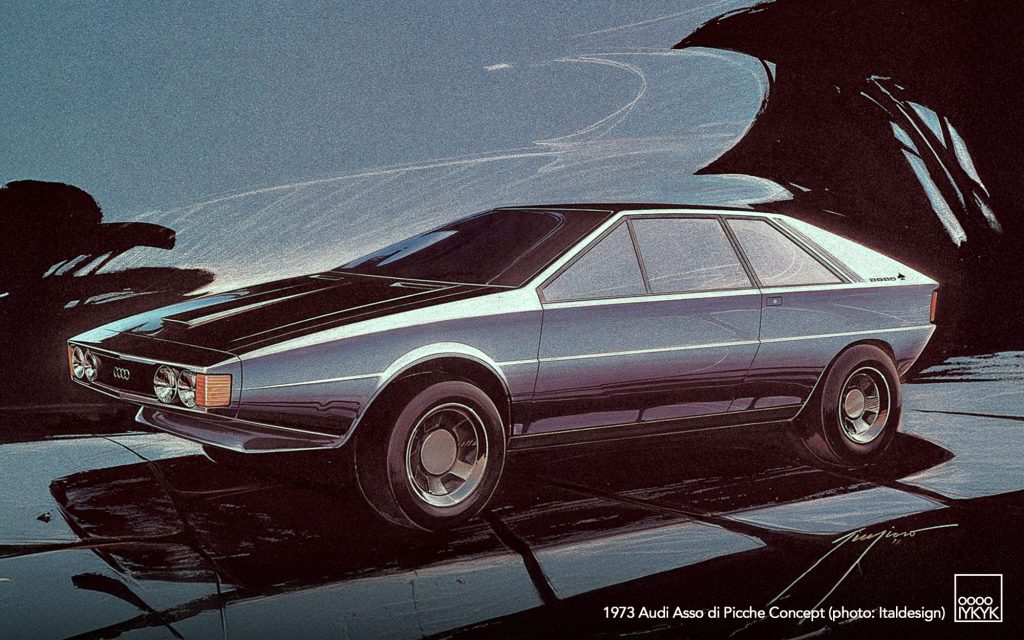
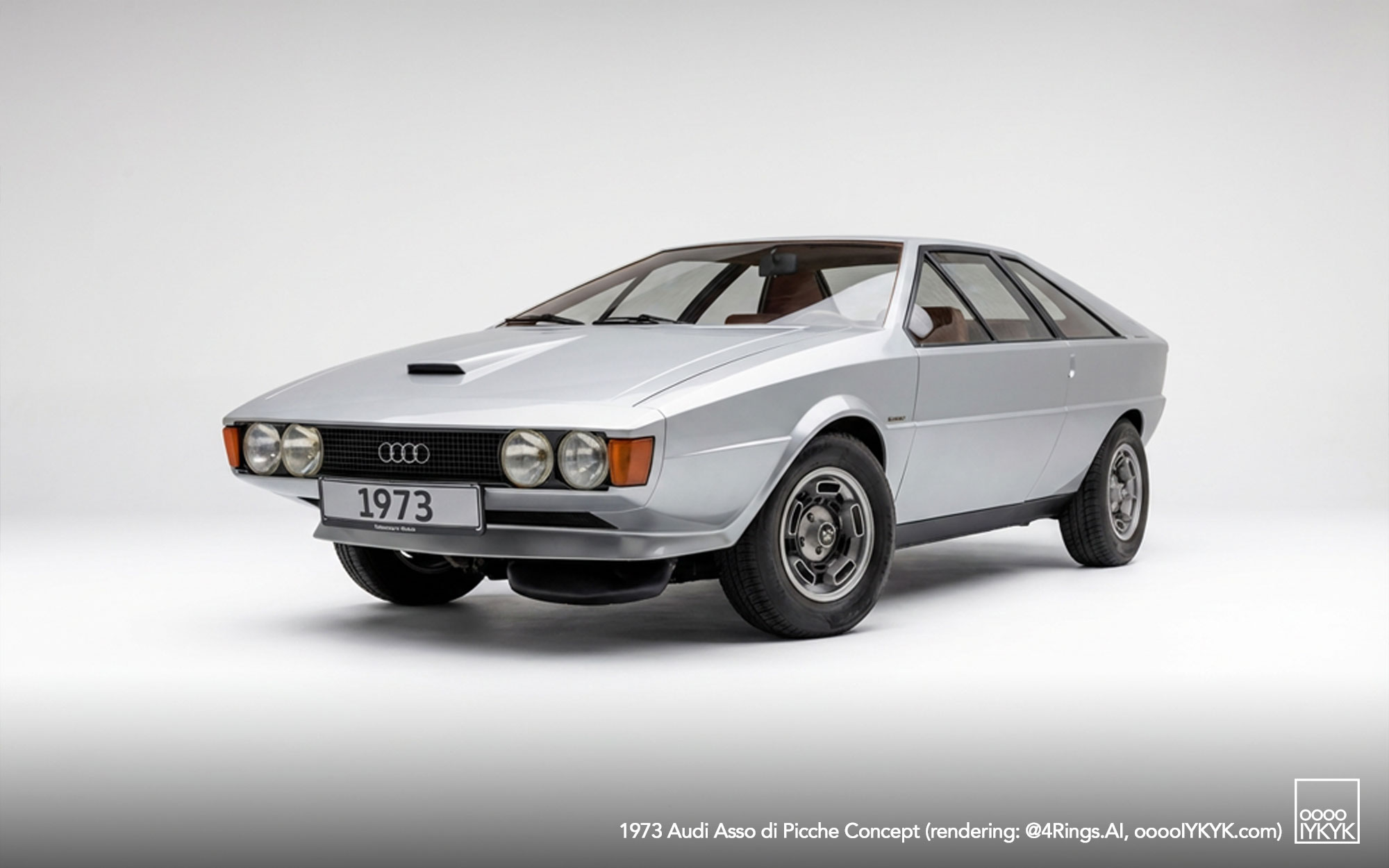
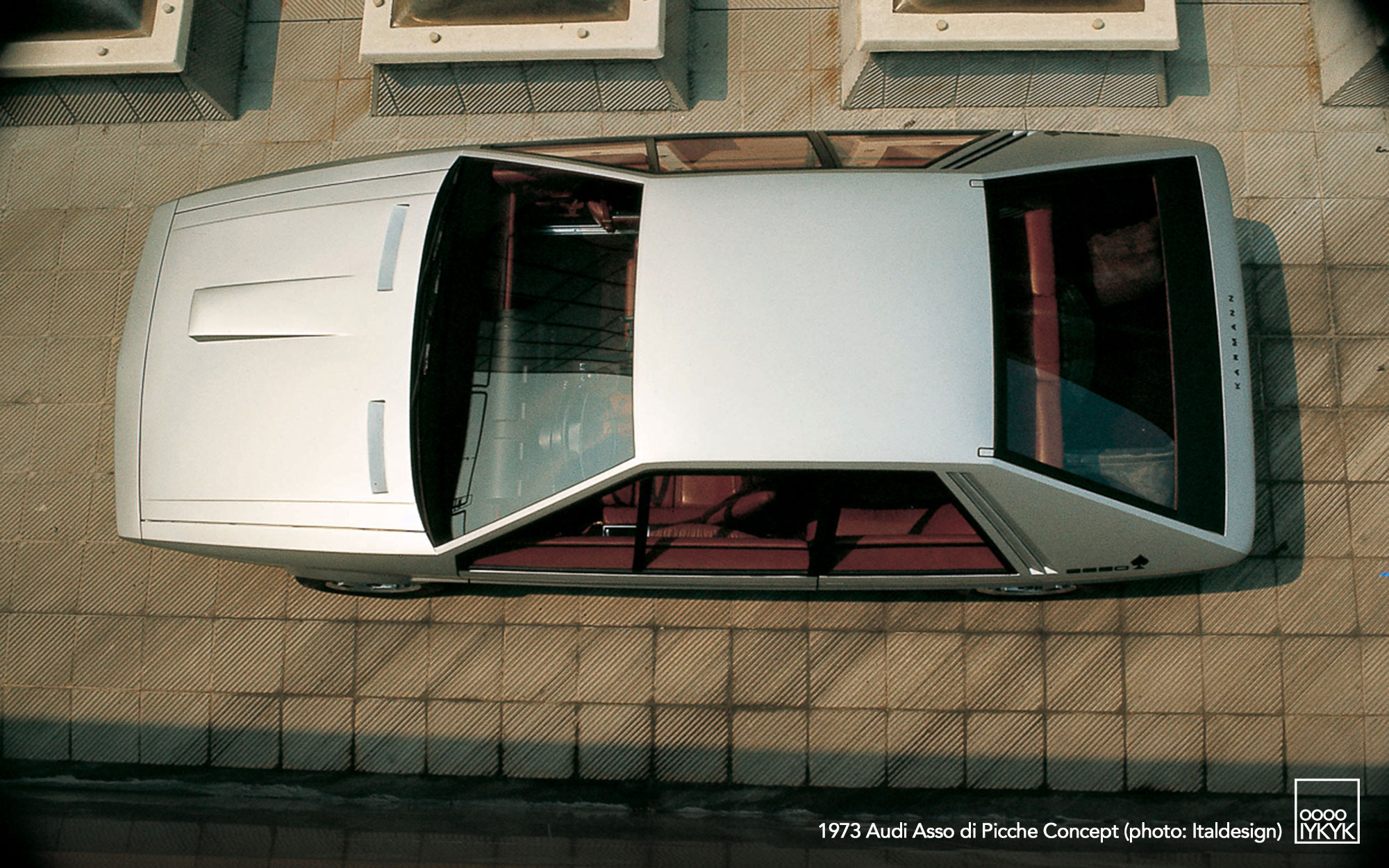
Stylistically, the car was heavily influenced by the geometric principles explored in the Maserati Boomerang. Its bodywork was defined by strong trapezoidal forms, creating a pronounced wedge profile with high visual impact. The vehicle was widest at the shoulder line, tapering both upward and downward—an approach intended to improve aerodynamics, interior accessibility, and perceived width.
Although often compared to the Volkswagen Scirocco due to shared Giugiaro design origin and certain visual similarities, the Asso di Picche was conceived independently and exhibits a far more radical execution, particularly in its proportions and surface treatment.
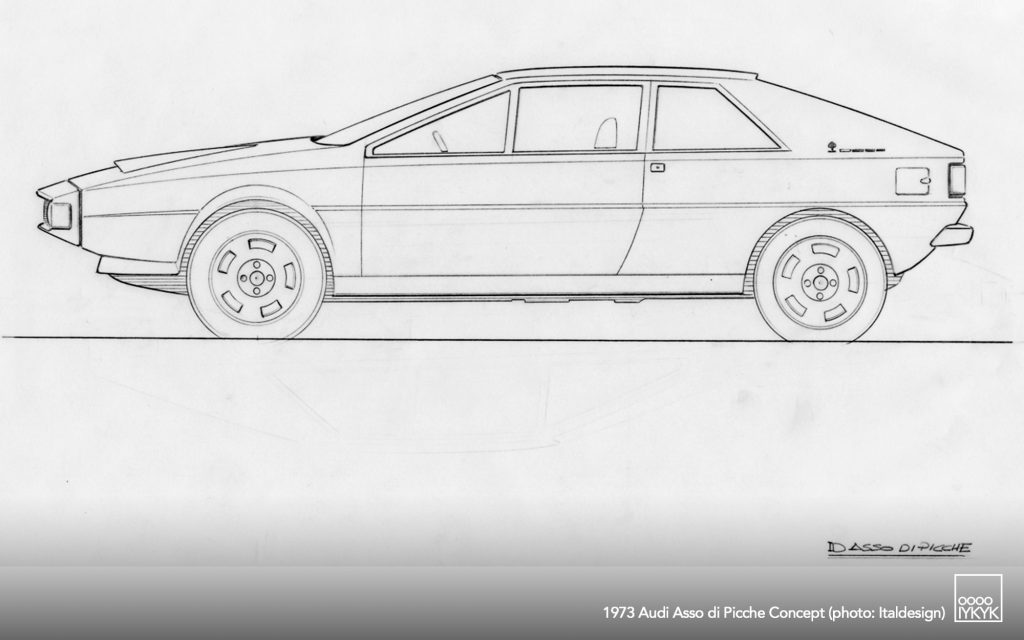
EXTERIOR DESIGN
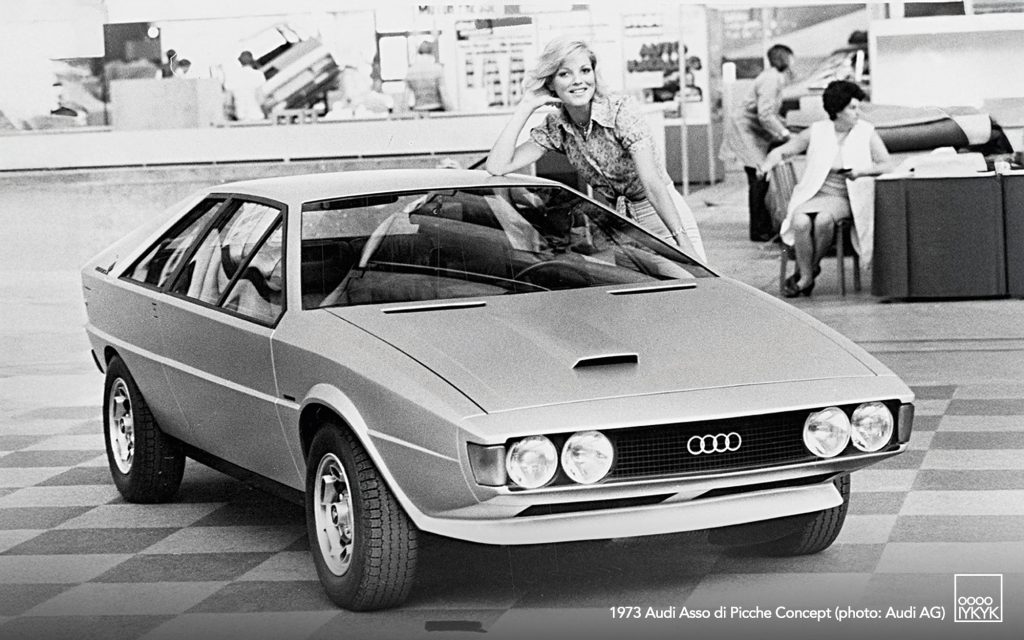
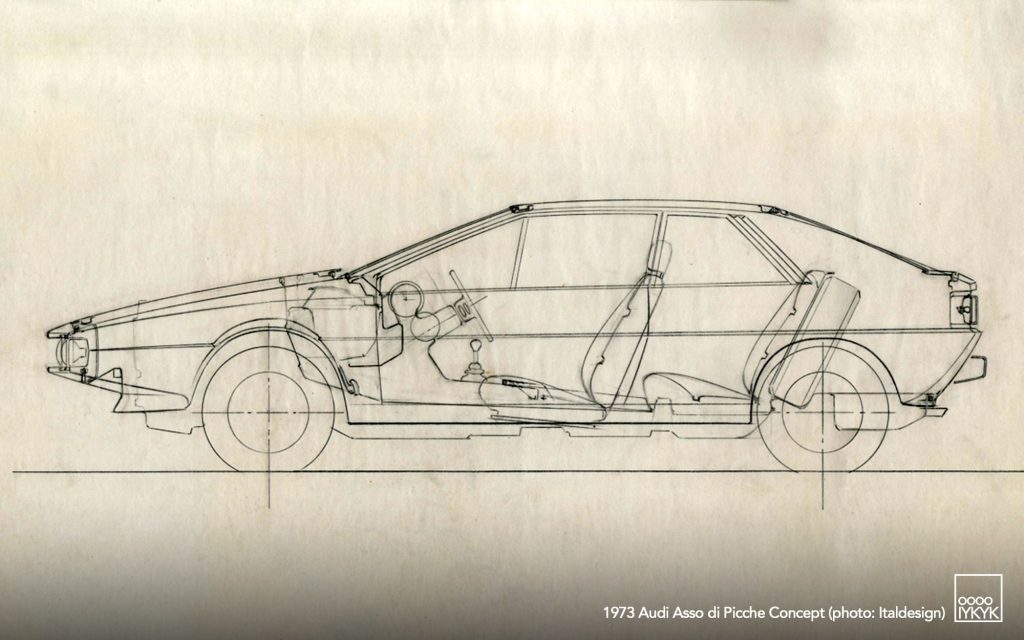
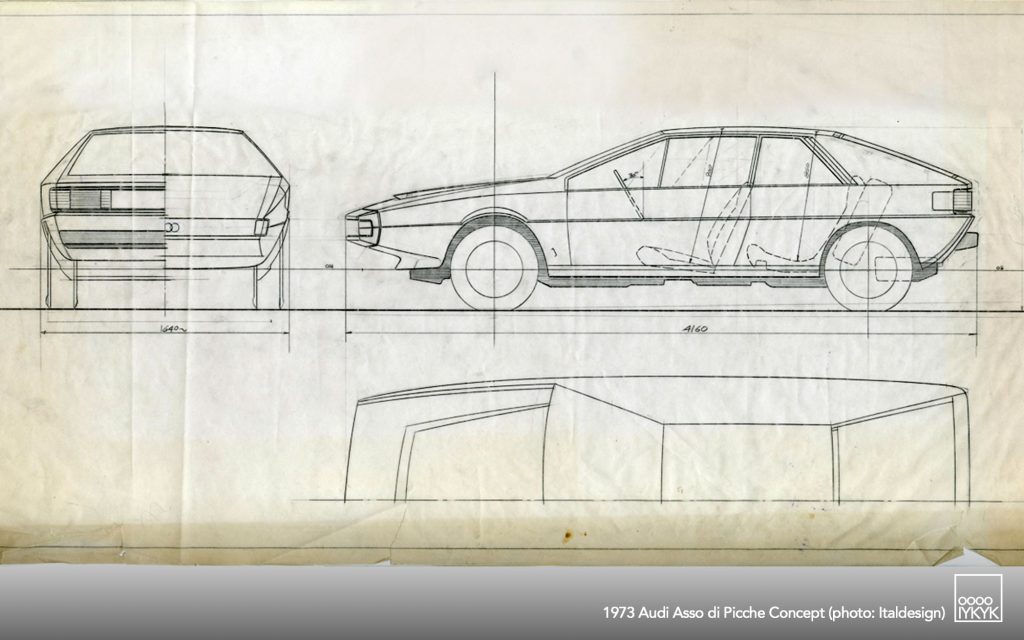
The exterior of the Asso di Picche is characterized by:
- A sharply raked windshield closely aligned with the angle of the hood
- A long, flat front section terminating in an integrated, body-colored bumper
- Quad round headlamps housed within a horizontal front fascia
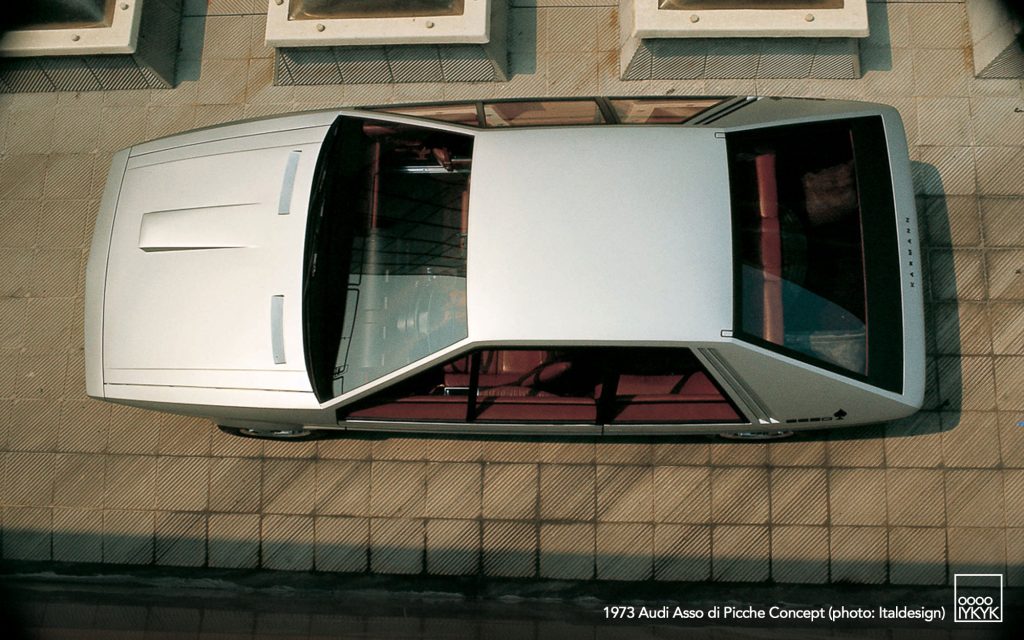
- A delta-shaped C-pillar and fastback roofline
- Pronounced wheel arch flares and a subtle front ducktail spoiler
The hood featured a prominent longitudinal air intake offset to one side, while the four-ring Audi emblem appeared in a flat, minimalist form within the front grille. Side glazing was bonded flush from the inside, reducing drag and contributing to the car’s clean surfaces. Despite the opposing rake of the doors and windows, fully functional roll-down side windows were incorporated, using a patented mechanism developed by Italdesign.
The rear bumper, unlike the front, was more conventional and not fully integrated into the bodywork.
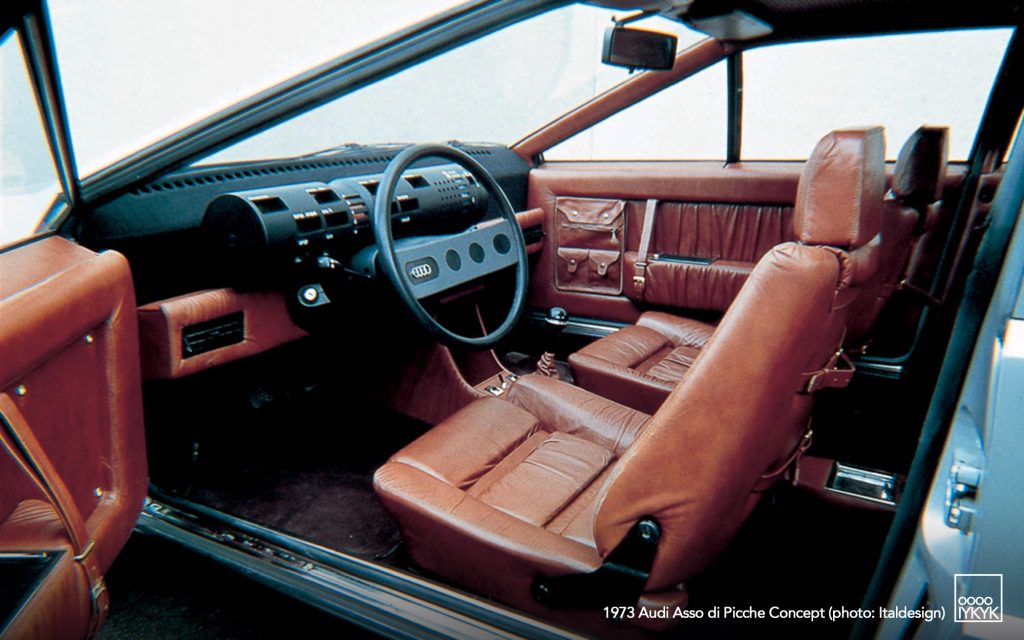
INTERIOR
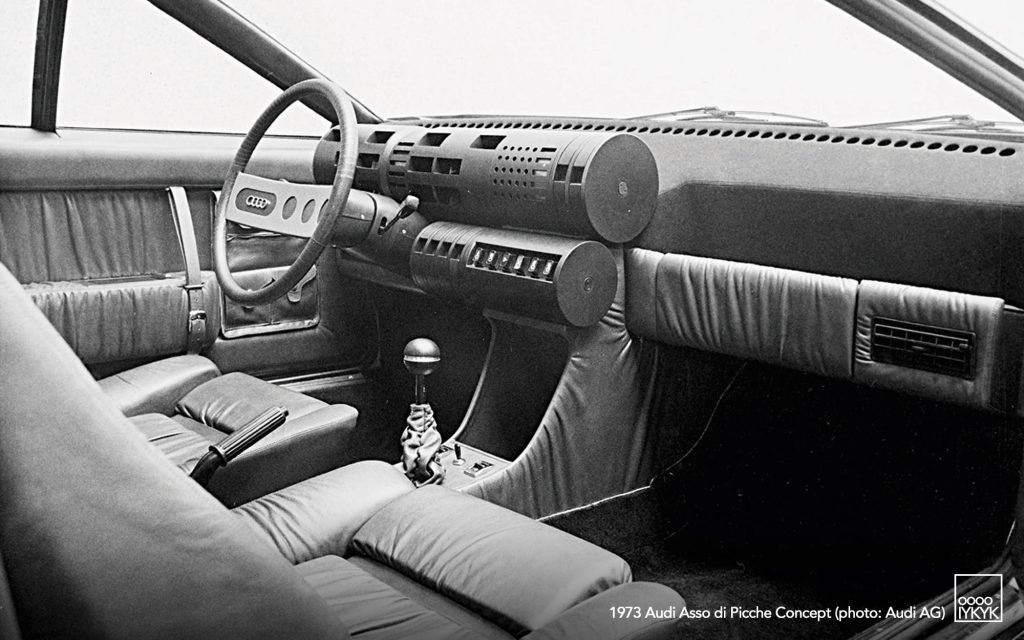
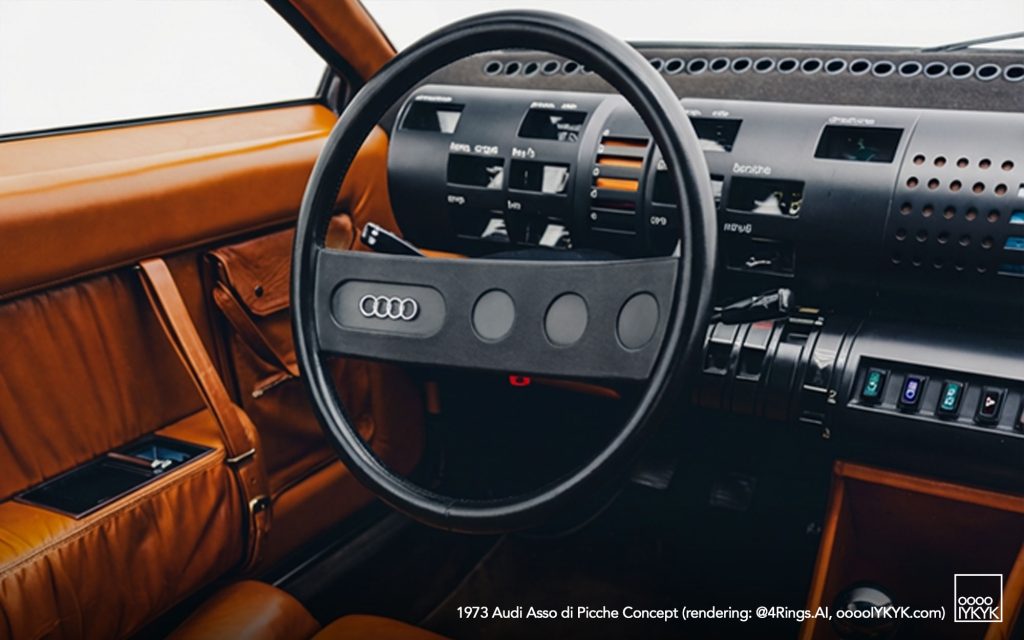
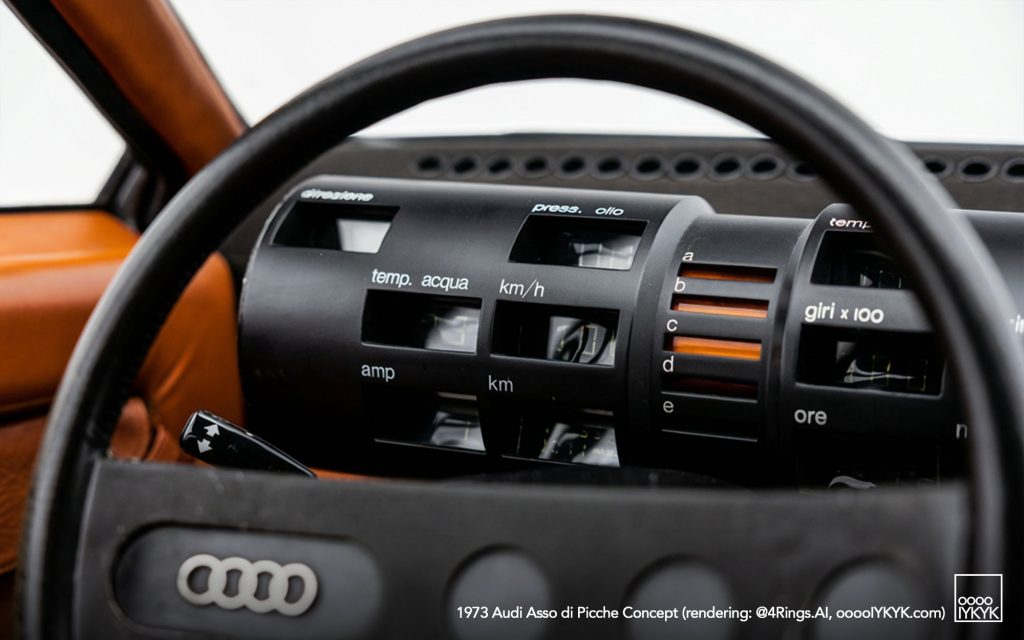
The interior of the Asso di Picche reflected the same experimental ethos as the exterior. The instrument panel was designed as a cylindrical module, housing recessed gauges and controls and offering an unconventional alternative to traditional dashboard layouts. This approach echoed earlier Giugiaro concepts, such as the Alfa Romeo Iguana.
Interior materials included leather-trimmed seating and door panels, integrated storage elements, and patterned textiles. A distinctive single-spoke steering wheel with circular design motifs reinforced the concept’s avant-garde character.
INFLUENCE & LEGACY
Although never approved for production, the Asso di Picche proved highly influential. Its geometric surfacing, wedge profile, and integrated bumper treatment anticipated design themes that would later appear across multiple Giugiaro-penned production vehicles.
The concept is frequently cited as a stylistic precursor to the Lancia Delta, introduced in 1979, particularly in its surface treatment and cross-sectional form. The Delta also became the first production car to feature body-colored integrated bumpers as standard.
Broader echoes of the Asso di Picche’s design philosophy can be seen in later Giugiaro works such as the DeLorean DMC-12 and, decades later, in retro-futuristic concepts like the Hyundai N Vision 74.
While Audi did not pursue the concept directly, its exploration of sharp, architectural forms aligned with the brand’s gradual transition toward a more design-led identity during the late 1970s and 1980s. This is seen most closely in the AO Coupé concept Audi began considering in 1973 for basis on the same platform as the Audi 50.
LATER HISTORY
Karmann would go on to secure major production contracts within the Volkswagen Group, including assembly of the Volkswagen Scirocco and Golf Cabriolet, as well as later Audi Cabriolet models. Italdesign continued its long relationship with the Group, eventually becoming part of Audi AG in 2010.
The Asso di Picche concept is preserved and displayed in Germany, where it survives as a rare example of an independently initiated Audi-branded design study from a formative period in the brand’s post-war history.
PHOTO GALLERY