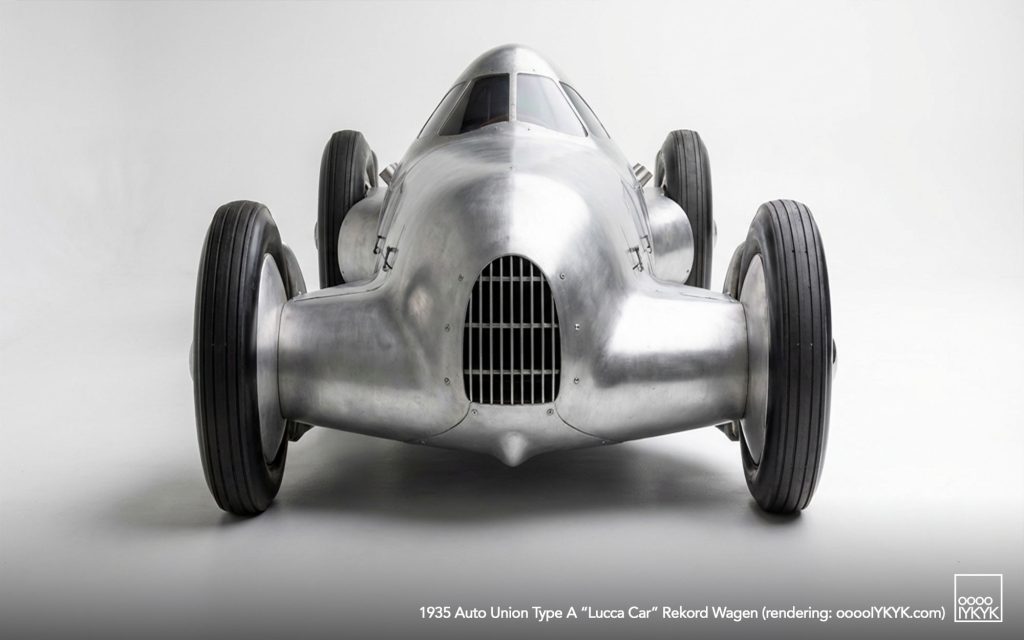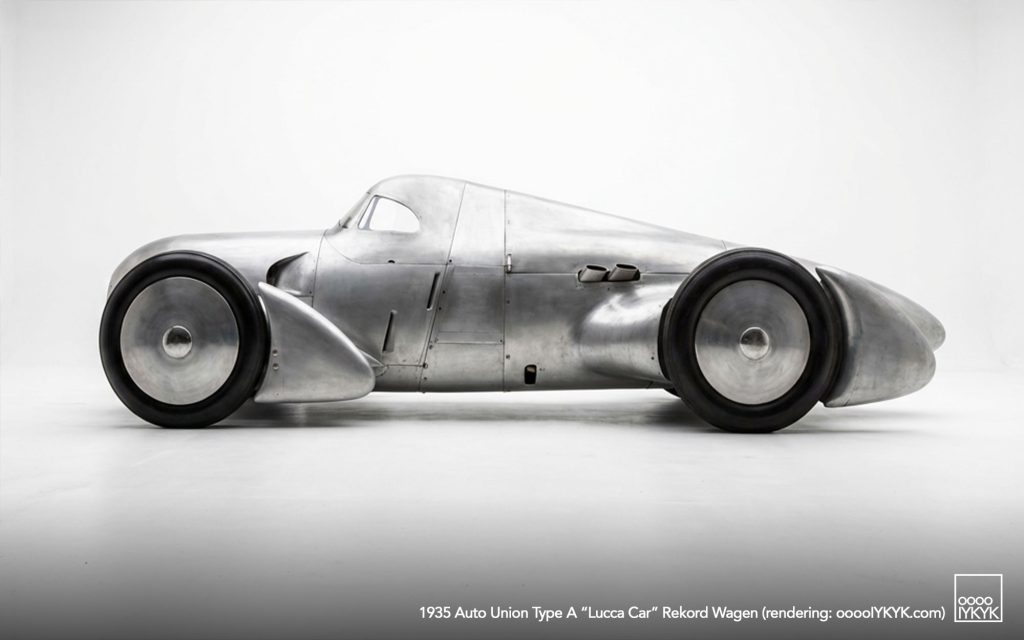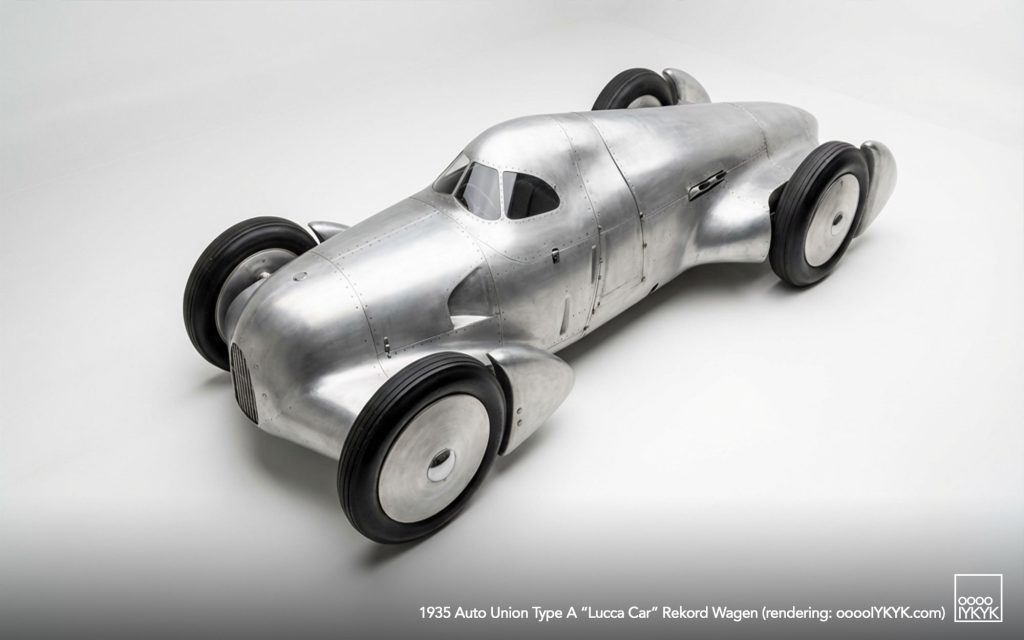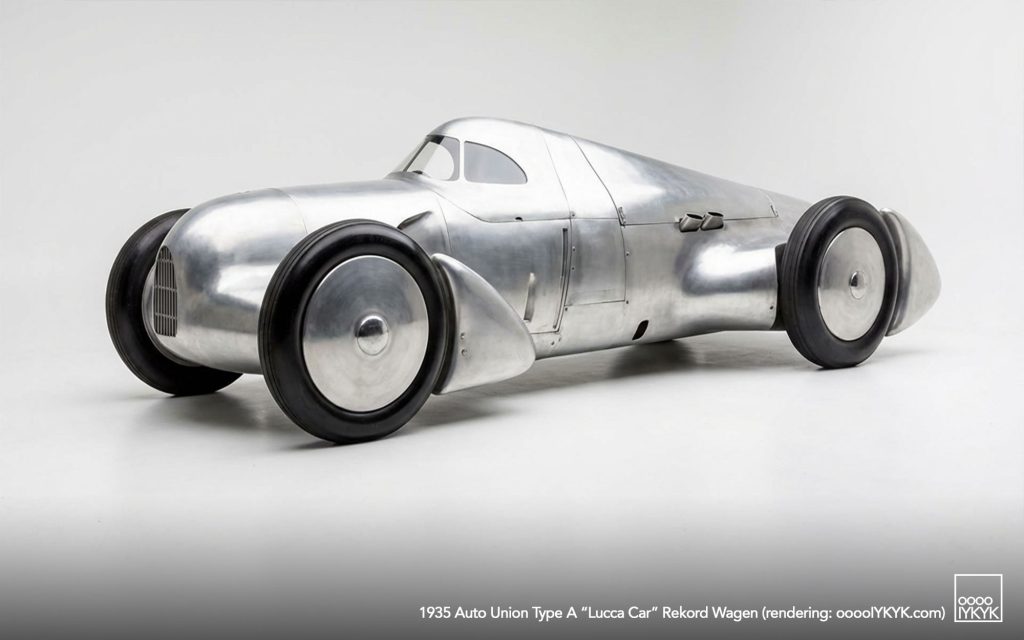

What: Auto Union Type A Rekordwagen, a.k.a. “Lucca Car”
Era: Auto Union Silver Arrow Grand Prix Cars
Manufacturer: Auto Union AG (Chemnitz, Germany)
Model Family: Auto Union Type A
Year: 1934, 1935
Era: Auto Union prewar
Production: Experimental record vehicle
Number Produced: 1 (plus exhibition replica)
Debuted: December 17, 1934 – AVUS test presentation
Record Event: February 15, 1935 – Autostrada near Lucca, Italy
Class: Land speed record racing car
Designer: Ferdinand Porsche (P-Wagen design lineage)
Body style: Fully enclosed aerodynamic “Racing Limousine” record car
Layout: Mid-engine, rear-wheel drive
Engine: 4,951 cc V16 supercharged
Displacement: Approximately 5.0 liters
Power output: 343 PS at 4,700 rpm
Transmission: 5-speed manual
Top speed: 326.975 km/h (203.2 mph)
Record Speed: 320.267 km/h average over the flying-start mile
TECHNICAL DETAILS
Chassis: Auto Union Type A-derived Grand Prix chassis
Suspension: 1934 Auto Union Grand Prix specification
Engine Position: Mid-mounted behind the driver and ahead of the rear axle
Body Construction: Streamlined light-metal bodywork
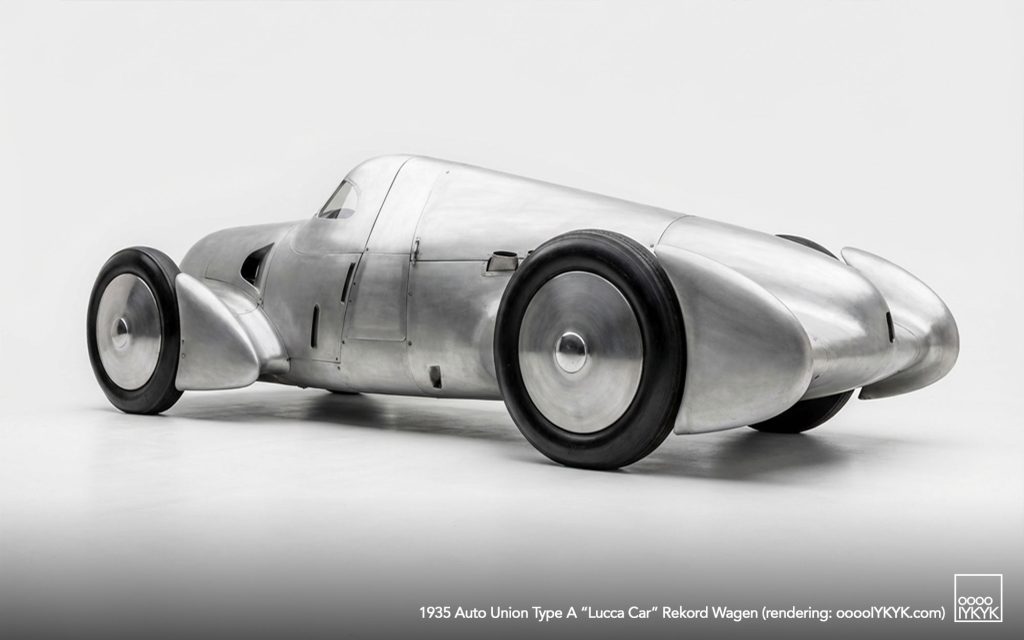
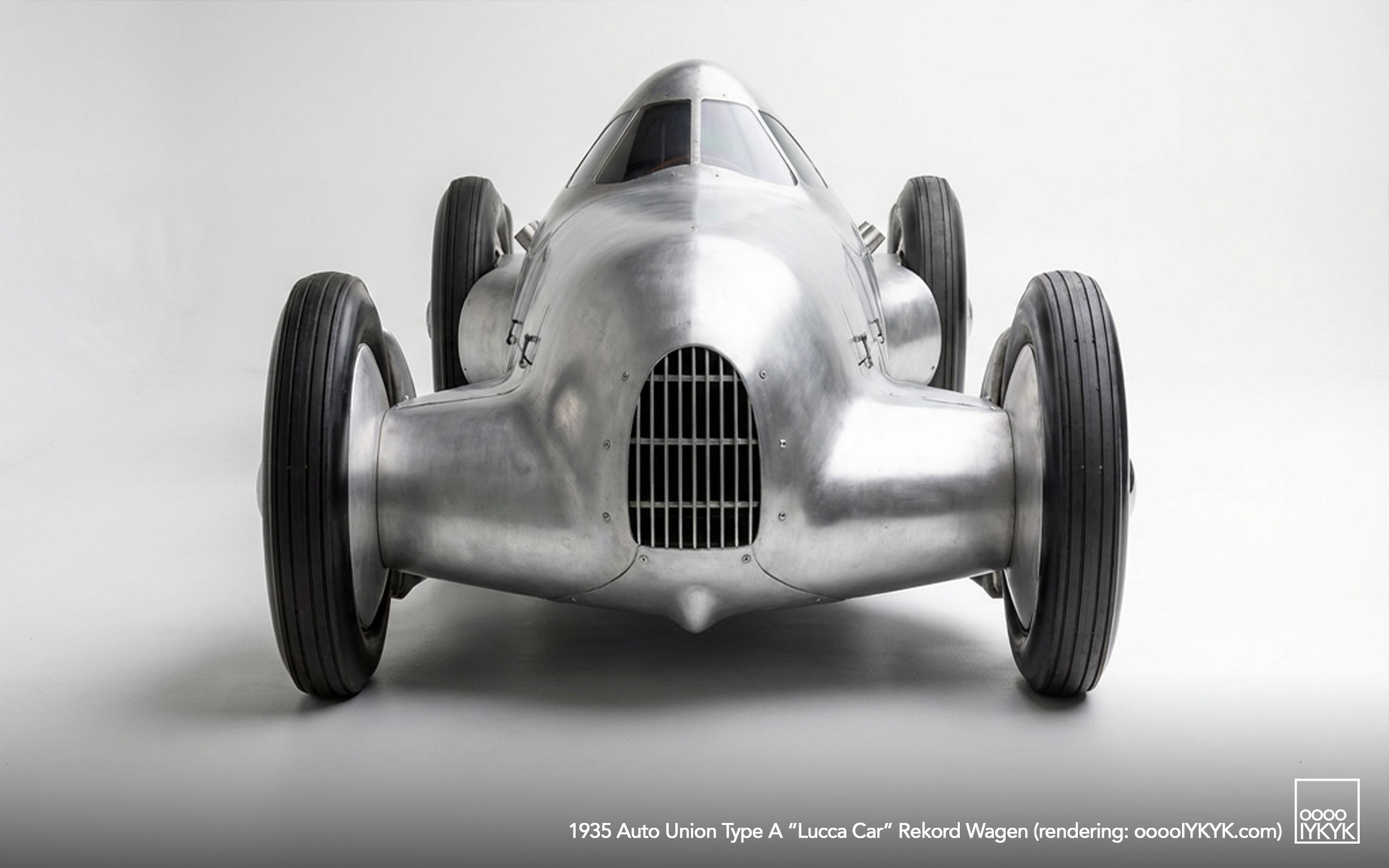
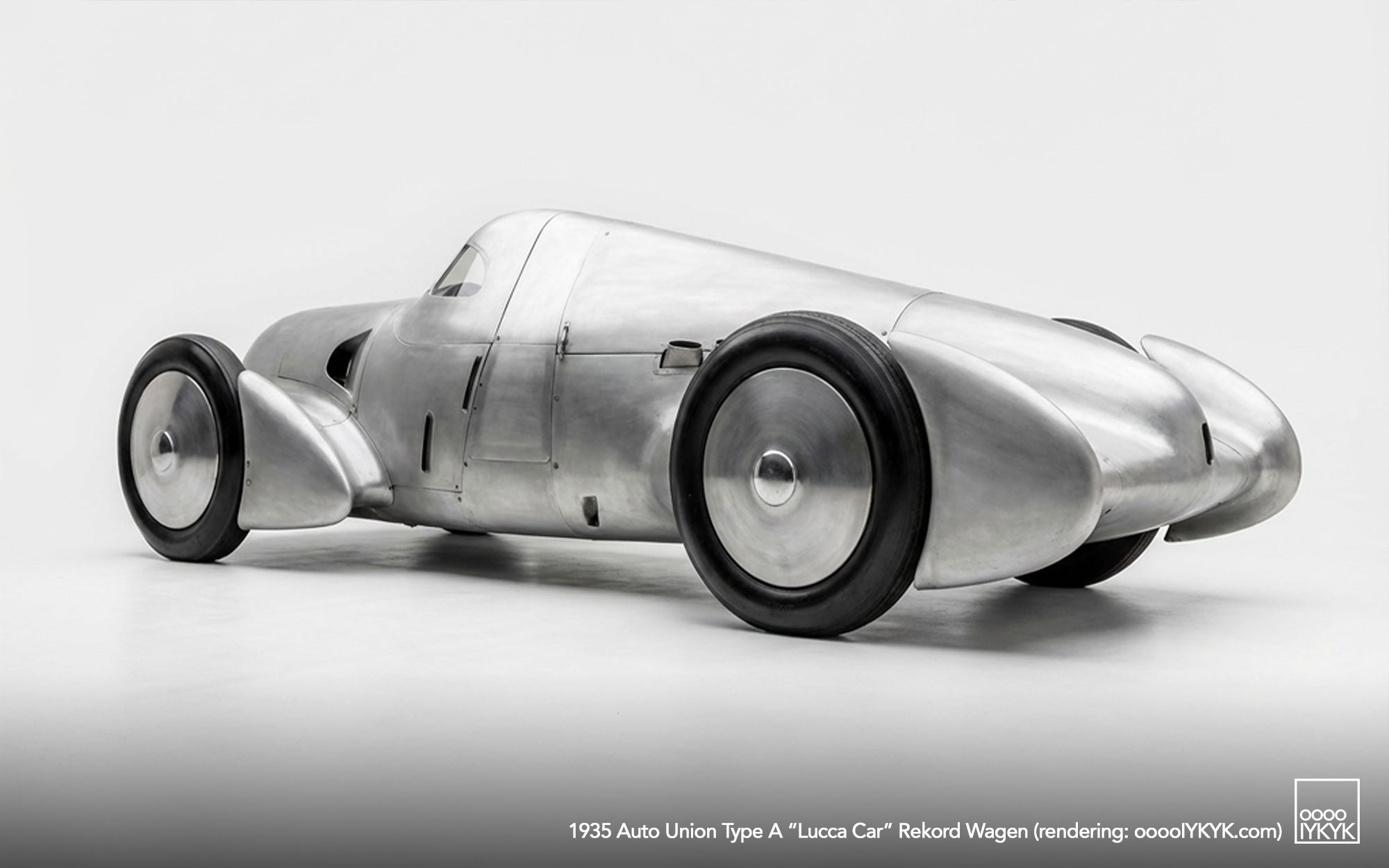
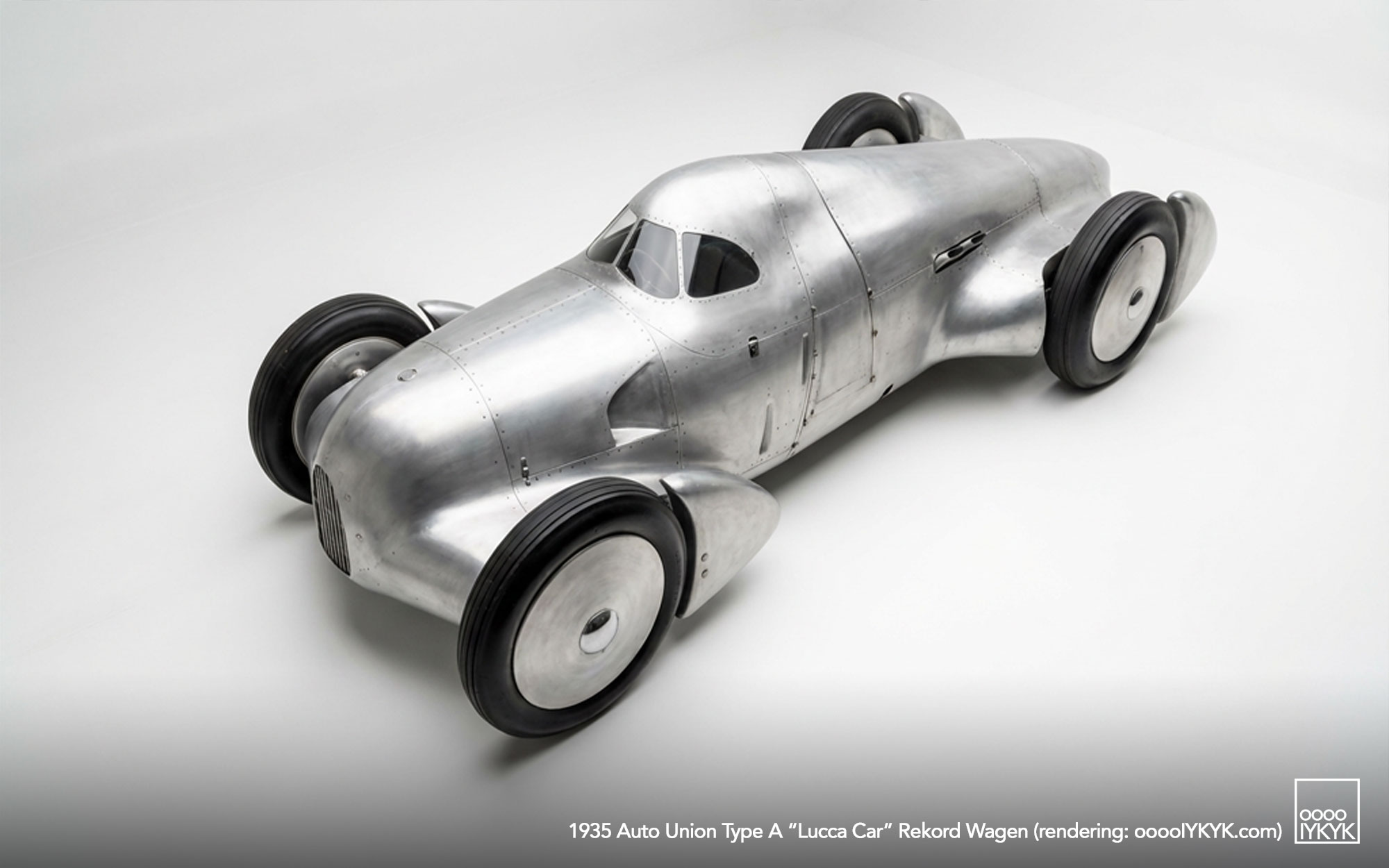
Aerodynamics: Fully enclosed cockpit, covered wheels, enclosed rear bodywork, tapered tail and faired wheel arches
Air Intakes: Circular rear body openings for carburetor intake air
Exhaust Layout: Upward-routed grouped exhaust outlets on each side of the body
Record Location: Florence-Viareggio autostrada between Pescia and Altopascio near Lucca, Italy
RELATED
Grand Prix Cars: Auto Union Type A (1934), Auto Union Type B (1935)
Record Cars: Auto Union Stromlinienwagen AVUS streamliner
Drivers: Hans Stuck
OVERVIEW
The Auto Union Type A Lucca Car, also known as the Auto Union Rekord Wagen or Rennlimousine, was one of the earliest streamlined record cars built by Auto Union during the Silver Arrow era. Developed during the winter of 1934-1935, it was created to reclaim speed-record supremacy from Mercedes-Benz and to demonstrate the technical potential of Auto Union’s revolutionary mid-engine Grand Prix architecture.
Although commonly associated with the Auto Union Type A, the Lucca car was not simply a Type A Grand Prix car with a streamlined body. It was a transitional engineering machine that combined the chassis and suspension of the 1934 Type A with aerodynamic development work carried out for record attempts and an early enlarged V16 engine that previewed the 1935 Type B program. As such, it occupied an important position between the debut Auto Union Grand Prix car of 1934 and the faster, more powerful cars that followed.
BACKGROUND
Auto Union entered Grand Prix racing in 1934 under the new 750-kilogram formula with the Type A. Developed from Ferdinand Porsche’s P-Wagen concept, the car was radically different from front-engined rivals. Its supercharged V16 sat behind the driver and ahead of the rear axle, giving Auto Union a layout that was unusual in the 1930s but would later become foundational to modern racing car design.
The Type A was difficult, powerful and spectacular. It also provided Auto Union with an ideal platform for record attempts. During 1934, Hans Stuck established multiple records for Auto Union, including three world records in March and five more in October. These achievements created substantial publicity for the new company, which had only been formed in 1932 through the merger of Audi, DKW, Horch and Wanderer.
Mercedes-Benz responded. Rudolf Caracciola set several records near Gyón, Hungary, including an average speed of 316.592 km/h over a flying-start mile. That benchmark became the target for Auto Union’s next development program. The competition was not merely sporting. During the 1930s, Grand Prix victories and speed records were treated as national technical achievements, and Auto Union’s four rings were now competing directly with the Mercedes star for prestige.
DEVELOPMENT
Auto Union’s response was to pursue aerodynamic efficiency rather than relying only on additional power. The record car was developed from the vehicle used during Auto Union’s October 1934 record attempts, but the bodywork was completely rethought.
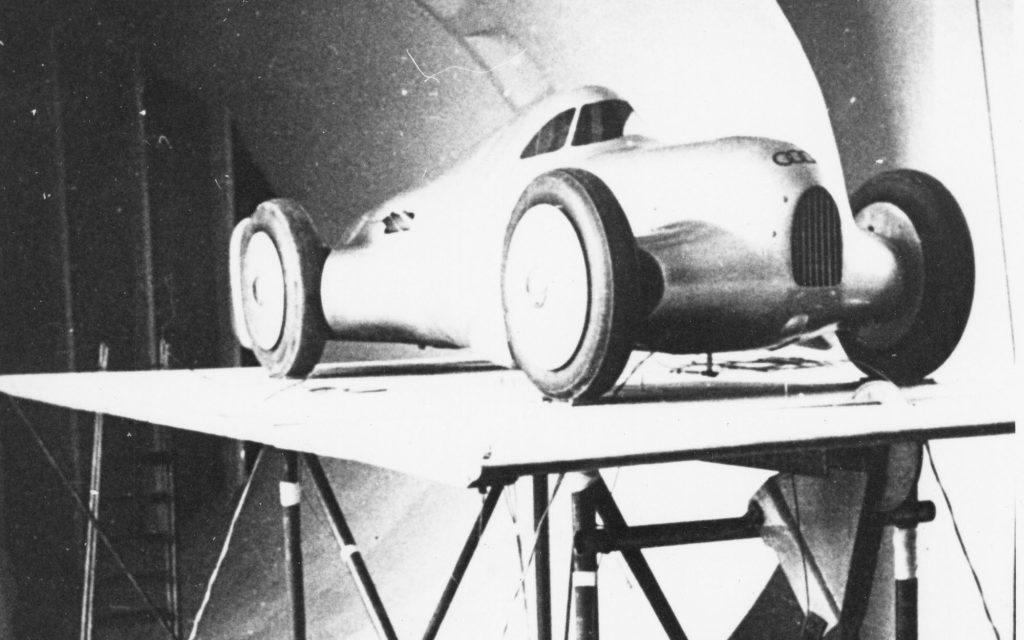
Engineers first created a wind-tunnel model and tested it at the Berlin-Adlershof Aeronautical Research Institute. Both open and closed configurations were studied before Auto Union settled on a fully enclosed form. Contemporary reports noted the significance of this process, as the use of wind-tunnel findings in the design of a racing car was still unusual in European motorsport.
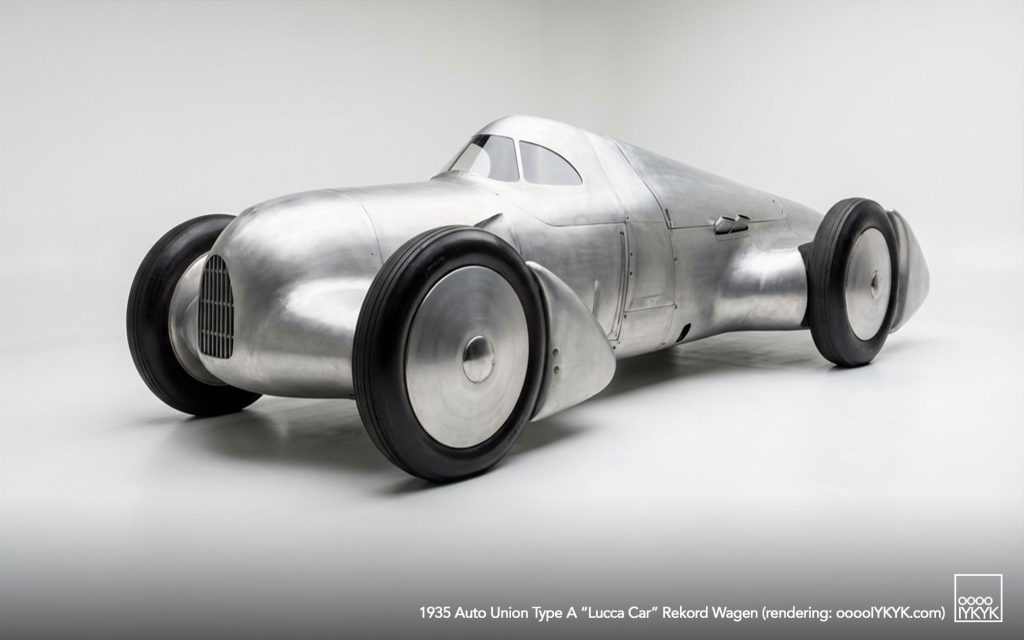
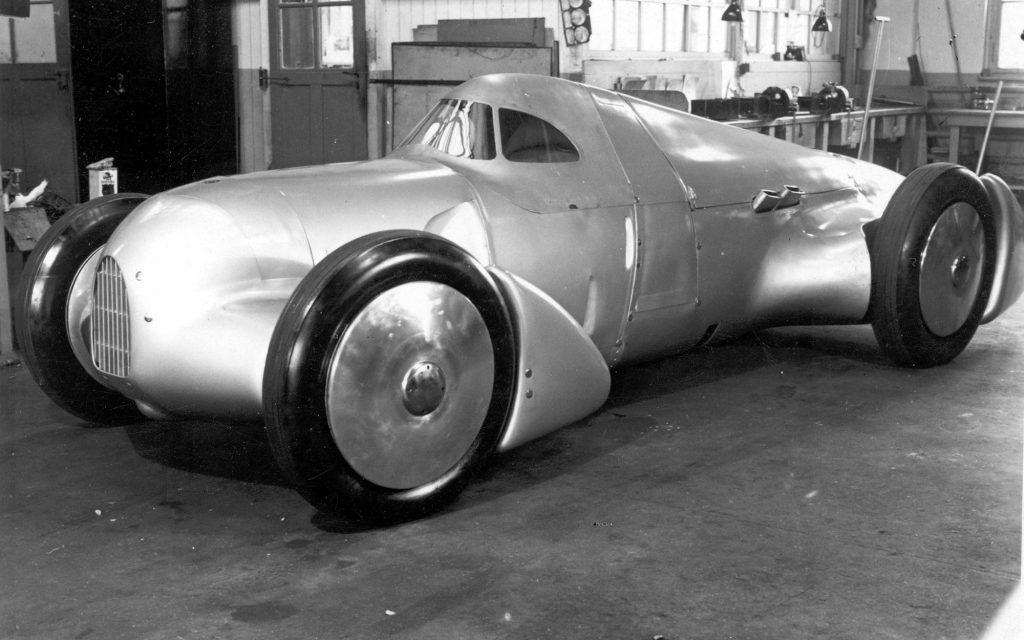
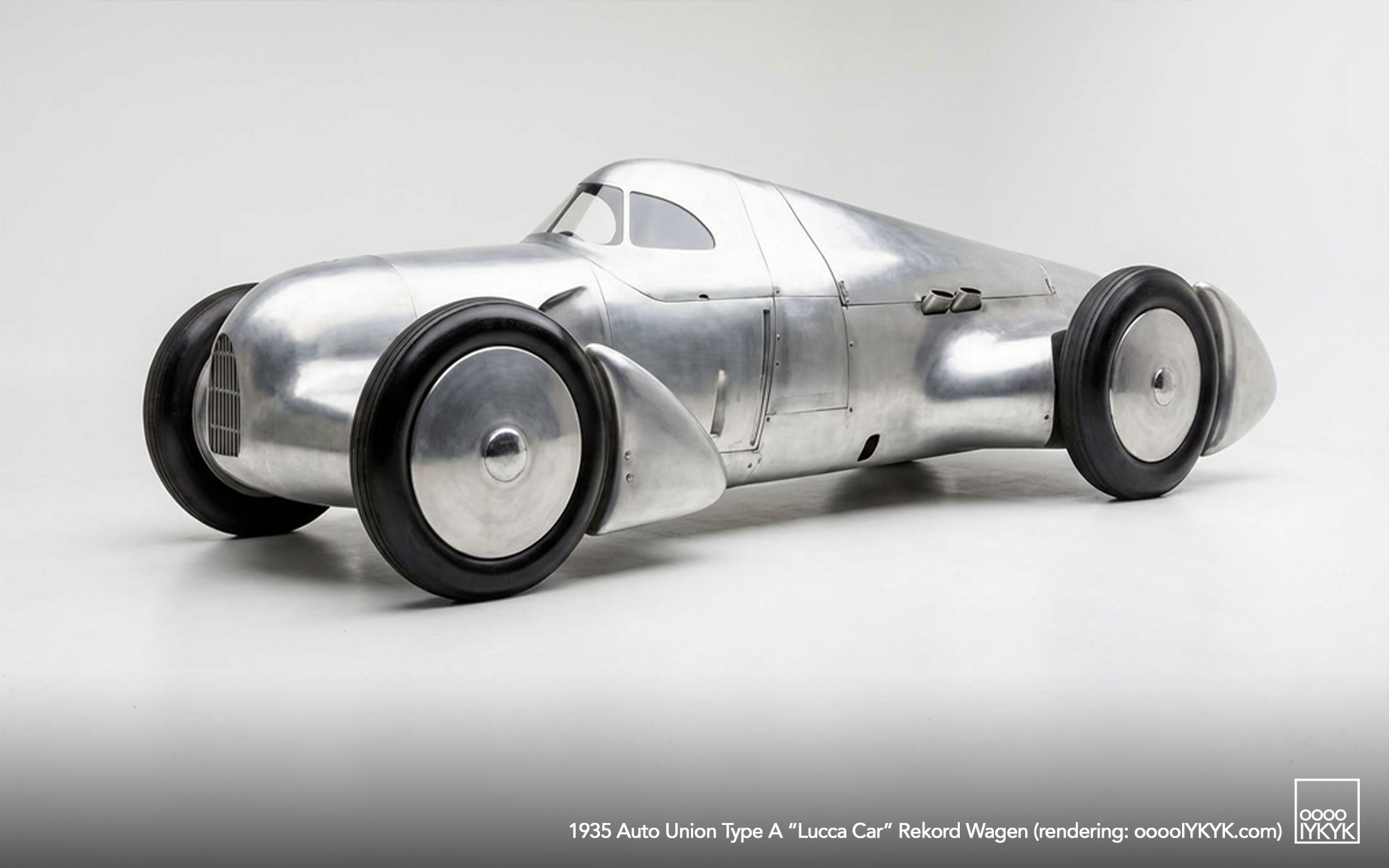
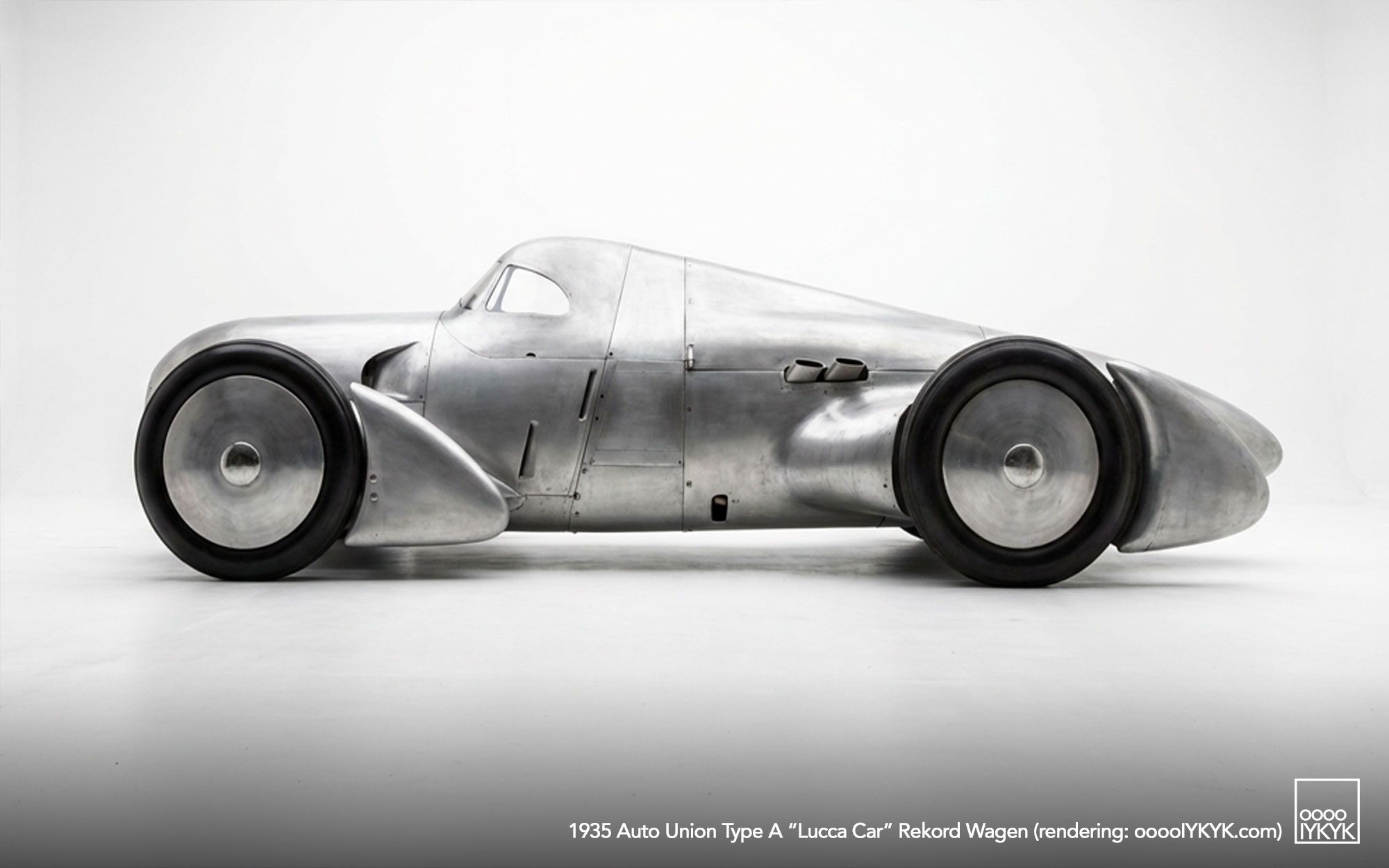
The finished car was dramatically different from the exposed-wheel Grand Prix machines from which it evolved. The wheels were covered with smooth discs and enclosed by teardrop-shaped bodywork. The cockpit was covered by a canopy. The rear bodywork extended into a long, tapered tail, giving the car a fin-like silhouette. The body was finely sanded and coated with clear lacquer, while two circular openings at the rear fed fresh air to the carburetors. The exhaust pipes were routed upward and grouped into two outlets on each side.
Mechanically, the car remained close to Auto Union’s 1934 Grand Prix architecture. The chassis and suspension were largely carried over from the Type A, but the engine was an early version of the enlarged 1935 V16. Displacement was increased to approximately five liters, though output was still around 343 PS rather than the 375 PS reached later in the 1935 season.
The result was neither a normal Grand Prix car nor a pure showpiece. It was a functional record-attempt machine, built quickly and with a specific purpose: surpass Mercedes-Benz and prove Auto Union’s technical authority.
The car was first presented publicly on December 17, 1934, during a demonstration at the AVUS track in Berlin, where Auto Union racing director Willy Walb conducted initial test drives to evaluate the vehicle’s behavior at speed.
ENGINE AND CHASSIS
Mechanically, the Lucca record car remained closely related to the Type A Grand Prix racer. The vehicle retained the innovative mid-mounted V16 engine, a configuration that placed the powerplant behind the driver but ahead of the rear axle, an arrangement designed to improve weight distribution and traction.
The supercharged 4,951 cc V16 engine produced approximately 343 horsepower at 4,700 rpm, delivering enormous power for the era. As with the Grand Prix car, the five-speed transmission was mounted behind the rear pendulum axle, which was guided and sprung by a transverse leaf spring.
Despite the added aerodynamic bodywork, the car maintained a curb weight of just over one metric ton including the driver, enabling extremely high speeds on long straight road sections.
PRE-LUCCA TESTING
The record car was completed by Auto Union’s racing department in Zwickau by December 1934. It was test-driven at Berlin’s AVUS circuit on December 17, 1934, giving Auto Union its first opportunity to evaluate the fully streamlined body at speed.
The original plan was to return to Hungary and challenge Caracciola’s records on the same roads near Gyón. Auto Union made arrangements with the Royal Hungarian Automobile Club and transported the car to Budapest, where it arrived on February 4, 1935. The following day, the team traveled to the road section approximately 40 kilometers south of the city.
Conditions quickly turned against the attempt. The weather deteriorated and, during the second test run, an exhaust pipe burned through. The Hungarian attempt was abandoned.
Auto Union then moved south toward Italy. A route south of Milan was considered, but snow made it unsuitable. The team continued further south until it found a usable section of the Florence-Viareggio autostrada between Pescia and Altopascio, near Lucca. The road was level, straight, approximately eight meters wide and offered around five kilometers of usable surface. It was nearly ideal for a flying-start record attempt.
LUCCA RECORD RUN
Testing near Lucca began on February 14, 1935. Auto Union experimented with several configurations, including changes to the radiator grille and wheel covers. Data was analyzed between runs, and the car was adjusted for the next day’s record attempt.
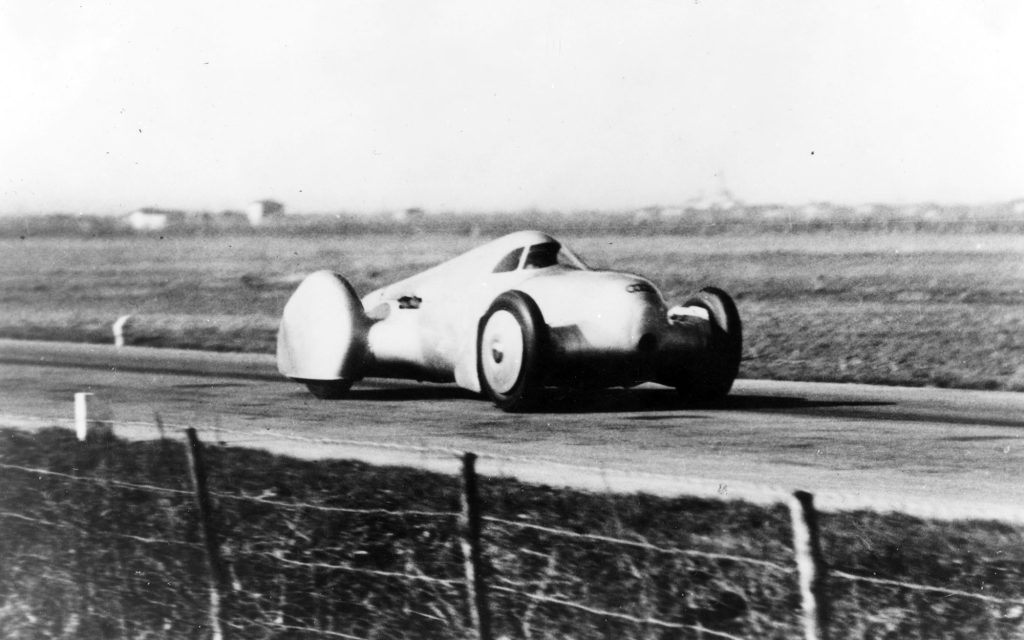
On February 15, 1935, Hans Stuck returned to the autostrada. For the successful attempt, the radiator grille was mostly covered, leaving only a small opening. This reduced drag for the short high-speed run, though it would not have been practical for longer-distance racing.
Over two averaged runs, Stuck established a flying-start mile record in International Class C at 320.267 km/h. During one measured section of the return run, timing equipment recorded 326.975 km/h. Auto Union promoted the car as the fastest road racing car in the world.
The Lucca record was more than a speed figure. It gave Auto Union a major publicity success at a moment when the company’s Grand Prix program was still young. It also demonstrated that the mid-engine Auto Union layout, combined with aerodynamic bodywork, could achieve speeds far beyond conventional racing conditions.
BERLIN MOTOR SHOW DISPLAY
At nearly the same time as the Lucca record attempt, Auto Union displayed a second, very similar streamlined car at the 1935 International Motor Show in Berlin. This car was not the Lucca record car itself, but a related Rennlimousine that differed most visibly through a larger radiator opening.
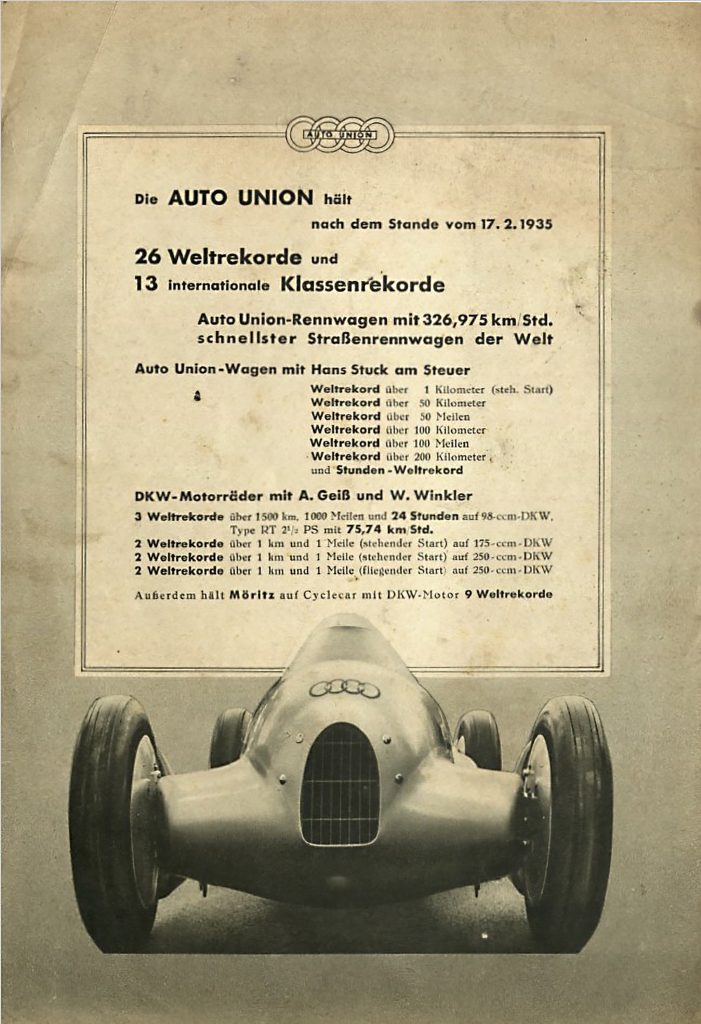
The timing was deliberate. While Stuck and the Auto Union team were pursuing records in Italy, the Berlin show car allowed Auto Union to present the streamlined concept to the public and emphasize the company’s technical achievement. Even before the record was officially recognized, Auto Union used the car and associated posters to promote the top speed of 326.975 km/h and the claim that it had created the fastest road racing car in the world.
The Berlin display reinforced the marketing role of the record program. The Lucca car was not only an engineering exercise; it was a public demonstration of what the young Auto Union company could do.
AVUS APPEARANCE
The Lucca story continued after the Italian record run. Auto Union brought both streamlined Rennlimousinen to the 1935 International Avus Race in Berlin on May 26. Because the AVUS event was not run under the 750-kilogram Grand Prix formula, Auto Union could enter the heavier streamliners alongside its conventional Grand Prix cars.
The former Lucca record car appeared with starting number 3 and was driven by Prince Hermann zu Leiningen. The second Rennlimousine, the car previously shown at the Berlin Motor Show and now carrying a larger radiator grille, was driven by Bernd Rosemeyer with starting number 4. It was Rosemeyer’s first circuit race for Auto Union.
The cars were fast, but the event exposed the difference between a short-duration record machine and a circuit racing car. Rosemeyer reached approximately 290 km/h in practice and started impressively, but a right rear tire failure ended his race early. Zu Leiningen also retired after the car suffered cooling-related problems. Neither Rennlimousine finished.
FATE OF THE ORIGINAL CARS
The original Lucca record car and its Berlin/AVUS counterpart are not known to survive. Their exact post-1935 fate is unclear, though they appear to have been treated as development machines rather than preserved historic artifacts.
This was typical of the era. Racing departments continually modified, repurposed and dismantled cars as newer designs appeared. The Lucca and AVUS streamliners had already served their purpose by providing publicity, record results and aerodynamic data. Their lessons fed into later Auto Union racing and record-attempt cars, but the original bodies and chassis were lost.
The disappearance of the cars is one reason the Lucca record machine remained a relatively obscure but important chapter in Auto Union history. It stood at the beginning of the company’s streamlining work and linked the Type A Grand Prix car to the later record cars and high-speed AVUS machines of the Silver Arrow era.
LEGACY
The Auto Union Lucca Car was one of the earliest examples of Auto Union applying aerodynamic science to high-speed racing machinery. It combined the radical mid-engine layout of the Type A with wind-tunnel-developed bodywork, covered wheels and a fully enclosed cockpit at a time when most Grand Prix cars still retained open wheels and upright bodywork.
Its importance lies not only in the 326.975 km/h speed recorded near Lucca, but in what it represented. The car showed that Auto Union’s engineering team could respond rapidly to Mercedes-Benz, develop highly specialized record machinery and use aerodynamic research as a competitive weapon. It also foreshadowed the later Auto Union streamliners that would define some of the most dramatic speed-record efforts of the 1930s.
PHOTO GALLERY (photos: Audi AG, renderings: ooooIYKYK.com)