
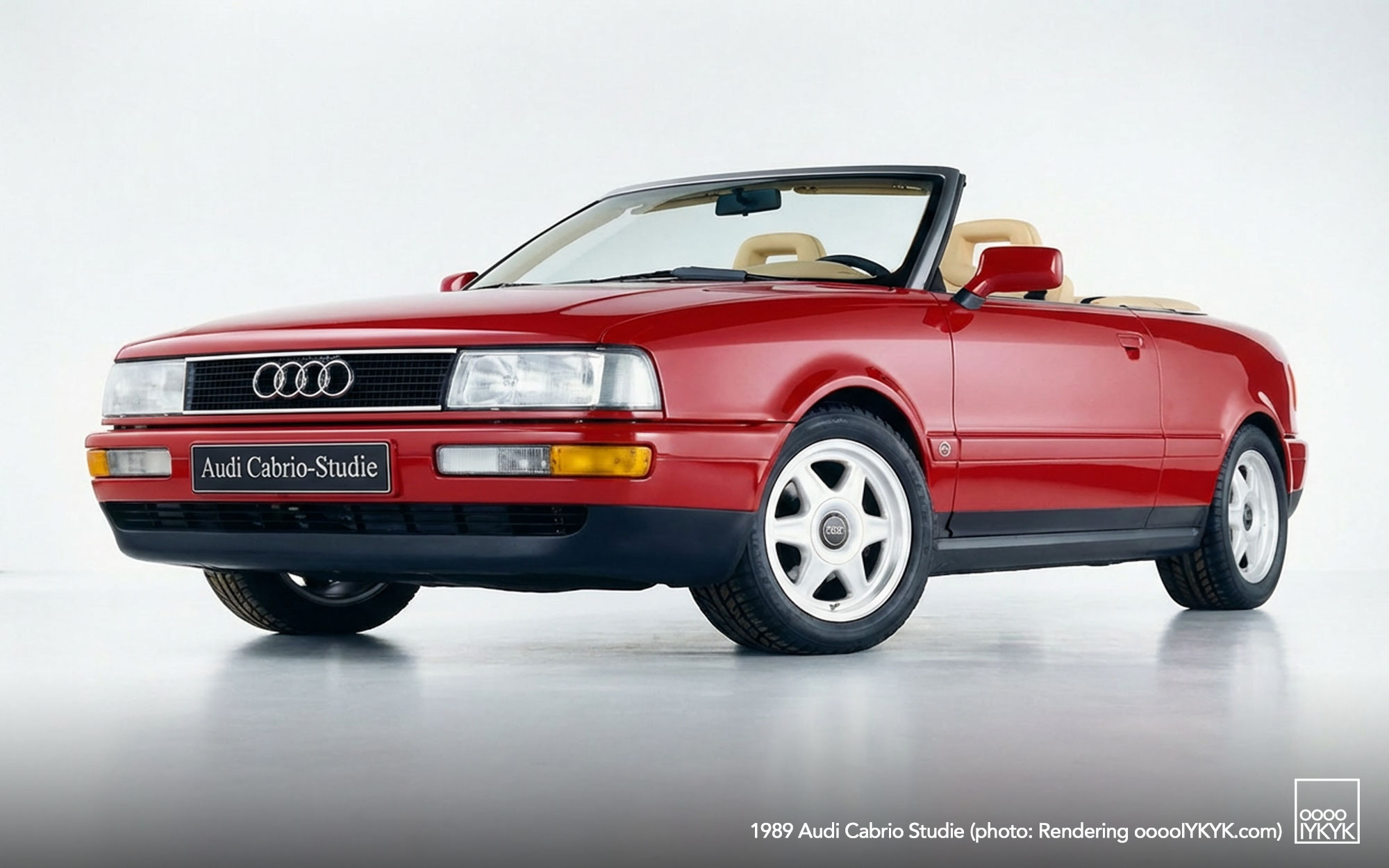

What: Audi Cabriolet Studie
Model Family: B3 (type 8G)
Debuted: 1989 Frankfurt IAA, Frankfurt, Germany, 1990 Geneva Motor Show
Year: 1989, 1990
Number Produced: 1
Model / Generation Code(s): type 8G
Chassis / Matrix: B3
Engine: 2.3-liter 5-cylinder, normally aspirated
Transmission: 5-speed manual
Power: 136 hp
Peak Torque:
Acceleration (0-100 km / 62 mph:
RELATED
Concept Cars:
Road Cars: Audi Cabriolet (type 8G)
Race Cars: none
SUMMARY
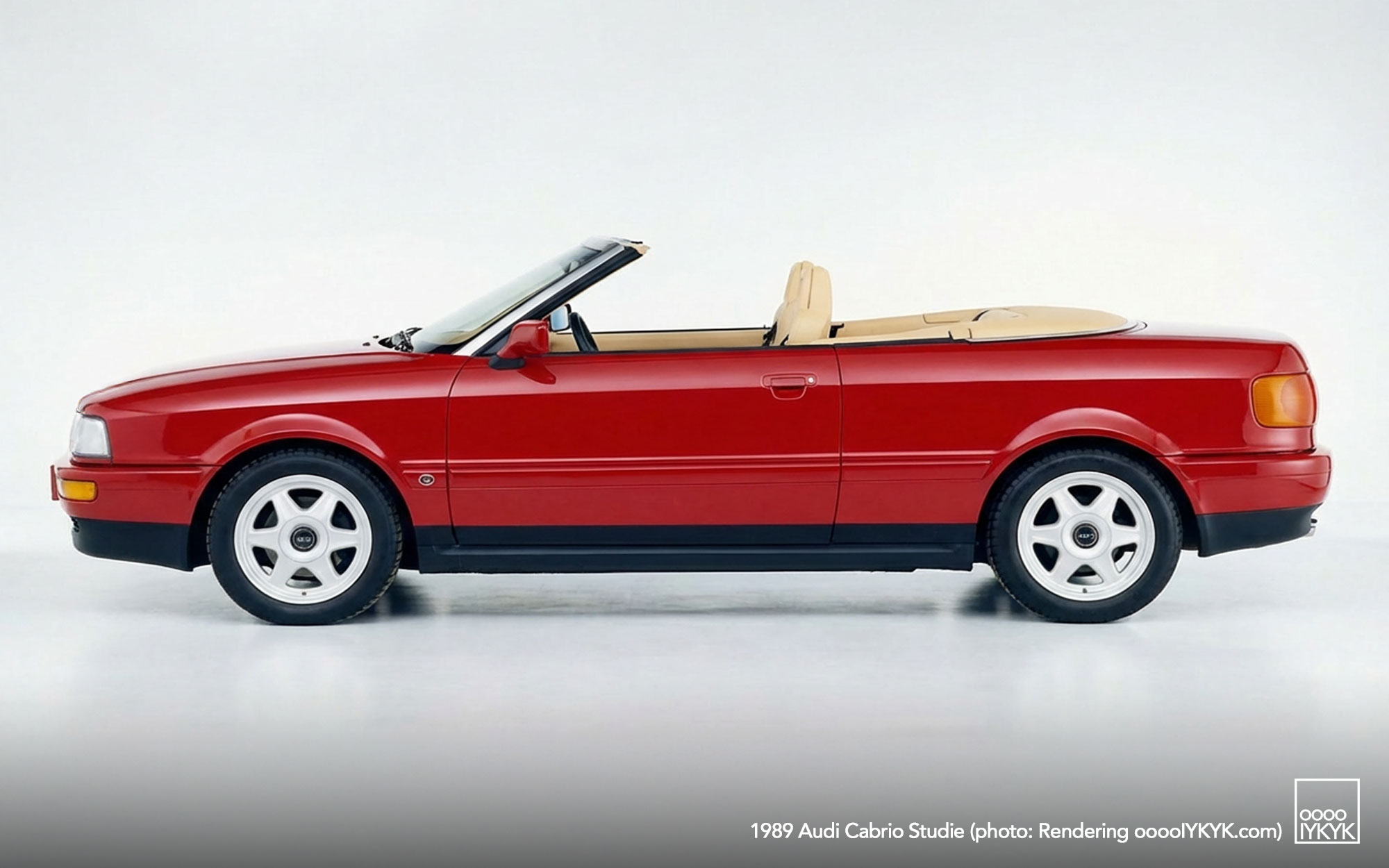
The 1989 Audi Cabriolet Design Study is a four-seat convertible concept car unveiled by Audi at the Frankfurt International Motor Show (IAA) in September 1989. Conceived as a forward-looking exploration of open-top motoring, it previewed the production Audi Cabriolet introduced in 1991 and represented an important milestone in the brand’s return to the convertible segment. Built on the technical foundation of the Audi Coupé (B3), the concept combined fresh design language, advanced safety innovations and broad mechanical compatibility, signaling both Audi’s creative direction and its intent to re-engage customers seeking refined yet sporting open-air vehicles.
BACKGROUND & DEVELOPMENT
Throughout the late 1980s, Audi was redefining its brand identity with a renewed focus on design, engineering excellence and emotional appeal. Although the company had a history of soft-top models in earlier decades, it had not offered a modern convertible for some time. Growing market interest in stylish four-seat convertibles prompted Audi to study the feasibility of a premium, design-led cabriolet. The resulting concept car was engineered on the platform of the newly introduced Audi Coupé, allowing the company to explore a standalone convertible rather than a simple roofless derivative of an existing sedan. The project placed emphasis on achieving structural rigidity, integrated safety systems and cohesive exterior design without compromising interior space or daily usability.
DESIGN & STYLING
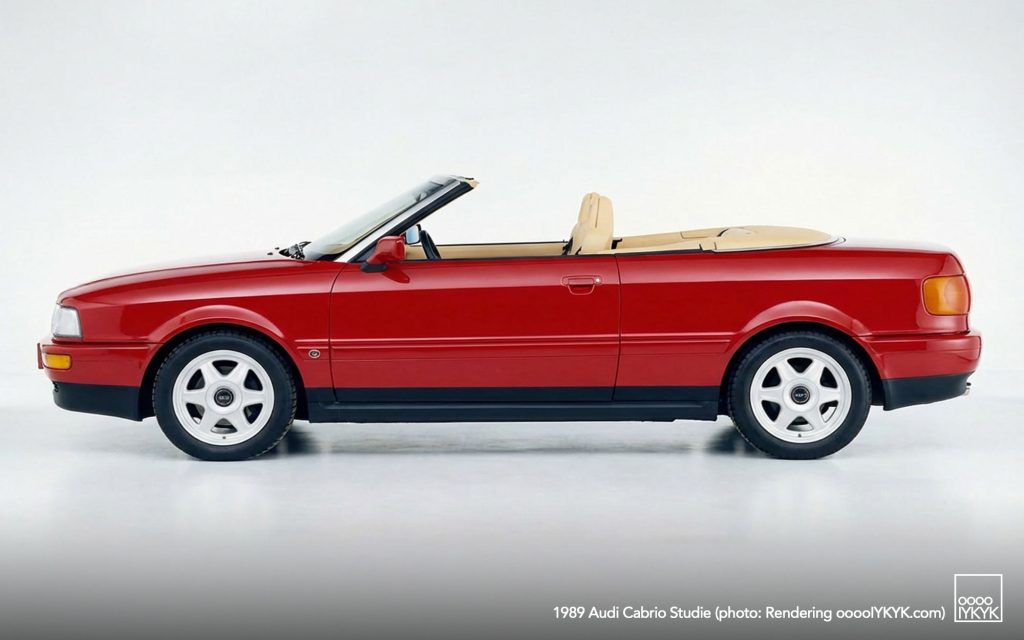
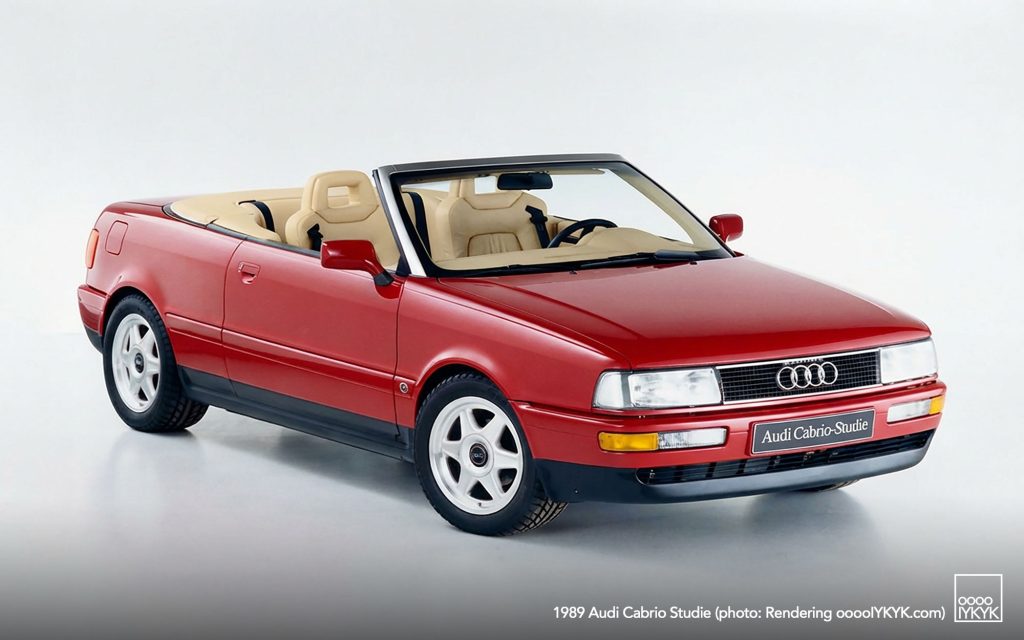
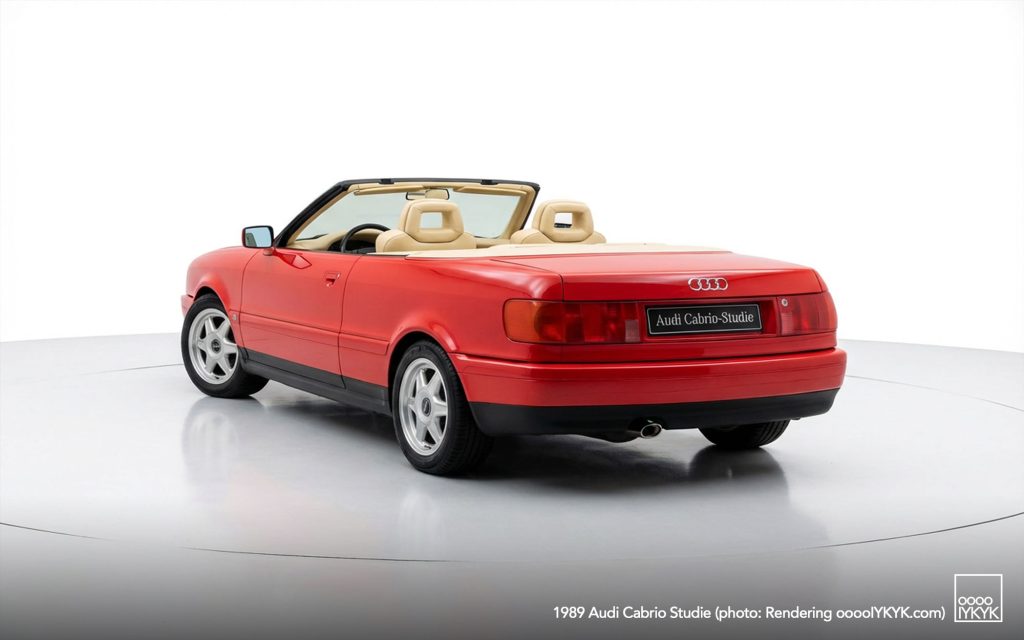
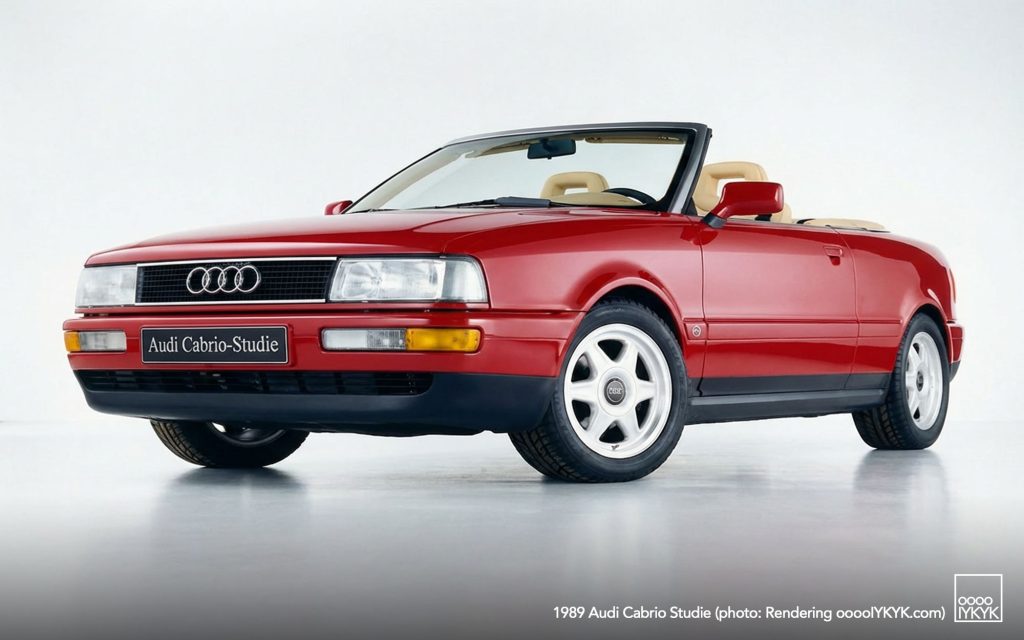
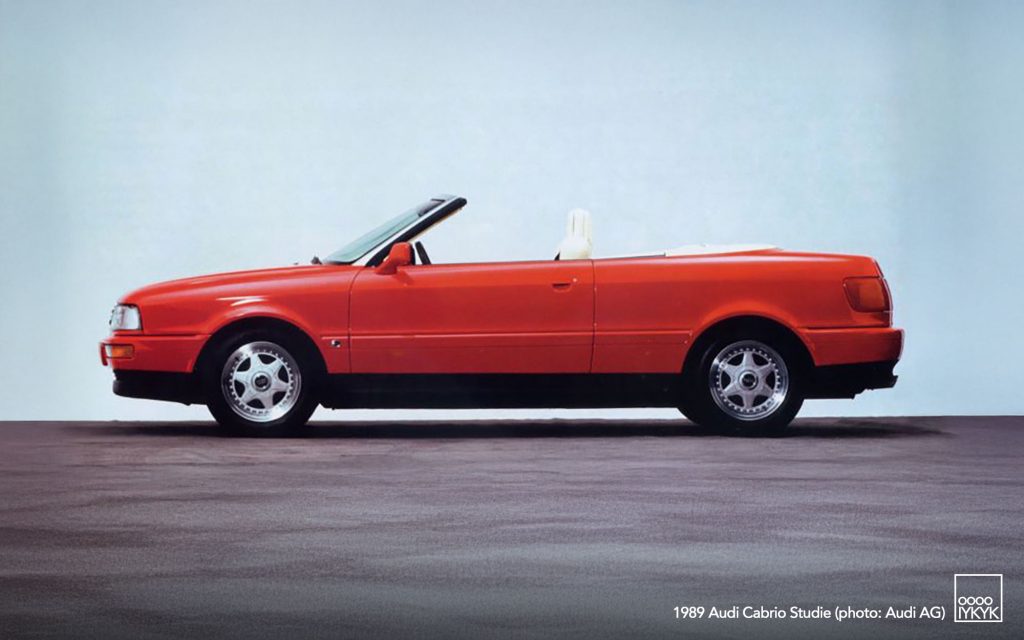
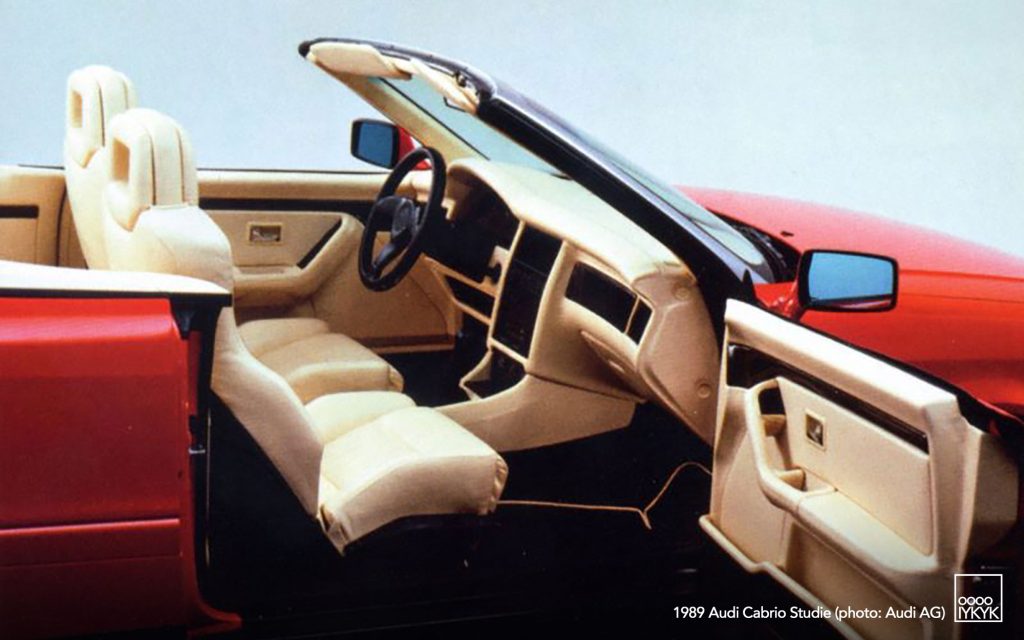
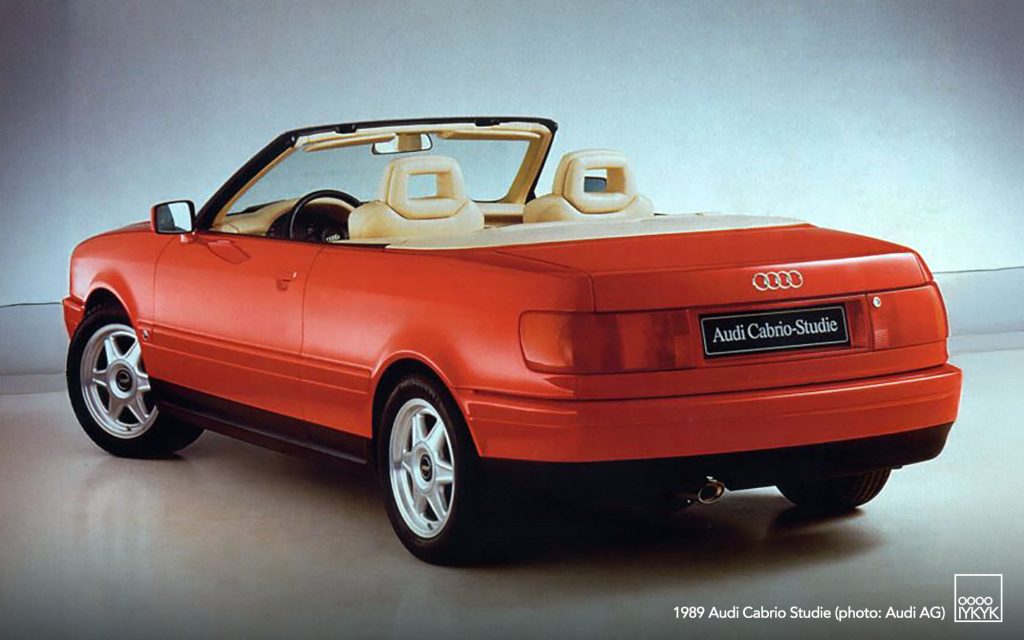
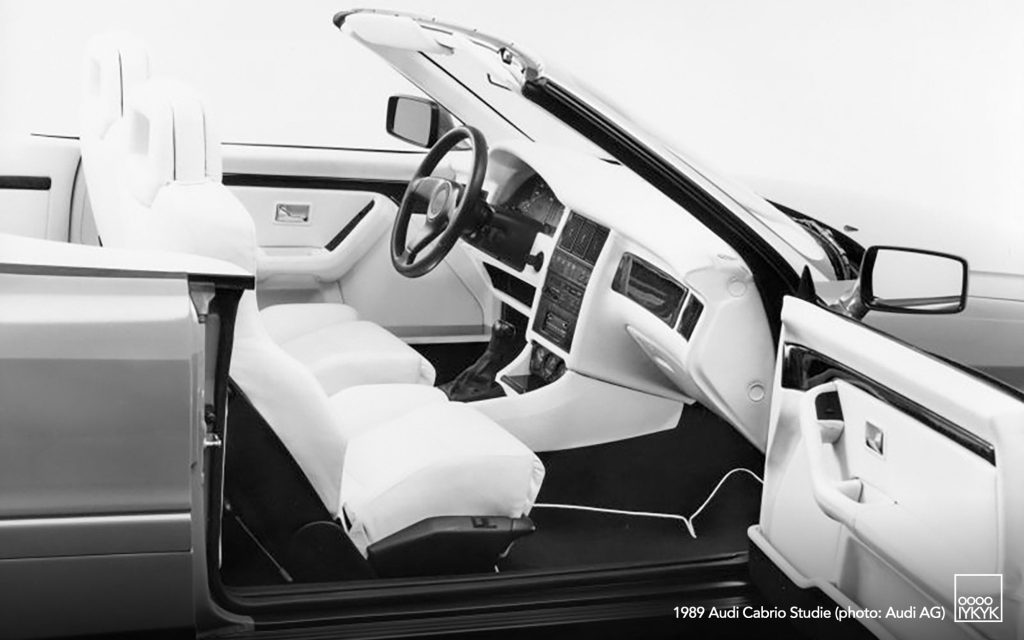
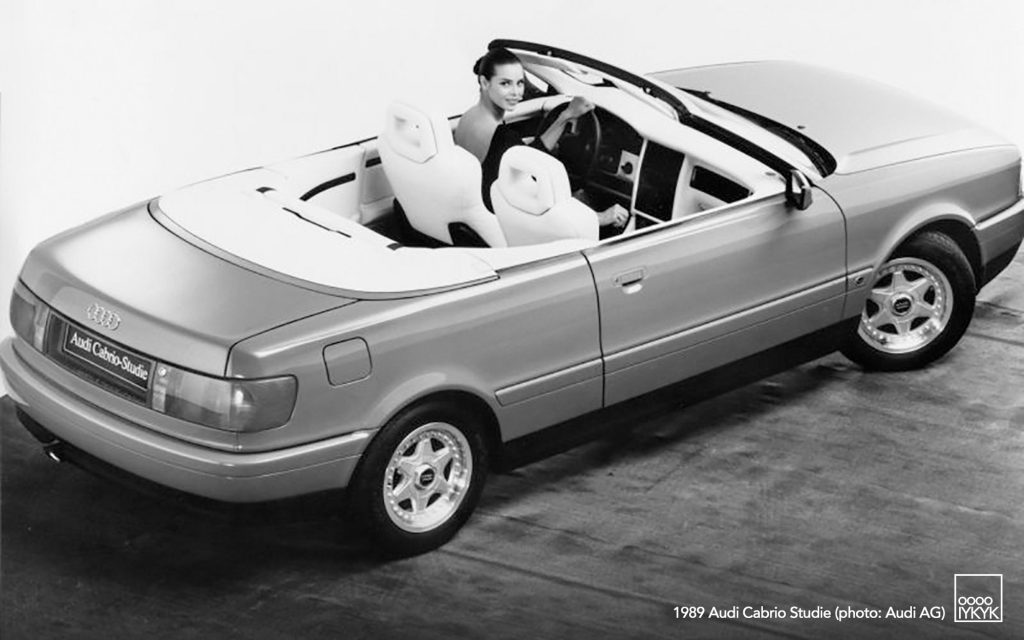
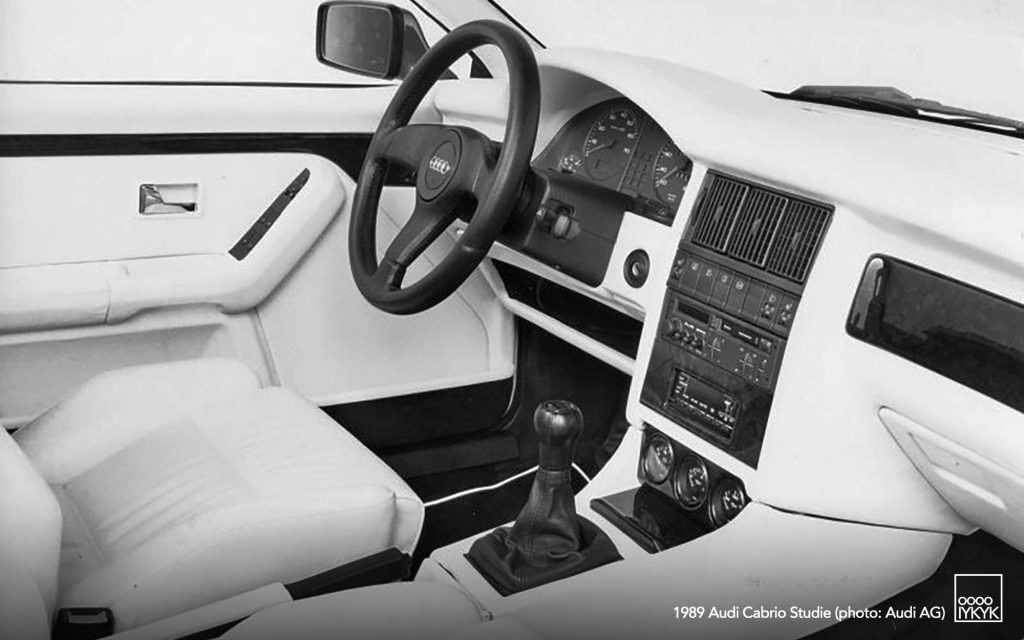
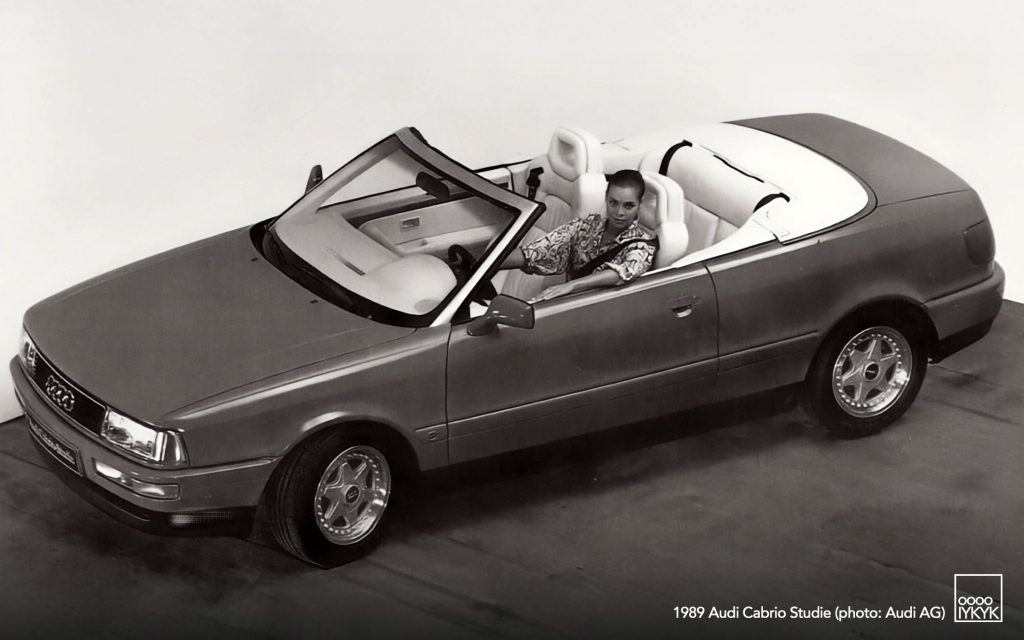
Presented initially in Laser Red with a beige leather interior, the Cabrio Design Study showcased proportions and surfacing intended to communicate elegance and sportiness. It featured a low stance, balanced overhangs and a steeply raked windshield framed in polished aluminum for improved wind management. Large doors facilitated entry to both front and rear seats, underscoring its positioning as a practical four-seater rather than a 2+2. When the car appeared again at the 1990 Geneva Motor Show, it wore two-piece 15-inch Speedline wheels that would later enter series production on various B3 models, reinforcing the realism of the study and its path toward a road-going variant.
The soft top was designed for all-season use and incorporated thermal insulation to ensure comfort in colder climates. Rather than adapting an existing body shape, Audi designers developed the concept with the goal of creating a modern sports convertible that retained the brand’s design identity while presenting a more emotive silhouette than its sedan and coupé counterparts.
At the front, the Cabrio Study is most easily recognized for its horizontal unframed grille similar to that of the B3 Audi Coupé. By the time the production version arrived and now named “Cabriolet”, that car had the updated framed “B4” style grille.
ENGINEERING & SAFETY INNOVATIONS
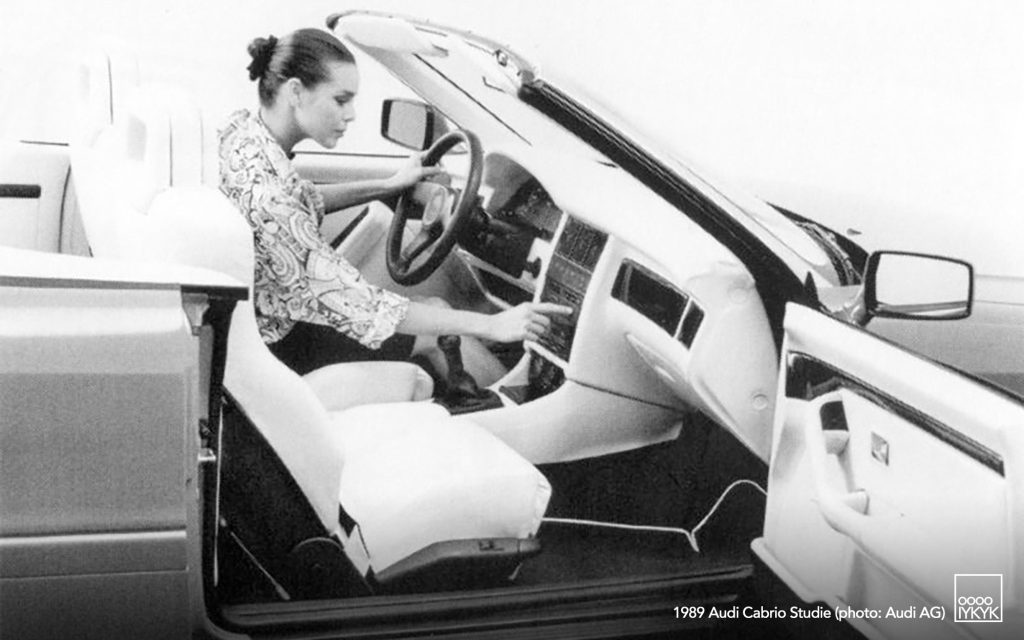
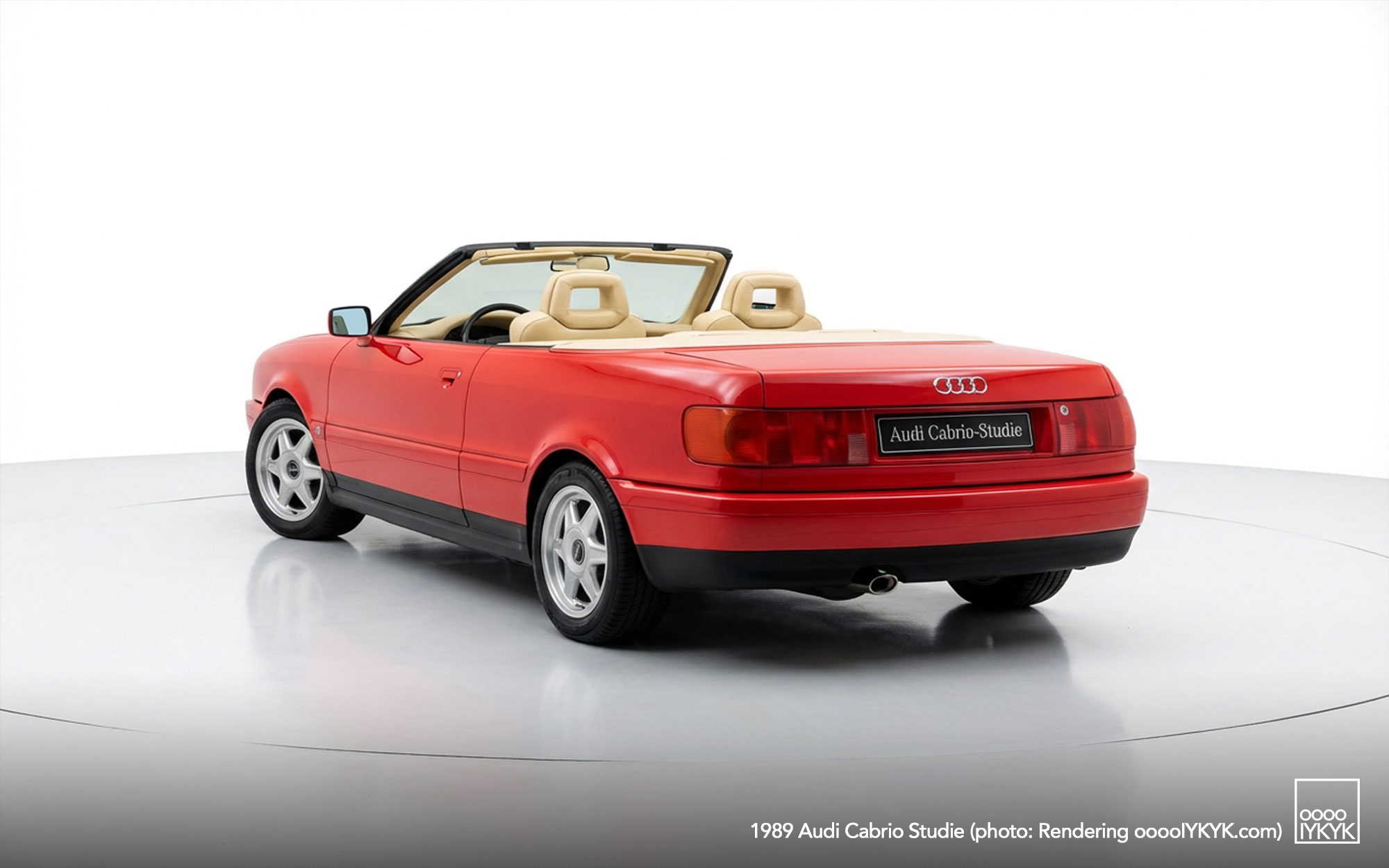
One of the most significant aspects of the design study was its exploration of integrated occupant protection. The concept introduced Audi’s GIS seating system, a seat design featuring an integrated belt and concealed rollover protection structure within the seat back. This system aimed to provide improved safety in a rollover by transferring forces through a reinforced seat shell and rails directly into the floor structure. Height-adjustable seating, consistent belt positioning and simplified usability were also core elements of the system. The GIS seat previewed technology later offered on the production Audi Cabriolet.
Mechanically, the concept was designed to accommodate a broad range of Audi engines and both front-wheel-drive and quattro drivetrains, though the production version ultimately launched in front-wheel-drive form only. The show car itself was fitted with Audi’s 2.3-liter inline-five engine producing 136 hp, giving it a top speed near 198 km/h. This familiar powerplant underscored the study’s production viability and aligned with the early engine offering of the road car.
TRANSITION TO SERIES PRODUCTION
The public reaction to the Cabriolet Design Study encouraged Audi to move forward with a production model. The road-going Audi Cabriolet made its debut in 1991 at the Geneva Motor Show, retaining much of the study’s overall design character and adopting several of its engineering solutions. Initially offered exclusively with the 2.3-liter five-cylinder engine, the model later expanded to include various four- and six-cylinder petrol engines as well as a TDI option. Two subsequent facelifts updated exterior lighting, bumpers and interior materials, keeping the car visually aligned with broader Audi design developments throughout the 1990s.
PRODUCTION & LEGACY
Early production took place in Ingolstadt before assembly was shifted in late 1997 to Karmann in Rheine due to capacity constraints. When production concluded on 27 July 2000, a total of 71,510 Audi Cabriolets had been built, including 12,112 units completed at Karmann. The model went on to establish a loyal following and played an important role in shaping Audi’s image during a period of transition toward more emotive and design-focused vehicles. It also laid groundwork for subsequent open-top models, including the TT Roadster and later A4 and A5 Cabriolet lines.
The 1989 Cabriolet Design Study remains a notable moment in Audi’s design history. It demonstrated the company’s renewed interest in lifestyle-oriented vehicles, showcased forward-thinking safety engineering and directly influenced one of the brand’s most recognizable models of the 1990s. Today, the concept is regarded as both a starting point for Audi’s modern convertible lineage and a representative example of the brand’s late-1980s design renaissance.
REFERENCE LINKS
PHOTO GALLERY