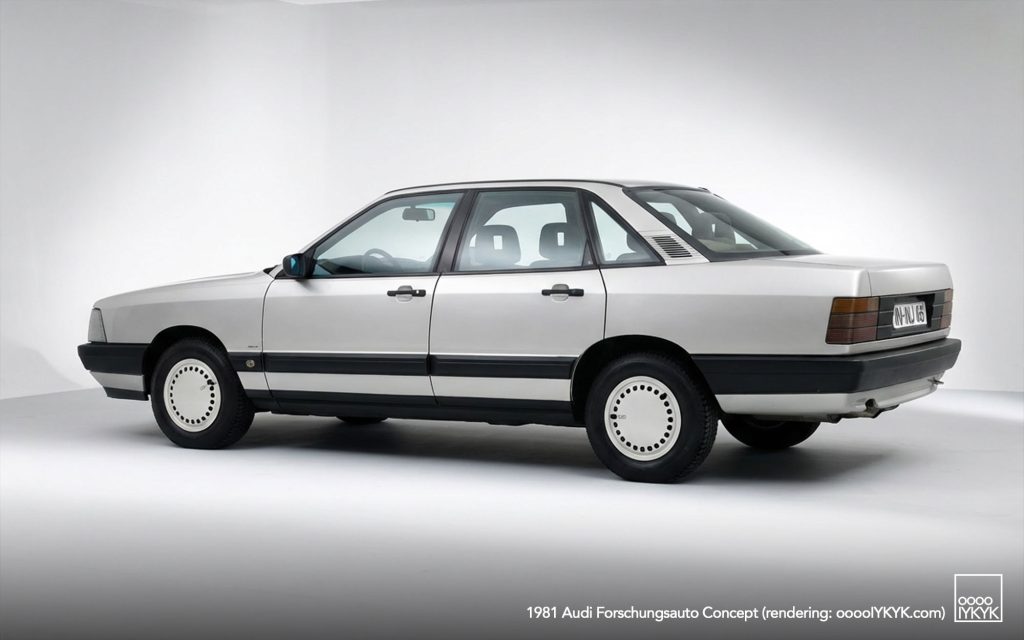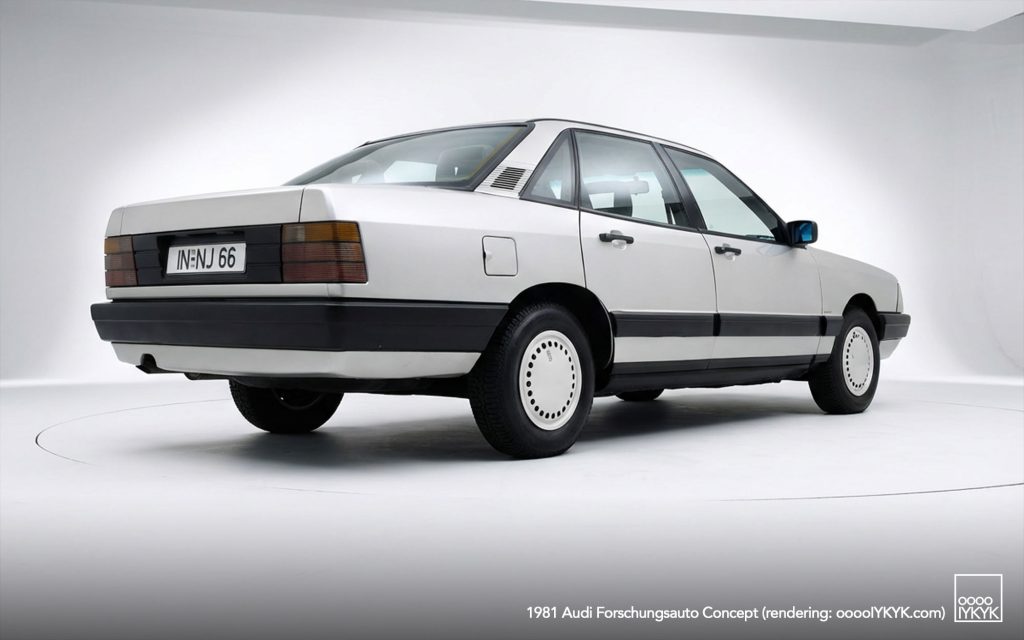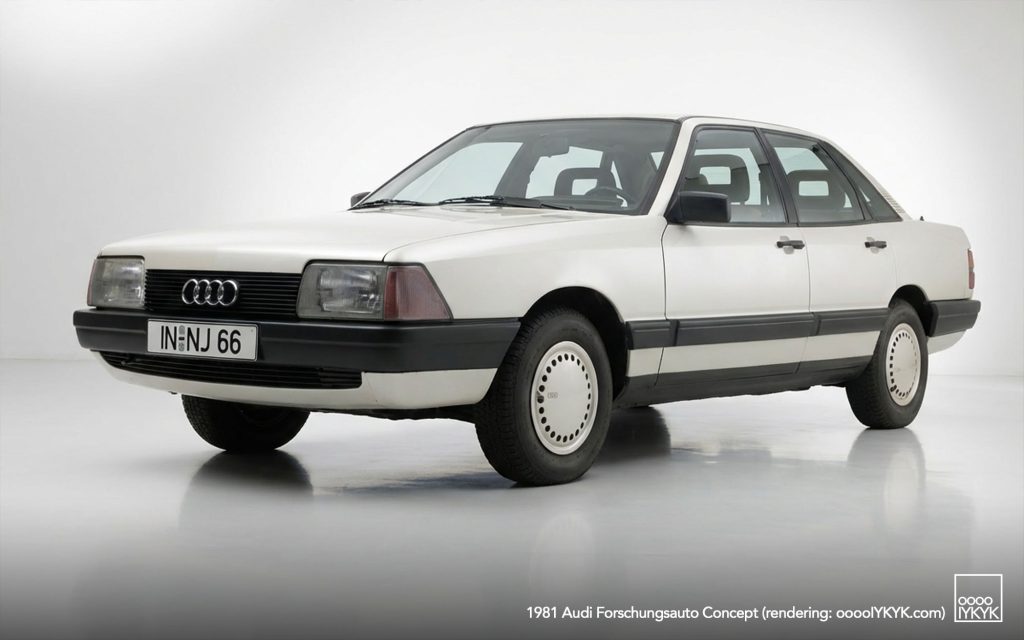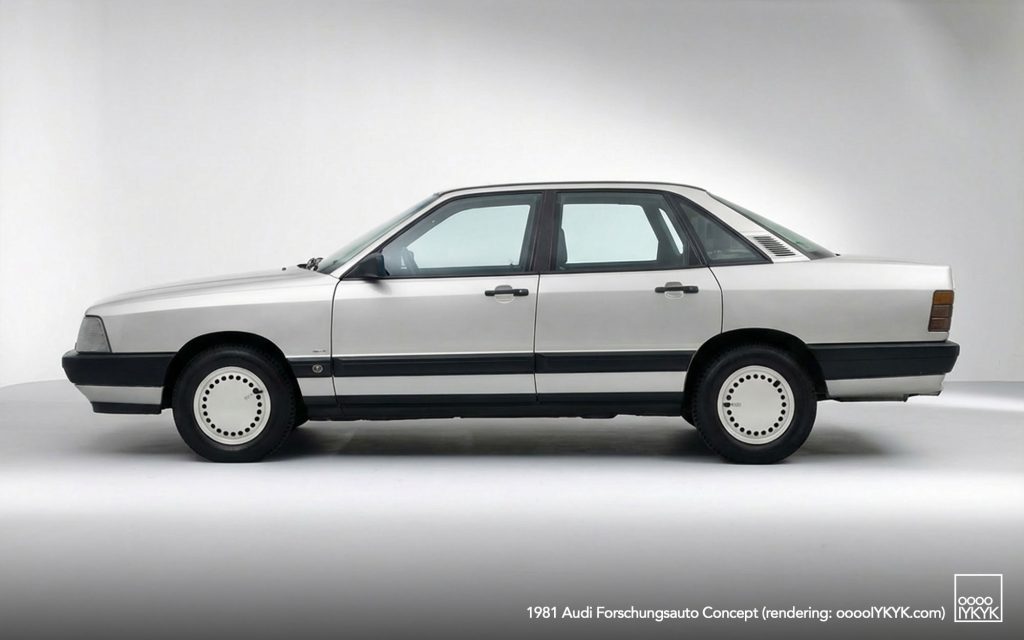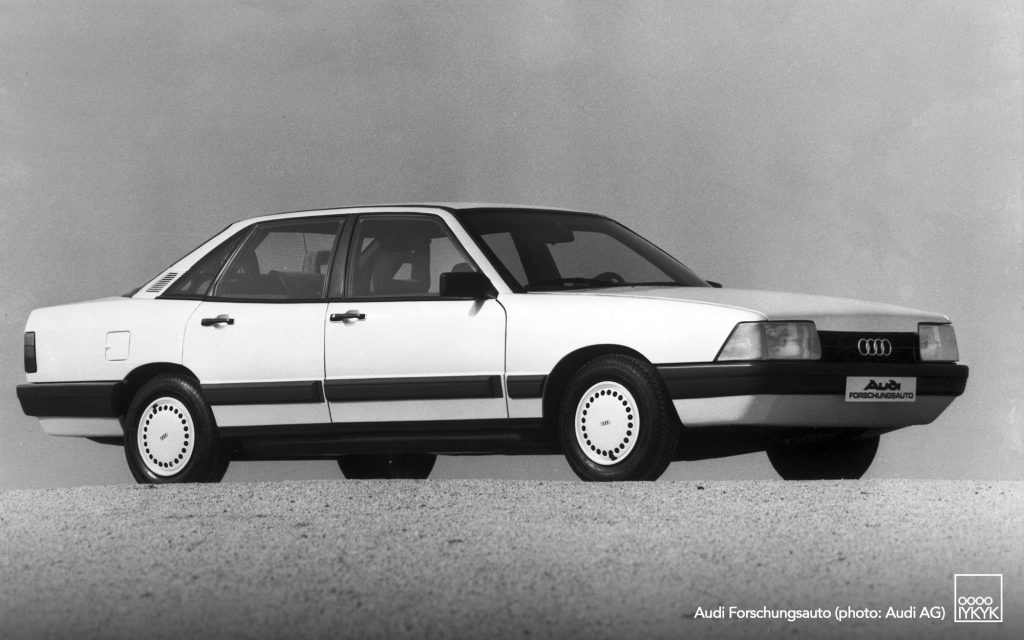


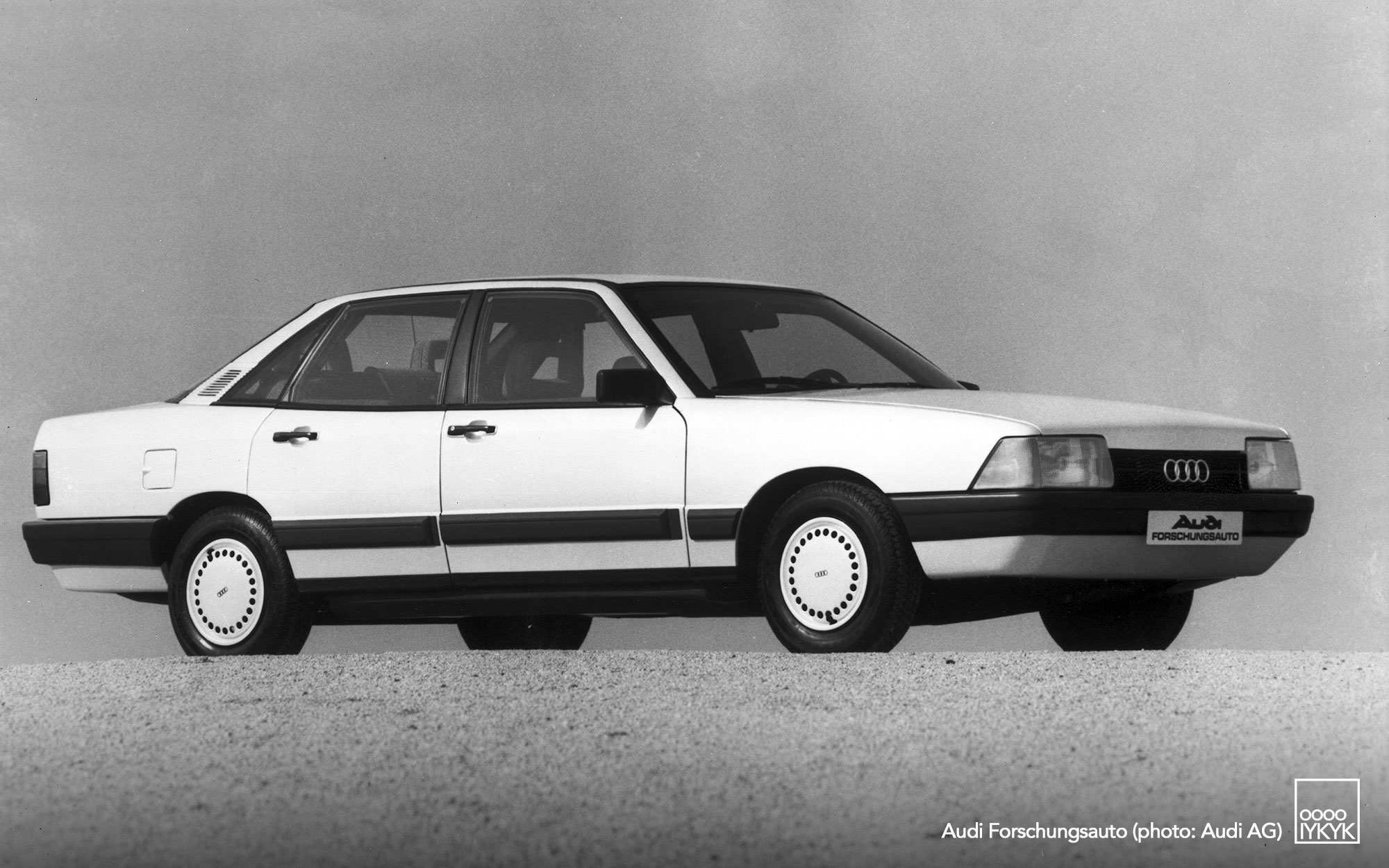
What: Audi Forschungsauto “Research Car”
Model Family: C
Debuted: 1981 Frankfurt IAA, Frankfurt, Germany
Year: 1981
Number Produced: 1
Model / Generation Code(s): type 44
Chassis / Matrix: C3
Engine: 1.6-liter 4-cylinder, turbocharged
Transmission: 5-speed manual
Power: 81 kW / 110 PS / 108 hp at 5000 rpm
Peak Torque:
Acceleration (0-100 km / 62 mph:
Wheelbase: 2726 mm, 107.3 in
Length: 4767 mm, 187.7 in
Width: 1787 mm, 70.4 in
Height: 1408 mm, 55.4 in
Weight: 1180 kg, 2601 lb
Top Speed: 180 km/h, 112 mph
0-62 mph: 12.0 seconds
Designer: Karl Witowski under Hartmut Warkuß
RELATED
Concept Cars: none
Road Cars: Audi 100 (C3)
Race Cars: none
SUMMARY
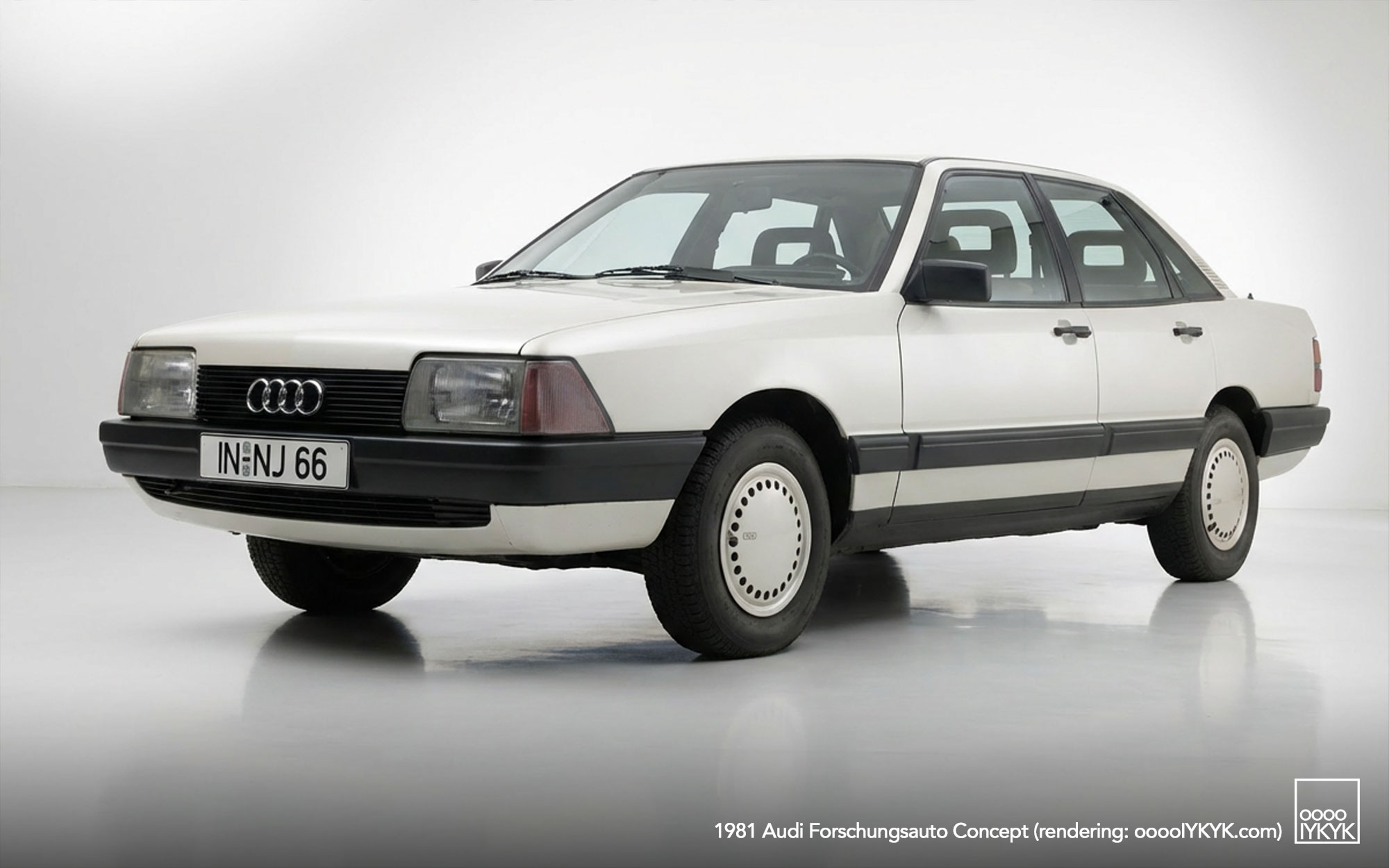
The Audi Forschungsauto, unveiled at the 1981 Frankfurt International Motor Show (IAA), was an experimental research vehicle developed as part of a German federal initiative to advance automotive efficiency, materials innovation and environmental compatibility. Conceived with support from the Federal Ministry for Research and Technology (BMFT), the Forschungsauto represented one of the most ambitious pre-production studies of its era. It served both as a technical showcase and as an indirect preview of the aerodynamic Audi 100 C3 introduced in 1982.
BACKGROUND & GOVERNMENT RESEARCH PROGRAM
In 1978, the BMFT launched a wide-ranging program encouraging German manufacturers to explore new methods of reducing fuel consumption, conserving raw materials and improving environmental performance. Audi participated as one of three selected manufacturers, developing a forward-thinking experimental vehicle that integrated innovations in aerodynamics, materials, construction and user-oriented technology. The project emerged during a period of escalating interest in energy conservation and lightweight design, providing Audi with a platform to test future technologies in a realistic vehicle format.
DESIGN ORIGINS & STYLING DEVELOPMENT
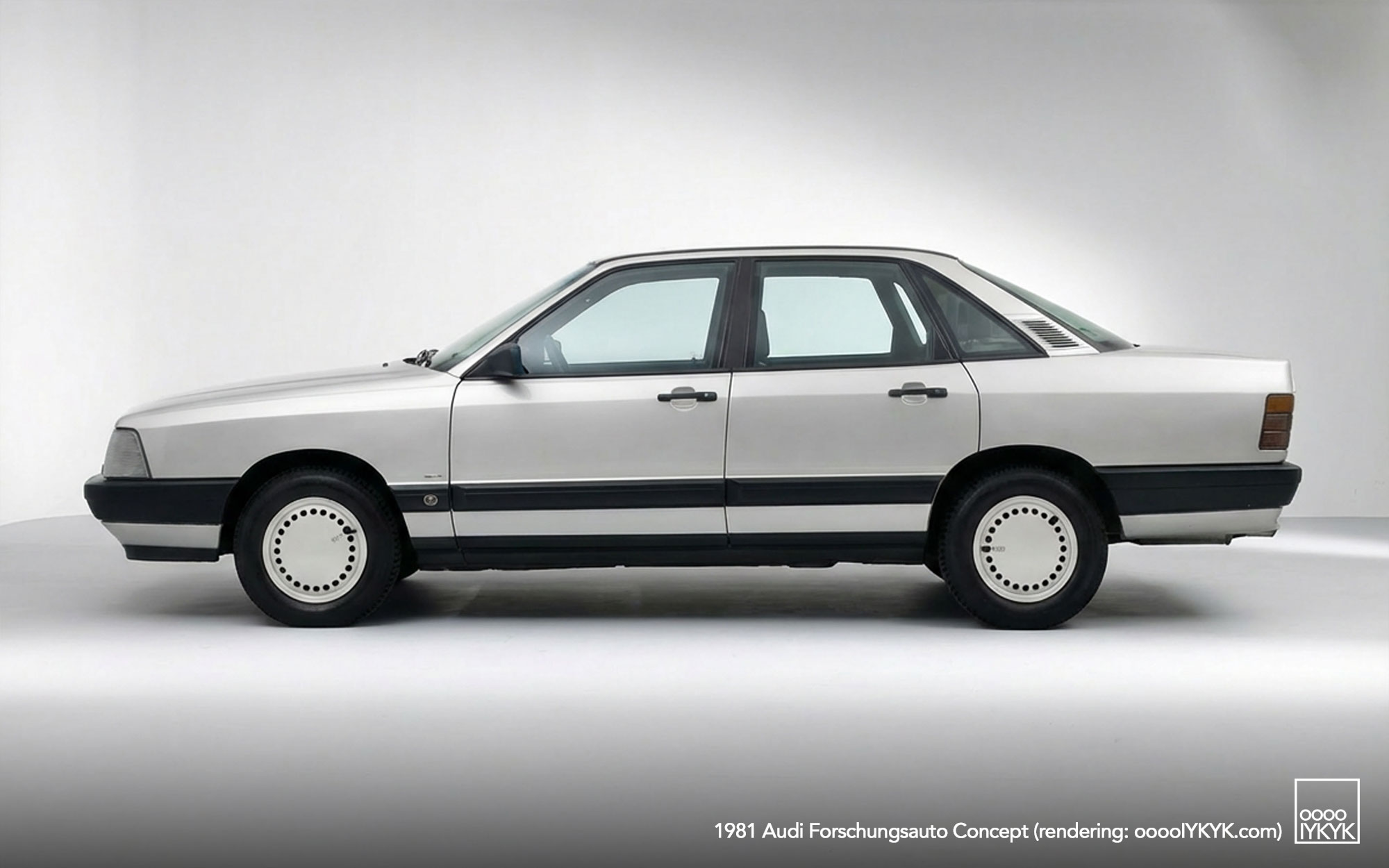
The Forschungsauto’s exterior design is closely tied to the early development of the Audi 100 C3. By late 1979, three proposals for the next-generation Audi 100 were under evaluation by Volkswagen management: a hard model from Italdesign and two clay proposals from Audi designers Martin Smith and Karl Witowski under design chief Hartmut Warkuss. While Witowski’s proposal ultimately became the foundation of the production Audi 100 C3, Smith’s design—with its beltline inspired by the NSU Ro80—was repurposed by Ferdinand Piëch for the experimental research car.
This strategic move was twofold: the Forschungsauto could serve as a public-facing aerodynamic study while also diverting media attention away from the already-finalised C3 production design. Elements of Italdesign’s proposal later influenced the refinement of the production model’s front-end treatment.
EXTERIOR CONSTRUCTION & AERODYNAMICS
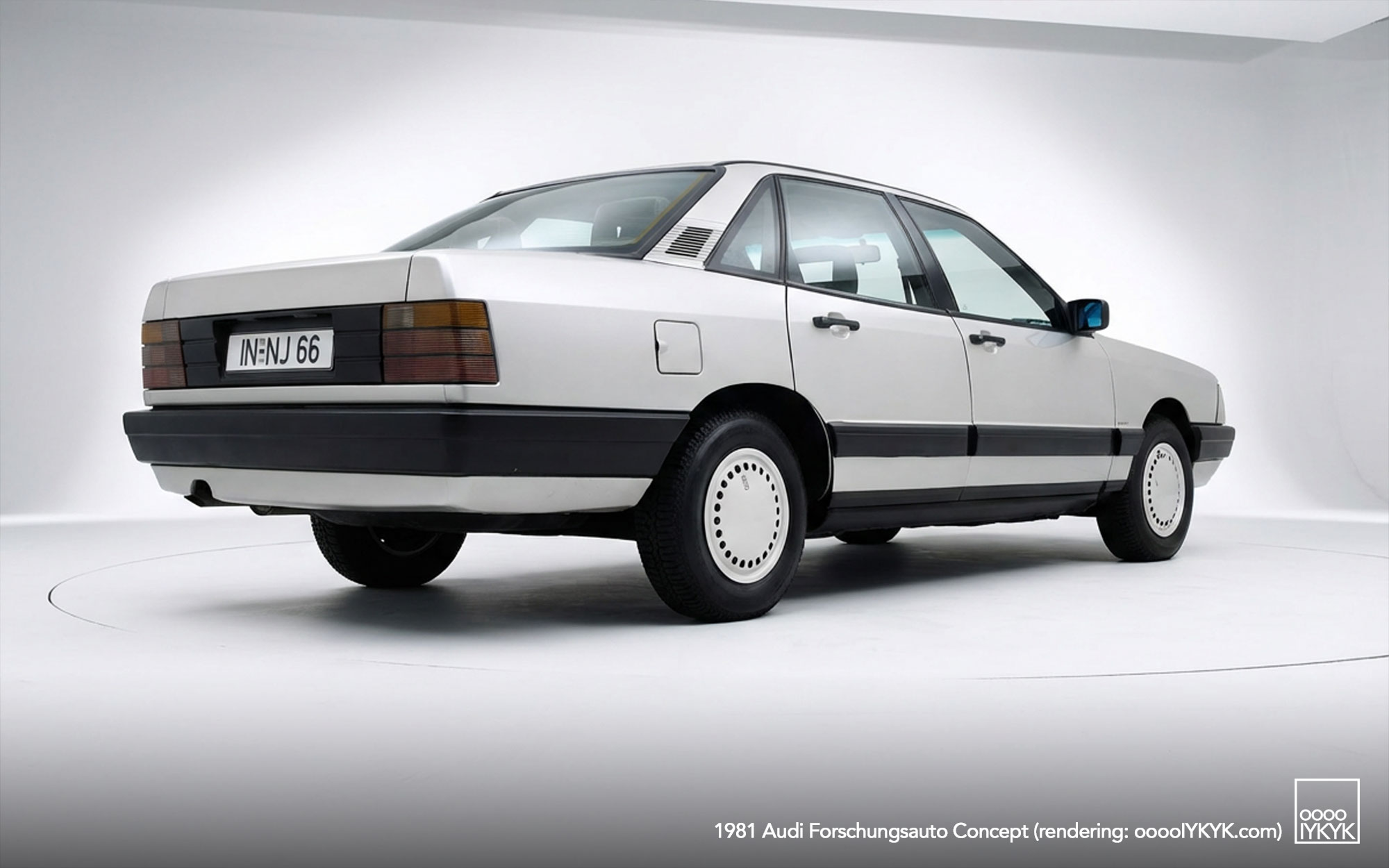
Aerodynamic efficiency was central to the Forschungsauto. Its body featured flush-fitted bonded front and rear windscreens, flush crank-operated side windows and a clean, low-drag silhouette characteristic of Audi’s design trajectory in the early 1980s. The crash-optimised steel safety cell supported bolted alloy front wings and a bonded sandwich roof structure. Underneath, a single-piece fibre-composite sandwich panel with a rigid polyurethane foam core formed the underbody, improving both rigidity and aerodynamic airflow.
These construction techniques anticipated several technologies later adopted for the Audi 100 C3, whose benchmark aerodynamic performance would define Audi’s brand identity through the decade.
POWERTRAIN & MECHANICAL INNOVATION
The Forschungsauto employed a turbocharged inline four-cylinder carburetor engine mounted within a sound-insulating capsule. The engine was tuned for lean-burn operation, reducing both fuel consumption and emissions. Although not intended for production, the powertrain demonstrated Audi’s parallel exploration of efficiency gains through combustion and thermal management research. This emphasis on efficient forced induction and drivetrain refinement foreshadowed developments that would influence Audi’s future petrol and diesel engines.
INTERIOR DESIGN & USER-CENTERED FEATURES
The interior was designed by French advanced designer Robert Broyer, who had been working with Audi since 1975. Selected directly by Ferdinand Piëch—outside of the knowledge of senior design leadership—Broyer was given substantial creative freedom, resulting in one of the earliest examples of Audi’s “intelligent interior” philosophy.
Key features included:
- Programmable personal keys, capable of storing seat, mirror and other user preferences for multiple drivers.
- An integrated child safety seat, positioned in the centre of the rear bench in place of the armrest and developed in collaboration with medical experts. Although Volkswagen patented the concept and intended to roll it out across the range, its size made it impractical for vehicles smaller than the largest saloons, limiting its application to research only.
- A vehicle information system and onboard computer, anticipating later digital instrumentation and driver-assistance interfaces.
The production Audi 100 C3 would not adopt these concepts directly, but the ideas informed Audi’s growing focus on ergonomics, personalization and safety.
PUBLIC DEBUT & INFLUENCE
Displayed on Audi’s stand at the 1981 IAA, the Forschungsauto demonstrated how closely research concepts and production planning had converged by the early 1980s. Many structural and aerodynamic ideas showcased in the study reappeared in refined form on the Audi 100 C3 unveiled the following year, whose aerodynamic drag coefficient set new global standards.
At the same time, the Forschungsauto served as a strategic design decoy: while its styling previewed Audi’s upcoming direction, it concealed the finalised design of the next Audi 100, which had been internally approved nearly two years earlier.
LEGACY
The Audi Forschungsauto is regarded as one of the most important research vehicles in Audi’s history. It encapsulated the company’s commitment to innovation in aerodynamics, lightweight construction and user-focused interior technology well before these became industry norms. Many of its experimental themes—flush glazing, composite underbodies, integrated electronic interfaces and safety-focused interior systems—were influential in shaping the Audi 100 C3 and subsequent generations of Audi design.
Although the car remained a one-off research model, its impact extended beyond its public debut, establishing Audi’s focus on aerodynamics and technologically driven engineering and laying groundwork for future advances in efficiency and safety.
RELATED LINKS
Car Design Archives, Part 1 Exterior
Car Design Archives, Part 2 Interior
PHOTO GALLERY