

/ Eras / Auto Union Postwar / 1000
MODEL DETAILS
What: Auto Union 1000 S Coupé de Luxe
Era: Auto Union Postwar Automobiles
Manufacturer: Auto Union GmbH (West Germany)
Model Family: 1000
Market / Zone: West Germany; export markets
Model Years: 1962, 1963
Production Span: 1962–1963
Number Produced: 21,488
Model / Generation Code(s):
Chassis / Matrix:
TECHNICAL DETAILS
Body Style(s): 2-door coupé (de Luxe trim); 4 seats
Drivetrain Configuration: longitudinal front engine, front-wheel drive
Engine(s): 981 cc inline 3-cylinder, two-stroke; 74.0 × 76.0 mm; compression ratio 7.25:1
Engine Structure: ported two-stroke; cast iron cylinder head and block; Bing carburetor; water cooled
Power Output: 33.3 kW (44.6 bhp) @ 4,500 rpm
Torque: 47.7 Nm @ 2,250 rpm
Transmission(s): 4-speed manual with freewheel; spiral bevel final drive (3.87)
Steering: rack and pinion
Brakes: front disc brakes; rear drum brakes; single braking circuit
Fuel Tank Capacity: 44.6 L (11.8 US gal / 9.8 Imp gal)
Wheelbase: 2,350 mm (92.5 in)
Front Track: 1,290 mm (50.8 in)
Rear Track: 1,351 mm (53.2 in)
Length: 4,227 mm (166.4 in)
Width: 1,697 mm (66.8 in)
Height: 1,468 mm (57.8 in)
Ground Clearance: 190 mm (7.5 in)
Turning Circle: 11.2 m (36.9 ft)
Kerb Weight: approx. 900 kg
Top Speed: 129 km/h (80 mph)
0–100 km/h: 24.2 seconds
Fuel Consumption (test): 28 mpg (10.1 L/100 km)
CHASSIS DETAILS
Construction: separate chassis with steel bodywork
Front Suspension: independent; lower wishbones; upper transverse semi-elliptic spring
Rear Suspension: dead axle; transverse semi-elliptic spring; telescopic dampers
OTHER DETAILS
Predecessor:
Successor: DKW F102
Platform Mates: Auto Union 1000; Auto Union 1000 Universal
Concept Cars:
Assembly Location(s): Ingolstadt
Designer(s):
Homologations:
WHEEL / TIRE DETAILS
Wheel Diameter(s): 15 in
Tire Size(s): 5.60 × 15
Bolt Pattern:
Offset:
SUMMARY
DESIGN & STYLING
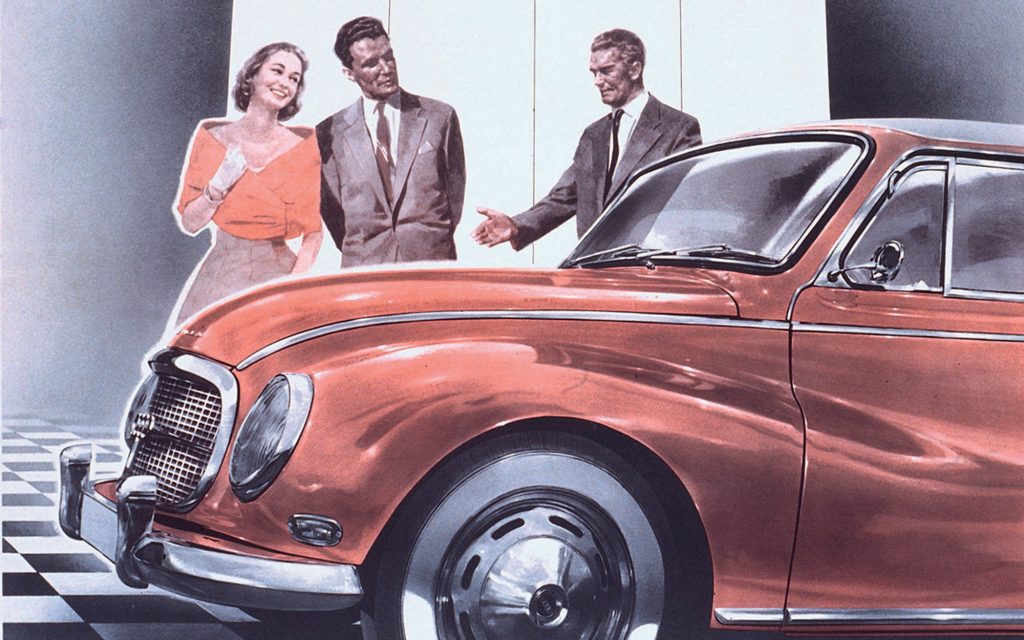
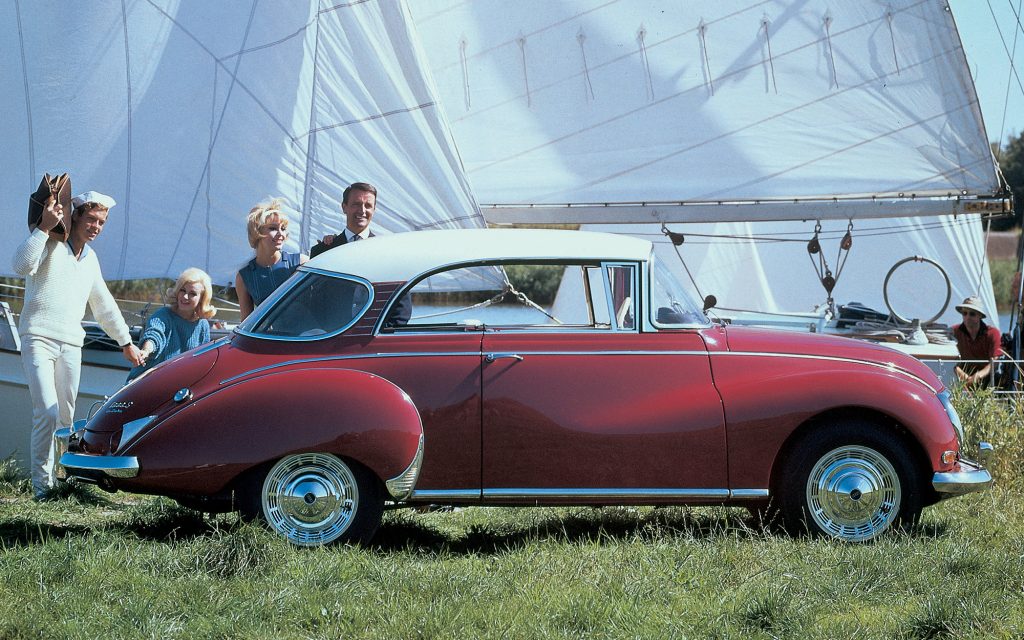
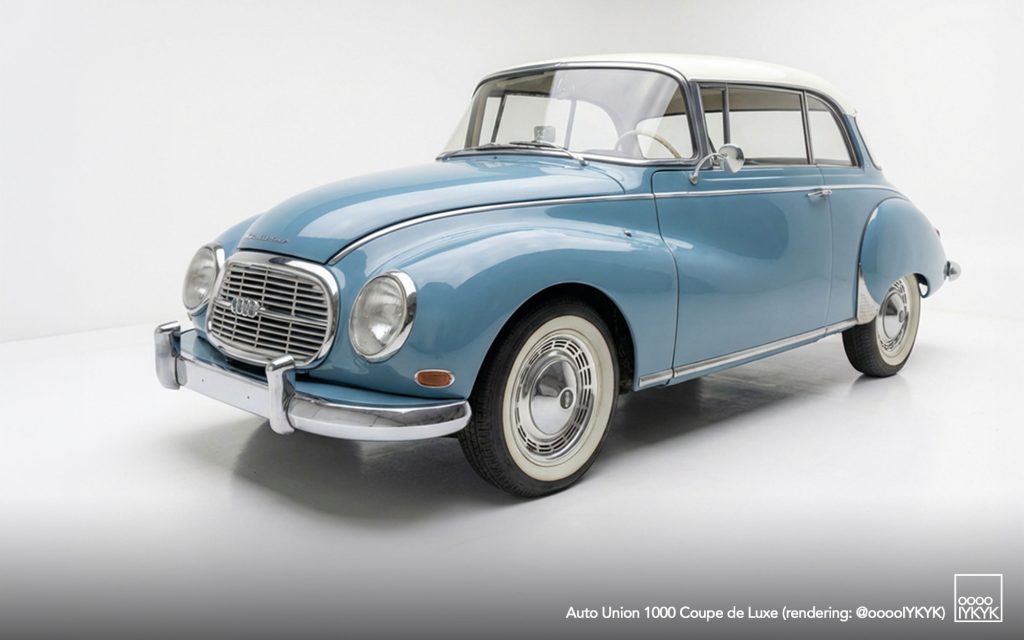
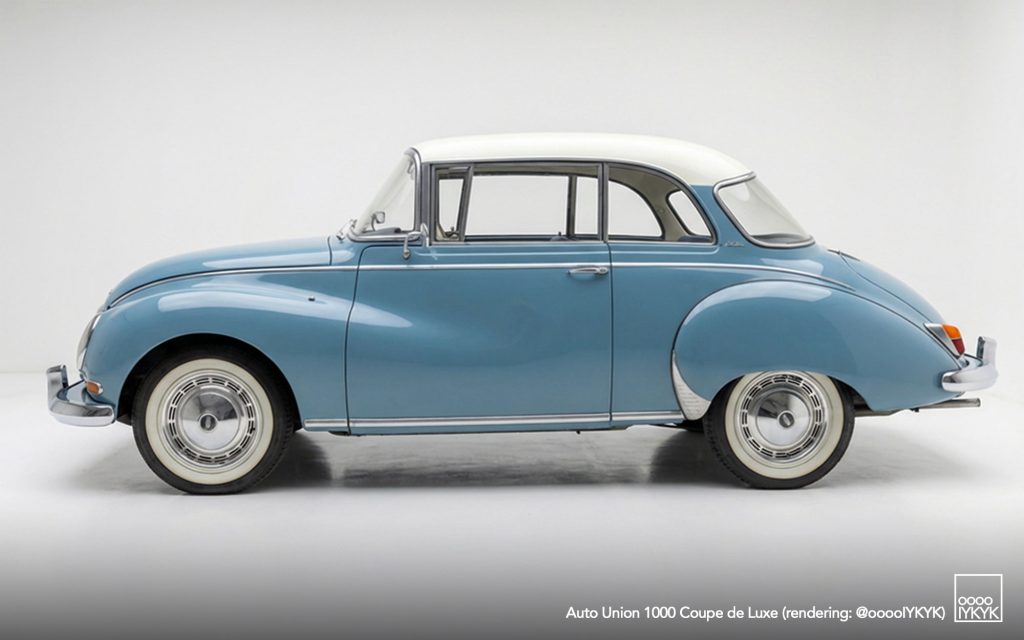
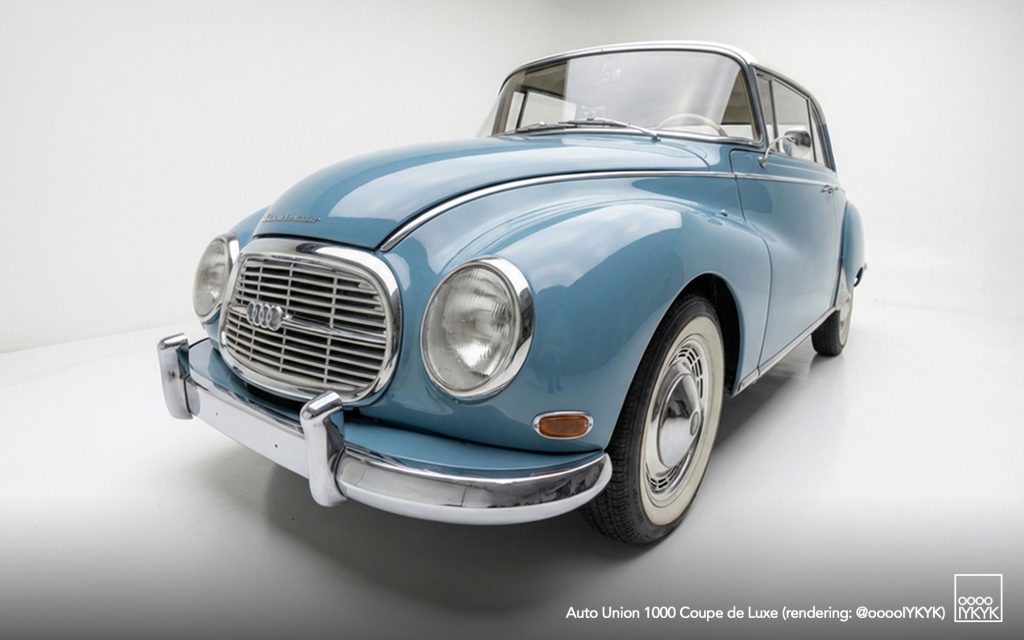
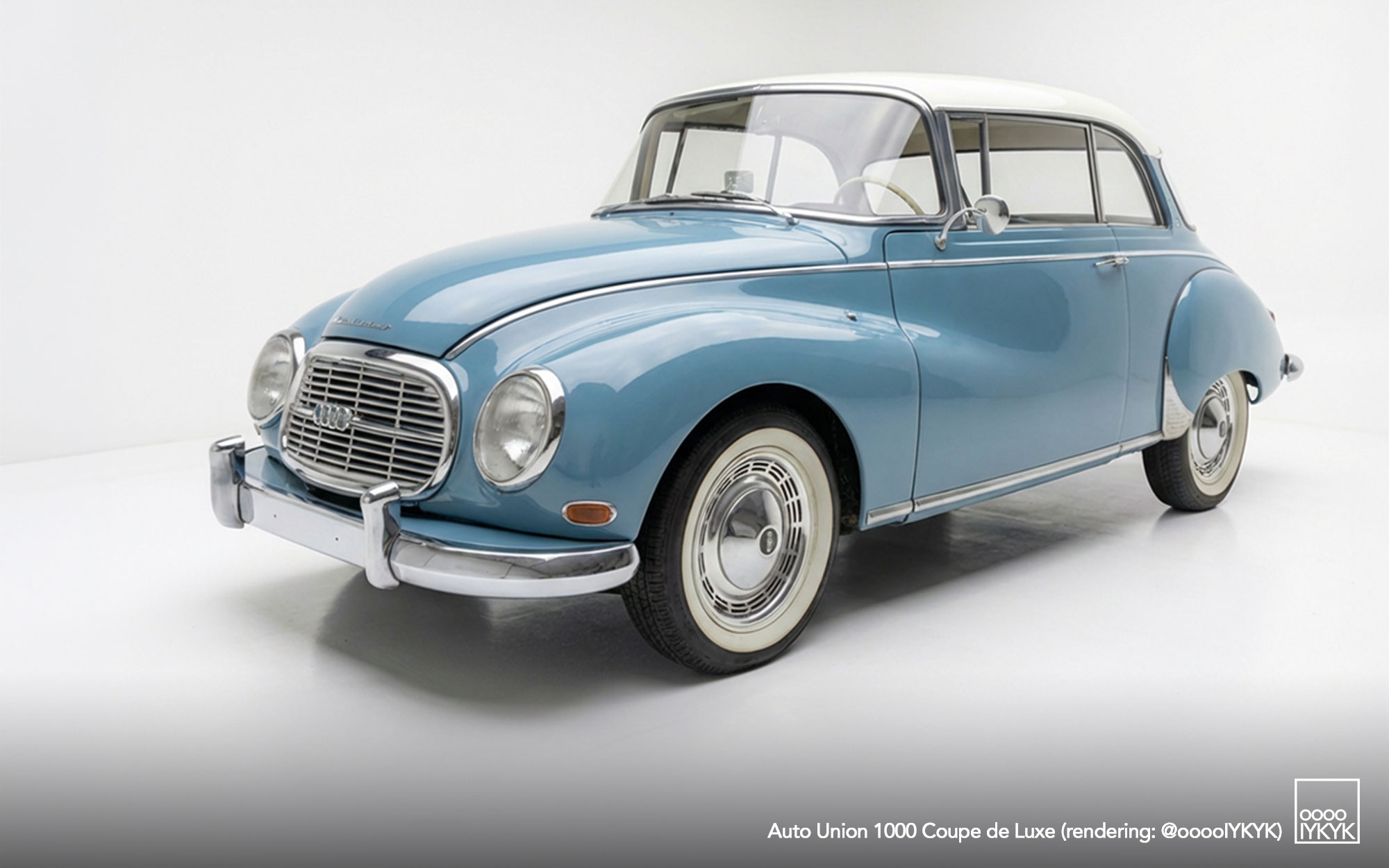
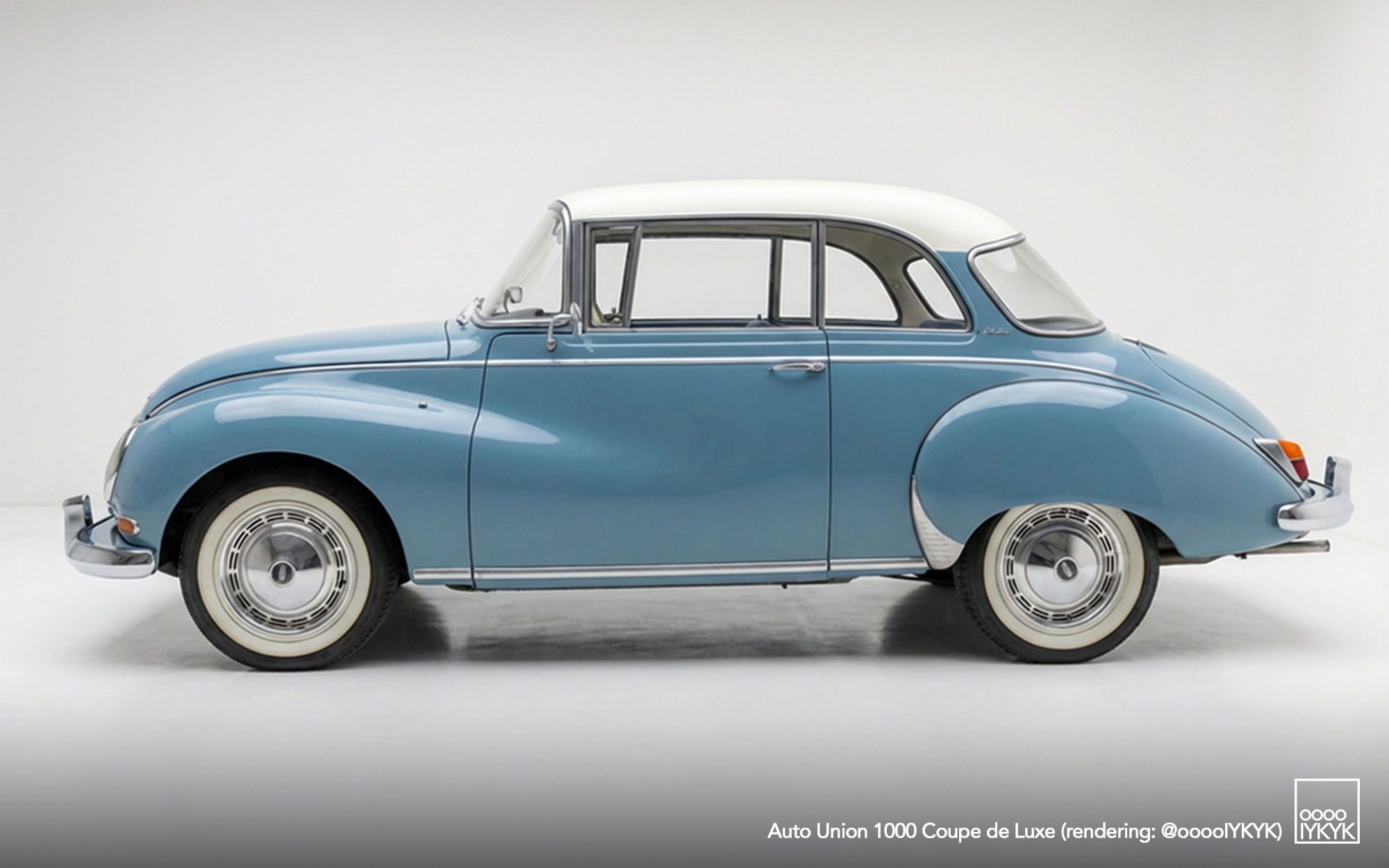
The Auto Union 1000 S Coupé de Luxe was introduced as the flagship of the 1000 range and represented the final visual and technical refinement of the Auto Union two-stroke era. Based on the 1000 S saloon platform, the coupé featured a lower, more streamlined roofline and more elegant side glazing, while retaining the same 2,350 mm wheelbase and chassis architecture. The “de Luxe” designation signified upgraded interior trim, enhanced brightwork and more sophisticated detailing compared with the standard sedan models.
By the early 1960s, the 1000 series had adopted the panoramic wraparound windshield introduced for the 1960 model year, giving the coupé a more contemporary appearance without altering its core structural dimensions.
ENGINEERING & TECHNICAL ADVANCEMENT
Mechanically, the Coupé de Luxe retained the 981 cc three-cylinder two-stroke engine, the largest iteration of Auto Union’s postwar two-stroke design. The compact powertrain was mounted longitudinally ahead of the front axle with the gearbox integrated into the final drive unit. The radiator was positioned behind the engine within the bay, and a belt-driven shaft powered the cooling fan—an arrangement designed to optimize packaging and weight distribution.
The defining engineering milestone of the 1000 S Coupé de Luxe was the adoption of front disc brakes, making Auto Union the first German manufacturer to equip a mid-range production car with this braking technology. Rear braking remained by drum, operating within a single hydraulic circuit. Steering was rack and pinion, and the four-speed manual gearbox incorporated the company’s characteristic freewheel mechanism.
POSITION WITHIN THE 1000 RANGE
The 1000 S Coupé de Luxe occupied the upper tier of the 1000 lineup, positioned above the two- and four-door sedans and alongside the sport-oriented SP variants. Production commenced in March 1962 following the relocation of Auto Union’s passenger car manufacturing from Düsseldorf to Ingolstadt in summer 1961.
A total of 21,488 examples were produced before the final 1000-series vehicle left the Ingolstadt production line in September 1963, marking the end of mainstream Auto Union two-stroke production.
LEGACY & HISTORICAL SIGNIFICANCE
The 1000 S Coupé de Luxe represents the technical culmination of Auto Union’s postwar two-stroke development program. Its introduction of front disc brakes and refined trim signaled the brand’s attempt to modernize its offerings amid growing competition and shifting engineering trends.
Shortly after its discontinuation, Auto Union transitioned toward four-stroke power with the DKW F102. Under Volkswagen ownership, that engineering shift ultimately led to the reestablishment of the Audi brand in 1965. As such, the 1000 S Coupé de Luxe stands as one of the final and most developed expressions of the DKW-based Auto Union philosophy before the emergence of modern Audi.
PHOTO GALLERY