

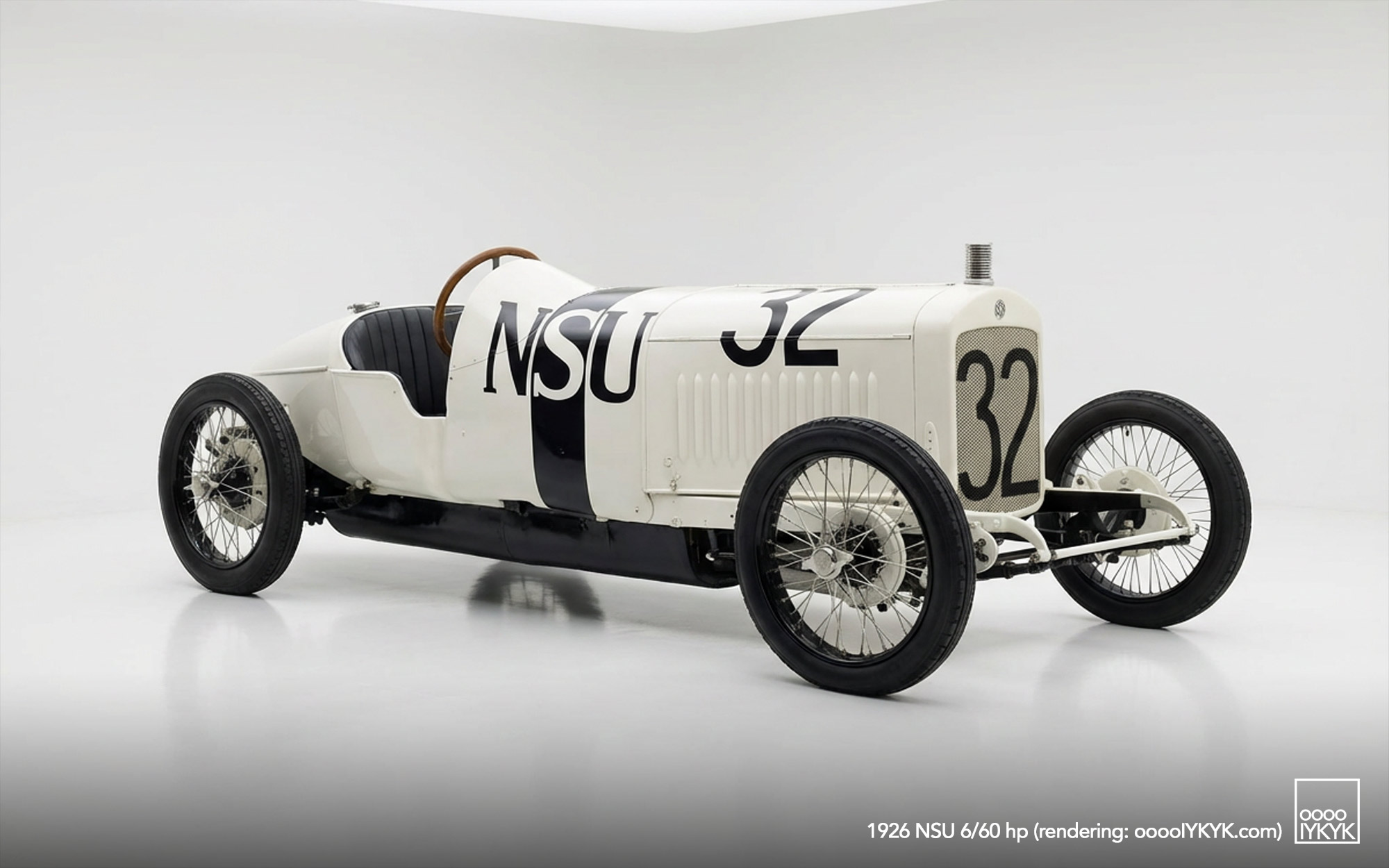

MODEL DETAILS
What: NSU 6/60 hp
Genre / Series: Grand Prix Racing
Racing Class: F Class
Era: NSU prewar
Model Family:
Market / Zone: Germany
Season: 1925, 1926
Model / Generation Code(s):
Chassis / Matrix:
TECHNICAL DETAILS
Body Style(s): body on ladder-frame 2-seat front-engine open racing car
Drivetrain Configuration: longitudinal front engine, rear-wheel drive
Engine(s): 1.5-liter supercharged Straight 6
Displacement: 1,482 cc
Bore/Stroke: 59.0 mm / 90.0 mm
Valvetrain: 2 valves per cylinder, side-valves
Fuel Delivery: Carburetor
Aspiration: Roots-Type Supercharger
Power: 60 hp
Torque:
Top Speed: 175 km/h, 109 mph
Transmission(s):
Wheelbase: 285 cm
Width: 1,814 m (71.4 inches)
Height: 1,335 mm (52.6 inches)
Kerb Weight: 840 kg, 1,830 lbs
RACE RESULTS
International Taunus Race, Public road circuit, Homburg vor der Höhe, Germany, Aug 23, 1925
- 1st August Momberger🥇
German Grand Prix, AVUS Circuit, Berlin, Germany, July 11, 1926
- F Class, 1st Georg Klöbe #32 🥇, 2nd Jakob Scholl #28 🥈, 3rd Franz Islinger #37 🥉, 4th Josef Müller #54
Summary:
The NSU 16/6 hp, more widely known in contemporary sources as the NSU 6/60 hp, is a German racing car developed by NSU Motorenwerke AG for competition in the mid-1920s. Introduced in 1925 as NSU’s first six-cylinder racing model, the car played a significant role in establishing the company’s reputation in international motorsport. Its victories in major events such as the International Taunus Race and the inaugural 1926 German Grand Prix on the AVUS circuit positioned NSU among the leading racing marques of its era.
BACKGROUND
NSU’s involvement in automobile competition predates the First World War, with factory entries appearing as early as 1908. The company earned notable success in endurance, reliability, and long-distance trials, including strong performances in the 1909 Prinz-Heinrich Rally. NSU continued to build its motorsport profile through the 1910s and early 1920s, achieving a class victory with the small NSU 8/24 hp at the opening race on the newly constructed AVUS circuit in September 1921.
By the mid-1920s, with racing technology rapidly advancing and competition intensifying across Europe, NSU developed a purpose-built racing car to return to the international stage with a modern technical platform. This effort culminated in the creation of the NSU 6/60 hp.
DEVELOPMENT
The NSU 6/60 hp was engineered specifically for motorsport and introduced in 1925. It was NSU’s first six-cylinder automobile, marking a significant technical step for the company. The racing engine featured:
- A displacement of 1.5 liters
- Six cylinders
- A Roots-type supercharger
- An output of 60 horsepower
Despite its modest displacement, the car’s forced-induction setup and lightweight construction gave it a remarkable power-to-weight ratio. The chassis and bodywork were designed with competition in mind, resulting in a total weight of 830 kilograms. The car was capable of reaching 175 km/h, placing it among the fastest 1.5-liter racing machines of the period.
RACING HISTORY
1925 International Taunus Race
A prototype of the NSU 6/60 hp made its competitive debut in the 1925 International Taunus Race, a 450-kilometer event held in the Taunus mountain region. The car secured overall victory at its first attempt, demonstrating both its reliability and its top-end performance. The win was widely regarded as a breakthrough achievement for NSU’s racing program.
1926 German Grand Prix
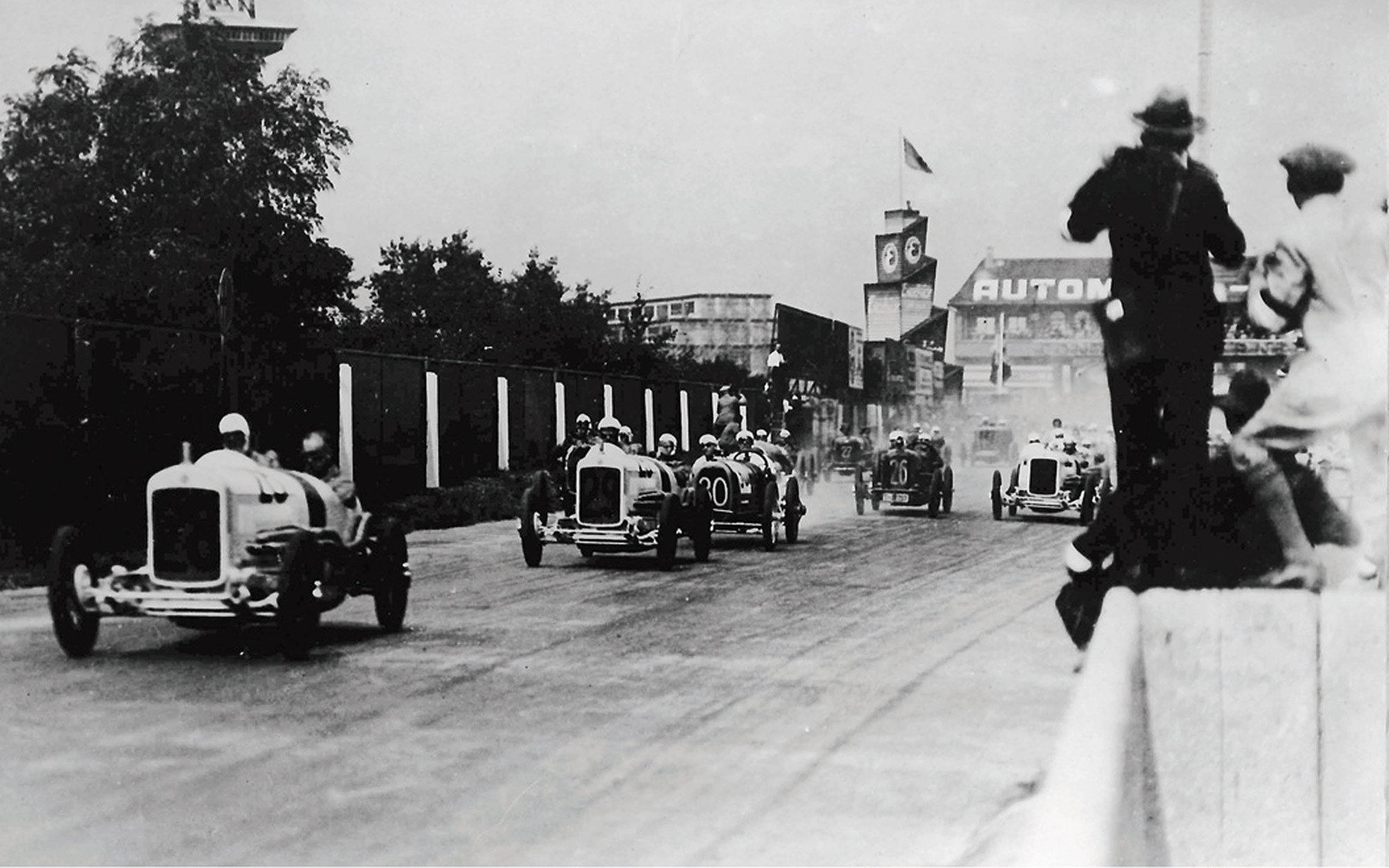
On 11 July 1926, NSU entered a team of 6/60 hp cars in the first German Grand Prix, held on the AVUS circuit in Berlin. Organized by the Automobilclub von Deutschland (AvD), the event was the premier German motorsport competition of the year and attracted an estimated 250,000 spectators.
NSU achieved a highly acclaimed quadruple victory in the 1.5-liter “F” class, securing the top four positions. In addition, one of the NSU cars finished fifth overall, competing against larger and more powerful machines in the general classification. The result established the 6/60 hp as one of the dominant small-displacement racing cars of the mid-1920s.
SIGNIFICANCE
The NSU 6/60 hp occupies an important place in early German racing history. Its combination of lightweight engineering, supercharged performance, and strong competitive record helped elevate NSU’s international standing during the 1920s. The success of the car also reinforced the company’s tradition of technical innovation, which would later contribute to NSU’s influence within Auto Union and, ultimately, the engineering heritage of present-day Audi.
LEGACY
Although produced in limited numbers for factory competition, the NSU 6/60 hp is remembered as one of the most successful 1.5-liter racing cars of its time. Its victories at AVUS and in the Taunus Race remain defining achievements for NSU Motorsports. Surviving examples and period photographs are preserved within the Audi Tradition collection, where the car is recognized as an early milestone in the development of German Grand Prix racing. In as much, the NSU 16/60 hp exemplifies how Audi traces its F1 roots back to victory at the very first German Grand Prix.
MORE INFORMATION