


/Concept Cars & Design Studies
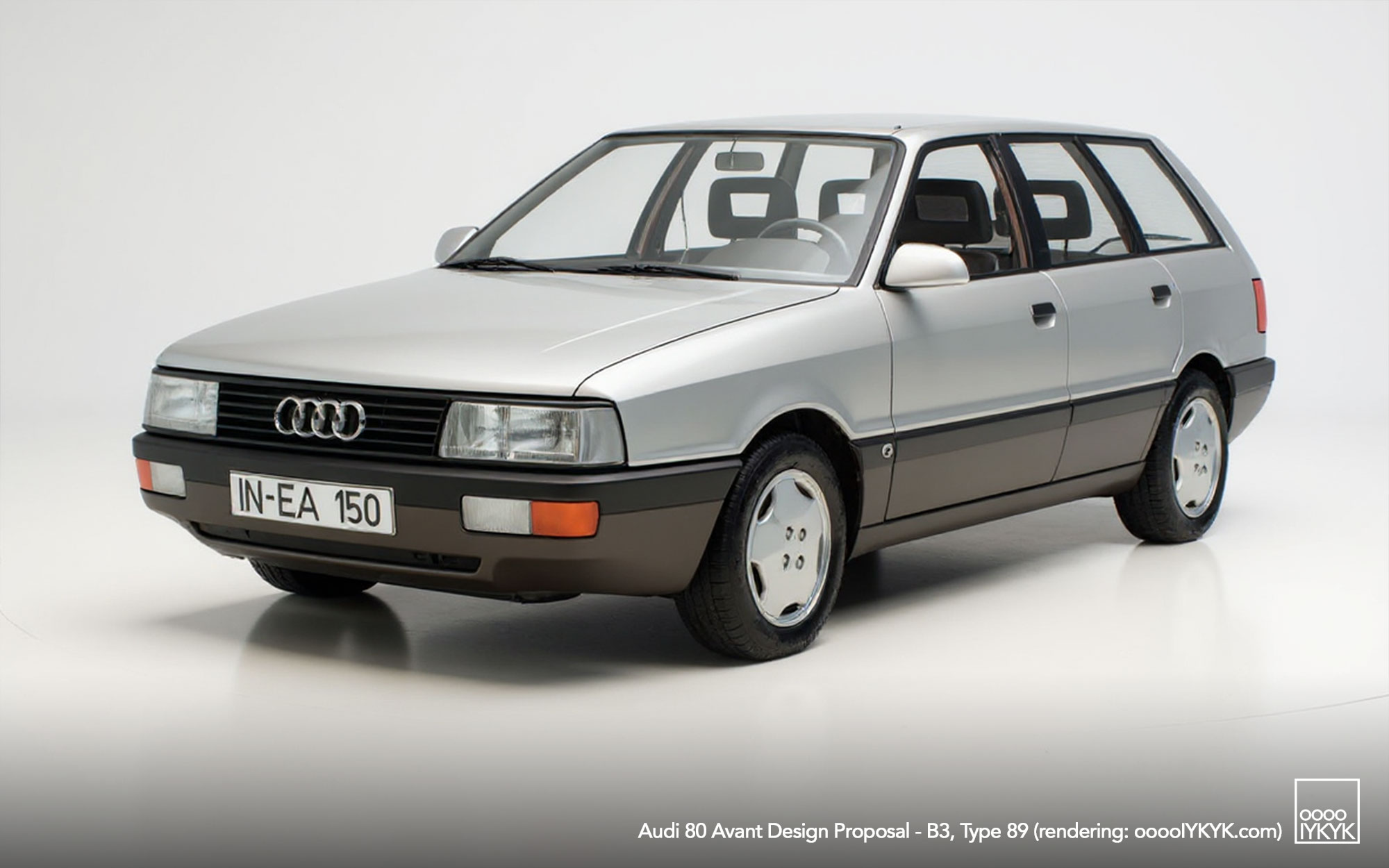
What: Audi 80 Avant Design Proposal
Project Name: EA 150
Model Family: 80 (B3, type 89)
Debuted: N/A
Year: 1982 / 1983
Intended Introduction: 1986
Status: Unproduced design proposal
Number Produced: 1, Believed Full-Sized Model Only
Model / Generation Code(s): 80 / type 89
Chassis / Matrix: B3
Body style: 5-door station wagon
Engine: N/A
Transmission: N/A
Power: N/A
Peak Torque: N/A
Weight: N/A
Acceleration (0-100 km / 62 mph: N/A
Paint Color: N/A
RELATED
Concept Cars: N/A
Road Cars: Audi 80 (B3, type 89)
Race Cars: N/A
OVERVIEW
The Audi 80 Avant Conventional Wagon Design Proposal was one of two estate-body studies explored during development of a five-door variant of the Audi 80 (B3). Unlike the sportier fastback-oriented proposal developed in parallel, this design followed the established long-roof station wagon formula with a taller rear cargo area and more upright tailgate.
This direction ultimately proved closer in spirit to the production Audi 80 Avant (B4) introduced in the early 1990s, making it a key conceptual stepping stone between Audi’s earlier wagon experiments and the modern Avant lineage.
INDUSTRY & CORPORATE CONTEXT
During the 1970s and early 1980s, model overlap between Audi and Volkswagen frequently led to certain body styles being reserved for one brand. Five-door fastback and wagon variants on earlier shared platforms were often marketed primarily under the Volkswagen Passat name, while Audi focused on sedans and coupes in the same size class.
By the late 1980s, this separation began to shift. The upcoming B3 Audi 80 was based on a longitudinal-engine platform distinct from the next-generation Passat, which was moving to a transverse layout. This divergence created room for Audi to develop a dedicated wagon version of the 80 without directly mirroring a Volkswagen product.
At the same time, market perceptions were evolving. Hatchbacks were increasingly associated with smaller economy cars, while buyers in the mid-size segment expected more refined, premium-oriented estates. A conventional long-roof wagon better aligned with Audi’s brand positioning at the time.
BODY STYLE & PACKAGING
The conventional Avant proposal featured a near-horizontal roofline extending to a largely vertical tailgate, maximizing interior cargo volume and rear headroom. Compared to the fastback proposal, this design emphasized utility and practicality over aerodynamic expressiveness.
Large rear side windows and a squared-off cargo area provided the proportions typical of European estates of the era. The design also allowed for a low load floor and a more spacious luggage compartment, key attributes for family and business use.
DESIGN LANGUAGE
Stylistically, the proposal followed the clean, aerodynamic design language of the B3 Audi 80 sedan, characterized by smooth surfaces, integrated bumpers, and flush glazing. The wagon roof and rear quarters were carefully integrated to maintain the cohesive, wind-cheating form that defined Audi design in the late 1980s.
Compared with earlier Audi wagons, the surfacing was more rounded and modern, reflecting advances in aerodynamics and manufacturing techniques. The result was a wagon that appeared more premium and less utilitarian than earlier estate designs within the Volkswagen Group.
RELATION TO PRODUCTION MODEL
This conventional wagon study is widely regarded as a conceptual precursor to the production Audi 80 Avant (B4). While the final B4 Avant introduced its own distinct rear lighting and detailing, its overall proportions and packaging closely matched the direction established by this earlier proposal.
The decision to pursue the conventional wagon over the fastback-style alternative reflected changing market expectations and Audi’s intention to position the Avant as a practical yet premium extension of the sedan rather than a niche body variant.
SIGNIFICANCE
Although never directly produced in this exact form, the Audi 80 Avant Conventional Wagon Design Proposal marked a turning point in Audi’s estate-car strategy. It represented the moment when the Avant concept shifted decisively toward the refined, versatile wagon formula that would become a core element of Audi’s identity.
This design direction ultimately underpinned some of Audi’s most iconic performance wagons in later years, establishing the template for a lineage that balanced everyday usability with advanced engineering and, eventually, high performance.
REFERENCES
1986 Audi 80 Avant, Car Design Archives
Never Known: 1986 Audi 80 Forward Design Study, Audi Club North America