


/Concept Cars & Design Studies
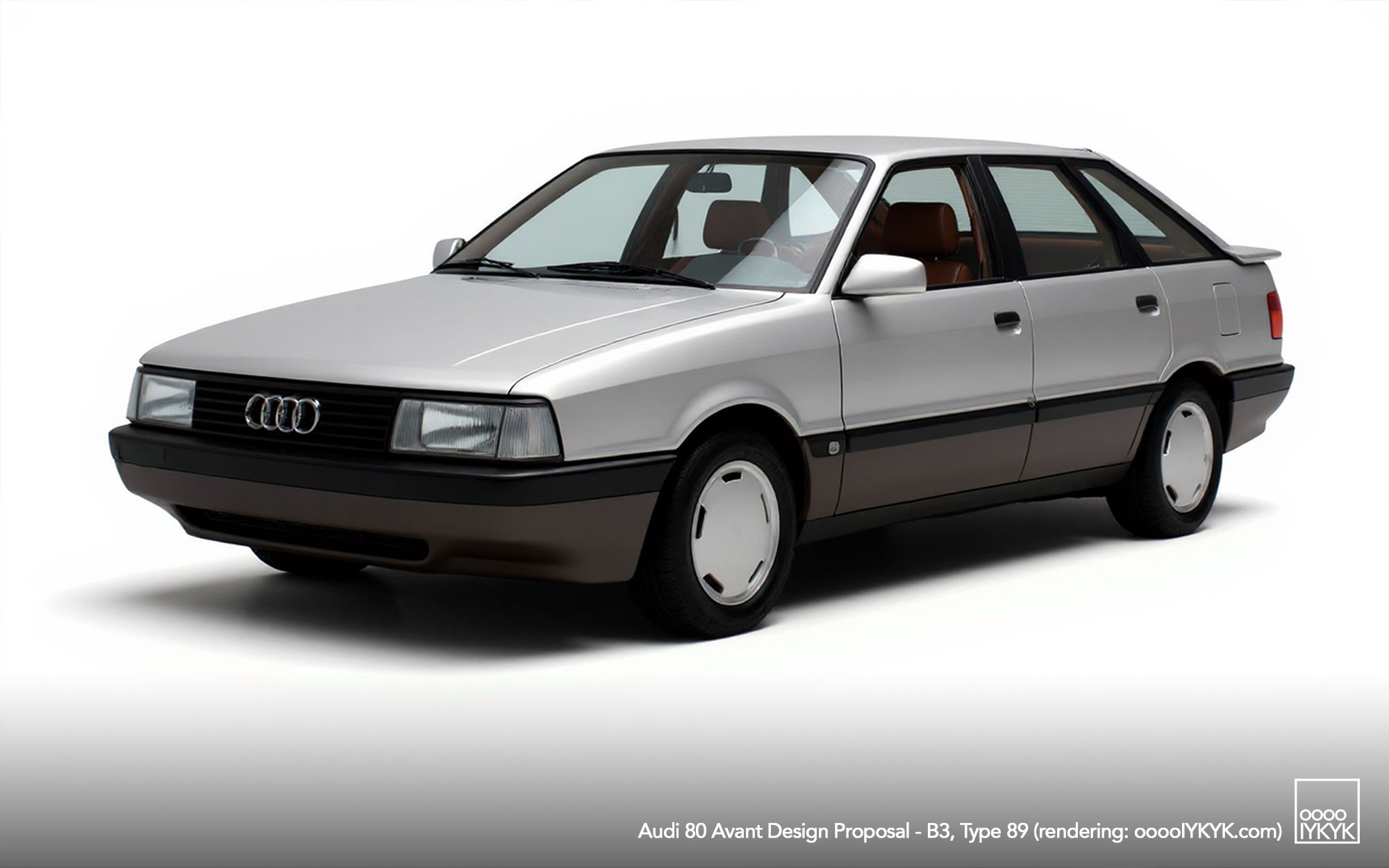
What: Audi 80 Avant Design Proposal
Model Family: 80 (B3, type 89)
Debuted: N/A
Year: 1982 / 1983
Intended Introduction: 1986
Status: Unproduced design proposal
Number Produced: 0, Believed Scale Model Only
Model / Generation Code(s): 80 / type 89
Chassis / Matrix: B3
Body style: 5-door fastback hatchback
Engine: N/A
Transmission: N/A
Power: N/A
Peak Torque: N/A
Weight: N/A
Acceleration (0-100 km / 62 mph: N/A
Paint Color: N/A
RELATED
Concept Cars: N/A
Road Cars: Audi 80 (B3, type 89)
Race Cars: N/A
OVERVIEW
This Audi 80 Avant design proposal was one of two body-style studies explored circa 1982 and 1983 during development of an estate variant for Audi’s then upcoming 80 (B3) generation. Unlike the conventional long-roof station wagon that would later evolve into the production Audi 80 Avant (B4), this proposal adopted a sloping fastback tail and large rear hatch, creating a profile that in modern terminology would more likely align with a “Sportback.”
The design reflected Audi’s experimentation with combining aerodynamic efficiency and cargo versatility, drawing visual inspiration from earlier fastback Avant concepts while aligning with the more rounded, flush-surfaced design language of the B3 Audi 80.
DESIGN CONTEXT & INFLUENCES
During the late 1980s, Audi designers explored multiple directions for extending the Audi 80 range into a five-door configuration. One direction followed the traditional station wagon formula, while the other — represented by this proposal — pursued a more aerodynamic hatchback silhouette.
This fastback concept echoed the five-door configuration of the Audi 100 Avant (C2, type 43), which blended wagon practicality with a sloping rear window. At the same time, the rear proportions and integrated spoiler treatment bore resemblance to the hatchback form of the Audi Coupé (B3), suggesting an attempt to blend that car’s sporty styling with the more practical usability of a five-door.
BODY STYLE & AERODYNAMICS
Unlike a traditional wagon with a near-vertical tailgate, this proposal featured a raked rear hatch that extended the roofline into a smooth, aerodynamic taper. The glasshouse flowed continuously into the rear deck, visually reducing drag and giving the vehicle a more dynamic stance than a conventional estate.
The overall shape aligned with Audi’s aerodynamic priorities of the time, which emphasized rounded surfaces, flush glazing, and reduced visual mass. In contemporary terms, the concept’s proportions might be described as a sport-oriented five-door fastback rather than a traditional wagon.
The idea that an “Avant” had to be more of a conventional station wagon still hadn’t been established. The Audi 100 Avant (C2) had definitely been more of a 5-door hatchback or even Sportback, while its successor the Audi 100 Avant (C3) had followed the same path with a sloped hatchback that closely mirrored design elements also seen in Volkswagen’s Scirocco Mk2 with rear glass rounded at the bottom and bisected by a rear spoiler.
RELATION TO OTHER PROPOSALS
The fastback design was evaluated alongside a more upright, long-roof station wagon concept that more closely resembled a conventional estate. That second direction ultimately informed the production Audi 80 Avant (B4) introduced in the early 1990s.
The production B4 Avant adopted a taller rear cargo area and traditional wagon proportions we think of today when we hear the word “Avant”, prioritizing load capacity and rear headroom over the fastback’s sleeker silhouette. The fastback proposal was therefore not pursued beyond the design-study phase.
SIGNIFICANCE
Although never produced, this Audi 80 Avant design proposal illustrates Audi’s willingness during the B3 era to explore alternative body styles that blended practicality with sport-oriented design. It also foreshadowed later Audi models that would use the “Sportback” designation for fastback-style hatchbacks combining coupe-like rooflines with four or five doors.
The study stands as an example of Audi’s late-20th-century design experimentation, bridging the gap between traditional wagon architecture and the more style-driven, aerodynamically optimized body forms that would become increasingly common in the decades that followed.
REFERENCES
1986 Audi 80 Avant, Car Design Archives
Never Known: 1986 Audi 80 Forward Design Study, Audi Club North America