

MODEL DETAILS
What: Auto Union Type C Grand Prix
Manufacturer: Auto Union AG, Racing Department (Horch Works, Zwickau)
Genre / Series: Grand Prix Racing
Category: 750 kg Formula
Era: Auto Union prewar
Model Family:
Market / Zone: Germany
Season: 1936, 1937
Model / Generation Code(s): Type C
Chassis / Matrix:
Designer: Ferdinand Porsche (P-Wagen design lineage)
TECHNICAL DETAILS
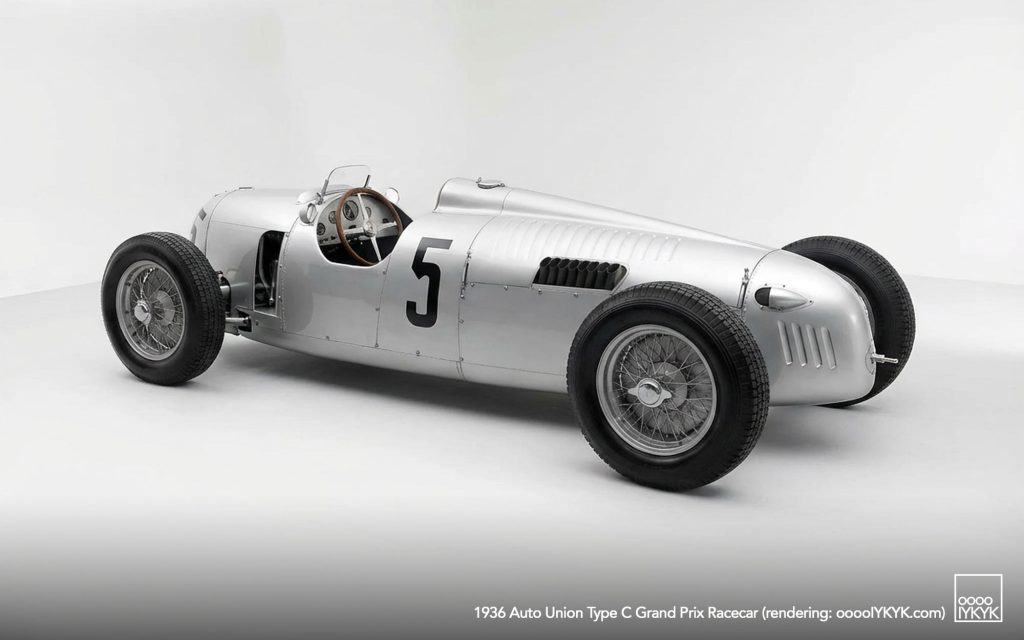
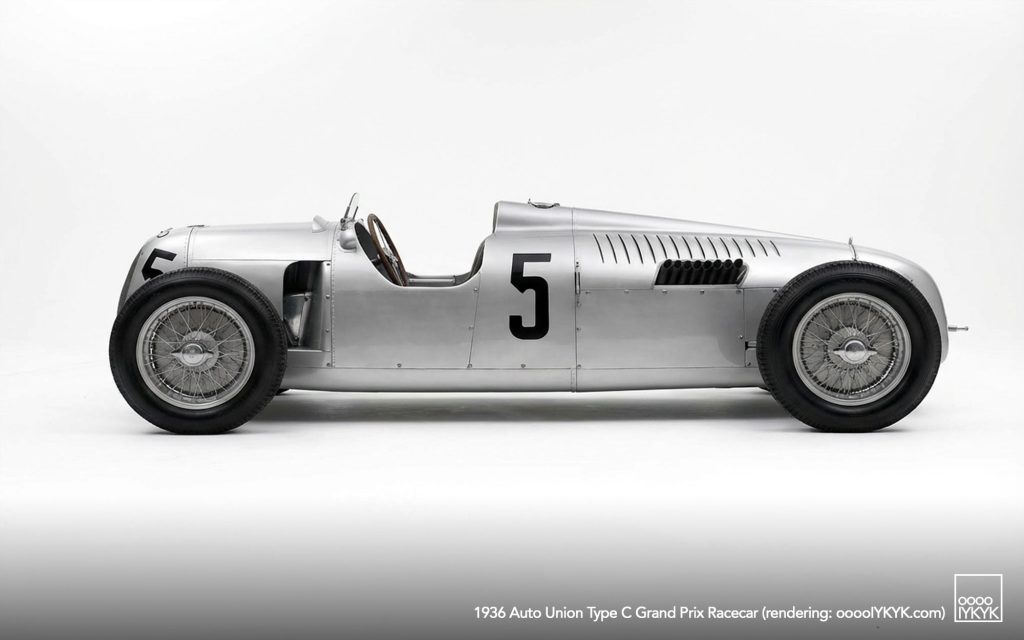
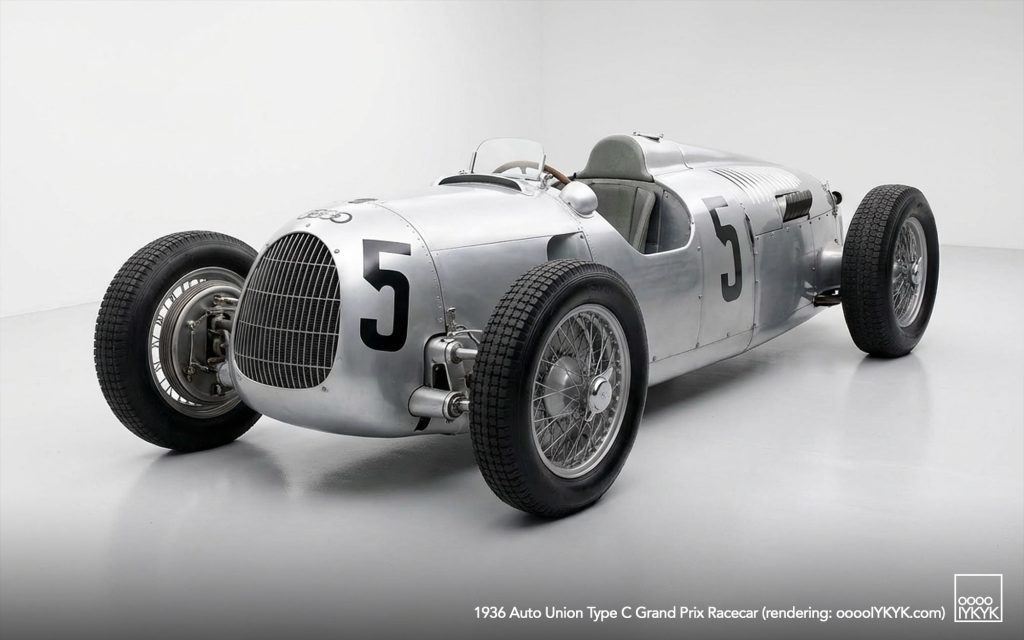
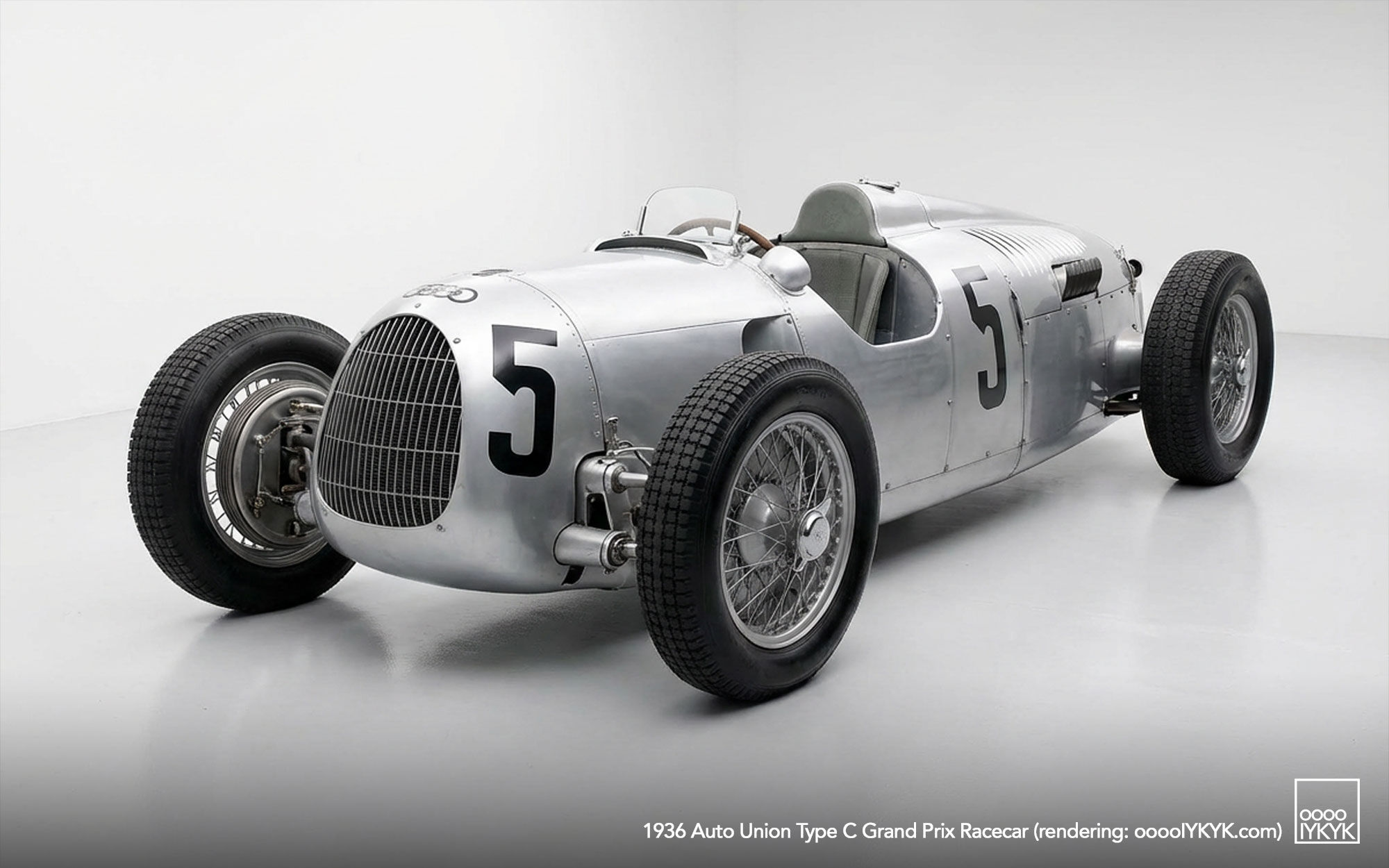
Body Style(s): open-wheel single seat racecar
Chassis Type: Tubular ladder-type frame with aluminium bodywork
Drivetrain Configuration: longitudinal rear mid-engine, rear-wheel drive
Engine(s): Supercharged V16, 45° bank angle
Displacement: 6.0 litres (5,990–6,016 cc depending on version)
Valvetrain:
– Single overhead camshaft per bank
– 32 valves total (2 intake, 2 exhaust per cylinder)
– Pushrod-actuated exhaust valves via overhead tubes
Fuel: High-octane racing blend (typically 70–80% methanol with acetone, benzene, ether, and castor oil variations)
Induction: Roots-type supercharger (~0.7 bar / 10 psi boost)
Power: approx. 520 hp (390 kW) @ ~5,000 rpm
Torque:
Cooling: Front-mounted radiator with plumbing routed through chassis tubes (later revised due to leakage issues)
Top Speed: 330–340 km/h (205–211 mph) depending on gearing and circuit
Transmission(s): 5-speed manual racing gearbox, Rear transaxle integrated with final drive
Differential: ZF limited-slip differential (introduced late in 1935; used throughout 1936–37)
Wheelbase: approx. 2,700 mm
Width: approx. 1,480 mm
Length: approx. 4,200 mm
Height: approx. 1,000 mm
Track: (front/rear): approx. 1,300 / 1,300 mm
Weight (dry): ≤ 750 kg (regulatory limit; actual build ~ 740–750 kg)
Tires: Racing cross-ply tyres from Continental
Wheel Size: Varied by circuit (approx. 19-inch wheels typical)
(Note: Dimensions varied slightly depending on circuit and hill-climb bodywork.)
DRIVERS (SELECTED)
• Bernd Rosemeyer – European Champion, 1936
• Achille Varzi
• Hans Stuck
• Ernst von Delius
• Rudolf Hasse
SUMMARY
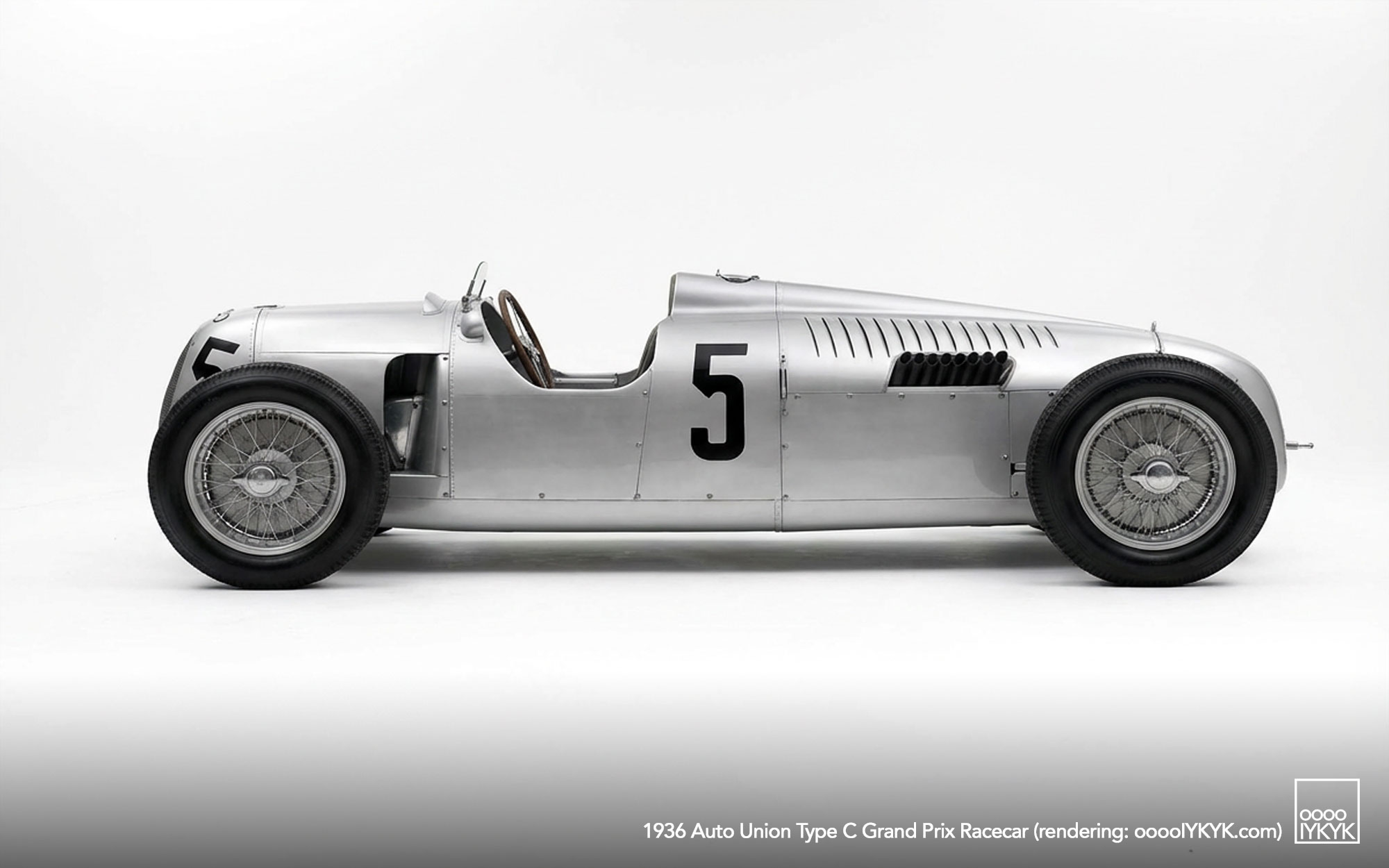
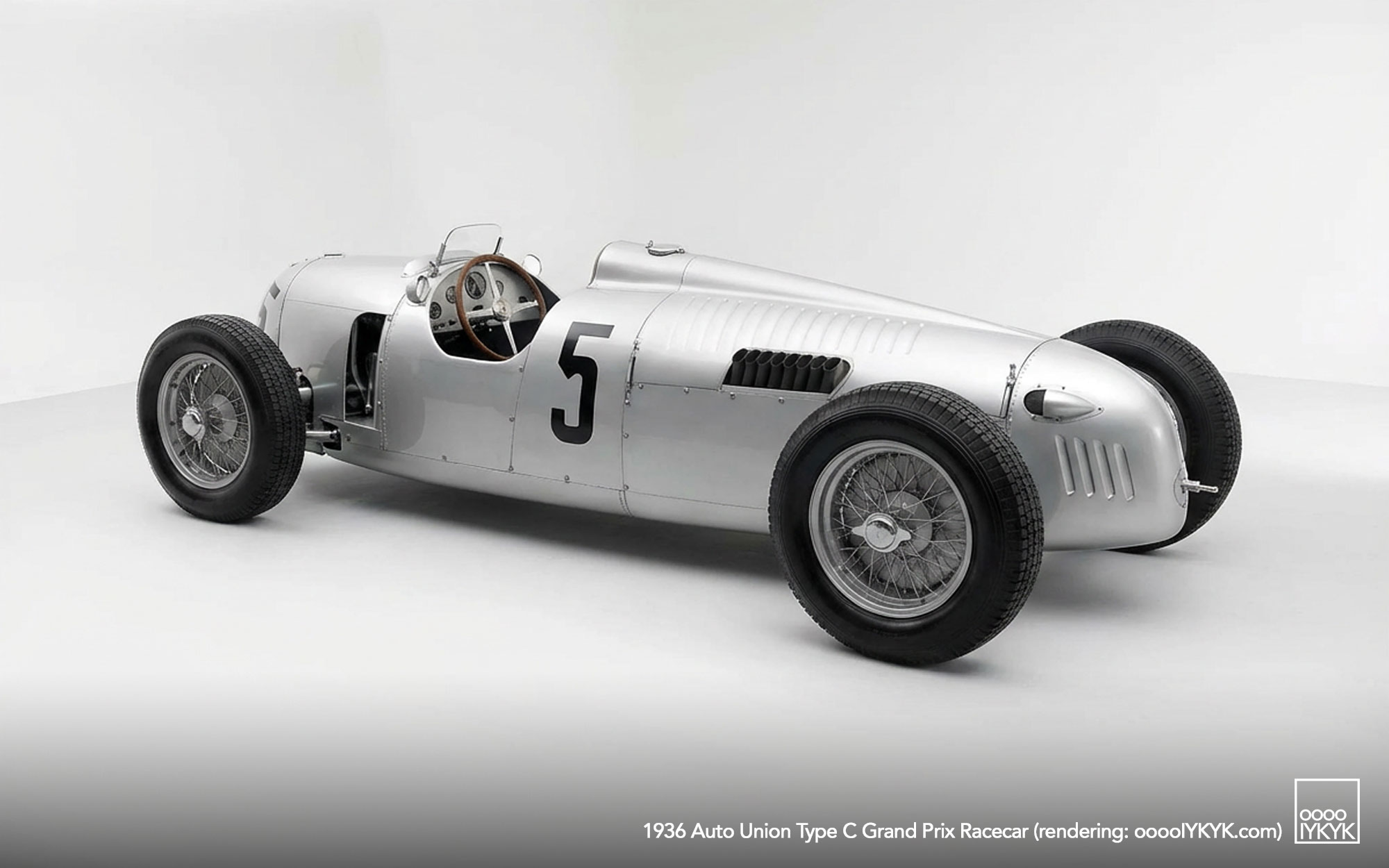
The Auto Union Type C is a Grand Prix racing car developed for the 1936 and 1937 European Championship seasons under the 750-kg formula, and represents the pinnacle of the mid-engined V16 design lineage created by Ferdinand Porsche for Auto Union. Campaigned during the height of the German “Silver Arrows” era, the Type C became the most successful machine ever fielded by Auto Union, securing multiple Grand Prix victories, dominating hill climbs, and helping launch the legendary career of Bernd Rosemeyer. With its six-litre supercharged V16 engine producing approximately 520 hp, the Type C embodied the extreme engineering of prewar Grand Prix racing and remained a technical milestone long after its competitive life ended.
BACKGROUND AND DEVELOPMENT
Auto Union’s racing programme originated with Porsche’s P-Wagen project, which proposed a radical mid-engined layout inspired in part by earlier concepts such as the 1923 Benz Tropfenwagen. After receiving state-backed motorsport funding announced by Adolf Hitler in 1933, Auto Union acquired Porsche’s project and established a dedicated racing department at the Horch works in Zwickau. The resulting Auto Union racing cars—Types A, B, C, and later D—were all constructed to the 750-kg weight limit and represented some of the most advanced racing machinery of their time.
By 1936, successive development of the Type A (1934) and Type B (1935) culminated in the Type C, which enlarged Porsche’s supercharged V16 engine to the maximum practical displacement permitted by the weight formula. The car was designed to achieve the highest possible power output while staying within the 750-kg mass limit, resulting in a power-to-weight ratio that remains extreme even by modern standards.
DESIGN AND ENGINEERING
The Type C featured a distinctive rear mid-engine layout, placing the supercharged V16 behind the driver and ahead of the rear axle—decades before mid-engined designs became standard in Formula One. The layout provided improved traction under acceleration and reduced the polar moment of inertia, though at the cost of challenging handling characteristics.
Key engineering features included:
- Engine: 6.0-litre supercharged V16
- Output: approximately 520 hp
- Supercharger: Roots-type, delivering up to ~10 psi boost
- Chassis: lightweight structure with central fuel tank for stable weight distribution
- Suspension: Porsche-designed system with swing axles at the rear, contributing to oversteer
- Bodywork: lightweight aluminium, developed with wind-tunnel testing at the German Institute for Aerodynamics
Although the mid-engine design improved straight-line performance and traction, the heavy engine and swing-axle rear suspension created significant oversteer, making the car extremely difficult to master. Only a few drivers—including Rosemeyer and Achille Varzi—were able to exploit the Type C’s enormous potential consistently.
THE 1936 SEASON: TYPE C DOMINANCE
The 1936 racing season became one of the most successful campaigns for any prewar Grand Prix car. Auto Union Tradition records that the Type C:
- Won three of the five Grand Prix counting toward the European Championship
- Won half of all circuit races in which it competed
- Won all hill-climb events contested by Auto Union
- Became the most successful German racing car of its time
Central to this success was Bernd Rosemeyer, hired in 1935 as a relatively unknown junior driver. In 1936 he delivered a breakout performance that made him one of the legends of prewar motorsport:
- European Champion (Drivers’ Championship)
- German Road Racing Champion
- German Hill-Climb Champion
- Seven major victories, including three Grand Prix wins
His aggressive driving style and ability to handle the Type C’s difficult dynamics set him apart from his contemporaries. Historian accounts emphasize that 1936 “belonged to Rosemeyer.”
THE 1937 SEASON
The Type C design remained largely unchanged for 1937, continuing to compete against the increasingly powerful Mercedes-Benz W125. Despite Mercedes’ advancements, the Type C remained competitive and secured several key victories:
- Wins at the Donington Grand Prix, Eifelrennen, Coppa Acerbo, and the Vanderbilt Cup
- Belgian Grand Prix victory with Rudolf Hasse
- Multiple podium finishes by Rosemeyer, Stuck, Varzi, and von Delius
While Mercedes won more races overall in 1937, the Type C remained the primary challenger and remained admired for its prodigious speed and technical audacity.
V16 ENGINE CHARACTERISTICS
The Porsche-designed V16 used in the Type C was the largest-displacement and most powerful engine developed under the 750-kg formula. Notable characteristics included:
- Two cylinder blocks set at a 45-degree angle
- Hemispherical combustion chambers
- Single overhead camshaft per bank operating 32 valves
- Pushrods and rocker arms used for exhaust valve operation
- Exceptional torque at low RPM, allowing Rosemeyer to lap the Nürburgring entirely in a single gear as a demonstration of engine flexibility
The engine enabled the Type C to achieve speeds in excess of 250 mph (415 km/h) in specialized streamliner configurations, including record attempts.
HANDLING AND DRIVER EXPERIENCE
While blisteringly fast, the Type C was notoriously challenging to drive. Its handling tendencies reflected:
- Heavy rearward weight bias (around 60%)
- High power output that could induce wheelspin above 160 km/h (100 mph)
- Swing-axle dynamics that produced sudden oversteer
- A forward driving position that created unique visual and physical cues
Auto Union lacked a driver-engineer equivalent to Mercedes’ Rudolf Uhlenhaut, so the company pioneered the use of onboard measuring instruments—including a mechanical data recorder—to aid chassis development.
LEGACY
The Auto Union Type C represents one of the most ambitious engineering achievements of the prewar racing era. Its legacy includes:
- Establishing mid-engine layouts as a viable Grand Prix design decades before their widespread adoption
- Demonstrating the extreme potential of supercharged, large-displacement engines in lightweight racing chassis
- Cementing Auto Union as a powerhouse rival to Mercedes-Benz during the Silver Arrows era
- Launching the enduring legend of Bernd Rosemeyer
- Influencing later Auto Union designs, including the Type D under the new 1938 regulations
Today, rebuilt Type C vehicles—crafted by Audi’s heritage program in collaboration with original Auto Union drawings—are exhibited at Audi museum mobile and select automotive institutions. They serve as striking reminders of the technological experimentation and national investment that characterized Grand Prix racing in the 1930s.
The Type C remains a symbol of the height of the Silver Arrows era: a machine of extraordinary speed, demanding handling, and engineering daring unmatched before or since.
REFERENCES
Auto Union Racing Cars, Wikipedia
1936 Auto Union Typ C, Supercars.net
PHOTO GALLERY