

MODEL DETAILS
What: Horch 11/22 hp
Genre / Series: Rally
Racing Class:
Era: Horch
Model Family:
Market / Zone: Germany
Season: 1906
Model / Generation Code(s):
Chassis / Matrix:
RACE RESULTS
Herkomer Competition, June 5-13, 1906
- 1st Rudolf Stöß🥇
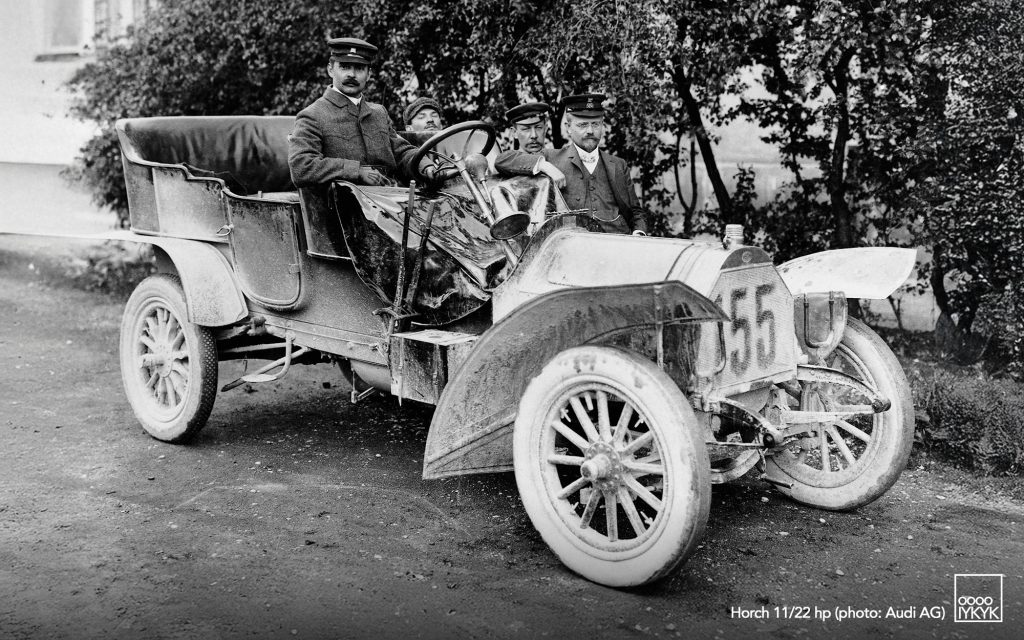
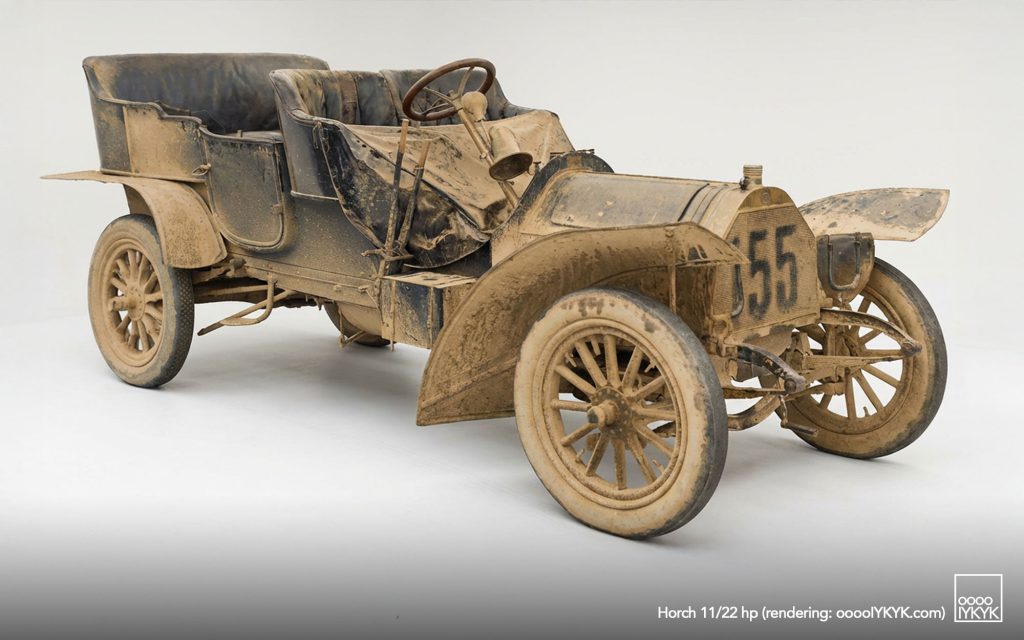
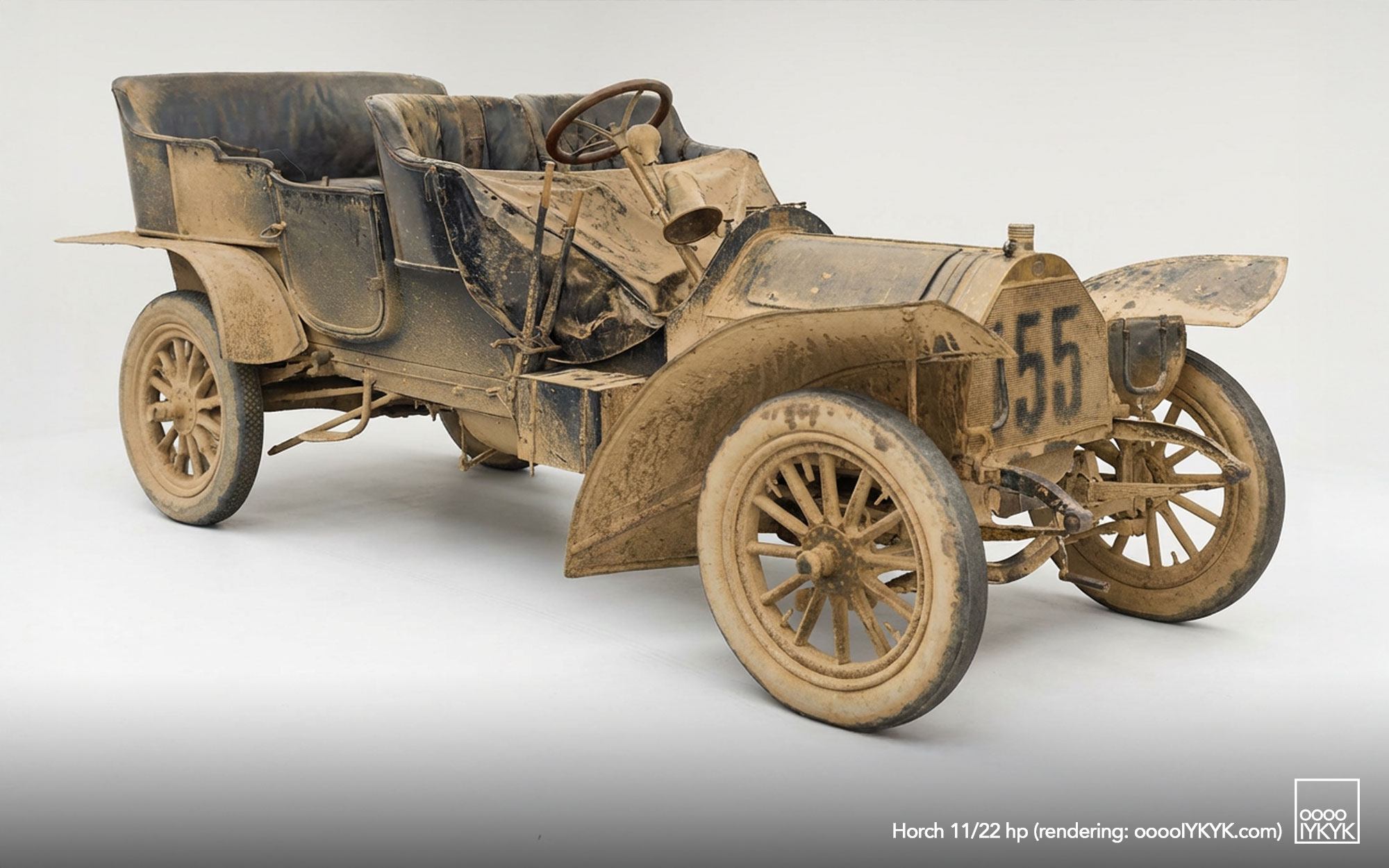
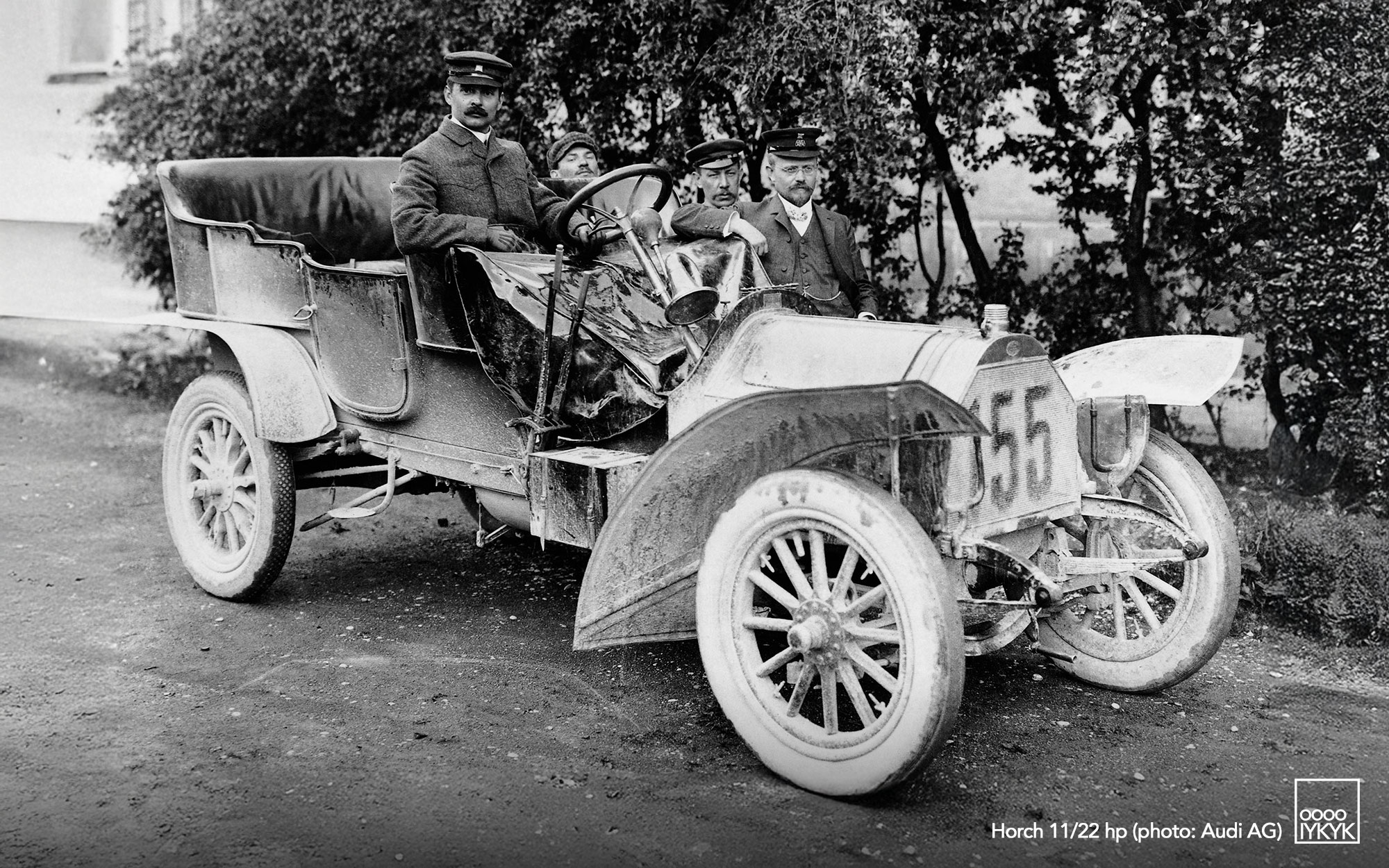
The Horch 11/22 hp, also known as the Horch 18–22 hp, was an early four-cylinder automobile produced by Horch & Cie. Motorwagenwerke in Zwickau and is most notable for winning the 1906 Herkomer Competition, one of the most demanding long-distance automotive trials of its era. Driven by Dr. Rudolf Stöß, a Zwickau attorney, the Horch achieved a landmark victory that established the reputation of August Horch’s young company and demonstrated the competitiveness of its engineering just five years after Horch built his first automobile.
BACKGROUND AND DEVELOPMENT
In 1904, August Horch relocated his company from Reichenbach to Zwickau, a move that marked the beginning of Horch’s rapid rise as a high-quality automobile manufacturer. Horch’s engineering philosophy centered on producing strong, reliable, and technically advanced cars while proving their performance through competitive events. Motorsport trials, then in their infancy, served as crucial public demonstrations of durability and mechanical excellence.
The model that earned Horch its early success was the Horch 18–22 hp, a 2.6-liter four-cylinder vehicle produced in Zwickau. Known interchangeably as the Horch 11/22 hp under contemporary German tax-horsepower classifications, the model exemplified Horch’s commitment to robust construction and reliability—key attributes in long-distance endurance competitions.
THE 1906 HERKOMER COMPETITION
The Herkomer Competition (Herkomer-Konkurrenz), established by the artist and automotive enthusiast Hubert von Herkomer, was designed to test automobiles in real-world conditions rather than in short-distance speed contests. The second running of the event, held 5–13 June 1906, was regarded as one of the most challenging automotive trials of its time.
The 1906 route covered 1647–1648 km, divided into five daily stages, and passed through:
- Frankfurt am Main
- Munich
- Linz
- Vienna
- Semmering Pass
- Klagenfurt
- Innsbruck
- Zirlerberg Pass
- Return to Munich via Forstenrieder Park
The terrain included Alpine grades, poor road surfaces, and significant elevation changes—conditions that emphasized endurance, torque, and mechanical reliability.
Competition records from Mercedes-Benz note that 41 Benz and Mercedes touring cars participated in the event. The final standings list nearly exclusively vehicles from those two manufacturers—with the single exception of the first-place finisher: the Horch.
VICTORY OF THE HORCH 11/22 HP
Dr. Rudolf Stöß, driving the Horch 11/22 hp, secured overall victory, defeating a field almost entirely populated by Benz and Mercedes automobiles. Second place went to Fritz Erle in a Benz, and third to Willy Pöge in a Mercedes.
The triumph was particularly significant given August Horch’s personal history. Horch had worked for Carl Benz from 1896 to 1899 as head of the Motor Vehicle Production Department in Mannheim before leaving to pursue his own automotive designs. His victory in a competition filled almost entirely with cars from his former employer carried strong symbolic weight, demonstrating that Horch had successfully established a technically competitive alternative in the German automotive landscape.
SIGNIFICANCE AND LEGACY
The 1906 victory played a critical role in elevating the status of Horch as a premium manufacturer. It proved the capability of the brand in endurance events and aligned directly with August Horch’s philosophy of validating engineering quality through motorsport.
Key impacts included:
- Enhanced reputation for durability and performance
- Increased visibility for the Horch brand across Germany and Europe
- Reinforcement of Zwickau’s identity as an emerging automotive center
- A foundational success that set the stage for later Horch eight-cylinder luxury models
For August Horch personally, the triumph was an early validation of his independent engineering vision and a symbolic milestone, achieved barely five years after producing his first self-designed automobile.
Today, the Horch 11/22 hp stands as an important artifact of early automotive history, representing both the beginnings of German endurance competition and the formative years of a company that would later become part of Auto Union, the precursor to modern Audi.
OVERALL RANKING
| Pos. | Start No. | Driver | Car | Points |
| 1 | 155 | Rudolf Stöß | Horch | 4 57/60 |
| 2 | 78 | Fritz Erle | Benz 40 hp | 4 51/60 |
| 3 | 18 | Willy Pöge | Mercedes 60 hp | 4 45/60 |
| … | ||||
| 5 | 93 | Carl Neumaier | Benz 40 hp | 4 00/60 |
| 6 | 19 | Hermann Weingand | Mercedes 60 hp | 3 47/60 |
| 7 | 1 | Otto Hieronimus | Mercedes 90 hp | 3 23/60 |
| 8 | 24 | von Lengerke | Mercedes 70 hp | 3 19/60 |
source: Mercedes-Benz Archive
PHOTO GALLERY