

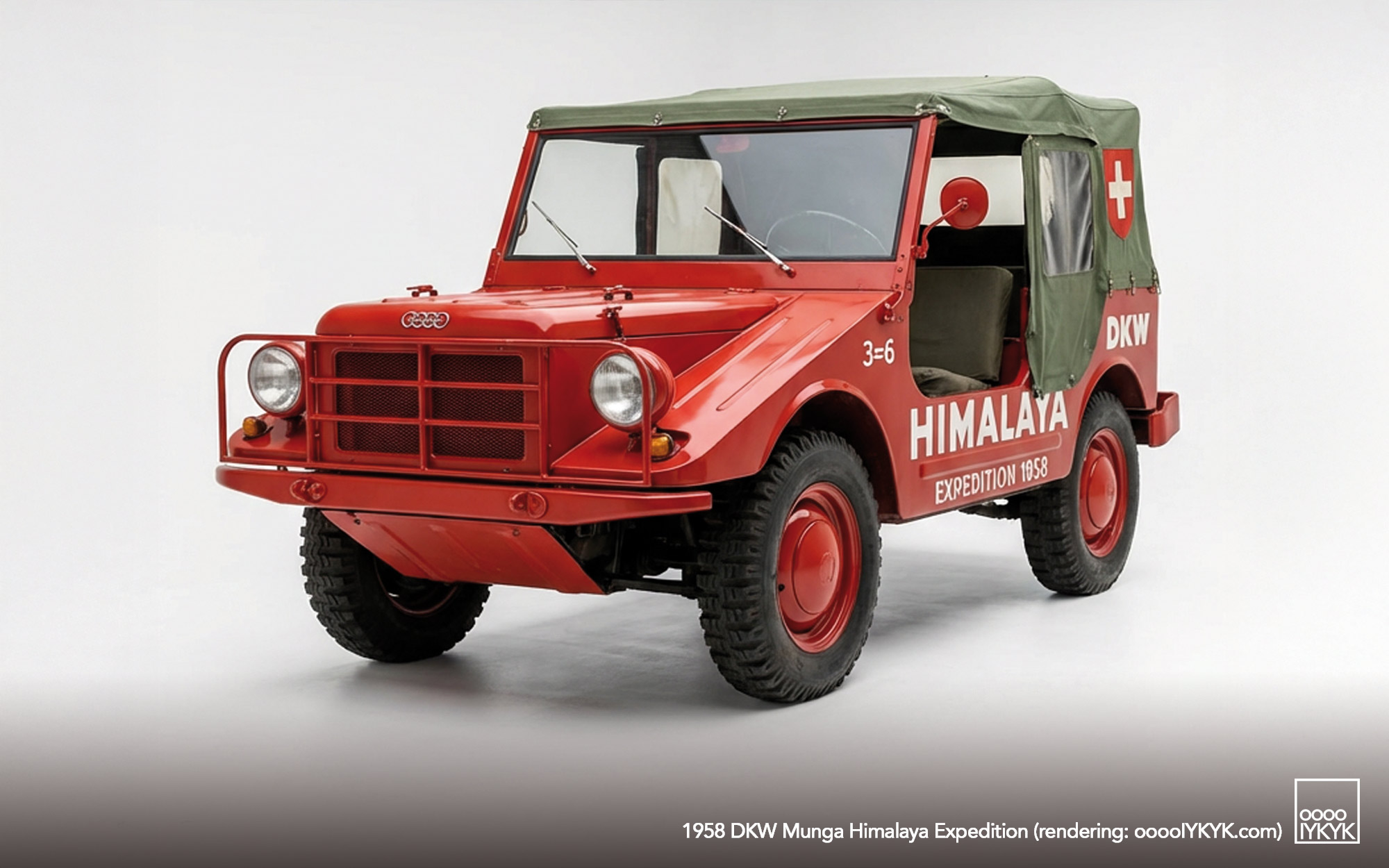

The 1958 DKW Munga Himalaya Expedition refers to the overland journey undertaken in early 1958 by members of the Swiss Dhaulagiri expedition using two DKW Munga four-wheel-drive vehicles (also identified in period sources as DKW F91 and F91/4). While the primary purpose of the journey was logistical support for a mountaineering attempt on Dhaulagiri in Nepal, the vehicles’ performance attracted publicity for Auto Union, which had recently introduced a more powerful version of the Munga. Photographs from the journey, including an image taken in Kathmandu, later circulated in automotive publications and model representations, contributing to the Munga’s reputation for extreme-terrain capability.
BACKGROUND
The DKW Munga, produced by Auto Union in Ingolstadt from 1956, was designed as a lightweight, mechanically simple multi-purpose off-road vehicle for both civilian and military applications. Early variants, using DKW’s established two-stroke three-cylinder engine, were valued for robustness but often regarded as underpowered relative to competing Geländewagen of the period. In 1958 Auto Union introduced a more powerful engine option in response to military procurement feedback and export expectations.
This improvement coincided with preparations for the Swiss Dhaulagiri expedition of 1958 and its likely this correlated given the “3=6” branding on the side of the vehicle. The “3=6” on an Auto Union (DKW) meant its 3-cylinder, 2-stroke engine produced power as smoothly as a 6-cylinder, 4-stroke engine, thanks to power strokes on every crankshaft revolution. Auto Union began using this marketing slogan for their DKW 3=6 (F91/F93/F94 models) as far back as their debut at the Frankfurt Auto Show in 1953, highlighting quiet power and smooth feel despite its small size. Whether or not the Himalayan Munga had the 1958 engine improvement remains to be seen, but promoting the “3=6” power of the 2-stroke 3-cylinder was no doubt in the mind of Auto Union marketing executives.
Five members of the expedition’s road party departed Zürich in January in two DKW 4×4 vehicles, intending to transport personnel and equipment overland to India before proceeding to Nepal for the mountaineering campaign. The overland journey, which covered roughly 10,000 kilometres across winter conditions in Turkey, arid regions of Iran and Pakistan, and the Indian subcontinent, provided an unplanned but highly visible endurance test for the updated Munga design.
ROUTE & JOURNEY
Contemporary Swiss Alpine Club reports describe the road team departing on 15 January 1958 and reaching New Delhi on 7 March. Their route passed through Austria, Yugoslavia, Bulgaria, Turkey (including a well-documented storm near Mount Ararat), Iran, Pakistan, and finally northern India. The Mungas are reported to have endured heavy snow, extreme cold, poor road surfaces, and dust without significant mechanical issues—conditions often cited later in Auto Union’s informal accounts of the expedition.
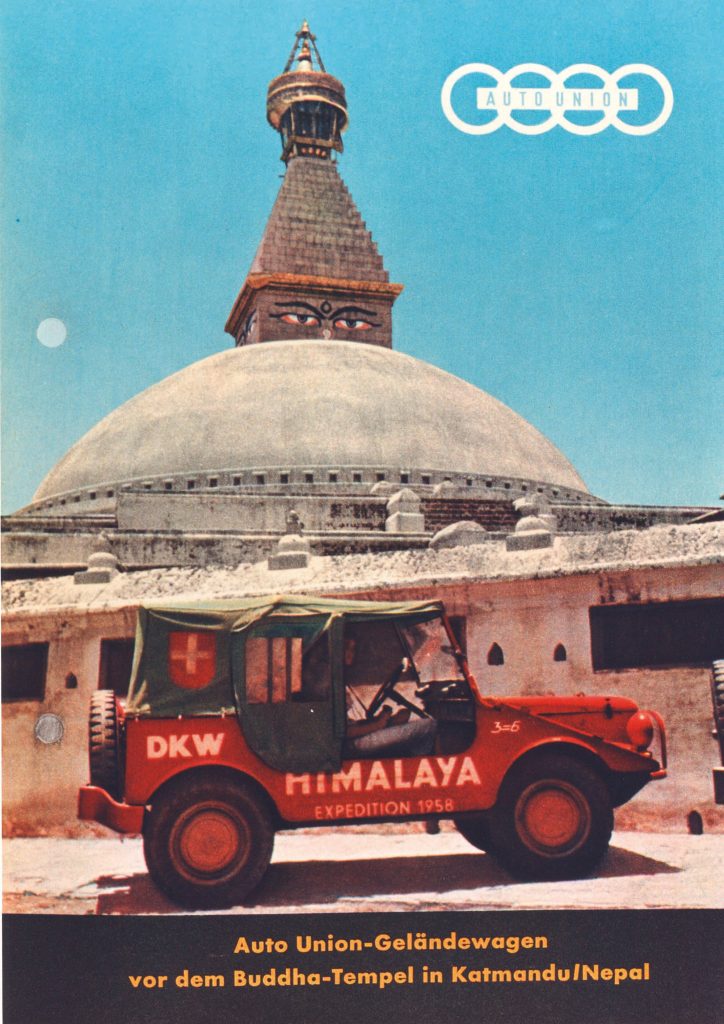
After India, the vehicles continued toward Nepal. A widely circulated period photograph shows one of the DKW 4×4s in Kathmandu in front of a Buddhist temple, confirming that at least one vehicle reached the Kathmandu Valley. Likely both made it though, as the back bumper and part of the spare tire of the second Munga appears to be seen at the far right edge of the promotional image. The extent to which the Mungas were driven beyond Kathmandu is not fully documented, and typical mountaineering logistics of the era would have required pack animals and porters for the final approach to the Dhaulagiri region.
PUBLICITY & AUTO UNION INVOLVEMENT
Although Auto Union did not formally organise the expedition, the vehicles carried side graphics identifying the journey along with “DKW” and “3=6” branding, and the company appears to have recognized its promotional value. The timing—coinciding with the introduction of the more powerful engine—suggests that the expedition served informally as a demonstration of the vehicle’s improved performance.
Model manufacturers in later decades (including Minichamps and Starline) produced 1:43 replicas of “DKW Munga – Himalaya Expedition 1958,” drawing on period photographs and reinforcing the association between the expedition and the vehicle’s endurance reputation. These models typically depict the red-painted vehicles with expedition markings similar to those seen in surviving photographs.
The story’s endurance within DKW and Auto Union enthusiast circles parallels other automotive publicity feats of the mid-20th century, where vehicle manufacturers often highlighted overland expeditions to emphasise capability, durability, and suitability for government or defence procurement.
The photo at the top of this story was created with A.I. tools for this website. Whether or not any of these vehicles survived is unknown. It remains possible that one or both expedition vehicles survive but either are unrecognized as such, destroyed or in private hands without publicly verified provenance.
ROAD ACCESS TO NEPAL AND KATHMANDU IN 1958
The significance of motor vehicles reaching Kathmandu in the late 1950s is underlined by the scarcity of road infrastructure at the time. A well-known photograph from the same era shows a Mercedes-Benz being physically carried by porters on a mountain trail near Kathmandu—an image that has been widely reproduced due to its dramatic illustration of limited road access into the valley.
Against this backdrop, the arrival of the DKW Mungas by road held symbolic value. Reaching Kathmandu by motor vehicle was both unusual and logistically challenging, reinforcing the perceived toughness of any machine capable of completing the journey. For Auto Union, whose Munga competed with more powerful four-wheel-drive designs for military contracts, such imagery offered a compelling demonstration of reliability, mechanical simplicity, and real-world capability.
ROLE IN THE 1958 SWISS DHAULAGIRI EXPEDITION
Once in India and Nepal, the DKWs primarily served as transport for personnel and equipment to staging points accessible by road. The mountaineering team ultimately advanced toward Dhaulagiri using traditional Himalayan expedition methods, establishing base camp on the Mayangdi glacier at approximately 4,600 metres. The 1958 expedition did not achieve the summit, but it laid groundwork for the successful 1960 Swiss expedition.
The Munga vehicles returned to Europe after the conclusion of the 1958 campaign. Accounts from expedition members—some published in memoir form decades later—often note the reliability and versatility of the DKWs, underscoring their suitability for difficult terrain.
LEGACY & QUATTRO
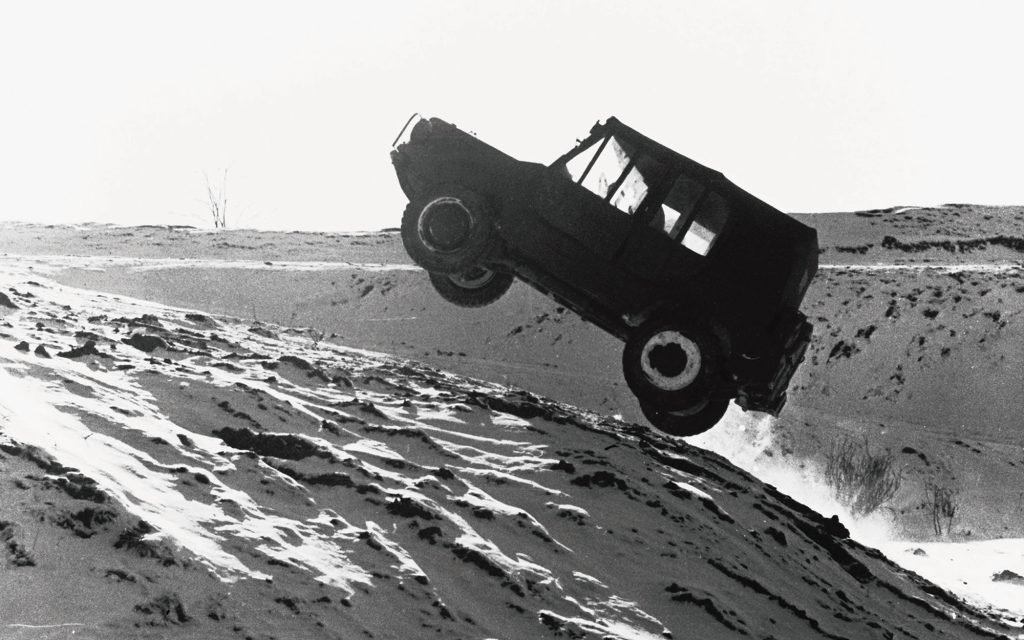
The 1958 Himalaya journey is today one of the best-known historical anecdotes associated with the DKW Munga. Although modest in scale, the expedition demonstrated the practical limits of light four-wheel-drive transport across Eurasia and into the Himalayan foothills at a time when such travel was still relatively rare. It also contributed to a small but lasting body of imagery that positioned the Munga as a capable and dependable Geländewagen for both military and civilian use.
Within Auto Union and DKW enthusiast communities, the expedition is frequently cited in historical summaries, model representations, and retrospective publications on the marque’s off-road vehicles. The surviving Kathmandu photograph, in particular, represents an emblem of the Munga’s role in mid-century automotive expedition history. That it would also lead to the conception of quattro all-wheel drive technology is notable.
REFERENCES
Primary & Contemporary Expedition Sources
Swiss Alpine Club – Die Alpen / Himalaya-Chronik 1958
Eiselin, Max; Stäuble, Werner; et al. “Himalaya-Chronik 1958.” Die Alpen, Swiss Alpine Club, 1958.
Summary of the 1958 Dhaulagiri expedition, including details of the DKW vehicles’ overland journey.
Eiselin, Max – 50 Jahre Dhaulagiri (retrospective)
Eiselin, Max. 50 Jahre Dhaulagiri. Swiss Alpine Club, 2008.
Contains retrospective accounts of the 1958 road party using two DKW off-road vehicles; includes photographic material.
Winterhalter, Kaspar – Der letzte Achttausender
Winterhalter, Kaspar. Der letzte Achttausender: Die Geschichte der Schweizer Dhaulagiri-Expeditionen. Hallwag, Bern, 1962.
Provides a narrative of the 1958 and 1960 expeditions; includes the overland journey via DKW 4×4 vehicles.
DKW Munga – Manufacturer Information
Auto Union GmbH. DKW Munga Technical Literature and Sales Brochures (various). Ingolstadt, 1956–1960.
Primary manufacturer data on the F91/F91/4 Munga, including engine upgrades introduced in 1958.
Pietsch, Karl-Heinz – DKW Munga Monograph
Pietsch, Karl-Heinz. DKW Munga: Der geländegängige DKW der Auto Union. 2nd ed., Heel Verlag, Königswinter, 1996.
A technical and historical monograph on the Munga; includes sections on testing, exports, and publicity activities.
Photographic Reference
Kathmandu DKW Photograph
Unknown photographer. “Auto Union Geländewagen vor dem Buddha-Tempel in Kathmandu / Nepal (1958).”
Published in various automotive-history archives; circulation documented in enthusiast literature and model-car references. Sourced here from Audi AG.
Related context sources (roads, Kathmandu logistics, Mercedes photograph)
PrewarCar – Mercedes-Benz Carried to Kathmandu
PreWarCar.com. “Carrying a Controversial Car to Kathmandu.” Accessed YYYY-MM-DD.
Describes the well-known image of a Mercedes-Benz being transported by porters into Kathmandu, illustrating road limitations in the 1950s.
Historical road access to Nepal
Hagen, Toni. Nepal: The Kingdom in the Himalayas. Oxford University Press, 1960.
One of the earliest systematic surveys of Nepal’s geography and infrastructure; describes the absence of reliable road access to Kathmandu before the 1960s.
Model-car documentation (commonly cited in secondary automotive histories)
Minichamps / Starline model documentation
Starline Models / Minichamps. DKW Munga 4 – Himalaya Expedition 1958 (1:43 scale), product literature and catalogues.
Cites the Munga’s participation in the 1958 Himalaya expedition and includes artwork based on period photographs.
EXTERNAL LINKS
PreWarCar – “Carrying a Controversial Car to Kathmandu.” A period photograph and historical note illustrating the difficulty of bringing motor vehicles into Kathmandu in the 1950s.
https://www.prewarcar.com/carrying-a-controversial-car-to-kathmandu
Swiss Alpine Club (SAC) – Digital archive of Die Alpen. Repository for mountaineering reports including the 1958 Dhaulagiri expedition summaries.
https://www.sac-cas.ch/de/die-alpen/
Franschhoek Motor Museum – DKW Munga overview. Background information on preserved examples of the Munga in museum collections.
https://www.fmm.co.za/
DKW Munga enthusiasts’ registry (DKW IG / Munga IG Germany). Community-maintained technical data, surviving-vehicle records, and period literature references.
https://www.dkw-munga-ig.de/
(Note: community site; reliability depends on sourced material.)
Auto Union / Audi Tradition. Corporate heritage archive with technical materials on DKW vehicles, including the Munga (F91/F91/4).
https://www.audi.com/tradition
Model documentation – Minichamps / Starline “DKW Munga Himalaya Expedition 1958.” Information about commercially produced scale models derived from period photographs.
https://www.minichamps.de/
https://www.starline-models.de/
FURTHER READING
Winterhalter, Kaspar. Der letzte Achttausender: Die Geschichte der Schweizer Dhaulagiri-Expeditionen. Bern: Hallwag, 1962.
Detailed historical account of the 1958 and 1960 Swiss expeditions; includes contextual references to the overland journey using DKW vehicles. (German)
Eiselin, Max. 50 Jahre Dhaulagiri. Swiss Alpine Club, 2008.
Retrospective publication containing photographs and narrative descriptions of the DKW Munga road party in 1958. (German)
Eiselin, Max; Stäuble, Werner; et al. “Himalaya-Chronik 1958.” Die Alpen, Swiss Alpine Club, 1958.
Contemporary reporting on the Dhaulagiri expedition; mentions the Zürich-to-Delhi vehicle journey. (German)
Pietsch, Karl-Heinz. DKW Munga: Der geländegängige DKW der Auto Union. 2nd ed., Königswinter: Heel Verlag, 1996.
Comprehensive technical and historical monograph on the Munga, including development, military evaluation, and early promotional uses. (German)
Hagen, Toni. Nepal: The Kingdom in the Himalayas. Oxford University Press, 1960.
A foundational geographic and infrastructural survey of Nepal during a period when road access to Kathmandu was extremely limited; provides context for the significance of vehicle expeditions.
Audi Tradition Archives. Auto Union DKW Munga Technical Literature (1956–1960). Ingolstadt: Auto Union GmbH.
Period documentation on vehicle specifications, including updates introduced in 1958.
Koblmüller, Manfred. Auto Union und DKW: Geschichte einer Marke. Motorbuch Verlag, 2010.
Broader history of DKW and Auto Union with sections on post-war models and light off-road vehicles. (German)