


MODEL DETAILS
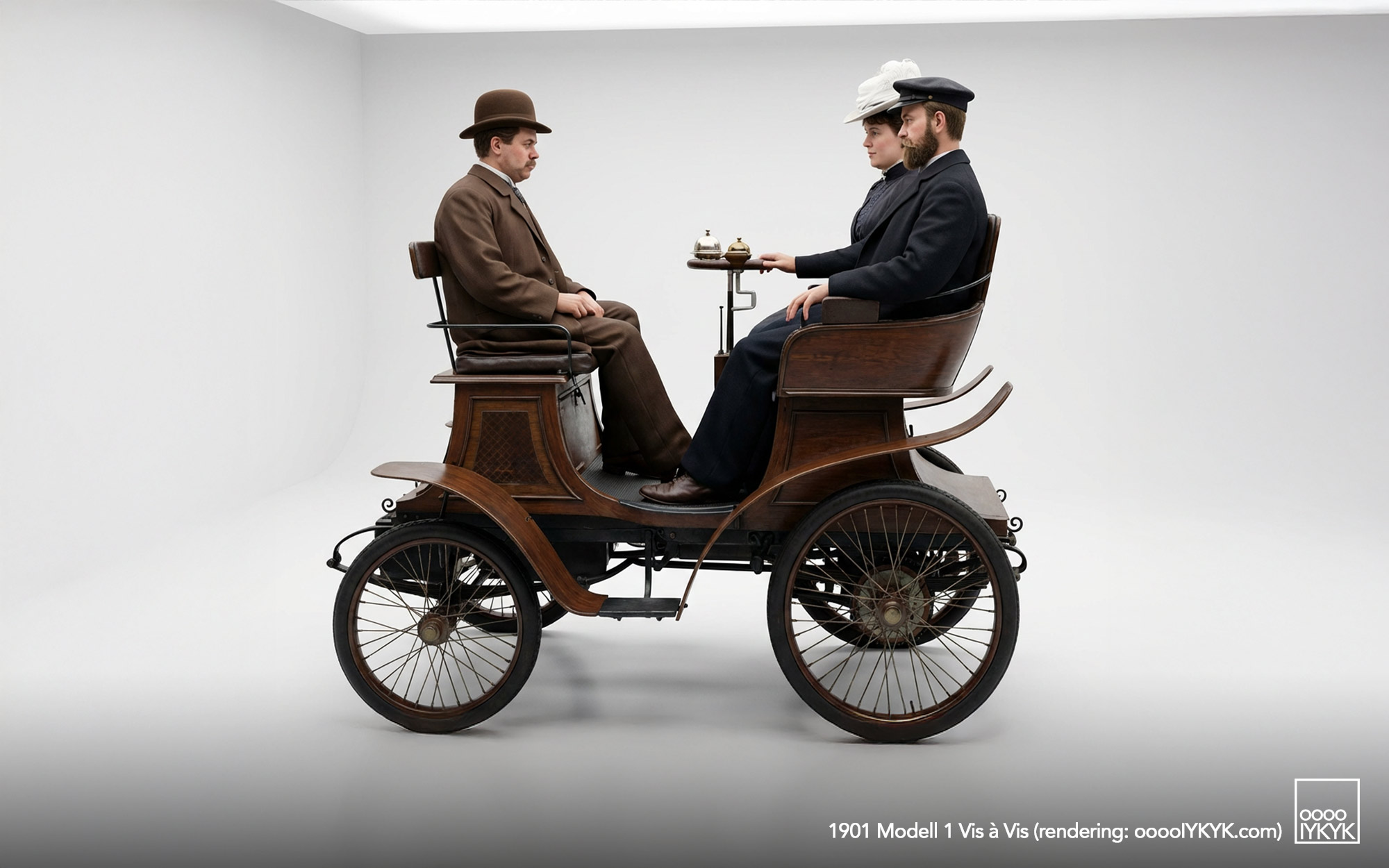
What: Horch Modell 1 Vis à Vis
Brand / Era: Horch
Model Family: Modell 1
Market / Zone:
Year: 1900, 1901
Number Produced:
Model / Generation Code(s): Modell 1
Chassis / Matrix:
Engine: 2-cylinder, Horizontally Opposed
Fuel Type(s):
Horsepower: 4 to 5 hp
Peak Torque:
Top Speed: 30 km/h, 18.6 mph
SUMMARY
The Horch Modell 1 Vis à Vis is the first automobile produced by August Horch and the earliest known vehicle of the Horch brand, completed in 1900. Built shortly after Horch founded his own company in Cologne in 1899, the Modell 1 marks the beginning of the engineering lineage that would ultimately evolve into Audi. The car is notable for its early automotive innovations, its face-to-face seating configuration, and its place in the formative years of German motor manufacturing.
BACKGROUND
August Horch (1868–1951) trained as an engineer and joined Carl Benz in Mannheim in 1896 as head of Motor Vehicle Production. Though ambitious and technically inventive, Horch found his proposals repeatedly constrained at Benz. Seeking independence to execute his ideas, he established A. Horch & Co. in Cologne in 1899. Initially, the company focused mainly on repairing engines, while Horch simultaneously began work on his first self-built automobile.
Horch’s early engineering contributions included patents such as an improved commutator switch designed to accelerate engine ignition. These technical developments, combined with his interest in building larger, more powerful, and more refined cars, informed the direction of his first prototype.
DEVELOPMENT OF THE MODELL 1
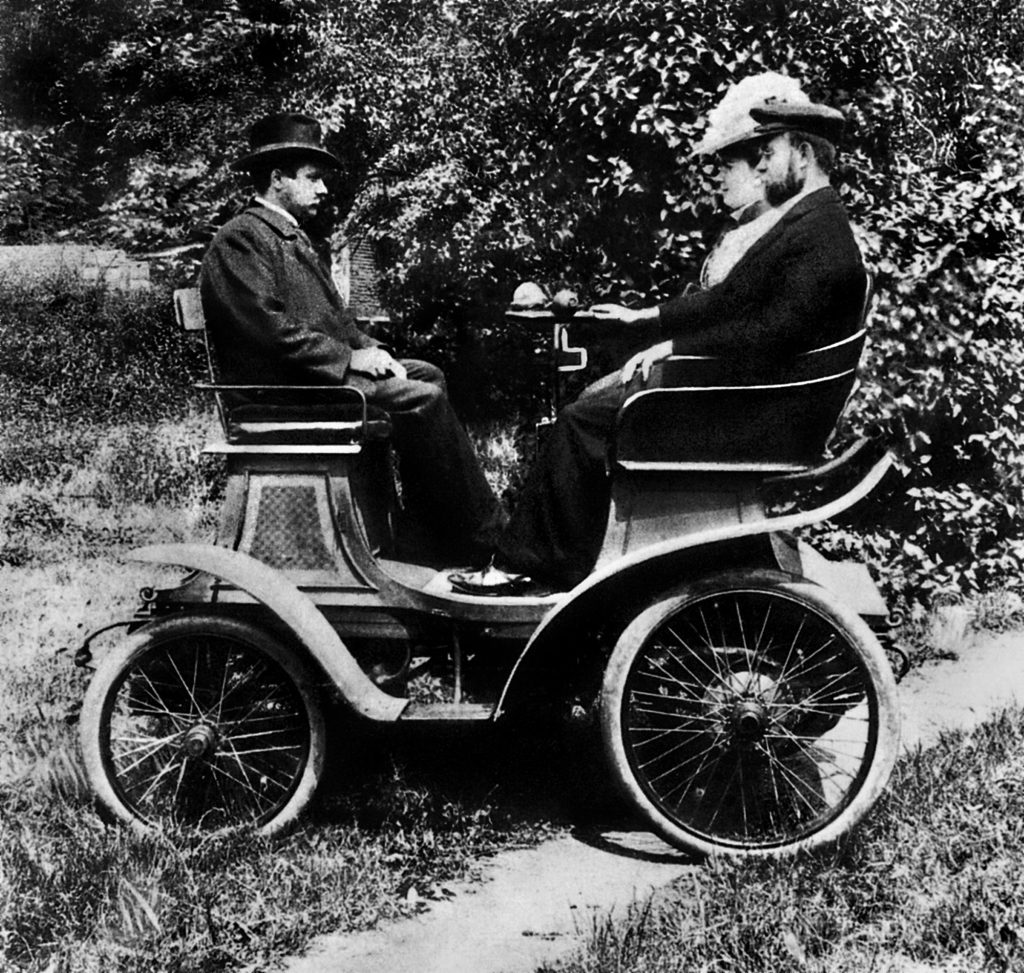
The Horch Modell 1 was completed in 1901. While still close in concept to the motor carriages of the late nineteenth century, it represented a significant step forward for Horch’s new company. The vehicle featured a horizontally mounted, two-cylinder engine, which Horch referred to as a shock-free engine. Contemporary accounts estimate its output at approximately 4 to 5 horsepower, consistent with early light automobiles of the era.
The car incorporated several advanced elements uncommon in early German motor vehicles, including:
- Electric ignition associated with Horch’s patented commutator improvements
- Friction clutch and cardan shaft, departing from the earlier belt-drive systems seen in some contemporaries
- Construction principles reflecting Horch’s emphasis on durability and smooth running
Although it lacked doors and retained carriage-style candle lamps, the Modell 1 demonstrated Horch’s intention to move beyond simple adaptations of horse-drawn vehicles.
VIS À VIS SEATING CONFIGURATION
The Modell 1 was produced in multiple examples, one of which adopted the Vis à Vis seating layout. The term, from the French for “face to face,” described a passenger arrangement in which the front occupants faced rearward while the rear passengers faced forward. This configuration was inherited from nineteenth-century carriages and was still widely used in the earliest automobiles.
In the Horch application, the Vis à Vis format placed the driver and passengers opposite one another. This layout disappeared from mainstream automotive design as handling, ergonomics, and forward vision requirements increased, but it remains a defining characteristic of the earliest Horch vehicles.
PRODUCTION & LEGACY
Fewer than ten examples of the earliest Horch automobiles were built, placing the Modell 1 Vis à Vis among the rarest surviving representatives of the pre-Auto Union era. These cars embodied Horch’s philosophy of building “big, powerful and reliable cars,” though such ambitions initially resulted in limited commercial success due to their high cost.
Horch continued to refine his designs, relocating his operations first to Reichenberg and then, in 1904, to Zwickau, where Horch & Co. became a joint-stock company. There, Horch laid the foundation for the Saxon automotive tradition that would later include Auto Union and eventually Audi. Despite his technical achievements and competitive appearances in early motorsport, conflicts with shareholders forced Horch to leave the company in 1909. He went on to establish a new firm, Audi Automobilwerke, setting the stage for one of Germany’s most enduring luxury marques.
SIGNIFICANCE
The 1901 Horch Modell 1 Vis à Vis is historically important for several reasons:
- It represents August Horch’s first complete automobile, launching a lineage that leads directly to modern Audi.
- It showcases early automotive innovation, including electric ignition improvements, a friction clutch, and cardan-shaft drive.
- It preserves one of the last instances of the Vis à Vis seating layout in early German motorcars.
- It illustrates the transition from motorised carriages to purpose-built automobiles in the pre-1905 era.
As an artifact of pioneering engineering, the Modell 1 embodies the experimental spirit of the early automobile industry and the beginnings of Horch’s long pursuit of technical excellence.