Before we shift gears by moving our attention to Madrid and the Spanish Grand Prix at the new MadRing, there’s one more piece of Audi’s Italian Grand Prix week worth revisiting. Away from the F1 paddock at Monza, Audi staged an unusually picturesque Italian debut for the Nuvolari, taking its new supercar from Mantua to Monza and Milan while surrounding it with some particularly significant pieces of Auto Union and Audi competition history.
Audi Nuvolari takes its name from Tazio Nuvolari, the legendary Italian racer whose career included one of Auto Union’s most important victories at Monza. Italy also played a much broader role in the project: the car was designed under Italian Audi Chief Creative Officer Massimo Frascella and underwent high-speed development testing at Nardò Technical Center.
For its first appearance in Italy, Audi Italia consequently avoided treating Nuvolari as just another supercar being dropped into a fashionable location for a photo shoot. Instead, the company created a three-city progression through Mantua, Monza and Milan, each chosen to represent a different aspect of the car’s story.
MANTUA: BACK TO THE NUVOLARI NAME
Mantua was the natural starting point. Tazio Nuvolari was born in nearby Castel d’Ario and remains closely associated with the city, where the Museo Tazio Nuvolari preserves his racing history.
Audi brought the Nuvolari to Mantua as a direct acknowledgment of the man whose name now appears on the most powerful production Audi ever built. This location provides more background to the naming exercise than the usual heritage reference attached to a modern performance model. In choosing it, Audi pays tribute to a name that carries enormous weight in Italian motorsport, and of course Nuvolari also has a celebrated place within the history represented by the four rings.
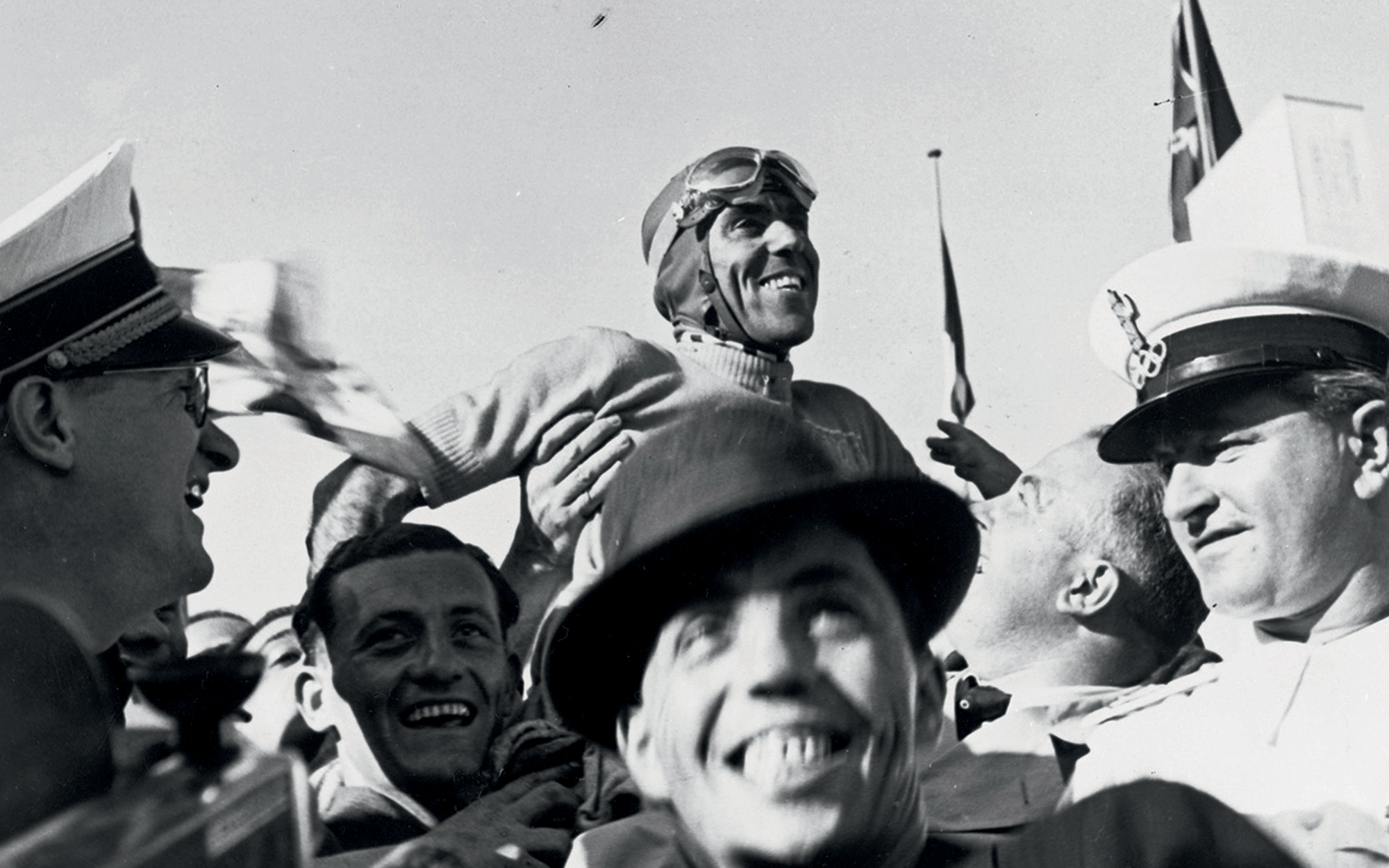
Nuvolari joined Auto Union relatively late in the company’s Silver Arrows Grand Prix program, arriving in 1938 after the departure of Bernd Rosemeyer. Driving the new V12 Type D, the Italian quickly demonstrated that he remained one of the era’s exceptional talents. That brings the story naturally to Monza.

MONZA: NUVOLARI MEETS NUVOLARI
In September 1938, Tazio Nuvolari drove the Auto Union Type D to victory in the Italian Grand Prix at Monza. Nearly nine decades later, Audi returned to the circuit with the car bearing his name.
It also brought the Type D. The resulting photographs are perhaps the most compelling imagery Audi has produced around the Nuvolari so far: the 1938 Grand Prix car and 2026 supercar together at the circuit where Nuvolari delivered one of Auto Union’s defining victories.
There are obvious differences between the two machines, but Audi is deliberately drawing some technical parallels. Both use mid-engine layouts, for example. The Type D’s 3.0-liter supercharged V12 produced as much as 485 hp, while the Nuvolari combines a 4.0-liter twin-turbo V8 with three electric motors for a system output of 1,001 hp. The new car reaches 100 km/h in 2.6 seconds, 200 km/h in 6.8 seconds and a top speed exceeding 350 km/h.
The connection becomes more interesting when viewed through Audi’s current Formula 1 program. Nuvolari incorporates active aerodynamics developed with input from Audi F1 drivers Nico Hülkenberg and Gabriel Bortoleto, while Audi says its Ceramic Pro braking system uses Formula 1-derived carbon discs. The company positions the R26 program as a development laboratory whose technology can migrate into production vehicles.
That makes Monza a worthy intersection. Audi had the R26 competing in the 2026 Italian Grand Prix while a production car incorporating technology influenced by that F1 program shared the historic circuit with the Auto Union racer that won there in 1938.

MILAN: FOUR GENERATIONS OF AUDI PERFORMANCE
Audi then took the story into Milan, where its participation in FuoriConcorso Monza expanded well beyond the Nuvolari itself.
Rather than putting all of the cars together in a conventional static exhibition, Audi placed significant cars around the city. Nuvolari occupied the Audi Nuvolari Lounge at Via MonteNapoleone 18, while the broader FuoriConcorso program included the Auto Union Type D, Auto Union Lucca and Audi R26. Collectively, the four cars covered more than 90 years of competition, aerodynamics and high-performance development.
The lesser-known Auto Union Lucca has a particularly strong Italian tie. Based on the Auto Union Type B, the streamlined Rennlimousine was created for high-speed record running. With Hans Stuck driving on public roads near Lucca in 1935, the supercharged 4,951-cc V16 machine reached 326.975 km/h, which Audi describes as a world speed record for a road racing car. Its aerodynamic aluminum body and 343-hp engine represented another branch of Auto Union’s relentless experimentation during the 1930s.
Placed alongside the Type D, it demonstrates that Audi Italia’s selection is a celebrate of the four rings local legendary history: Lucca through Stuck’s 1935 record run and the Type D through Nuvolari’s 1938 Monza victory.
At the opposite end of the timeline sat the Audi R26, representing the company’s return to Grand Prix racing in 2026. Between them was Nuvolari, a road car intended to translate some of that competition-derived thinking into a limited-production flagship.
‘
Now, with Monza finally behind us, attention turns to Madrid and the next chapter of Audi’s first Formula 1 season.
PHOTO GALLERY