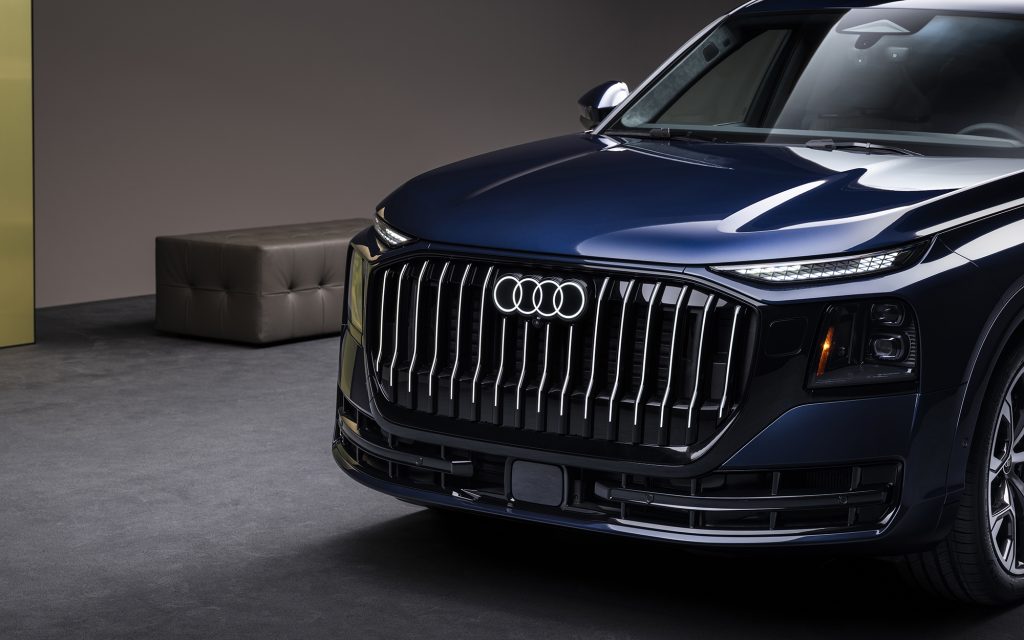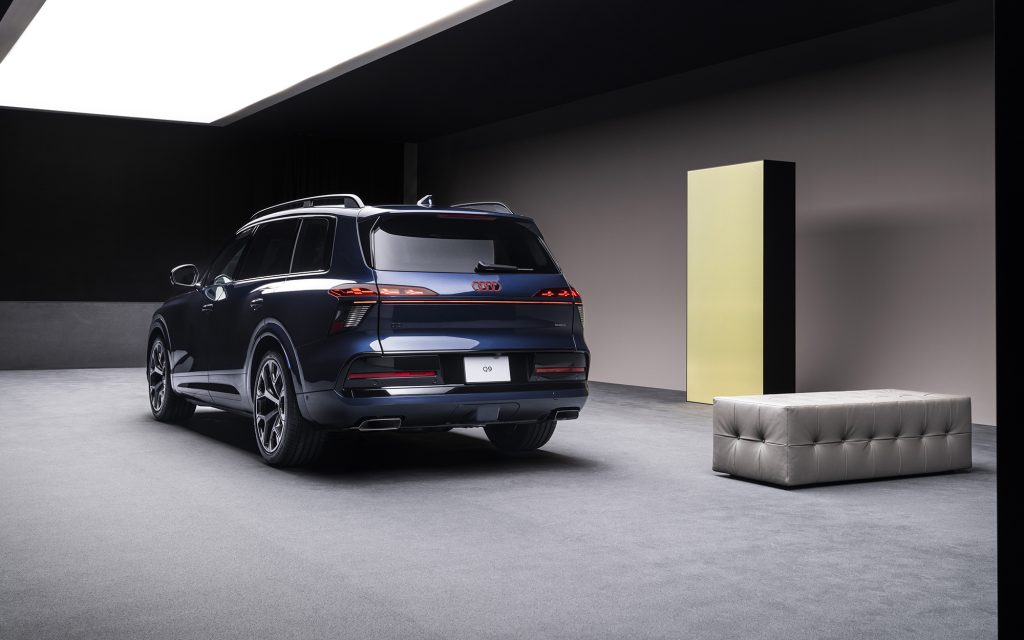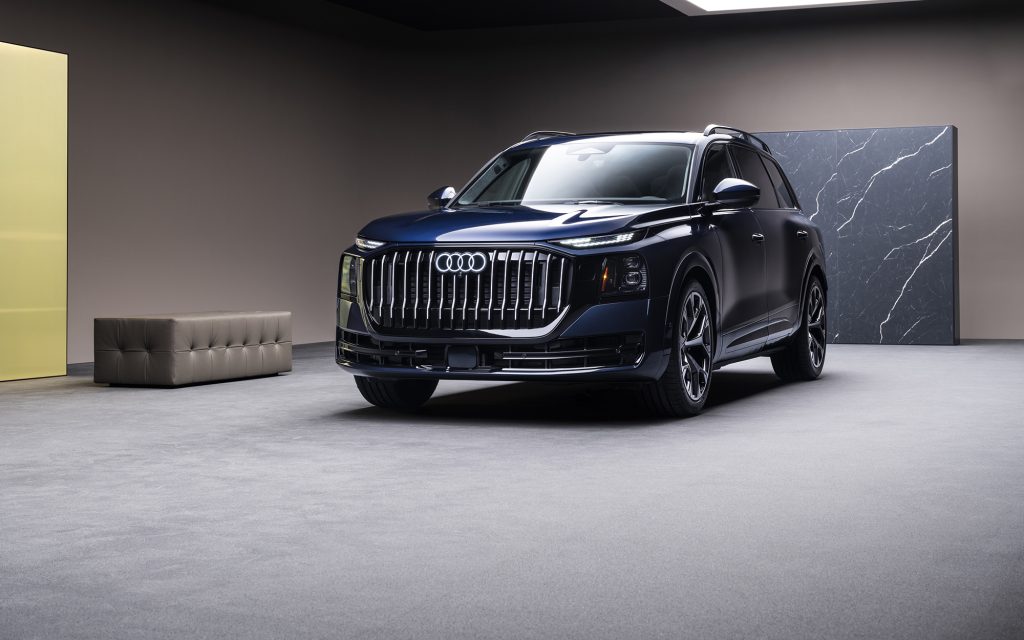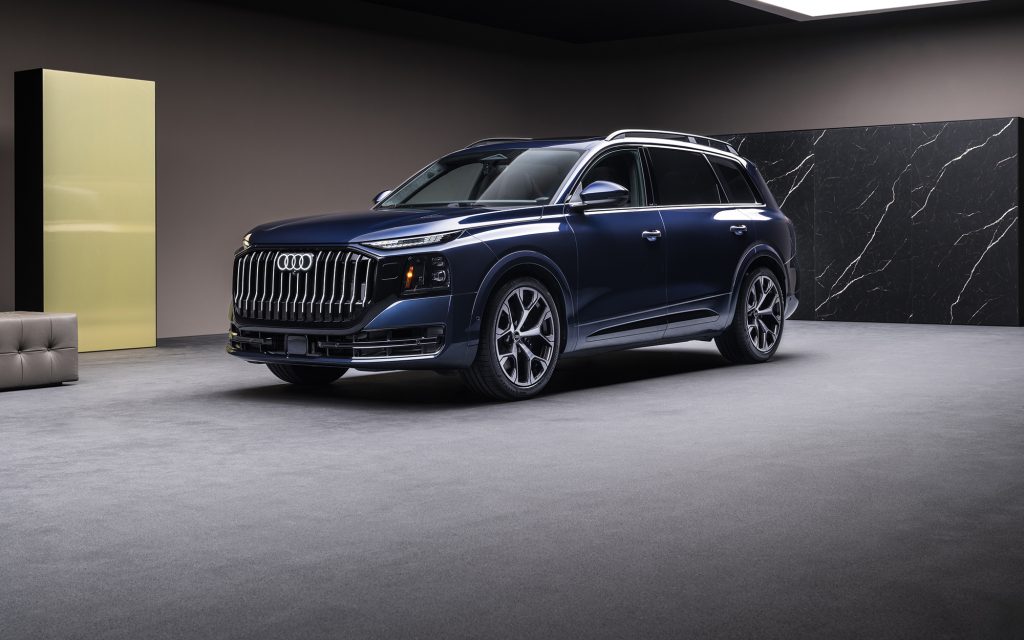

Audi has introduced the all-new 2027 Q9, its first full-size SUV and the new flagship of the brand’s model portfolio.
Measuring 209 inches long, the Q9 is the largest and most spacious production Audi to date. It arrives with three rows of seating, accommodation for six or seven passengers, a twin-turbocharged 2.9-liter V6 producing 429 hp, standard quattro all-wheel drive and an extensive range of new interior, lighting, infotainment and driver assistance technologies.
The Q9 is positioned above the Q7 and Q8, but it is not simply a stretched version of either model. Audi has developed it around the priorities of the full-size luxury SUV segment, including adult-usable third-row seating, increased cargo capacity, available second-row captain’s chairs, automatic doors, large-device charging throughout the cabin and a suspension engineered to combine long-distance comfort with the control expected of an Audi.
Audi CEO Gernot Döllner describes the Q9 as the new flagship of the company’s entire portfolio rather than merely the top of its SUV range. That positioning is reflected in the amount of new technology introduced with the model, including Digital Matrix LED adaptive lighting for the U.S., curved digital OLED taillights, hands-free Level 2 highway assistance and an expanded digital interior built around Android Automotive OS.
The Q9 will be built in Bratislava, Slovakia. U.S. deliveries are scheduled to begin in the fourth quarter of 2026 with a starting MSRP of $87,700. Three years or 30,000 miles of Audi Signature Care scheduled maintenance is included.
FULL-SIZE PROPORTIONS
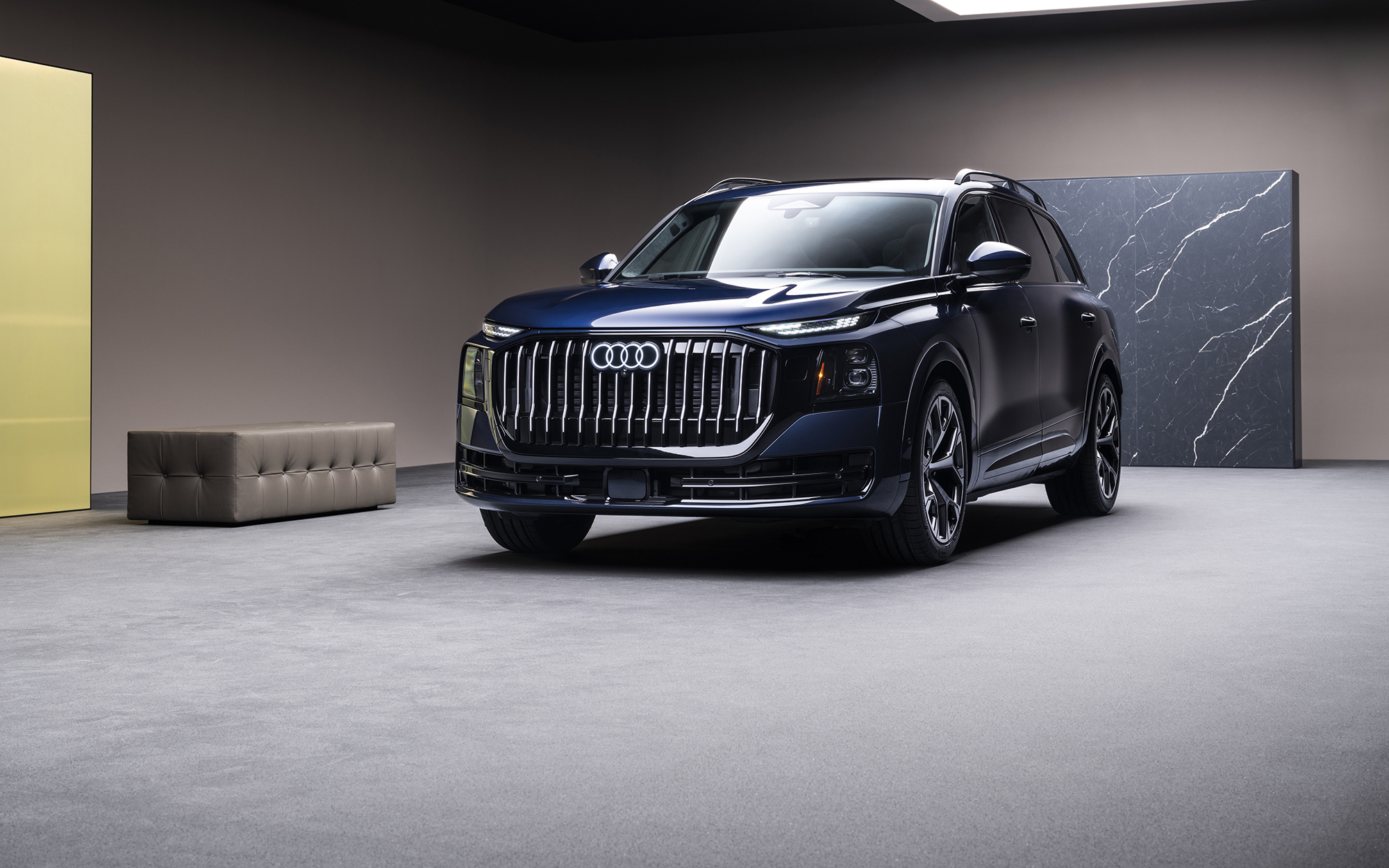
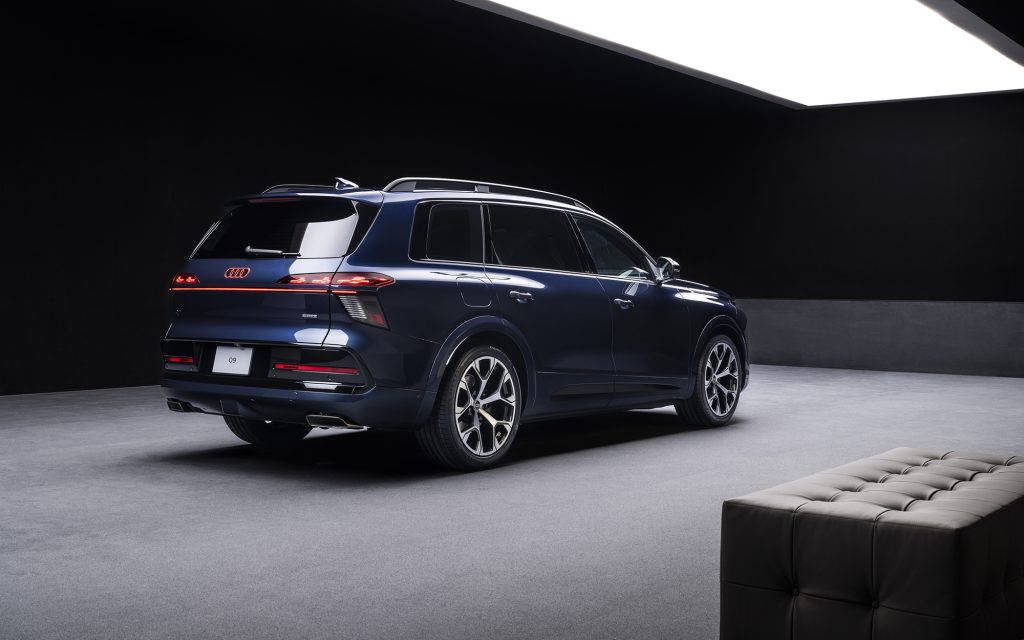
The Q9 measures 209.0 inches long, 86.8 inches wide and 71.4 inches tall. Its wheelbase spans 123.5 inches.
Those dimensions make the Q9 approximately 17.5 feet long and more than 7.2 feet wide before accounting for exterior mirrors. The length, extended rear doors, upright cabin and substantial rear overhang are all directly related to the vehicle’s three-row packaging.
Audi has avoided disguising that size. The Q9’s design instead emphasizes verticality, width and interior volume.
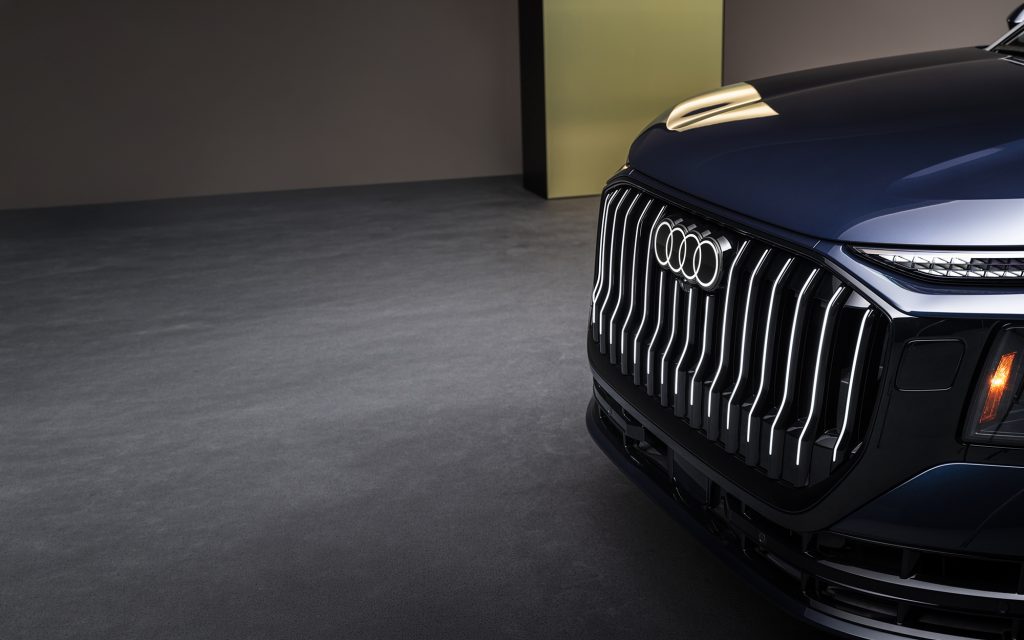
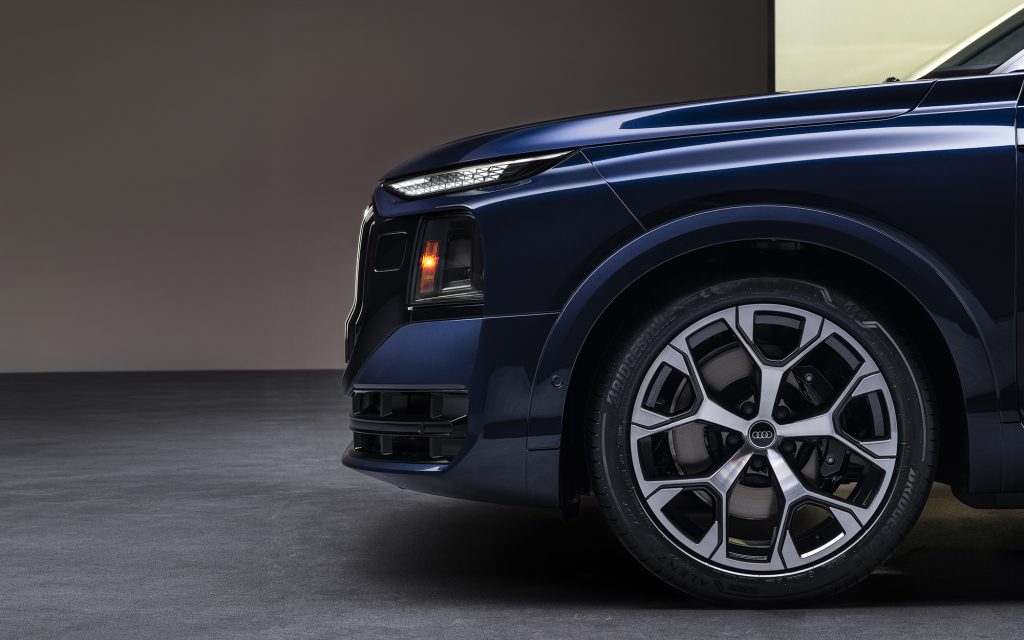
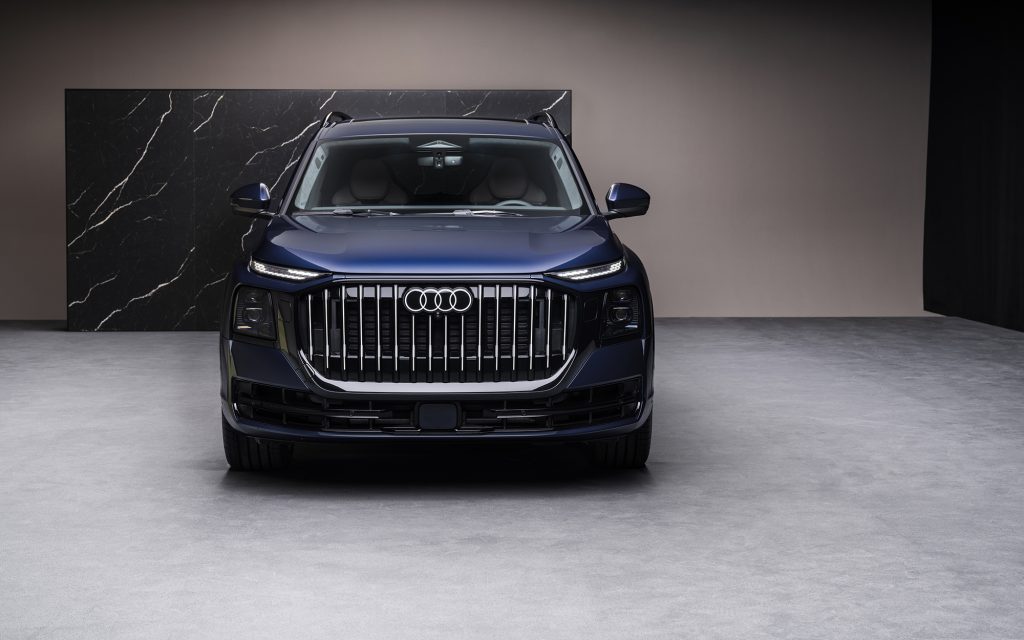
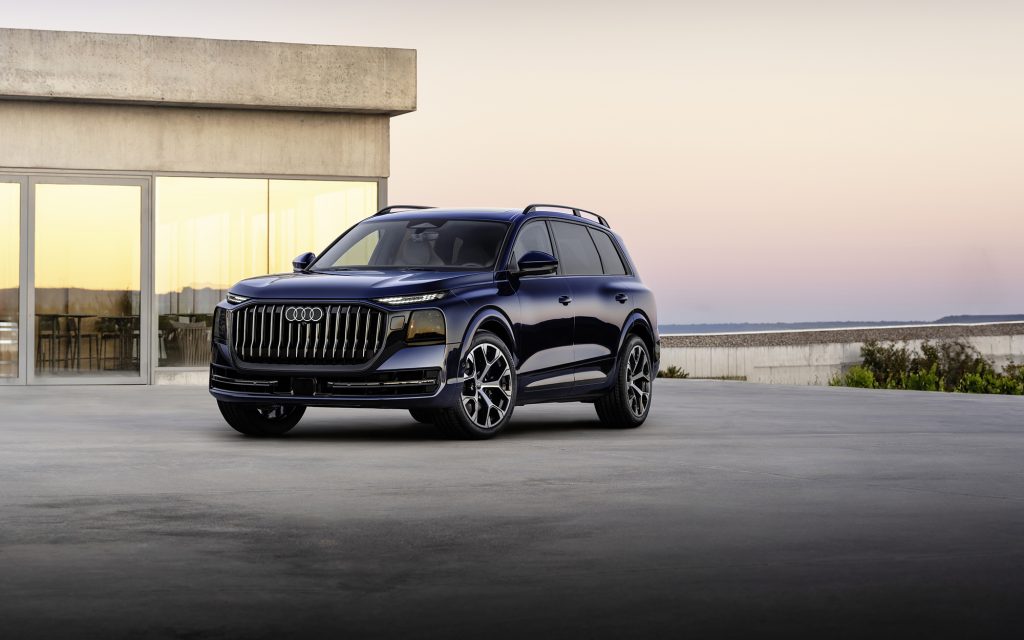
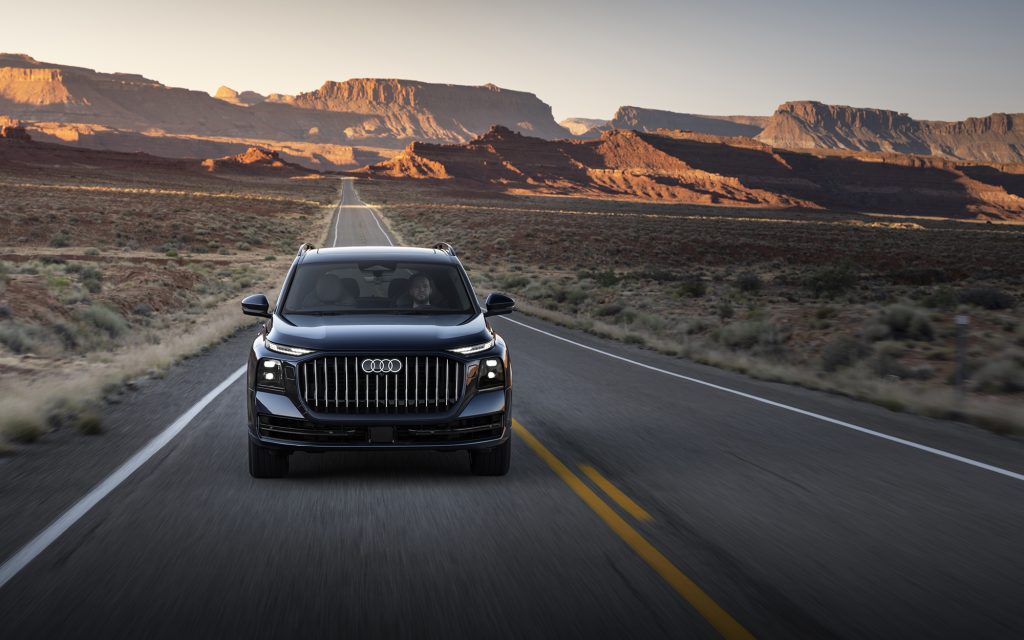
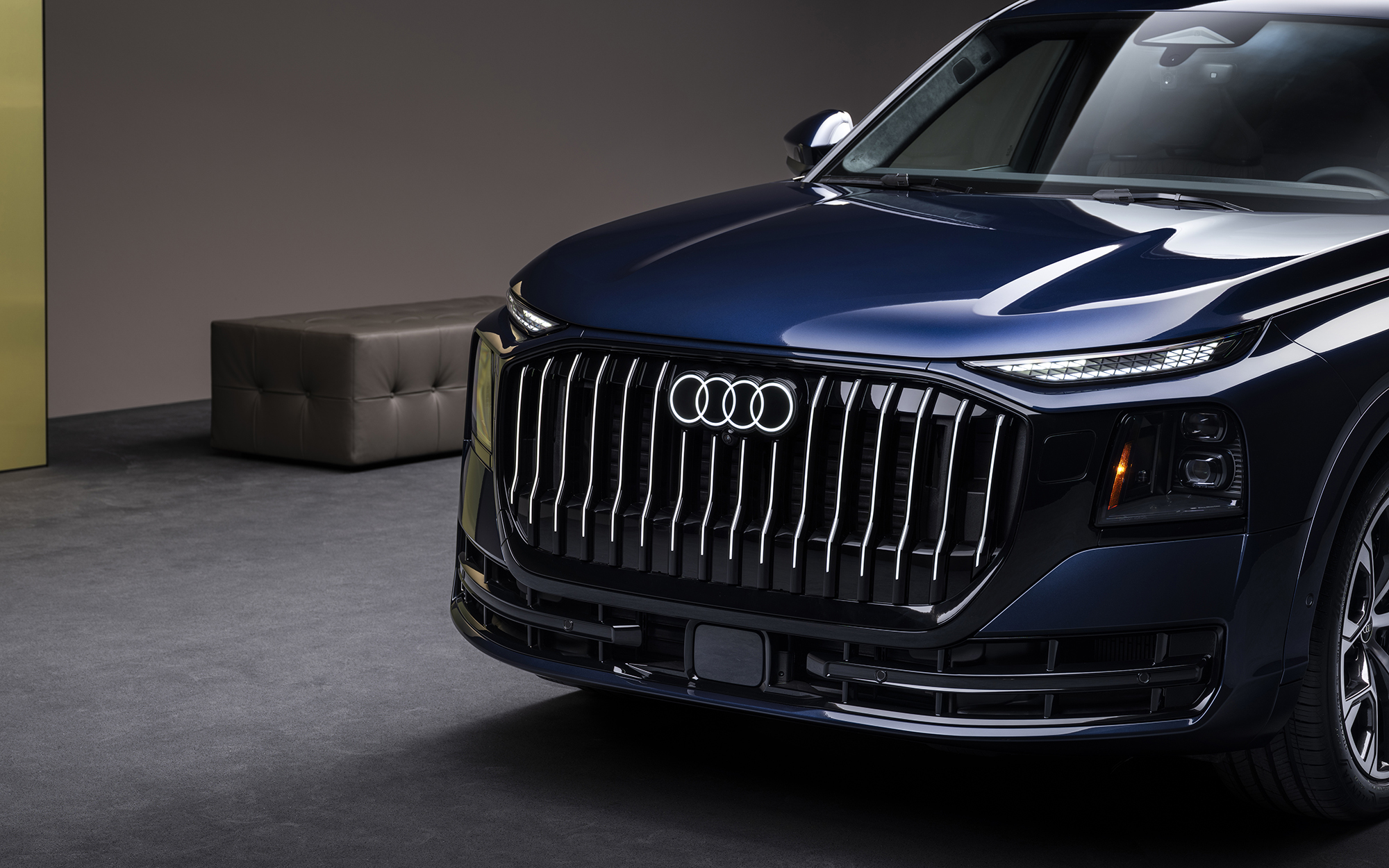
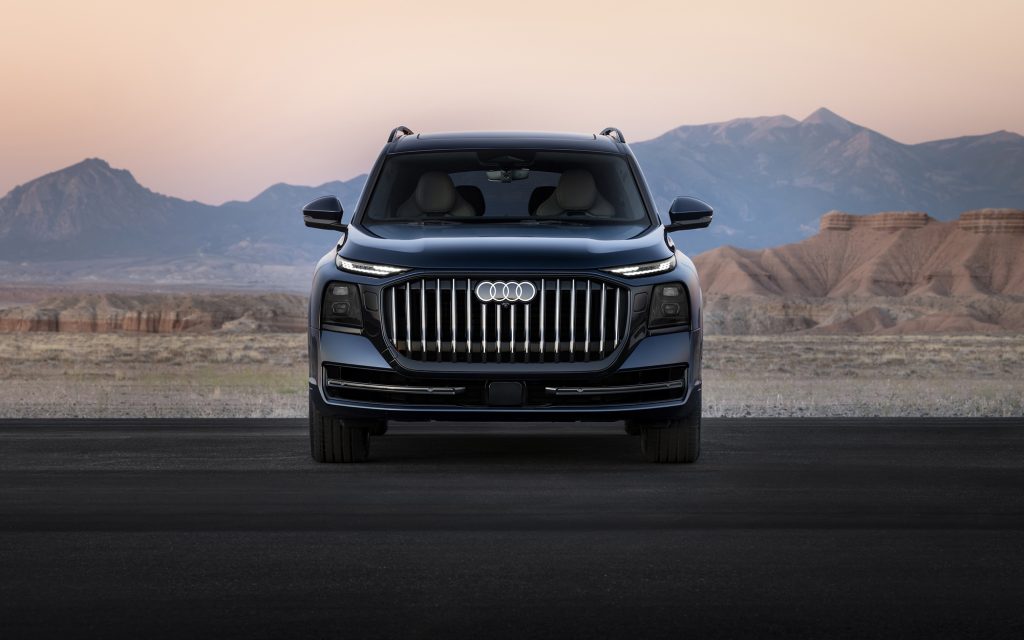
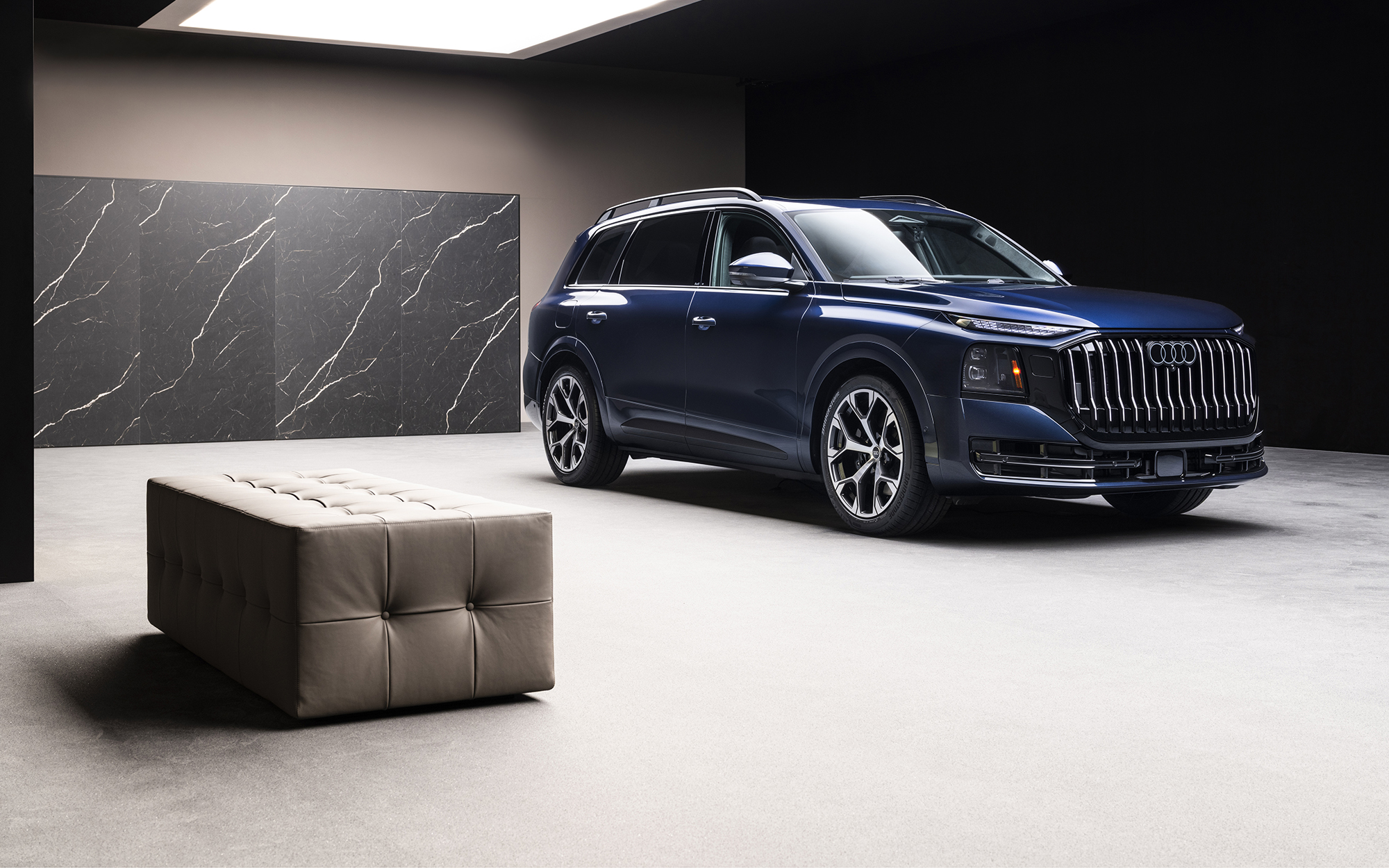
The front incorporates the Singleframe grille and headlights into a broad black mask. The grille extends deeply into the lower fascia, giving the Q9 a taller and more upright appearance than Audi’s smaller SUVs. The lower bumper treatment is comparatively restrained, with broad surfaces rather than a collection of small openings or heavily defined character lines.
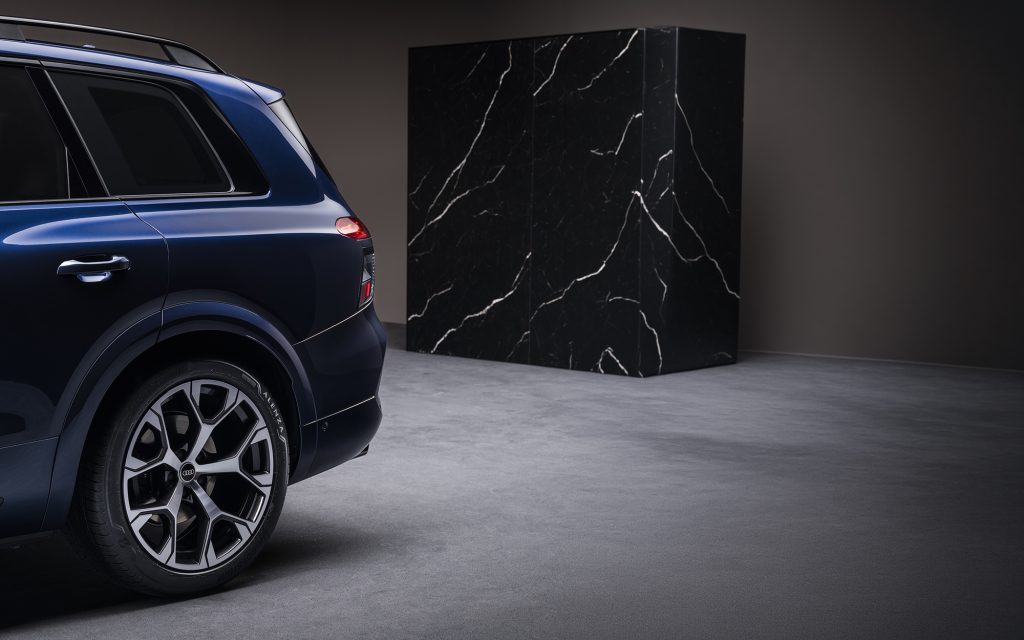
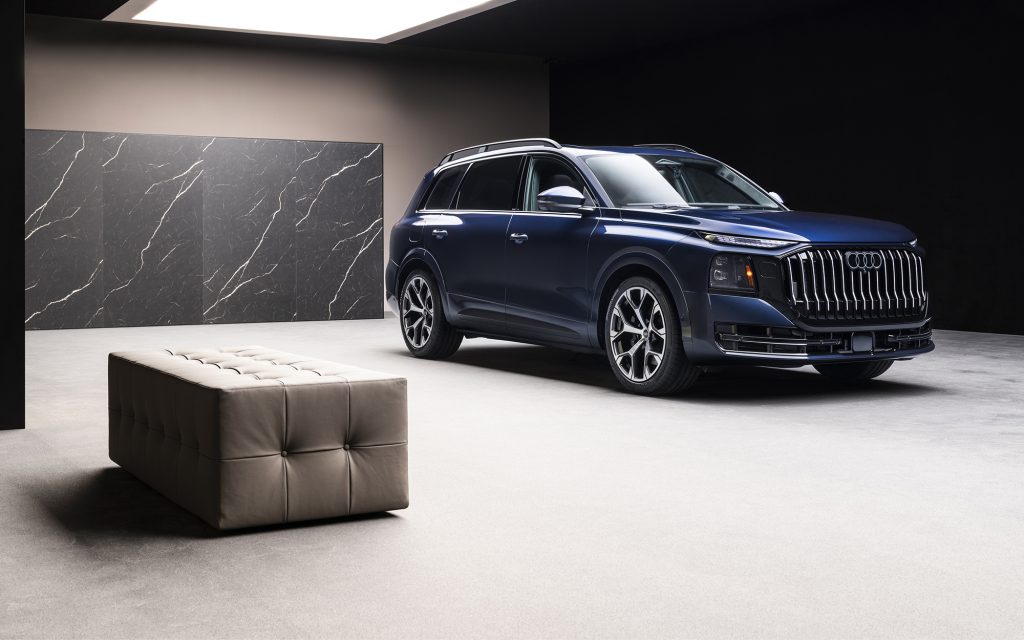
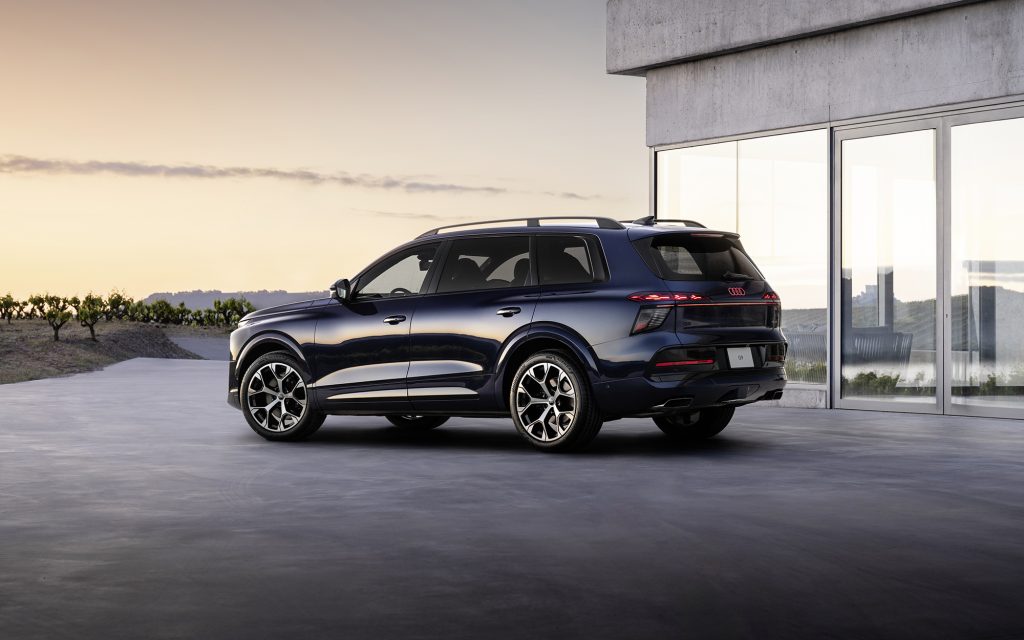
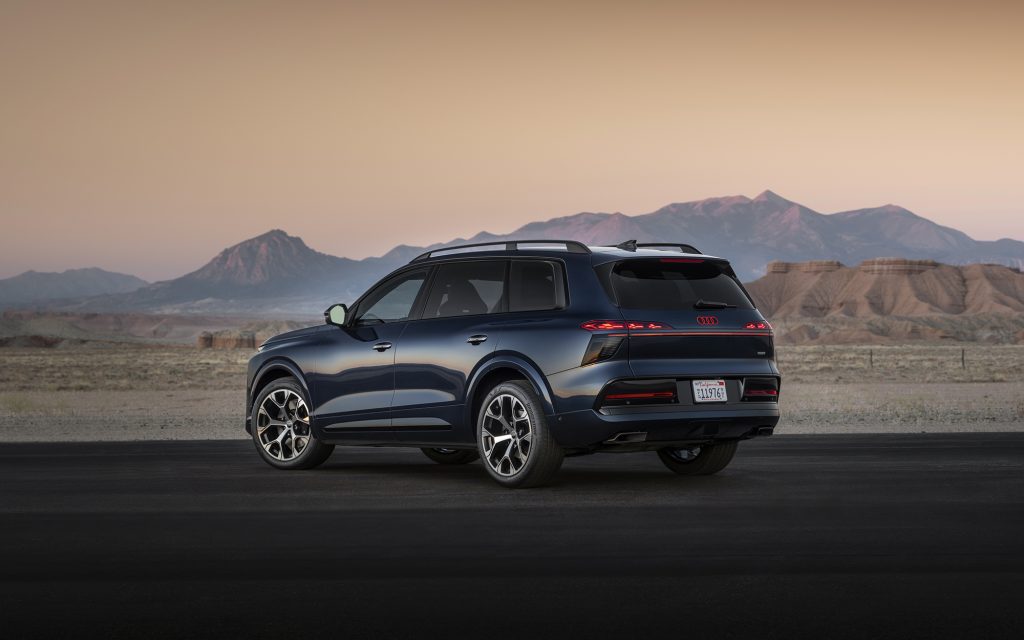
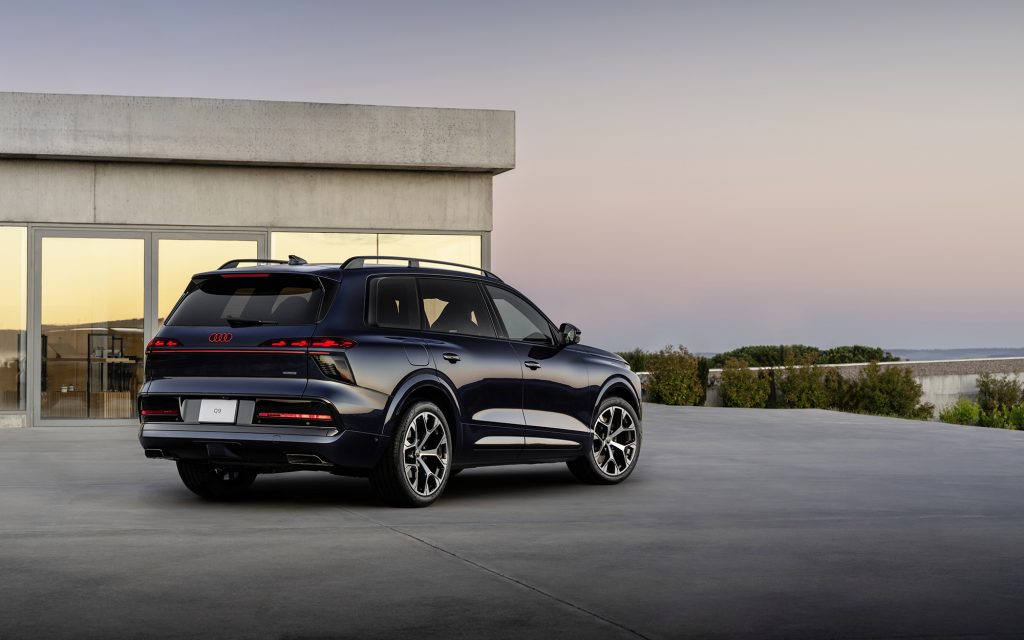
Along the side, a straight beltline and pronounced shoulder visually extend the body. The roofline remains relatively upright rather than tapering aggressively toward the rear, preserving third-row headroom and cargo volume. Raised roof rails, large rear doors and the extended rear overhang further identify the Q9 as a utility-focused three-row model rather than a coupe-shaped SUV.
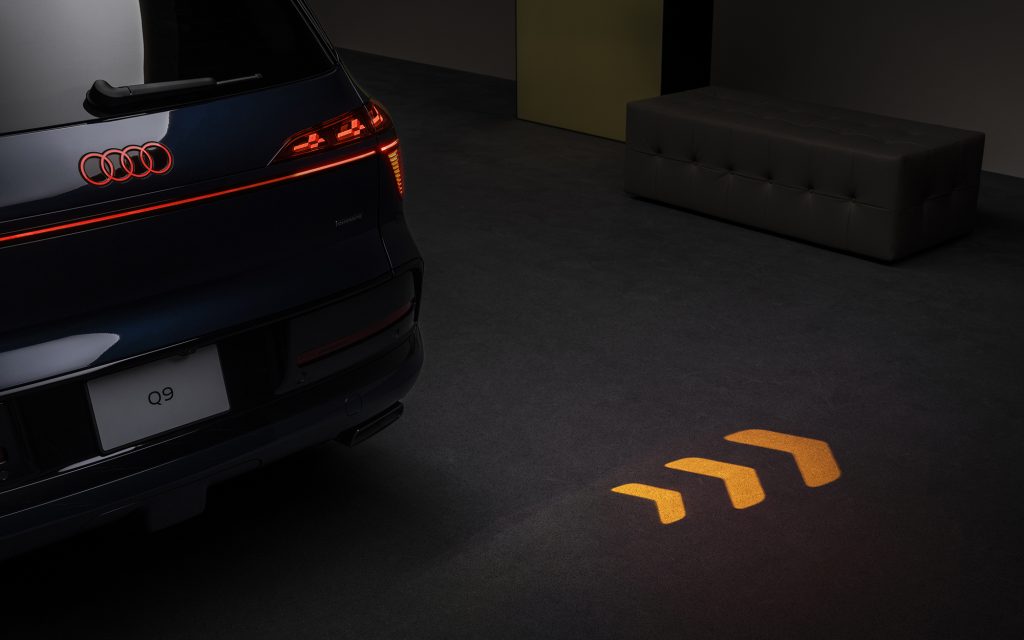
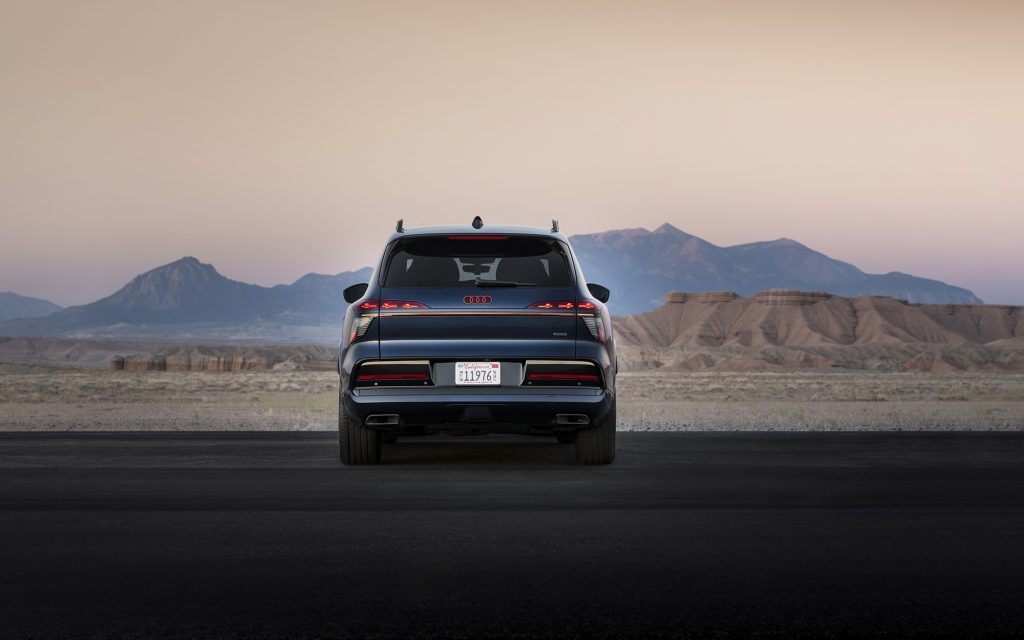
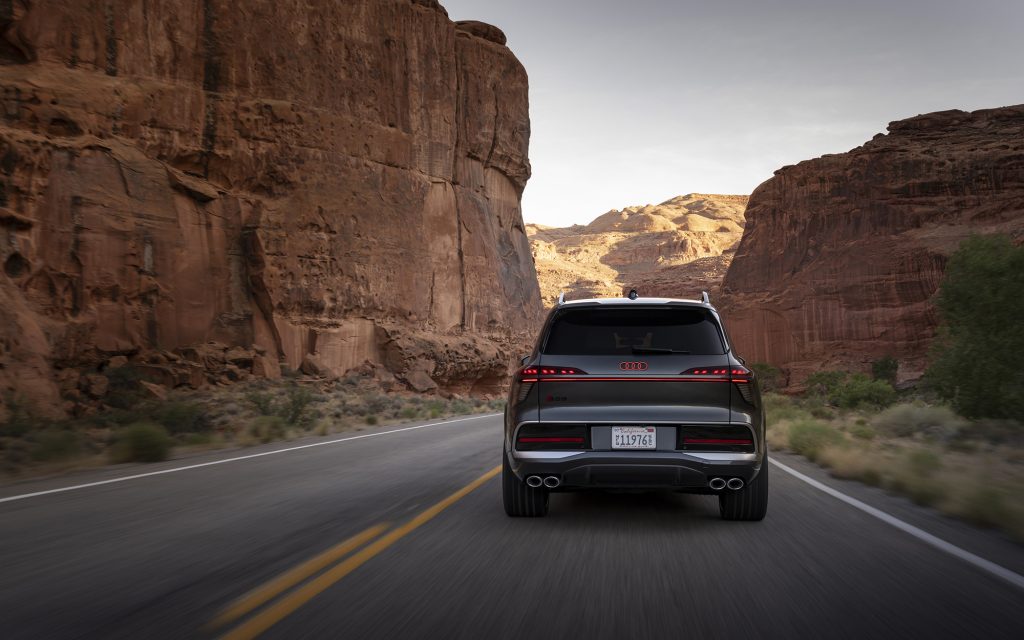
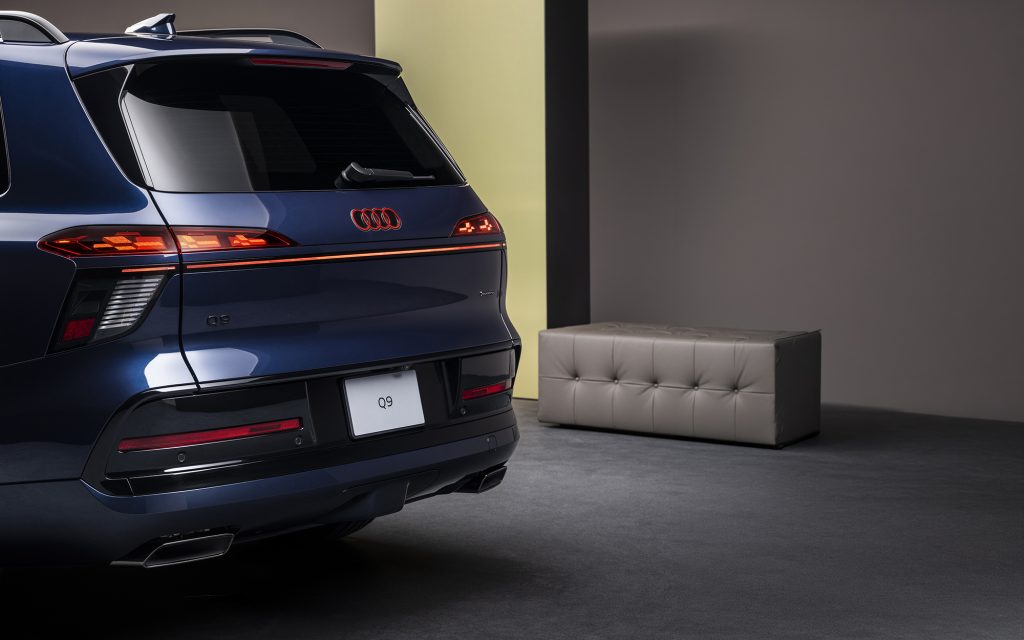
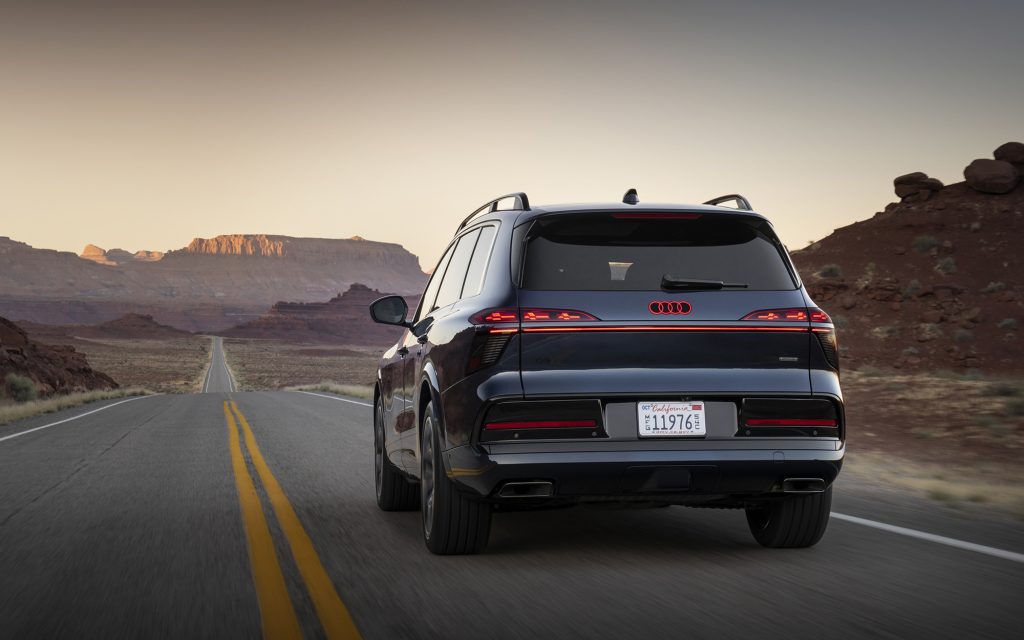
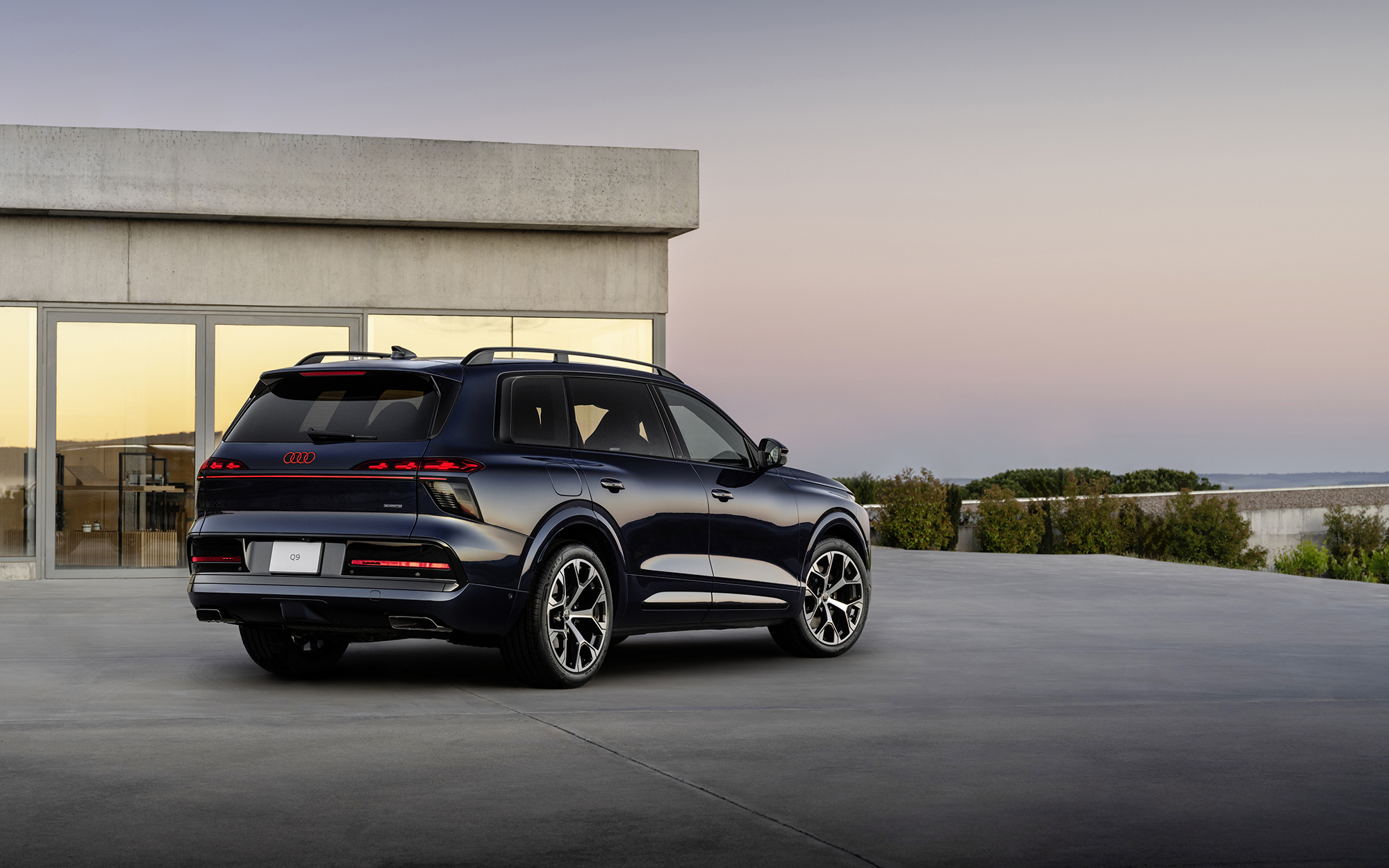
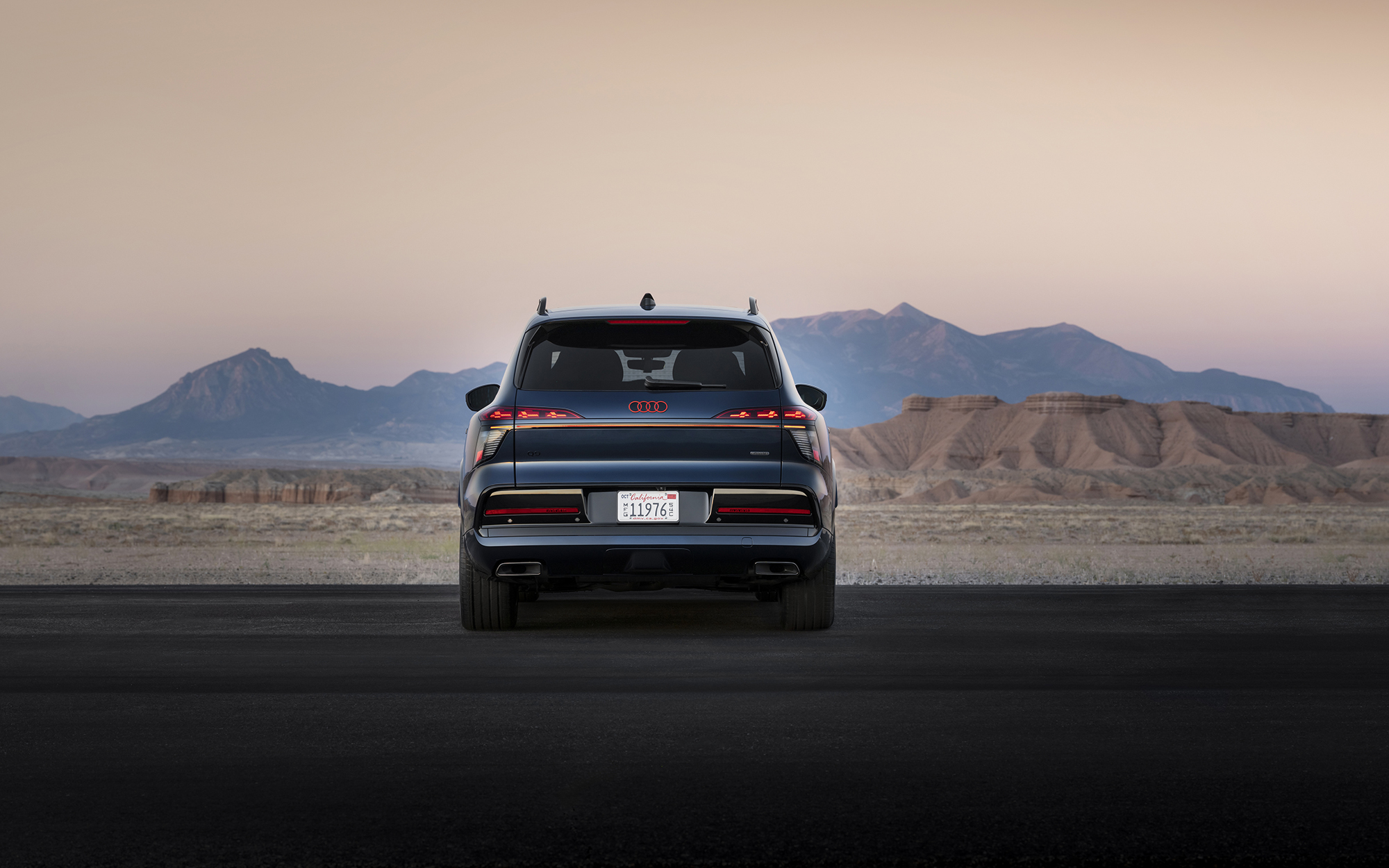
At the rear, Audi has moved the license plate into the bumper, leaving the tailgate itself largely uninterrupted. A continuous LED light strip runs across the rear and incorporates illuminated Audi rings between the available digital OLED taillights.
Two exterior presentations will be offered.
The standard advanced line uses vertical slats within the Singleframe grille and emphasizes the Q9’s formal, luxury-oriented character. An S line exterior is offered on launch edition models, replacing the vertical grille treatment with a more open design while adding a more pronounced lower fascia and rear spoiler.
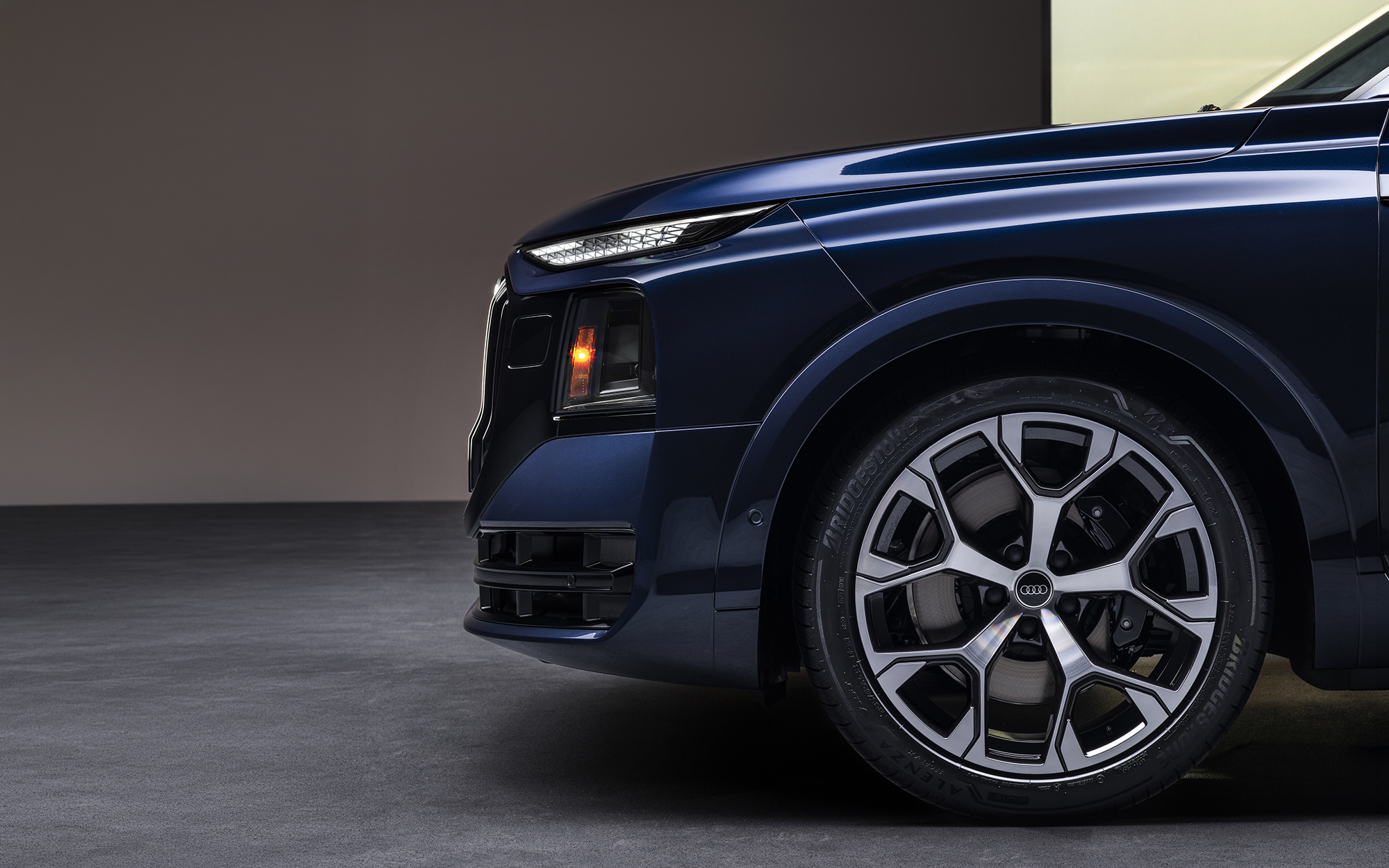
Wheel sizes range from 21 to 23 inches. The 21- and 22-inch wheels are fitted with all-season run-flat tires, while available 23-inch wheels use summer tires. Audi fits acoustic foam inserts to all 22- and 23-inch tires to reduce transmitted road noise. Wheel weights, valve stems and valve caps are coordinated with the finish of the wheel.
SEVEN SEATS AS STANDARD
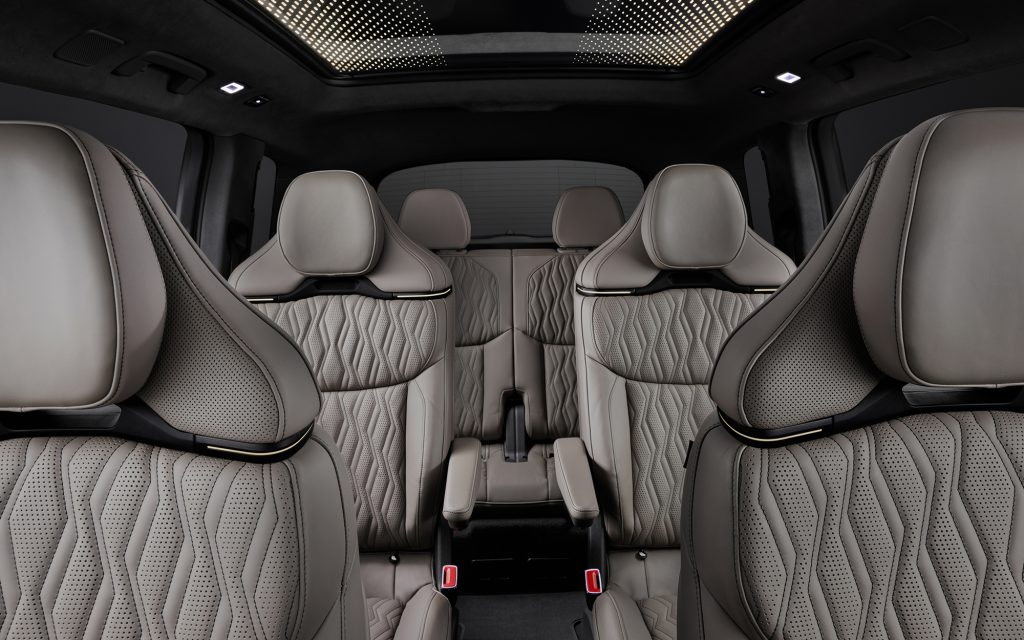
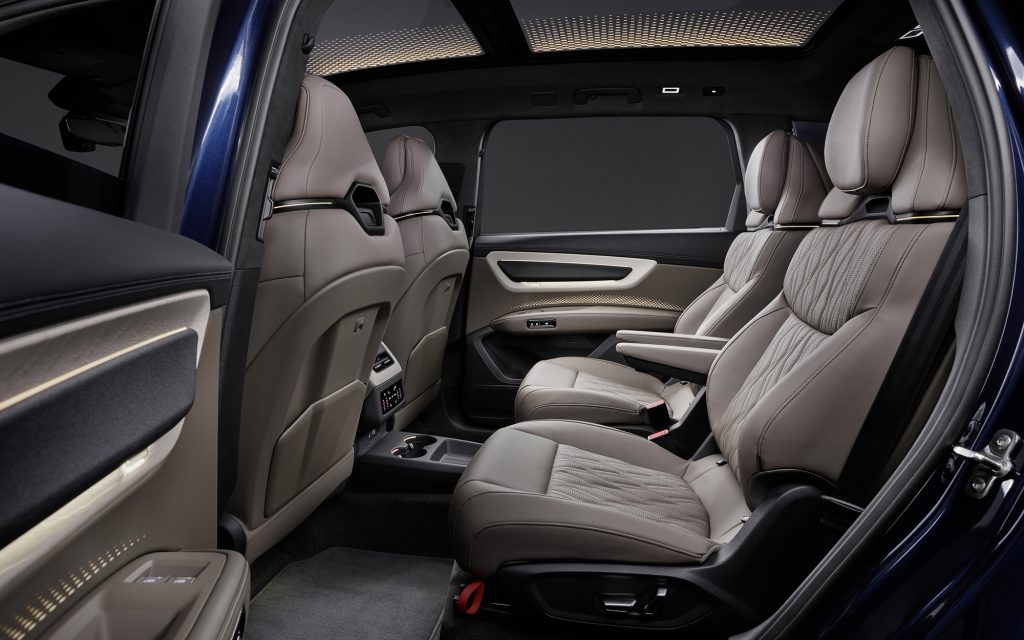
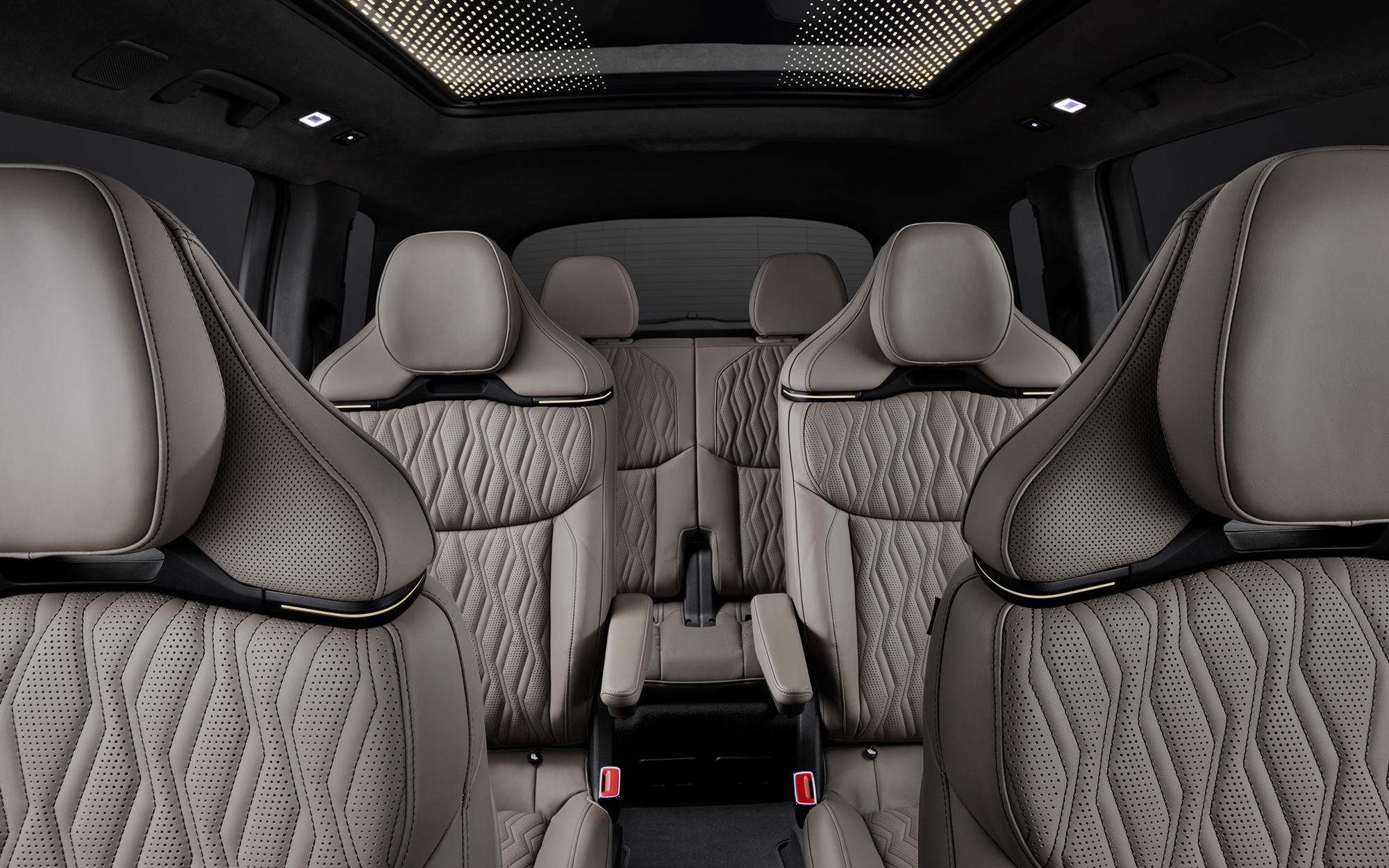
The Q9 comes standard with seven seats arranged across three rows.
Unlike many SUVs in which the third row is intended primarily for occasional use, Audi describes the rear seating area as suitable for adults. The long wheelbase allows the second row to be positioned farther rearward while retaining usable space behind it.
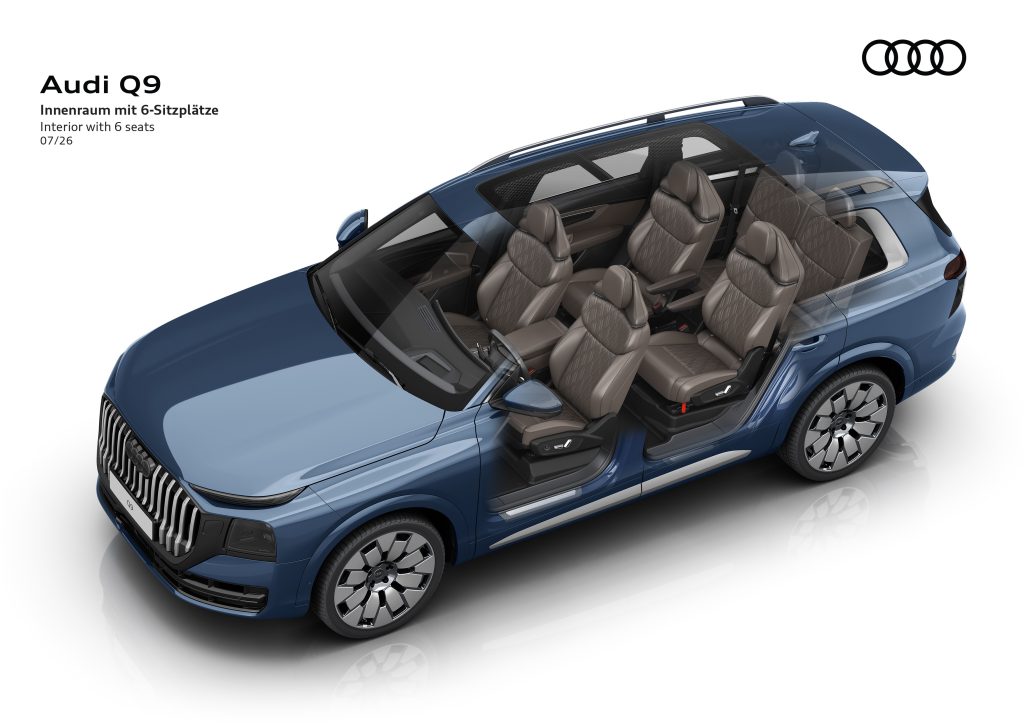
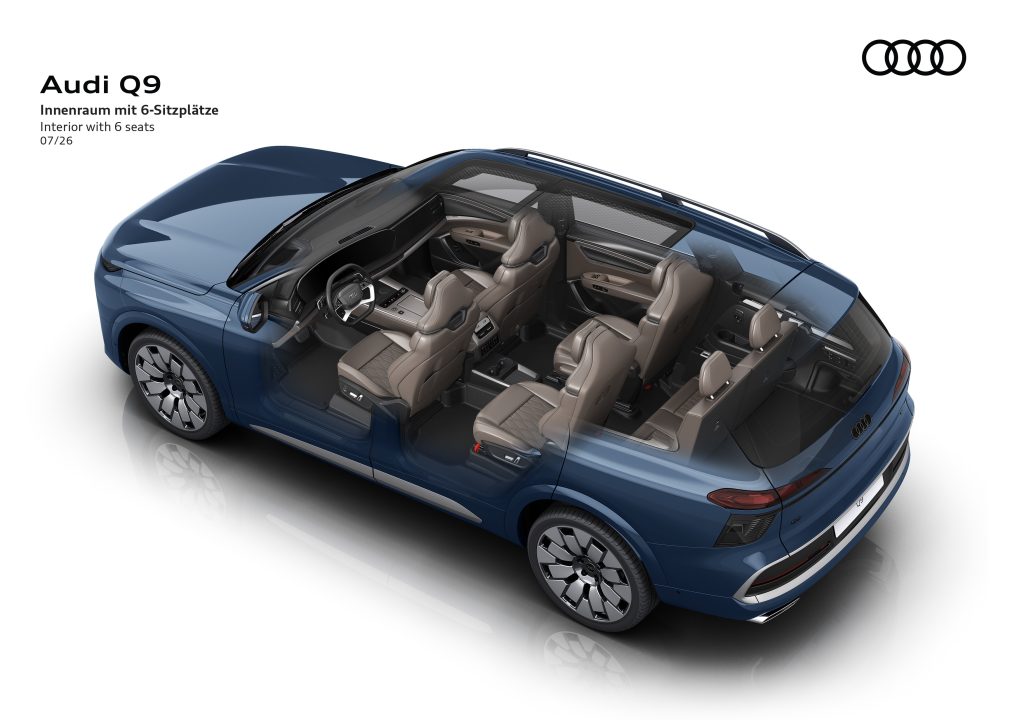
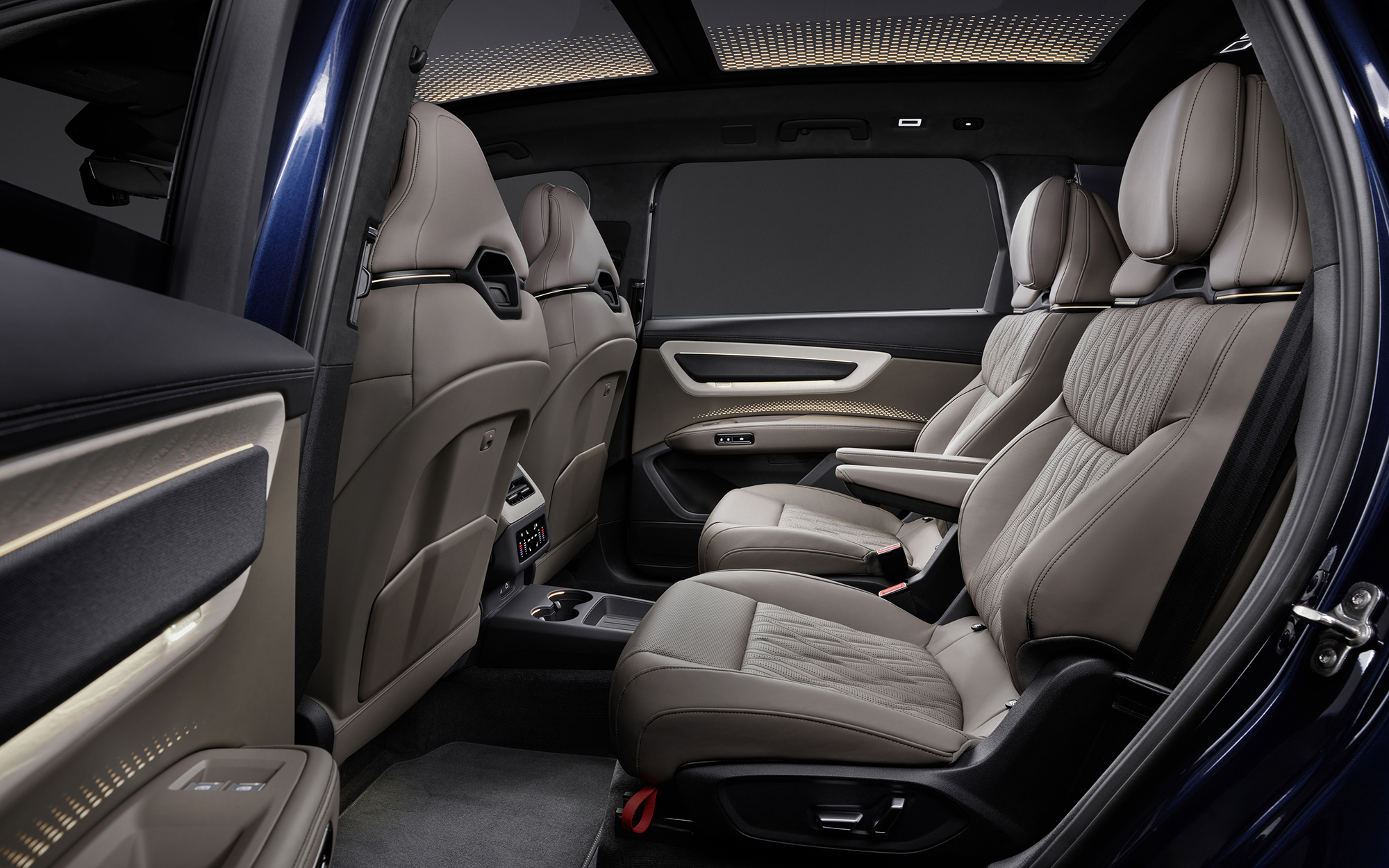
Every seating position is power adjustable, regardless of whether the Q9 is configured for six or seven occupants. In the standard seven-passenger layout, the second row uses a 35/30/35 configuration. The seats can be adjusted fore and aft electrically, while the backrests fold in a 65/35 split. The center portion of the wider section can also be folded separately, restoring the functional 35/30/35 division when additional pass-through space is needed.
All seating positions in both the second and third rows include LATCH-compatible child-seat mounting points.
Access to the third row is electrically assisted. The outboard second-row seat moves forward and tilts without requiring its backrest to fold flat. Audi says an unoccupied forward-facing child seat can remain installed while the seat is moved for third-row access.
The comfort entry function can be activated through the MMI interface or from a physical control near the rear door opening. Second- and third-row seats can also be folded sequentially using controls in the cargo area.
For buyers placing greater emphasis on second-row comfort, Audi offers a six-seat configuration with two individual power-adjustable captain’s chairs. Heating is available for the captain’s chairs, and Audi describes the resulting layout as providing a business-class atmosphere.
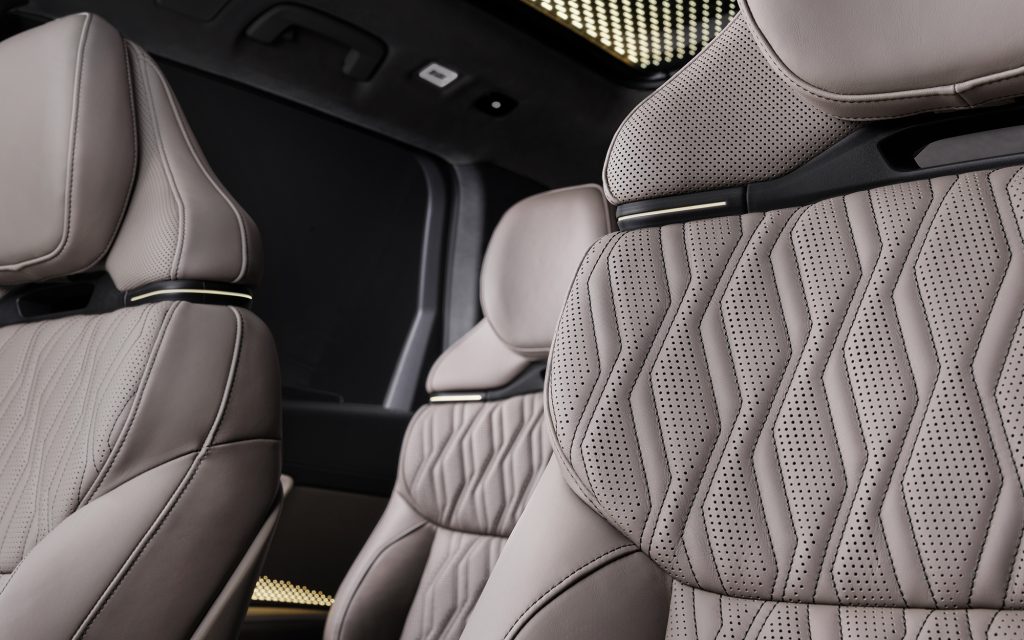
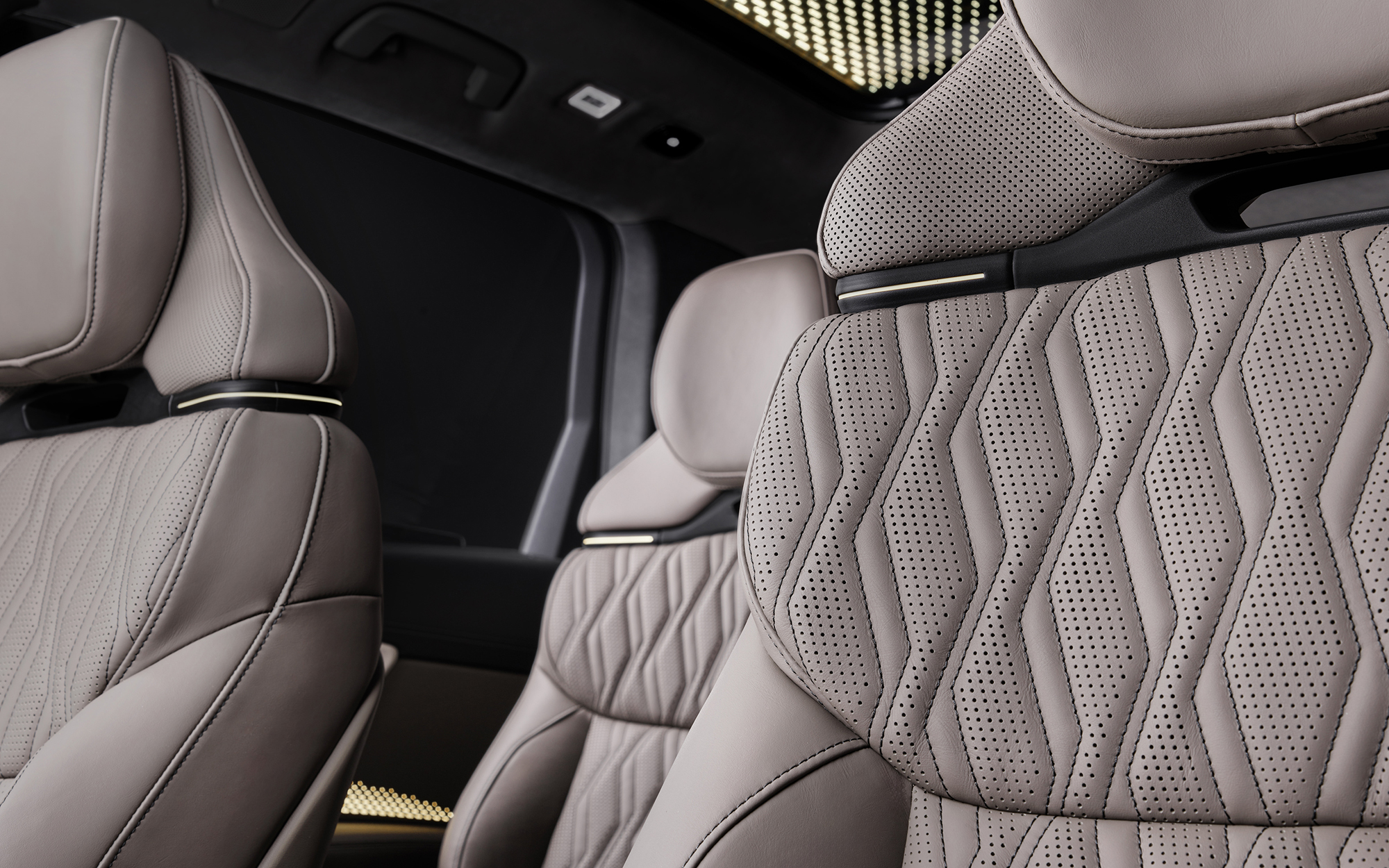
The front seats are sport seats as standard. Optional front-seat ventilation is available, while Sport seats plus add heating, ventilation and massage functions. The door armrests and center armrests in the first and second rows can also be heated when specified.
AUTOMATIC DOORS
The Q9 is the first Audi to offer automatic power-operated doors.
Each door can open to an angle of up to 90 degrees. The system can be controlled from several locations inside the vehicle and operated remotely through the myAudi app.
Surrounding sensors monitor the area around the vehicle while a door is opening. When the system detects a vehicle, cyclist, pedestrian or fixed obstruction in the door’s path, it can stop the door before contact occurs. An electric soft-close function pulls the door securely into its latch without requiring it to be slammed.
The door system also works with the Q9’s exit warning technology. Radar sensors in the rear bumper monitor approaching road users when the vehicle is stationary. If the system identifies a potential collision, it can prevent a closed door from opening or stop a door that has already begun moving.
Warnings are presented through interior lighting, the exterior communication lights and ground projections near the doors. The function is intended to assist all passengers but may be especially useful for children or third-row occupants who do not have a clear view of approaching traffic.
AUDI’S LARGEST PANORAMIC SUNROOF
A panoramic sunroof measuring more than 16 square feet is standard.
It is the largest glass roof Audi has fitted to a production vehicle and can be tilted or opened to ventilate the cabin. The opening mechanism is continuously adjustable rather than limited to a series of fixed positions.
An available version uses Polymer Dispersed Liquid Crystal laminated safety glass to provide electronically switchable transparency. The roof is divided into nine individually controlled segments, allowing different areas to be made clear or opaque.
When the Q9 is parked, the glass automatically turns opaque to reduce visibility into the cabin and limit heat buildup. When the vehicle is restarted, it returns to the transparency setting selected before shutdown.
The laminated glass reflects infrared energy and blocks more than 99.5 percent of ultraviolet radiation, eliminating the need for a conventional fabric sunshade. An integrated wind deflector is intended to reduce buffeting and wind noise while the roof is open. Operation is handled through a roof-mounted control or the MMI system.
Audi also plans to add personalized ambient roof illumination after the initial market launch.
INTERIOR DESIGN AND MATERIALS
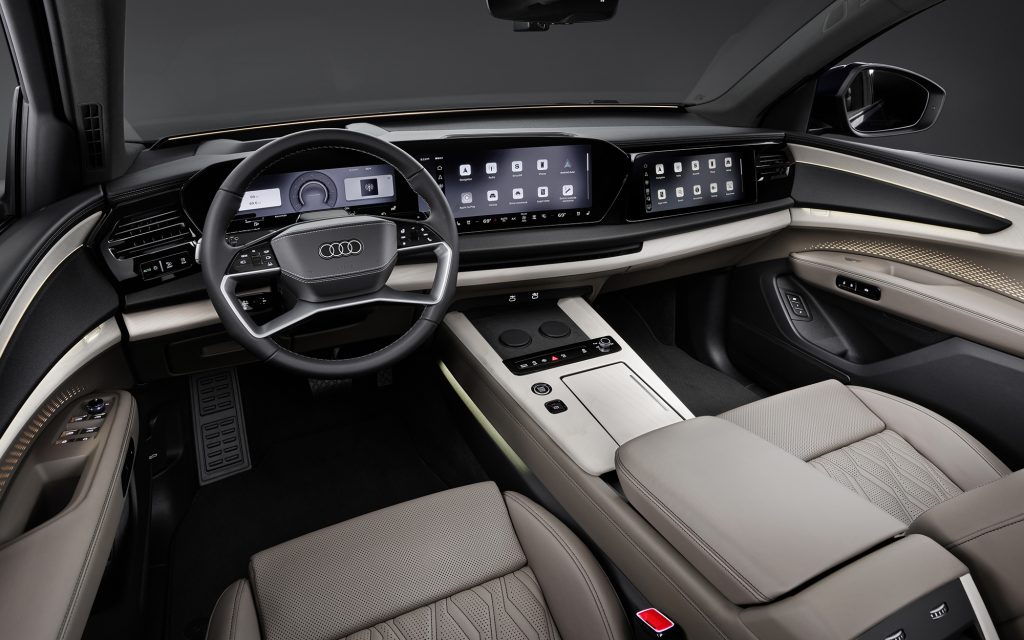
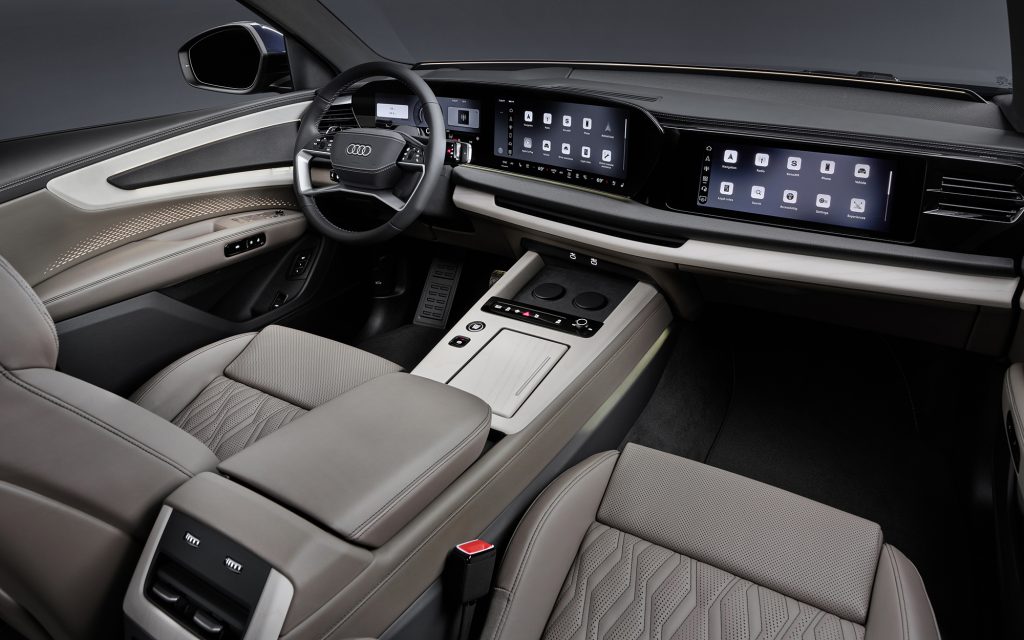
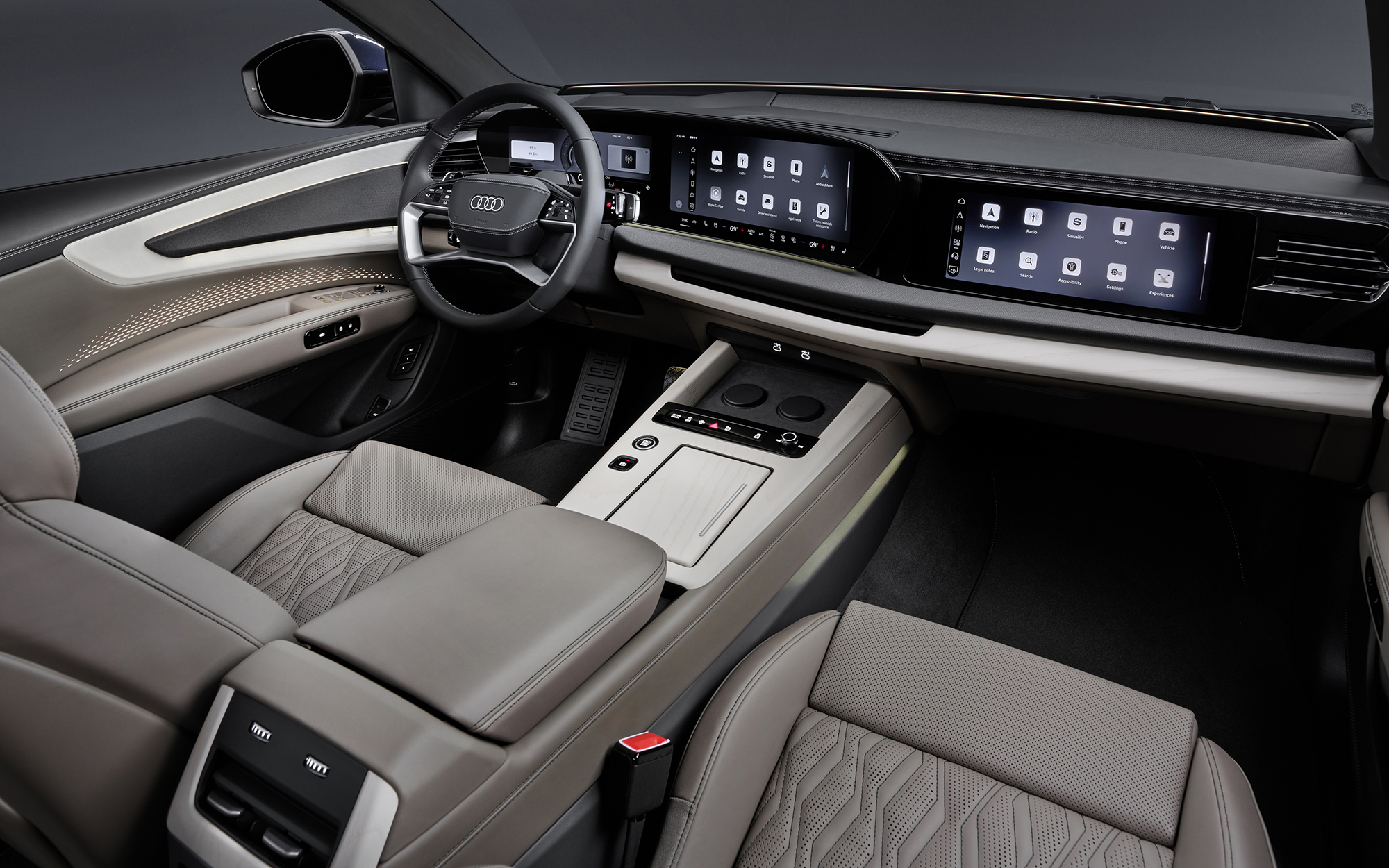
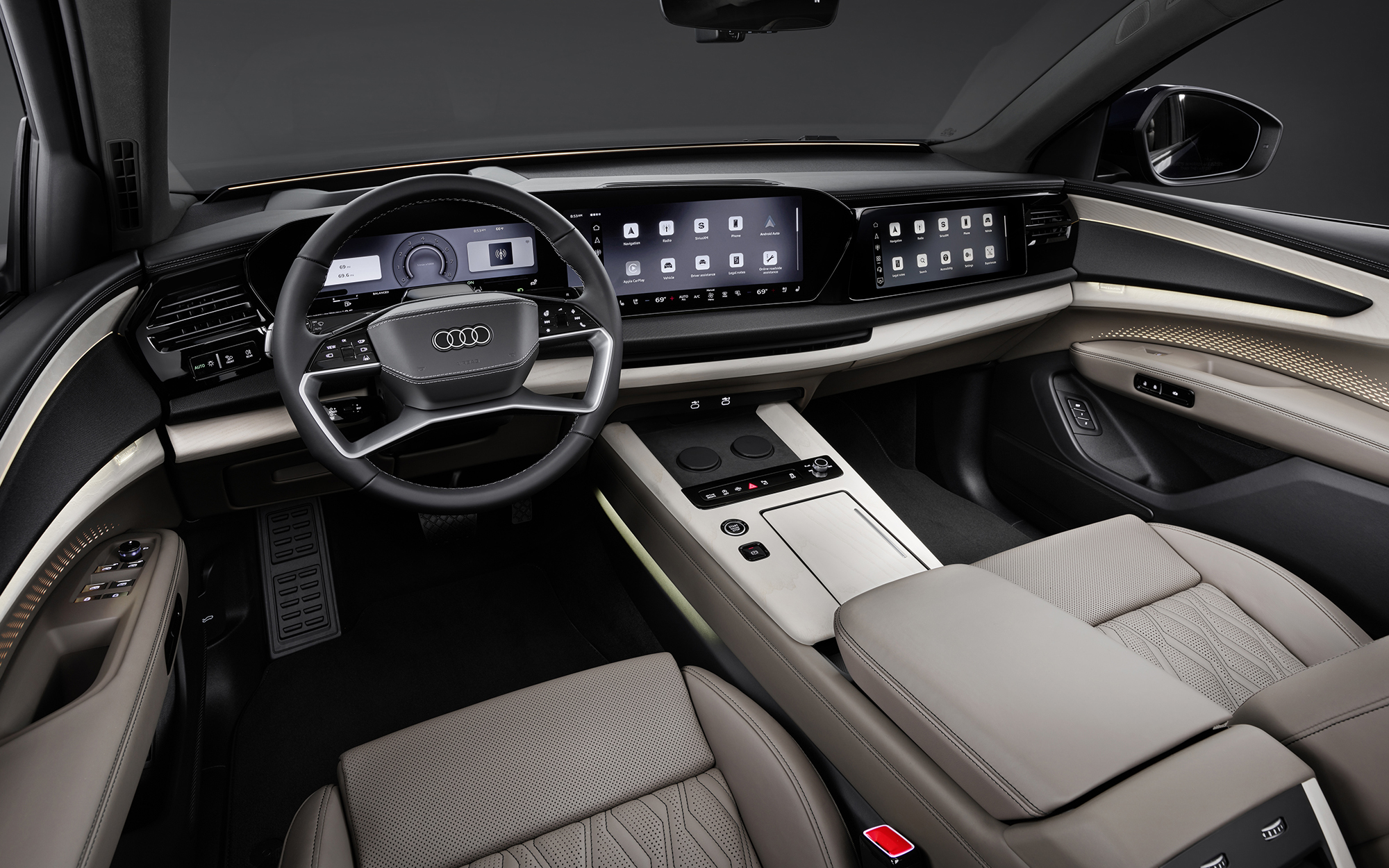
The Q9’s dashboard continues the horizontally oriented architecture introduced in Audi’s latest interiors, but the greater width of the vehicle allows the surfaces and displays to be spread across a larger area.
The dashboard and doors are visually integrated through continuous trim and material sections. Air vents are positioned discreetly within the architecture and adjusted electronically through the user interface.
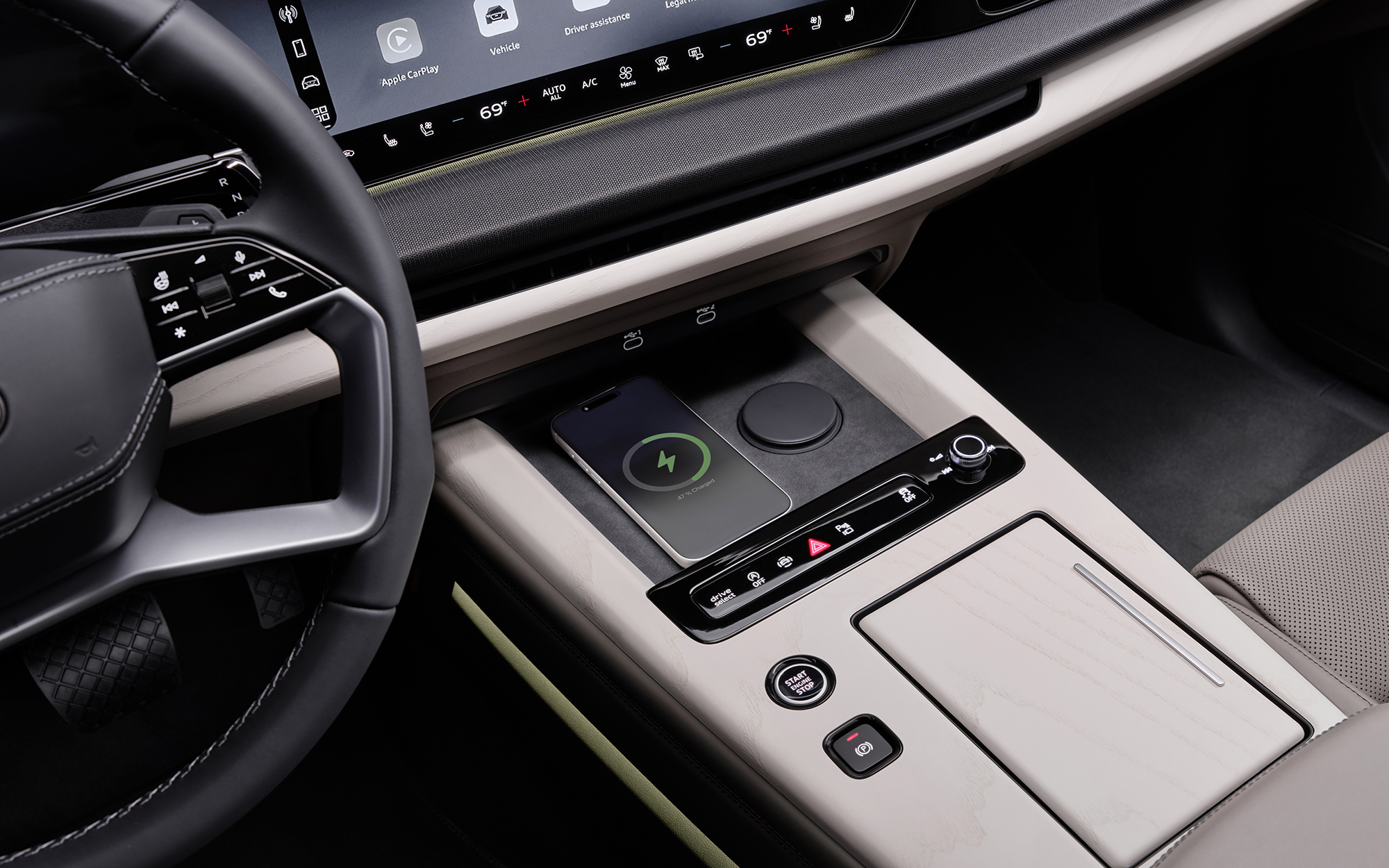
Audi has reduced the amount of gloss-black trim in favor of matte, textured and natural surfaces. Available materials include leather and leatherette combinations, Fine Nappa leather and several natural wood inlays.
Interior colors include tamarind brown and stone beige, while wood choices include Olive ash in amber brown, Lime structure in gray-brown and Fine grain ash in silk beige. The selected trim is coordinated with the corresponding upholstery color.
The steering wheel receives a leather-covered airbag panel with contrast stitching. Audi also offers an Audi exclusive Almond Beige design package that coordinates the cabin around a curated color and material specification.
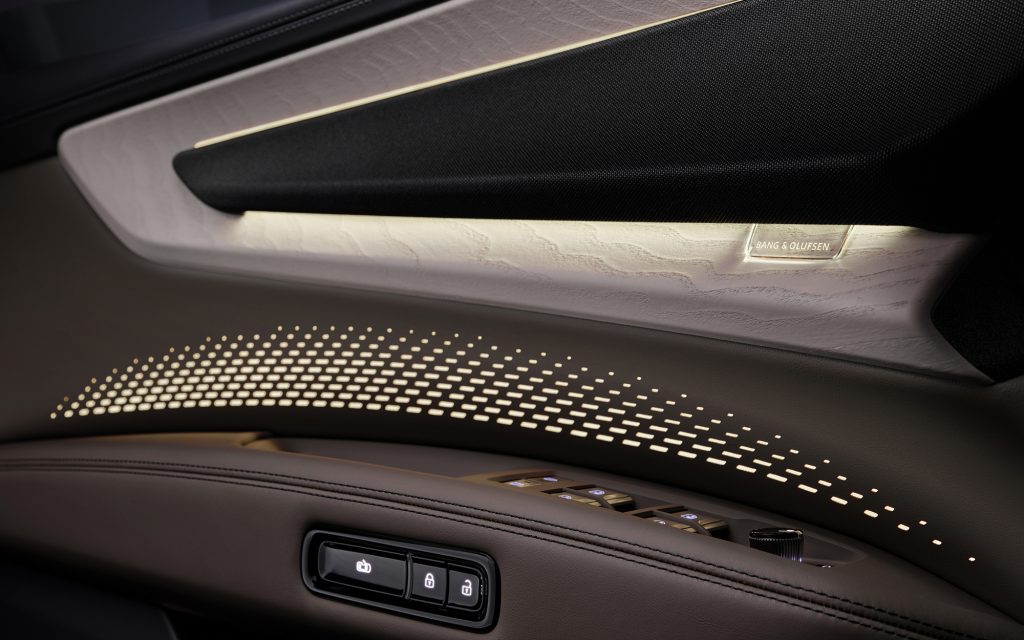
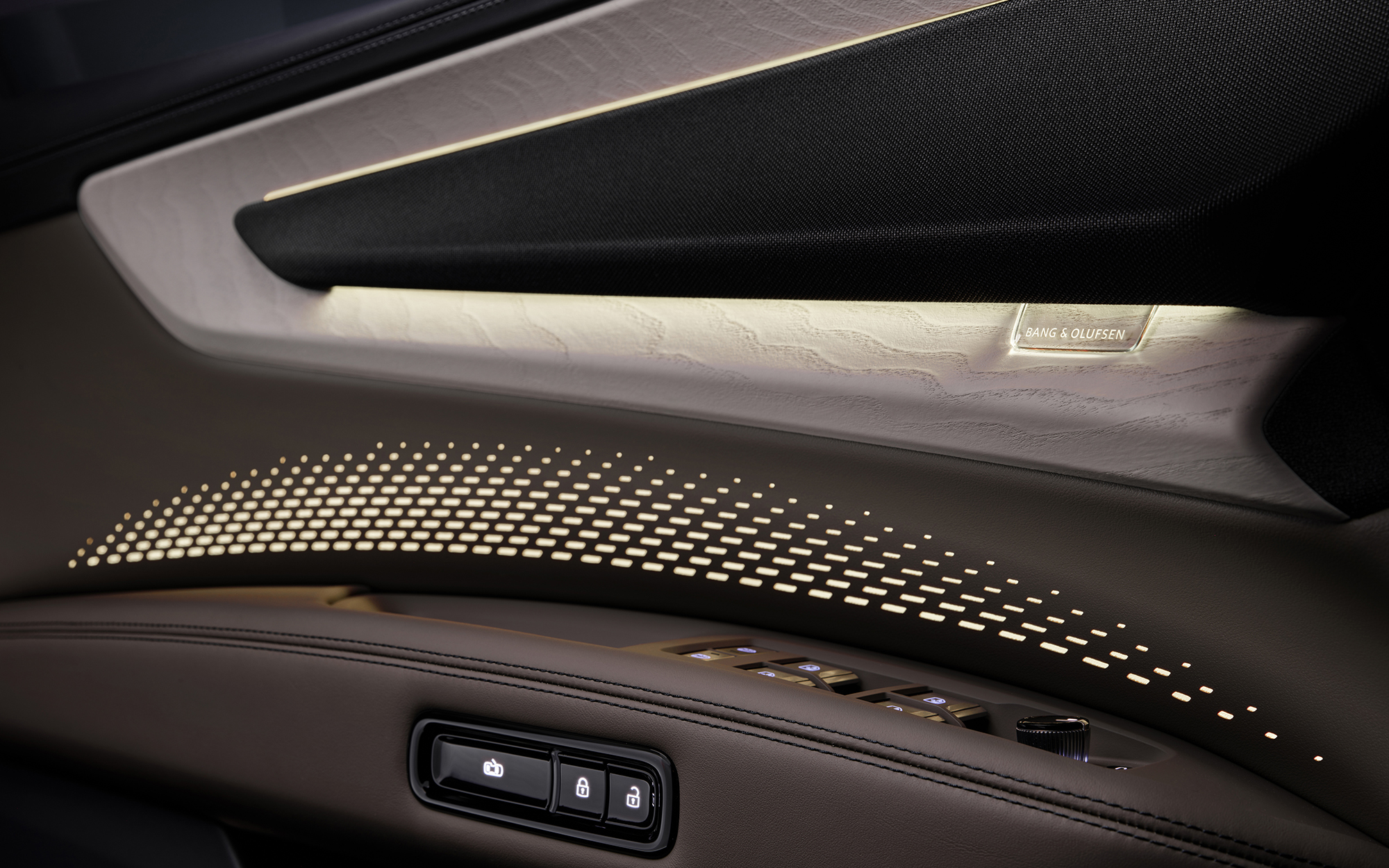
The standard ambient lighting package includes colored contour illumination across the dashboard and doors. Q9 Prestige models add backlit door surfaces through the ambient lighting plus package.
Indirect lighting beneath the panoramic display and around the center console creates the appearance that the primary interior elements are floating within the dashboard.
A continuous dynamic interaction light extends across the width of the cabin. It provides welcome and locking animations, visualizes the turn signals and communicates selected vehicle functions to the occupants. Available Sport seats plus add an illuminated signature within the headrests that can be seen from outside the vehicle.
CARGO CAPACITY AND STORAGE
Cargo volume measures 19.3 cubic feet with all three rows raised.
Folding the third row expands capacity to as much as 50.0 cubic feet behind the second row. With the second and third rows folded, total storage increases to 87.7 cubic feet behind the front seats.
The luggage compartment includes an aluminum rail system along its sides. Sliding hooks and adjustable anchors allow smaller items to be secured without consuming the full cargo floor.
When the third row is in use, the luggage cover can be stored beneath the floor rather than left loose inside the vehicle. A roof-rack system compatible with the raised roof rails is also included.
Storage inside the passenger compartment reflects the Q9’s North American focus.
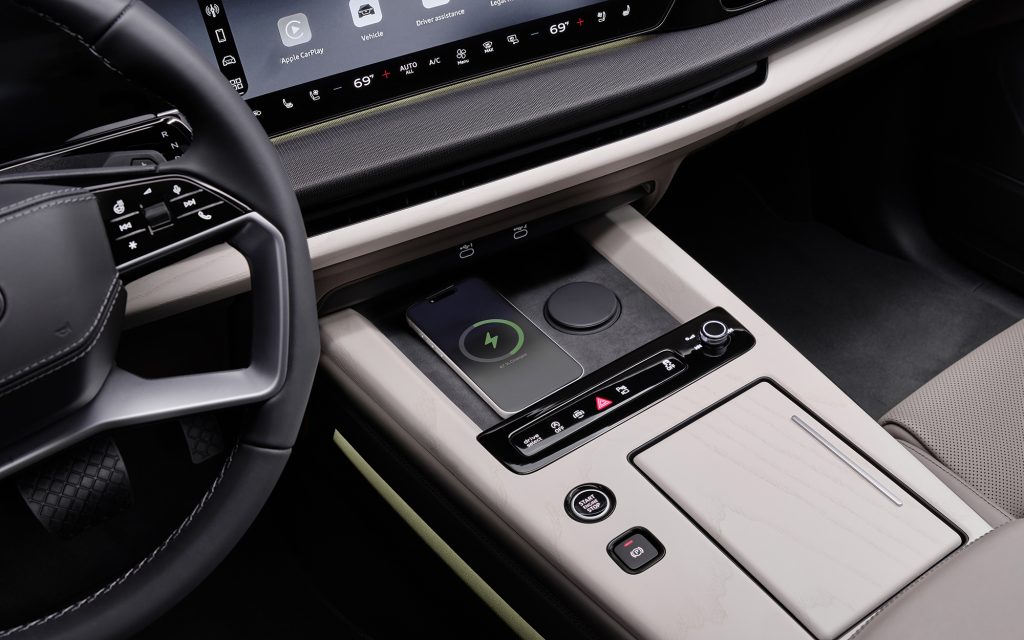
The redesigned center console includes two large cupholders intended to accommodate oversized insulated tumblers. Additional cupholders in the second row are sized for large containers and bottles.
A dual magnetic wireless charger supports the Qi2.2 standard and can charge two compatible smartphones simultaneously. Available USB-C Power Delivery ports are distributed across all three seating rows, with outputs ranging from 45 to 100 watts. The higher-output connections are capable of charging tablets and laptop computers rather than only mobile phones.
DIGITAL STAGE
The Q9 uses Audi’s latest Digital Stage display architecture.
The curved OLED MMI panoramic display combines an 11.9-inch Audi virtual cockpit with a 14.5-inch central touchscreen. A separate 12.3-inch front passenger display is standard.
The passenger screen incorporates an active privacy mode designed to prevent the driver from viewing distracting content such as video while the vehicle is moving. When the passenger display is not being used, or when no passenger is detected, it can show a background image rather than remaining dark.
A head-up display is also available, projecting speed, navigation guidance and assistance-system information into the driver’s field of view.
The infotainment system is based on Android Automotive OS. Third-party applications can be downloaded directly through the Audi Application Store without relying on a connected smartphone.
Audi says applications available at launch will cover music, video, gaming, navigation, parking, charging, productivity, weather and news. The application selection will vary by market and expand over time.
AUDI ASSISTANT WITH CHATGPT INTEGRATION
The Q9’s voice-control system uses the latest version of the Audi assistant.
With an Audi connect NAV subscription, the AI-based assistant can operate vehicle functions, search for destinations and answer general information requests. ChatGPT is integrated as a secondary information source when a request falls outside the Audi system’s own vehicle and navigation functions.
The vehicle determines whether a spoken request should control a feature, search for a location, provide information such as a weather forecast or be forwarded to ChatGPT. The change between systems occurs in the background without requiring the driver to select a separate assistant.
Audi states that the integration allows occupants to request general information while driving while retaining the vehicle-specific functions of the native Audi assistant.
An available factory-installed dashcam is integrated into the vehicle rather than attached separately to the windshield. It can record video when a microSD card is installed, providing a record of incidents or driving events.
BANG & OLUFSEN 4D SOUND
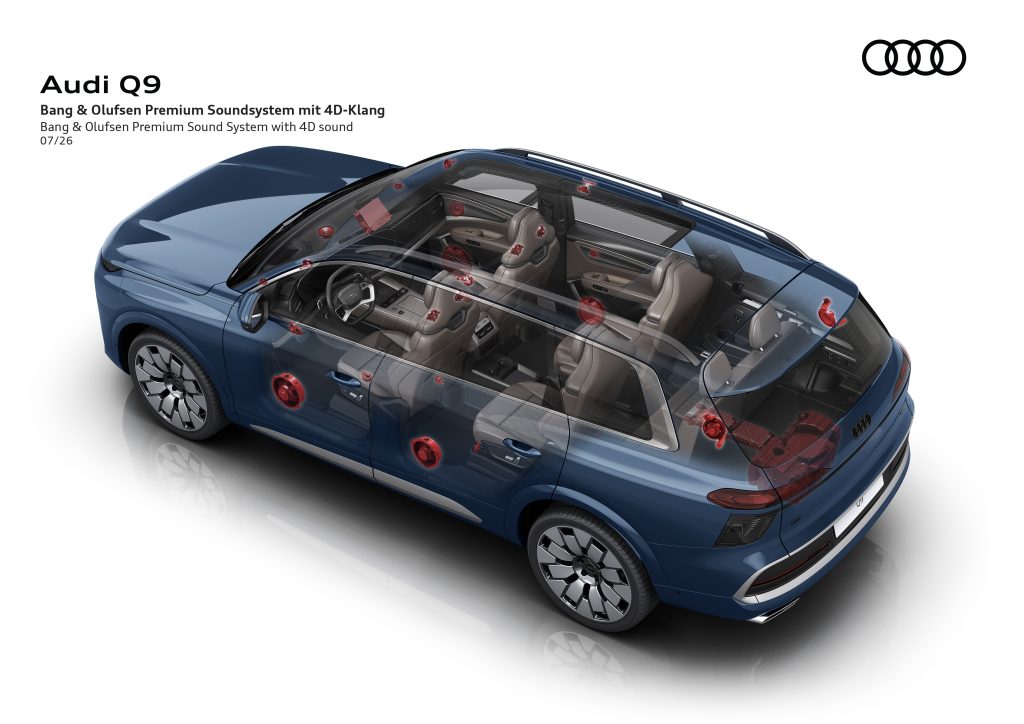
The available Bang & Olufsen Premium Sound System with 4D sound uses 22 speakers, four headrest speakers and two physical seat actuators.
The system is powered by a 1,360-watt amplifier.
The headrest speakers provide localized audio for the driver and front passenger. Navigation instructions, telephone calls and selected audio content can be directed toward the individual occupant rather than played through the entire cabin.
Fraunhofer Symphoria processing distributes sound spatially across the interior. The seat-mounted actuators translate low-frequency audio into controlled vibrations, allowing bass to be physically felt through the front seats.
The intensity can be adjusted using individual sliders or preset sound profiles and can be switched off entirely.
Audi also connects the sound system with the cabin’s interaction lighting. In supported modes, the interior lighting can respond to the rhythm of the music and adopt colors based on the artwork associated with the playing track.
429-HP TWIN-TURBO V6
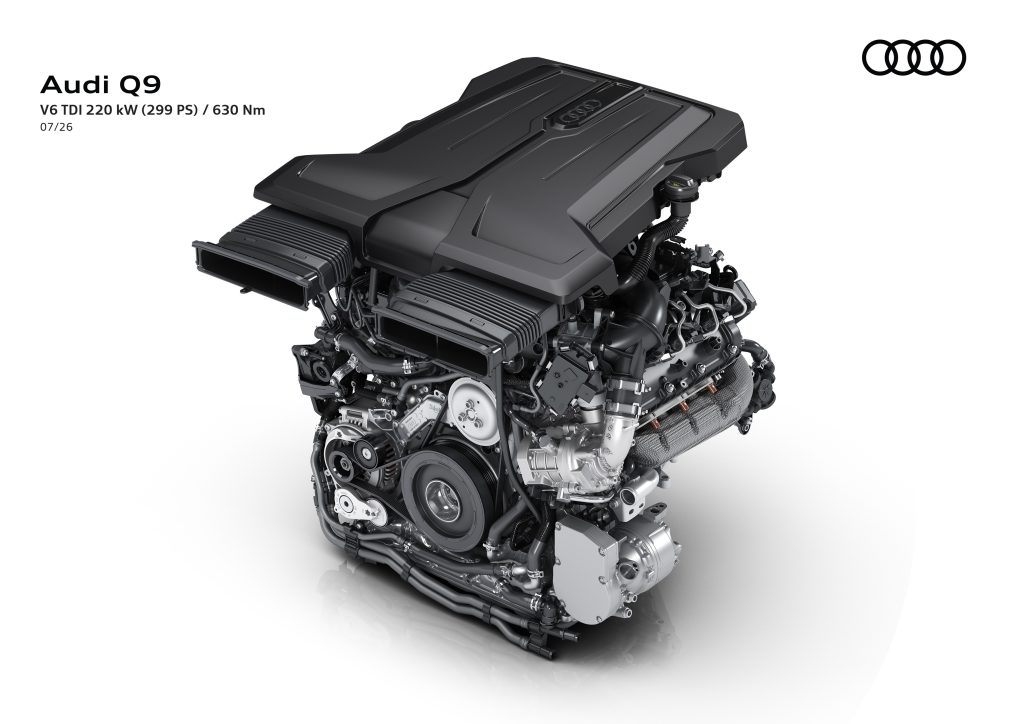
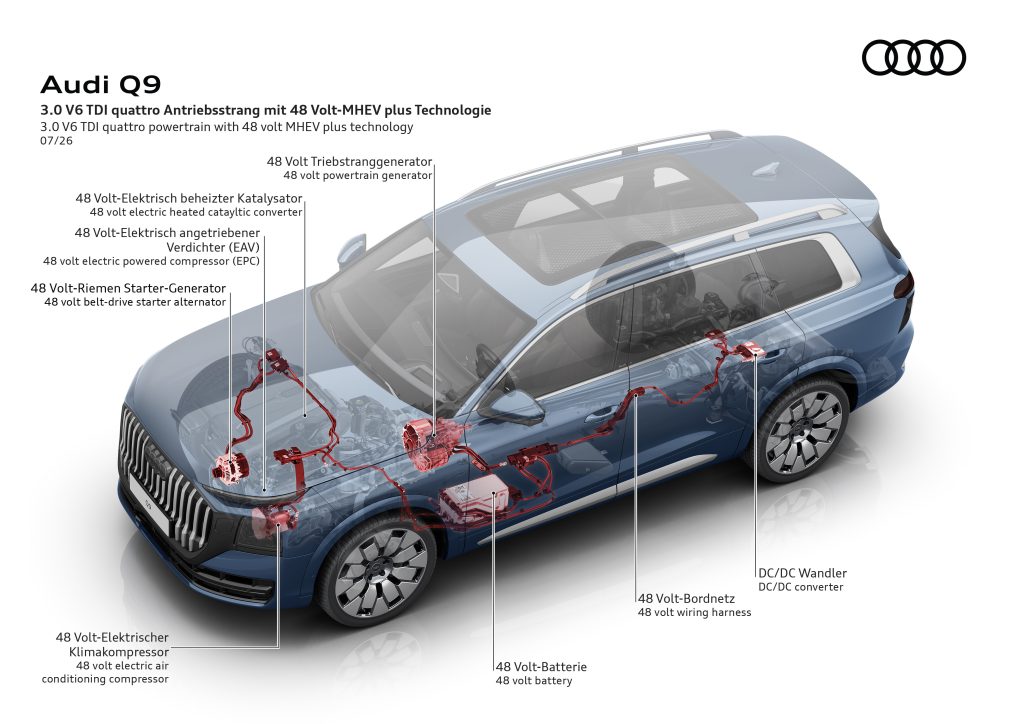
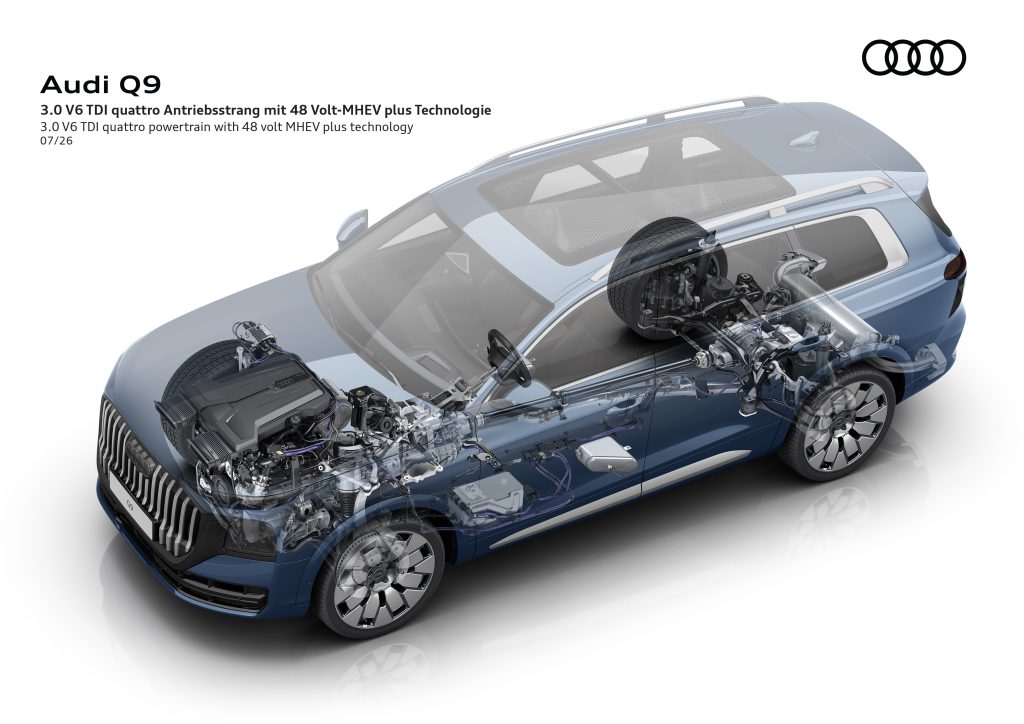
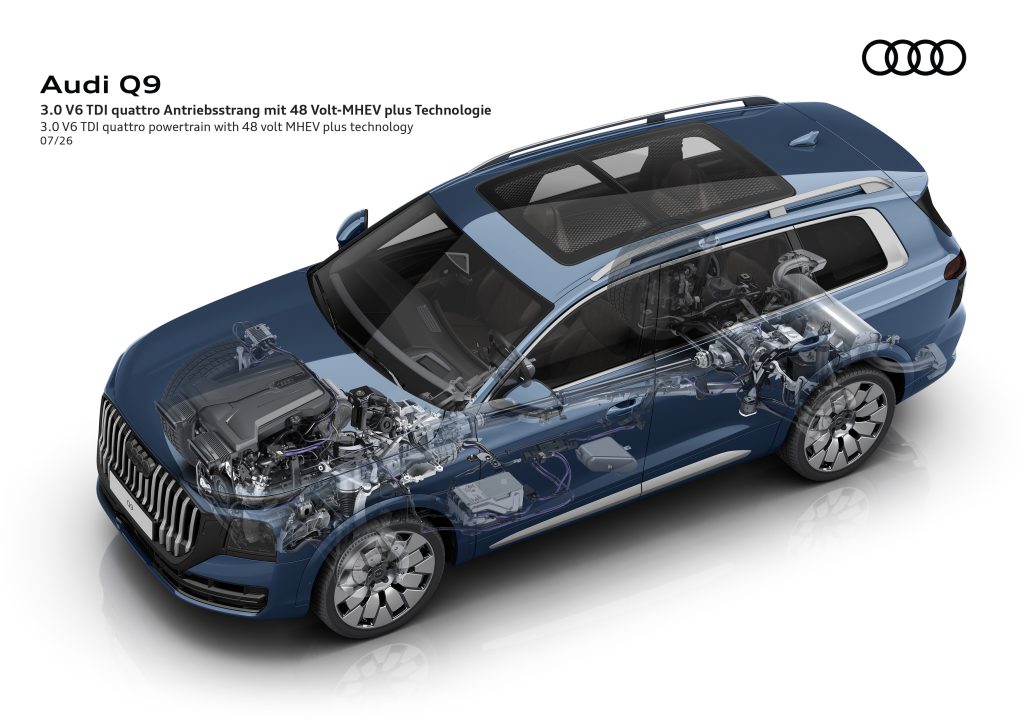
The Q9 launches in the United States with a twin-turbocharged 2.9-liter V6.
The engine produces 429 hp and 442 lb-ft of torque. It is paired with an eight-speed Tiptronic automatic transmission and permanent quattro all-wheel drive.
Audi claims a 0-60 mph time of 4.9 seconds, which it identifies as best in class for the standard Q9.
The press material does not identify additional Q9 powertrains for the U.S. market at launch.
Unlike the SQ9’s newly developed rear-biased performance system, the standard Q9 is presented with permanent quattro all-wheel drive calibrated around all-weather traction, stability and predictable power delivery. The eight-speed transmission is intended to balance acceleration with relaxed cruising and efficiency.
Audi has not yet published U.S. fuel economy estimates.
ADAPTIVE AIR SUSPENSION
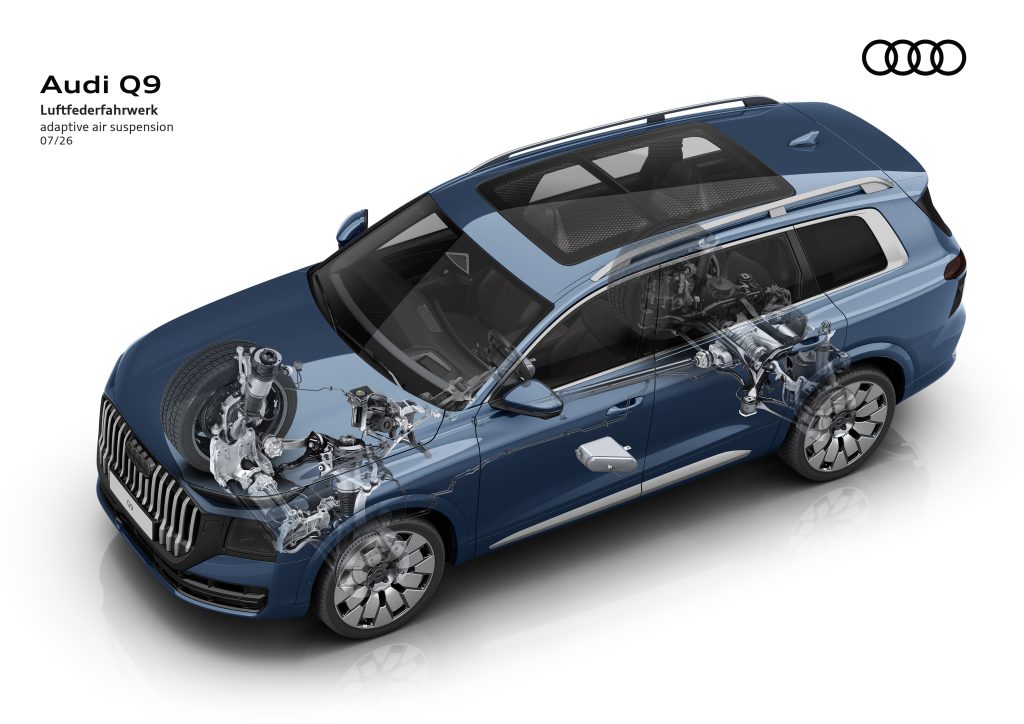
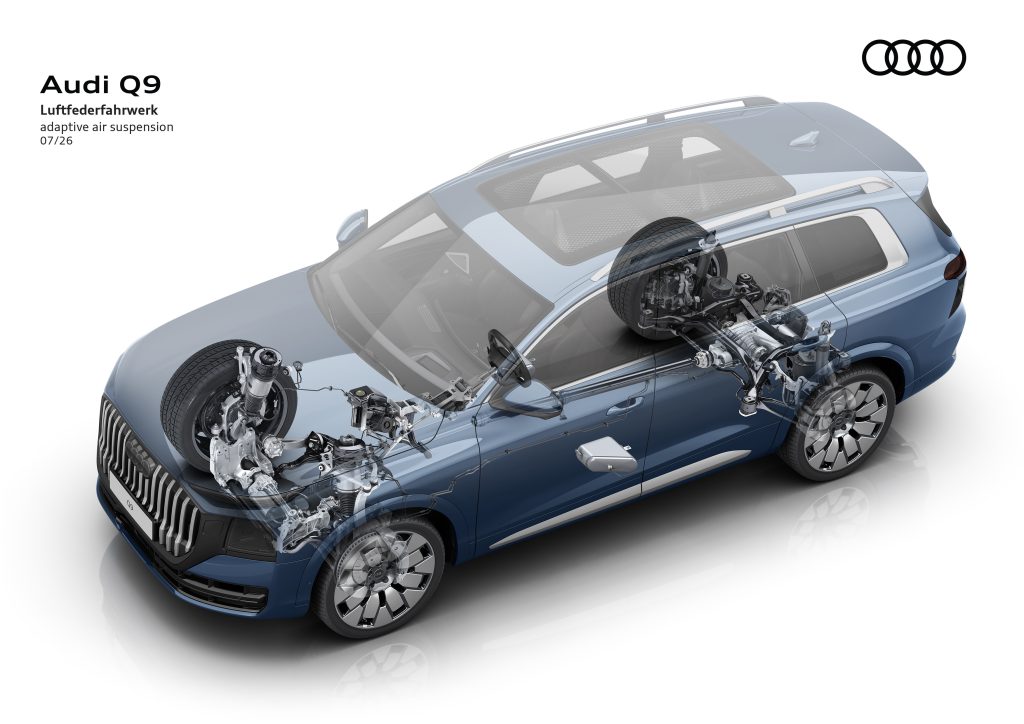
Adaptive air suspension is standard on the Q9.
The system combines variable damping with adjustable ride height and automatically responds to vehicle speed, load and road conditions. The driver can also alter the height and chassis behavior through Audi drive select.
Total vertical adjustment between the lowest and highest settings is 3.5 inches. From the standard balanced setting, the body can be lowered by 2.4 inches to a comfort-entry height, reducing the step into the cabin and simplifying loading.
Six Audi drive select modes are available:
Balanced
Comfort
Dynamic
Offroad
Individual
Assistant
Each mode alters the calibration of the drivetrain, steering, suspension and ride height. The drive select assistant can also choose an appropriate configuration automatically based on the road, driving situation and driver behavior.
PROGRESSIVE AND REAR-WHEEL STEERING
Progressive steering is fitted to the front axle.
The system varies its ratio according to vehicle speed and steering input. It provides a quicker response during parking and low-speed maneuvering while becoming more measured at highway speeds.
Rear-wheel steering is standard on Q9 Prestige models.
The rear wheels can steer by as much as five degrees. At lower speeds, they turn in the opposite direction from the front wheels, effectively shortening the wheelbase and reducing the turning circle.
At highway speeds, the rear wheels steer in the same direction as the fronts. This improves stability during lane changes and allows the vehicle to track more smoothly through long curves.
The system operates automatically and does not require the driver to select a separate mode.
Braking is handled by an integrated brake control system with ventilated discs measuring 15.7 inches at the front and 13.8 inches at the rear.
DIGITAL MATRIX LED LIGHTING COMES TO THE U.S.
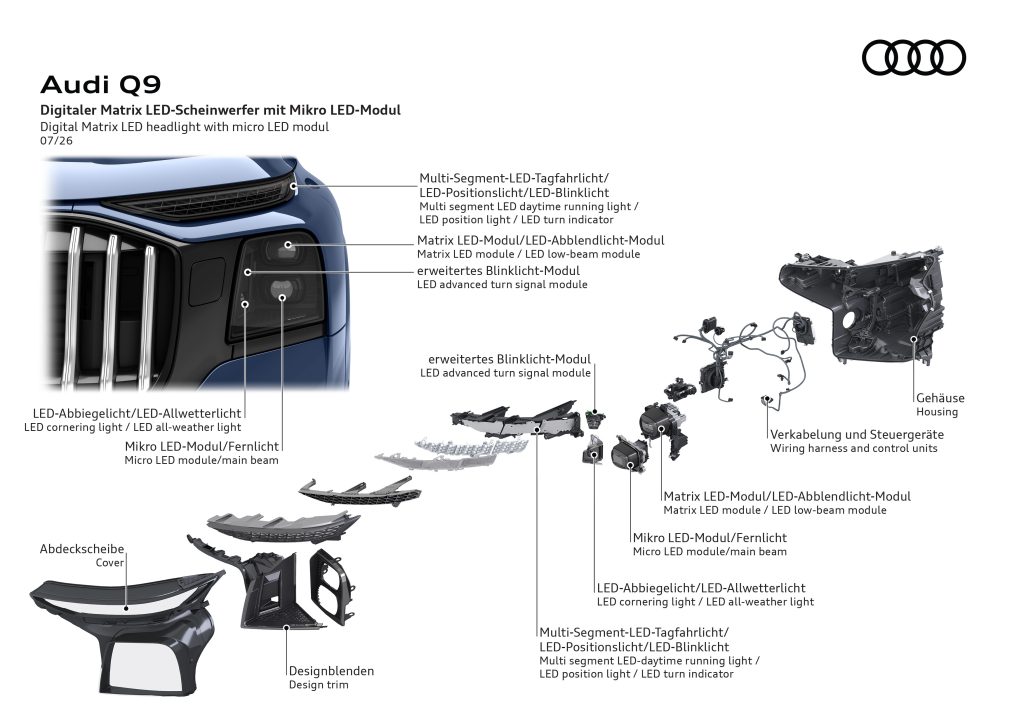
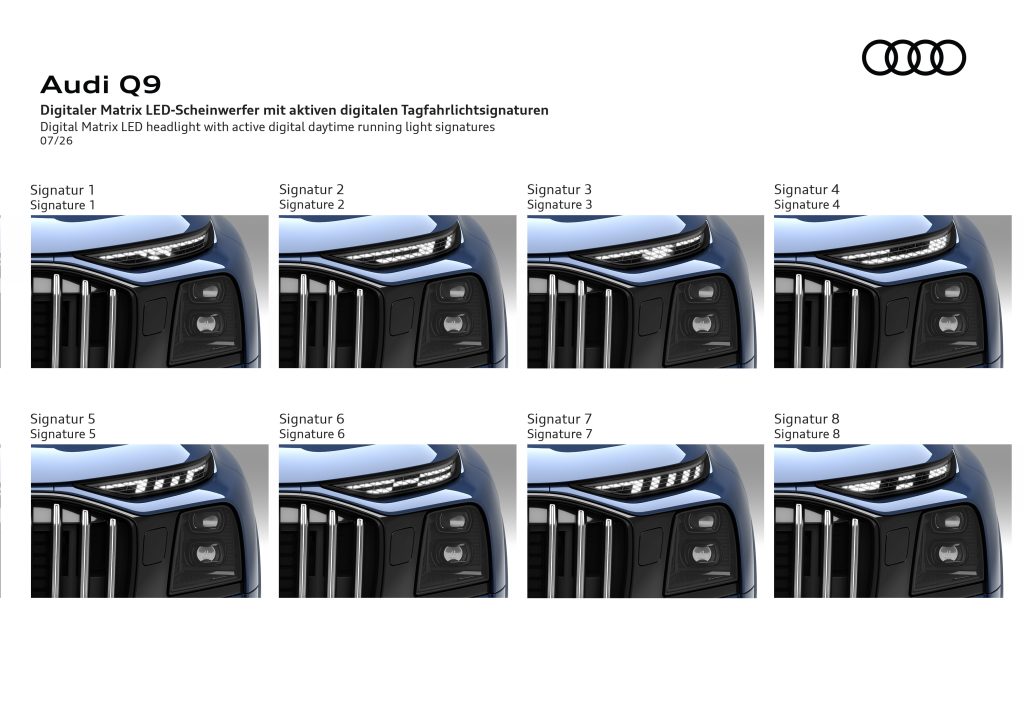
The Q9 introduces Audi Digital Matrix LED adaptive driving beam functionality to the U.S. market.
The system uses micro-LED technology to continuously shape the high-beam pattern rather than switching the entire beam between high and low settings.
A forward-facing camera identifies oncoming vehicles and vehicles traveling ahead. The system then creates a precisely controlled shadow around those road users while maintaining high-beam illumination across the remaining portions of the road.
The objective is to provide greater illumination than a conventional low beam while reducing glare for surrounding traffic.
Audi has offered related adaptive high-resolution lighting technology in Europe for more than a decade, but U.S. regulations previously prevented American-market vehicles from using the same functionality. The Q9 system has been developed to satisfy U.S. glare requirements while retaining the continuously variable beam-shaping capability.
CURVED DIGITAL OLED TAILLIGHTS
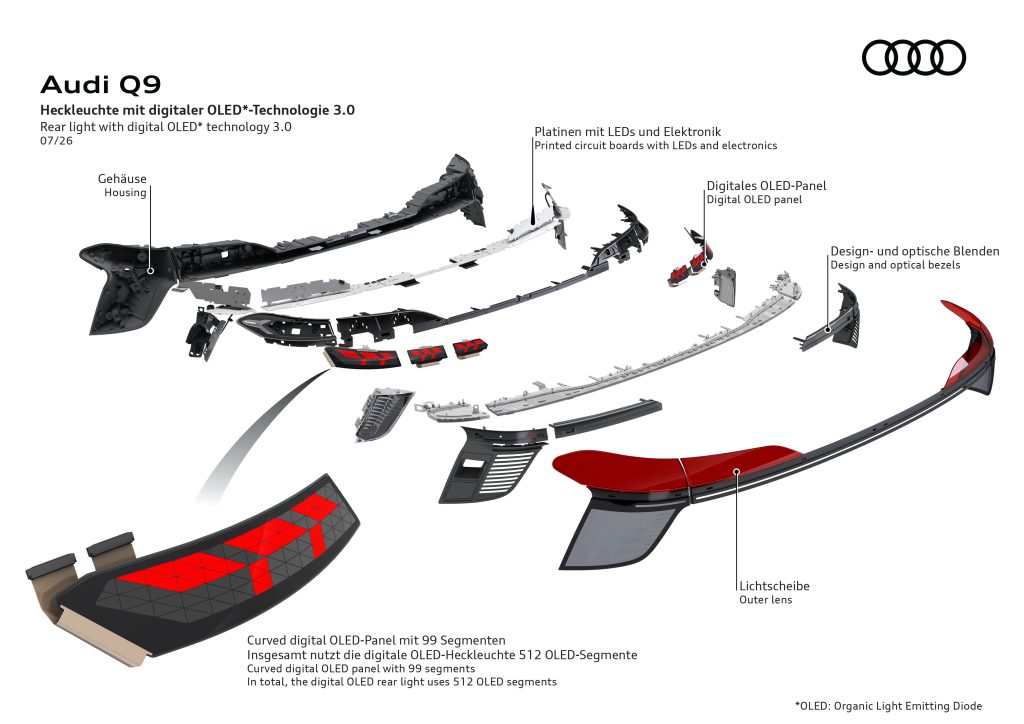
Q9 Prestige models introduce Audi’s third-generation digital OLED taillights.
The outer panels use curved OLED elements, representing the first application of curved digital OLED lighting in a production vehicle.
Traditional OLED panels are flat. The Q9’s panels use a glass substrate measuring just 0.1 millimeter thick, allowing the light surface to follow the three-dimensional curvature of the body.
The curved shape is not used solely for styling. Because the panel emits light across a broader angle, it can be seen more clearly from the side of the vehicle.
Each rear lamp incorporates three OLED panels. The outer curved panel contains 99 individual segments, the center panel contains 84 and the inner panel contains 73. Across both sides, six panels provide a total of 512 individually controlled segments.
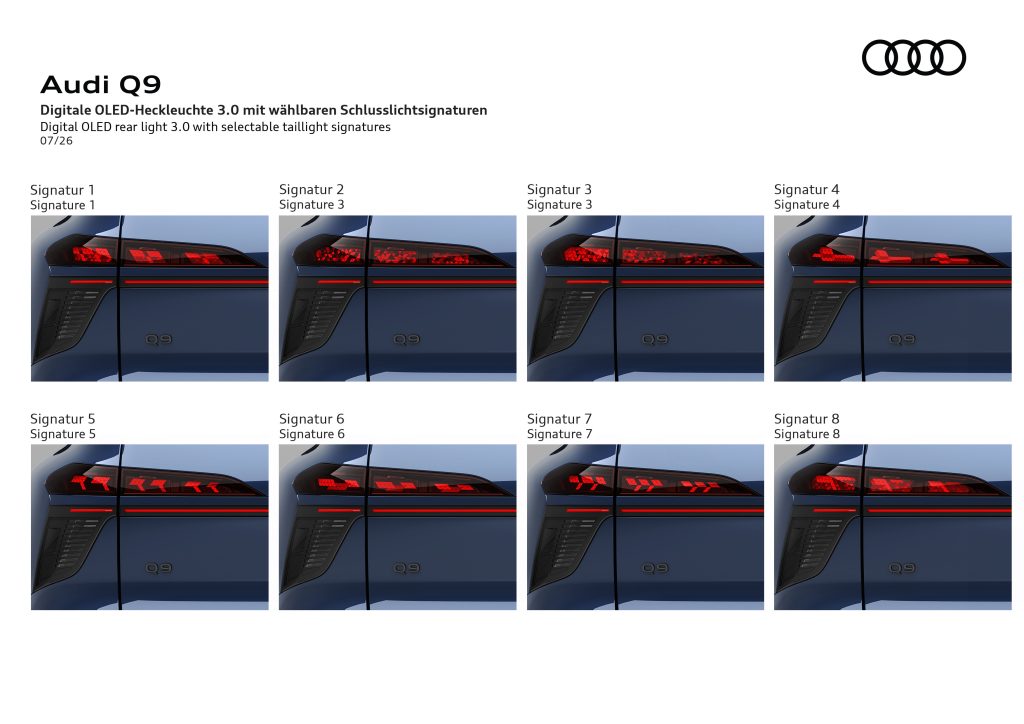
The increased segmentation enables more detailed graphics and eight selectable digital light signatures. It also allows the rear lighting to perform communication and warning functions rather than serving only as position, brake and turn-signal lighting.
COMMUNICATION LIGHTING
The optional digital OLED taillights can display specific graphics to communicate with other road users.
When the hazard lights are activated, or when an emergency or breakdown call has been initiated, the rear lighting can show a warning symbol based around a hazard triangle.
The connected exit warning can activate a dedicated signature when a vehicle or cyclist approaches from behind while an occupant is preparing to open a door.
The broader visibility provided by the curved outer OLED panels is intended to make those warnings easier to see from positions beside the vehicle as well as directly behind it.
TURN SIGNAL PROJECTION
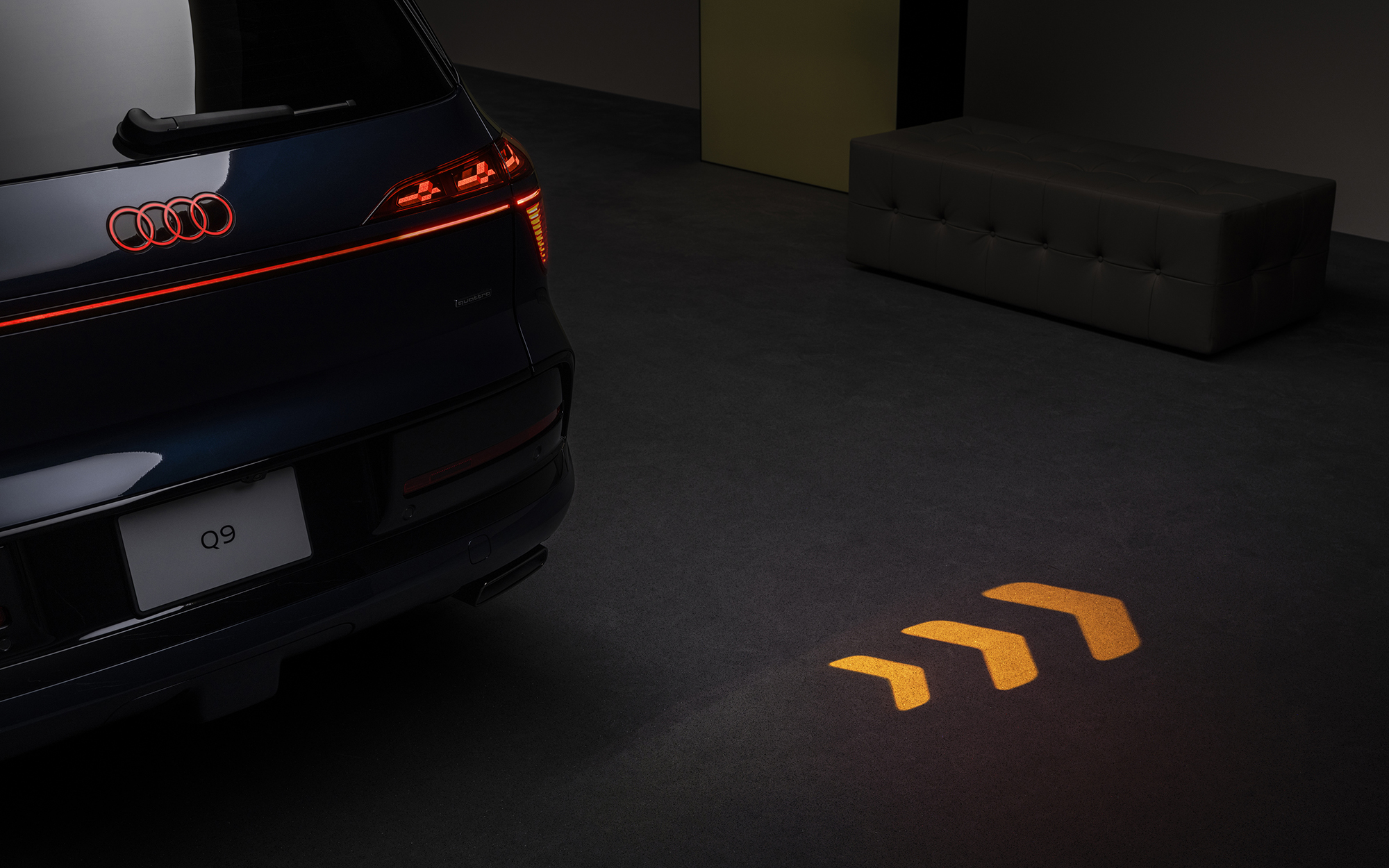
Available advanced turn signals add a projected indicator to the conventional front and rear signals.
When the turn signal is activated at night, the Q9 projects a stylized directional graphic onto the ground beside the vehicle. The projection operates in synchronization with the dynamic front and rear turn signals.
The additional signal is intended to improve visibility for cyclists, pedestrians and motorists who may not have a direct view of the lamps themselves.
Q9 Prestige models also use lighting modules in the door sills to project a rhombus-shaped graphic onto the ground.
A solid rhombus appears beneath the front doors, while a dashed version is projected beneath the rear doors. The graphic unfolds as the door opens, illuminating the entry area.
When the exit warning system detects an approaching cyclist or vehicle, the same projection can be used to indicate that an occupant is preparing to leave the Q9.
HANDS-FREE HIGHWAY ASSISTANCE
Adaptive cruise assist plus introduces hands-free highway driving to the Q9.
The system is standard on Q9 Premium Plus and Prestige models and operates on approved divided highways at speeds of up to 85 mph.
When active, the system controls steering, acceleration and braking. Activating the turn signal can prompt the vehicle to perform an assisted lane change when conditions allow.
A long-range front radar, side radar sensors and a forward-facing camera monitor the road and surrounding traffic. Navigation map data identifies highway sections approved for hands-free operation.
When the vehicle enters an eligible area, the Audi virtual cockpit offers the driver the option to activate the system. The driver can remove their hands from the steering wheel but remains legally and operationally responsible for supervising the vehicle.
A camera mounted on the steering column monitors eye position and head movement. If the driver looks away for too long or appears inattentive, the system issues visual, audible and haptic warnings.
Adaptive cruise assist plus is classified as SAE Level 2 partial automated driving. It does not make the Q9 self-driving and the driver must remain prepared to take control at all times.
EMERGENCY ASSIST
If the driver does not respond to escalating attention warnings, emergency assist can intervene.
The system first attempts to regain the driver’s attention using messages, sounds, steering-wheel feedback, seatbelt tensioning and brief brake applications.
When the driver remains unresponsive, the Q9 can maintain its lane, reduce speed, activate the hazard warning lights and bring the vehicle to a controlled stop within the system’s operating limits.
The Q9 also introduces two lane-departure warning settings.
Reduced mode provides a steering-wheel vibration and visual warning, with corrective steering applied according to the traffic situation. Normal mode provides steering correction, visual alerts and steering-wheel vibration whenever an unintended lane departure is detected.
ADDITIONAL DRIVER ASSISTANCE SYSTEMS
The Q9’s driver assistance equipment includes:
Automatic emergency braking with pedestrian and cyclist detection
Blind-spot monitoring
Rear cross-traffic assist
A 360-degree surround-view camera system
Park assist plus
Available trailer maneuvering assist
Trailer stability control
Exit warning
Park assist plus can control steering, acceleration and braking during parallel or perpendicular parking.
Trailer maneuvering assist takes over steering inputs while the driver reverses with a trailer. The intended trailer direction is selected through the MMI display.
Trailer stability control monitors trailer movement and can selectively apply the vehicle’s brakes when sway is detected. The trailer systems require the available factory tow hitch.
A NEW PORTFOLIO FLAGSHIP
The Q9 fills a position Audi has left open even as the full-size luxury SUV segment expanded around it.
The Q7 has provided three-row seating since Audi entered the SUV market, while the Q8 has served as the brand’s more design-focused utility flagship. The Q9 now establishes a separate full-size category with additional passenger space, a longer wheelbase, a larger cargo area and a feature set developed specifically around high-capacity luxury travel.
Its significance, however, extends beyond its dimensions.
The Q9 introduces Audi’s first U.S.-market adaptive Digital Matrix LED system, the first curved digital OLED taillights used on a production vehicle, automatic doors, a more deeply integrated Android Automotive infotainment platform and hands-free Level 2 highway driving.
It is also being positioned as a demonstration of Audi’s changing interpretation of Vorsprung durch Technik. While performance and chassis engineering remain central, the emphasis now includes the complete in-car environment: seating, lighting, sound, digital interaction, assistance systems and the ability to use the vehicle as a comfortable space over long distances.
The result is not simply Audi’s largest SUV. It is the model the company has chosen to establish the upper limit of its current portfolio.
2027 AUDI Q9: KEY SPECIFICATIONS
Engine: 2.9-liter twin-turbocharged V6
Output: 429 hp
Torque: 442 lb-ft
Transmission: Eight-speed Tiptronic automatic
Drivetrain: quattro all-wheel drive
0-60 mph: 4.9 seconds
Length: 209.0 inches
Width: 86.8 inches
Height: 71.4 inches
Wheelbase: 123.5 inches
Seating: Seven standard, six optional
Cargo behind third row: 19.3 cubic feet
Cargo behind second row: Up to 50.0 cubic feet
Maximum cargo capacity: 87.7 cubic feet
Wheels: 21 to 23 inches
Suspension: Standard adaptive air suspension
Rear-wheel steering: Standard on Prestige
Maximum rear steering angle: 5 degrees
Air-suspension adjustment range: 3.5 inches
Front brake diameter: 15.7 inches
Rear brake diameter: 13.8 inches
Starting MSRP: $87,700
U.S. arrival: Fourth quarter of 2026
Production: Bratislava, Slovakia
PHOTO GALLERY