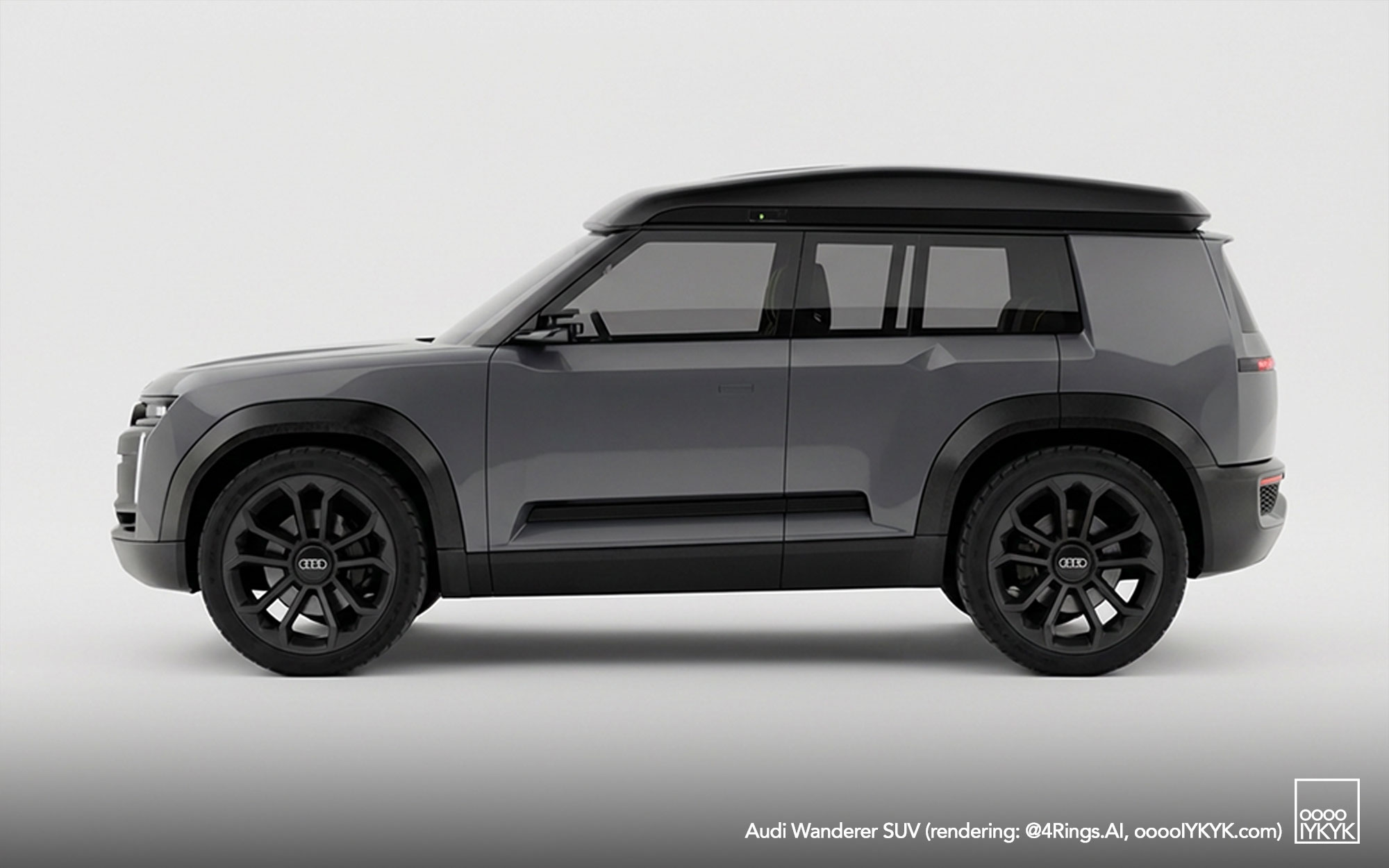

News is circulating out of the German press today that Audi is reportedly developing a two-stage U.S. manufacturing strategy that would pair a Scout-based off-roader built in South Carolina with a potential dedicated Audi factory in Georgia. Neither proposal has received formal approval, but the combination could establish a substantially different production footprint for Audi—and potentially other Volkswagen Group brands—in North America.
According to Handelsblatt, planning for Audi’s first dedicated U.S. factory is advanced. Audi CEO Gernot Döllner and Supervisory Board Chairman Manfred Döss reportedly traveled to Washington on October 20, although the outcome of those discussions has not been disclosed. Sources cited in the reporting say no decision has been approved at either Audi or Volkswagen Group, and Audi declined to comment.
The financial pressure is considerable. The reports put Audi’s U.S. business deficit at more than €1 billion in 2025, with senior decision-makers expecting another loss of approximately €800 million in 2026. Tariffs are identified as a contributing factor, although those figures describe reported business losses rather than a separately disclosed tariff bill.
SCOUT-BASED AUDI HARDQORE WOULD ADDRESS A DIFFERENT SEGMENT
The first stage reportedly involves manufacturing Audi vehicles at Scout’s new factory in Blythewood, South Carolina, using Scout architecture. The proposed Audi off-roader continues to be associated with the working title “Hardqore.” That name is believed to be a project designation.
The idea predates the latest factory discussions. Former Audi design chief Marc Lichte publicly discussed a more rugged Audi SUV in 2023, positioning the opportunity around vehicles such as the Mercedes-Benz G-Class and Land Rover Defender. The concept would extend Audi’s quattro identity into a more dedicated off-road product than its existing road-focused SUVs. We’ve reported on this subject of Audi using the Scout hardware before.
Scout provides a potentially relevant technical foundation. Its announced vehicles use body-on-frame construction, with a solid rear axle and front and rear mechanical differential lockers. Scout also plans an optional Harvester range extender, adding a gasoline-powered generator to its electric drivetrain. While these are Scout specifications, however, it seems reasonable to conclude this equipment could migrate into an equivalent platform-sharing Audi product.
A Scout-based Audi could enter the market as a purpose-developed luxury off-roader, with different capabilities and proportions from a conventional Q-series crossover. It would also share development and manufacturing resources with an existing Volkswagen Group project.
German reports describe this as an immediate measure, but that is relative to the longer process of establishing an independent factory. No Audi production date has been announced. And, though this is not an especially new idea, no test mules of any sort have been identified as a Hardquore. Combine that with the fact that Scout still isn’t in production and the time to any potential market arrival for the Hardquore would need to be measured in years.
GEORGIA POINTS TOWARD A DIFFERENT PRODUCTION ROLE
The second stage would be a dedicated Audi manufacturing operation in Georgia. The broader account circulating around the report identifies the Middle Georgia Mega Site and a potential early-2030s role producing large SUVs such as the Q7 and Q9. Those specific allocations remain reported possibilities.
The site itself is real. The Development Authority of Peach County markets approximately 1,500 acres of industrial land at the Middle Georgia Mega Site, broadly comparable with the roughly 620 hectares referenced in accounts of the Audi proposal. Its public materials do not identify Audi as a committed occupant.
A combustion-focused premium vehicle factory is a plausible interpretation of Georgia’s potential role. Volkswagen Group already has substantial U.S. manufacturing infrastructure: Chattanooga has produced MQB-based Atlas models and the MEB-based ID.4, while Blythewood is being developed around Scout’s separate architecture.
There is an important update to that comparison. Volkswagen ended Chattanooga ID.4 assembly in April 2026, and its current plant profile lists the Atlas and Atlas Cross Sport as its production models. The Group therefore has experience manufacturing both MQB and MEB vehicles in Tennessee, but they are no longer both in production there.
Against that background, a Georgia operation serving Audi’s longitudinal-engine combustion models would fill a different industrial role. PPC, Audi’s Premium Platform Combustion architecture, is an obvious candidate for consideration. Nevertheless, no platform allocation has been announced, and a factory potentially opening in the next decade cannot be defined solely by current demand or today’s production arrangements.
MEXICO PROVIDES A PRECEDENT—AND A COMPETING OPTION
Audi’s San José Chiapa factory offers a useful example of what a dedicated North American premium vehicle operation can do. The Mexican plant produces the Q5 and derivatives for global markets, with China the principal exception. It was conceived as an international production hub rather than simply a local assembly operation.
Mexico’s export access was central to that business case. At the factory’s opening, Audi highlighted the country’s extensive network of free-trade agreements. That history is relevant to Georgia, but it should not be reduced to a blanket claim that Mexican vehicles always face lower tariffs: the answer depends on destination, origin requirements and the trade rules in force.
If Georgia were allocated Q7 and Q9 production, North American demand would be an understandable starting point. Export production could also be considered. BMW has demonstrated that a U.S. luxury SUV factory can serve a much wider market: Spartanburg exported nearly 200,000 vehicles to approximately 120 countries in 2025, with an export value of about $9 billion.
Whether Audi could reproduce that model would depend on scale, supplier localization, production costs and access to export markets. A factory built to reduce import exposure in America would still need a separate business case for vehicles shipped elsewhere.
PORSCHE COULD ENTER THE EQUATION
The wider question is whether a new Audi operation would be restricted to Audi vehicles. Volkswagen Group is reconsidering production capacity and costs across its network, while reports of discussions about moving a future A8 to Porsche’s Leipzig factory illustrate how established brand-and-factory relationships could change.
Porsche is the most obvious additional brand to examine. The combustion-engine Cayenne belongs to the same broad longitudinal-platform family as Audi’s large SUVs. A future factory equipped for related Audi products could therefore merit consideration for Porsche Cayenne production.
That does not make Cayenne assembly a straightforward addition. Related architecture can improve the case for shared production, but each vehicle still requires appropriate body-shop equipment, tooling, logistics, quality processes and supplier support.
The forthcoming combustion-engine Porsche SUV and positioned alongside the electric Macan raises a similar possibility. Porsche has confirmed the new combustion and plug-in hybrid model for 2028, while prototypes wearing modified Audi Q5 bodywork have been reported. “Octan” remains an unconfirmed name associated with that project.
If that vehicle uses the anticipated PPC architecture, Mexico and a future U.S. factory would present different potential production cases. Mexico already has Q5 manufacturing infrastructure; Georgia could offer domestic U.S. production and the opportunity to spread investment across more models. Related Audi passenger cars, including A5 derivatives, could theoretically enter the discussion, although platform compatibility alone would not justify their allocation.
These are possibilities arising from the industrial logic of the proposal. None has been identified as an approved part of Audi’s U.S. plan.
BENTLEY AND LAMBORGHINI PRESENT A DIFFERENT QUESTION
The same platform discussion extends to the Bentley Bentayga and Lamborghini Urus, but their manufacturing identities add another consideration. Bentayga final assembly takes place in Crewe, England, while the Urus is assembled in Sant’Agata Bolognese, Italy. Both manufacturers explicitly connect their products to those locations.
Shared Group engineering therefore does not mean these vehicles lack a distinct national manufacturing identity. Moving final assembly to the United States would raise questions about customer expectations and brand positioning, alongside the usual production economics. There is no reported commitment to move either model.
Volkswagen’s own participation in this longitudinal-engine family is also winding down: the company announced that combustion-engine Touareg production would end in 2026. It is more accurate to describe that program as ending than to assume its production had already ceased when the latest Audi report appeared. Additionally, the Touareg is no longer sold in North America.
For now, the substantive news is that Audi is reportedly pursuing two distinct manufacturing opportunities while discussions with Washington remain unresolved. Scout could support a new kind of Audi off-roader. Georgia could provide a broader premium combustion-production base, with potential implications beyond Audi if the Group finds a viable business case. Formal approval, product allocation and the terms of any U.S. agreement remain the decisions that would turn those possibilities into a production strategy.