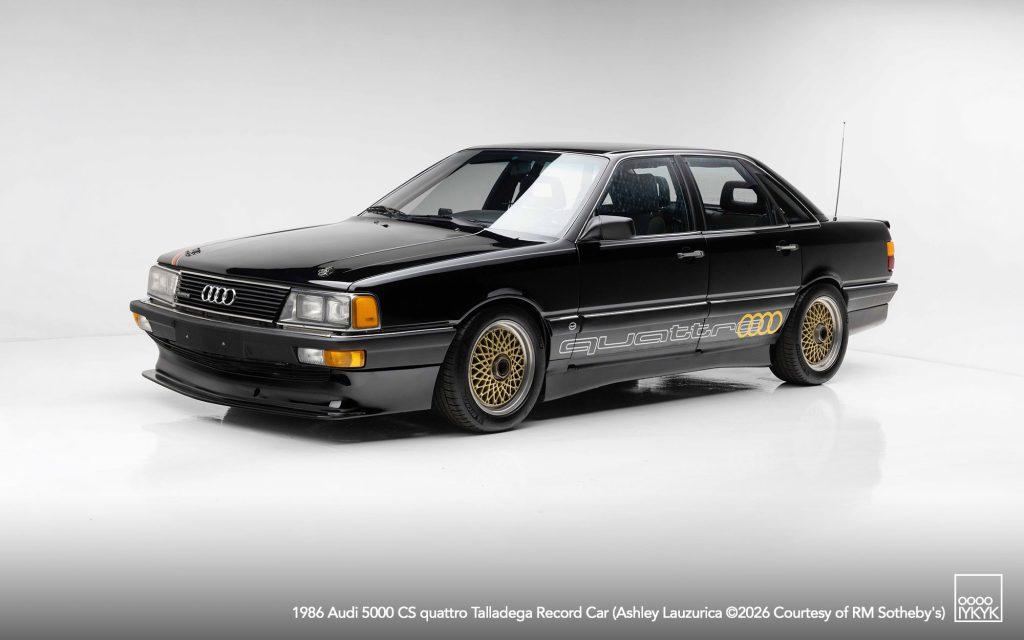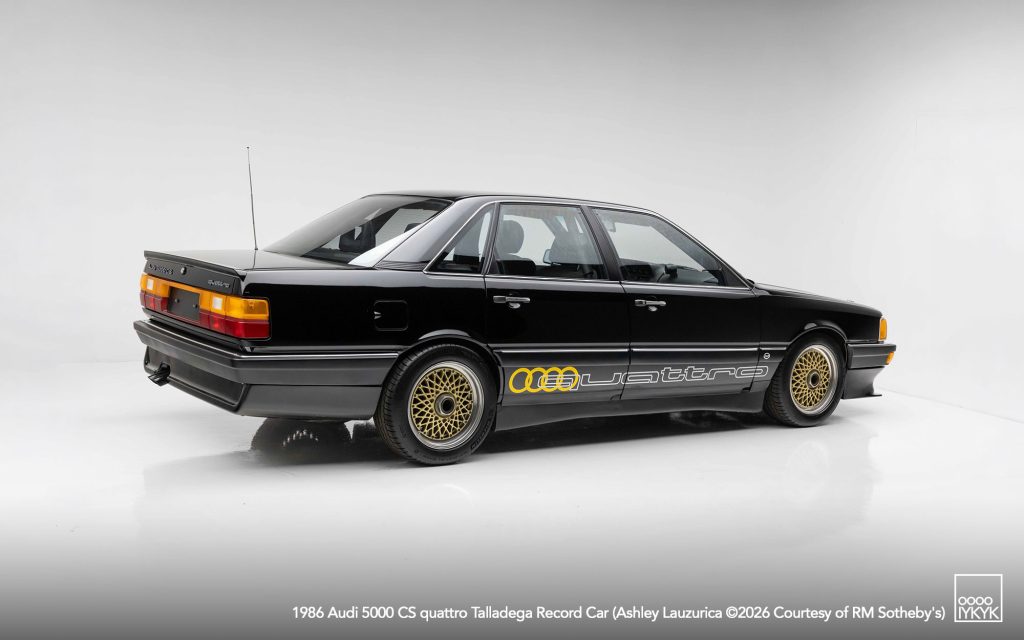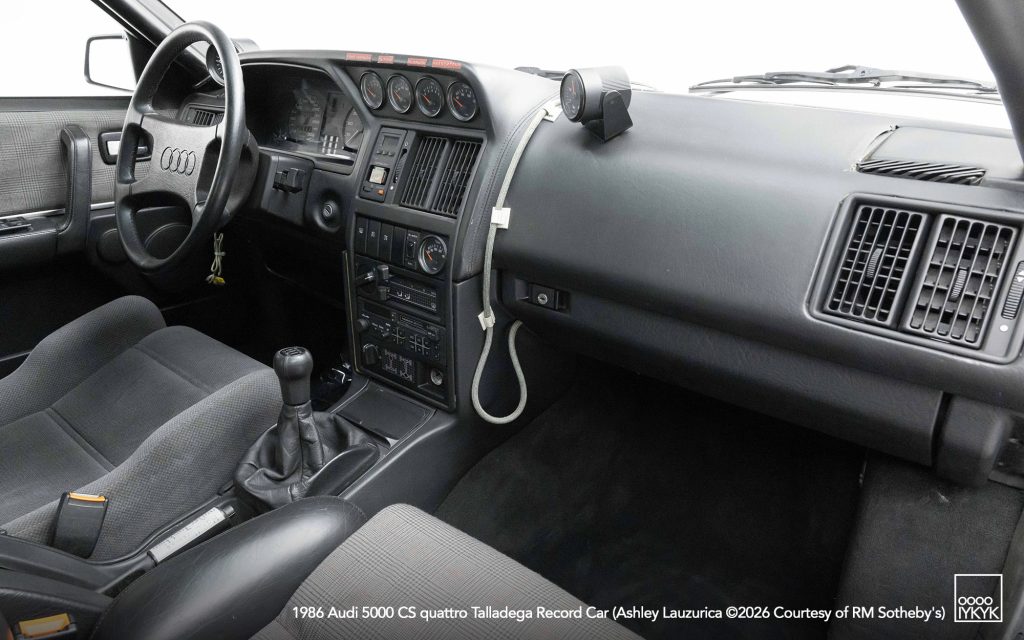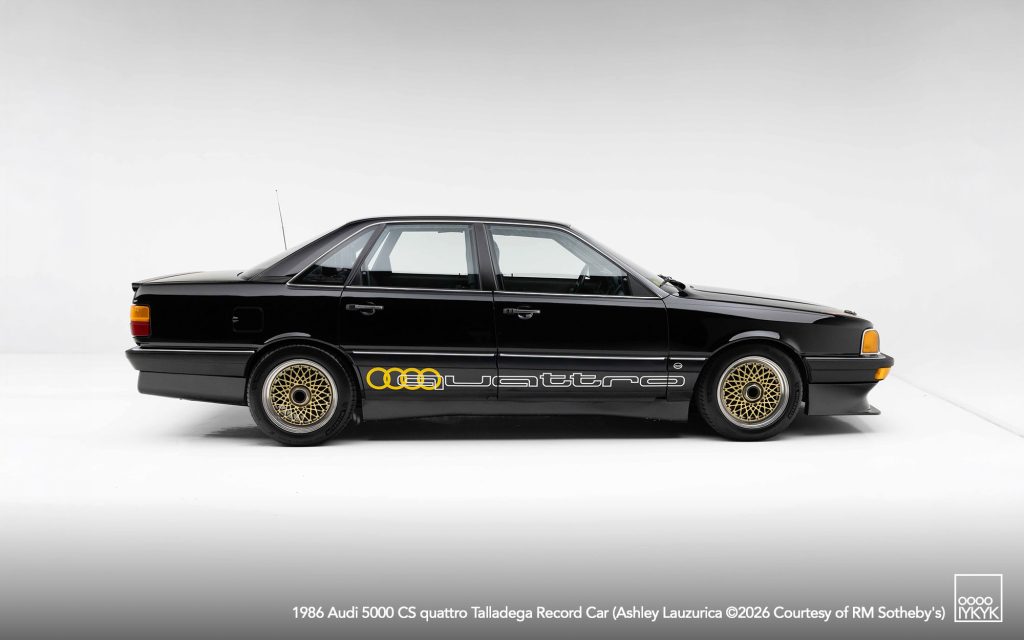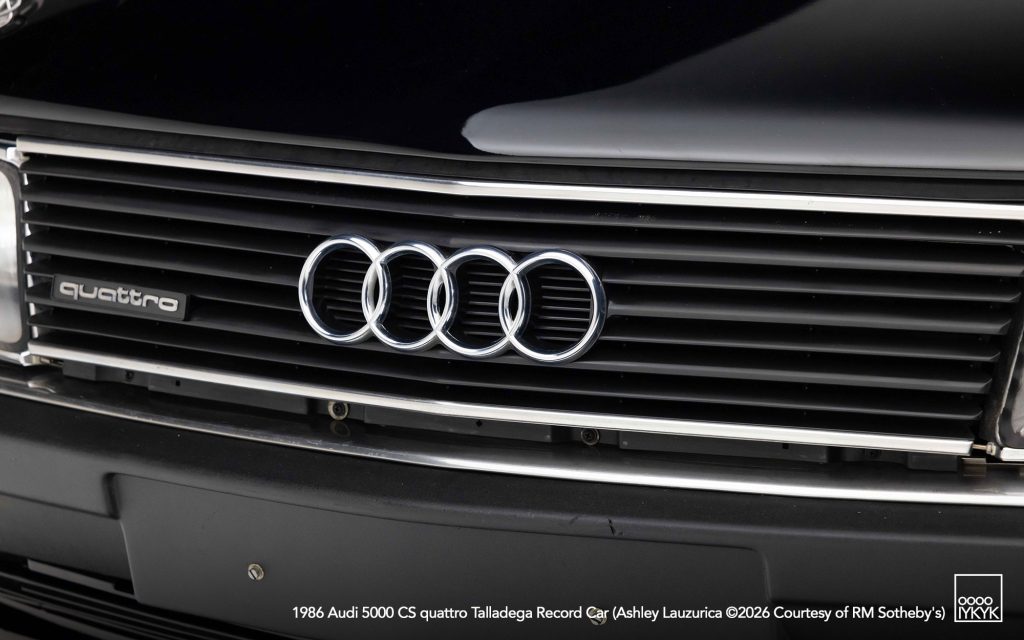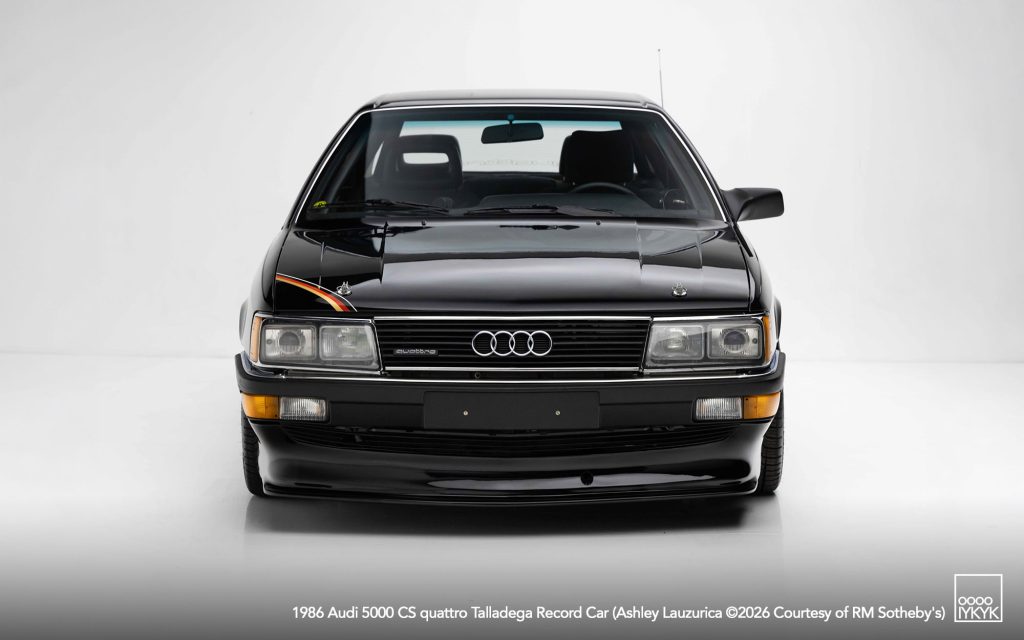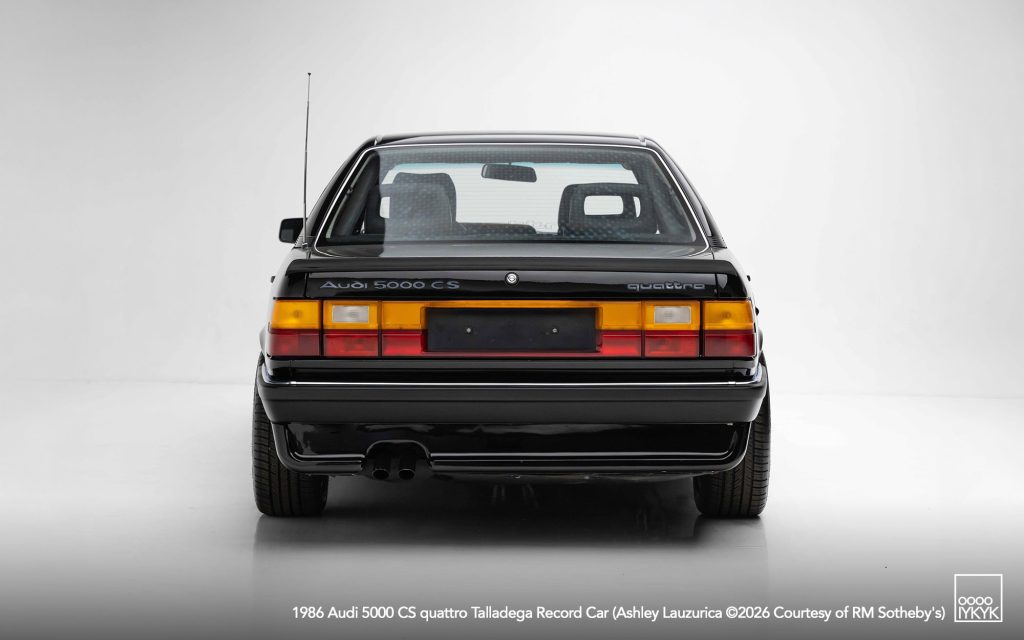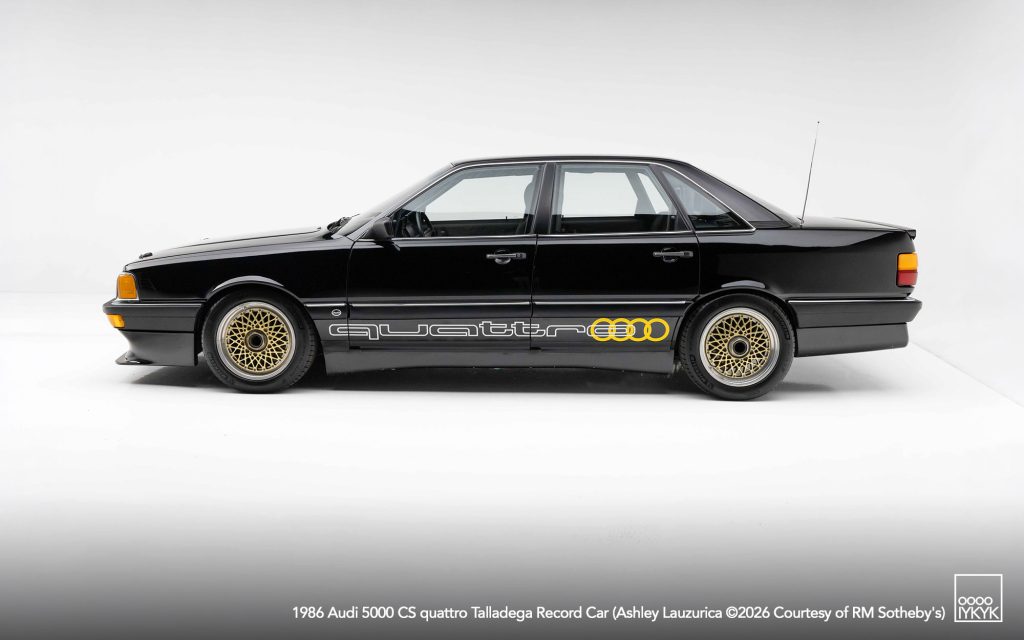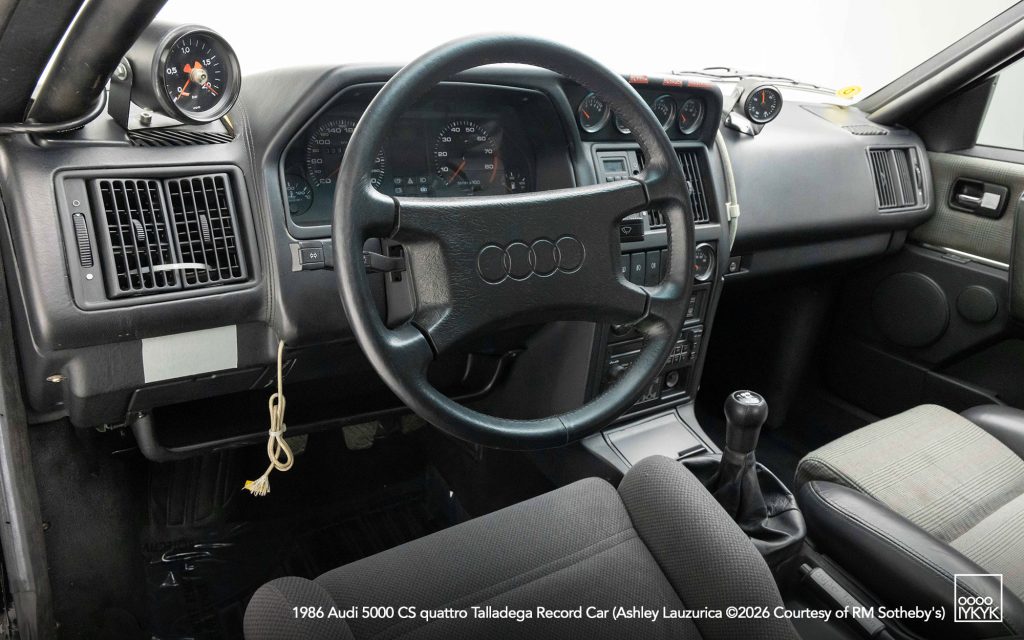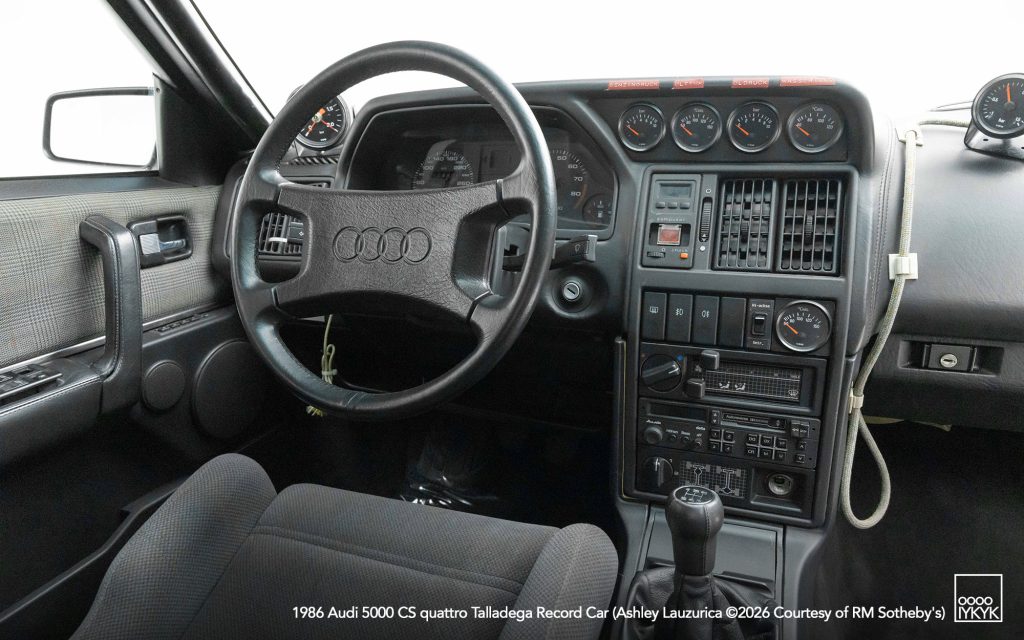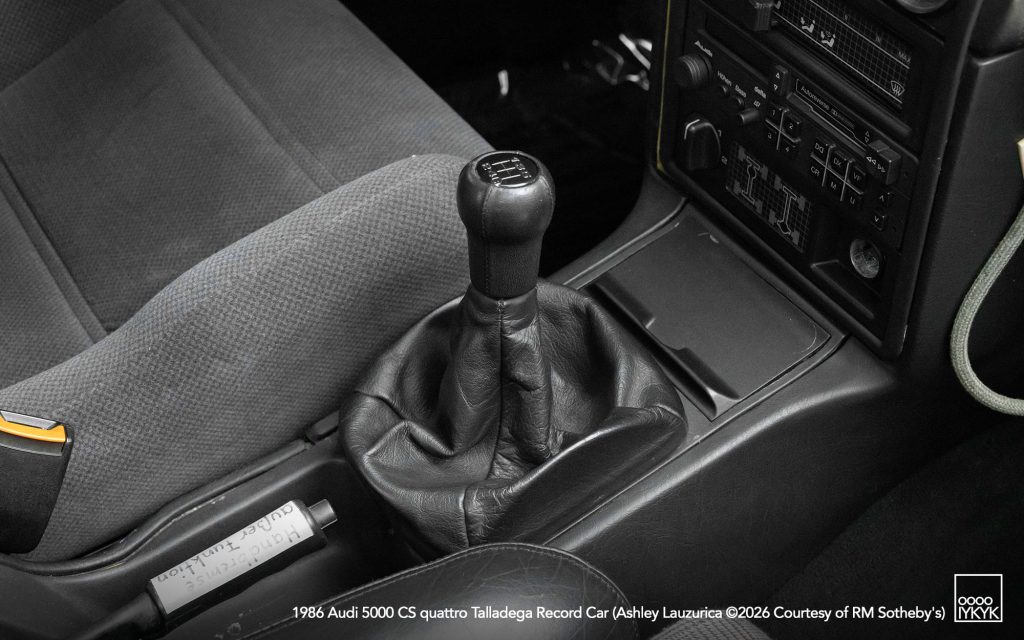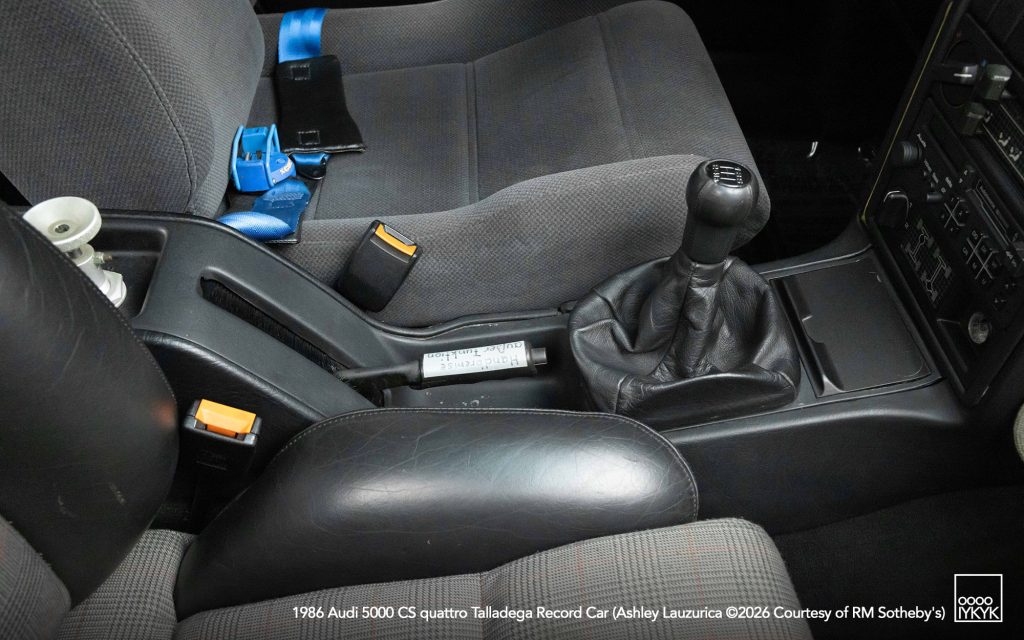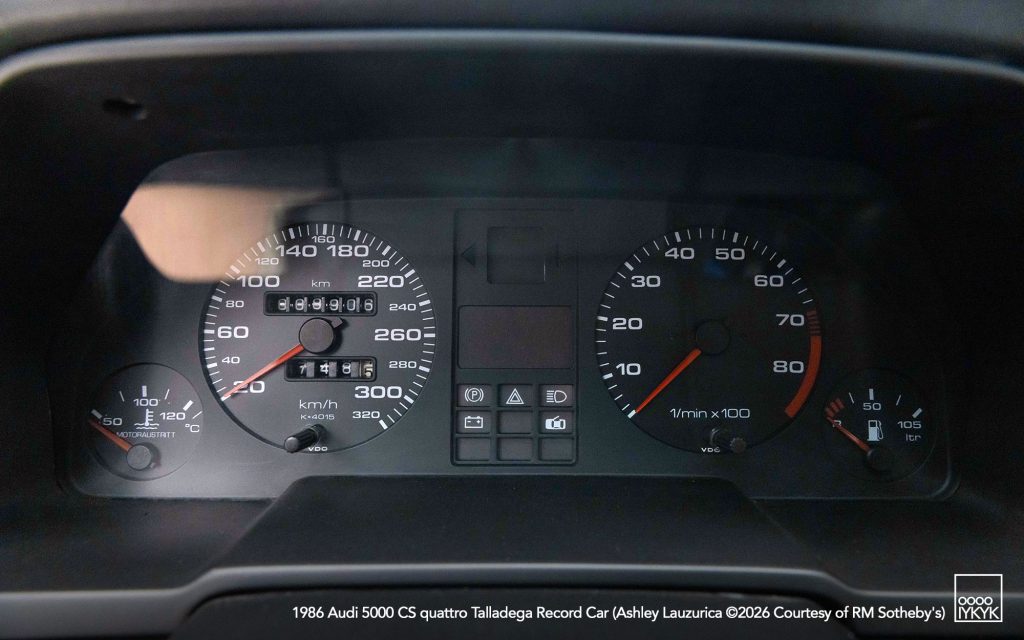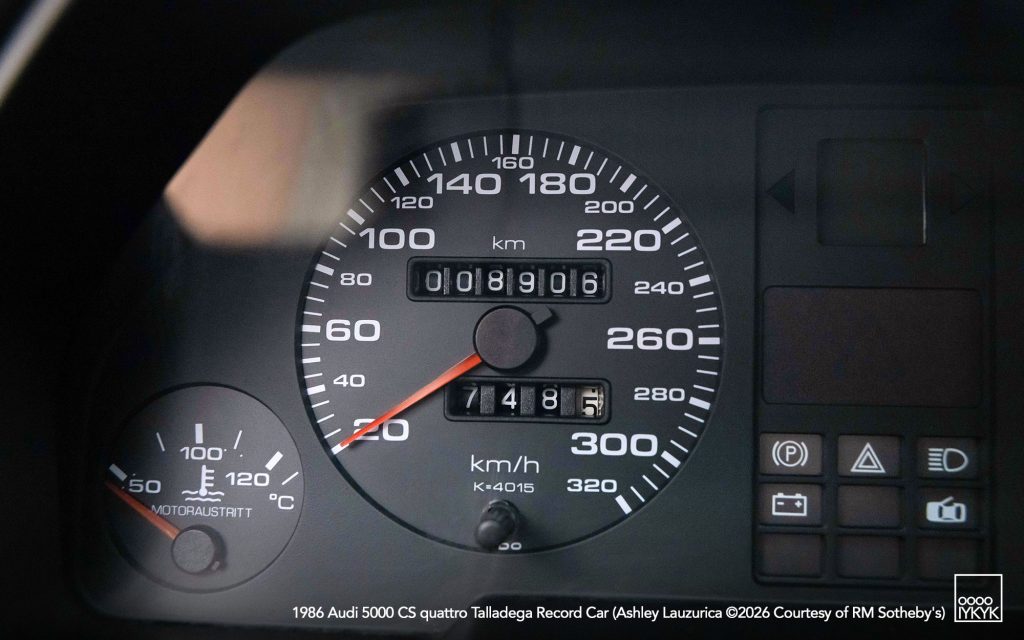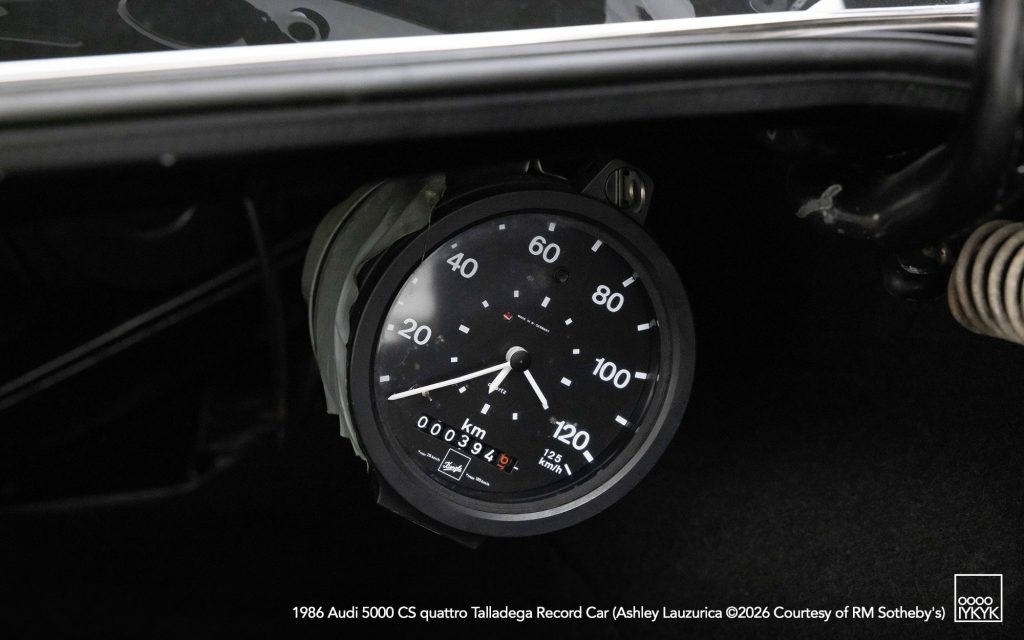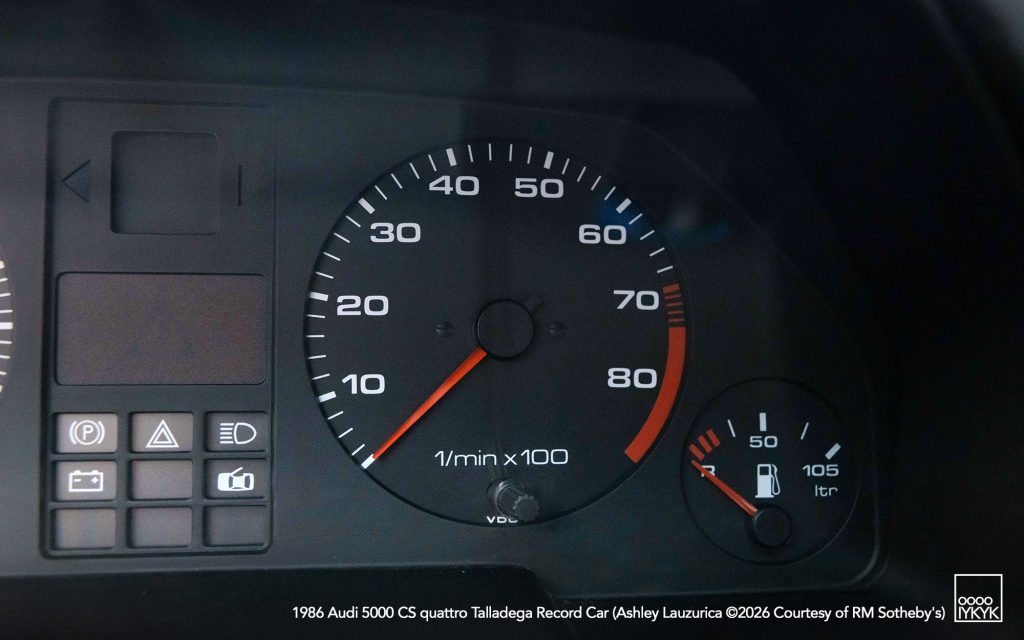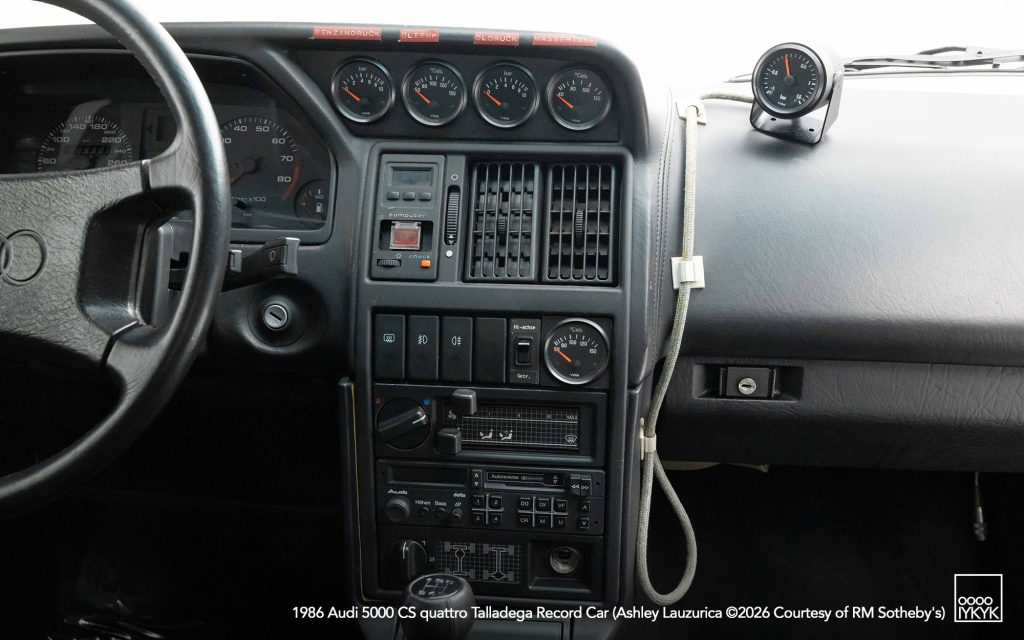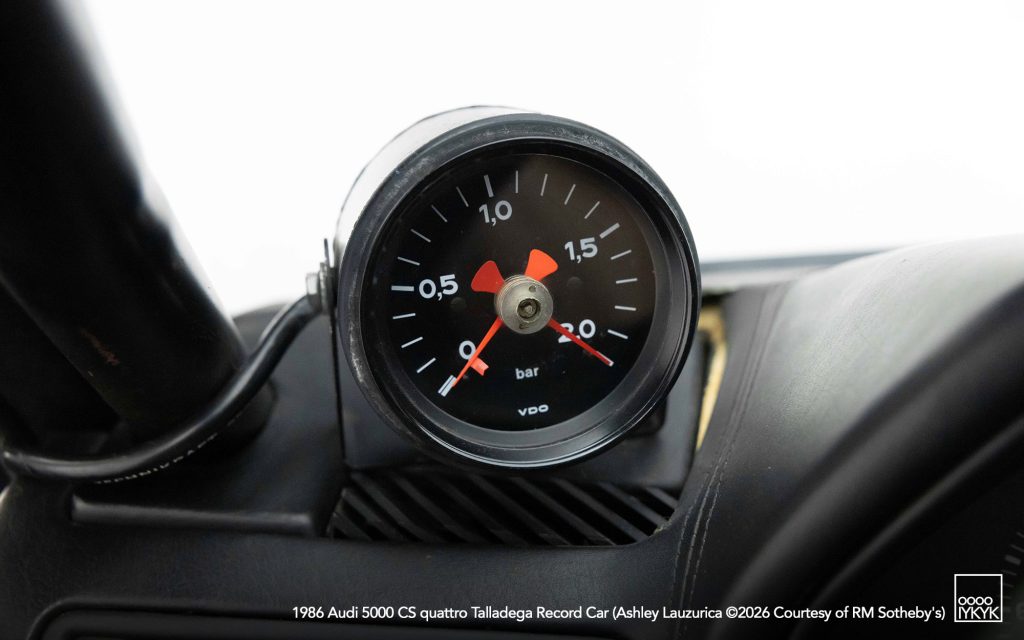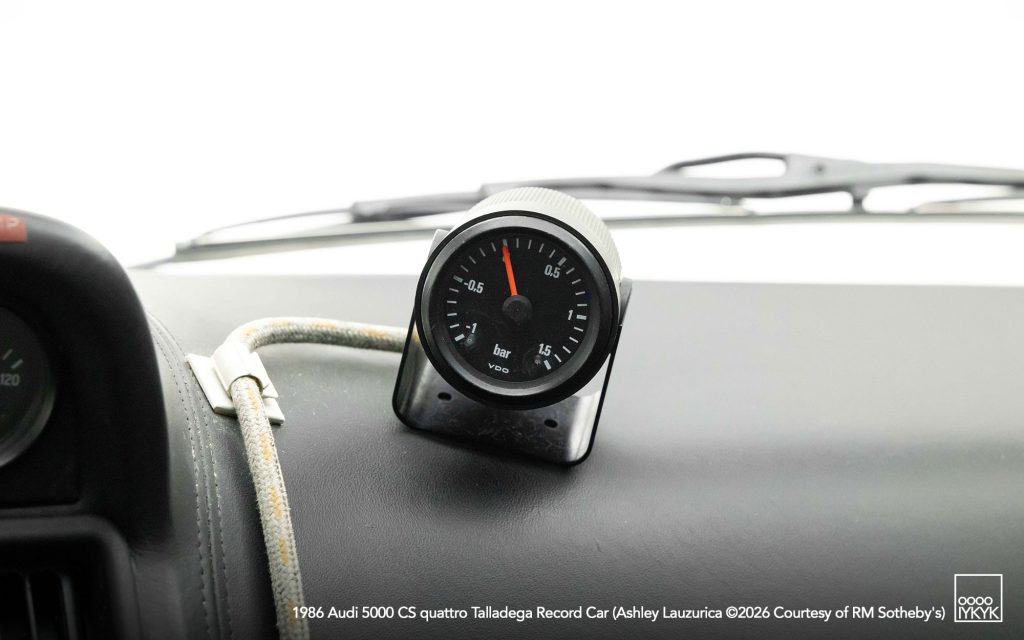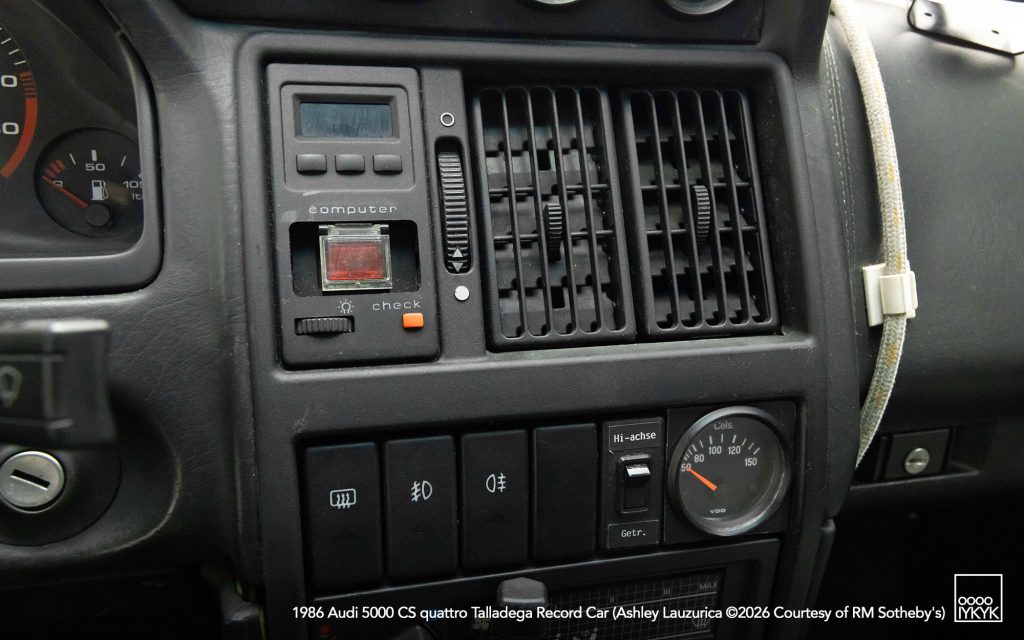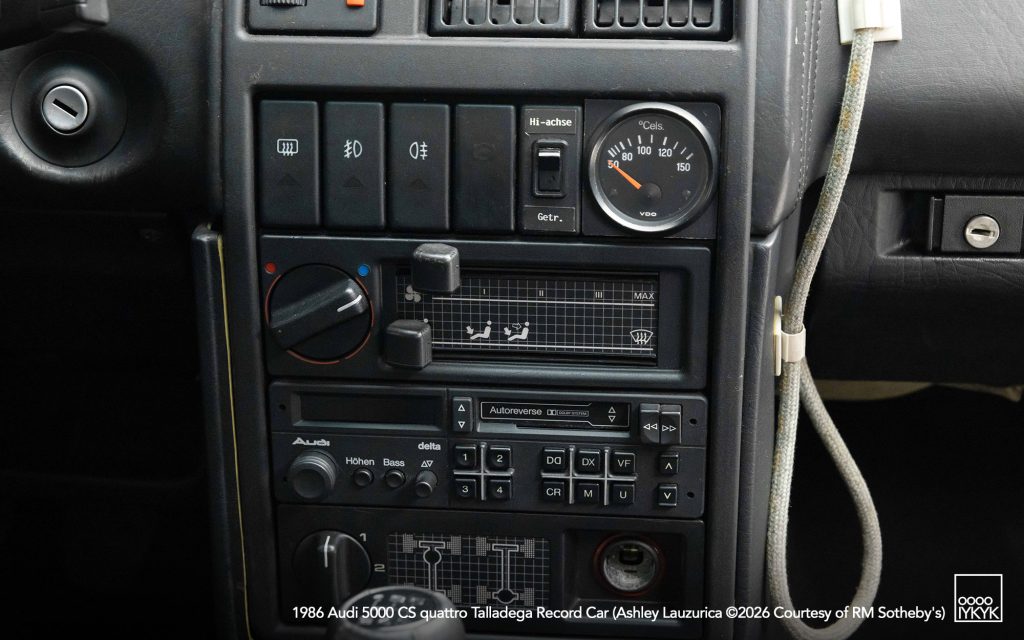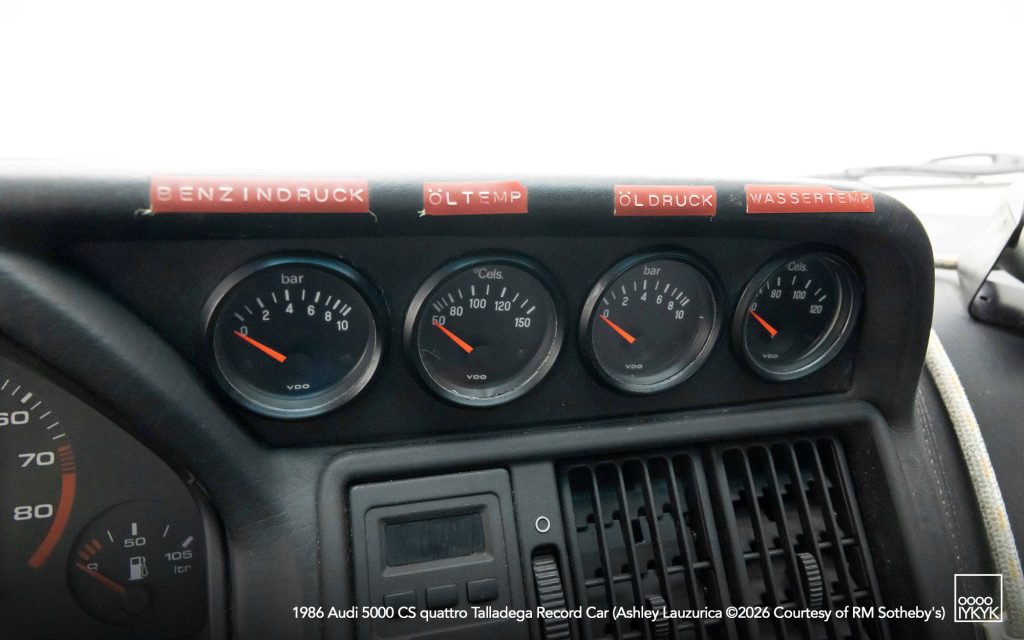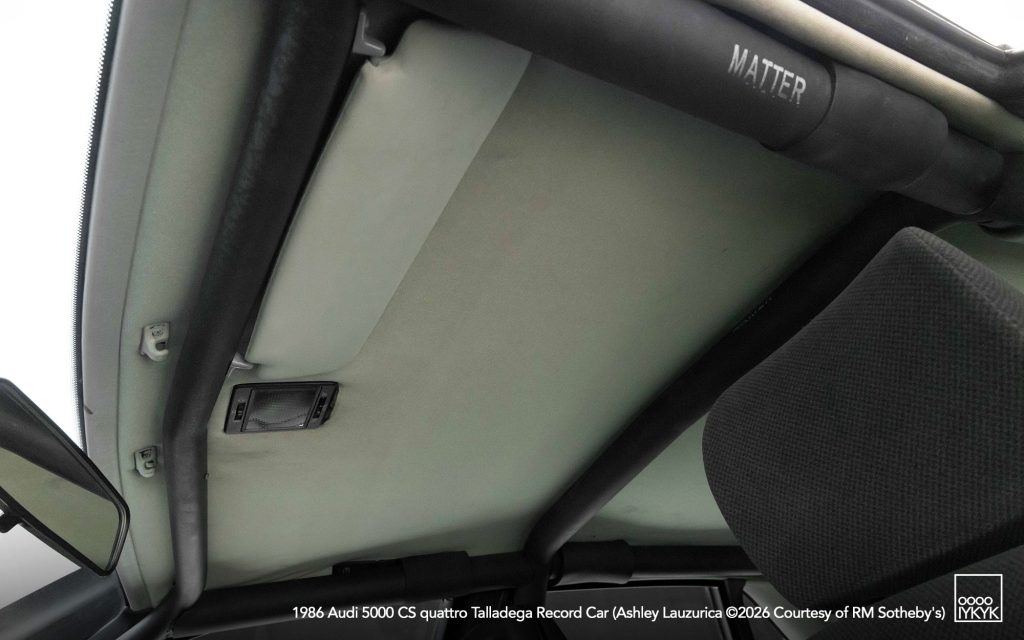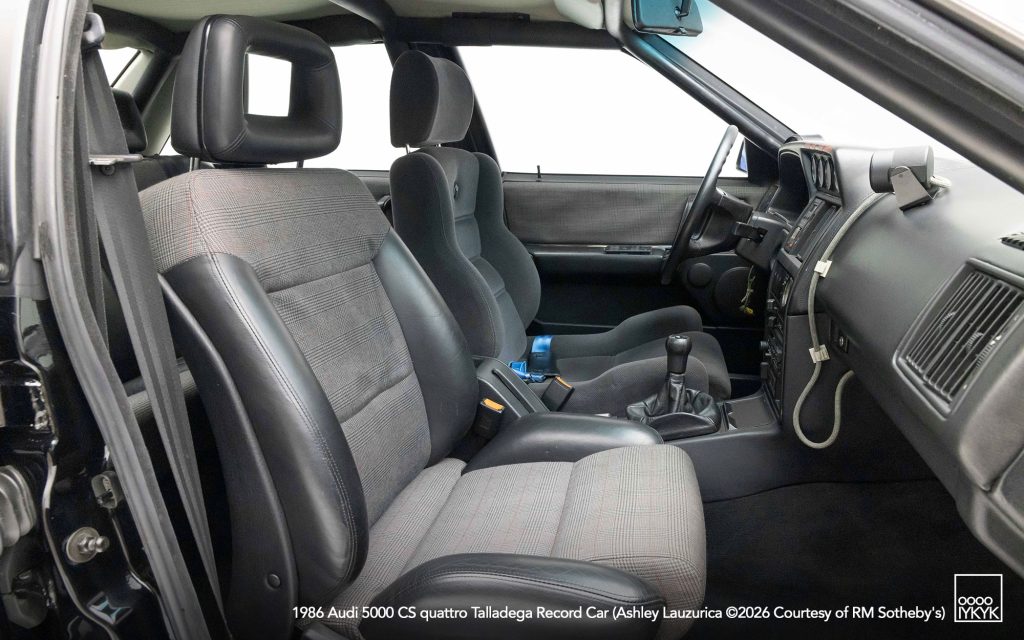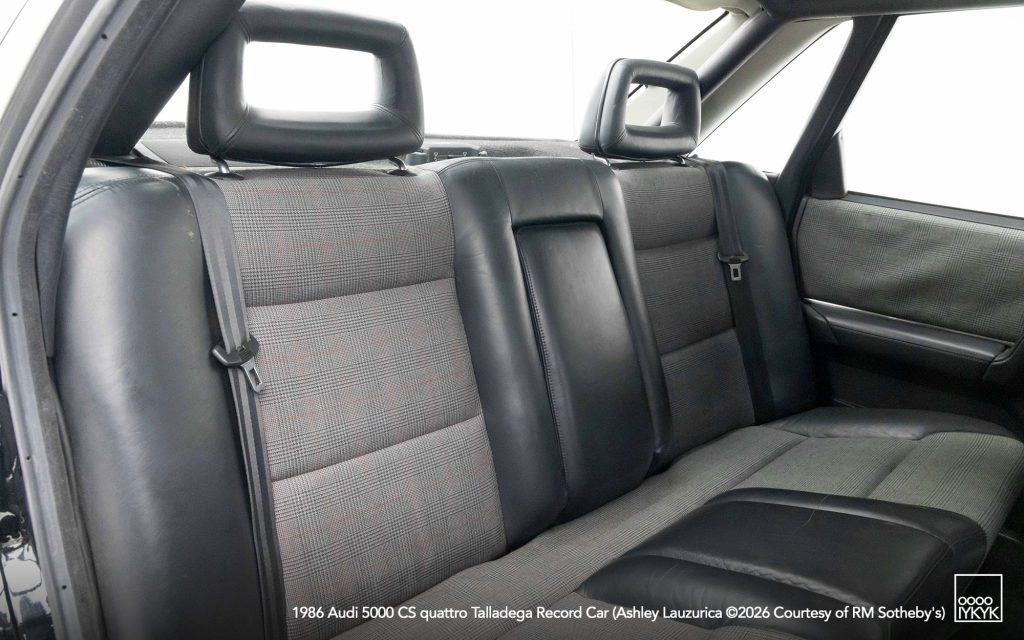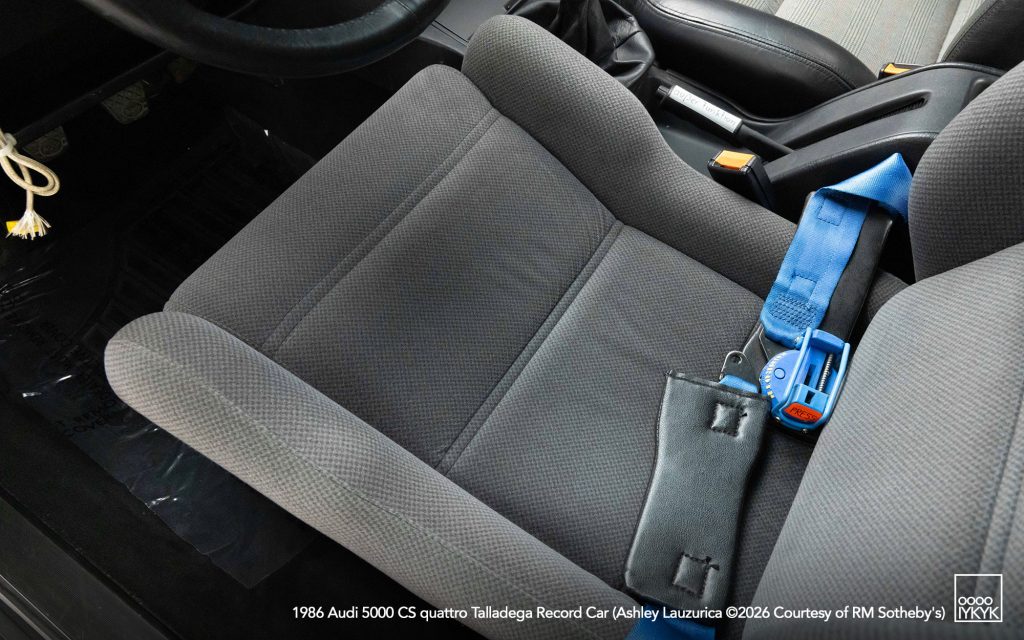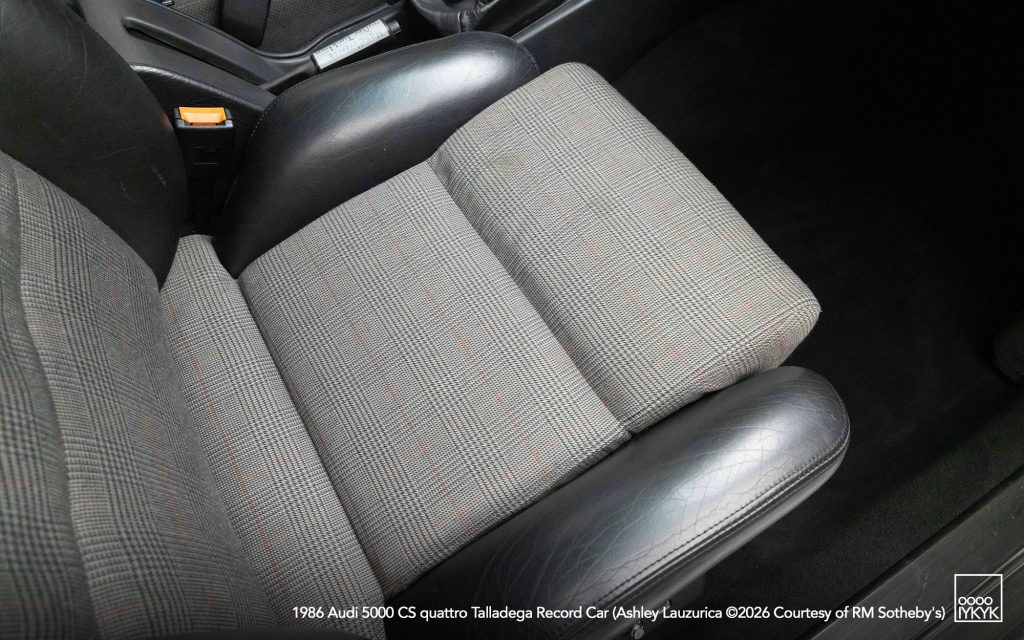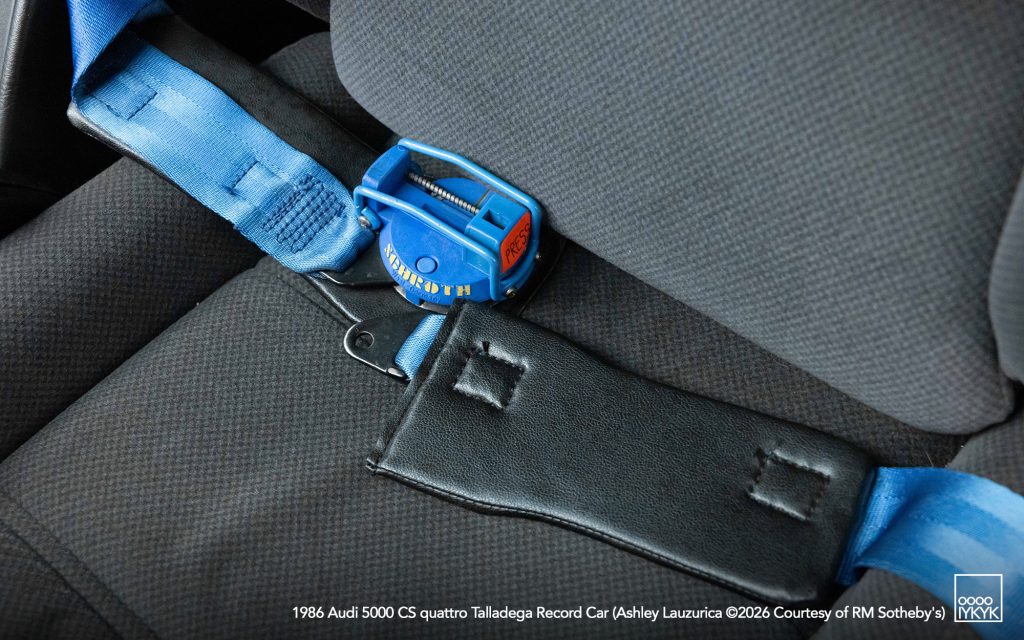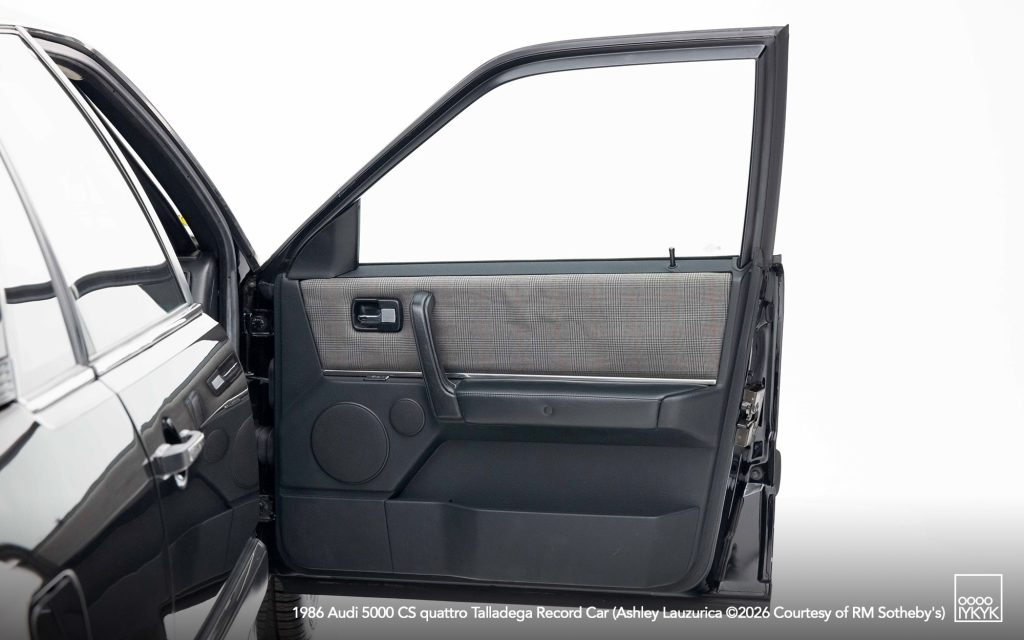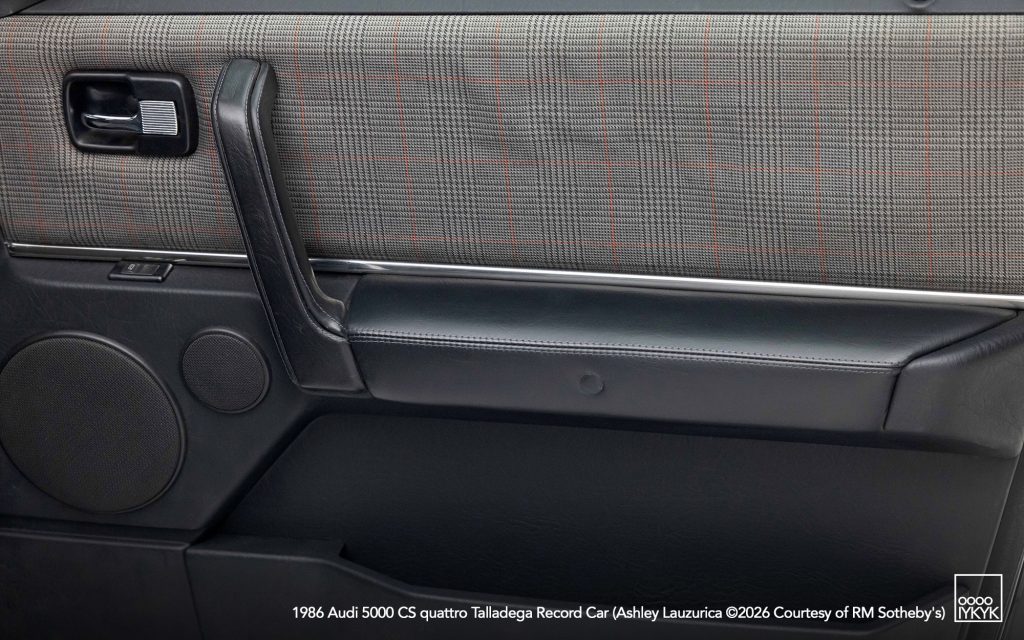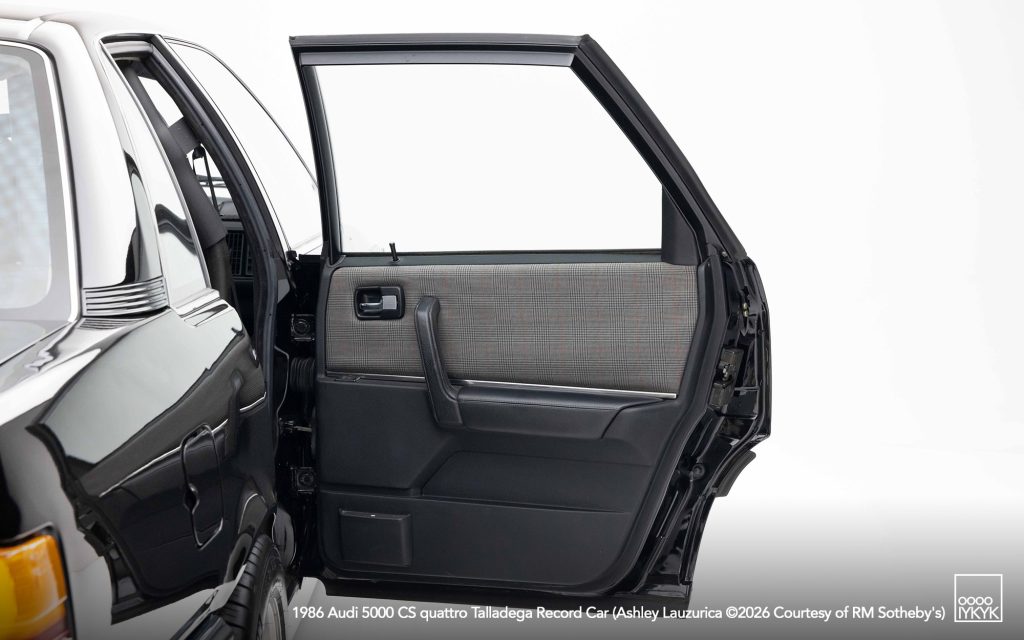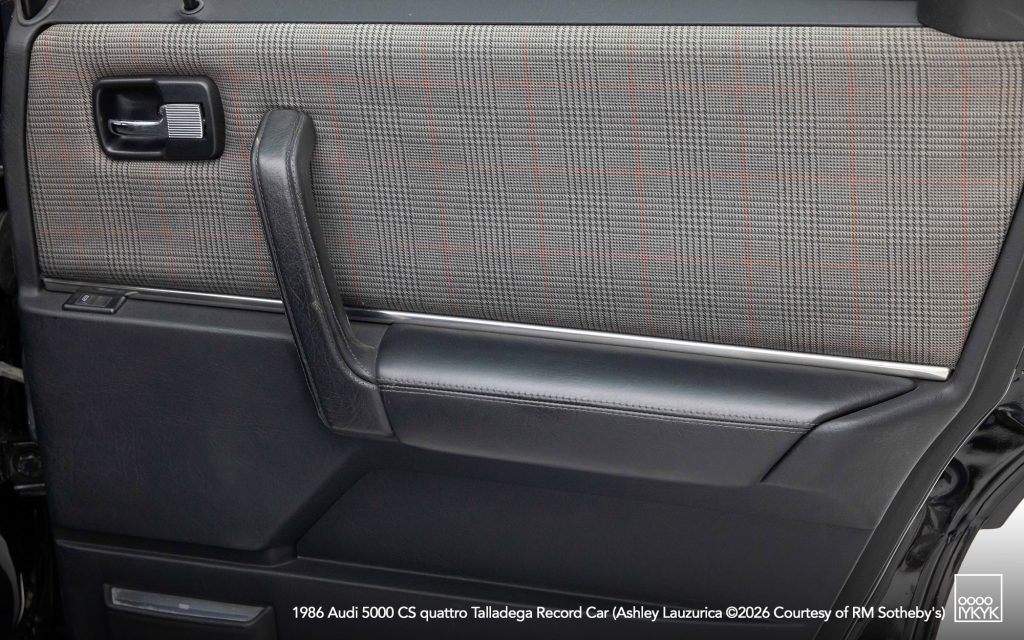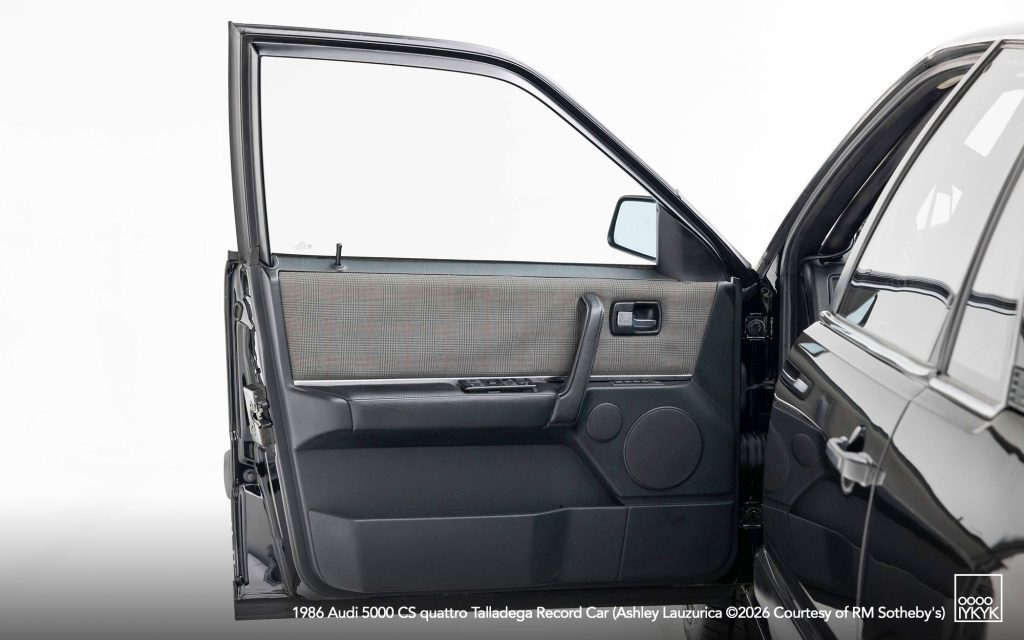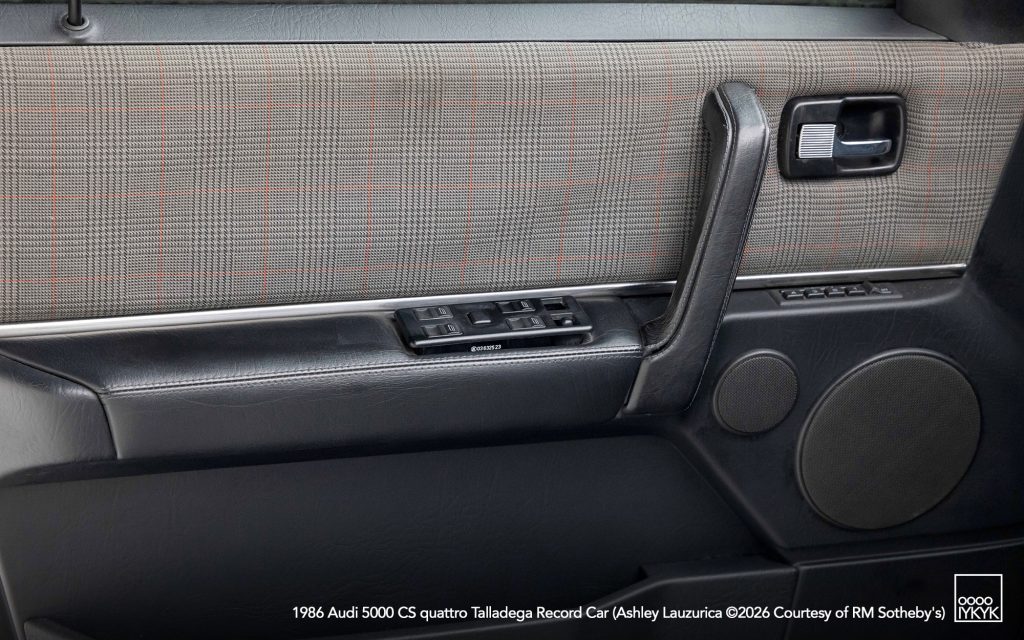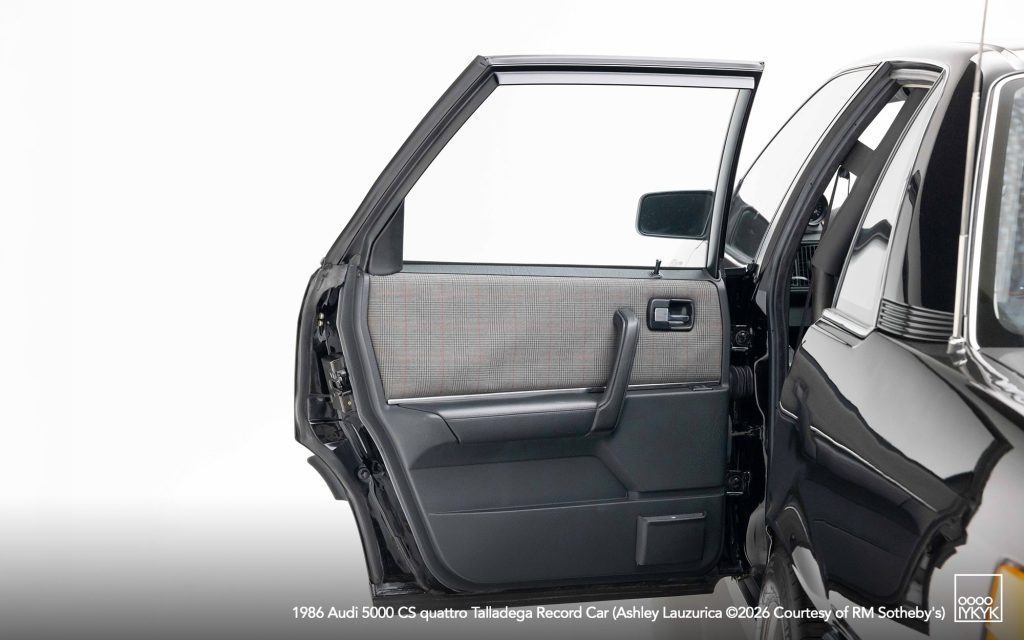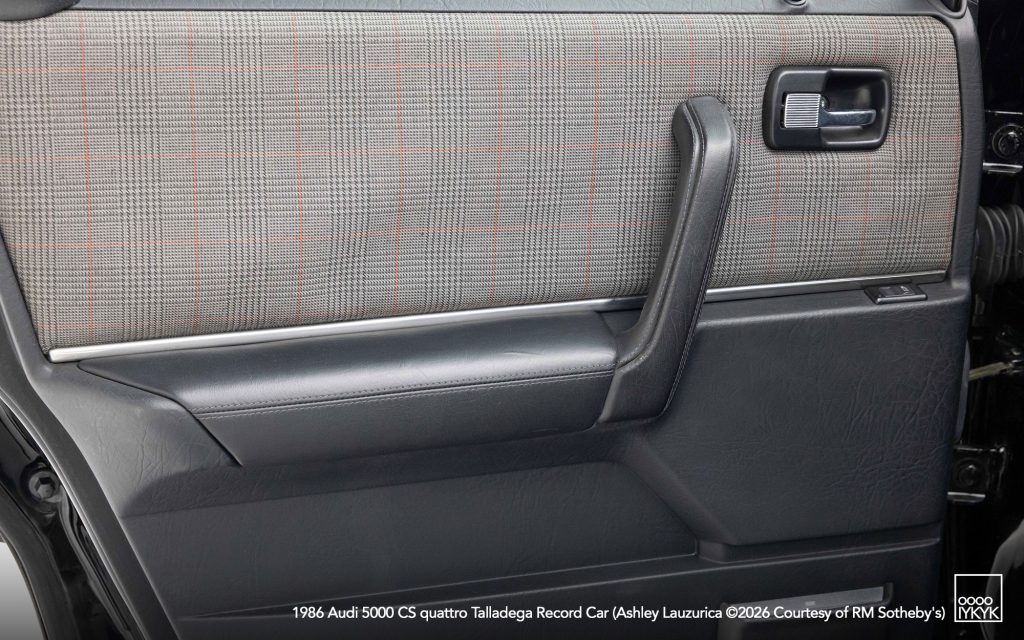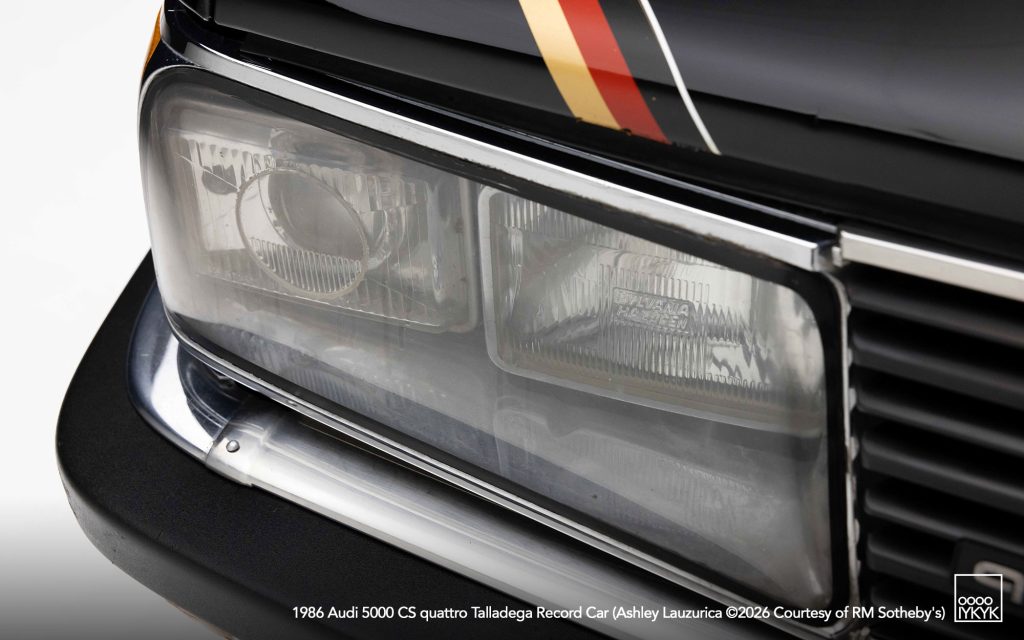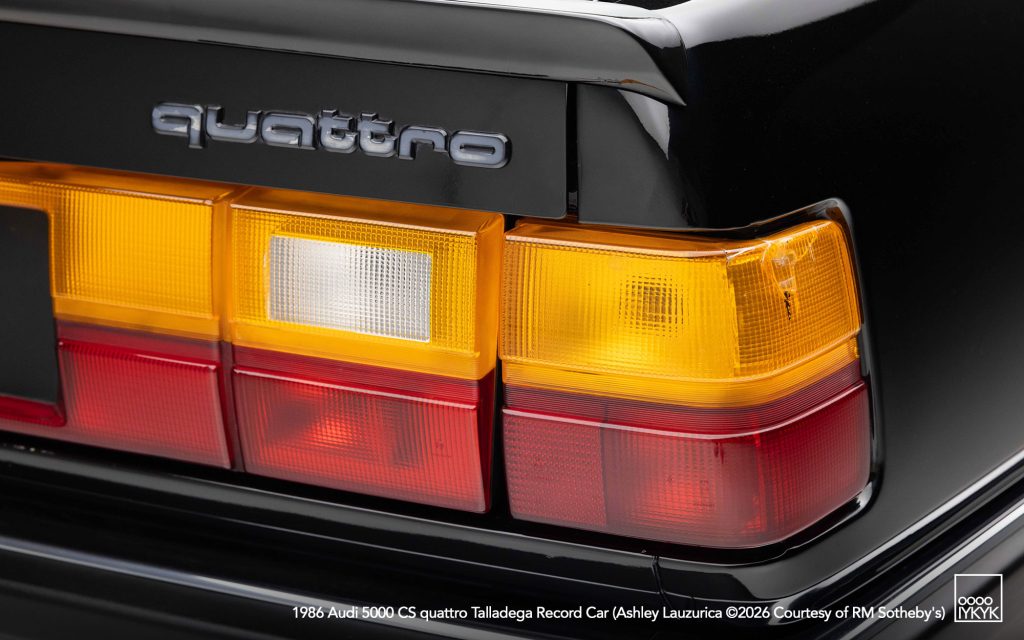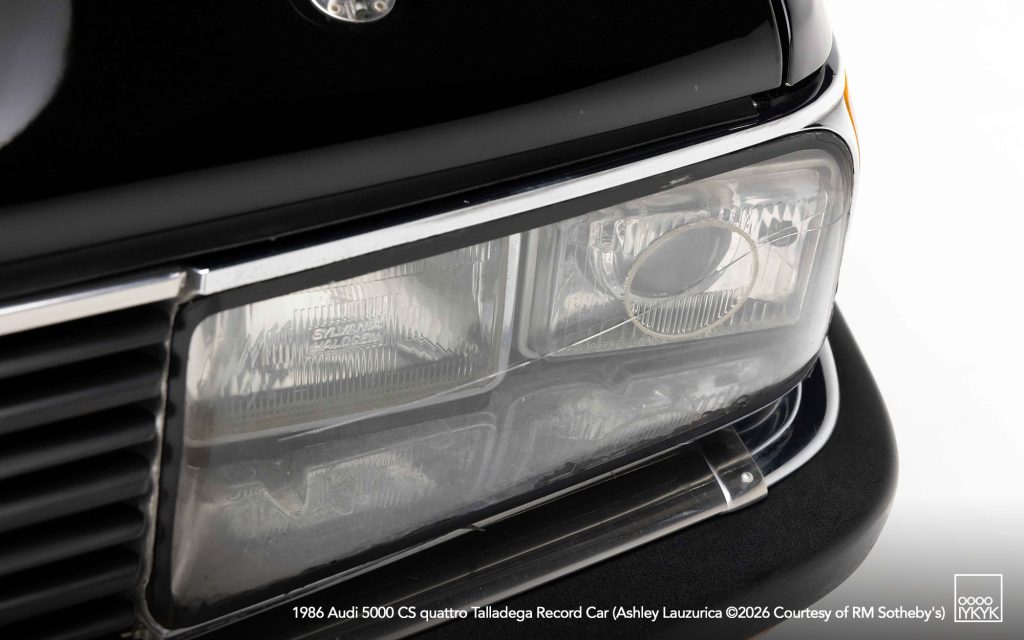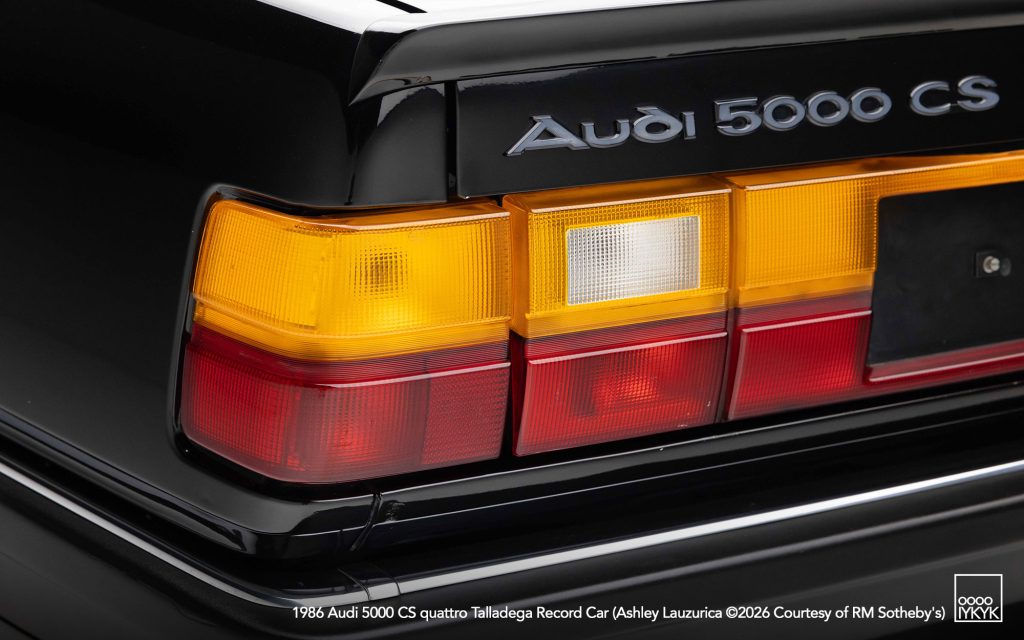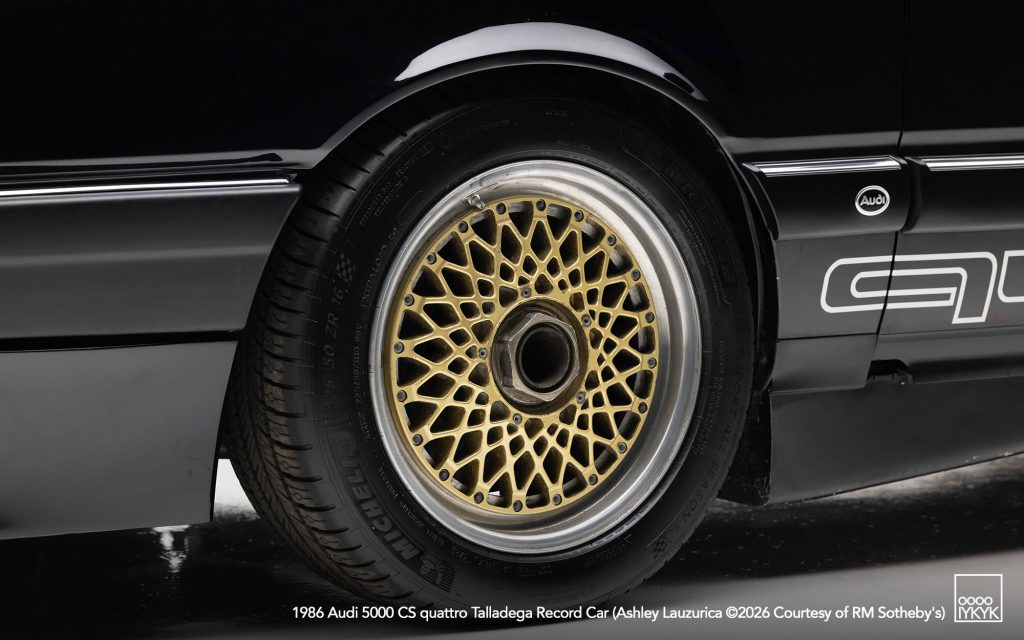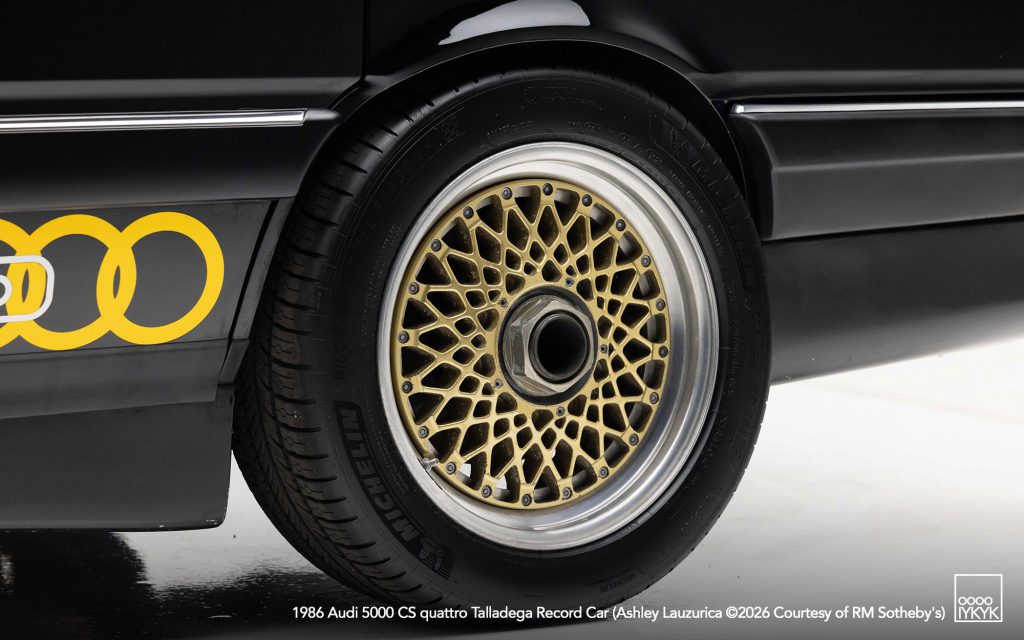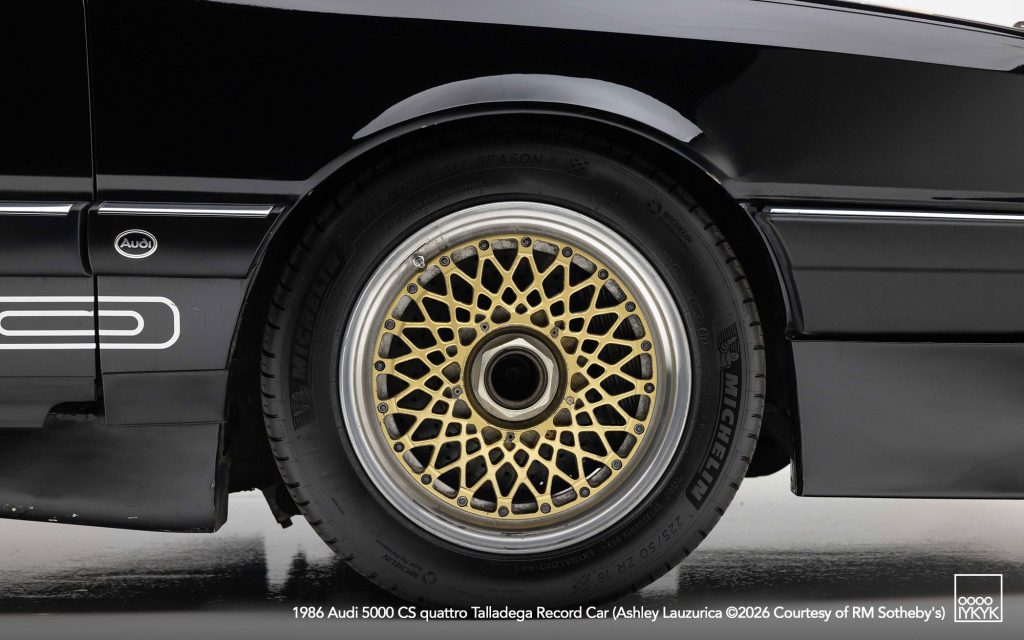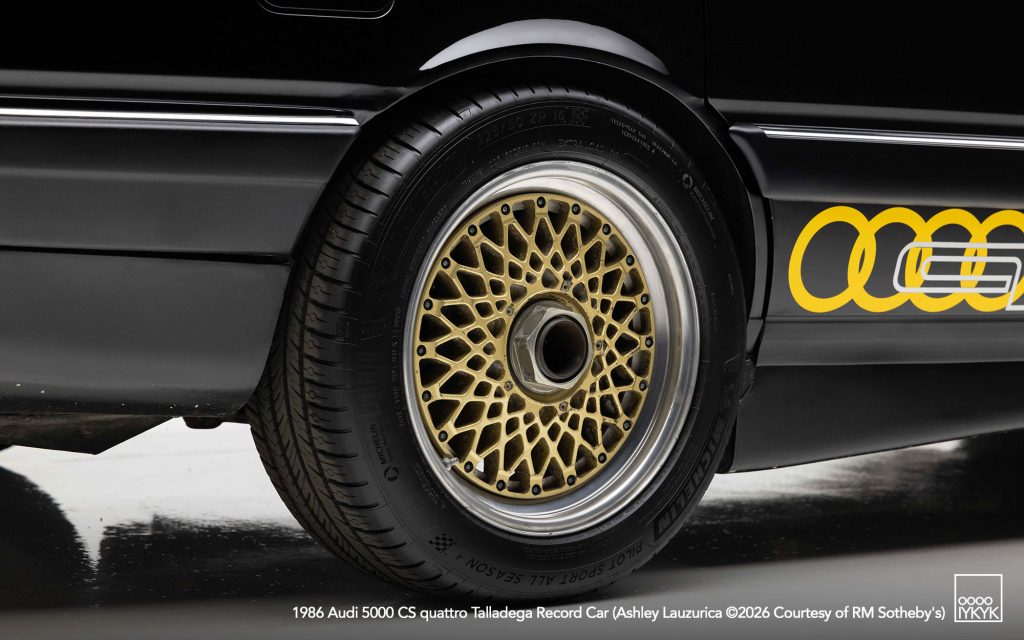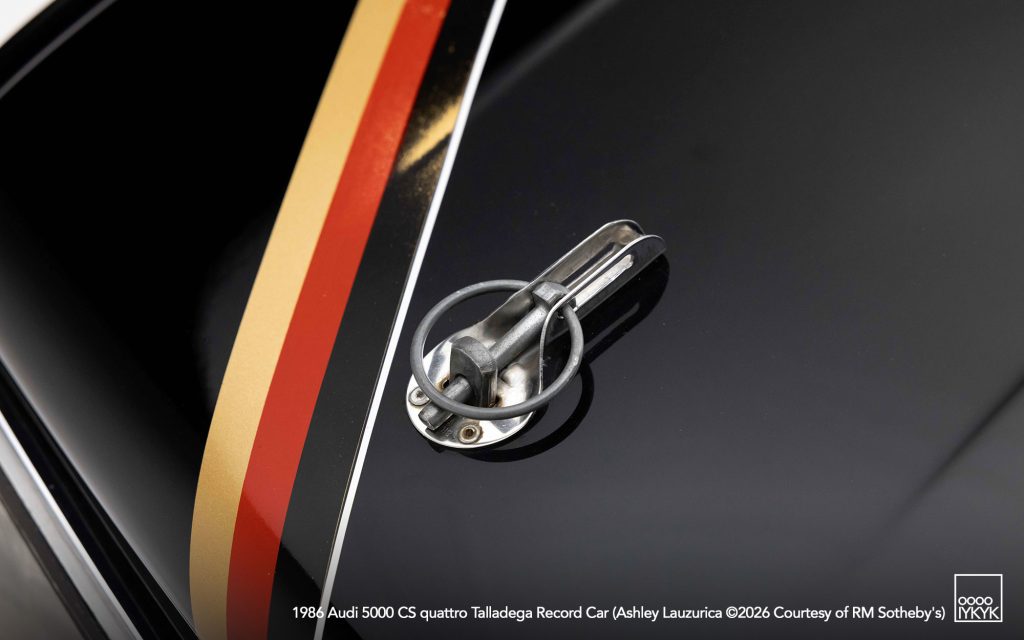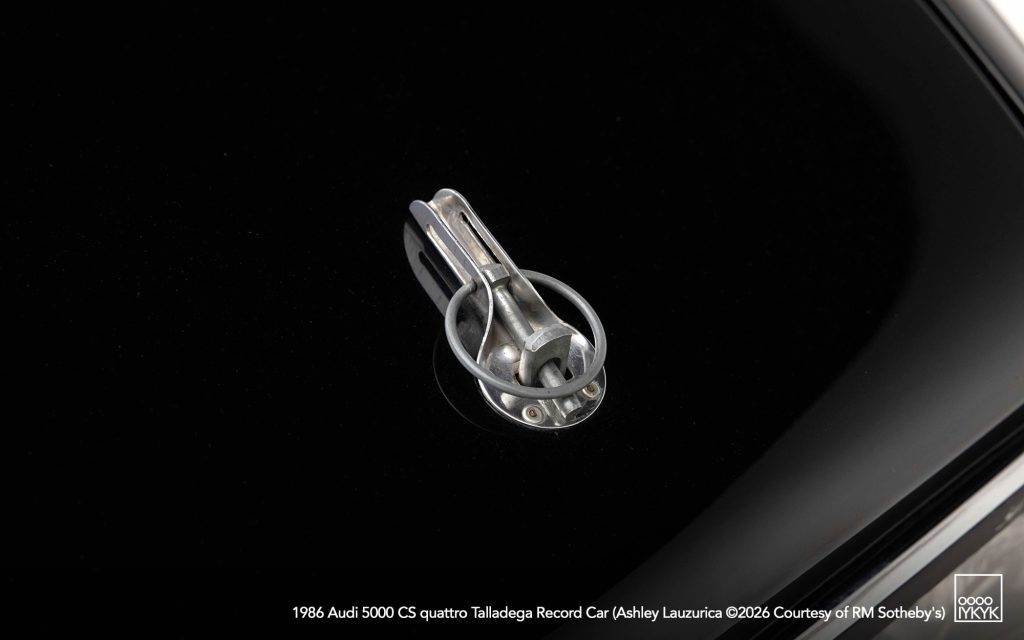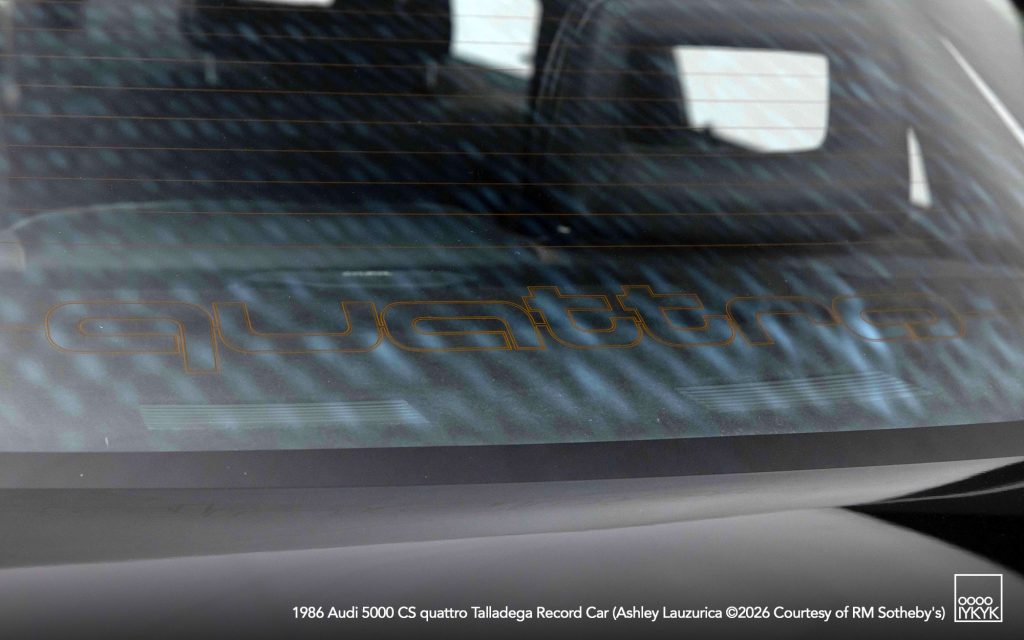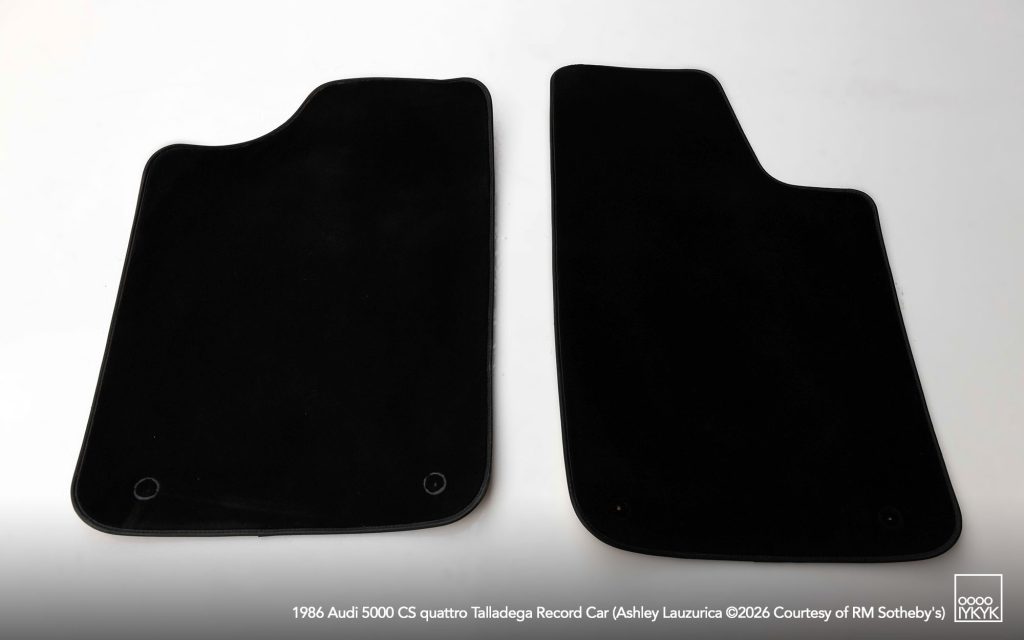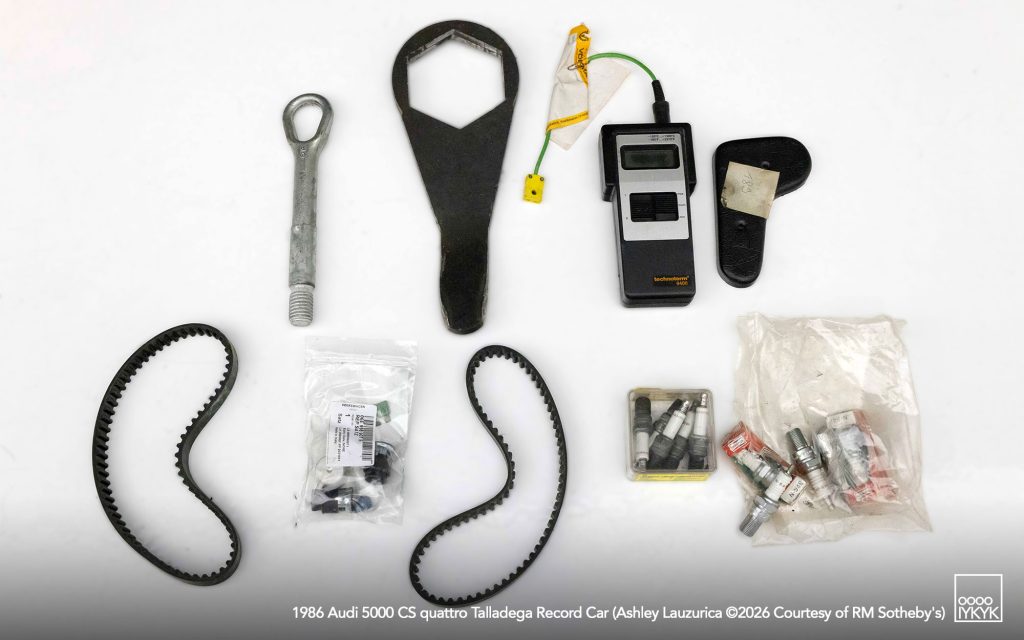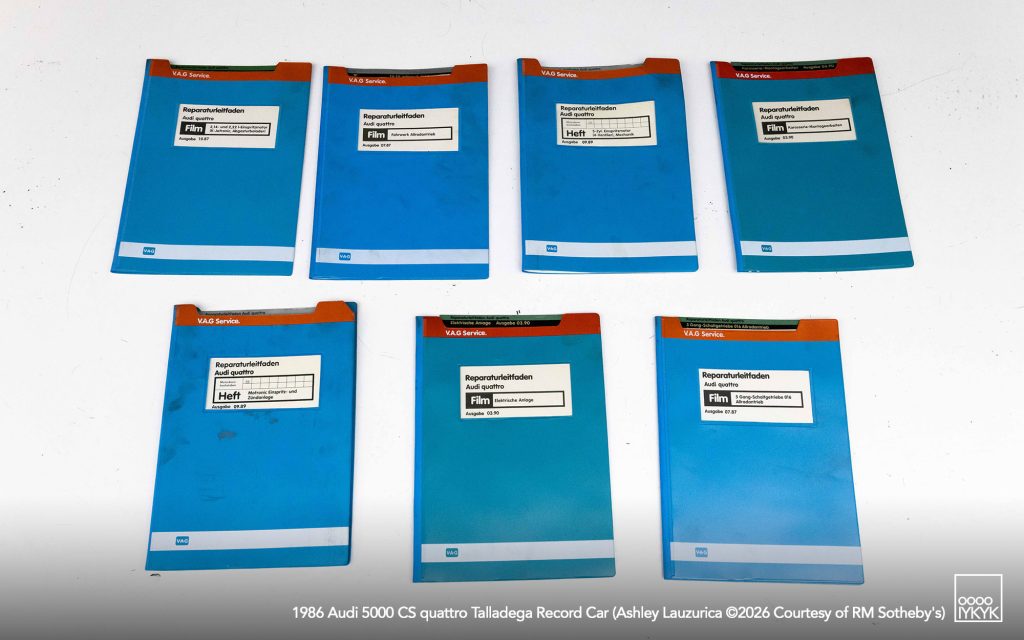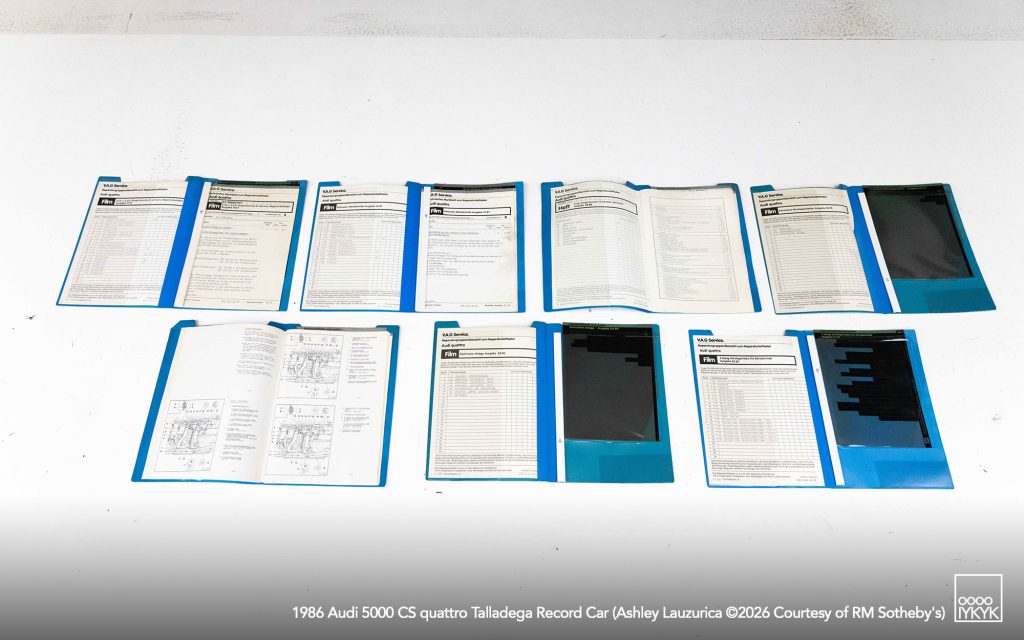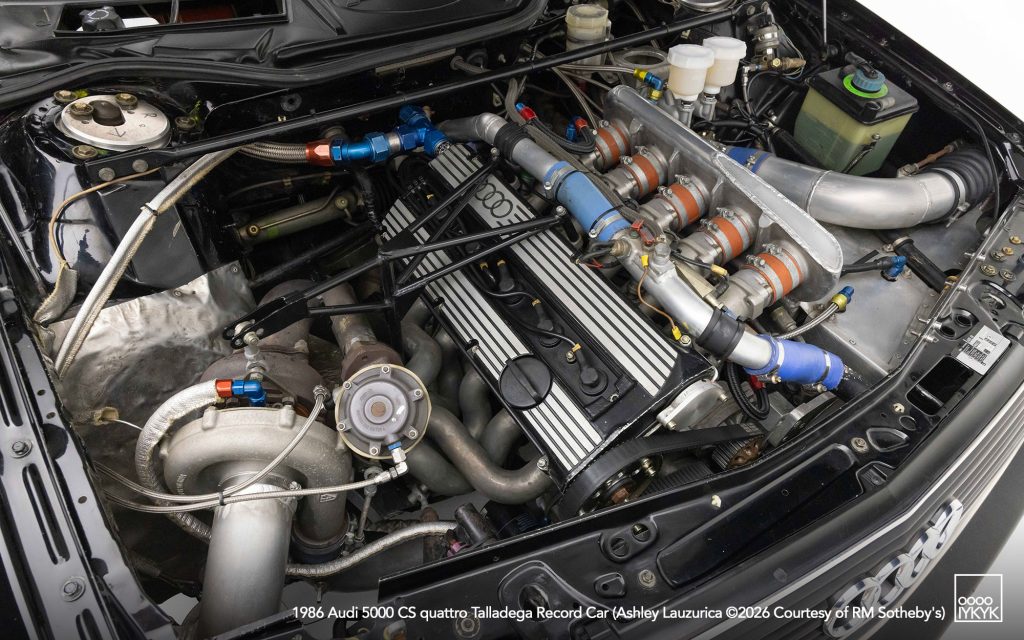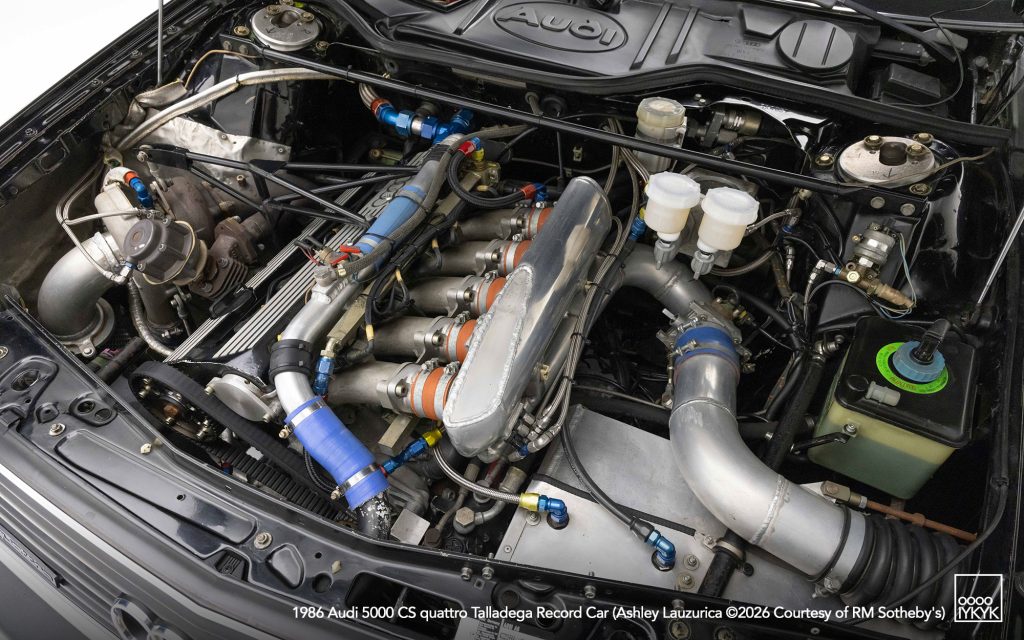

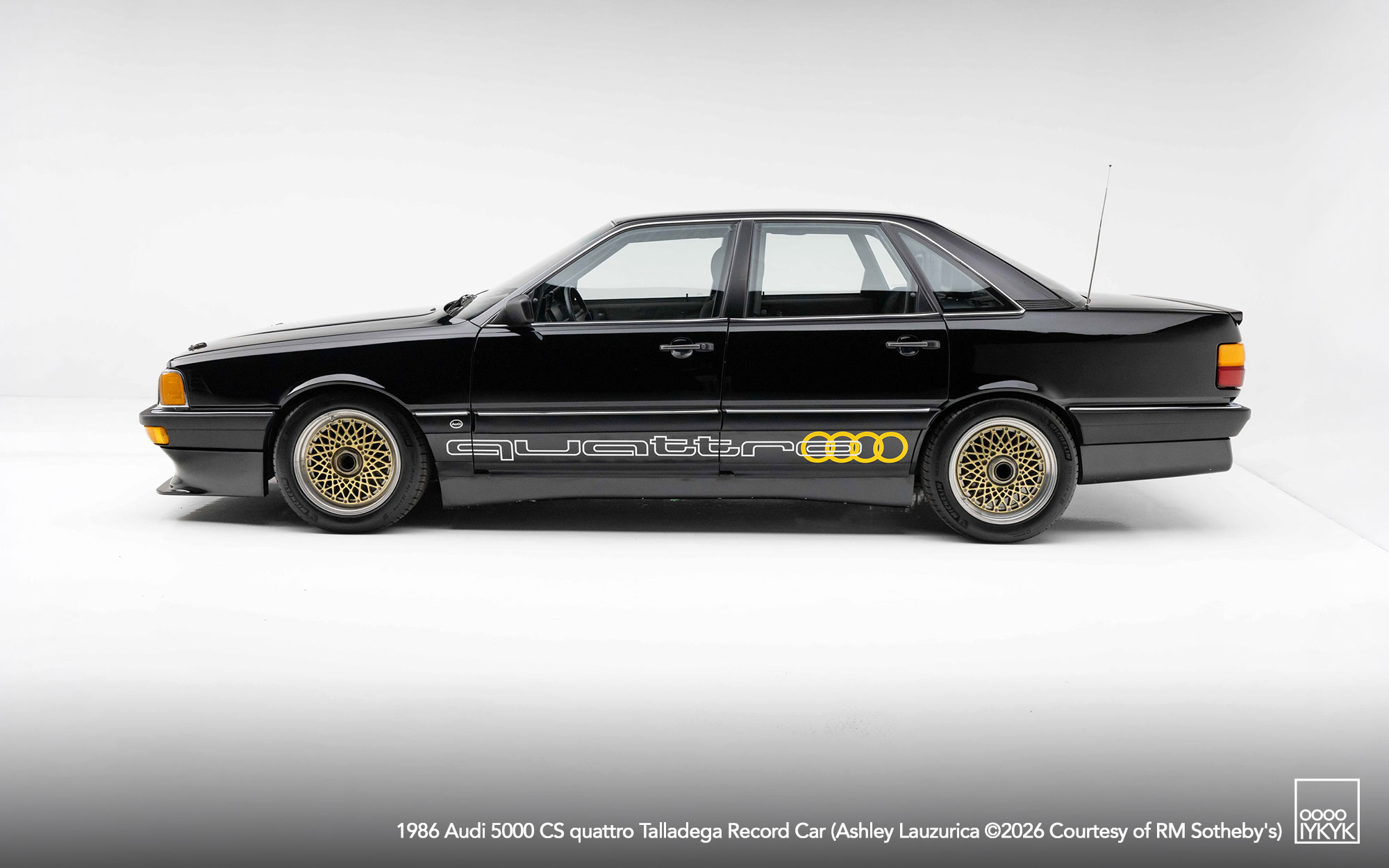

In most cases, use of “once in a lifetime opportunity” in a find of the week might be hyperbolic, but not today… not this car. This 1986 Audi 5000 CS quattro Speed Record Prototype is an obscure piece of Audi history that is most unique within the Audi lexicon and lore.
Heading to RM Sotheby’s Monterey sale during Monterey Car Week, this one-off factory prototype is arguably one of the most historically significant Audis to appear at public auction in years. Offered without reserve and carrying a pre-sale estimate of $250,000-$300,000, it represents the very car that helped prove Audi’s turbocharged five-cylinder engine and quattro drivetrain could do far more than dominate rally stages. In March 1986, on the banks of Talladega Superspeedway, it became the fastest production-based sedan in the world while establishing 16 international speed records, including a single-lap speed of 206.3 mph.
BUILT TO BREAK THE 200 MPH BARRIER
By the mid-1980s Audi had already rewritten the rally rulebook with quattro all-wheel drive. The next challenge was demonstrating that the same engineering philosophy could succeed in an entirely different arena.
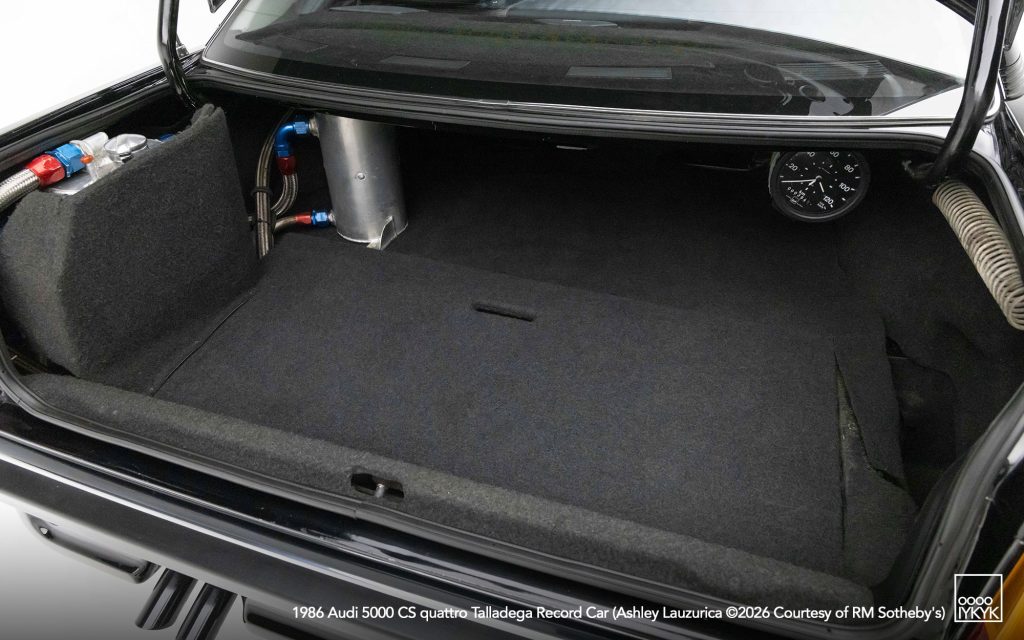
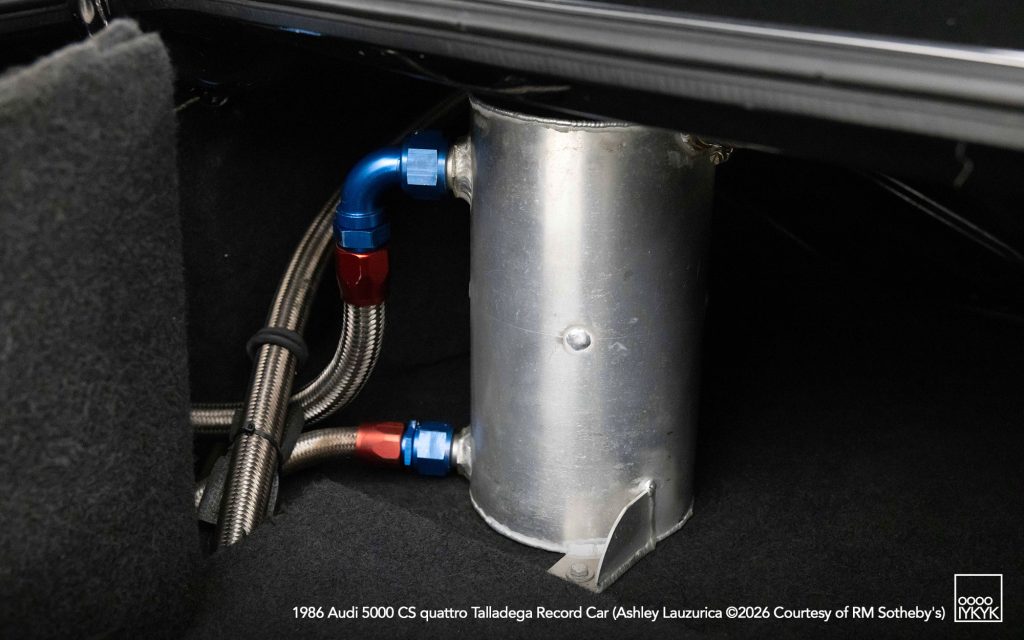
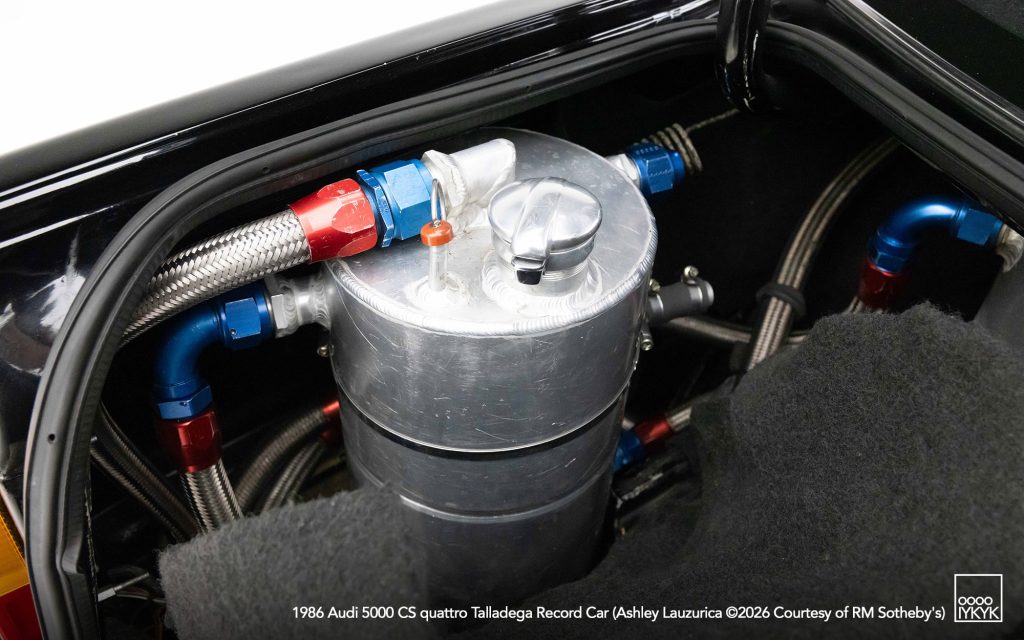
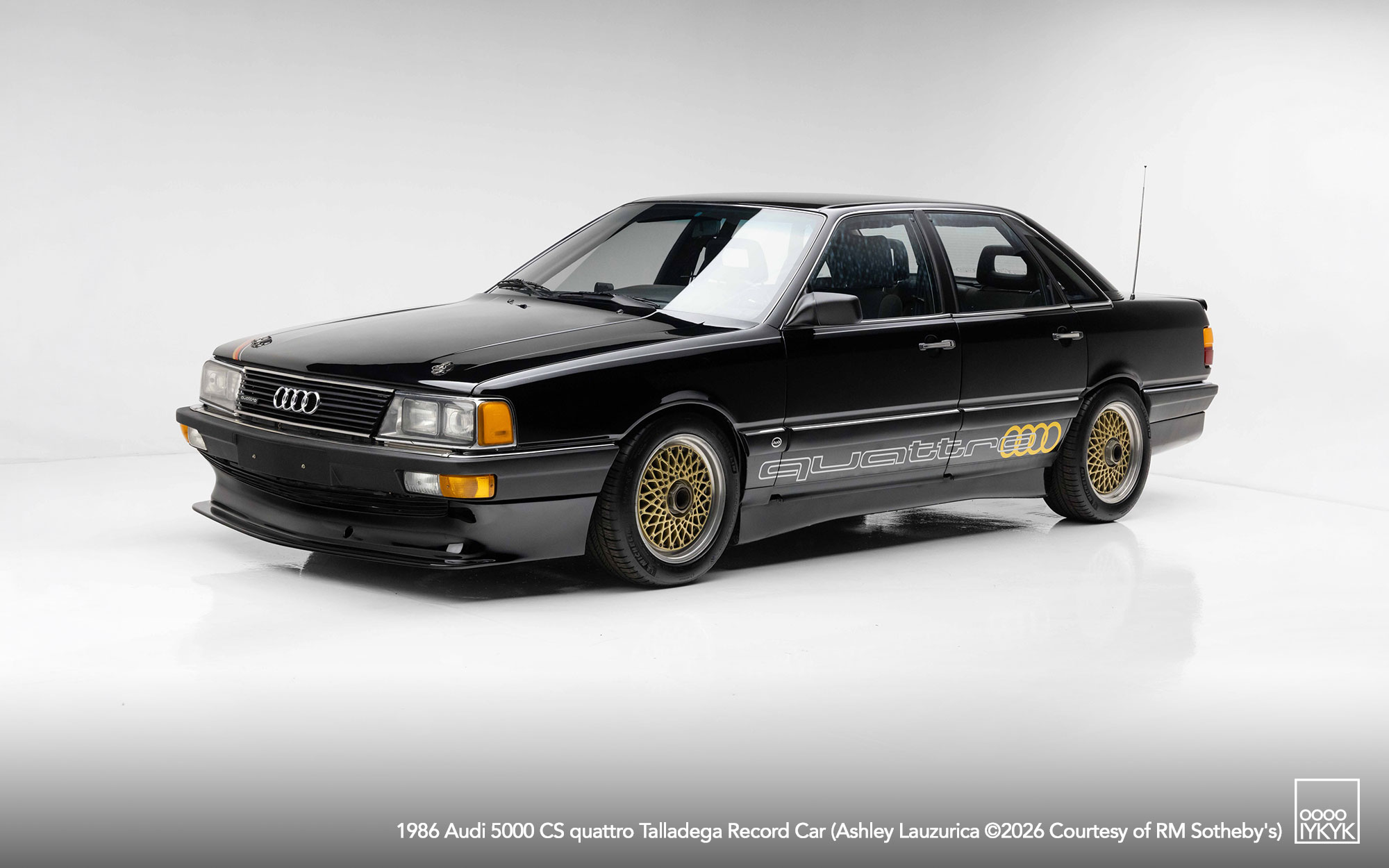
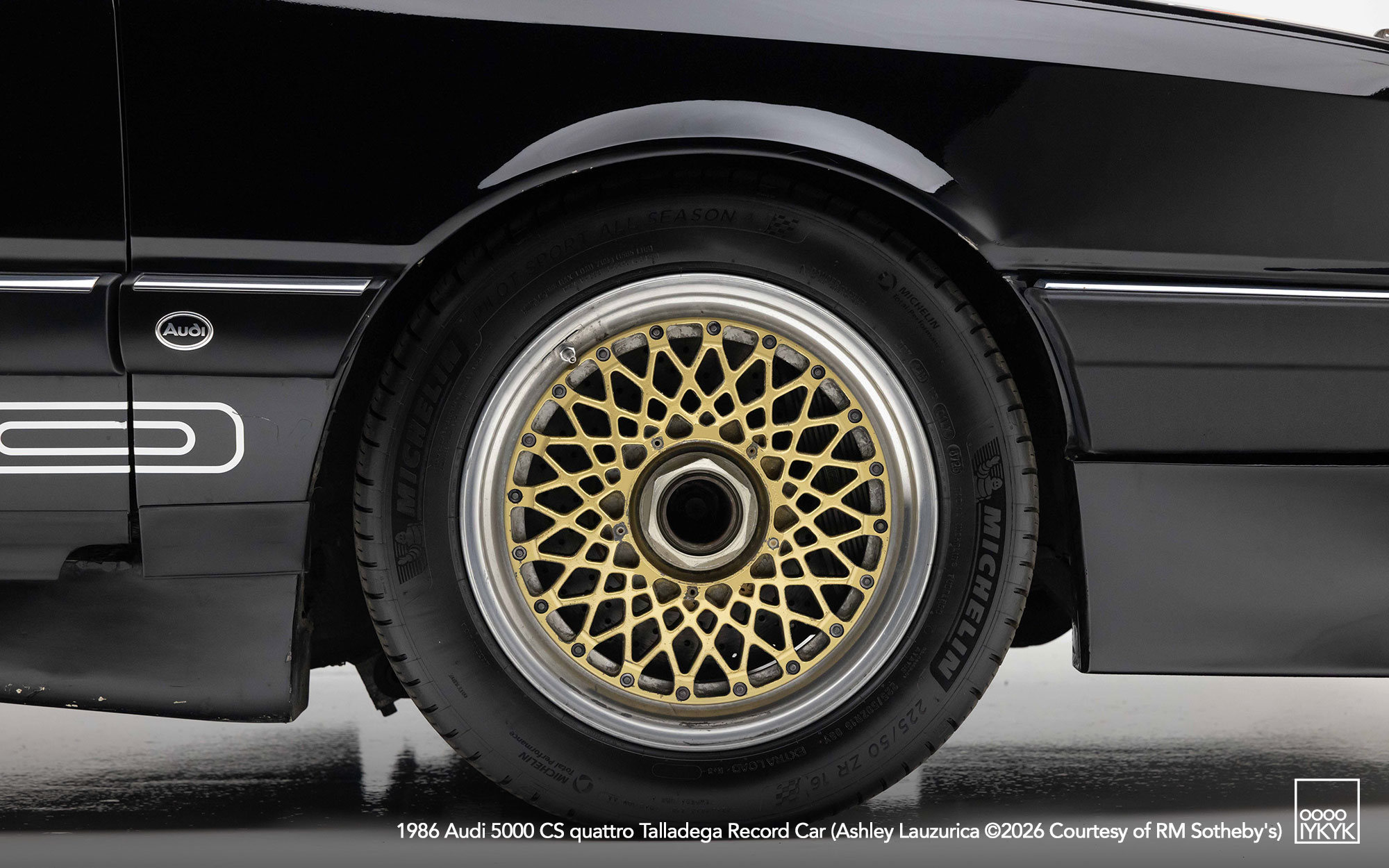
A project with major impetus from Audi of America and its then racing director Jo Hoppen, Audi selected a production-based U.S.-spec 5000 CS quattro as the foundation for an ambitious speed-record program designed to showcase turbocharging, aerodynamics, drivetrain durability and all-wheel-drive stability at sustained triple-digit speeds. The transformation was extensive.
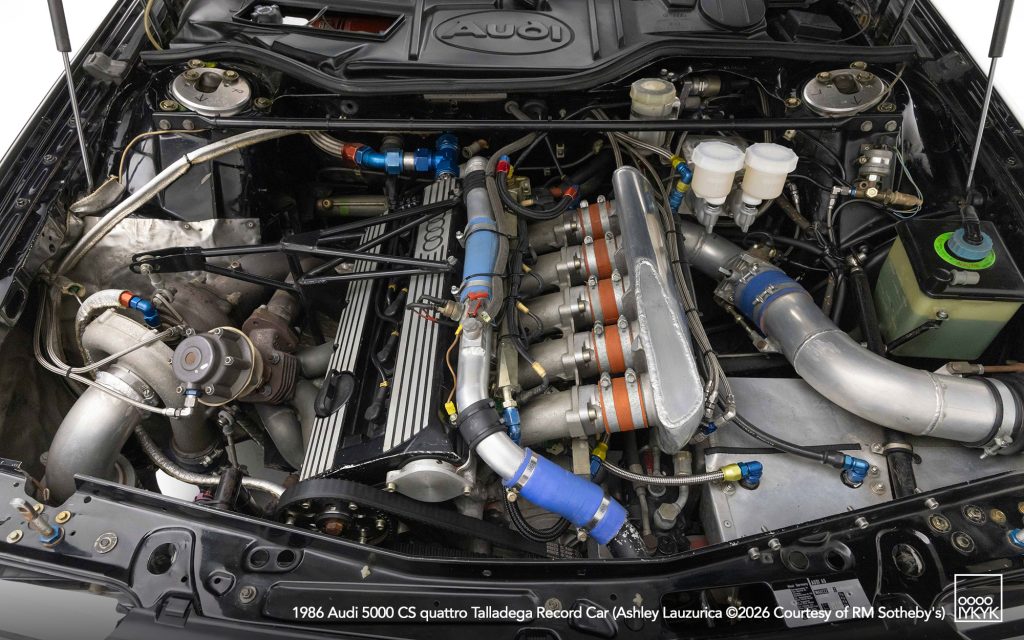
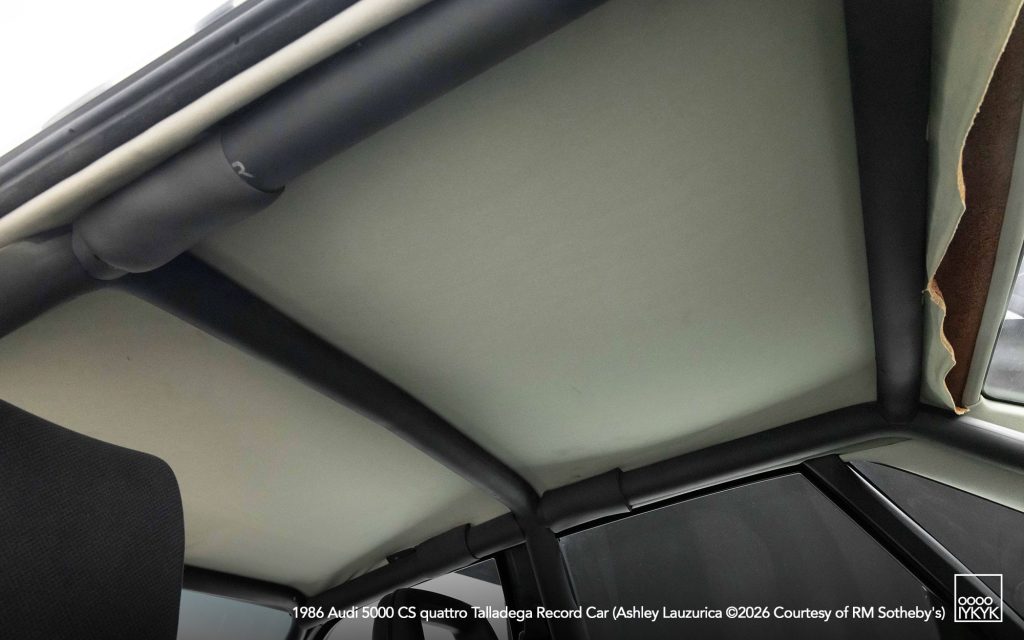
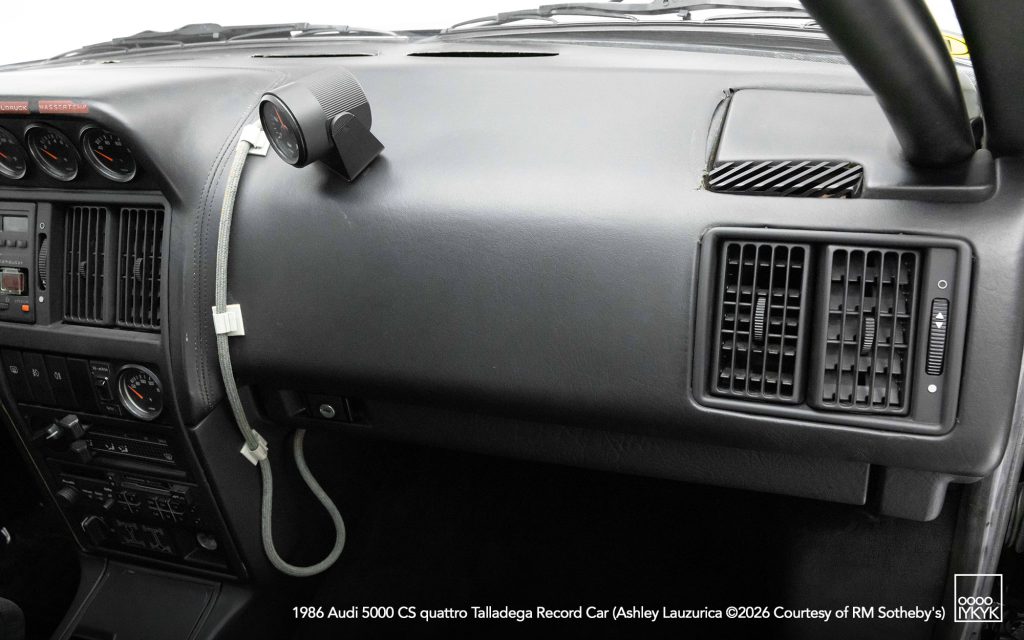
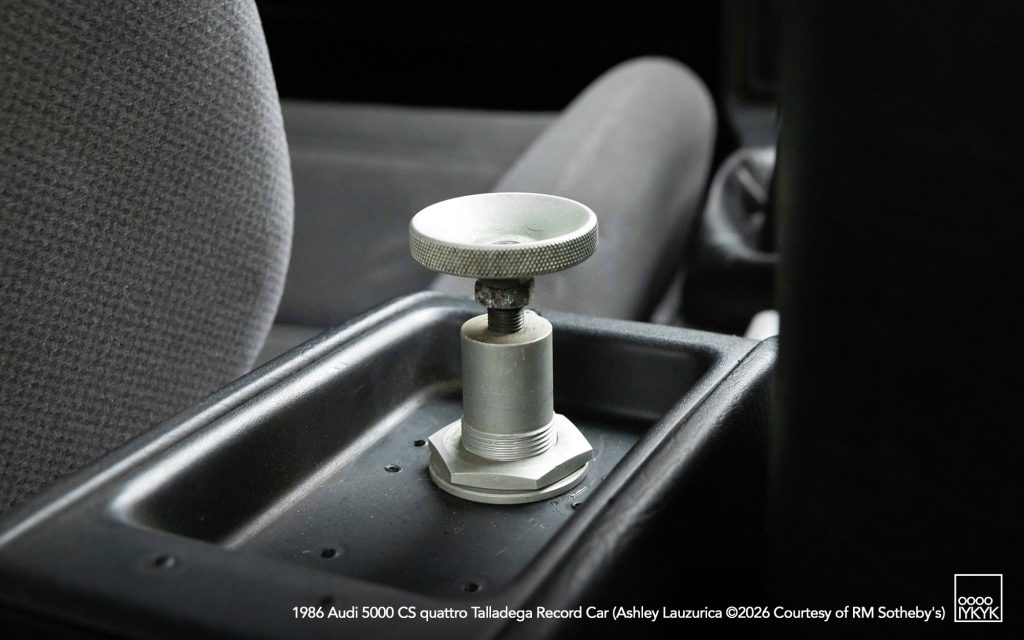
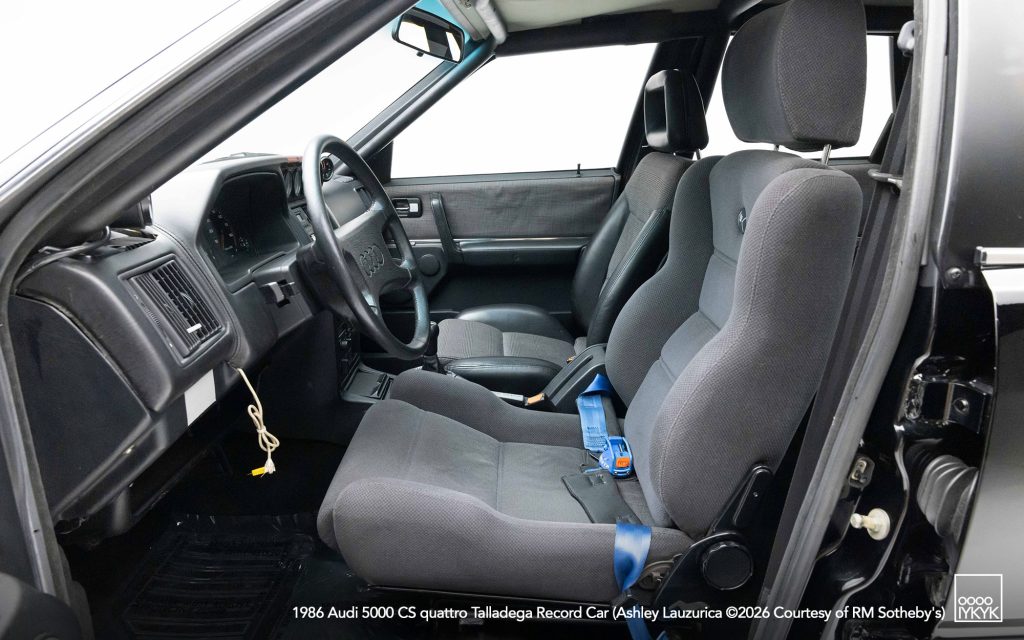
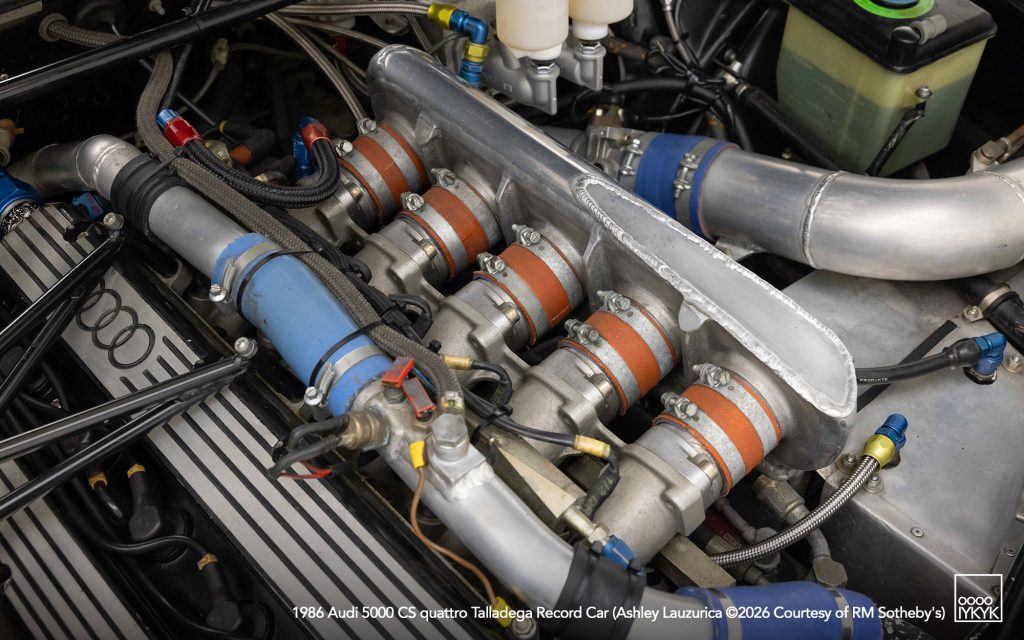
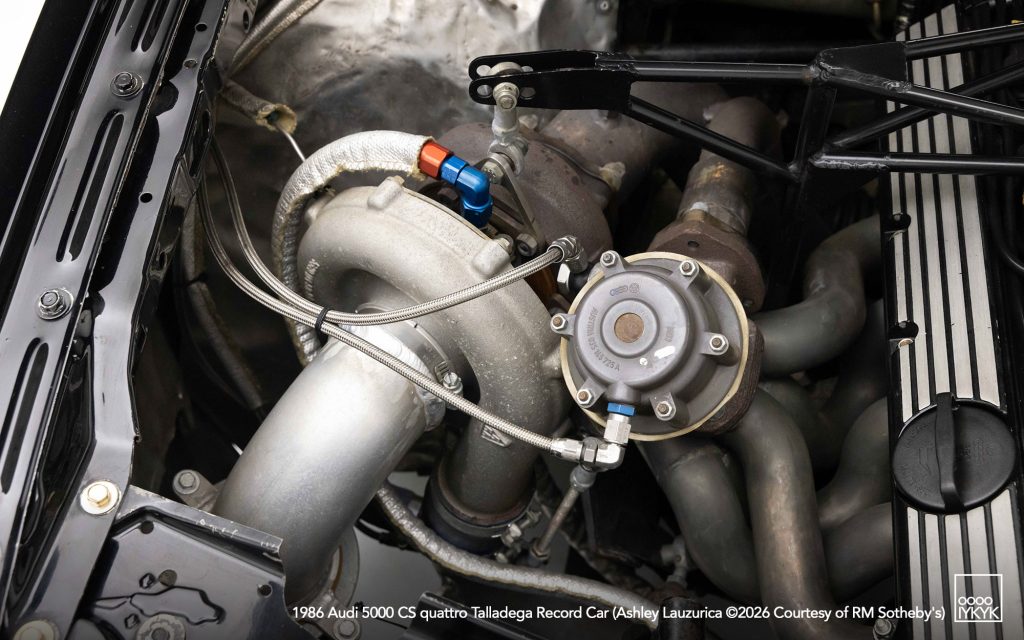
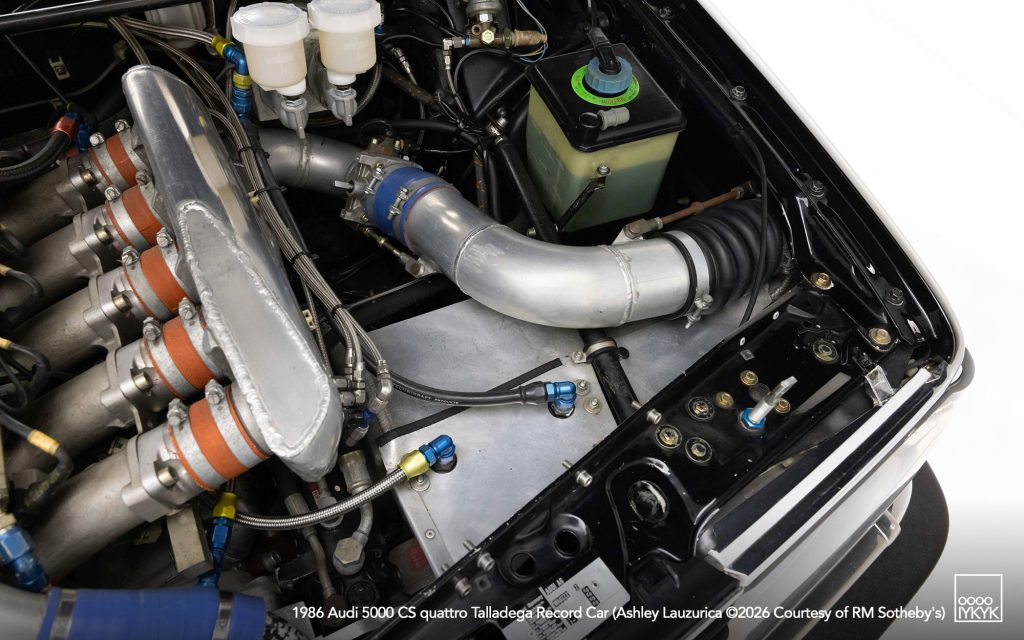
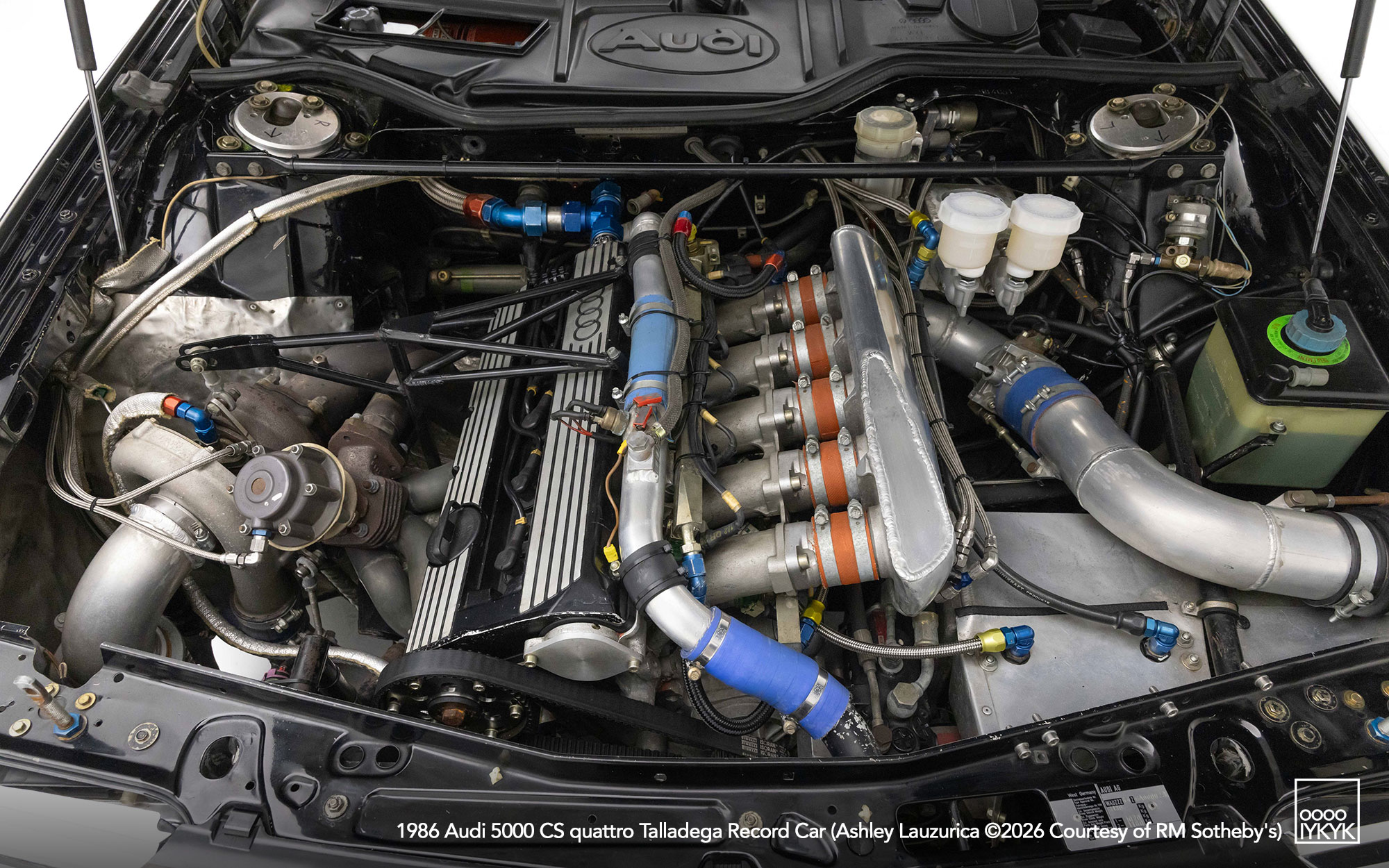
Virtually every unnecessary pound was removed from the car, while aerodynamic refinements prepared it for the demands of sustained high-speed running. Most dramatically, Audi engineers heavily revised the familiar 2.2-liter turbocharged inline-five, strengthening internal components and increasing output to approximately 650 horsepower—nearly four times that of the production sedan.
The result looked unmistakably like an Audi 5000, but mechanically it had become something entirely different.
WHEN BOBBY UNSER CHANGED EVERYTHING
Interestingly, Audi’s first choice behind the wheel wasn’t Bobby Unser according to the lore provided by RM Sotheby’s.
According to the RM lot description, Walter Röhrl had originally been slated to conduct the record attempts, but despite being one of the greatest rally drivers in history, Röhrl had virtually no experience racing on high-banked oval circuits.
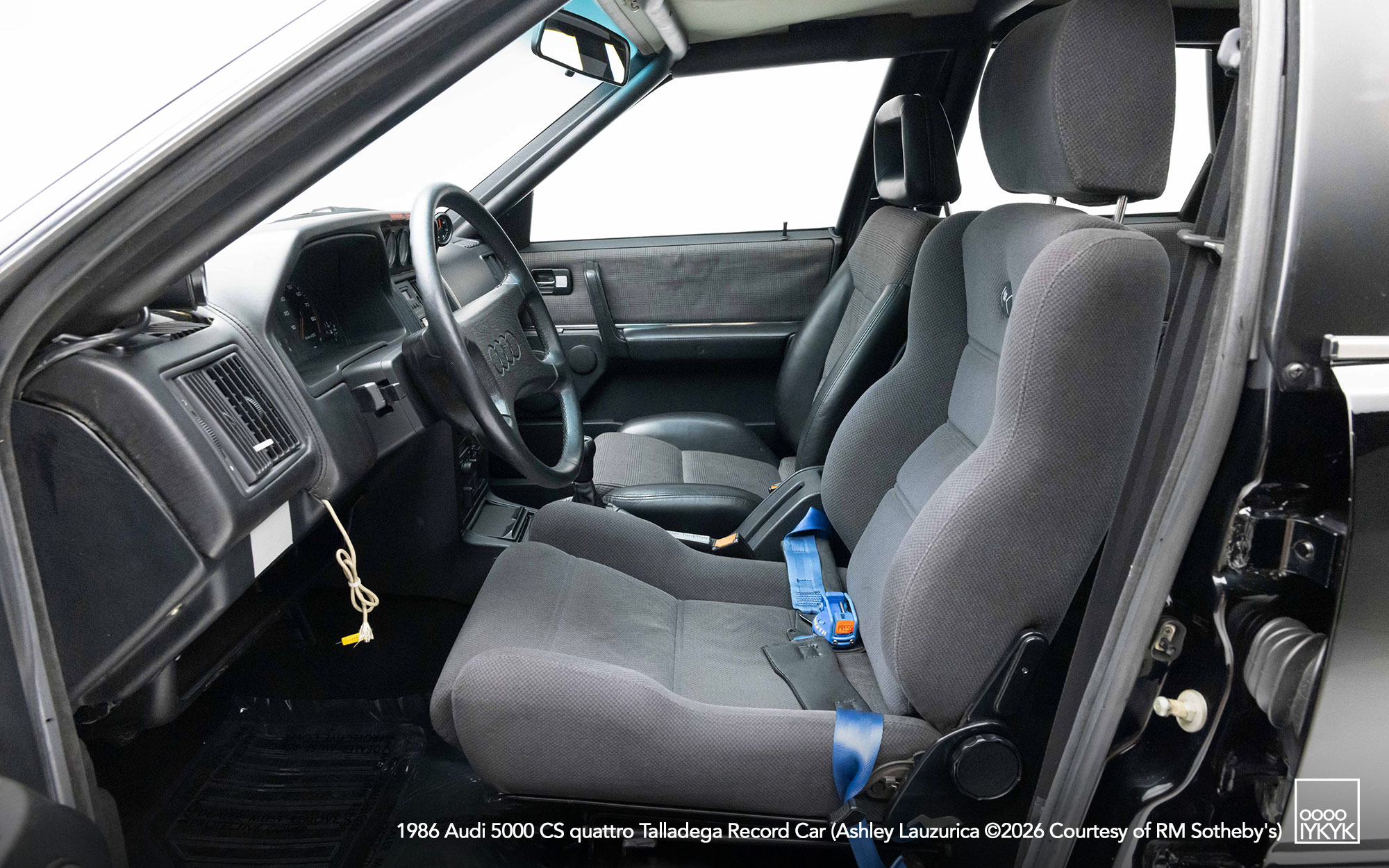
Instead, Audi turned to recently retired Bobby Unser, whose understanding of chassis setup and high-speed oval driving proved invaluable.
Also according to RM Sotheby’s, Audi had already spent three years and millions of dollars pursuing the elusive 200 mph milestone without success.
Unser changed that almost immediately.
Arriving at Talladega Superspeedway in March 1986, he applied his own chassis setup and exceeded 200 mph on his very first run. On his second attempt, the prototype recorded a 206.3 mph single-lap speed, ultimately helping establish 16 world speed records during the program.
For Audi, the achievement demonstrated that a production-derived turbocharged five-cylinder sedan equipped with quattro all-wheel drive could survive sustained speeds previously reserved for purpose-built racing machinery.
SAVED FROM THE SCRAP YARD
The story of this car could easily have ended there.
Like many factory development vehicles, the prototype was ultimately destined for disposal after its record-setting career concluded.
Instead, an unlikely friendship preserved it.
According to RM and likely shared by the unnamed seller, a father and son traveled to Ingolstadt during the late 1980s to collect their new Audi V8. During their visit they were given a factory tour by Dr. Werner Laurenz, then head of motorsport engine development.
The meeting developed into a lasting friendship.
One day Laurenz arrived at the family’s home in Dortmund with the record-setting 5000 CS on a trailer. Although still roadworthy, the prototype had been earmarked for the scrapyard.
Recognizing its historical importance, the family purchased the Audi directly from the factory, preserving it for decades. During their stewardship, the paintwork was refreshed and the specialized turbocharged engine was professionally rebuilt.
That continuous ownership history has helped preserve one of the most significant experimental Audis ever to survive outside factory hands.
A UNIQUE PIECE OF AUDI HISTORY
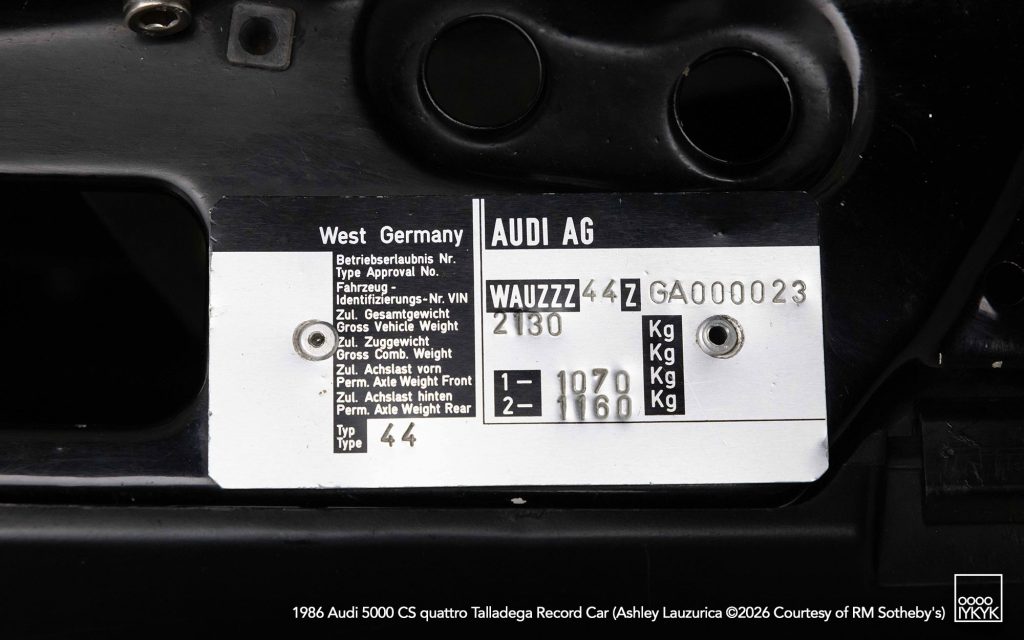
Carrying chassis WAUZZZ44ZGA000023, this is billed to be the actual record-setting vehicle that rewrote Audi’s place in post-war high-speed endurance testing. It also represents an important bridge between Audi’s Group B dominance and the company’s growing reputation for engineering innovation throughout the remainder of the decade.
As interest in historically important factory prototypes continues to grow among collectors, opportunities like this rarely emerge. Unlike restored competition cars or tribute builds, this Audi retains direct factory provenance, documented speed-record history, and a unique place within Audi’s engineering story.
Unlike homologation specials or limited-production road cars, there is no second example of this prototype though there are a few known similar cars such as the 1988 Audi 200 Turbo quattro Nardo speed record car auctioned off by Bonhams at that auction house’s 2022 Les Grandes Marques du Monde à Paris sale in February 2022 where it sold for €235,750.
Interestingly, this isn’t the first time WAUZZZ44ZGA000023 has been sold at auction. It also hit the block with Bonhams at Les Grandes Marques du Monde à Paris in 2025, fetching a far lower €120,750.
For anyone attending Monterey Car Week, this alone makes RM Sotheby’s auction worth a visit. Whether it ultimately sells near its $250,000-$300,000 estimate or exceeds expectations, the appearance of Audi’s 206 mph Talladega record setter on the public market is a genuinely significant moment for the marque—and one that enthusiasts may not see repeated for many years.
Worth noting for those who plan to attend the sale, Unser’s Talladega 5000 won’t be the only Audi set to cross RM’s auction block. A second car, a Samoa Orange Audi R8 V10 Spyder S tronic showing only 1,319 miles will also be featured.
PHOTO GALLERY