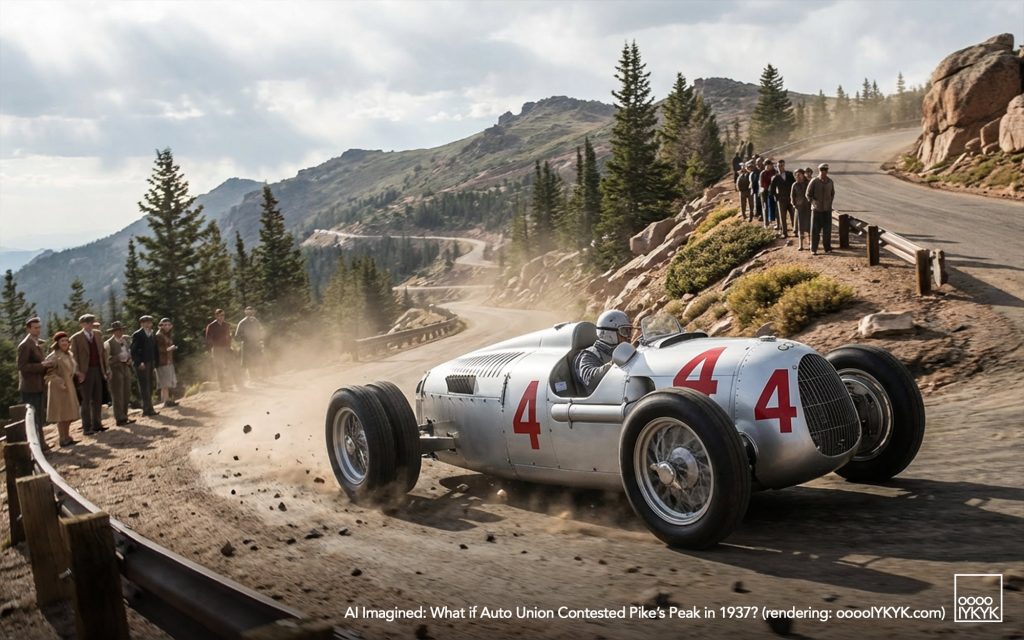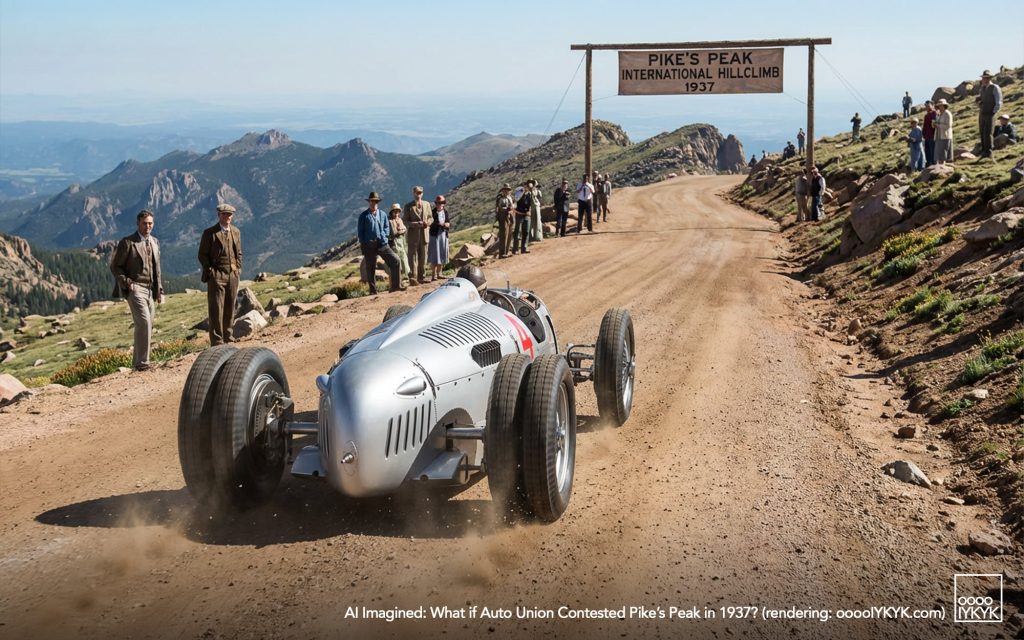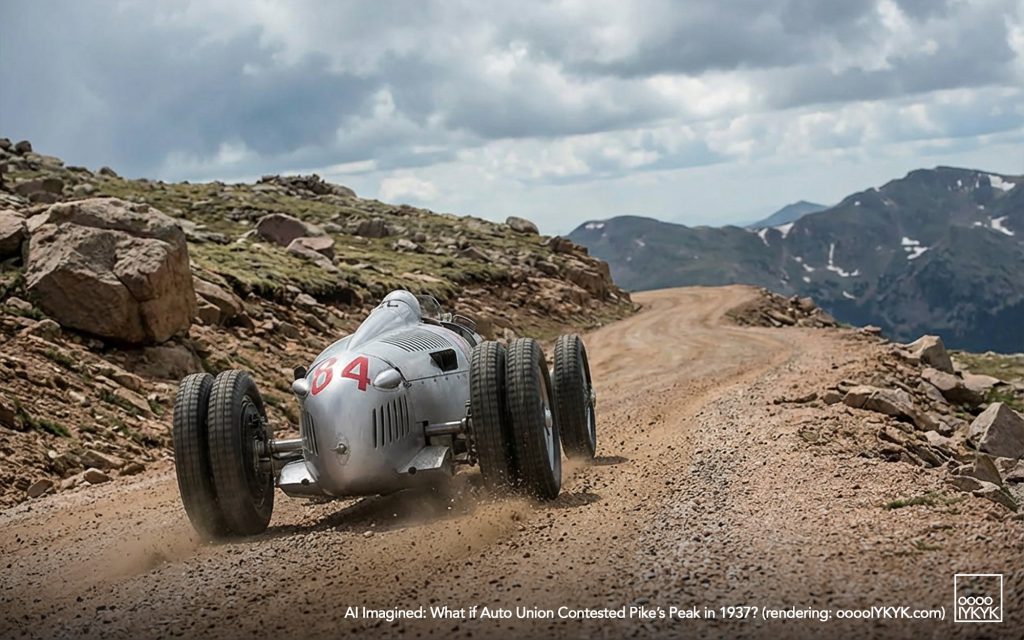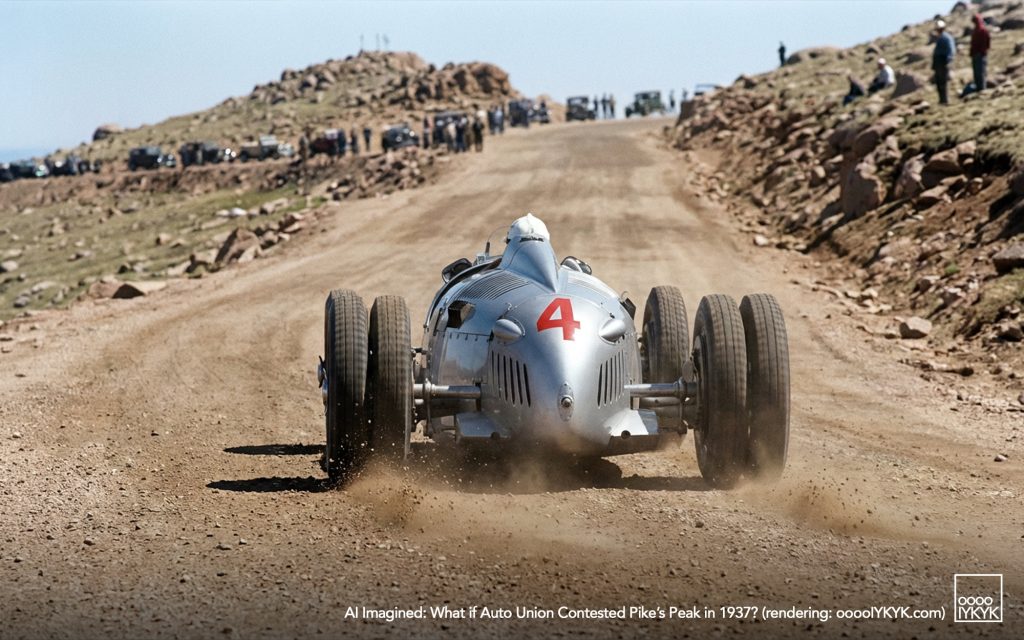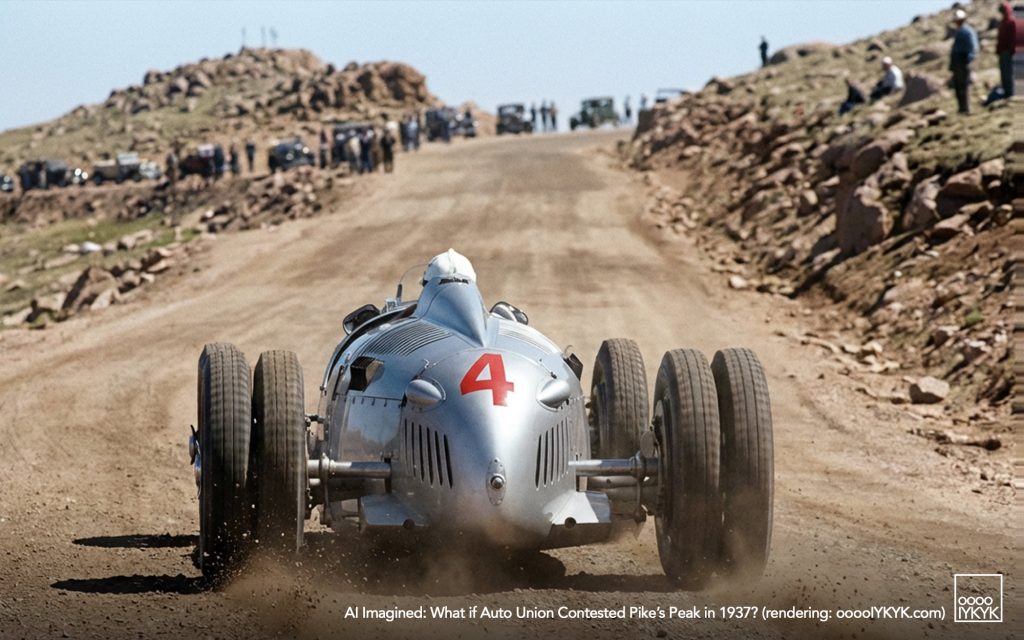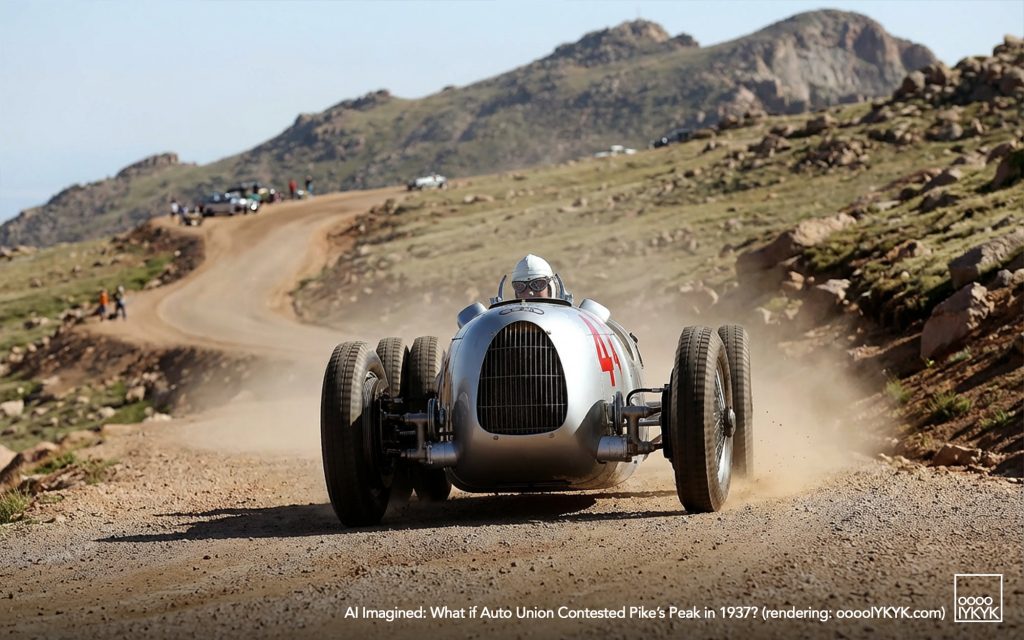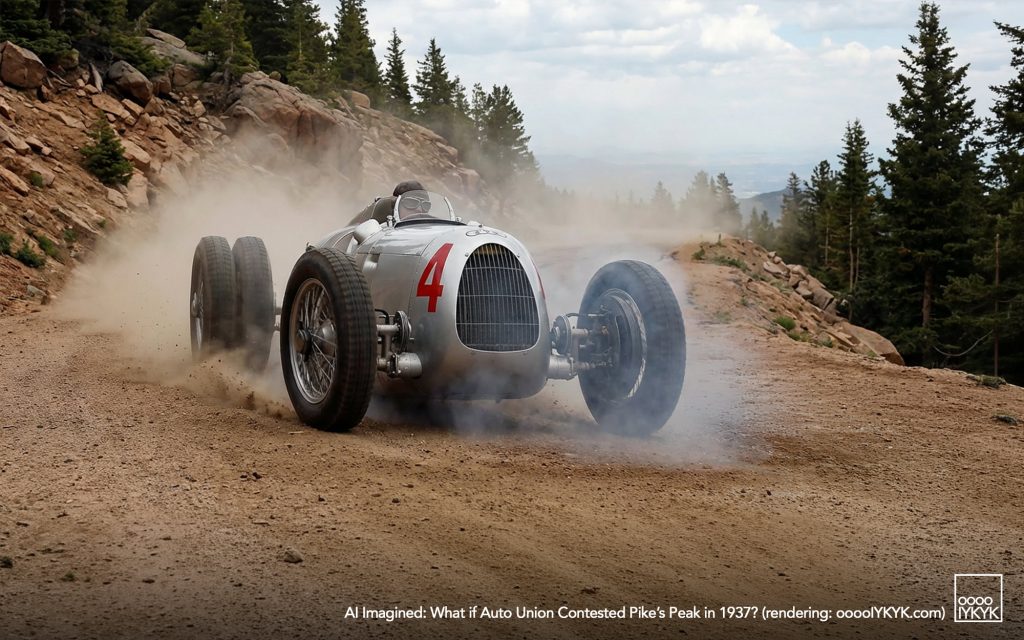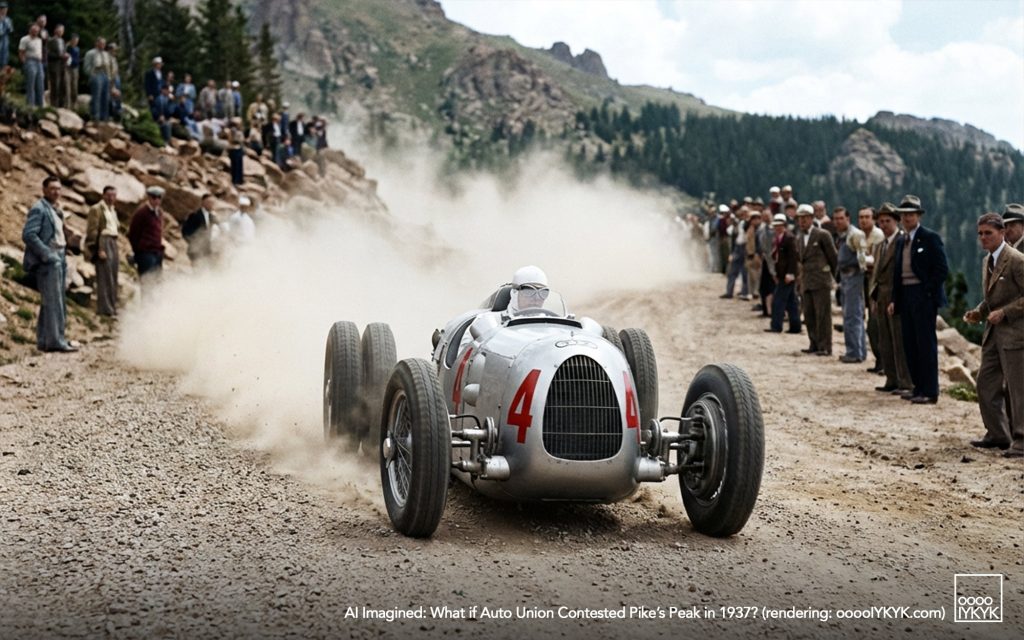

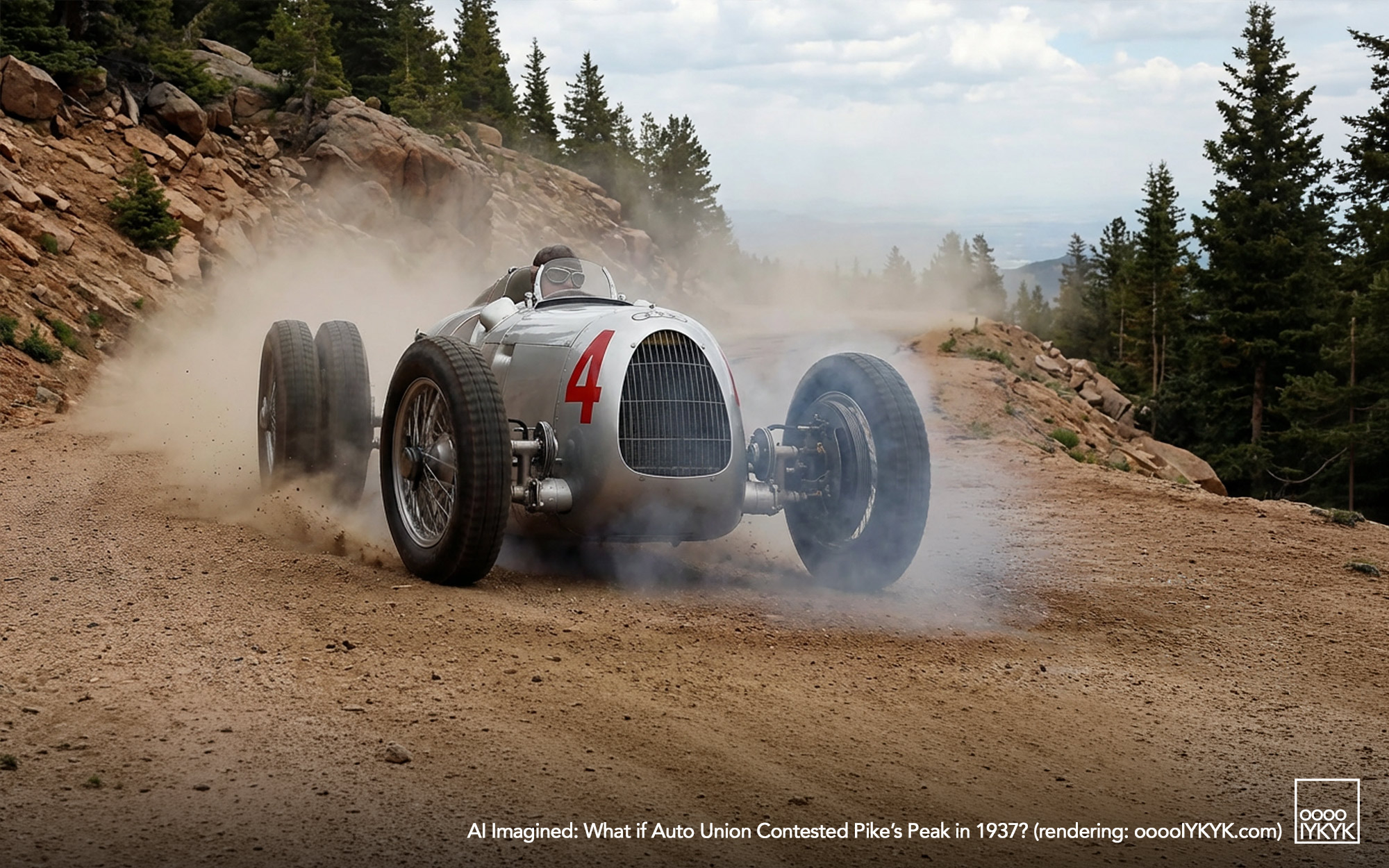

One of the more fun aspects of generating ficticious renderings. I find they’re more fun when they have some basis in reality – pictorial fiction of things that might have been in an alternate reality or had things played out differently.
Today’s focus is timely given it’s Pike’s Peak International Hillclimb week. Here, it’s a consideration of how actual history might have been different with little effort other than the whims of certain key individuals – Ferdinand Porsche, Hans Stuck, etc.
THE ACTUAL EARLY HISTORY OF THE PIKE’S PEAK INTERNATIONAL HILLCLIMB
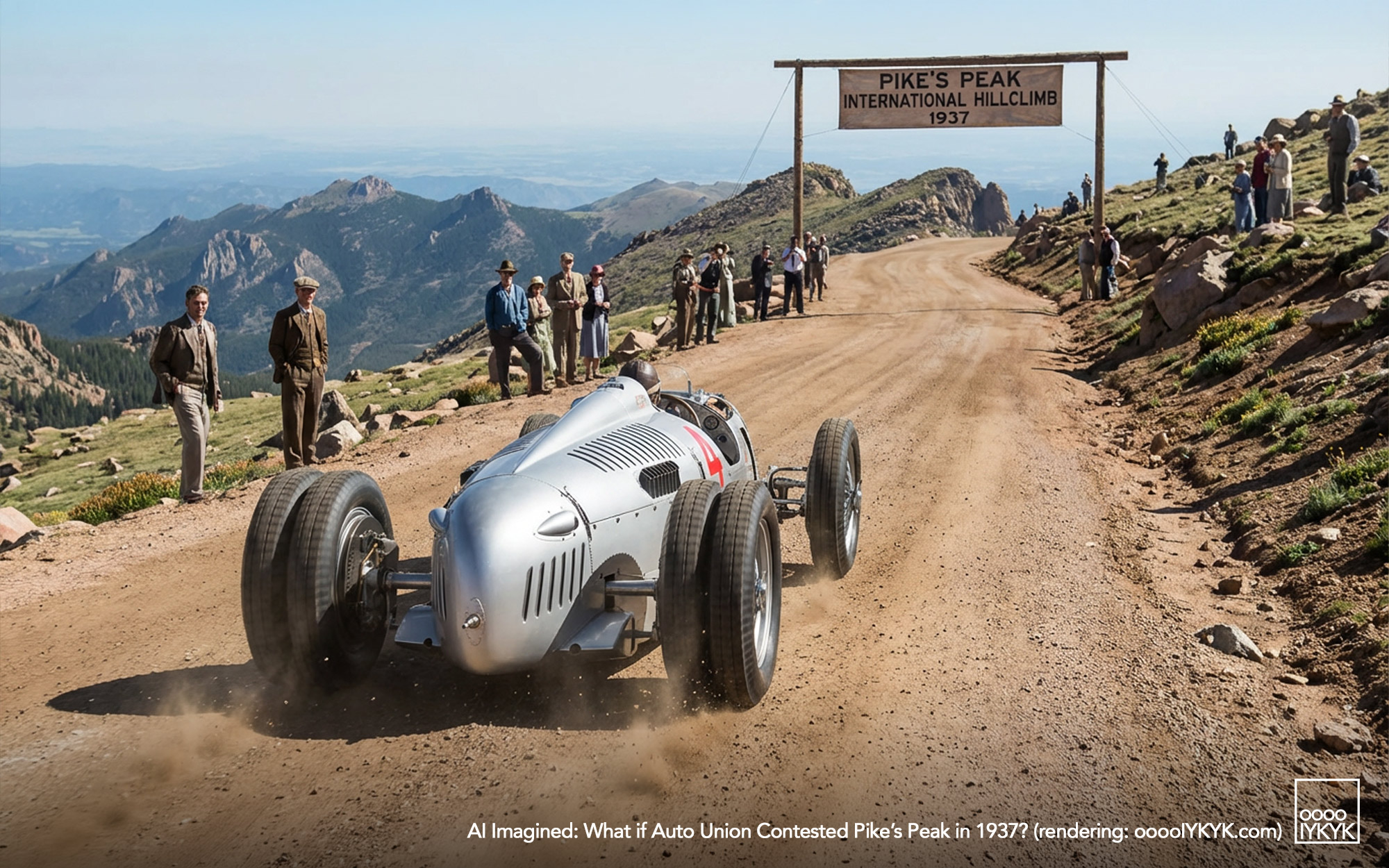
The origins of the Pikes Peak International Hill Climb can be traced to the development of the Pikes Peak Auto Highway by Colorado Springs entrepreneur Spencer Penrose. Seeking to capitalize on the growing popularity of automobile tourism, Penrose transformed the mountain’s narrow carriage road into a modern toll highway in 1915. To publicize both the new road and his nearby Broadmoor Hotel, he organized a race to the summit of Pikes Peak. The inaugural Pikes Peak Auto Hill Climb was held over three days in August 1916, with Rea Lentz taking victory in a Romano Demon Special in a time of 20 minutes, 55.6 seconds. The event immediately captured public imagination, challenging drivers and machines to ascend from the foothills above Colorado Springs to the 14,115-foot summit over a winding dirt road unlike any other in America.
Interrupted only by America’s participation in the First World War, the race returned in 1920 and steadily grew in stature throughout the 1920s and 1930s. By 1937, the hill climb had become one of the nation’s premier motorsport competitions, attracting many of the country’s finest drivers and specialized racing machinery. The 12.4-mile course, consisting entirely of dirt and gravel and climbing nearly a vertical mile through dozens of switchbacks and sweeping mountain curves, presented unique engineering challenges. Thin air robbed engines of power while sudden weather changes could transform conditions within minutes. Veterans such as Louis Unser emerged as local heroes, mastering the mountain through repeated victories and establishing family legacies that would become synonymous with the race. By the eve of the 1937 running, the “Race to the Clouds” was already regarded as one of the world’s great hill climbs and a proving ground where automotive innovation was tested against the unforgiving realities of high-altitude competition.
AUTO UNION’S OWN STATUS IN 1937
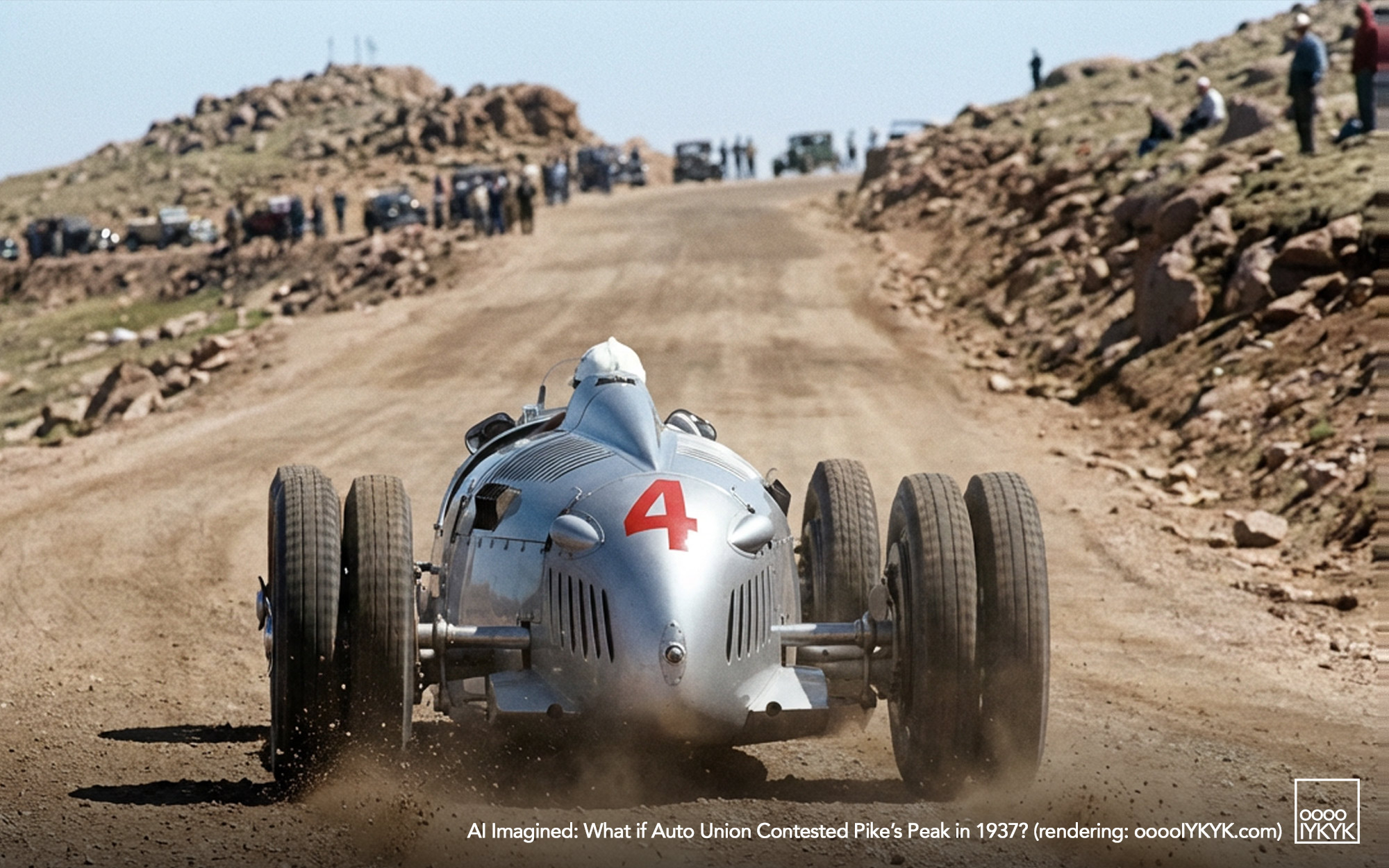
The rise of Auto Union’s Silver Arrows began in 1933 when the newly formed Auto Union conglomerate—comprising Audi, DKW, Horch and Wanderer—commissioned engineer Dr. Ferdinand Porsche to design a revolutionary Grand Prix racing car for the new 750-kilogram formula set to take effect in 1934. The result was the Type A, a radical mid-engine machine that placed its supercharged V16 engine behind the driver, a layout decades ahead of its time. Supported by the German government’s effort to showcase the nation’s technological prowess, Auto Union quickly became a formidable rival to Mercedes-Benz on Europe’s Grand Prix circuits. Led by drivers such as Hans Stuck, Bernd Rosemeyer and Achille Varzi, the Silver Arrows earned victories in Grand Prix races, record-breaking attempts and hillclimbs, establishing a reputation for immense power and daring engineering.
By 1937, Auto Union had evolved through the Type B and into the fearsome Type C, powered by a now supercharged 6.0-liter version of the V16 producing well over 500 horsepower. The Type C proved particularly effective for hillclimbs in the hands of Hans Stuck, whose background in mountain racing made him one of Europe’s most successful competitors. Between 1934 and 1937, Stuck and Auto Union dominated major European mountain events, claiming victories on courses such as the Grossglockner, Schauinsland and other prestigious climbs. Their success demonstrated not only the extraordinary performance of the Silver Arrows but also their ability to master steep grades, loose surfaces and high-altitude conditions. By the summer of 1937, Auto Union stood at the height of its pre-war racing powers, its engineers and drivers having accumulated years of experience in the unique demands of mountain competition—experience that made the prospect of tackling America’s most famous mountain race, the Pikes Peak Hill Climb, a tantalizing thing to imagine.
That summer, the Auto Union and Mercedes-Benz teams traveled by steamship to New York in order to take part in that year’s Vanderbilt Cup – a notable round of the AAA Championship Car Season, a series that also included the Indianapolis 500. Auto Union’s Bernd Rosemeyer would win that race, notable as the only competition the Silver Arrows contested in the USA. And while Rosemeyer would return immediately in order to continue his pursuit to defend his champion status in the European Grand Prix series, his friend and lead team engineer Ferdinand Porsche would stay on longer in America in order to visit American car factories and procure tooling for his new project setting up the Volkswagenwerk in Wolfsburg.
WHERE REALITIES DIVERGE
Not part of the championship Rosemeyer was chasing, Vanderbilt was effectively a publicity exhibition. In 1937, history shows Dr. Porsche was likely focused more on setting up a factory for the so-called “People’s Car” than he was on further exhibiting Auto Union’s technical prowess in America, bu thad he done so then Pike’s Peak would have been a most interesting place to do it.
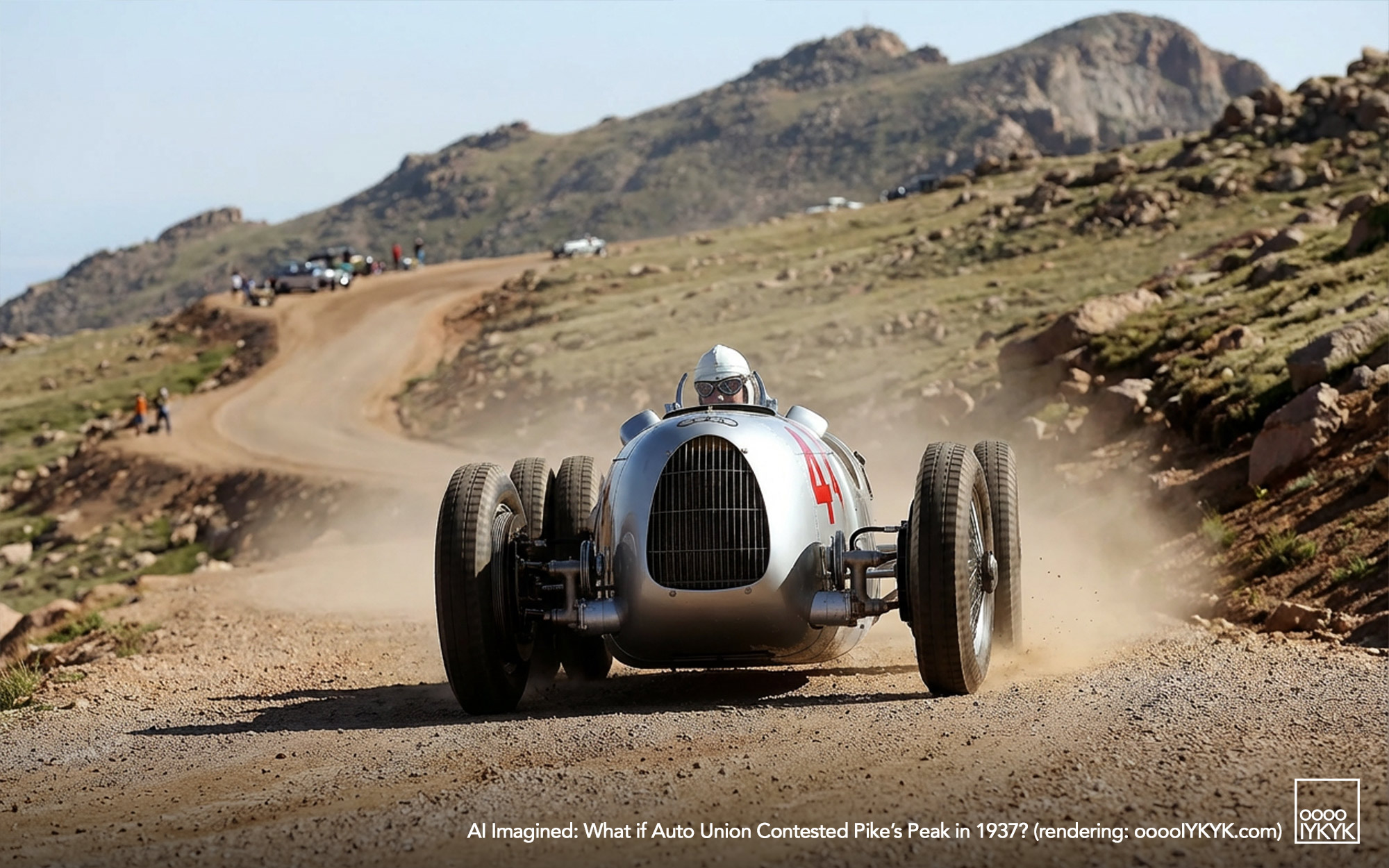
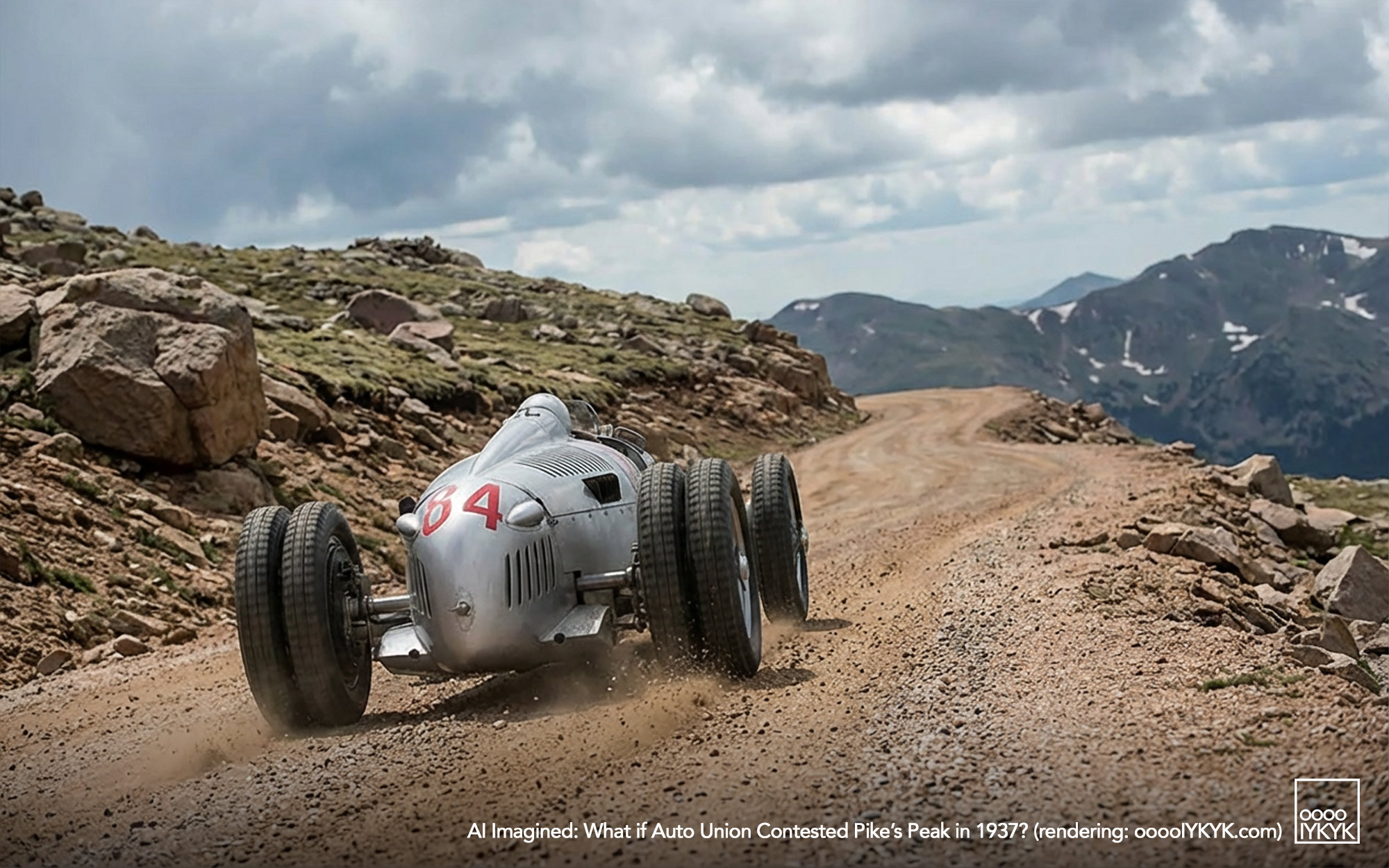
Auto Union was already the dominant player in European hillclimbs. Hans Stuck had already come to be known as “Der Bergkönig” (the Mountain King) while piloting Auto Unions converted to “Bergrennen” (hill climb) spec – at times with a shorter wheelbase or four rear tires fitted 2×2 on the rear axle in order to maximize handling and grip.
Even still, Europe’s top competitions at Grossglockner and Schauinsland topped out at about 9,000 feet, which is about the same elevation as Pike’s Peak’s starting line. From there, the Colorado competition climbs to its aforementioned 14,115-foot summit.
No doubt that would have been an intriguing challenge for Dr. Porsche. Now consider he had two Auto Union Type C Grand Prix cars in the United States already, theoretically easy enough to convert to mountain spec before sending them back, could or would he have considered putting one of the world’s most advanced drivers on the mountain with Europe’s most talented hillclimb driver at the wheel in an effort to log another German public relations win?
Without diving too deeply into the numbers, what we know is this. In optimum conditions, the Auto Union Type C with 6.0-liter supercharged V16 put out about 550 hp. At Pike’s Peak’s elevation and normally-aspirated, the engine would hav eput out about 333 hp. However, it was supercharged and so would have likely been more about 440-470 hp at the top of the mountain.
The Auto Union Type C weighed 1,650 lb.
Now compare that to the Stutz eight-cylinder Perry Special driven by Louis Unser that won Pike’s Peak that year. Its hard to be definitive on numbers for this car because it wasn’t built to a specific formula. Its normally-aspirated 5.28 liter engine featured double overhead cams and four valves per cylinder likely put out about 180-200 hp at sea level as compared to the 520-550 hp of the Auto Union.
Unser’s Stutz-powered Perry Special was estimated to weigh 1,700-2,200 lb.
Quite obviously, the Auto Union outclassed the Perry Special in power and potential for speed, but the greater challenge would be familiarity with the mountain and optimization for the conditions. It’s here that Louis Unser, with years of experience and two outright wins under his belt may have had an advantage.
Sure, Stuck was the Mountain King in Europe, but he’d done so on paved mountain passes and not dirt carriage roads where getting power to the ground would have undoubtedly been a challenge.
HOW DEEP DO WE DIVE?
There’s so much deeper you could go with imagining such a story. What could have happened 50 years before Walter Röhrl re-set the record in his 1987 victory there at the wheel of his 1987 Audi S1 E2 Pike’s Peak? I’ll work to get a much more detailed consideration together in time for next year’s running.
For now, here are some imagined AI renderings at what such a race could have looked like in period. Also, make sure to follow along this weekend with the 2026 Broadmoor Pike’s Peak International HiIllclimb where any number of privateer Audi efforts will be competing. You can find information on how to watch it HERE or check out a preview of Audi entries over at Audi Club North America HERE.
PHOTO GALLERY