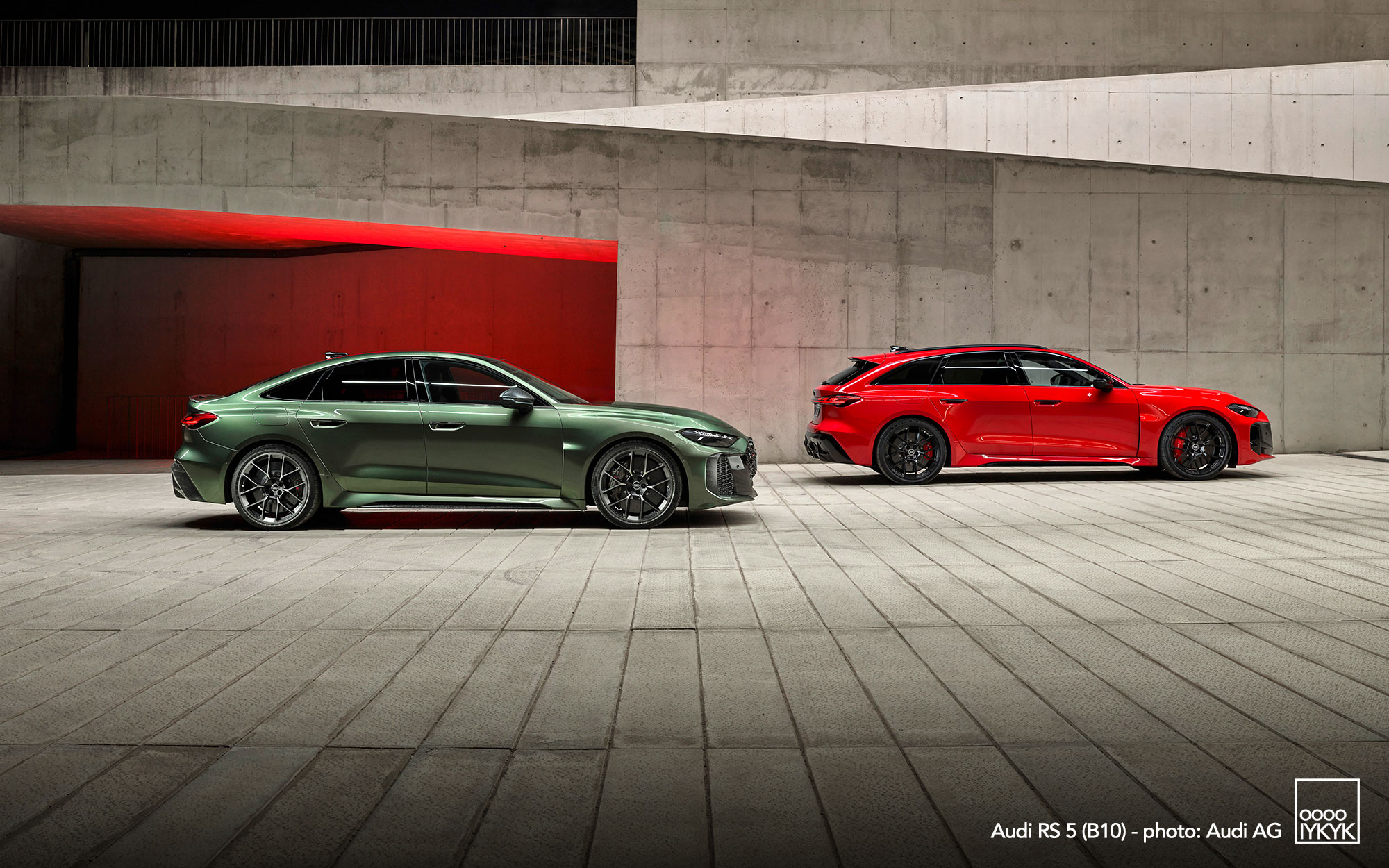

EDITOR’S NOTE Given there’s so much going on with this new RS 5 and the anticipation that remains around it, I’m including the full Audi press release below the photo gallery at the bottom of this story. If you are looking for more information, check there.
‘
Audi Sport’s first high-performance plug-in hybrid has arrived, and the numbers are impressive. The new RS 5 pairs a revised 2.9-liter twin-turbocharged V6 with a 130 kW electric motor for a combined system output of 470 kW (639 PS / approximately 631 SAE horsepower) and 825 Nm (608 lb-ft) of torque. It is capable of 0–62 mph (0–100 km/h) in 3.6 seconds, with a standard top speed that can be raised to 177 mph (285 km/h) when equipped with the optional Audi Sport package.
More than just a power bump, this RS 5 marks a structural change for the RS line: electrification without dilution of intent.
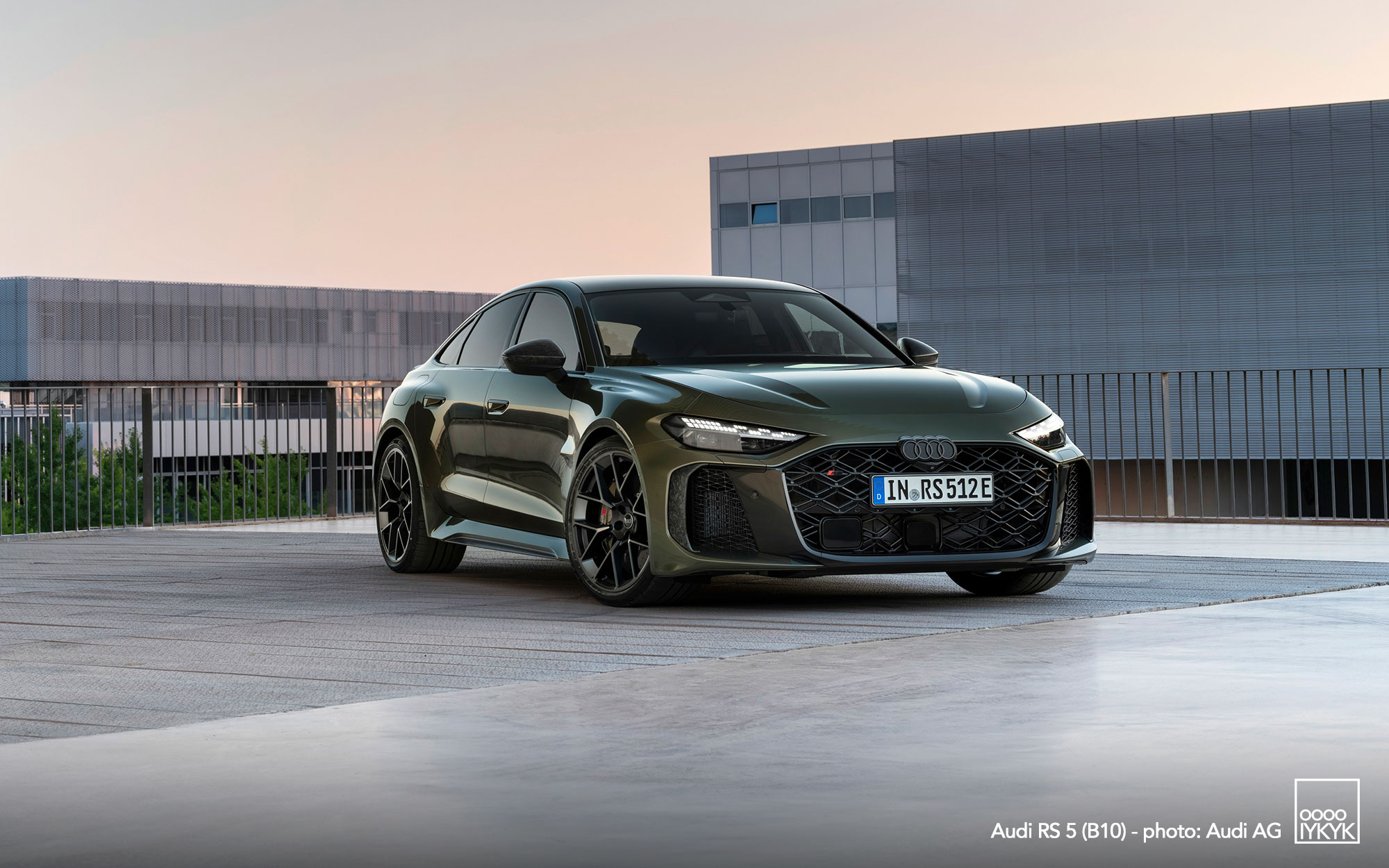
ENGINE 2.9 TFSI V6, NOW ELECTRIFIED
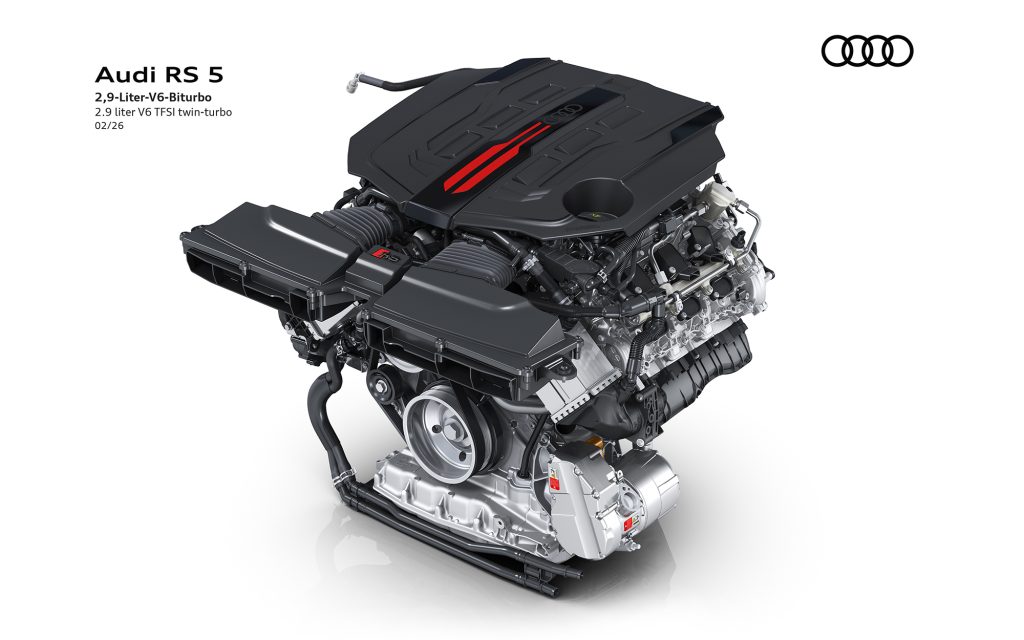
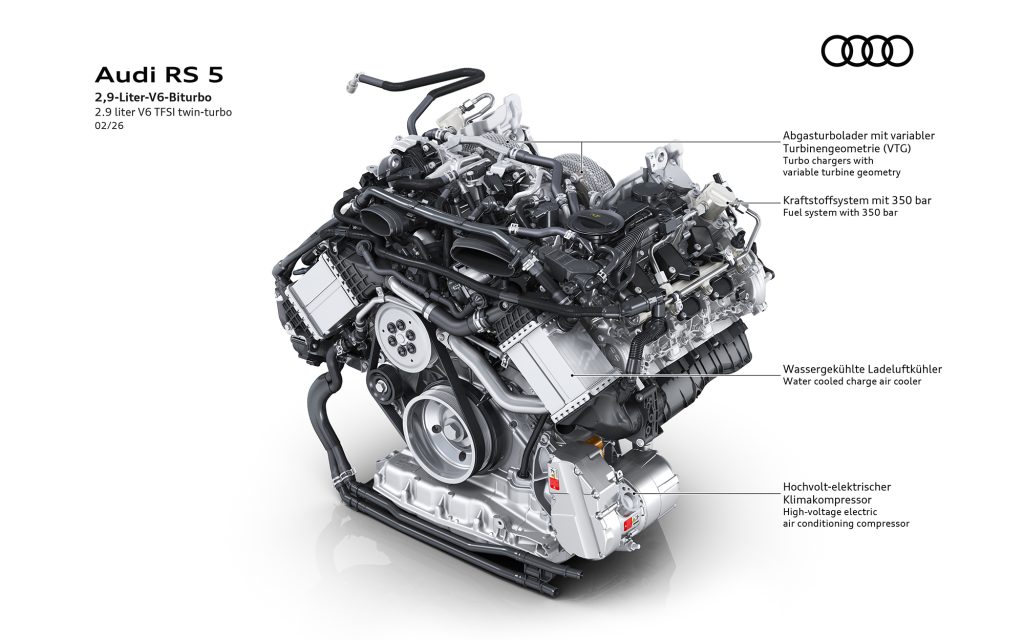
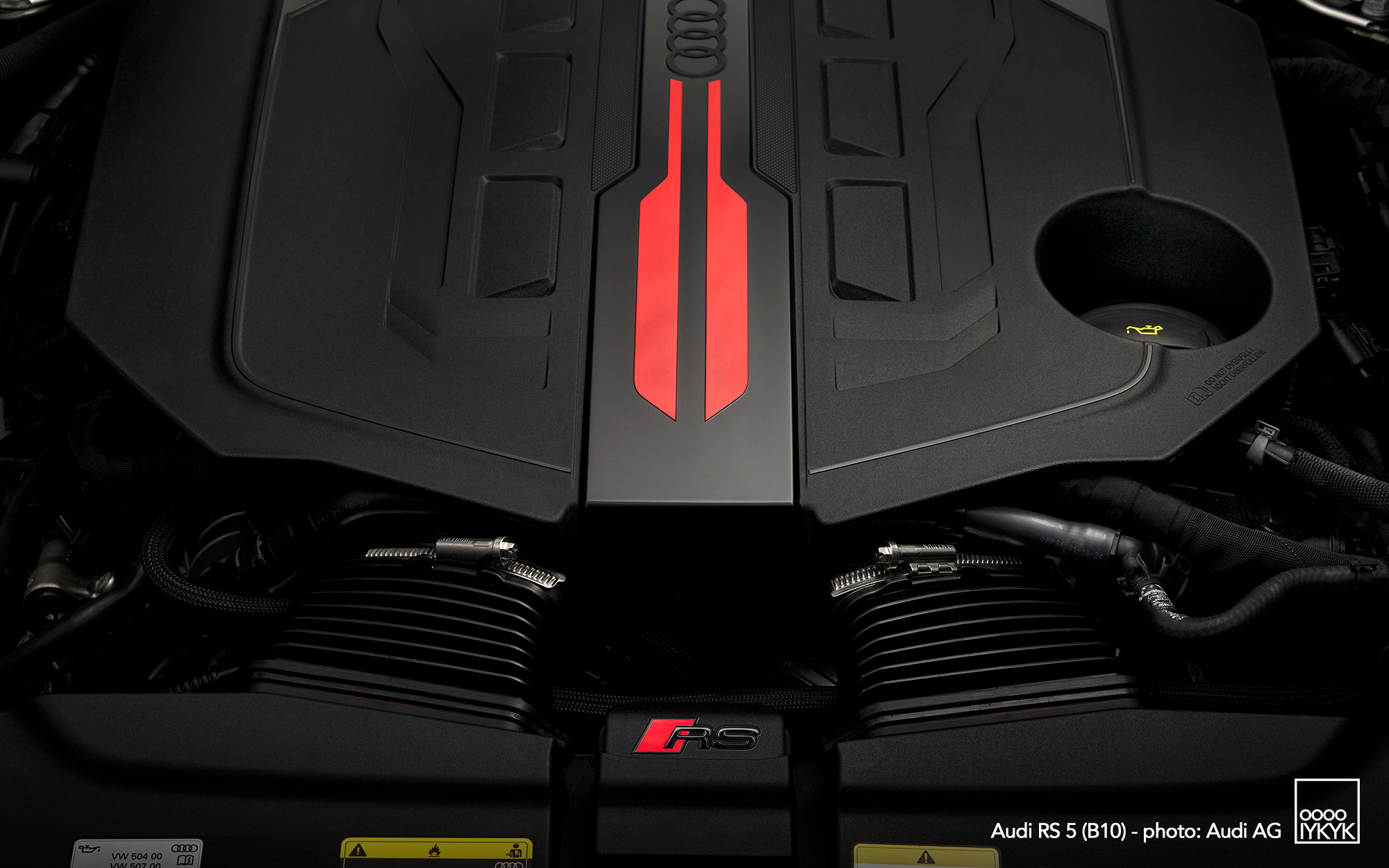
At the core remains Audi’s 2.9-liter twin-turbo V6, now producing 375 kW (510 PS / approximately 503 SAE horsepower) and 600 Nm (443 lb-ft). Audi Sport attributes the 44 kW increase over the prior generation to continuous performance-focused development, including a modified Miller cycle, higher injection pressure, optimized intake routing, and water-to-air intercoolers used for the first time on the RS 5.
The revised V6 is engineered for sharper throttle response and improved efficiency, with Audi claiming up to 20 percent lower fuel consumption under high load compared to its predecessor.
Supporting it is a 130 kW (177 PS / approximately 174 SAE horsepower) electric motor delivering 460 Nm (339 lb-ft) of torque. Together, combustion and electric power create a combined 470 kW (639 PS) system output and 825 Nm (608 lb-ft).
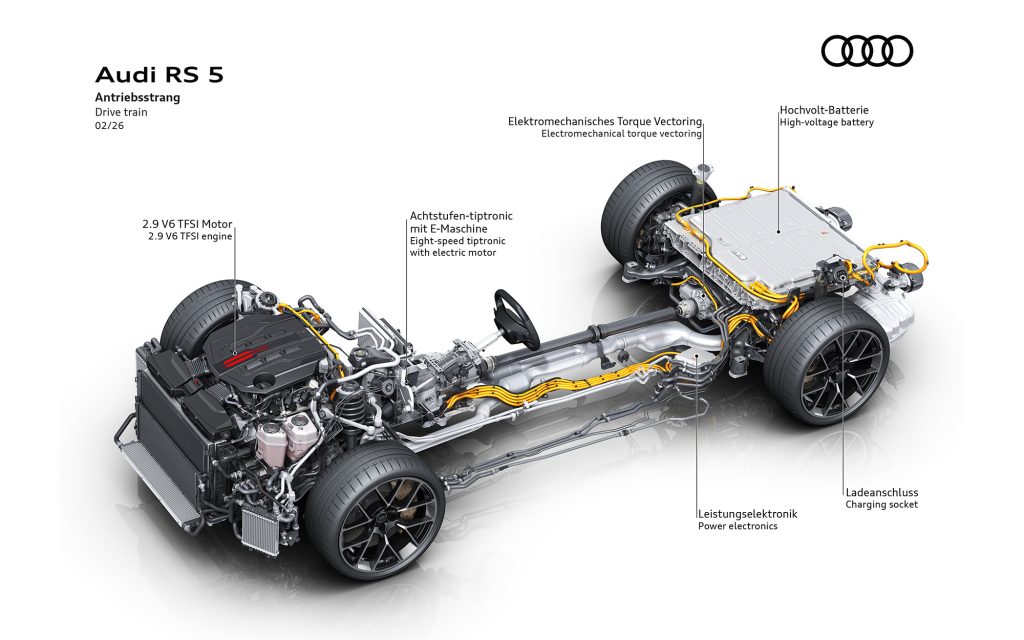
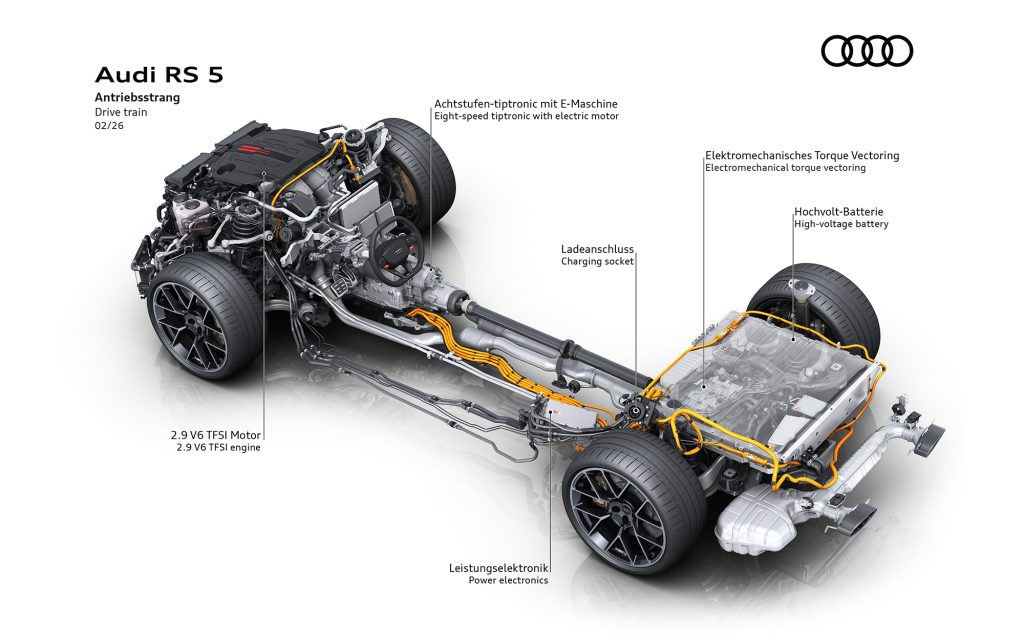
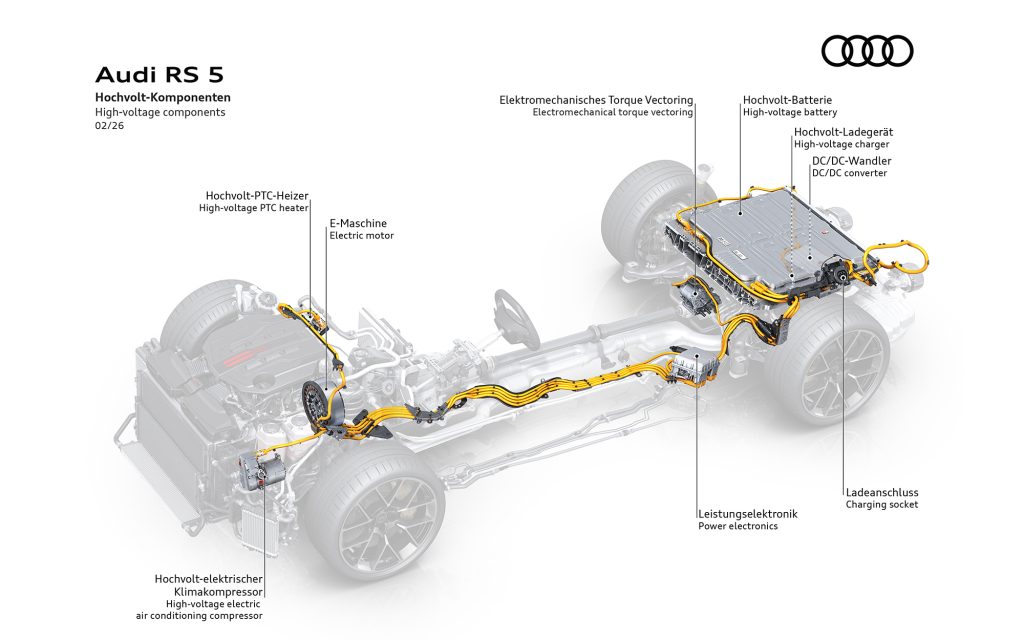
The electric motor is integrated into the hybridized eight-speed tiptronic transmission and also replaces the traditional 12-volt starter motor. Audi uses a 400-volt architecture with a 25.9 kWh battery (22 kWh net capacity).
ELECTRIC DRIVING RANGE & CHARGING
The RS 5 can travel up to 84 km (approximately 52 miles) on electric power alone, with up to 87 km (54 miles) in city driving.
Charging via AC at up to 11 kW allows the battery to replenish to 100 percent in approximately 2.5 hours.
Energy management is integrated into drive modes. In dynamic mode, battery charge is held above 20 percent to preserve boost capability. In RS sport and RS torque rear modes, state of charge is maintained at 90 percent to ensure full electric support for performance and torque vectoring.
The system also features adjustable regenerative braking with three stages via steering-wheel paddles, as well as predictive energy management in Hybrid mode.
HYBRID POWER DELIVERY & QUATTRO EVOLUTION
Power is delivered through an eight-speed tiptronic automatic with a torque converter and closely spaced ratios. The transmission has been optimized to reduce rotational resistance and sharpen shift response.
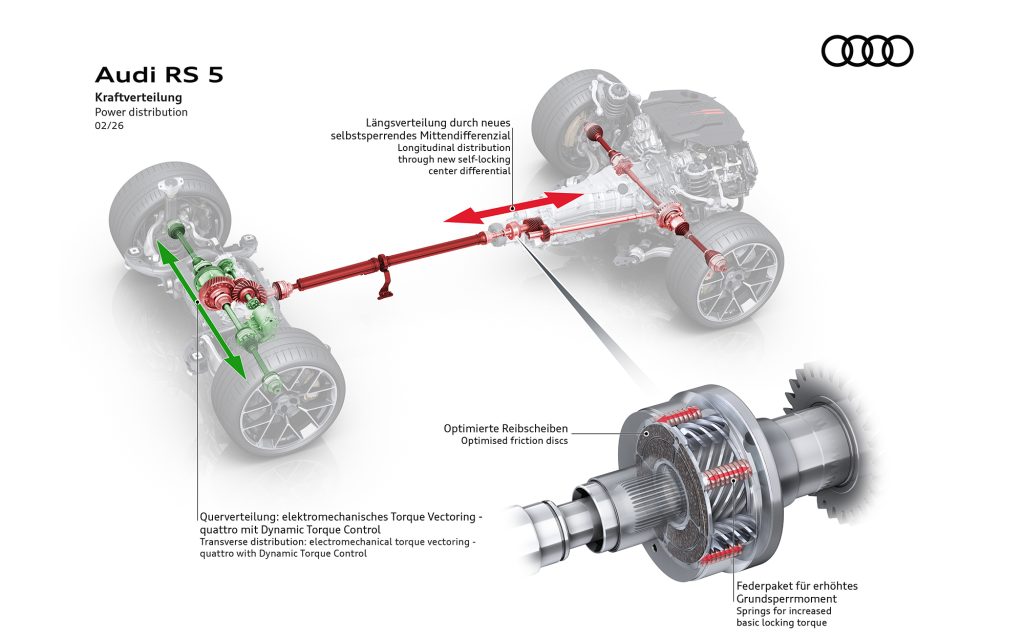
A limited-slip center differential distributes torque front-to-rear variably between 70:30 and 15:85. For the first time in an Audi Sport production model, the center differential incorporates preload, meaning it remains partially locked even off throttle to improve turn-in response and reduce internal understeer.
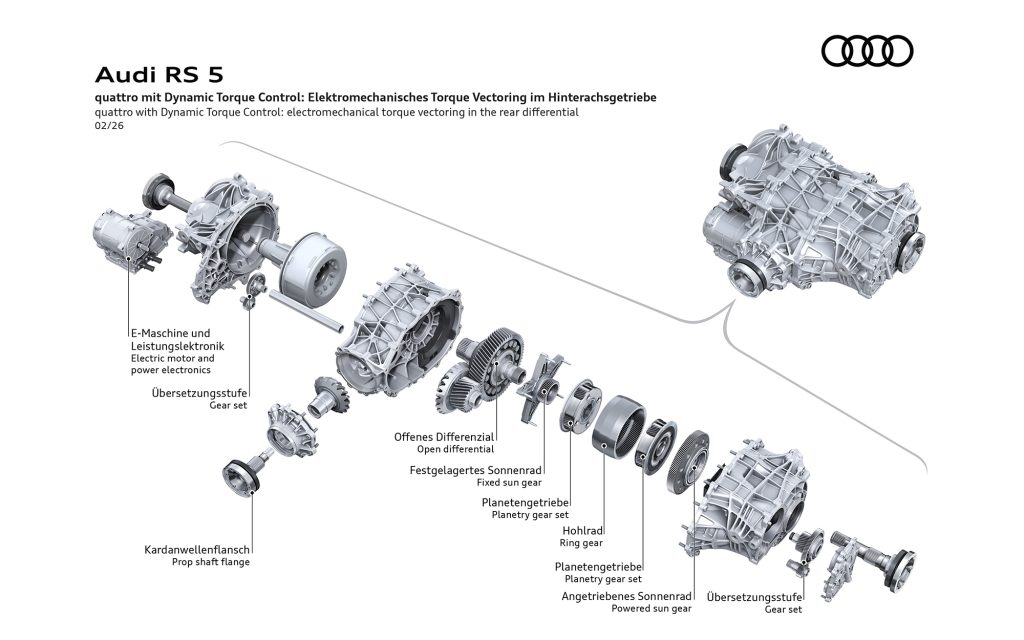
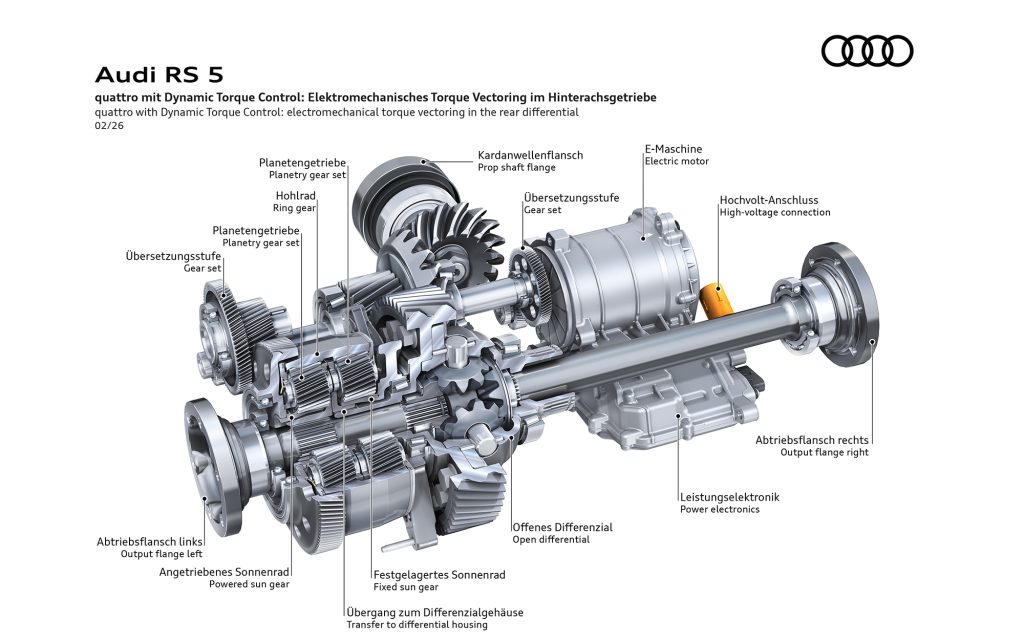
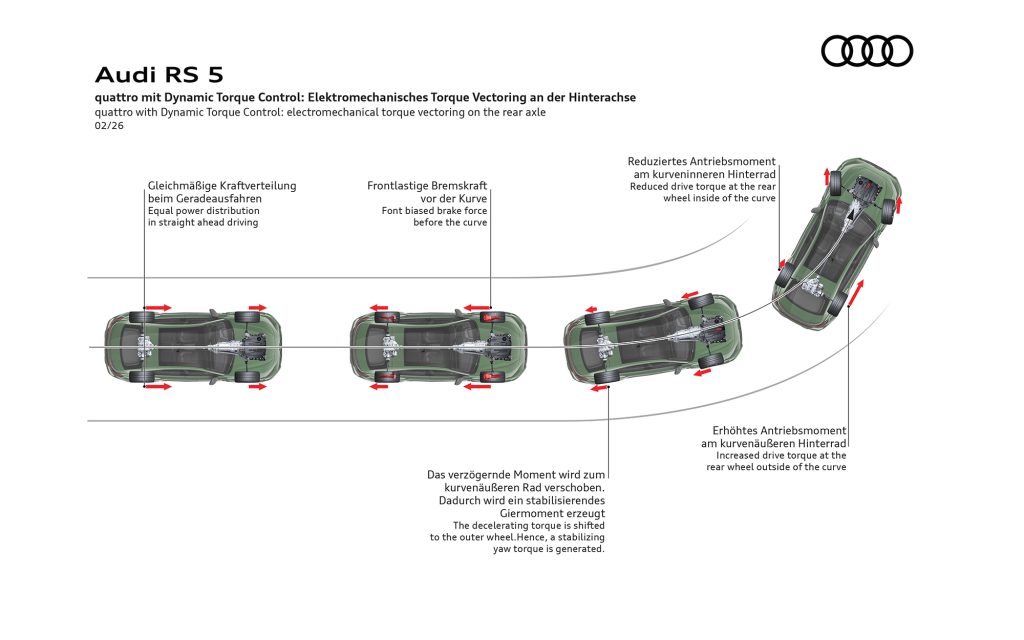
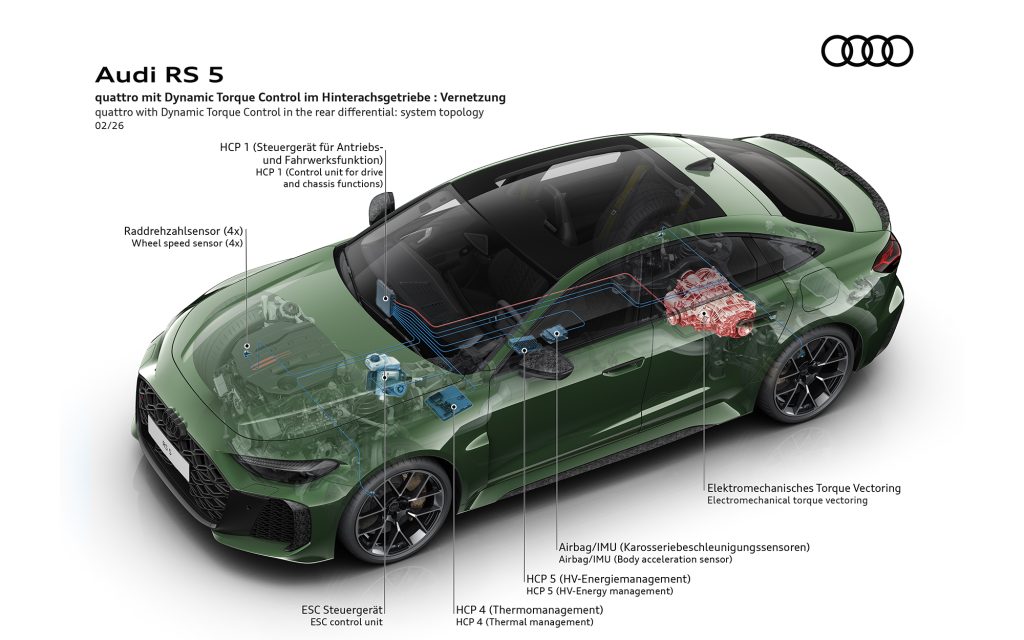
The headline innovation is quattro with Dynamic Torque Control, featuring electro-mechanical torque vectoring in the rear transaxle. A dedicated 8 kW actuator motor enables torque differences of up to 2,000 Nm (1,475 lb-ft) between the rear wheels in as little as 15 milliseconds. A central driving dynamics controller recalculates optimal torque distribution every 5 milliseconds (200 Hz).
The result is adjustable behavior from neutral balance to deliberate rear-biased rotation, including a new RS torque rear mode designed for controlled oversteer on closed courses.
SUSPENSION & CHASSIS
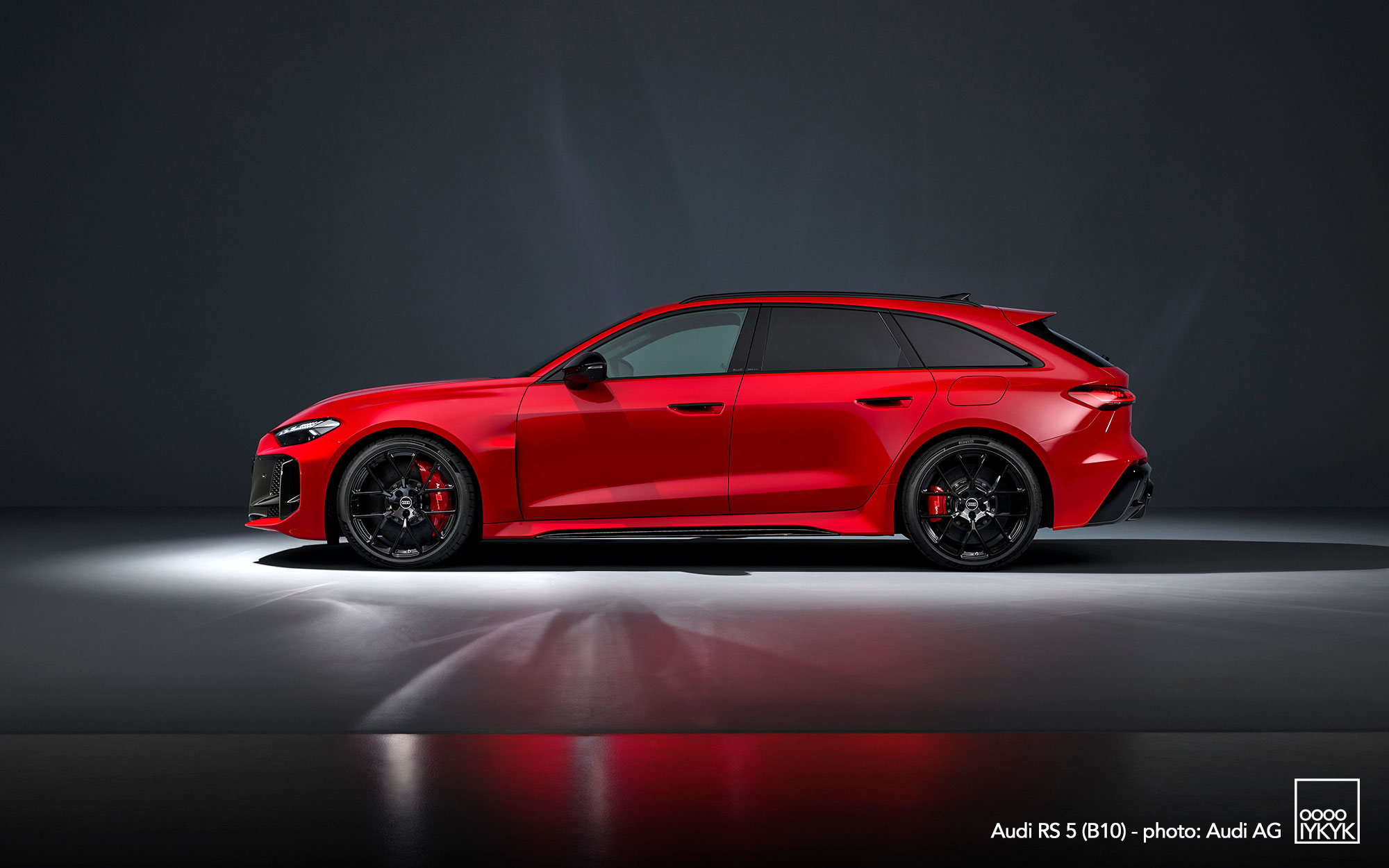
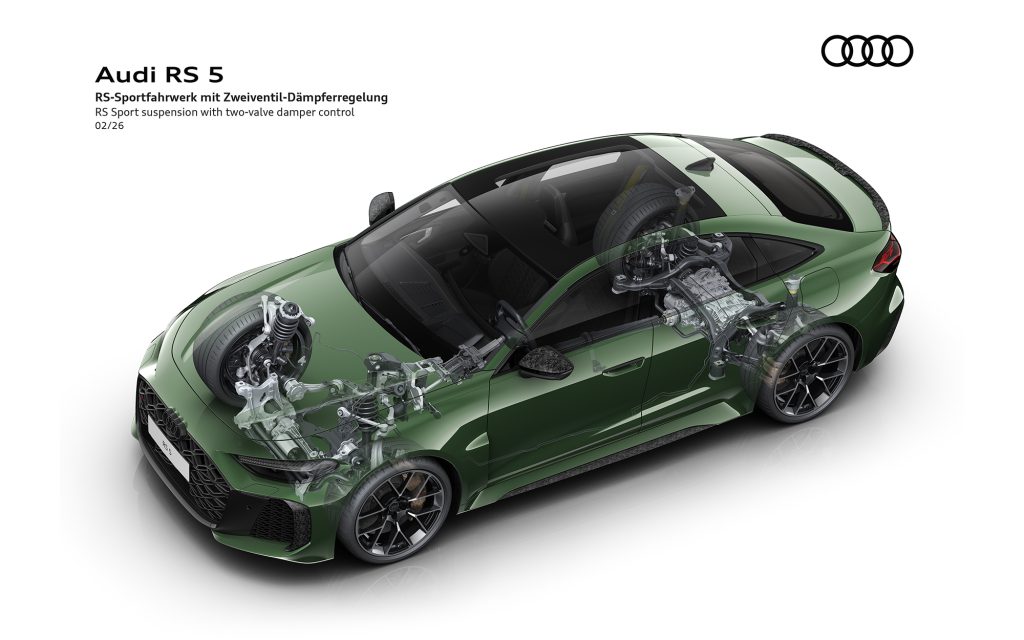
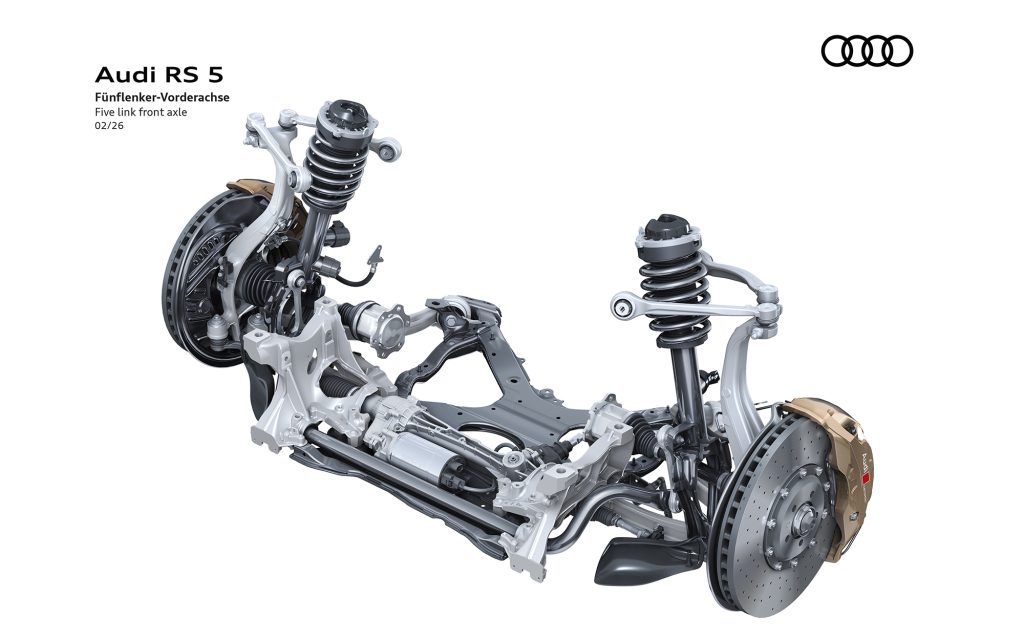
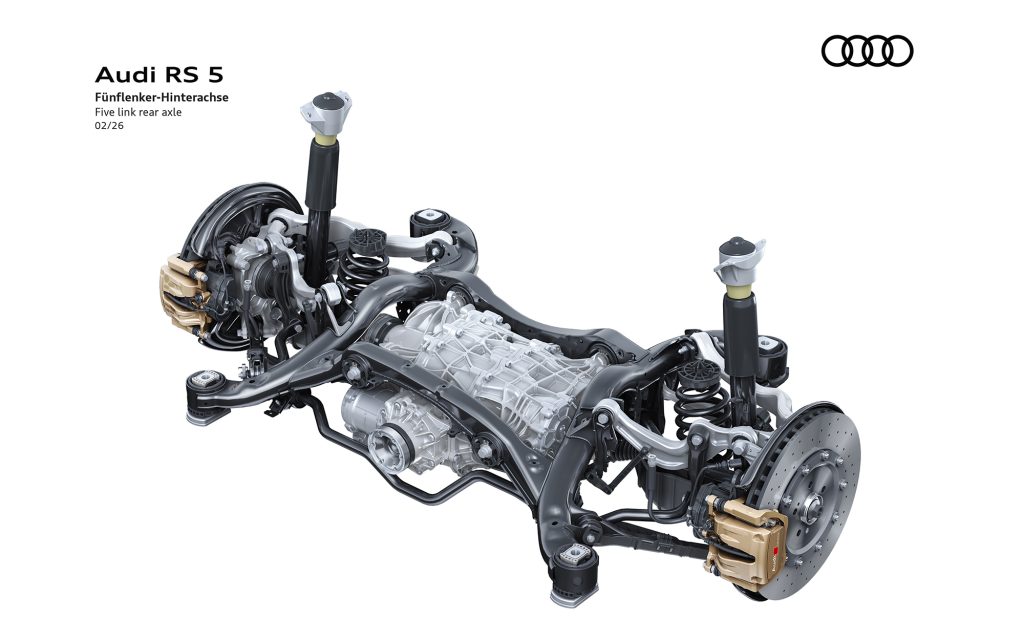
The RS 5 uses five-link suspension front and rear, with a rear axle developed specifically to accommodate the new torque-vectoring hardware. The unibody is 10 percent stiffer than the base A5.
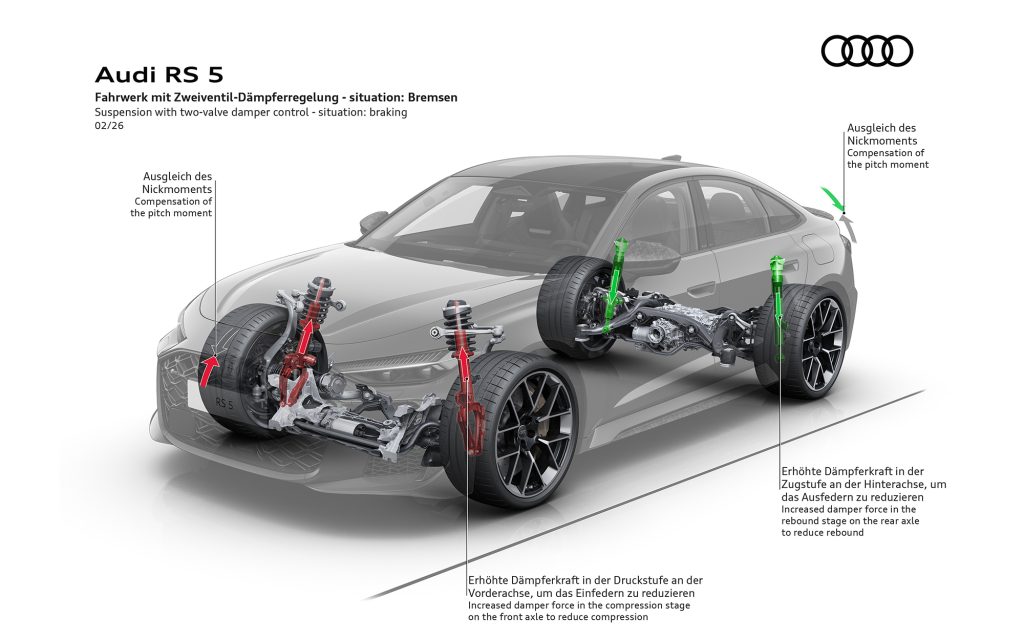
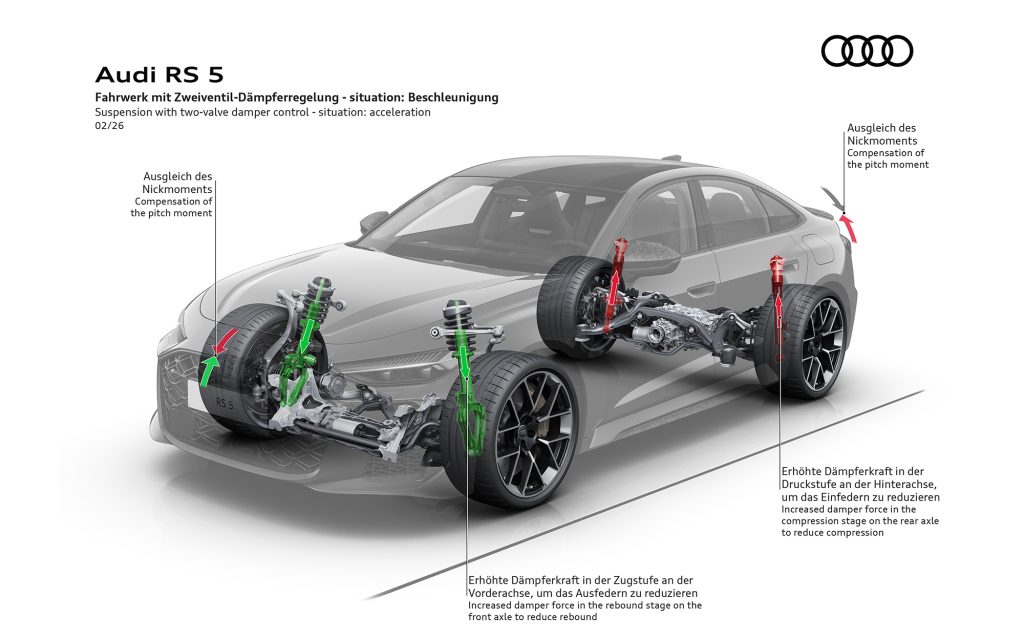
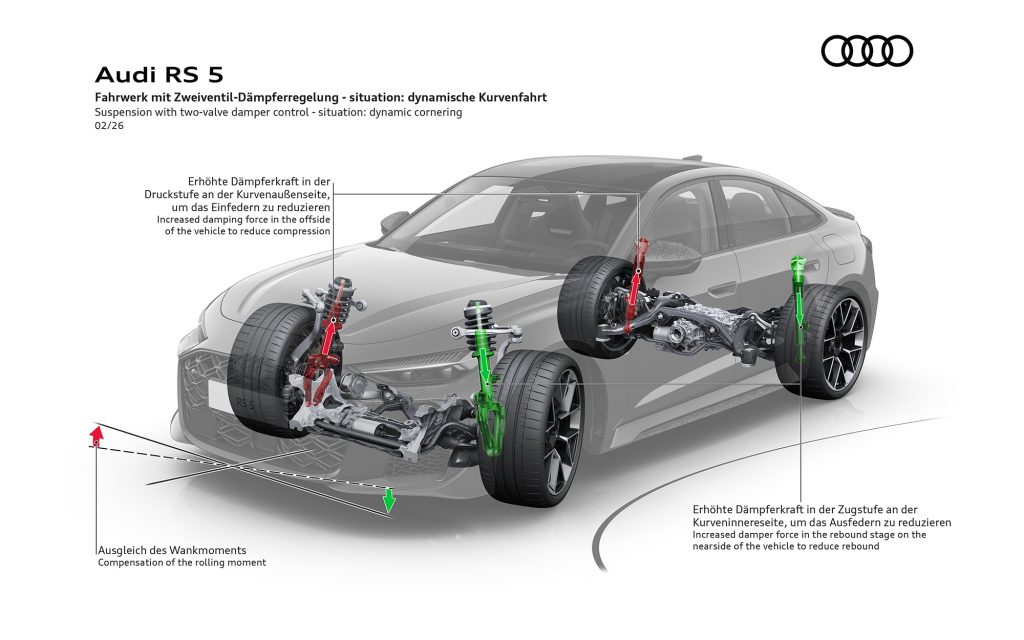
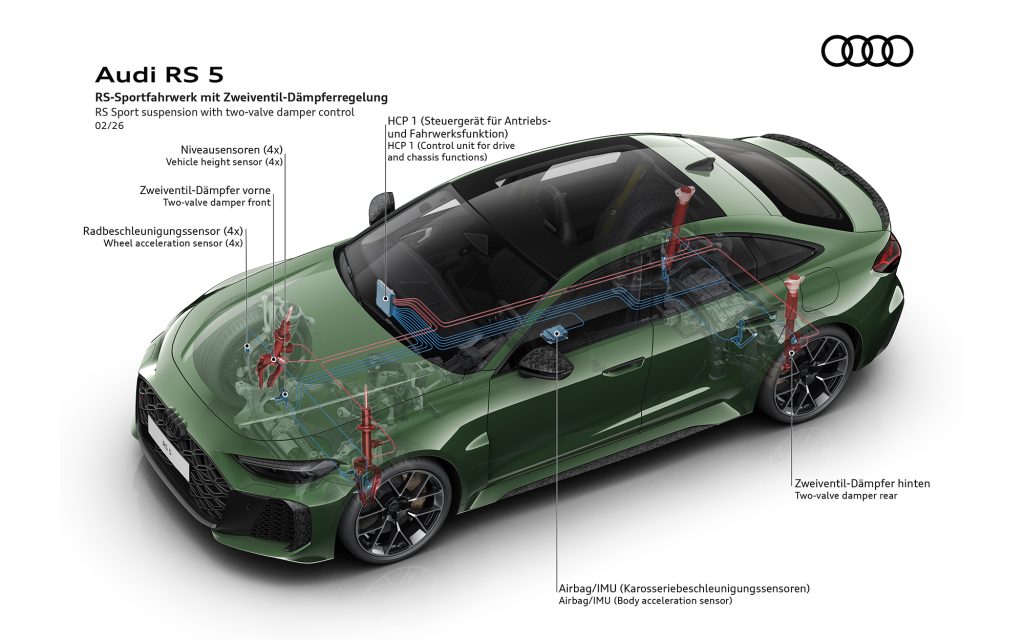
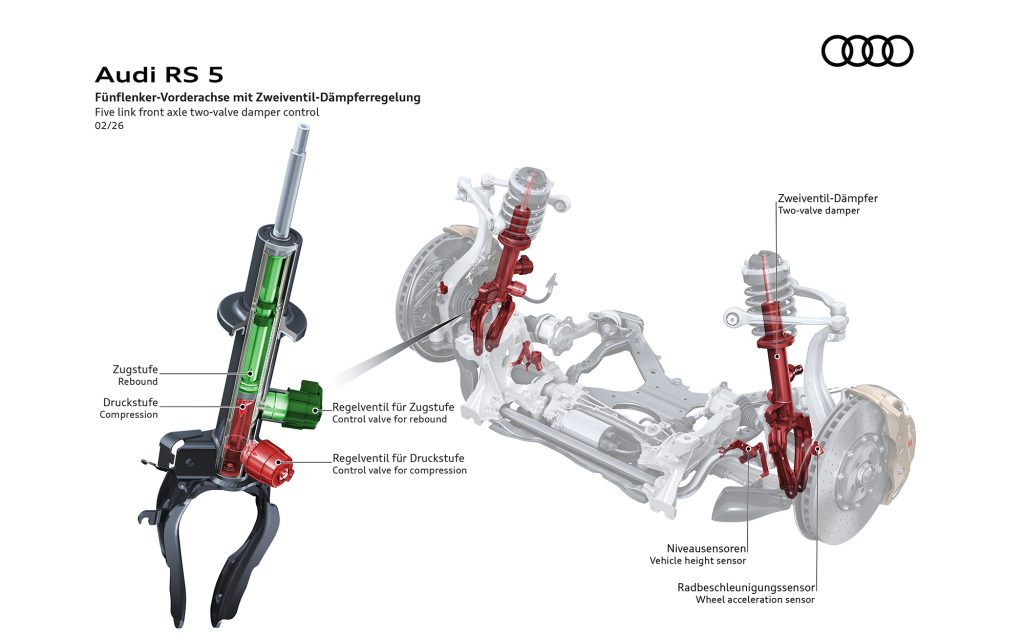
A new RS sport suspension with twin-valve dampers independently controls compression and rebound, reducing pitch and roll while maintaining everyday comfort. Audi tested the system on a hydro-pulse rig to simulate extreme load scenarios.
Curb weight is listed at 2,355 kg (5,193 lb) for the Sedan and 2,370 kg (5,225 lb) for the Avant.
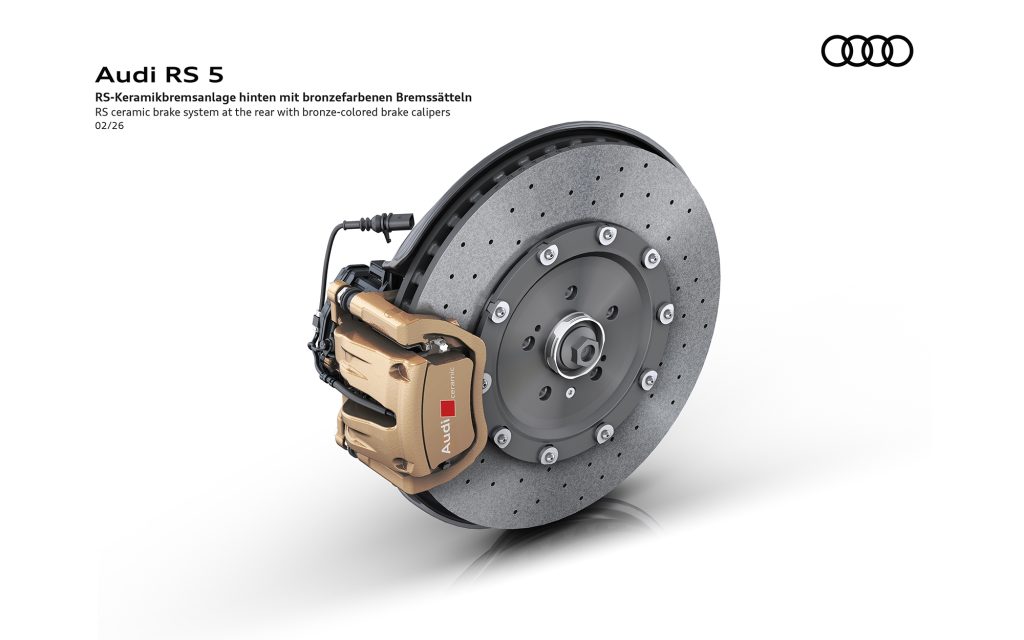
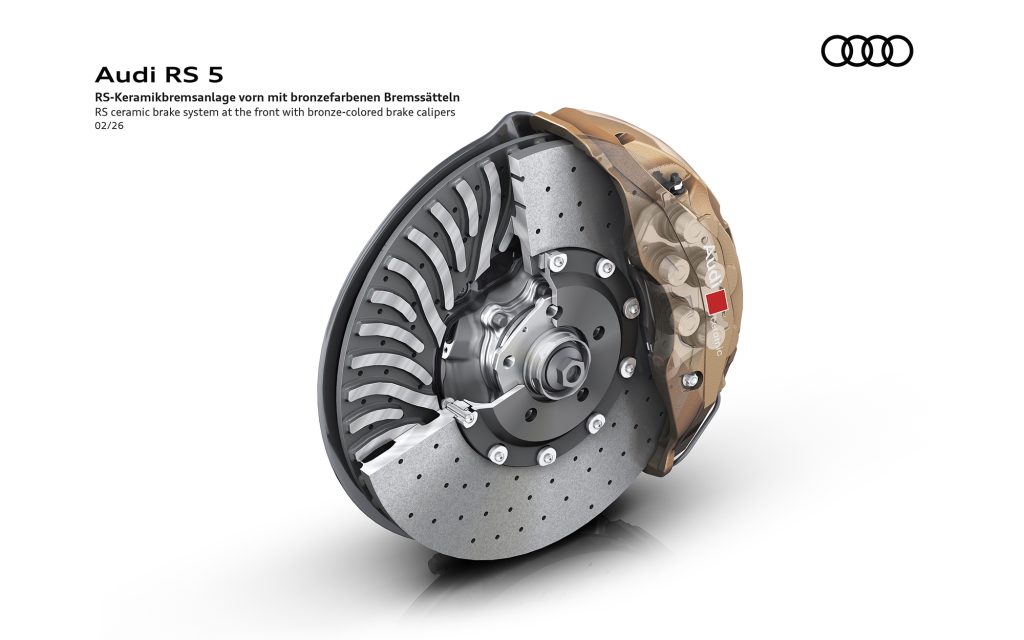
Standard braking consists of 20-inch RS steel brakes with 420 mm front and 400 mm rear discs. Optional 21-inch RS ceramic brakes measure 440 mm front and 410 mm rear, saving approximately 30 kg (66 lb). With ceramics, the RS 5 stops from 62 mph (100 km/h) in 30.6 meters (100.4 feet).
THE RS SPORT PACKAGE
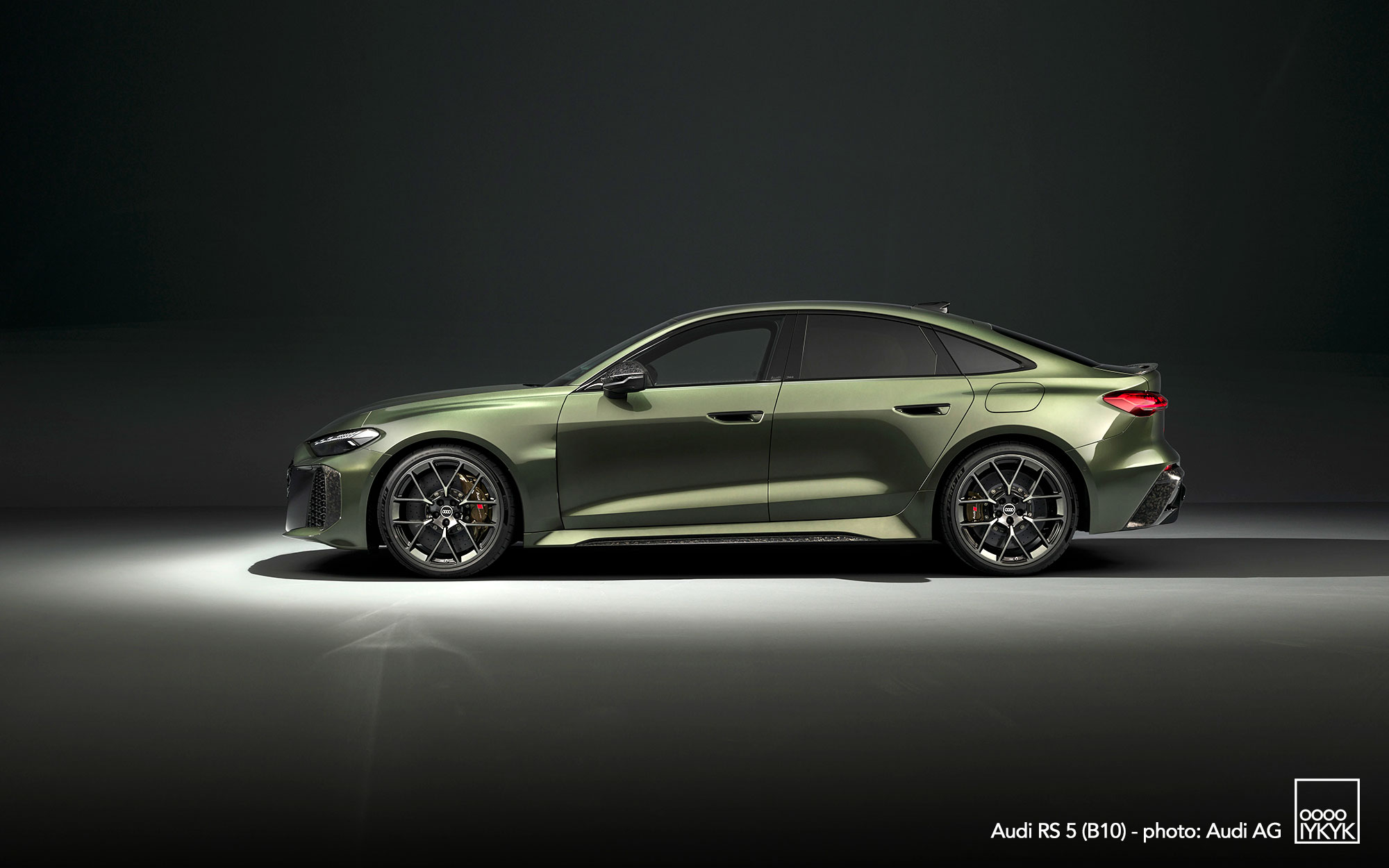
The optional Audi Sport package adds performance and visual differentiation. It includes larger front air intakes, a more aggressive rear diffuser, matte black exhaust tips, exclusive 21-inch bi-color wheels, and raises top speed to 177 mph (285 km/h).
Bedford green metallic is exclusive to this package. Bronze-finished ceramic brake calipers are available, along with brass interior accents and contrast stitching in Serpentine green. A Carbon Camouflage package can further extend forged carbon elements inside and out.
CONTEXT F1 TIMING & THE V6 HYBRID ERA
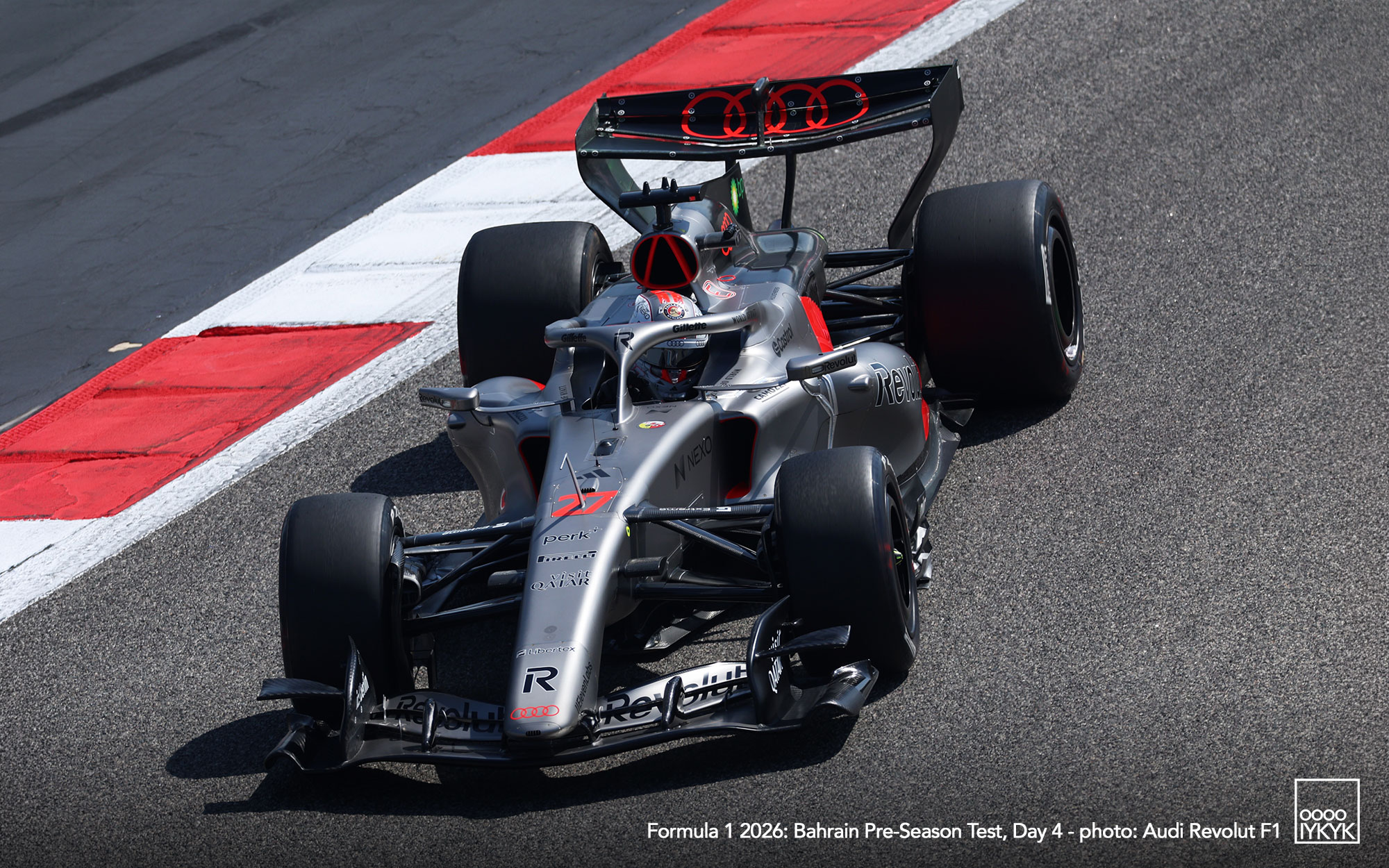
The timing of this launch is notable. Audi enters Formula 1 this season with the Audi Revolut F1 Team and its R26 challenger. The 2026 F1 technical regulations mandate a 1.6-liter turbocharged V6 hybrid power unit, combining internal combustion and advanced electric systems.
While the RS 5’s 2.9-liter twin-turbo V6 plug-in hybrid is architecturally different from the 1.6-liter F1 power unit, the philosophical alignment is clear: V6 turbocharging, hybridization, energy recovery, and sophisticated electronic torque management.
Audi Sport’s first high-performance plug-in hybrid road car arrives as Audi prepares to compete at the top tier of motorsport with a V6 turbo hybrid of its own. The RS 5 signals that electrification, for Audi, is not a retreat from performance but a recalibration of how it is delivered.
And at 639 PS (approximately 631 SAE hp) with 608 lb-ft of torque and over 50 miles of electric range, that recalibration is substantial.
WHAT ABOUT NORTH AMERICA?
Of course the question on everyone’s mind… at least everyone in North America… is whether we’ll get the Avant. That’s an important question and, even though we think it’s just the sedan based on what we’ve heard, the answer wasn’t a direct one.
Audi of America’s official answer to that question for us was, “We’ll have more information closer to lunch but at present this is this the Global release. Car will come sometime next year. Model year is not defined yet.”
Beyond that, several sources we know say it was sedan, though admittedly a fellow enthusiast I know reached out to me to tell me that his a contact at the factory in Germany seems to think we’ll be getting both. One can hope.
ASSOCIATED VIDEO FOOTAGE
The Design of the Audi RS 5 (B10)
Audi RS 5 Sedan (B10) Trailer – Studio
Audi RS 5 Avant / Audi RS 5 Sedan (B10) Trailer Dynamic
Audi RS 5 Avant (B10) Footage – Studio
Audi RS 5 Sedan (B10) Footage – Studio
Audi RS 5 Avant (B10) Footage – Dynamic
Audi RS 5 (B10) Sedan Footage – Dynamic
Audi RS 5 (B10) Drive Concept Animation
Audi RS 5 (B10) Chassis Technology Animation
Audi RS 5 (B10) quattro with Dynamic Torque Control Animation
Audi RS 5 (B10) Integrated Brake Control System with ABS 2.0 Animation
Audi RS 5 (B10) Operating Strategy and Battery Management Animation
Audi RS 5 (B10) Electrified Powertrain with Electric Motor Animation
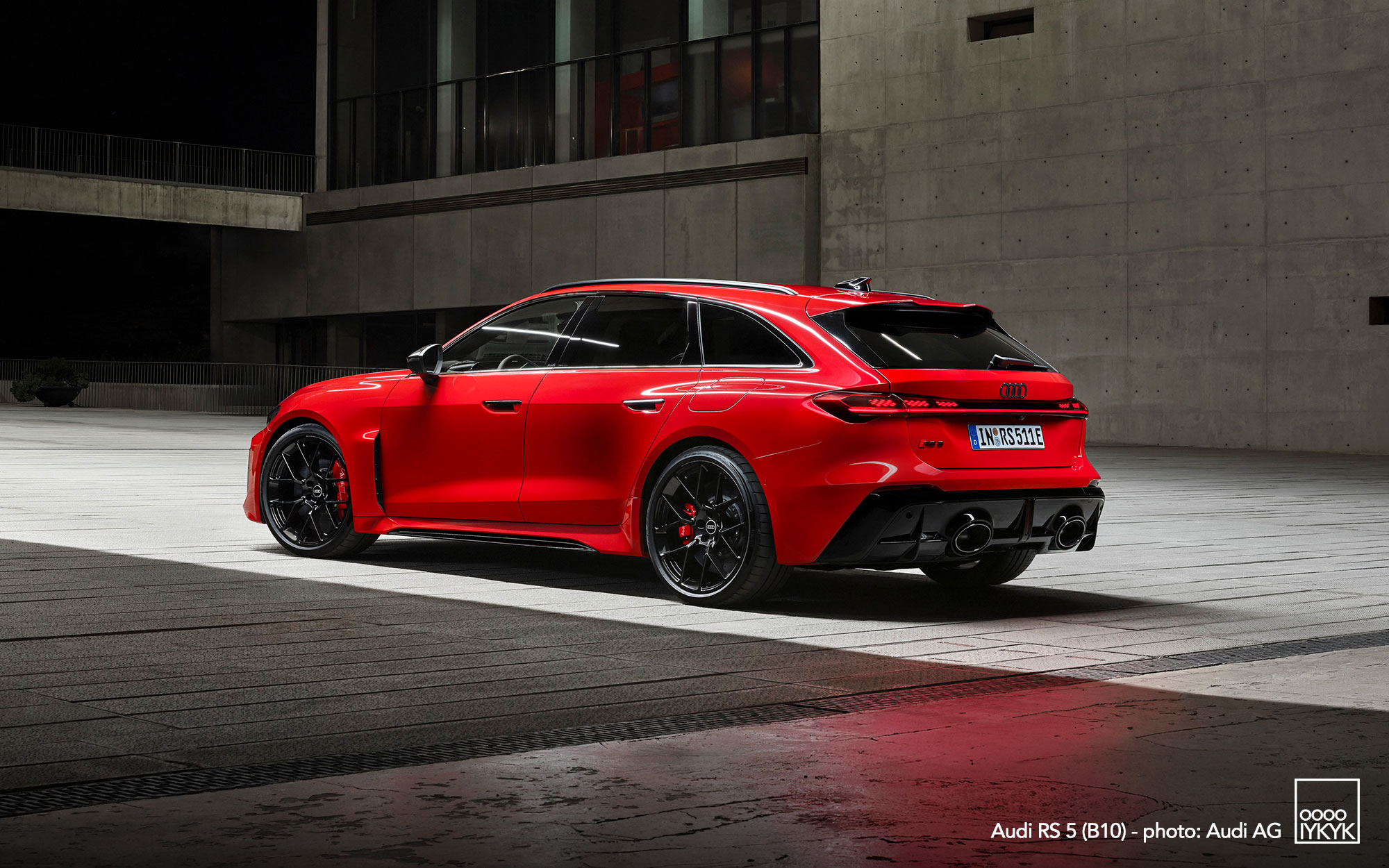
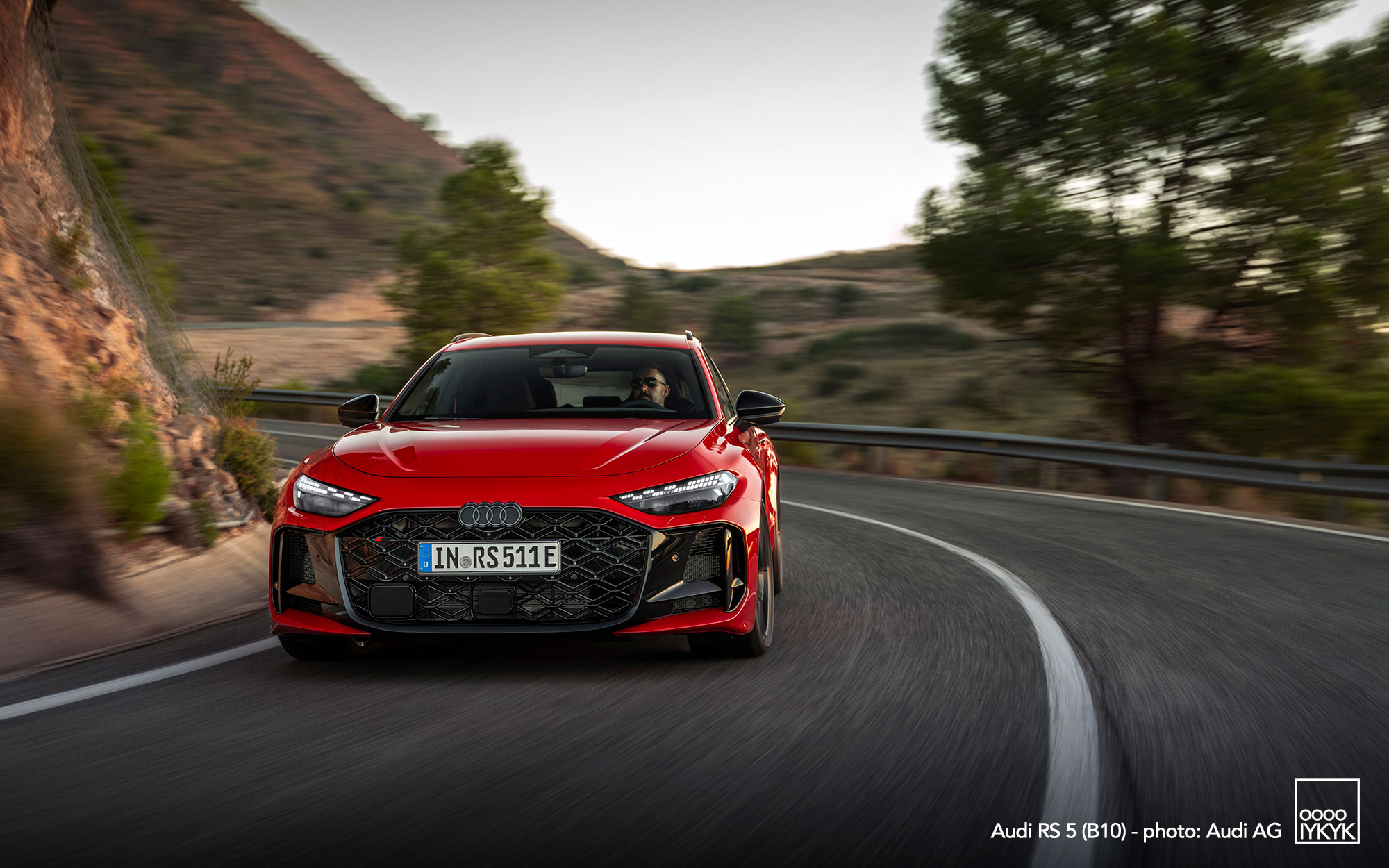
PHOTO GALLERY RS 5 AVANT
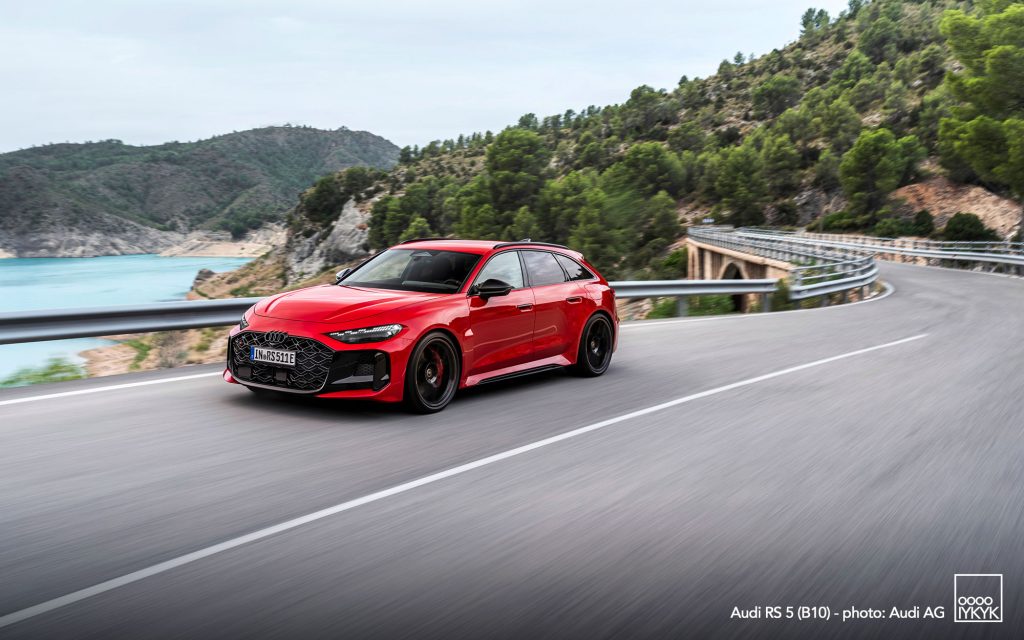
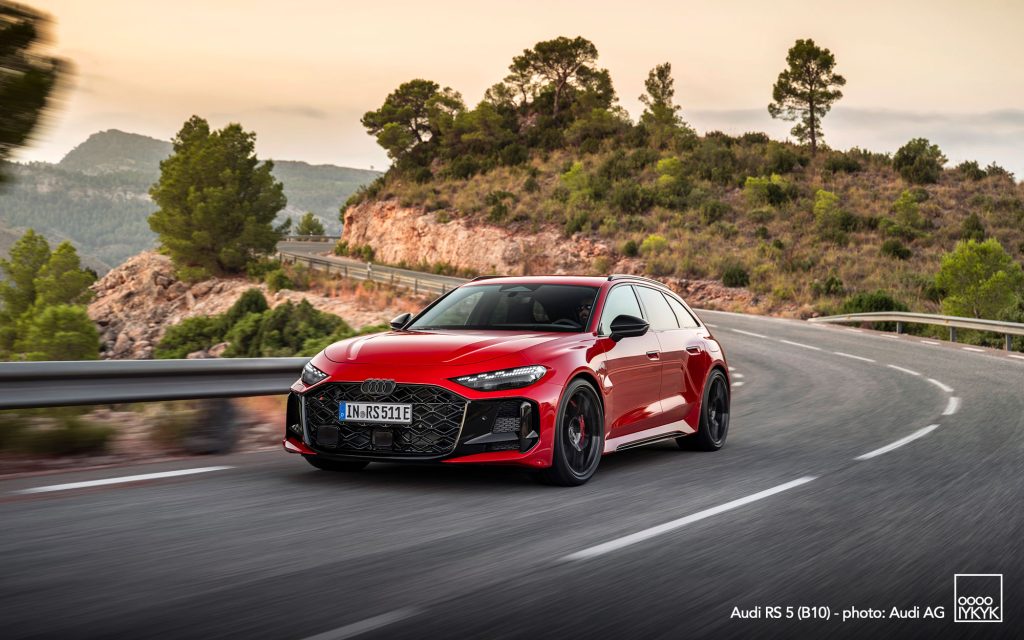
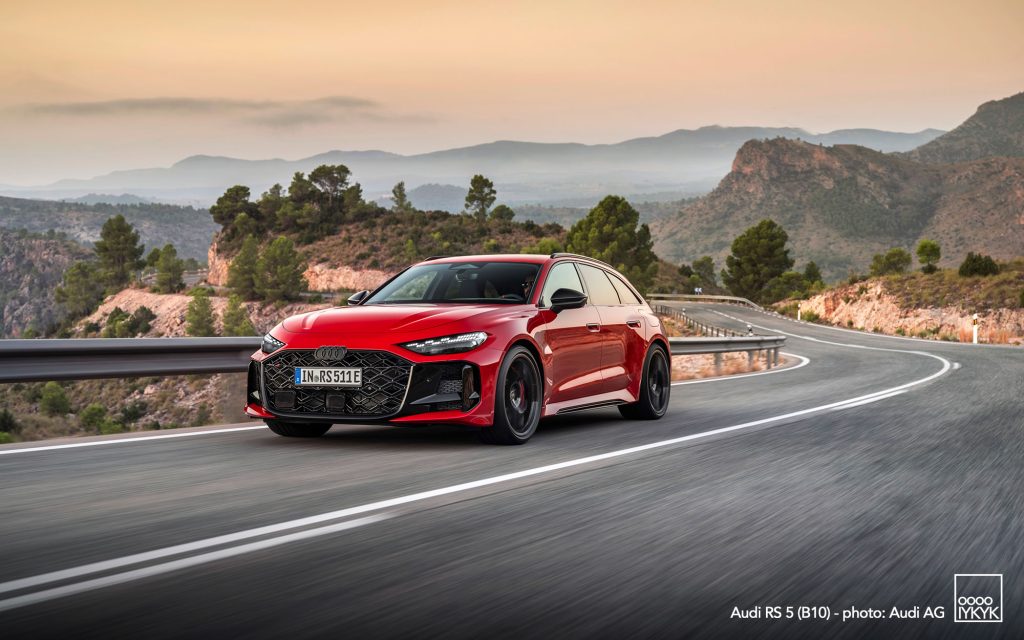
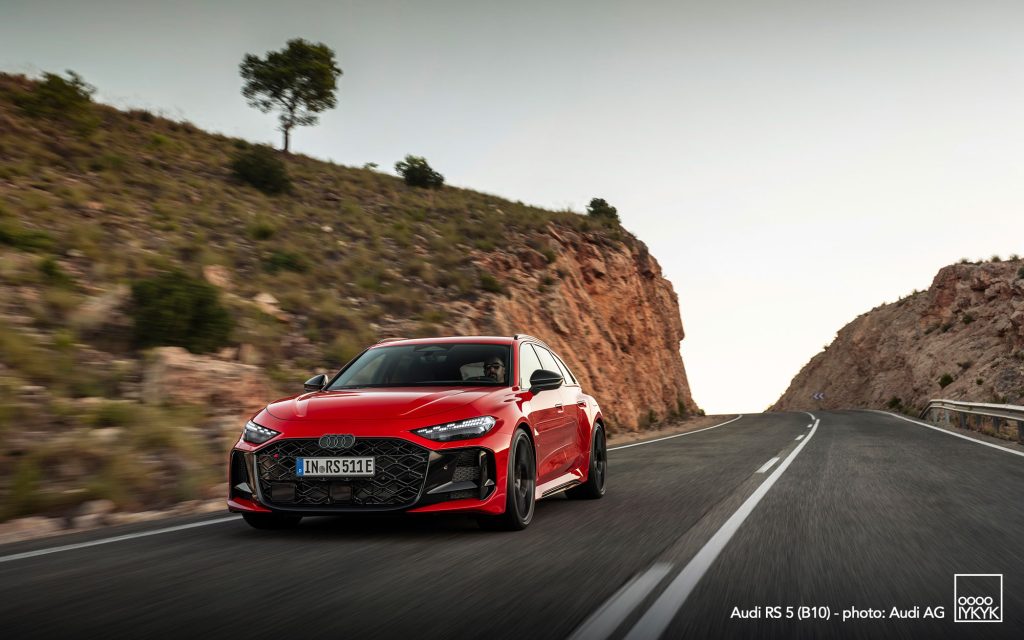
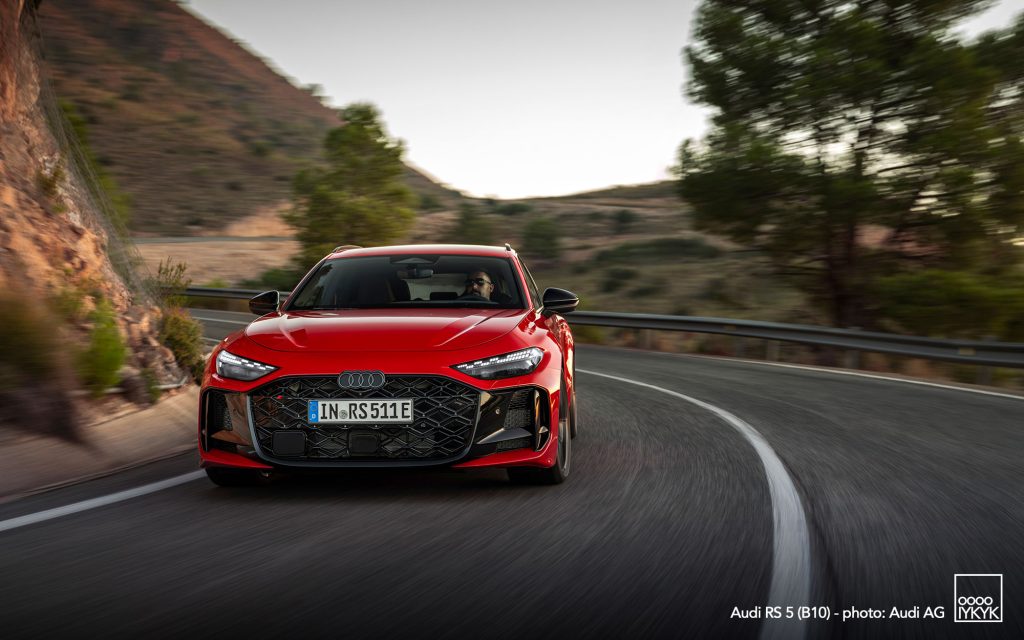
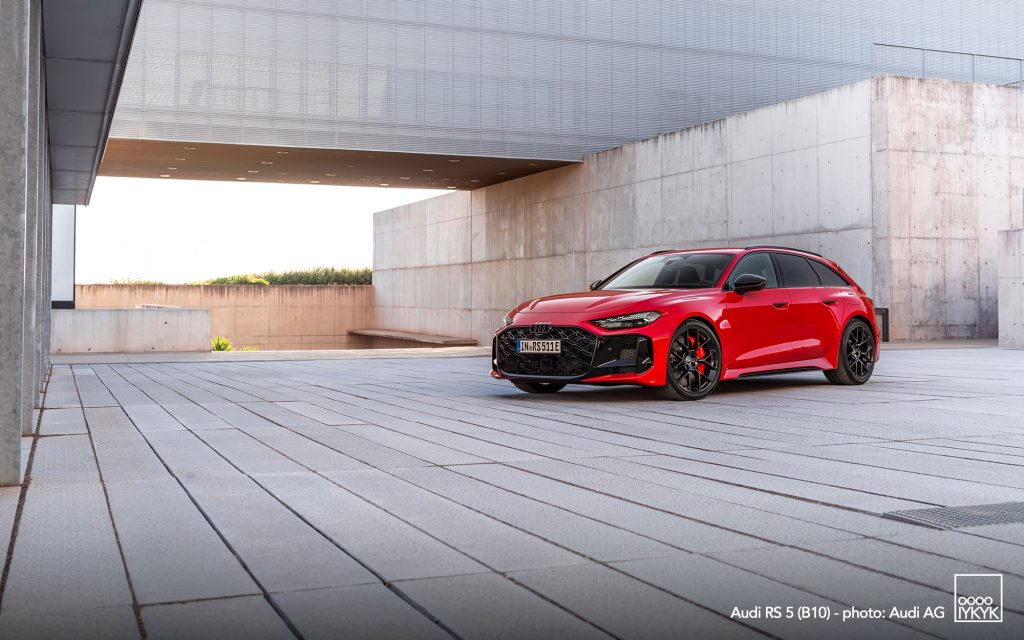
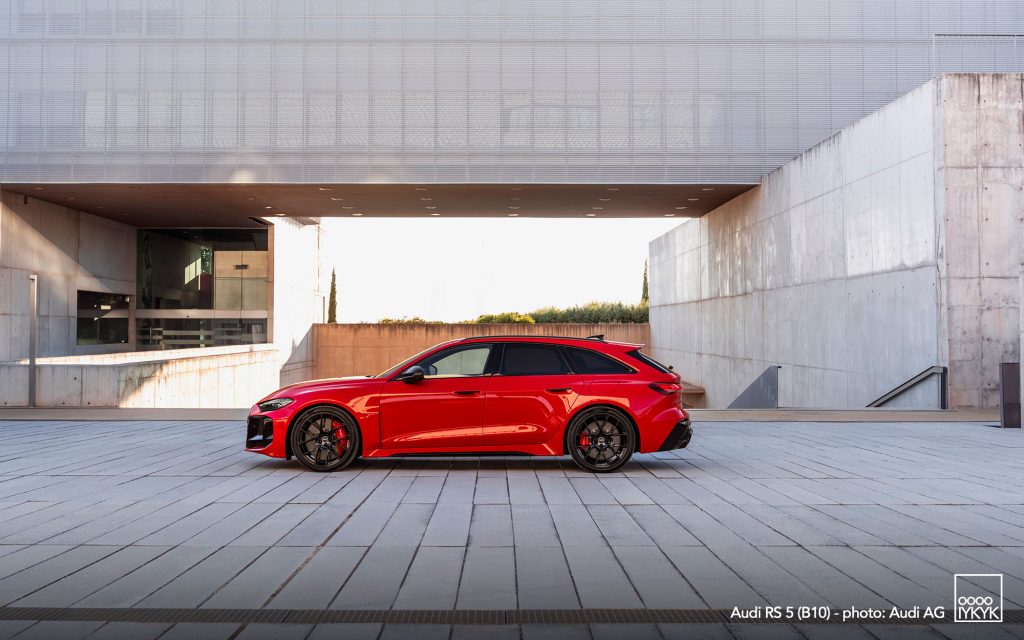
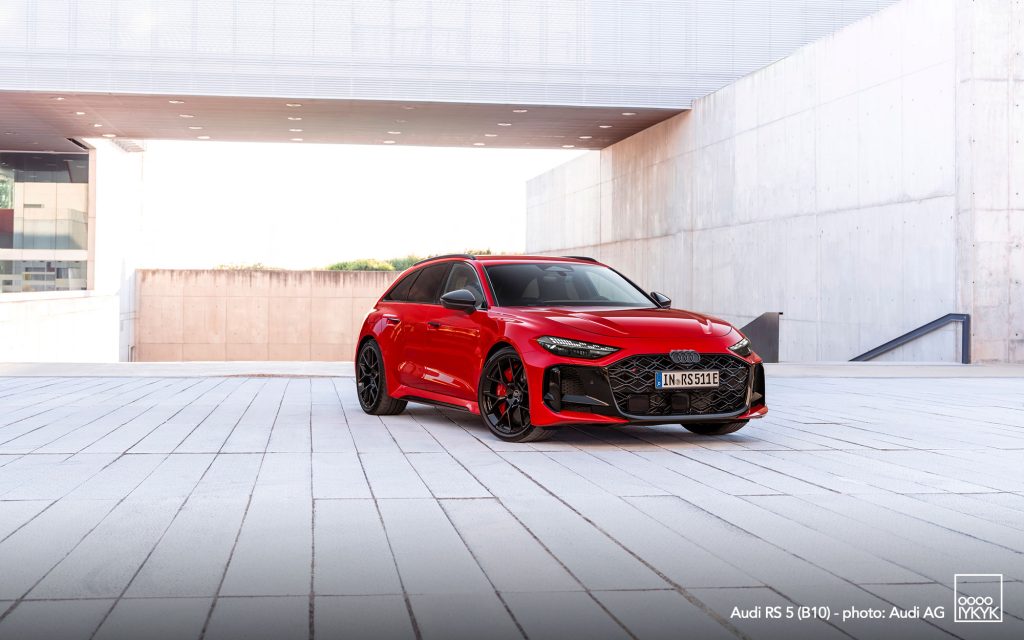
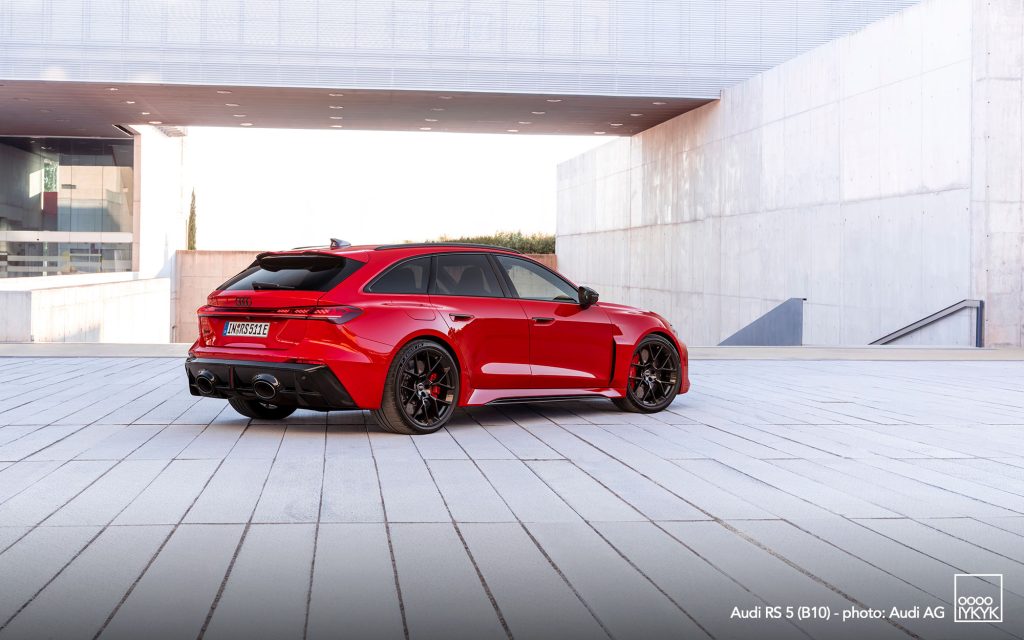
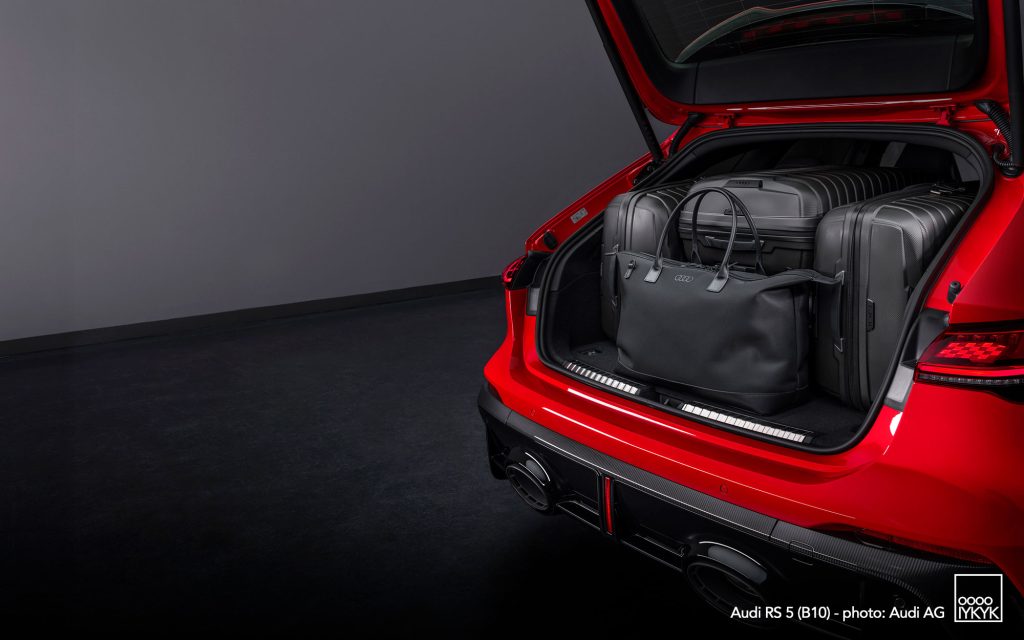
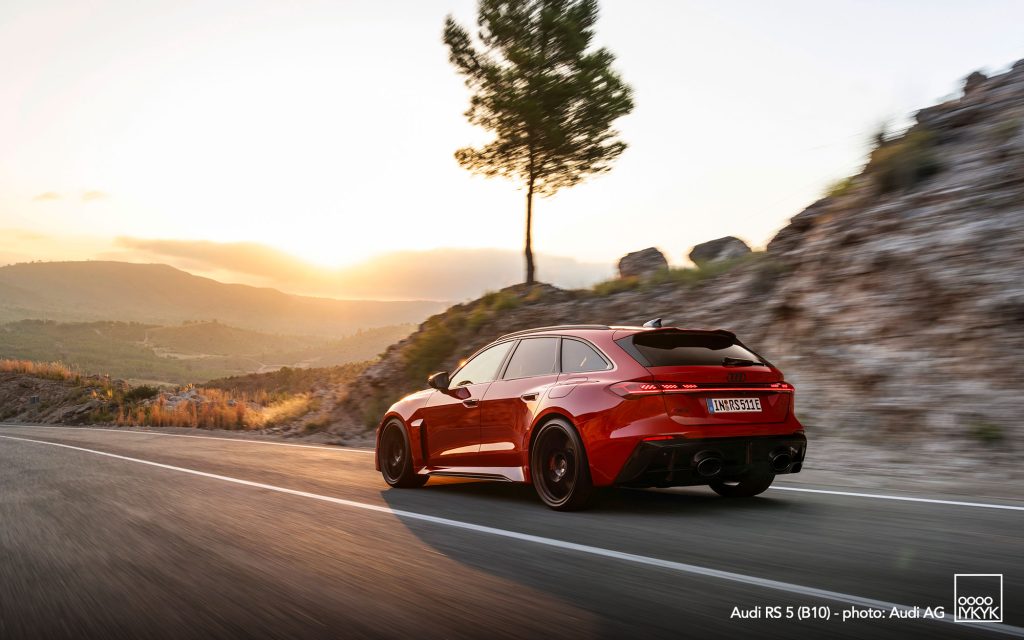
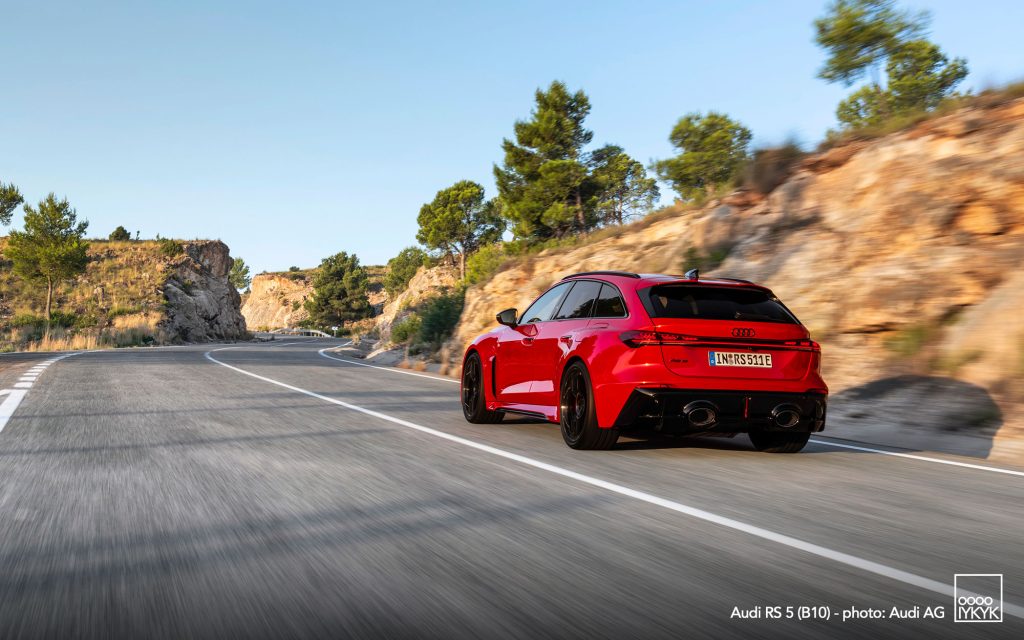
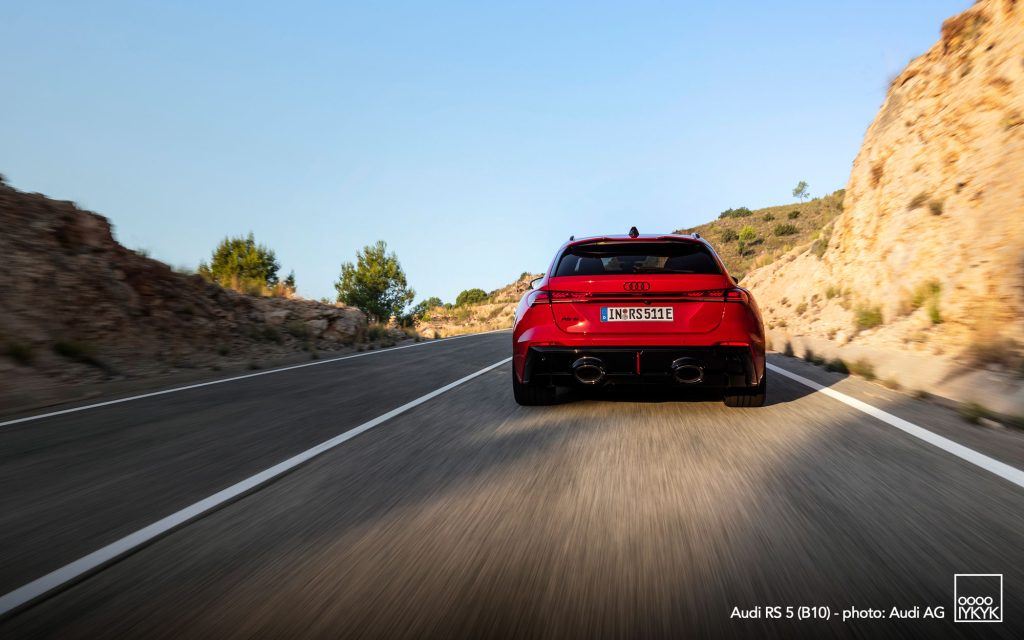
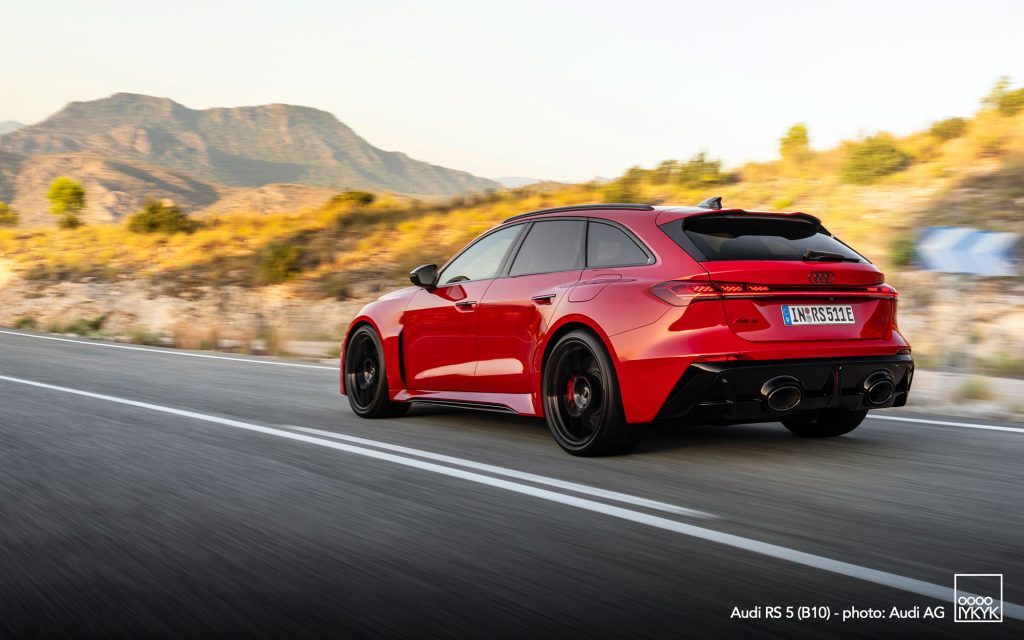
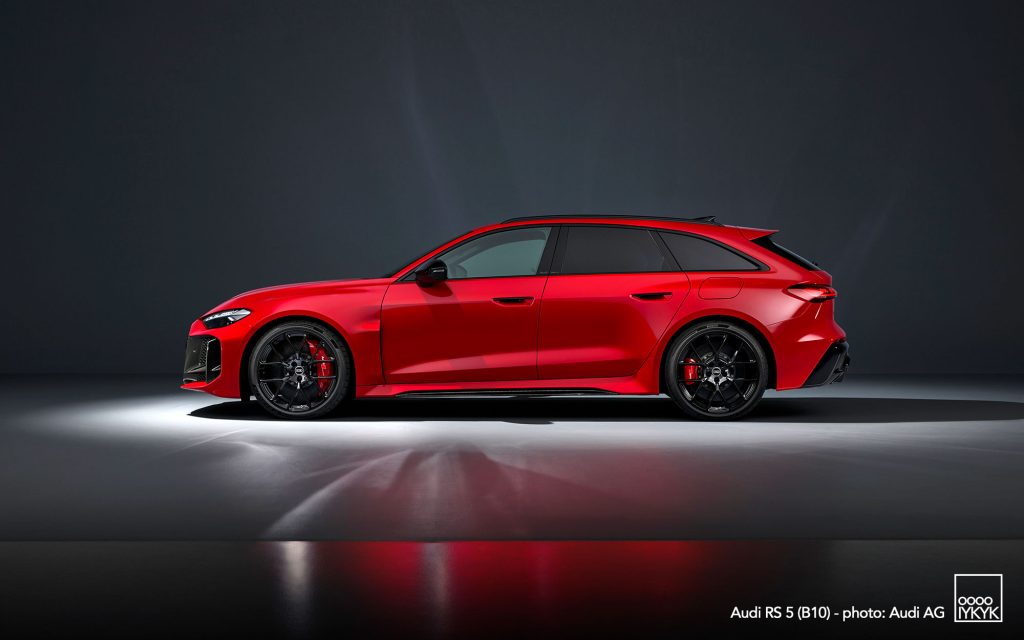
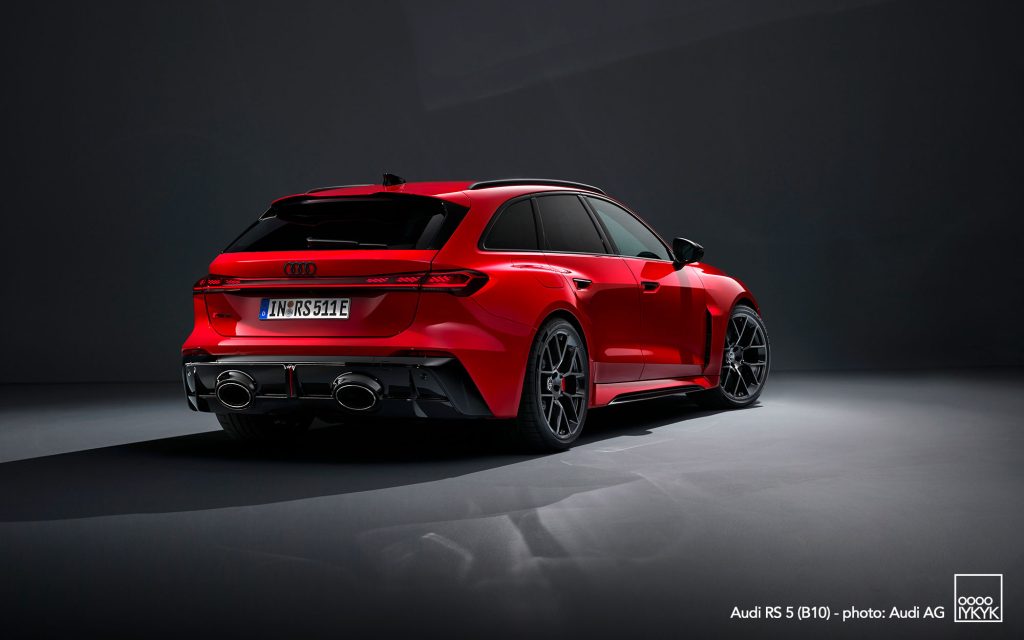
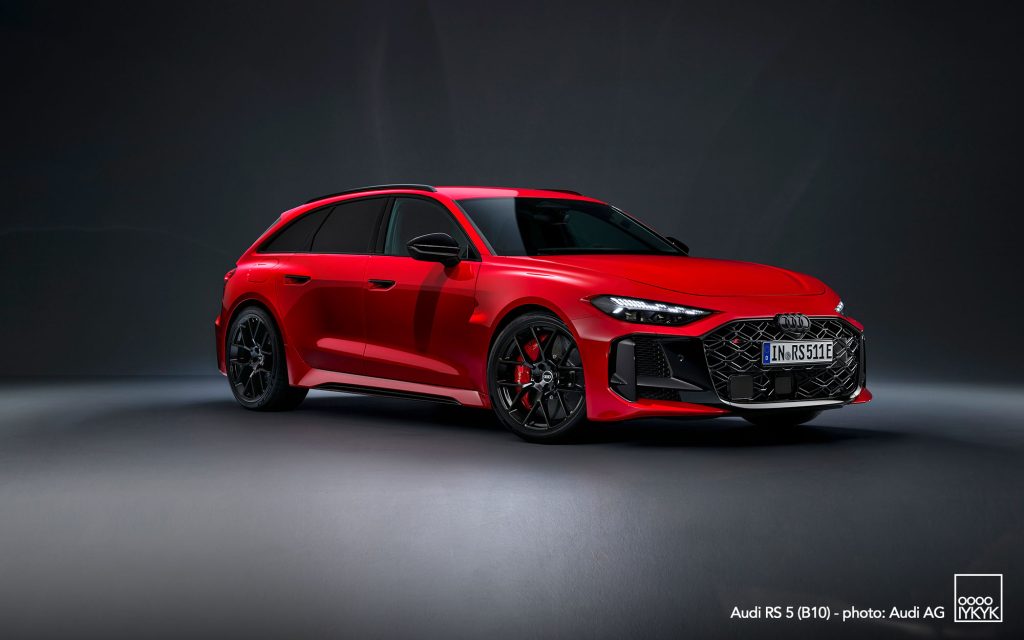
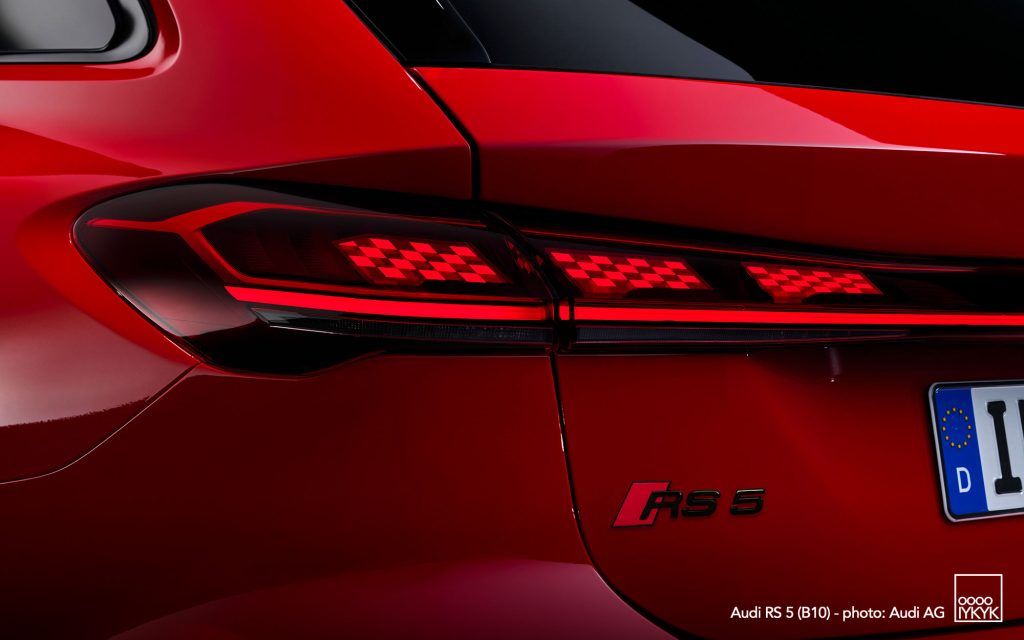
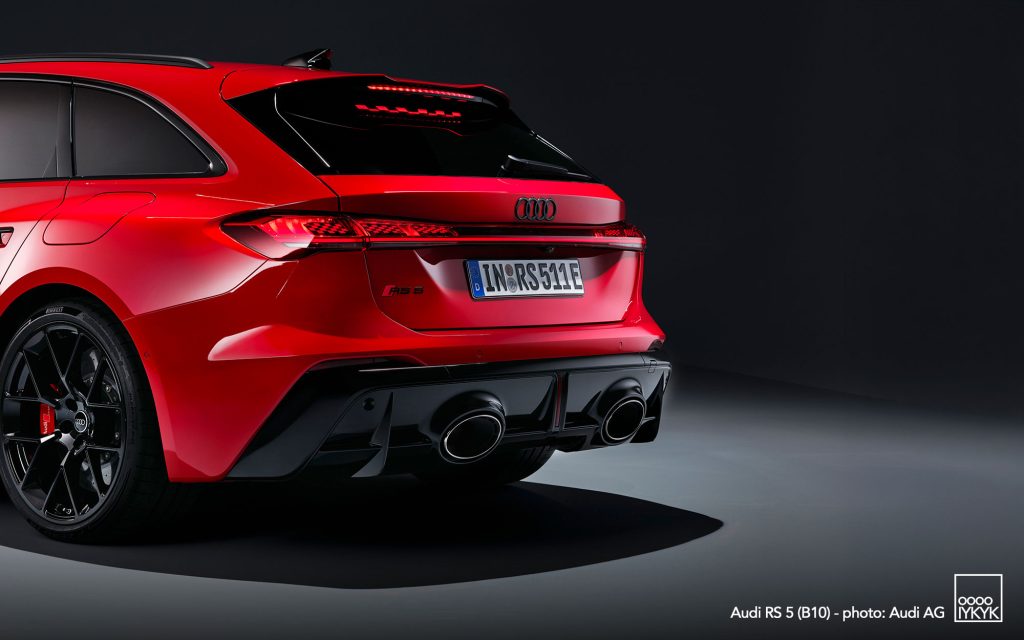
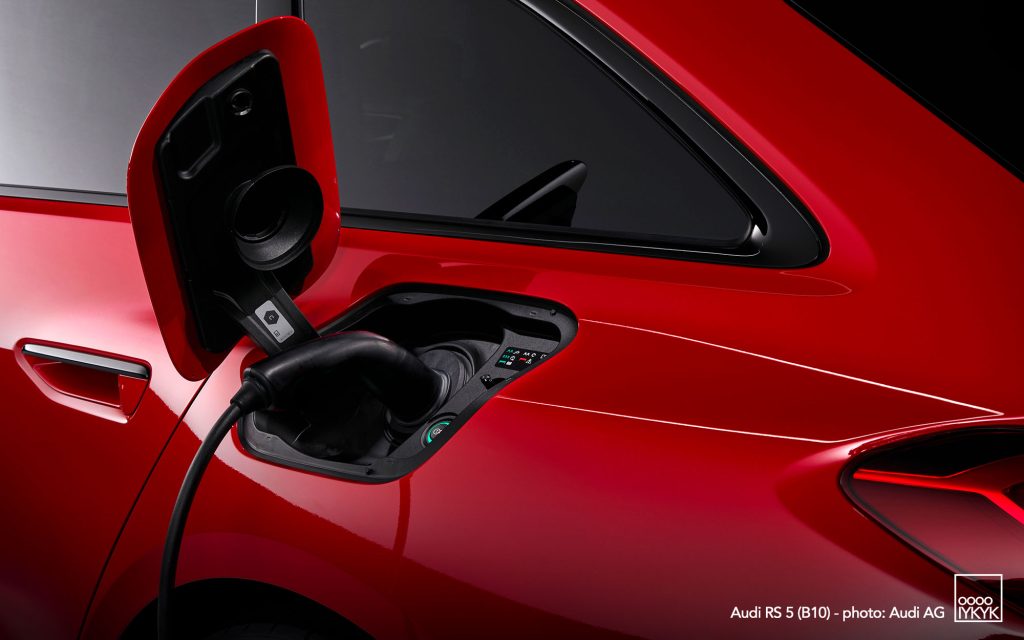
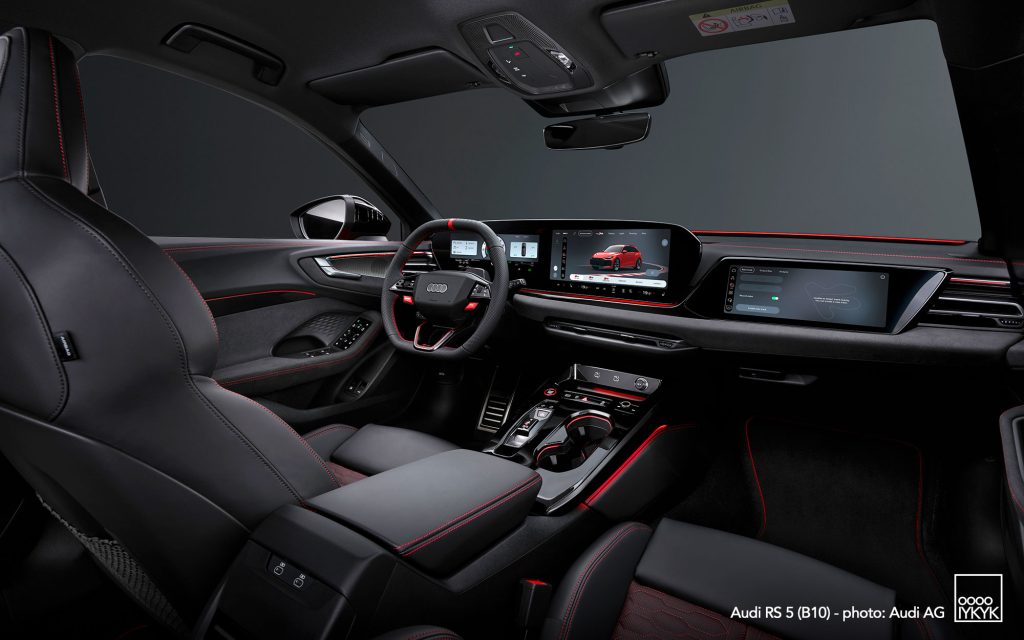
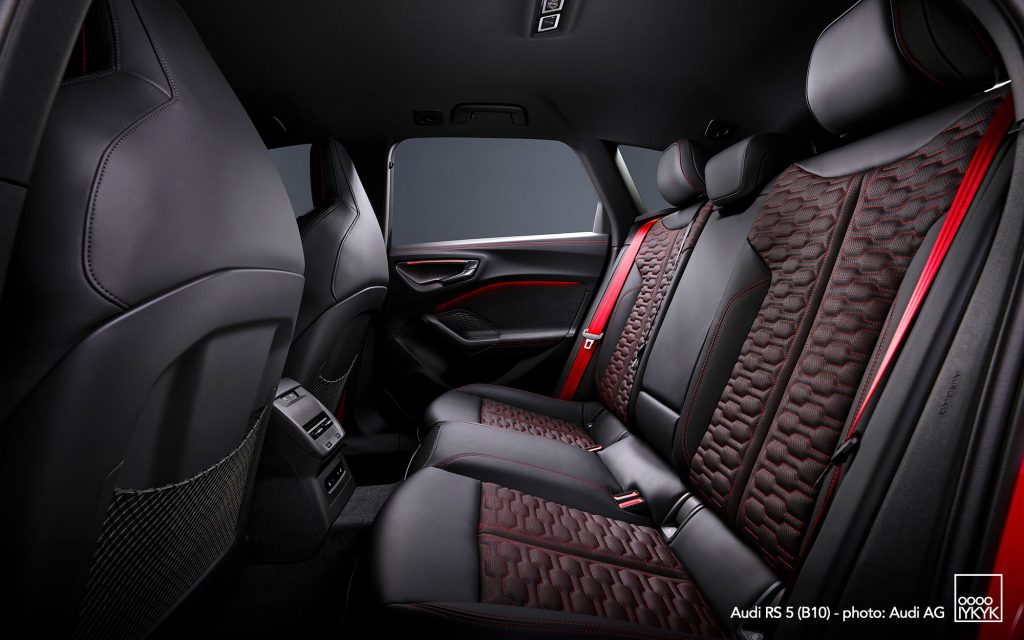
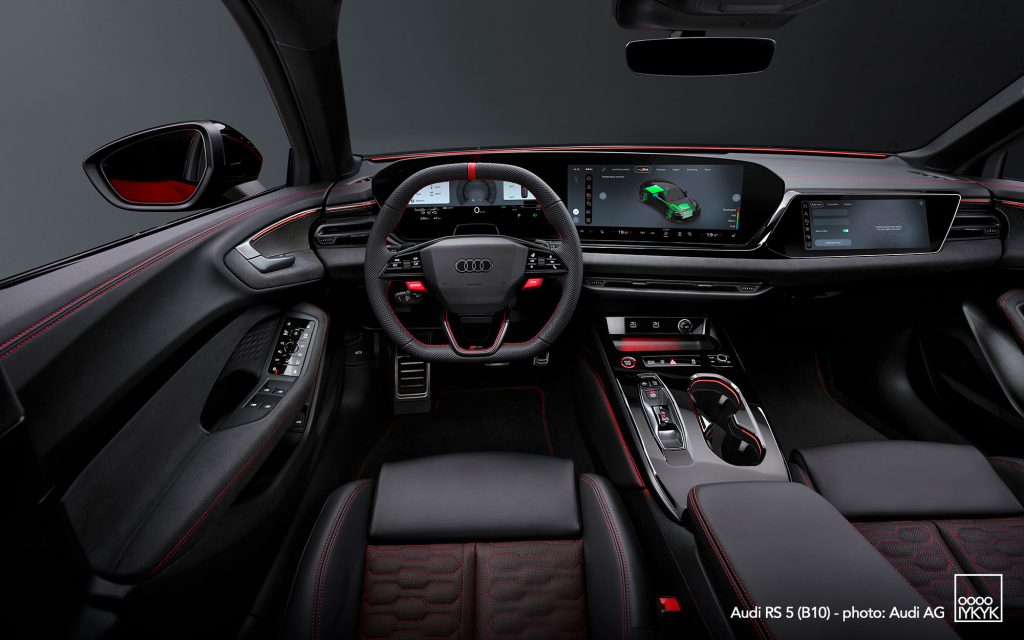
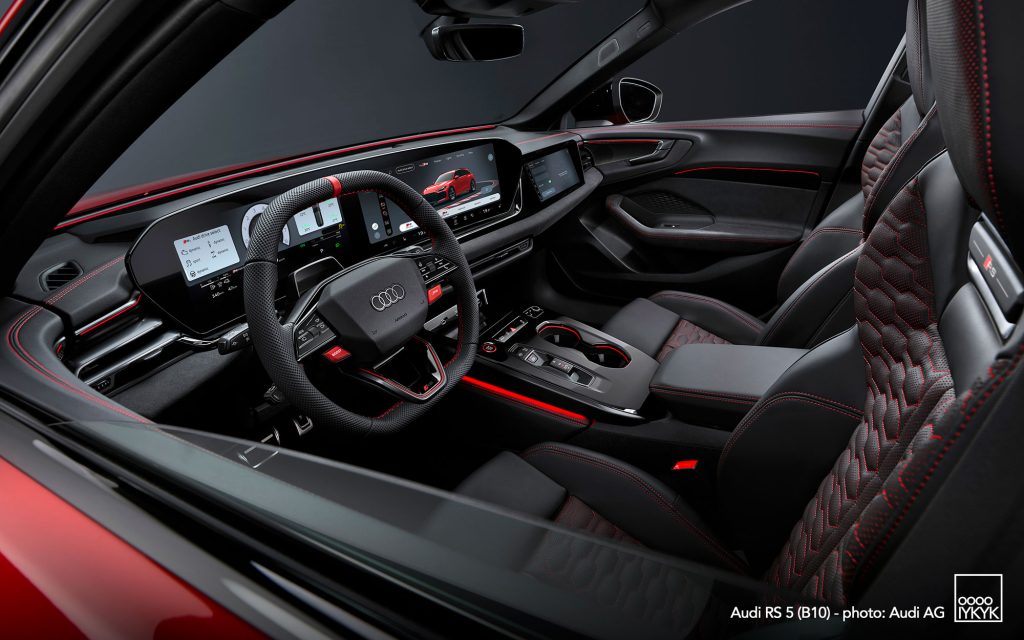
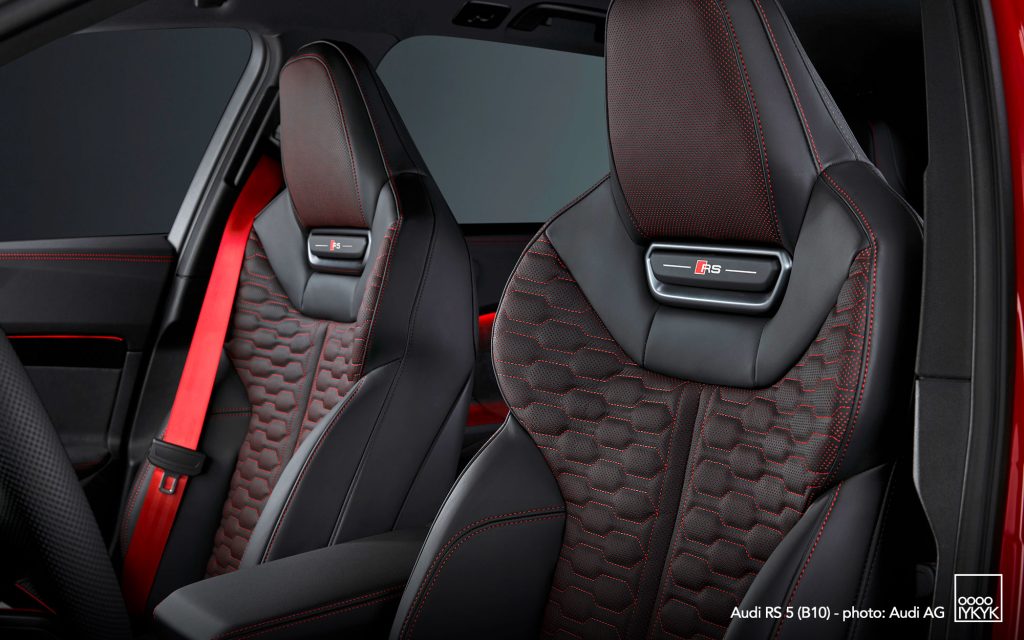
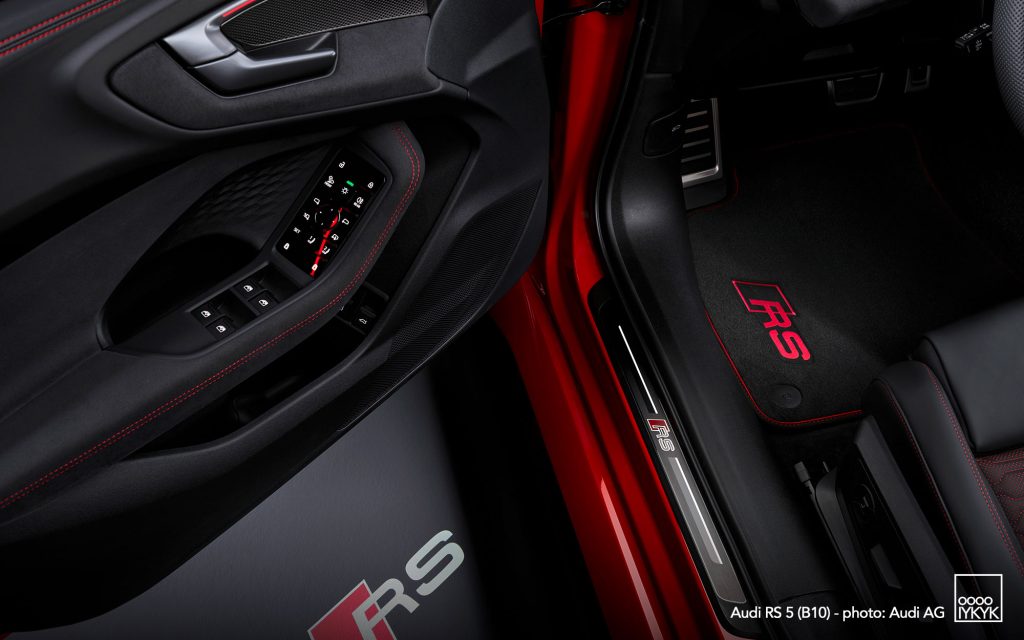
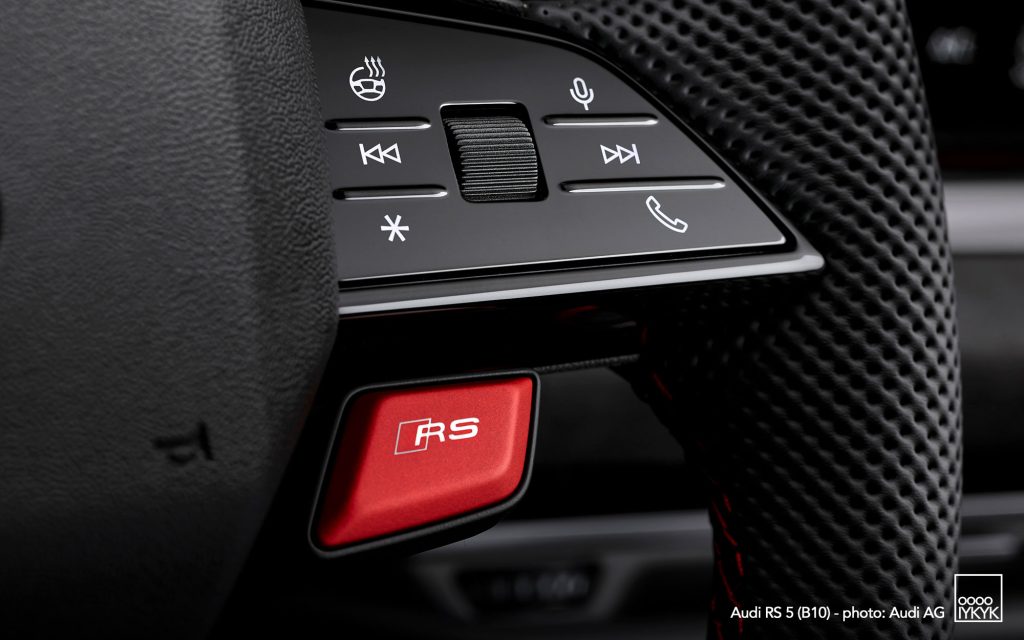
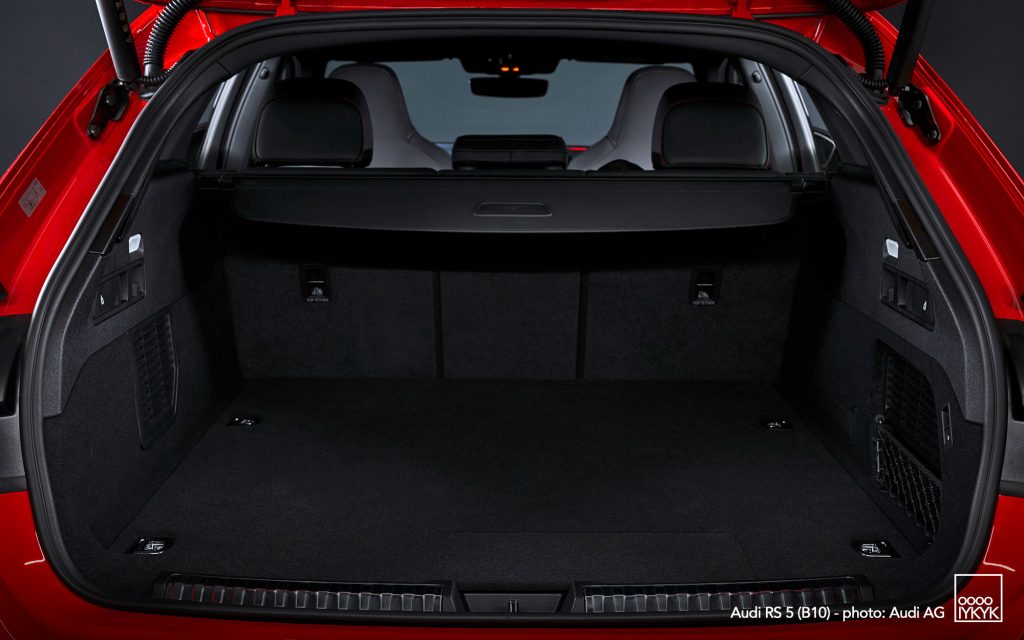
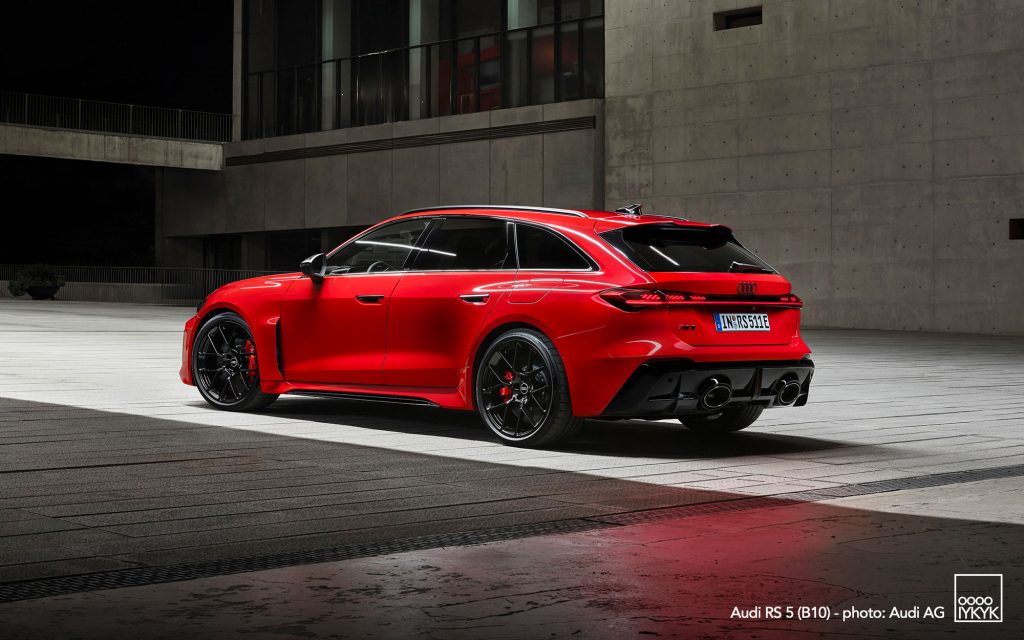
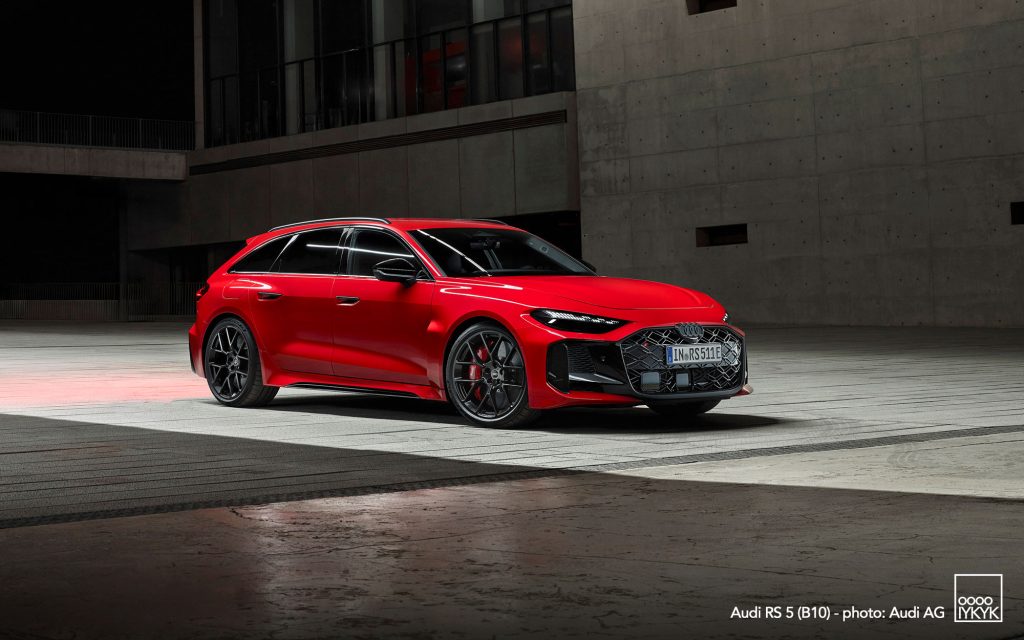
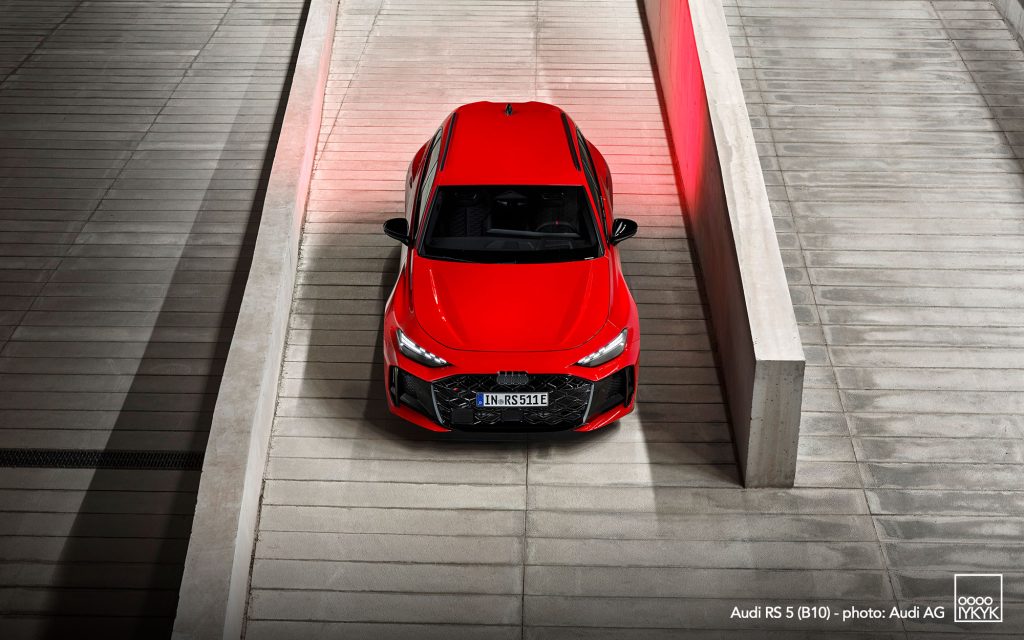
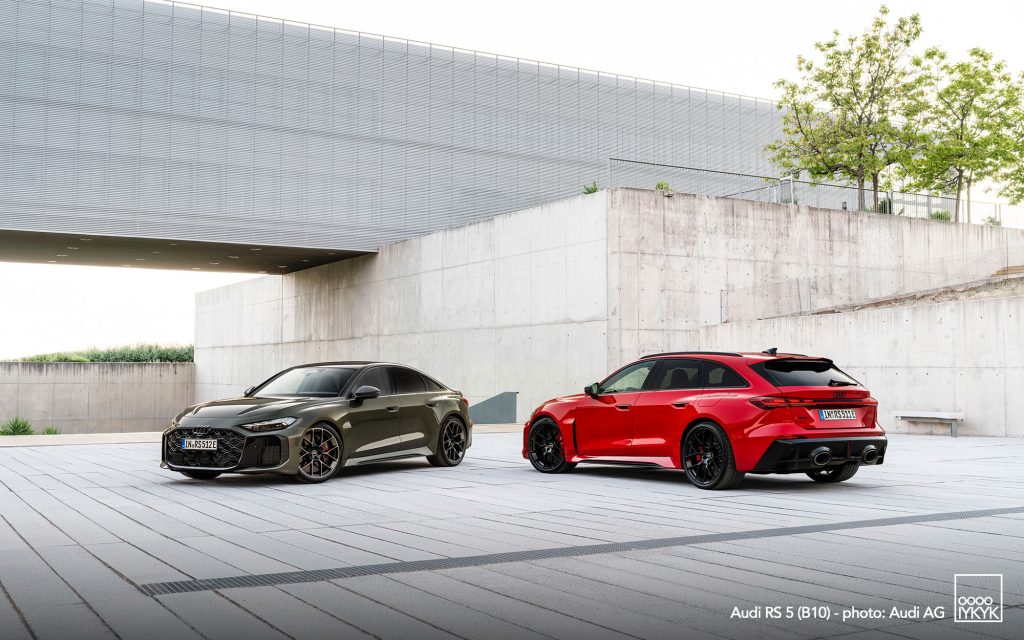
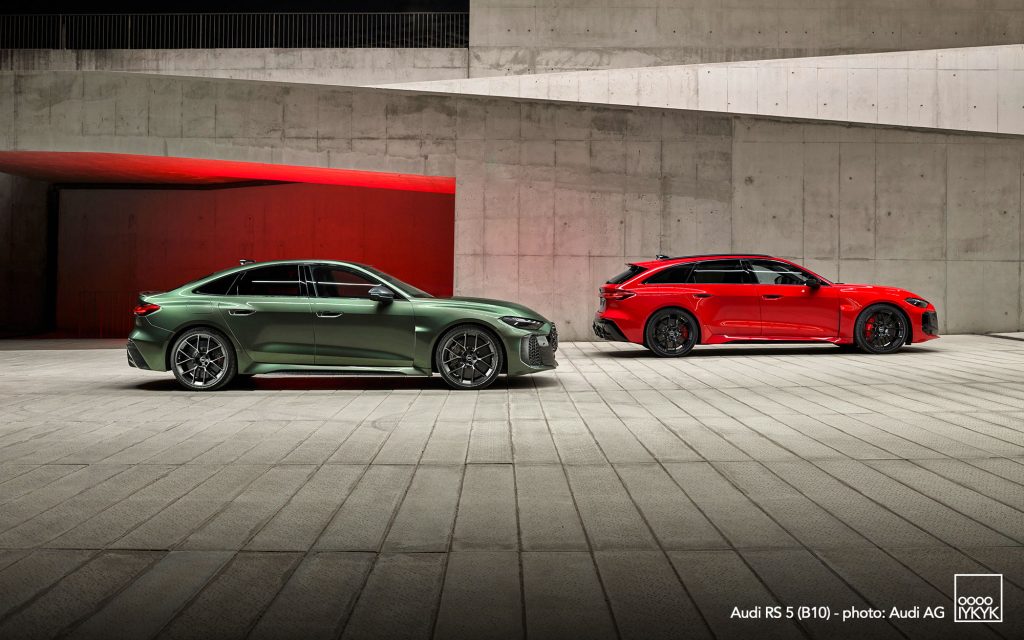
PHOTO GALLERY RS 5 SEDAN WITH RS SPORT PACKAGE
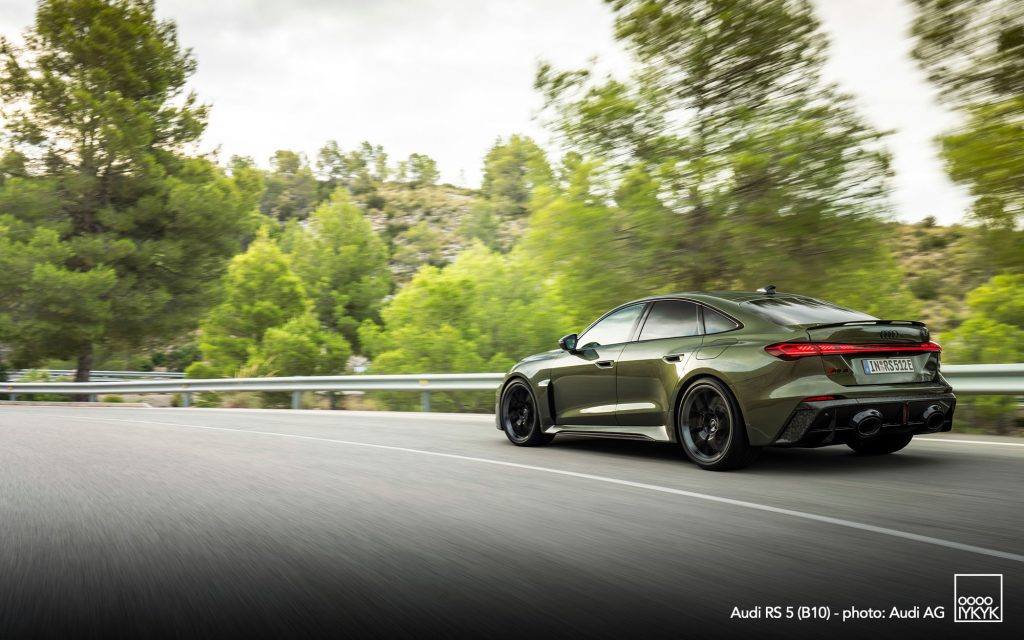
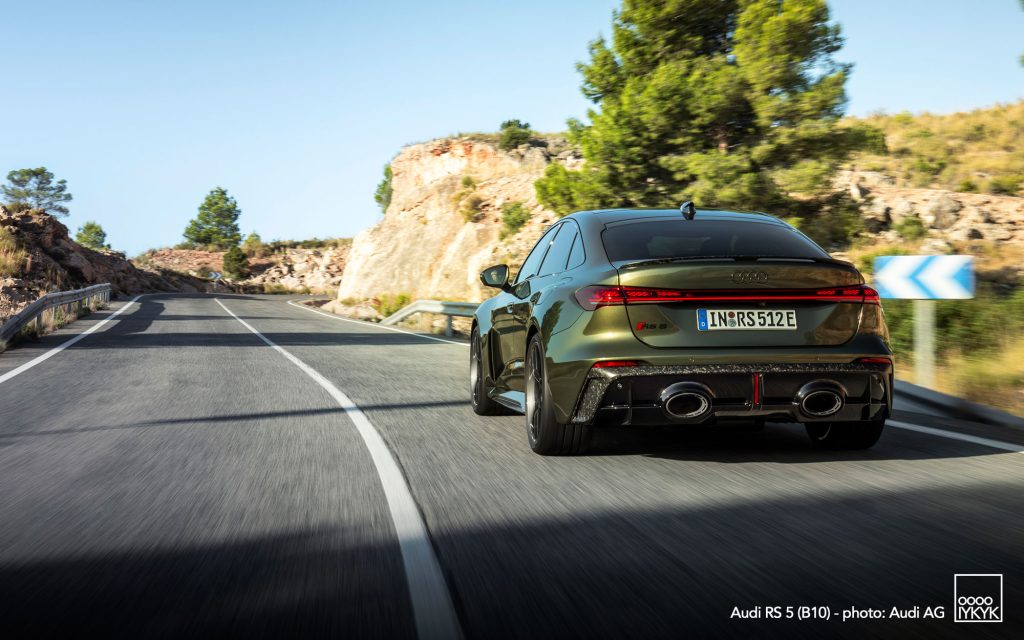
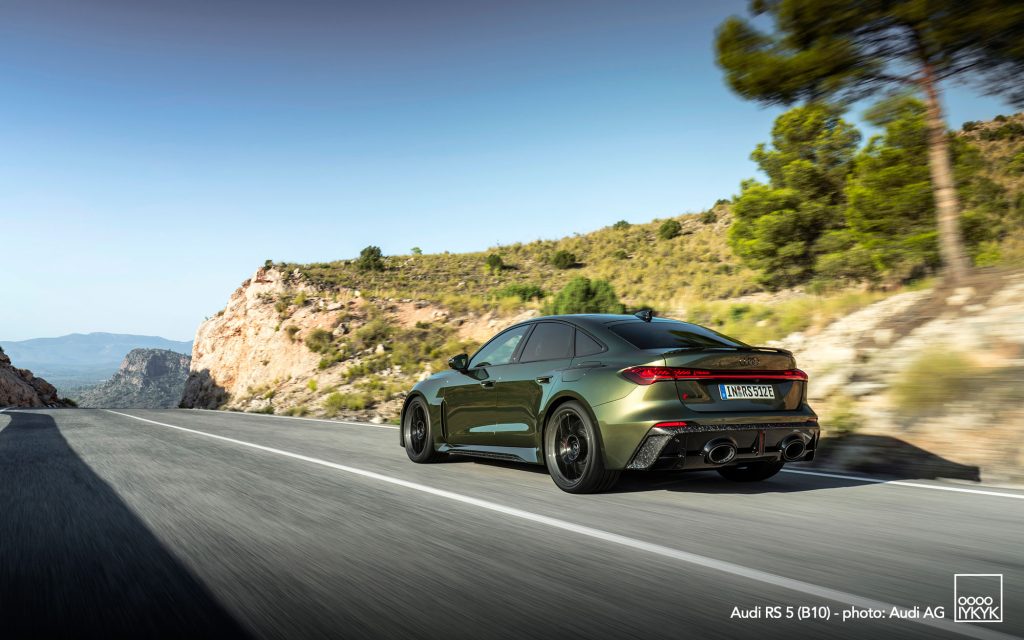
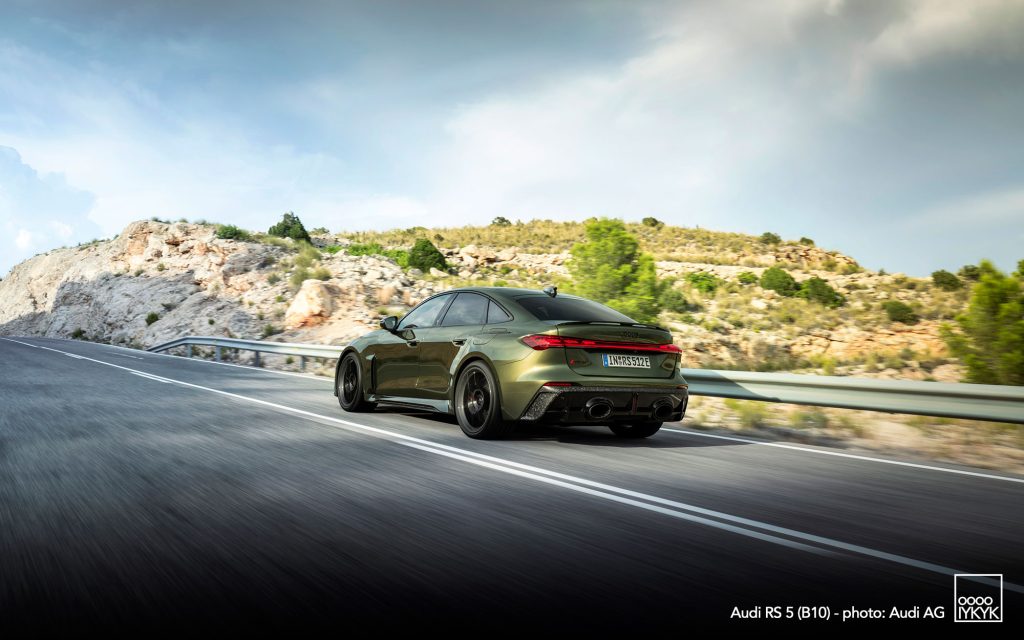
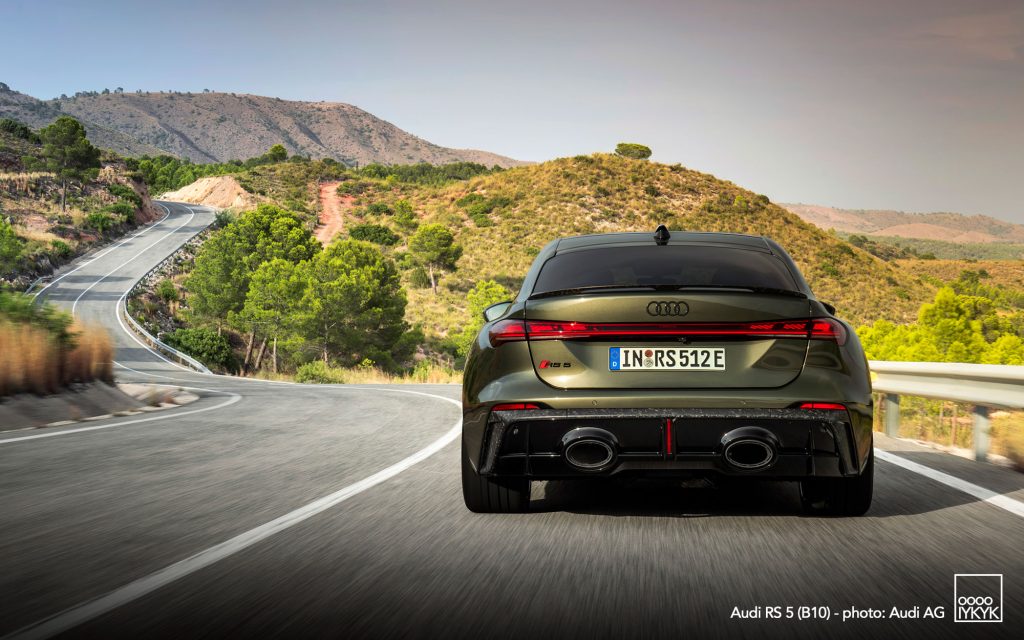
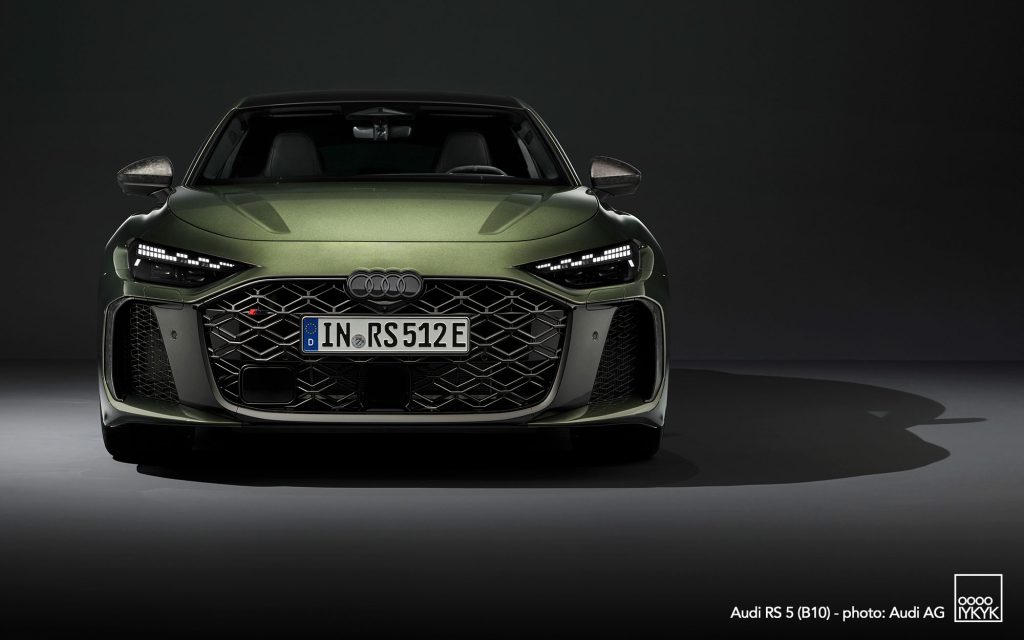
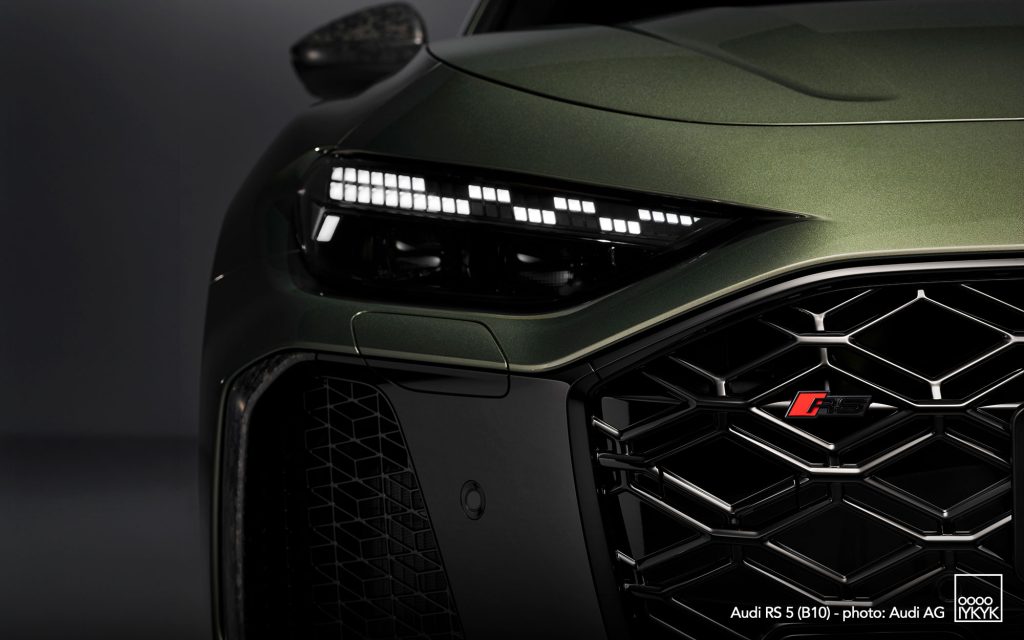
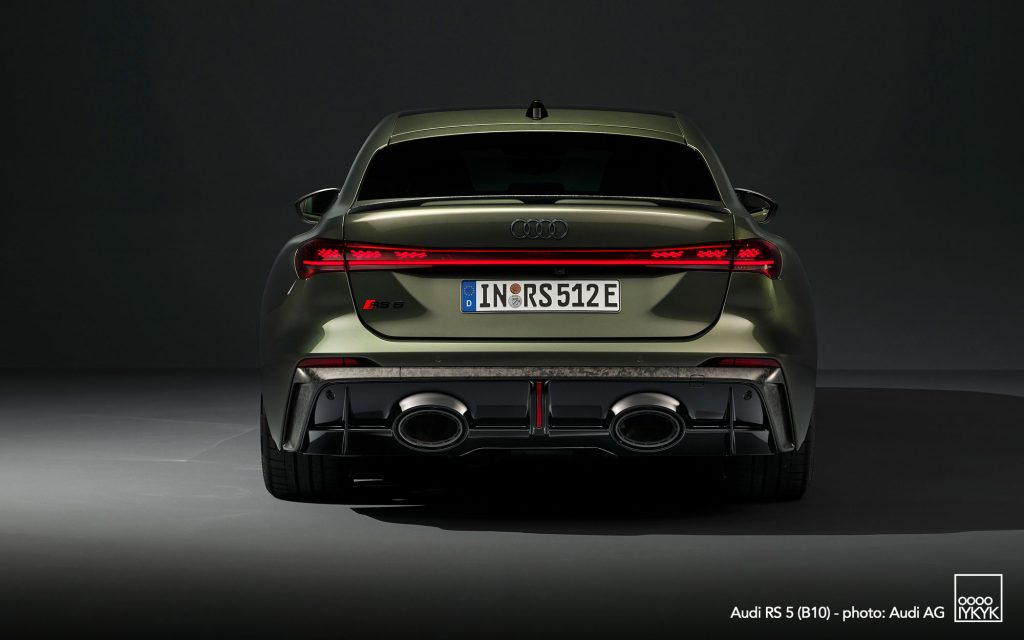
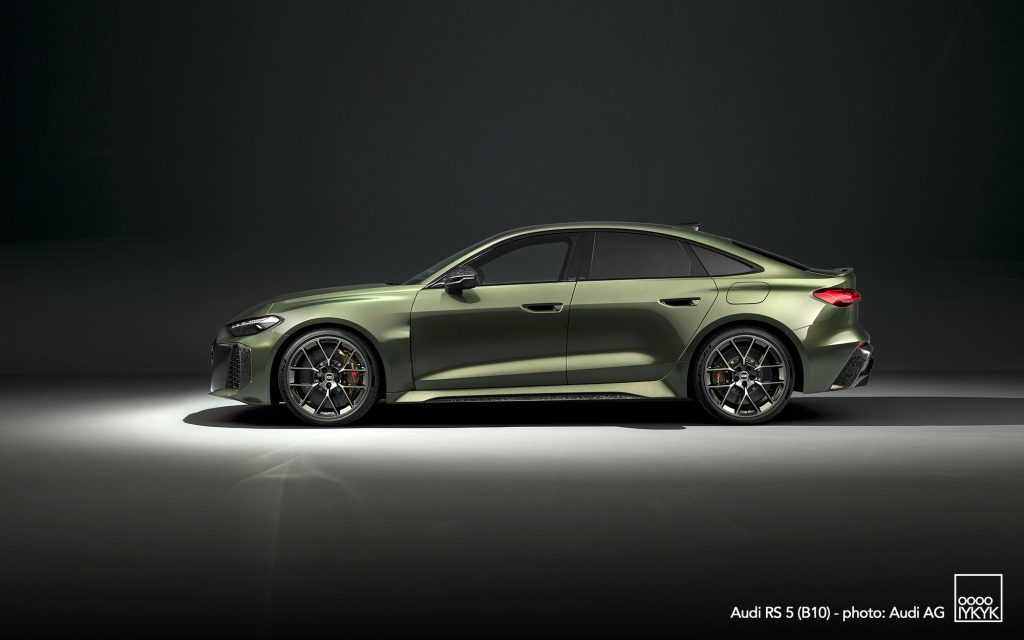
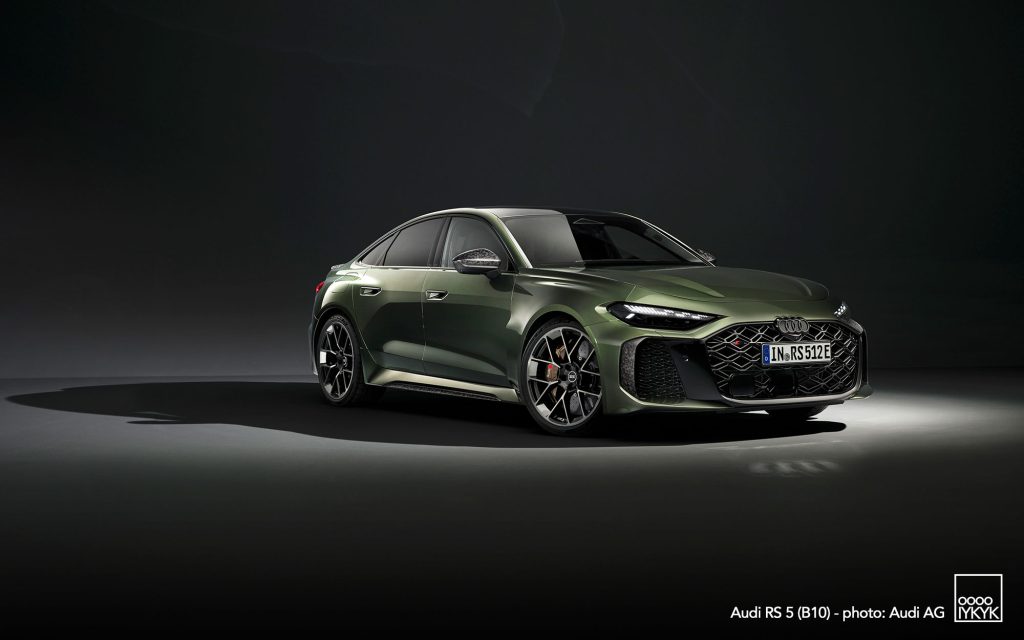
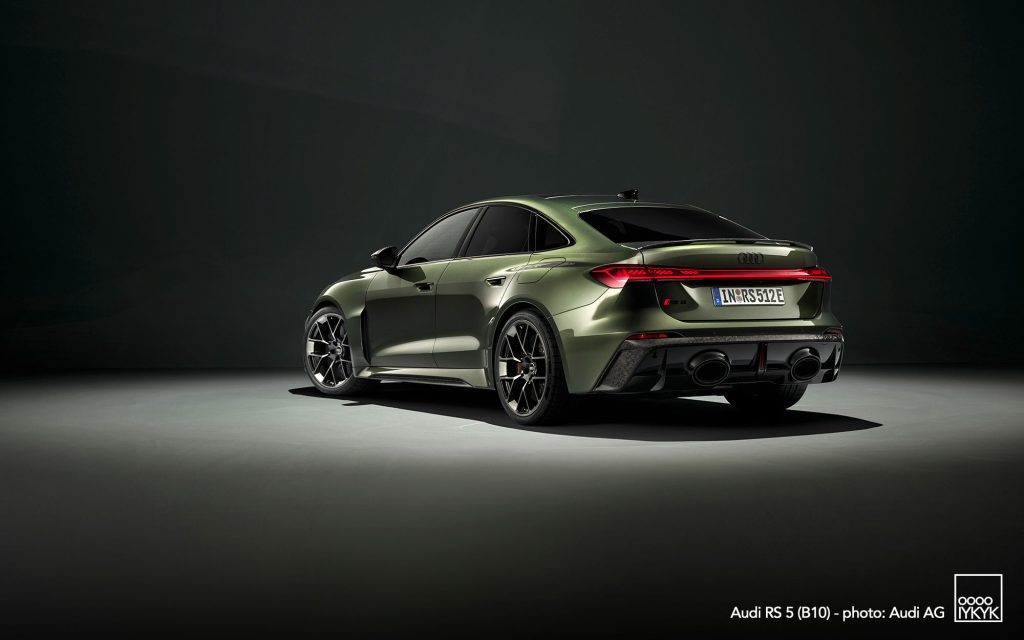
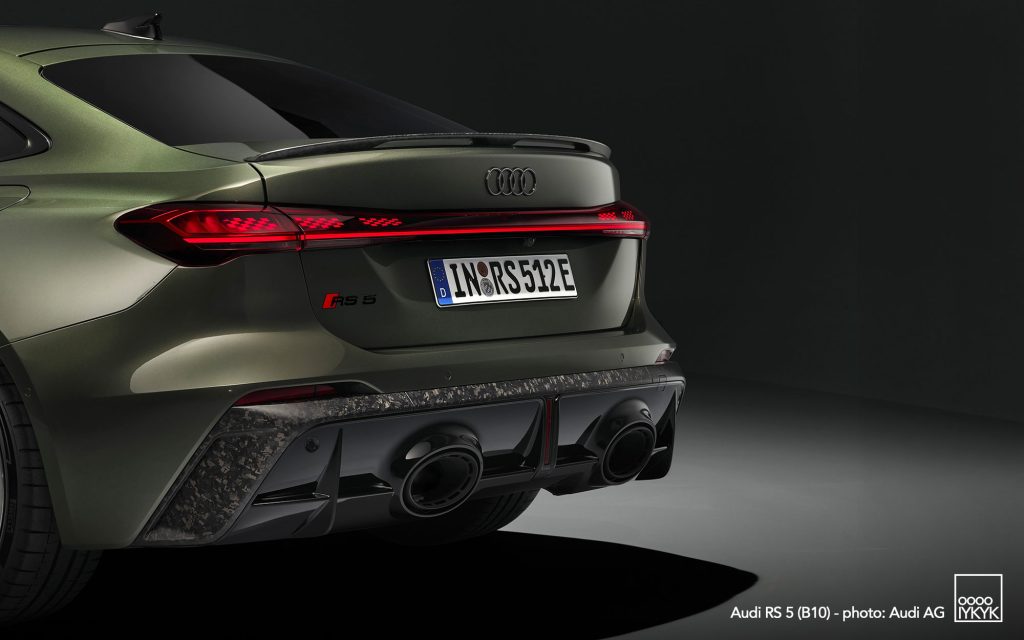
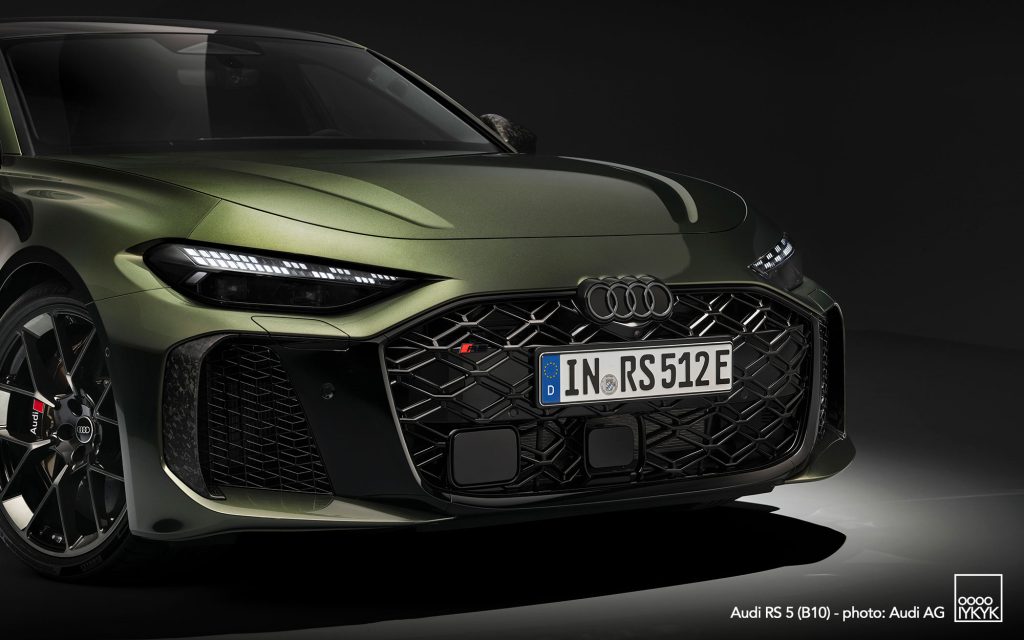
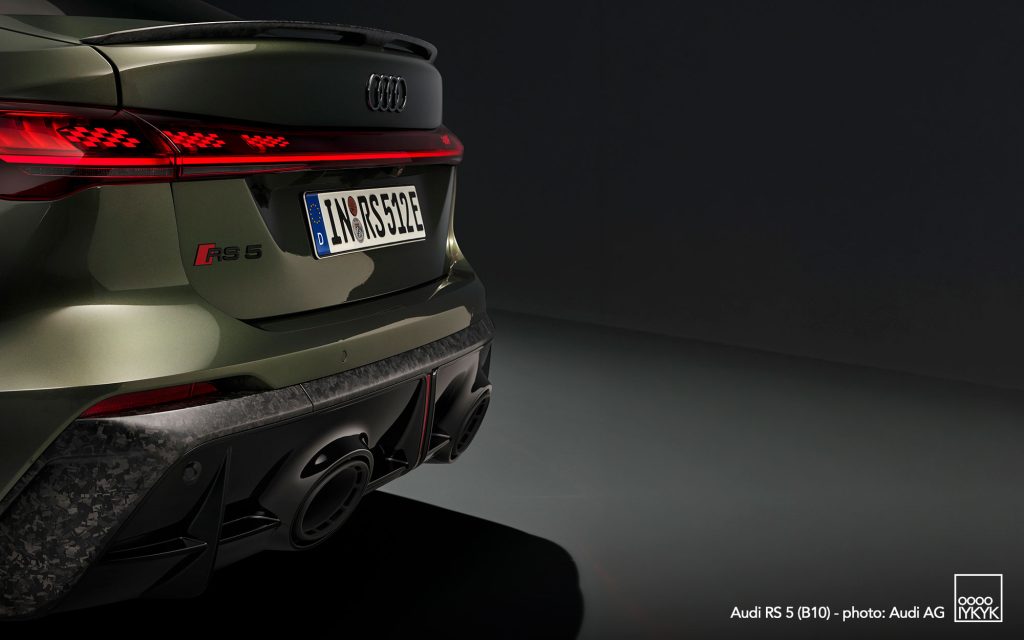
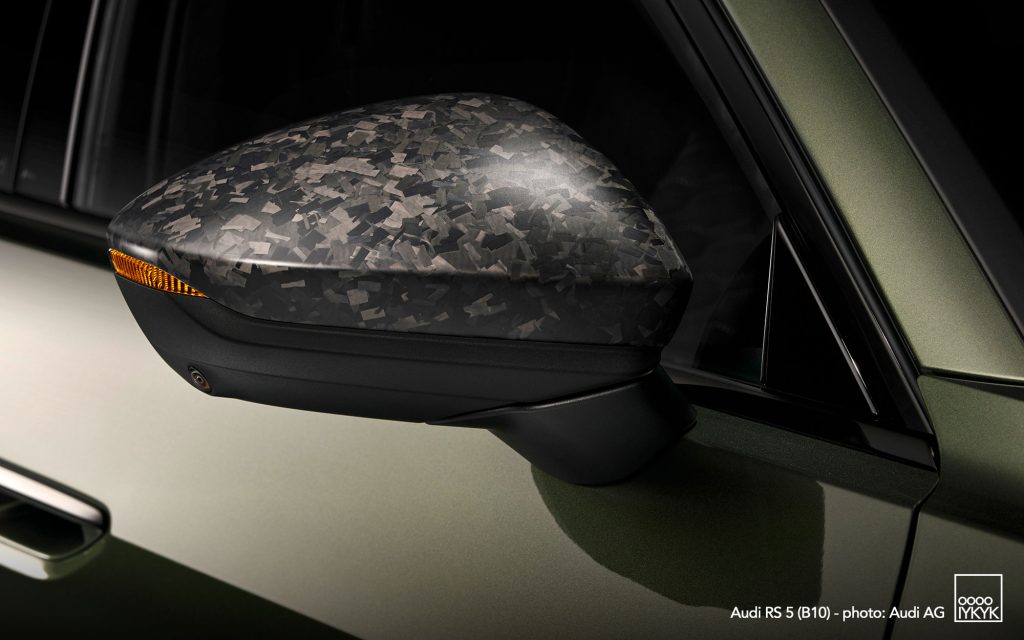
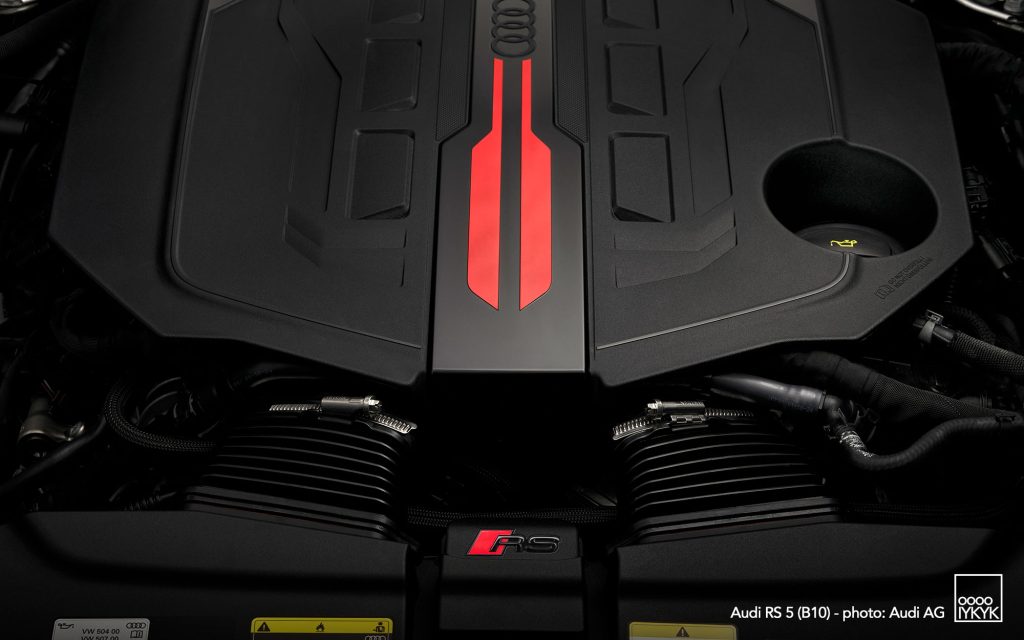
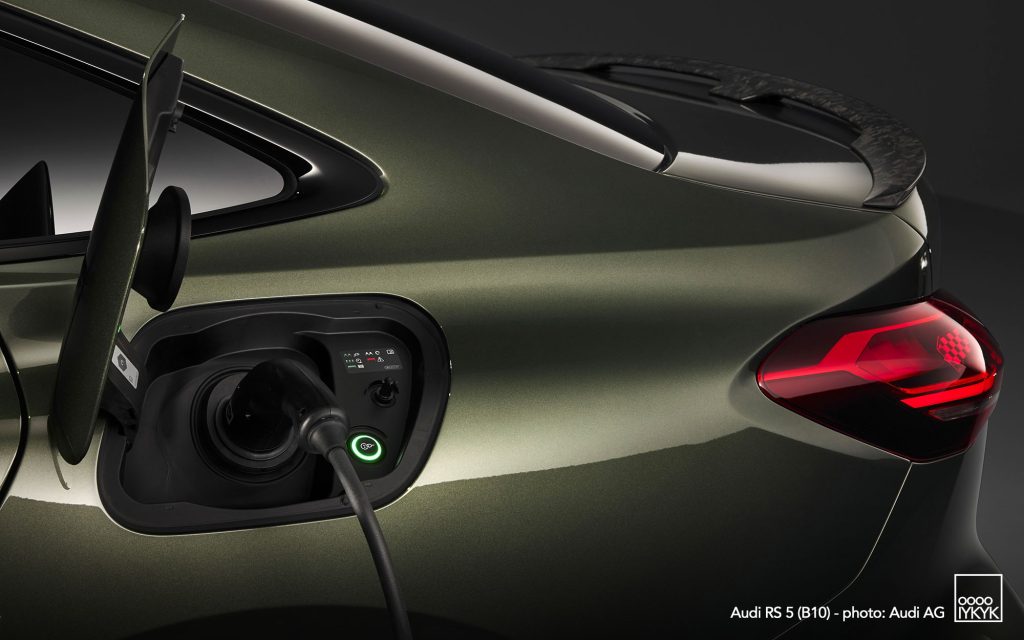
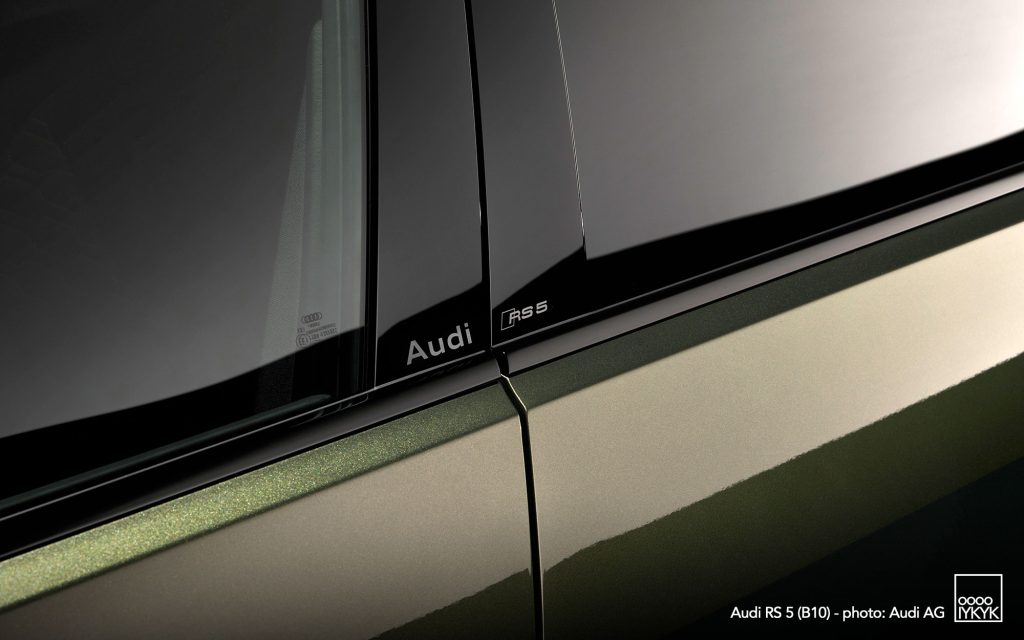
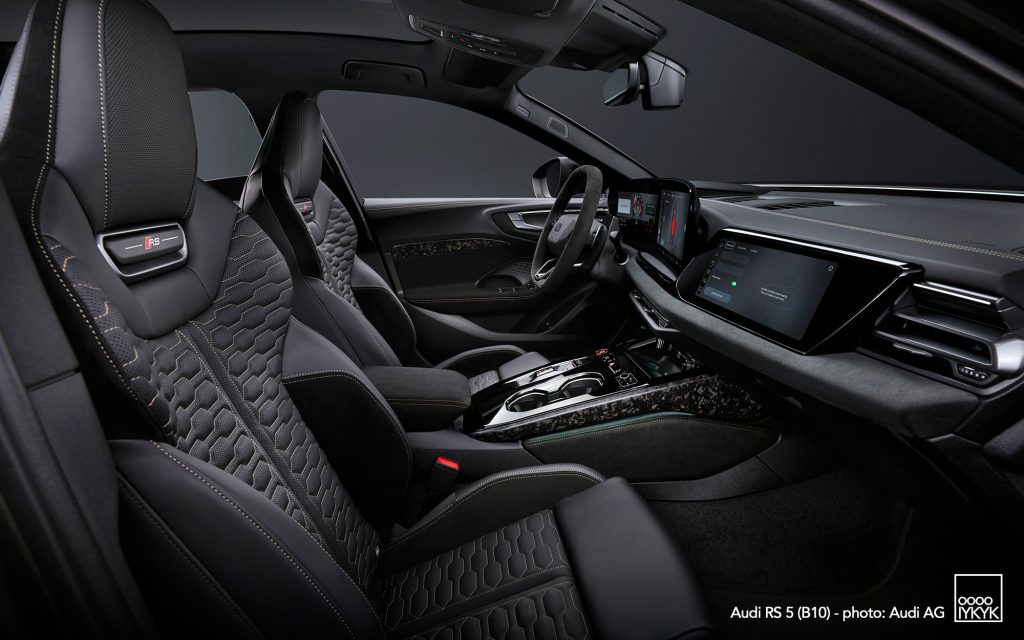
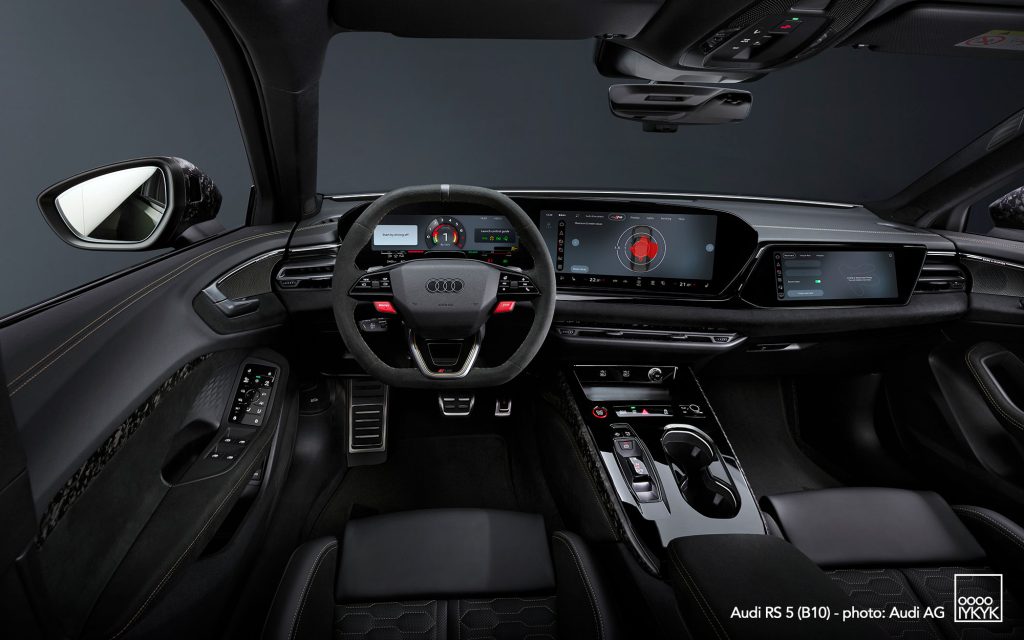
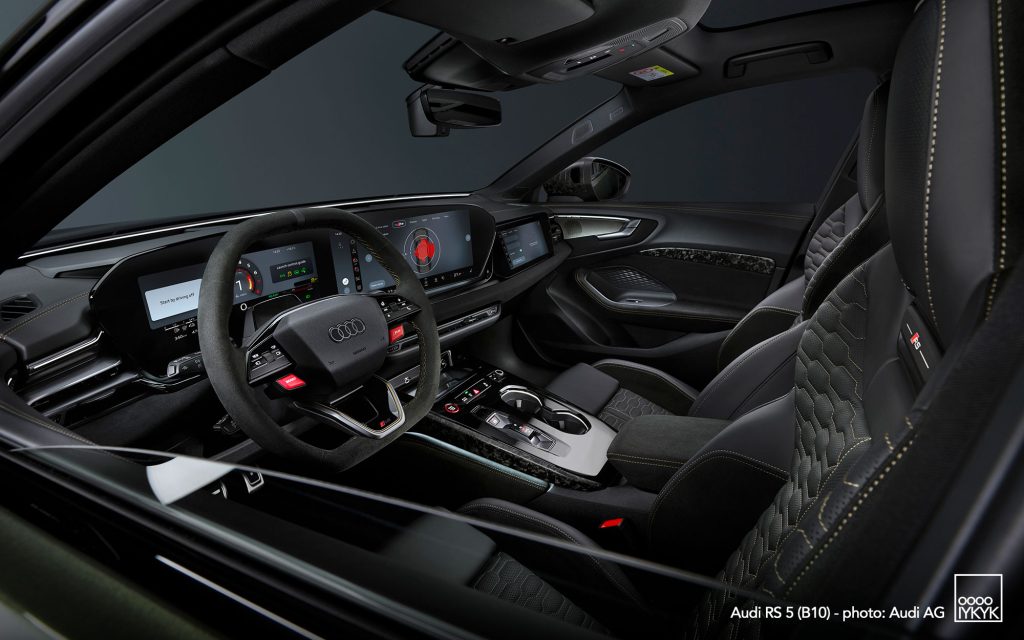
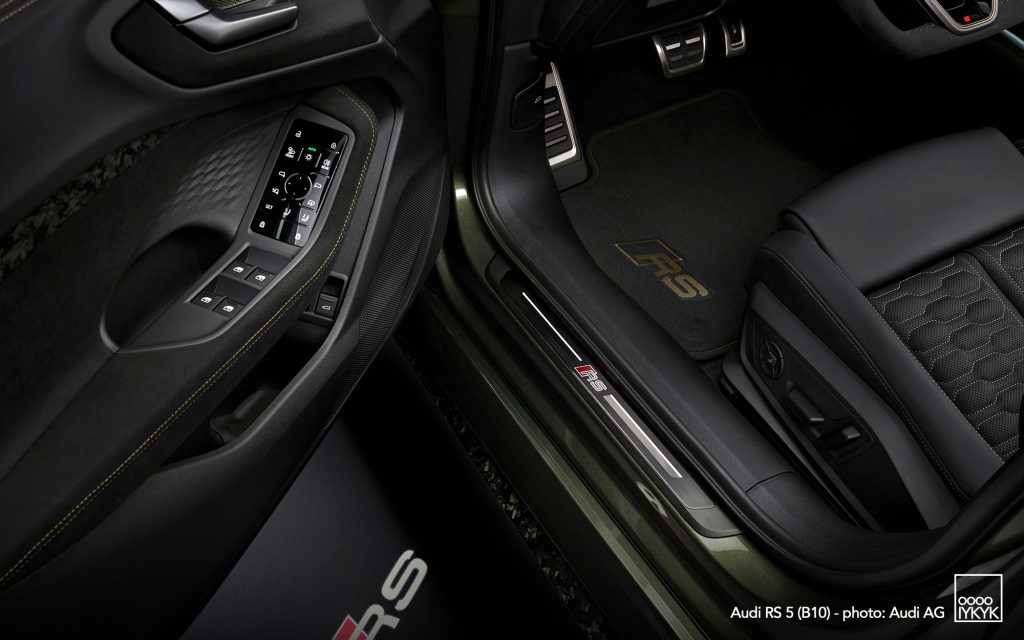
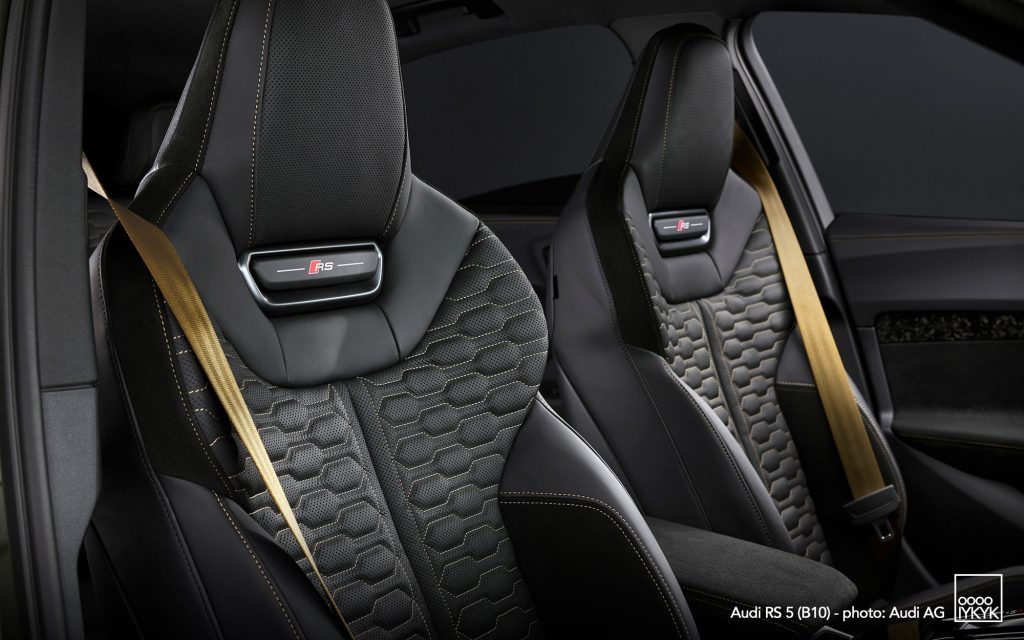
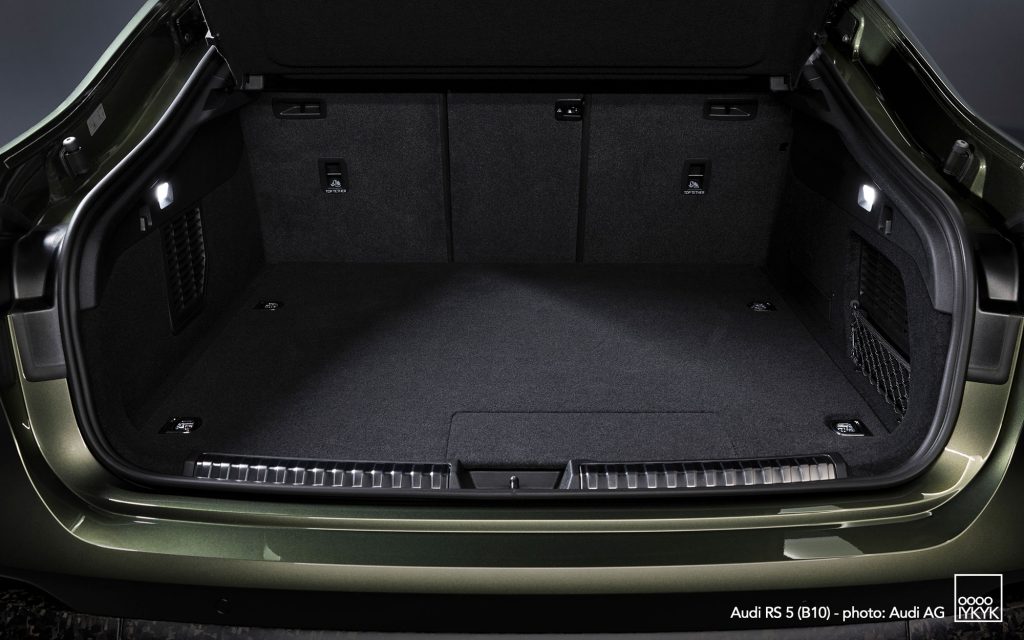
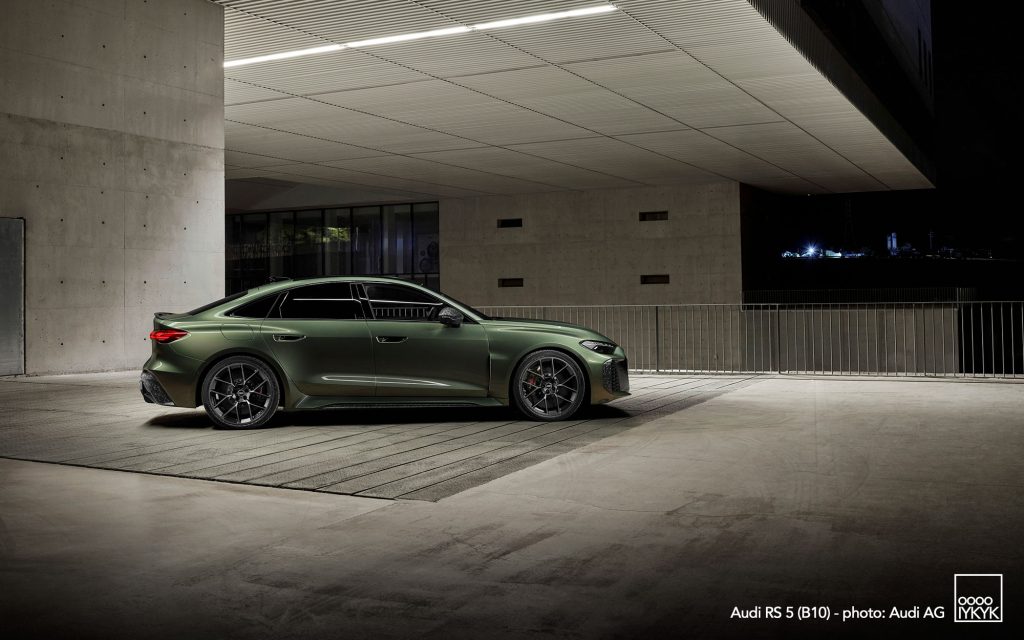
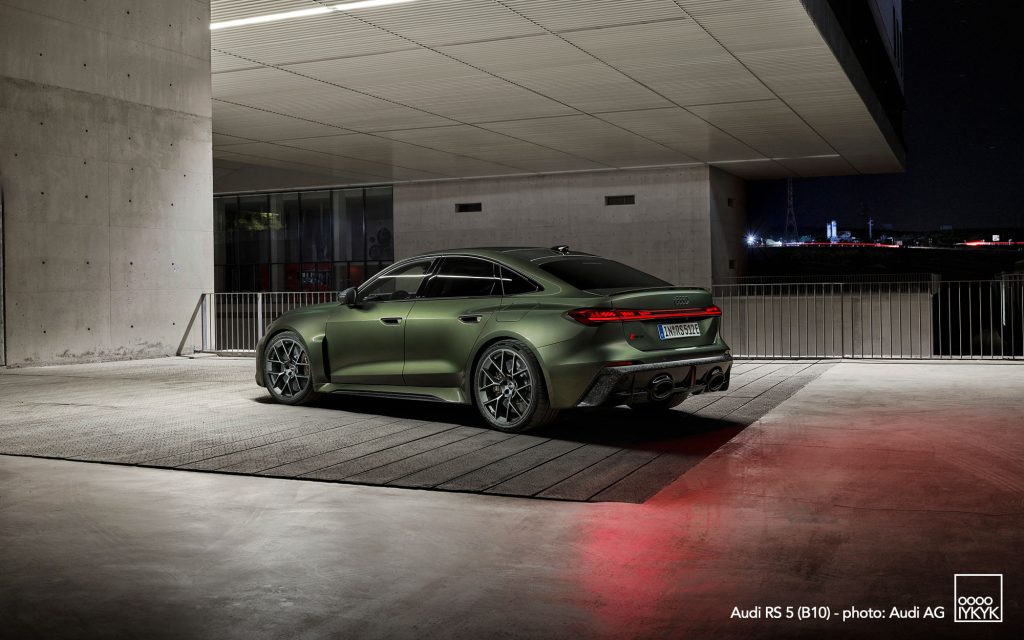
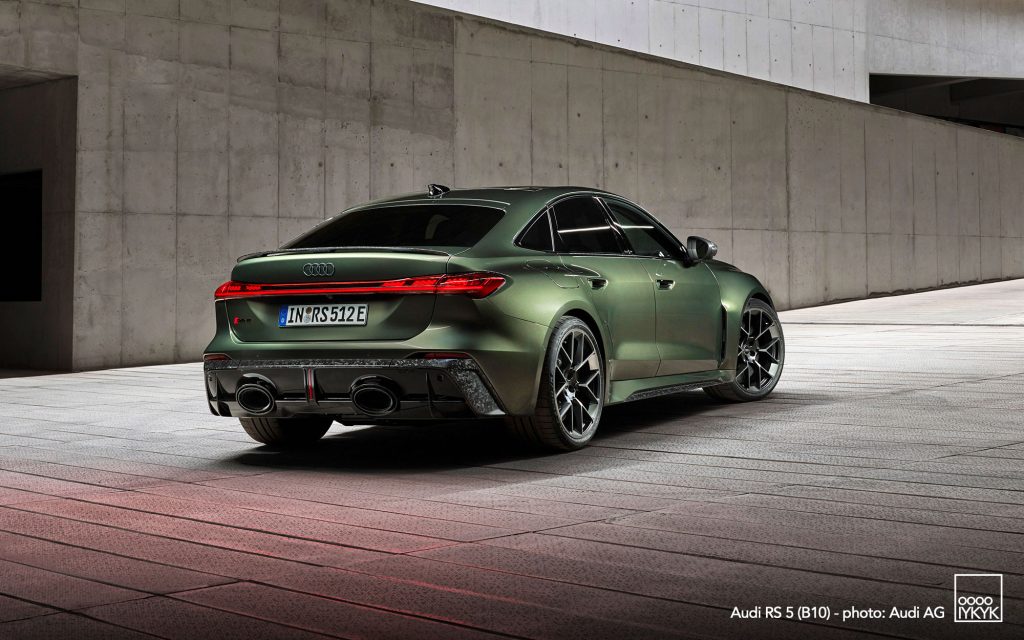
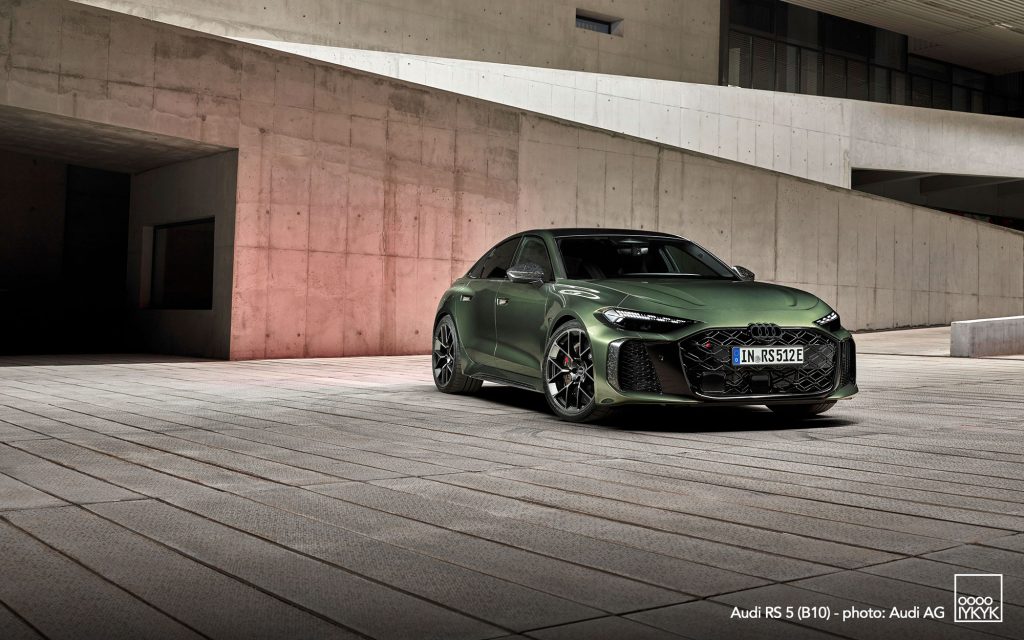
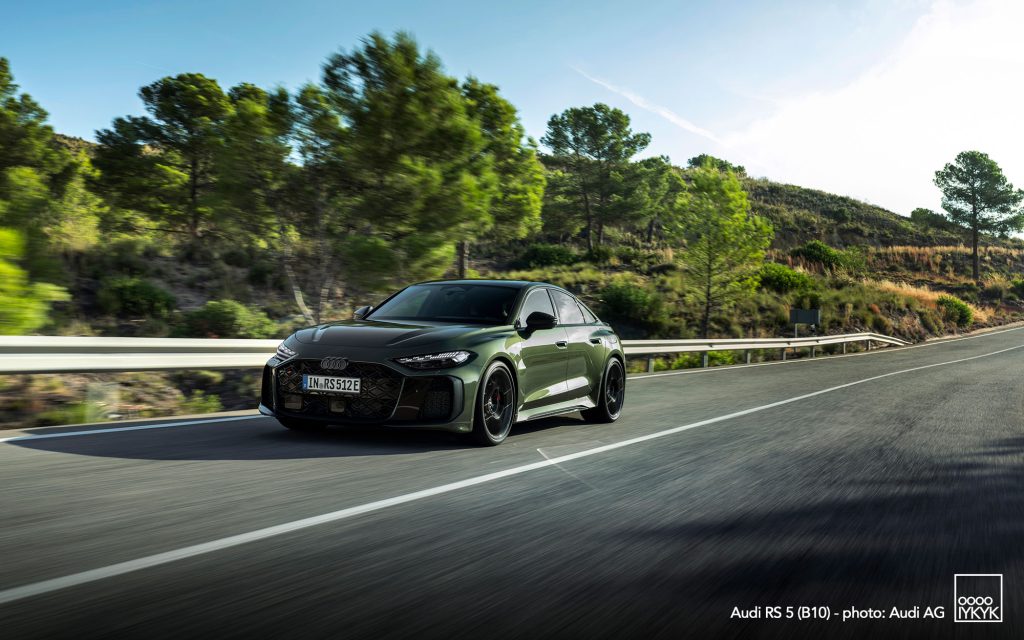
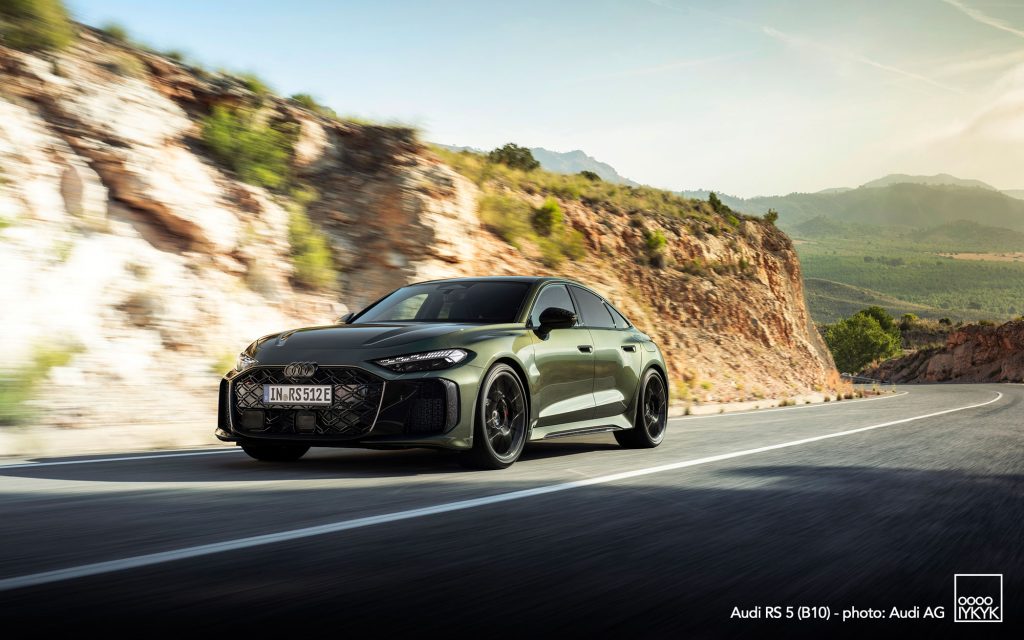
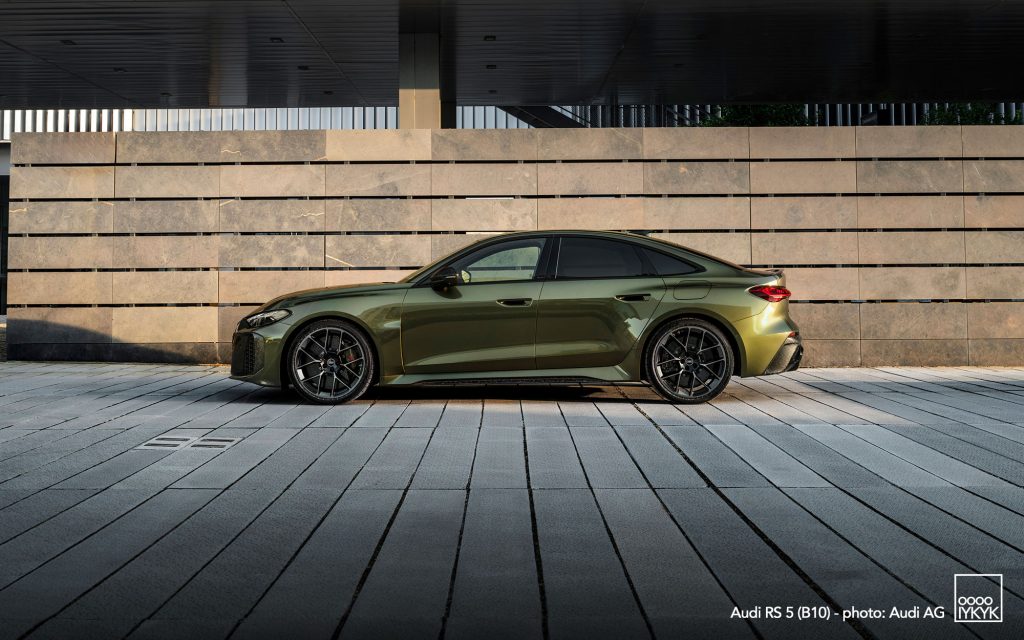
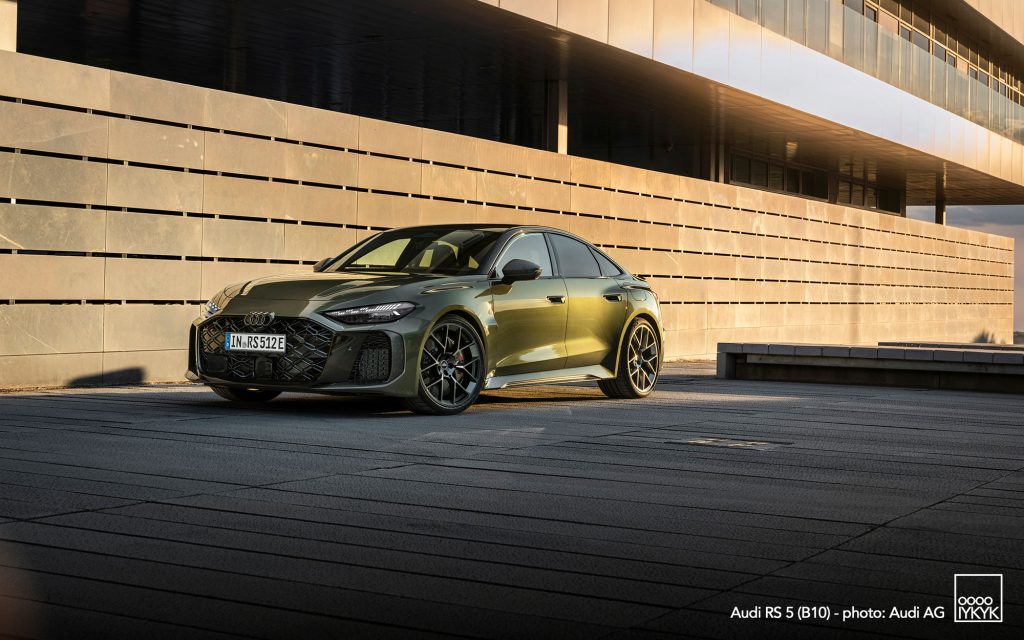
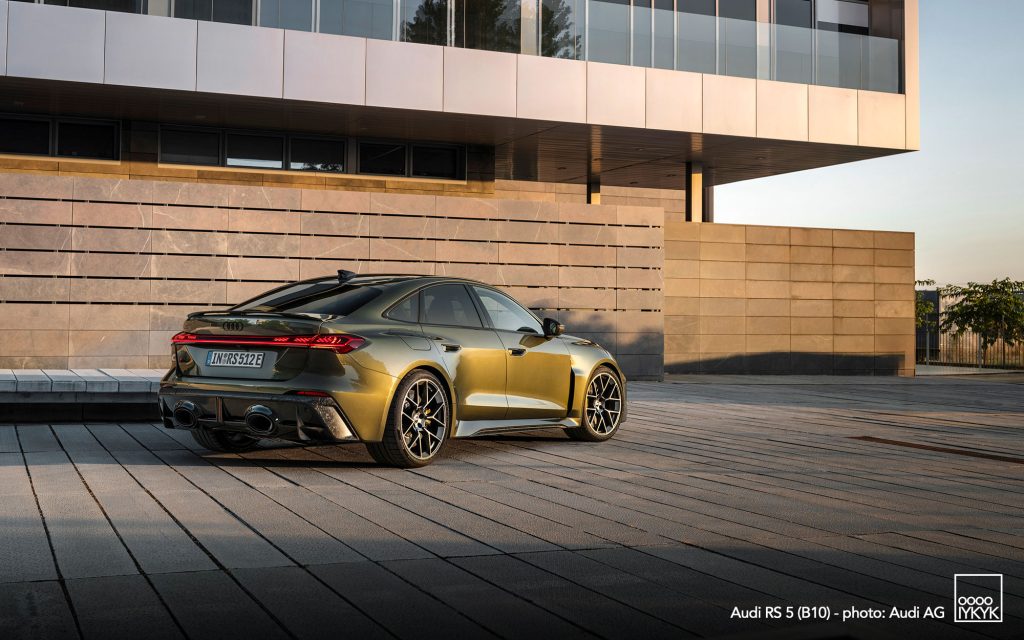
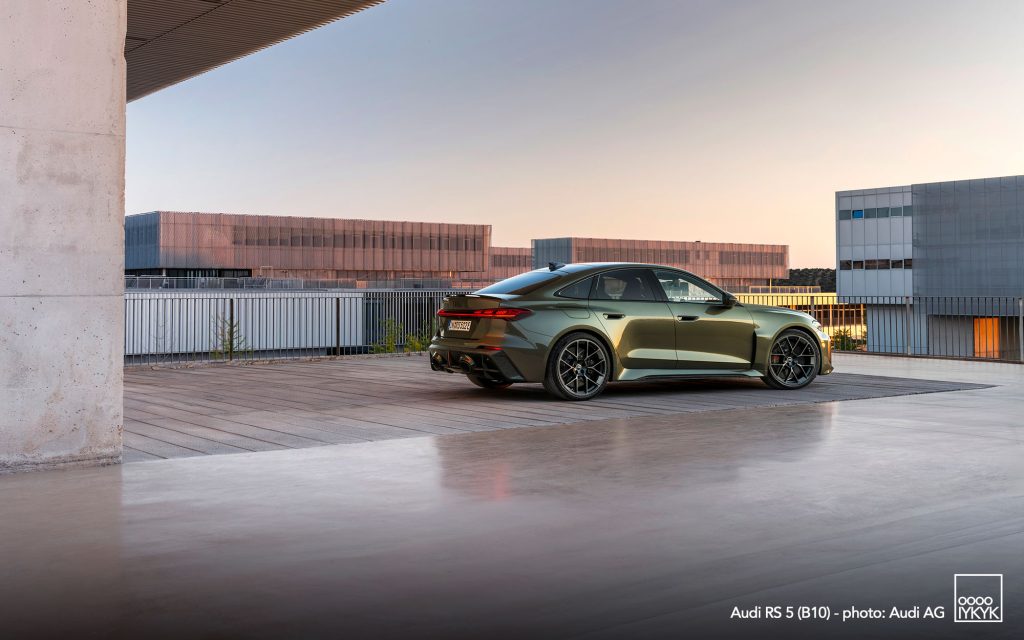
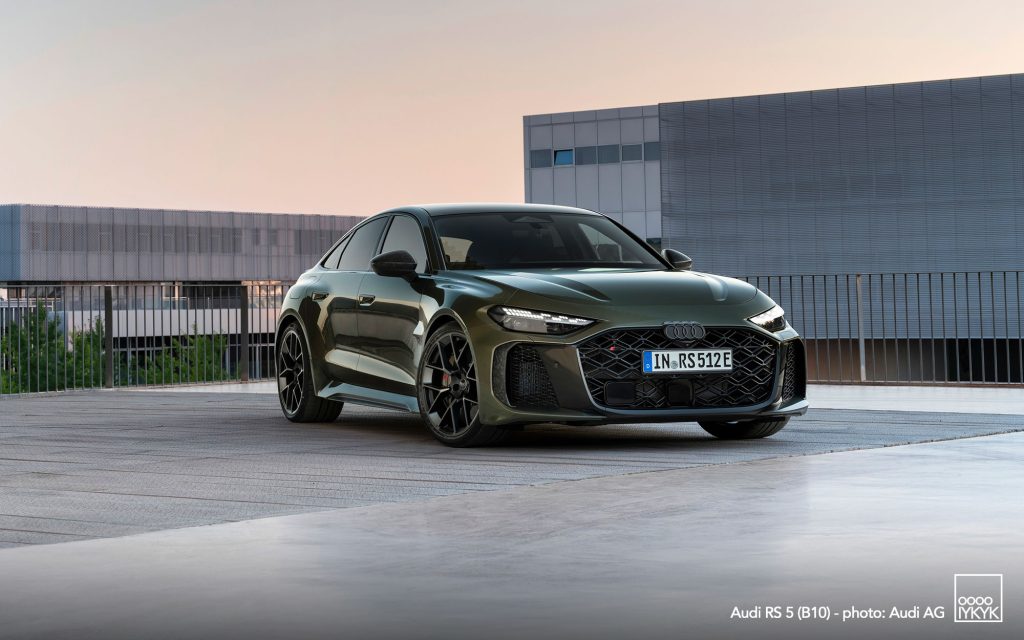
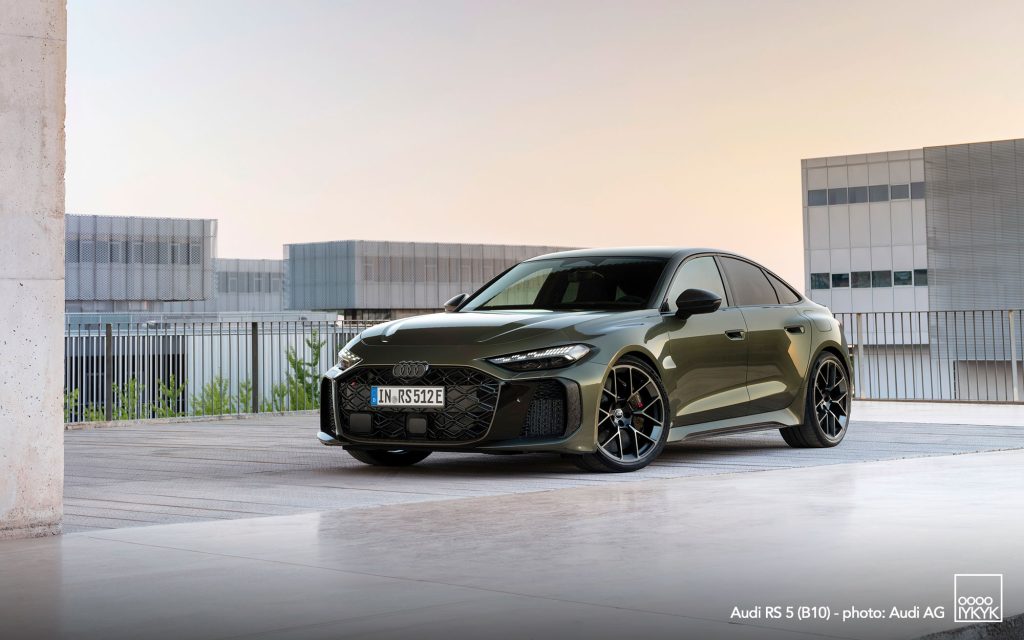
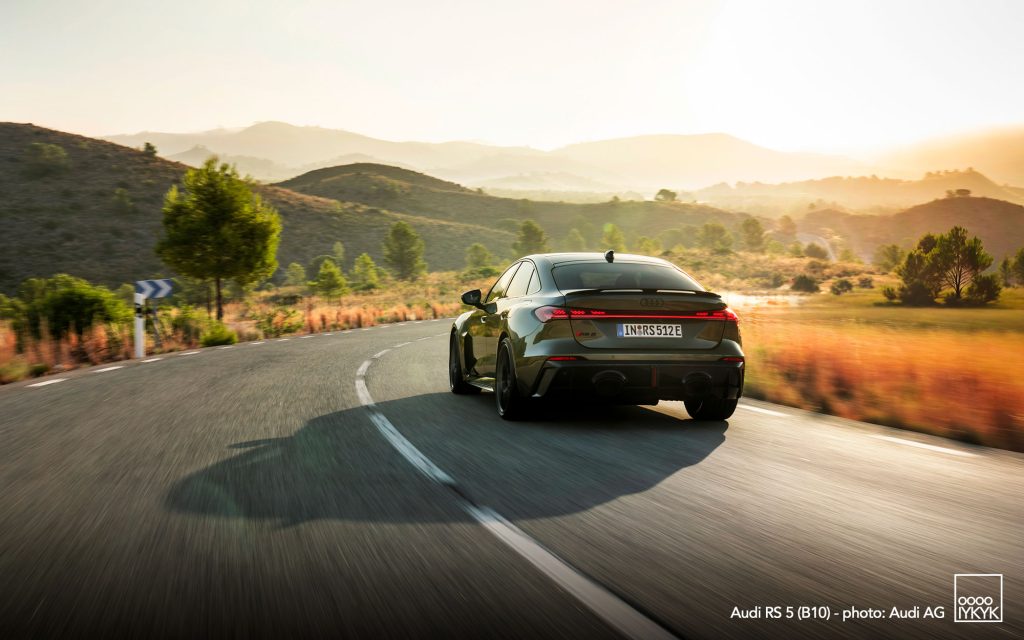
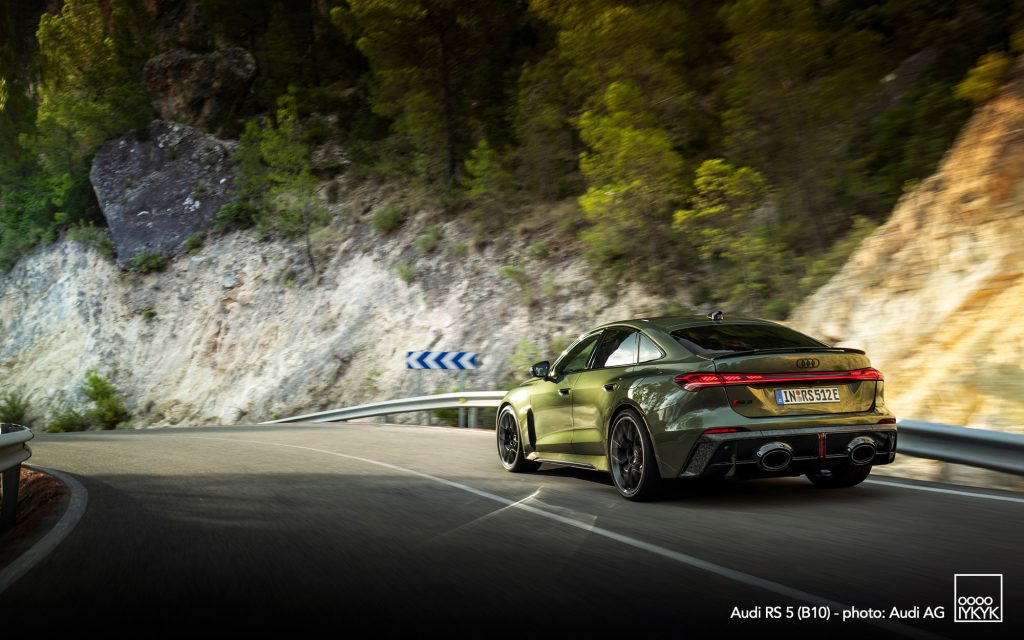
PHOTO GALLERY TECHNICAL DRAWINGS
PRESS RELEASE
[SOURCE: AUDI AG]
THE NEW AUDI RS 5: HIGH PERFORMANCE IN A HYBRID
- Audi Sport’s first-ever high-performance plug-in hybrid: 470 kW (639 PS) of system output, optional top speed of 285 km/h, and day-to-day driving more than 80 km on electric power alone in the city
- World-first quattro with Dynamic Torque Control in the rear transaxle brings handling to a new level
- Unmistakably RS: wider body work, darkened Matrix LED headlights, RS sport exhaust system and bold interior details
Ingolstadt, February 19, 2026 – The new Audi RS 5 is Audi Sport’s first high-performance plug-in hybrid (PHEV) – with real RS DNA and the highly-tuned hybrid-technology to match. Whether carving canyons, running highway marathons, or gliding through town on electric power – the RS 5 masters any situation with agility and impressive precision. It covers an extremely wide spread of driving dynamics – from comfortable every-day companion to potent performer. For the first time at Audi Sport, the powertrain pairs a 2.9-liter twin-turbo V6 outputting 375 kW (510 PS) and a 130 kW electric motor. They are joined by bespoke RS sport suspension with twin-valve shock absorbers and a completely new quattro drivetrain with Dynamic Torque Control, enabling electro mechanical torque vectoring at the rear as a world first. The new center differential has a preload to always remain partially locked, managing longitudinal torque distribution. Transverse torque distribution at the rear is provided by a new differential that can shift torque between the wheels in milliseconds. The result: exceptionally agile, composed, and effortless driving.
“The A5 model series’ new pinnacle is our first high-performance plug-in hybrid. Our newly developed quattro drivetrain with Dynamic Torque Control is the world’s first electro mechanical torque vectoring system in a production car. The sophisticated technical interplay between combustion engine and electric power brings performance and efficiency together in a new way at Audi. Customers can experience both peak sportiness and every-day comfort,” says Audi CEO Gernot Döllner.
Rolf Michl, Managing Director of Audi Sport adds: “The RS 5 and its innovative drive concept mark the beginning of a new era for our RS models. They bring a new level of dynamics to the driving characteristics our customers love and further improve day-to-day use value thanks to all-electric driving and innovative technologies. A new interpretation of the true RS experience.”
The Audi RS 5 delivers motorsport performance for the road. Measuring around nine centimeters wider than the base-model A5 at both ends with flared fenders, it has a muscular stance. The three-dimensional Singleframe with a honey-comb grille and Air Curtains to control airflow dominate the front. At the rear, the aerodynamic diffuser and the RS sport exhaust system’s matte oval tailpipes ensure a sporty finish. Both during the day and at night, the darkened Matrix LED headlights and their digital day-time-running-light signature in a checkered-flag design reinforce the car’s purposeful appearance.
The high-performance PHEV is the first production RS model to feature a modular electrified powertrain: quattro with Dynamic Torque Control. At its heart are an improved 2.9-liter twin-turbo V6, an electric motor outputting 130 kW, the hybridized eight-speed gearbox, and a completely new rear transaxle with electro mechanical torque vectoring – a world first in a production model. An actuator, overdrive gears, and a differential combine to intelligently transfer torque between the rear wheels. They do so almost fully variably and depending on the driving situation. A control unit recalculates optimal torque distribution between the rear wheel every 5 milliseconds – a frequency of 200 Hz. The torque vectoring system then immediately and precisely implements it. Put simply, electro mechanical torque vectoring is the invisible maestro conducting an orchestra of performance and making sure customers experience driving fun and safety like never before.
ELECTRIFYING: THE POWERTRAIN
The new RS 5 marks Audi Sport’s entry into the world of plug-in hybrids. A modular high-performance powertrain propels the muscular model. At its heart are an improved 2.9-liter twin-turbo V6, an electric motor outputting 130 kW integrated into the hybridized eight-speed gearbox, and a completely new rear transaxle. The latter enables electro mechanical torque vectoring – offering especially fast and precise torque distribution and ensuring maximum driving dynamics.
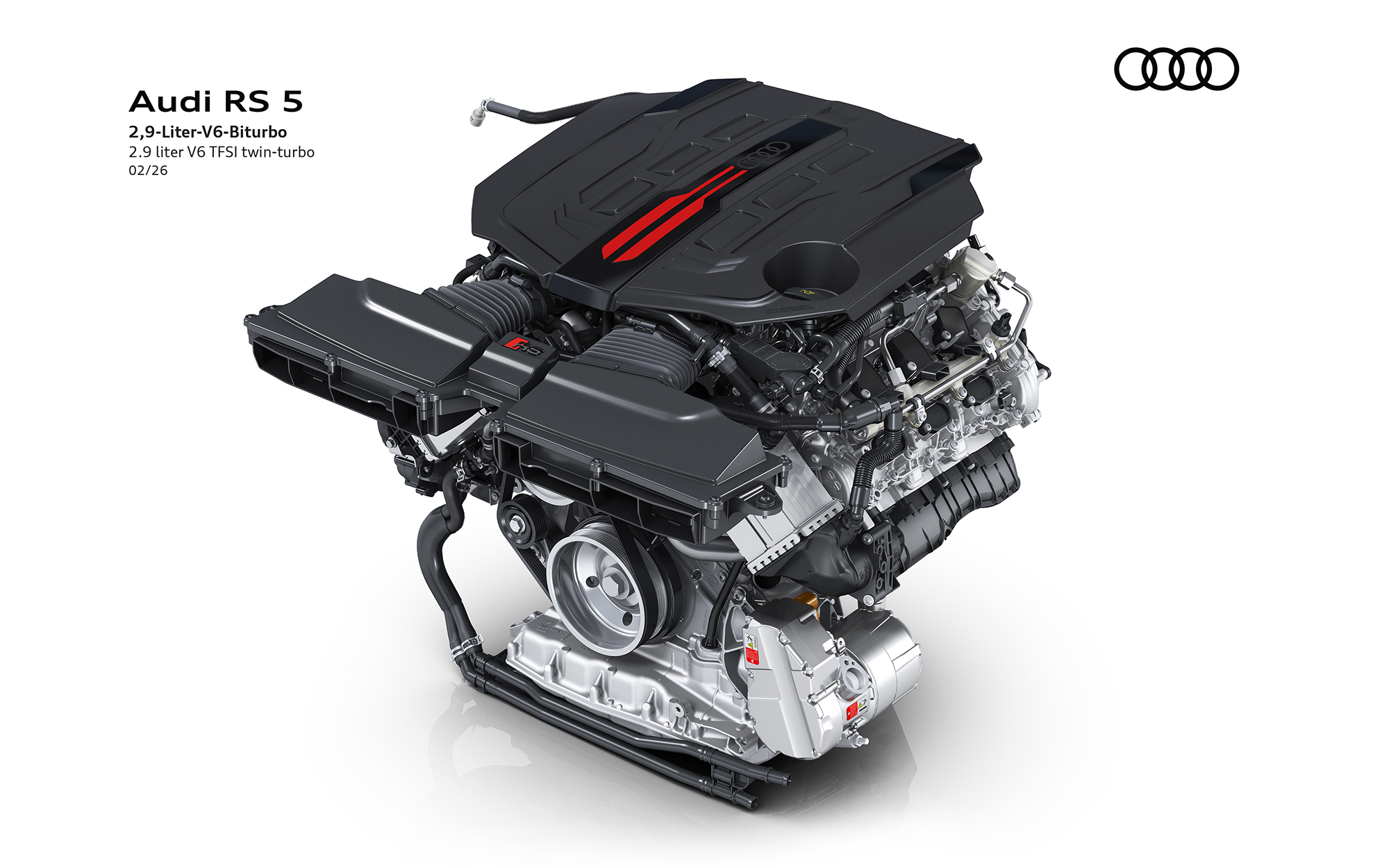
2.9-LITER V6 TFSI ENGINE: 375 KW (510 PS) OF POWER
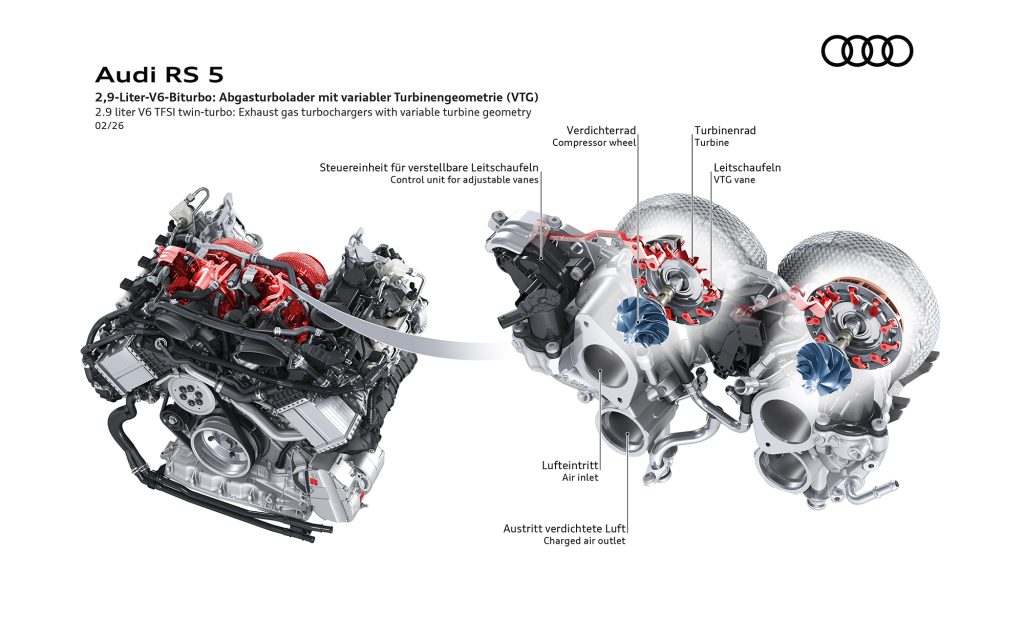
Putting out 375 kW (510 PS), the improved 2.9-liter V6 TFSI engine in the RS 5 contributes noticeably more power than the previous generation. The increase of 44 kW is due to continuous performance-oriented development by Audi Sport. The RS 5 uses a modified Miller cycle that offers significant advantages under partial load. In the Miller cycle, the intake valves close earlier, increasing the engine’s efficiency. Two variable-geometry turbochargers provide boost; the piping is optimized for high pressures and minimal losses. This means the engine responds much more eagerly to throttle inputs. The increase in power and torque meshes perfectly with the 130-kW electric motor. Additionally, Audi has upgraded fuel delivery through higher injection pressure, increasing efficiency and providing more performance with lower emissions.
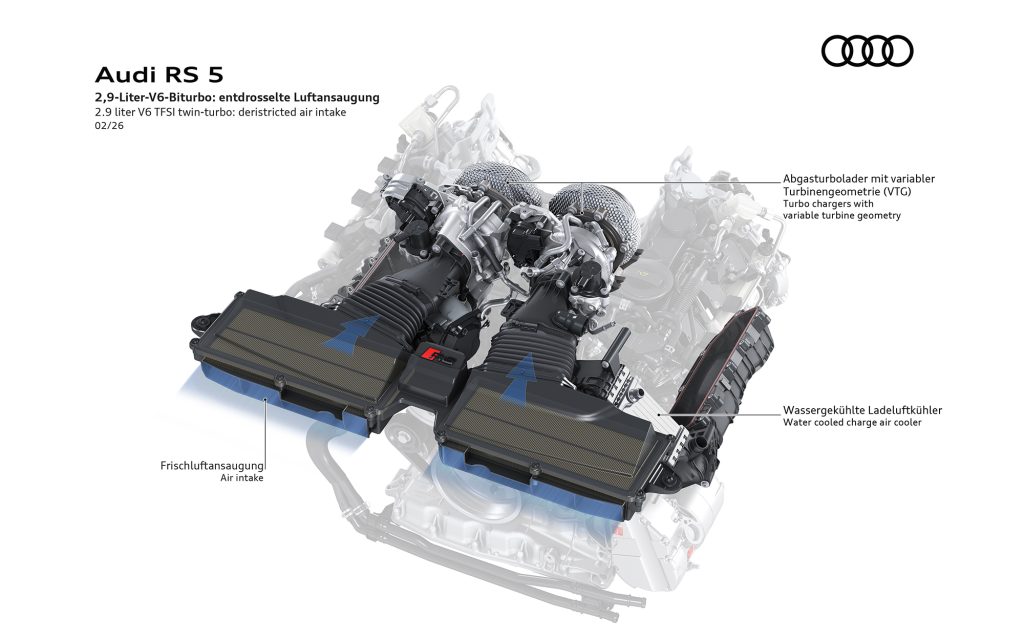
Seeking to maximize responsiveness and performance, Audi’s engineers designed the shortest and least restrictive intake system possible from the ground up. Water-to-air intercoolers are used for the first time in the RS 5, lowering intake temperatures – especially under intense conditions. The result: maximum power is always available at the tap of the driver’s right foot.
These components combined create a V6 that provides more power, operates more efficiently, and uses up to 20 percent less fuel under high loads than its predecessor – at the drop of a hat and with never-before-seen ease.
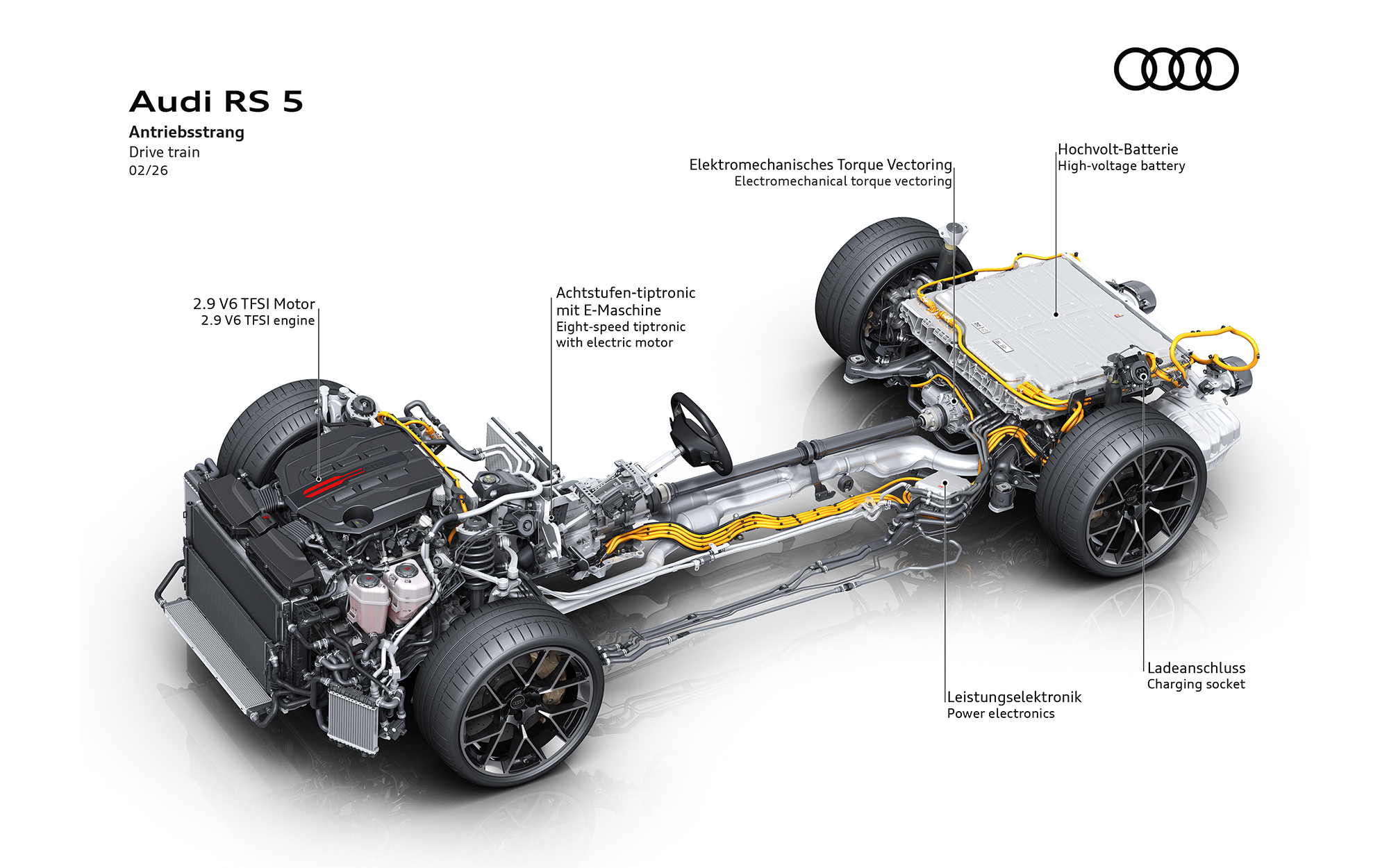
– 2.9-liter twinturbo V6
– electric motor outputting 130 kW
– hybridized eight-speed gearbox
– rear transaxle with Dynamic Torque Control
ELECTRIC MOTOR: 130 KW (177 PS) AND 460 NM OF TORQUE
For the new RS 5, Audi paired the improved 2.9-liter twin-turbo V6 outputting 375 kW (510 PS) and 600 Nm of torque with a powerful electric motor. It provides an additional 130 kW (177 PS) and 460 Nm of torque. The total system output is up to 470 kW (639 PS) and 825 Nm of torque.
When taking performance and fuel consumption together, the Audi RS 5 sets benchmarks in its class and offers sportiness and high efficiency without compromise. Furthermore, the electric motor enables even better throttle response and acceleration off the line. It also starts the engine, meaning a 12-volt starter motor is no longer needed.
The electric motor and the 400-volt electrical system are powered by a battery with a capacity of 25.9 kWh (22 kWh net) and form the basis for electric propulsion in the RS 5. They contribute to acceleration from 0 to 100 km/h in an impressive 3.6 seconds. The Audi RS 5 also boasts an all-electric range of up to 84 kilometers (EAER) – up to 87 kilometers in the city.
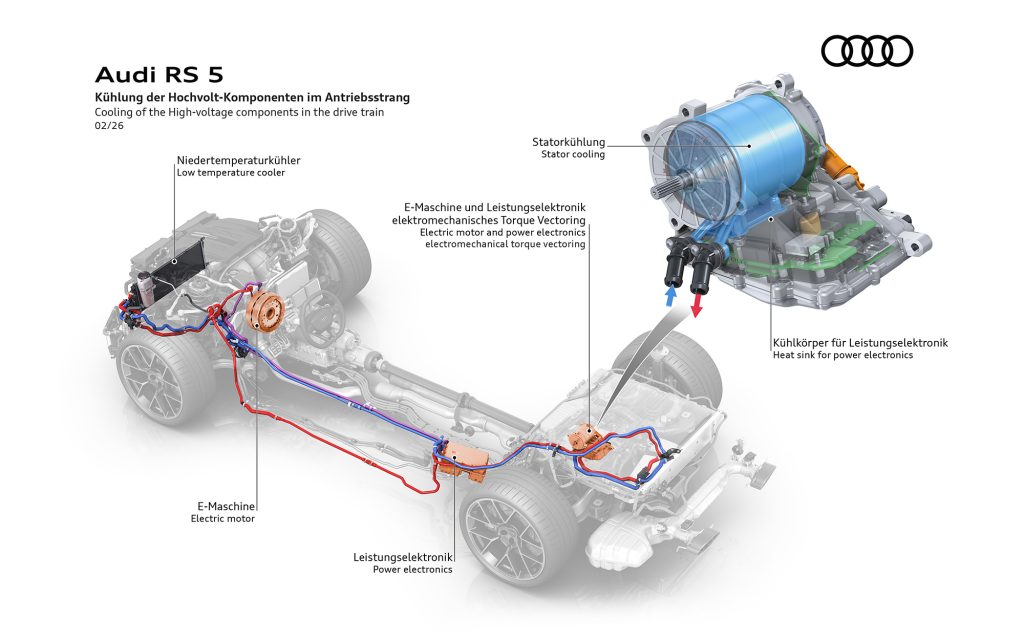
Specifically designed for the RS 5, the electric motor features an external-rotor design – meaning the stator is inside the moving rotor. It enables the two to interact over a wider area for increased torque, better cooling, and higher efficiency overall.
Be it every-day driving or canyon carving, the electrified drivetrain offers a wide range of characteristics between whisper-quiet motoring in town and exploring the outer limits of brawny power delivery. The electric motor also ensures the RS 5 feels like an RS-model when driving electrically too.
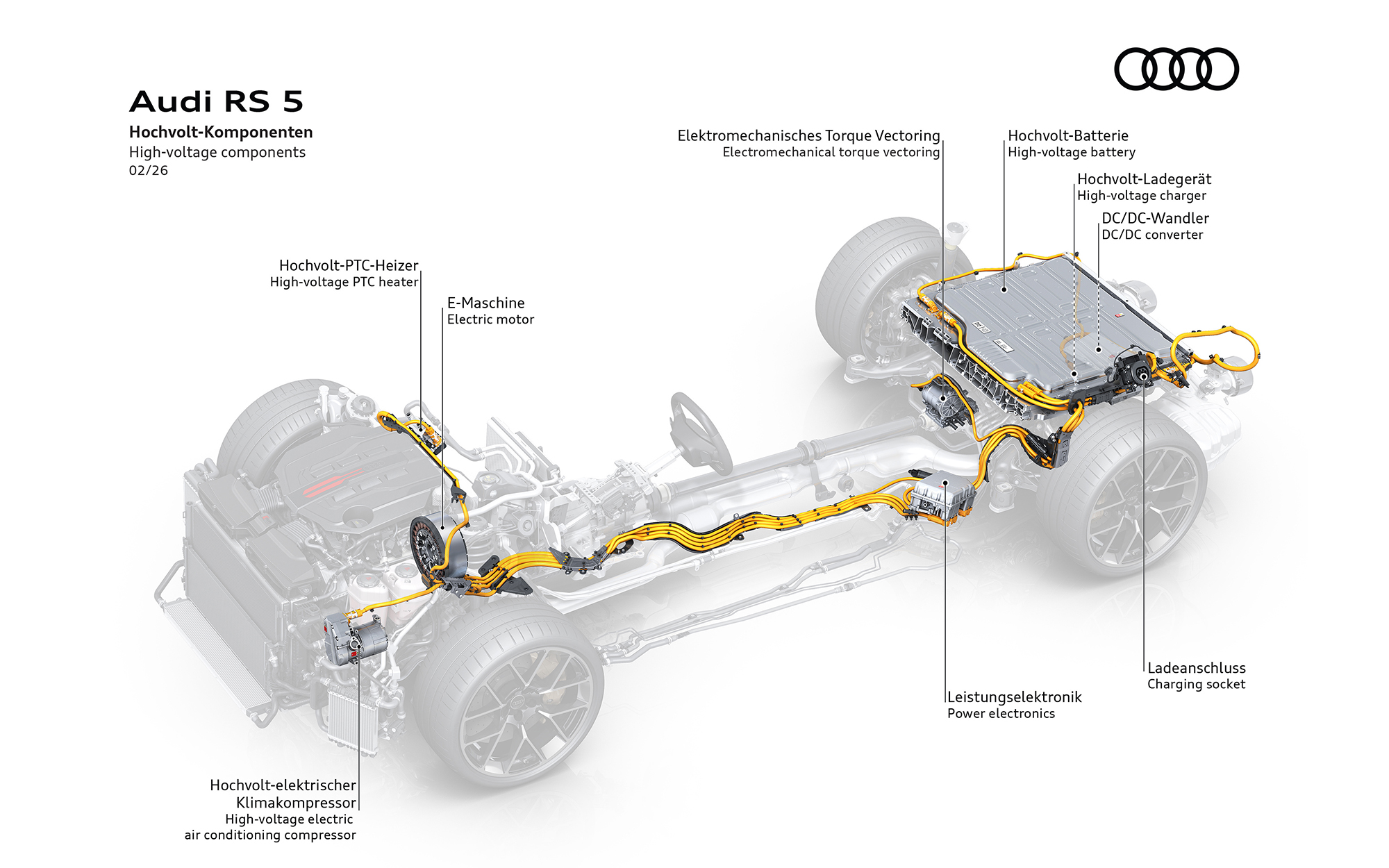
BATTERY AND CHARGING: IMPROVED CELL CHEMISTRY PUTS MORE POWER ON TAP
The battery cells of the RS 5 are integrated beneath the trunk floor. Thanks to their improved chemistry, they output more power at low states of charge as well as in extreme temperatures than the previous generation. The battery not only powers the traction motor. It also sends up to 8 kW to the permanent-magnet synchronous motor in the torque vectoring unit.
Using three-phase alternating current (AC), the plug-in hybrid charges at up to 11 kW, meaning the high-voltage battery is charged to 100 percent in just 2.5 hours. A charging cable (mode 3, type 2 connector) is standard equipment.
A high state of charge is essential to achieve the characteristics of RS-specific driving modes such as RS sport and RS torque rear. When they are activated, performance comes first. To ensure full electric support is available – for example for torque vectoring – the vehicle holds the state of charge at a high 90 percent in the modes RS sport and RS torque rear. This means drivers always have access to maximum electric power for sporty maneuvers or dynamic acceleration.
The battery always reaches and maintains ideal temperature thanks to intelligent thermal management. When using RS sport or RS torque rear mode, the battery is actively cooled to an optimal 20 degrees Celsius. Pumps, fans, and heat exchangers work together to ensure full electric performance at any time.
‘
‘
HYBRIDIZED POWER DELIVERY: EIGHT-SPEED TRANSMISSION & LIMITED-SLIP CENTER DIFFERENTIAL
The power produced by the potent plug-in hybrid’s V6 powerplant and traction motor are delivered to the wheels via an eight-speed tiptronic transmission. It uses a conventional design with a torque converter and planetary gearset. Thanks to its eight closely spaced ratios, it enables small steps when changing gears. It has an external cooler to ensure reliable performance at high load. As a result, the drivetrain components are always operating in their peak performance range. The dynamic electronically controlled shift logic automatically adapts its shift points to the chosen driving mode – prioritizing either sportiness or efficiency.
In addition, Audi reduced the resistance of heavy rotating components in the transmission. Put simply: the shift mechanism needs to use less energy to accelerate or decelerate them. This reduces lag when shifting gears, ensuring faster and more precise shifts as well as a more direct driving feel.
The eight-speed tiptronic transmission is paired with a limited-slip center differential that distributes torque between the two axles depending on the current driving situation. It can split power variably between 70/30 and 15/85 percent. This guarantees precise dynamics, excellent traction, and optimal agility while keeping stability continuously high. The exact recipe that made quattro drivetrains so successful for the last 45 years.
LONGITUDINAL TORQUE DISTRIBUTION ON A NEW LEVEL: CENTER DIFFERENTIAL WITH PRELOAD
The RS 5* marks the first time Audi Sport is using a new generation center differential to handle torque distribution between the front and rear axles. The center differential has a preload, meaning that it is always at least partially locked, and forms the newest and highest level of quattro drivetrains. It improves both traction as well as turn in, enabling noticeably more dynamic maneuvers.
Preload ensures the axles remain coupled when no torque is being applied to the differential. On the road, this plays a role when the driver takes their foot off the throttle to turn into a corner, for example. In these situations, the differential preload supports turn in and minimizes internal understeer. The car’s response to steering inputs – especially off throttle and during weight transfer – is more precise, making the RS 5* more agile, dynamic, and controllable.
While the engine in the RS 5* builds torque faster, it’s throttle response also further benefits from the new center differential. When rapidly transitioning between on-throttle and off-throttle sections, the differential preload and resulting coupling between the axles mean power is transferred to the wheels faster – for more spontaneity, including when accelerating.
When it comes to the drive concept of the Audi RS 5*, the entire package is entirely new. It combines the center differential with preload and innovative electro mechanical torque vectoring at the rear. This ensures more precise, faster, and predictive power distribution and revolutionizes the quattro drivetrain for electrified high-performance models.
‘
QUATTRO WITH DYNAMIC TORQUE CONTROL: PRECISION NEAR THE LIMIT
Audi is bringing a world first in a production vehicle with the RS 5*: Dynamic Torque Control in the rear transaxle. Electro mechanical torque vectoring is the invisible maestro conducting an orchestra of driving fun and safety like never before. This functionality is enabled by a central driving dynamics controller and the high-performance torque vectoring system. A water-cooled permanent-magnet electric motor with an output of 8 kW and 40 Nm serves as a high-voltage actuator, overdrive gears, and a conventional differential with low lock percentage are the key components. Combined, they can rapidly and precisely distribute torque between the rear wheels. It takes just 15 milliseconds – around a tenth of the blink of an eye – for the electro mechanical torque vectoring to deploy torque differences of up to 2.000 newton meters and react to any driving situation.
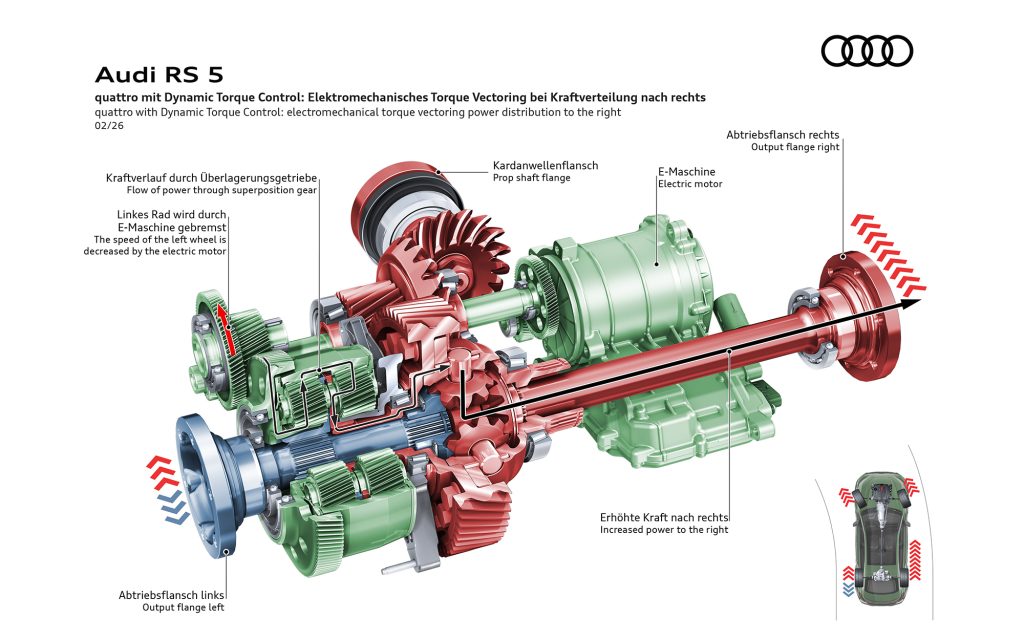
The overdrive gears use the actuator’s torque to transfer this difference to the wheels via the driveshafts. Unlike purely mechanical systems, electro mechanical torque vectoring can transfer torque in either direction. It operates accurately and reliably, both on and off throttle as well as under braking – irrespective of which way the forces are pushing. The result: both under forceful acceleration and sudden braking, the system’s full potential is always available.
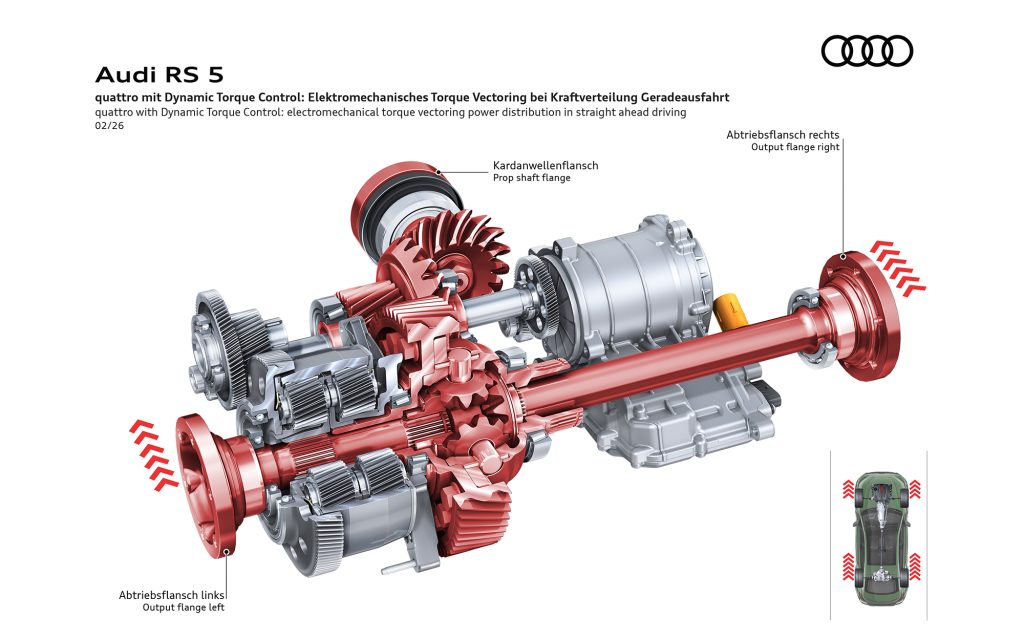
Electro mechanical torque vectoring in the rear transaxle ensures a perfect balance between agility, stability, and traction. In a straight line, the system initially splits torque evenly between both wheels. When necessary, it shifts it to the wheel with better traction – guaranteeing the Audi RS 5* maximum acceleration. When entering a corner, the torque differential has a stabilizing effect for high directional stability. At corner exit, torque is shifted to the outer wheel where it helps rotate the vehicle and realize its acceleration potential. Because the torque vectoring can be tuned differently for different cornering phases and different drive select modes, drivers can experience a broad range of driving characteristics in their RS 5*.
The driving dynamics controller (HCP1) makes this possible. It continuously analyzes many different input values: the driver’s inputs – such as steering angle, throttle position, and brake pressure – are all taken into account. As is data about the vehicles current state – such as longitudinal and transverse G forces, yaw rate, slip angle, speed, and the surface’s estimated friction coefficient. All computations happen in one place. At a frequency of 200 Hz – meaning every five milliseconds – the driving dynamics controller calculates the target differential torque for the given driving situation. This is then applied by the electro mechanical torque vectoring with the utmost dynamics and precision.
This rapid and exact torque distribution supports drivers under sporty as well as tricky driving conditions. During fast cornering, it means the RS 5* turns in more readily and has immense traction on corner exit, during sudden lane changes on the highway it ensures safety and directional stability. The car reacts precisely and directly to steering inputs for the highest level of control and agility in any conditions and on any surface.
Put simply, the innovation of quattro with Dynamic Torque Control combines the advantages of a conventional limited-slip differential with that of mechanical torque vectoring systems – without their drawbacks. The result: a highly dynamic and controllable system that ensures driving fun, stability, and safety both in day-to-day driving and at the limit.
AGILE: THE CHASSIS
The accurate interplay between all suspension components defines the driving characteristics of the Audi RS 5*. The standouts: optimized and RS-specific front and rear axles, RS sport suspension with innovative twin-valve shock absorbers, RS-tuned steering, large 20-inch and 21-inch wheels shod in specifically tailored tires, and powerful steel or ceramic brakes. The unibody is ten percent stiffer than the base model’s, reducing flex under high load and ensuring an even tighter and more controlled driving feel – the connection with the road is perceptibly more direct.
In order to optimally handle longitudinal and lateral forces, the Audi RS 5* uses five-link suspension front and rear. The front axle went through targeted redevelopment: new joints, links, and rubber bushings noticeably improve suspension tuning. More precise and agile handling with higher comfort is the result. Furthermore, the improvements make for more stable road holding, more direct reactions to steering inputs, and more effective damping of vibrations and bumps.
quattro all-wheel drive with Dynamic Torque Control necessitated sweeping changes at the back. As a result, Audi developed the rear axle of the RS 5* from a clean sheet. Compared to the predecessors, the elastokinematic properties have significantly improved. Elastic deformations ensure the wheels perfectly follow the road under high load – such as during acceleration, braking, or cornering. Since they remain in constant stable contact with the road, the vehicle drives in a more precise, safe, and agile way, with more grip and control, remaining composed during sporty driving.
The new RS sport suspension with twin-valve shock absorbers plays a major role in the muscular models balanced handling. Twin-valve technology allows the shock absorbers to provide both a very comfortable ride and an extremely sporty driving experience, as both compression and rebound can be controlled independently. It also noticeably reduces pitch and roll, and means the dampers respond very quickly to changing road conditions. The RS 5* stays on track, even in dynamic situations, and offers high everyday comfort. The Audi drive select modes mean drivers can tailor the suspension to their liking, from extremely compliant to maximally sporty.
The RS sport suspension’s dampers weren’t just tested on the road and the racetrack. Audi Sport also put them on a hydro pulse system – a special test facility – to optimally tune them under extreme conditions. Variations in wheel loads are minimal, even under conditions way beyond anything seen on the road.
The system simulates drastic shocks from the road surface, such as potholes, hard weight transfers, and high speeds on uneven terrain – precisely, repeatably, and with higher forces than real driving. This enables Audi to design a suspension setup that doesn’t just allow for controlled dynamics in day-to-day driving but also offers full control, stability, and feedback under extreme conditions.
The RS sport driving mode was tuned for maximum traction and speed using this facility. As a result, the RS 5* – with its curb weight of 2.355 kilograms (Sedan) or 2.370 kilograms (Avant) – delivers pure performance with precise handling, impressive stability, and feels quick on its feet.
The steering in the RS 5* has been RS-tuned. It reacts instantly and precisely to inputs. At 13:1, the steering ratio is much more direct than the base model’s and offers particularly exact feedback as well as rapid reactions to small steering inputs. Close integration with the electronic stability control (ESC) delivers stability and control, while reduced steering weight guarantees effortless handling. For confident inputs during fast cornering, steering weight is reduced further – a perfect combination of power, feeling, and technique.
The integrated brake regulation system (iBRS) of the RS 5* is blending-capable and operates through brake-by-wire. During deceleration, the system primarily uses regenerative braking
(recouperation), only when more braking force is needed are the friction brakes deployed. A newly developed and specifically tuned ABS software version 2.0 ensures finely dosed and direct adjustments and meshes perfectly with the steel or ceramic brakes’ high performance. As a result, the RS 5* offers fast and safe braking under any conditions.
Forged 21-inch RS wheels in a six-twin-spoke design are fitted on all four corners; the rears are wider than the fronts (10,5 J versus 10 J). This means a slightly larger contact patch. More rubber meets the road which supports higher lateral forces for more grip in corners, more stable handling, and more precise turn-in since the tire deforms less.
As standard, the car is equipped with 20-inch RS steel brakes, their disks have a diameter of 420 mm at the front and 400 mm at the rear with a choice of black or red calipers. As an option, 21-inch RS ceramic brakes are available. Here, the disks measure 440 mm at the front and 410 mm at the rear, and customers can also choose between black and red calipers. The ceramic brakes are around 30 kilograms lighter than their steel counterparts, extremely heat resistant, and more durable – advantages that mainly come into play under sustained heavy use. In a segment-first, ceramic disks are also fitted at the rear. With them equipped, an RS 5* travelling at 100 km/h comes to a stop in 30.6 meters – and makes a strong statement for safety and performance. Tires sized 20 or 21 inches stay in contact with the road and have been developed specifically for the RS 5* to guarantee optimal grip and performance.
INDIVIDUALIZED: THE DRIVING MODES
Sophisticated interplay between potent hybrid power, fine-tuned suspension, and electro mechanical torque vectoring that distributes torque between the left and right in milliseconds shapes the extraordinary driving experience the RS 5* provides and makes it more flexible than ever. The car stays manageable at any time. Drivers can choose between different driving modes – from relaxing all-electric travel to uncompromising sportiness. Intelligent energy recovery enables efficiency, and power deployment on tap. The result is a masterful synthesis of technology, precision, and pure driving fun.
GET OFF THE LINE AT ANY TIME: BOOST FUNCTION ON A BUTTON
Full power is available at the push of a button thanks to the boost function. Press it, and the performance hybrid deploys maximum acceleration for ten seconds – perfect for quick overtakes. When the function is activated, the gearbox selects the perfect gear to ensure instant, direct, and dynamic acceleration. A countdown in the driver information display shows how much of the ten seconds of boost remains. Afterwards, the system returns to the previously selected driving mode. Indeed, the function can be triggered while any drive select mode is active. When the boost button is pressed during all-electric driving, the 2.9-liter V6 TFSI engine is instantly ready to offer the car’s full power potential. At the same time, the exhaust valves open for an extra emotional sound experience.
ONE RS, MANY FACETS: THE AUDI DRIVE SELECT MODES
The Audi drive select modes cover an exceptional range of characteristics. Between comfort, balanced, dynamic and the RS-specific modes, they ensure true versatility. All-electric driving is available in comfort and balanced mode to ensure whisper-quiet travel in town and even on longer distances, while driving feels decidedly harmonious and handling on corner exit remains neutral.
At the touch of a button, the RS 5* transforms from relaxing travel companion to rear-biased canyon carver. Its dynamics can be precisely controlled – from neutral to intentional oversteer. In dynamic mode, the RS 5* responds even more directly and immediately to steering and throttle inputs. The car remains neutral off center, while a noticeable rear bias at corner exit ensures particularly dynamic acceleration. Reduced yaw damping at the limit makes the vehicle behavior even more lively – ideal for a sporty, direct driving experience with maximum feedback.
The RS torque rear mode, coming to the RS 5* for the first time, stands for maximum rear bias and controlled drifts on closed courses. In this driving mode, a particularly high proportion of torque is directed to the outside rear wheel. This makes the RS 5* feel extremely agile and playful – while maintaining full control and manageability. One highlight: the Audi driving experience function allows precise recording and evaluation of torque rear driving. Data such as lap times, distance covered, and drift angle can be recorded and analyzed later.
The RS sport mode stands for maximum propulsion without compromise. The neutral handling characteristics are specifically tuned for enormous lateral acceleration. As a result, the vehicle remains particularly agile in corners and precisely controllable with the highest traction on corner exit, even at high speeds and during dynamic driving maneuvers.
In RS individual mode, the RS 5* can be tailored entirely to personal preferences: customers can individually configure steering, suspension, throttle response of engine and electric motor, sound, ESC, and the electro mechanical torque vectoring – for a driving experience that aligns exactly with their own preferences.
In true RS fashion, gear changes in dynamic, RS sport, and RS torque rear are quick, precise, and forceful. The RS sport exhaust system underscores every throttle input with rich, full-bodied sound.
‘
INTELLIGENT ENERGY RECOVERY: COASTING AND BRAKING RECOUPERATION
The times during which the driver doesn’t have their foot on the throttle are of major importance to the plug-in hybrid’s efficiency. Energy recovery (recouperation) is controlled depending on the selected gear in accordance with a pre-defined deceleration rate. In addition, automatic recouperation can be activated via the MMI. It lets the vehicle vary regeneration automatically.
While the RS 5* is moving under electric power, the regen rate can be adjusted during coasting in three stages using the paddles on the steering wheel – just like on the all-electric models. The new RS 5* has two operating modes: “EV” and “Hybrid.” In EV mode, the high-performance model relies solely on electric propulsion. Besides automatic operation in Hybrid mode, a preferred state of charge for the battery can be selected using a digital slider, meaning users have full control over how far the battery is charged.
For example, they might decide to set it to a level that allows all-electric motoring near a destination that doesn’t have a charging point. Predictive operating strategies optimize energy planning for the upcoming route. The aim is to cover city driving and traffic jams on electric power – for more efficiency, lower local emissions, and a hybrid experience.
Whenever the selected state of charge (SoC) is below the current SoC, the battery is discharged to this value. As long as both values are the same, the combustion engine propels the car, saving battery charge. If the target SoC is above the current SoC, the combustion engine charges the high-voltage battery. During driving, the battery can be charged up to 80 percent. The RS 5* not only keeps the battery charged to maximize efficiency and minimize emissions, but also to enable sporty driving. While dynamic mode is active, the battery is never discharged below 20 percent to ensure sufficient reserves to deploy the boost function. In the modes RS sport and RS torque rear, the battery never goes below 90 percent. This means drivers always have access to full electric power for sporty maneuvers or dynamic acceleration.
‘
INTENSIFIED: THE DESIGN
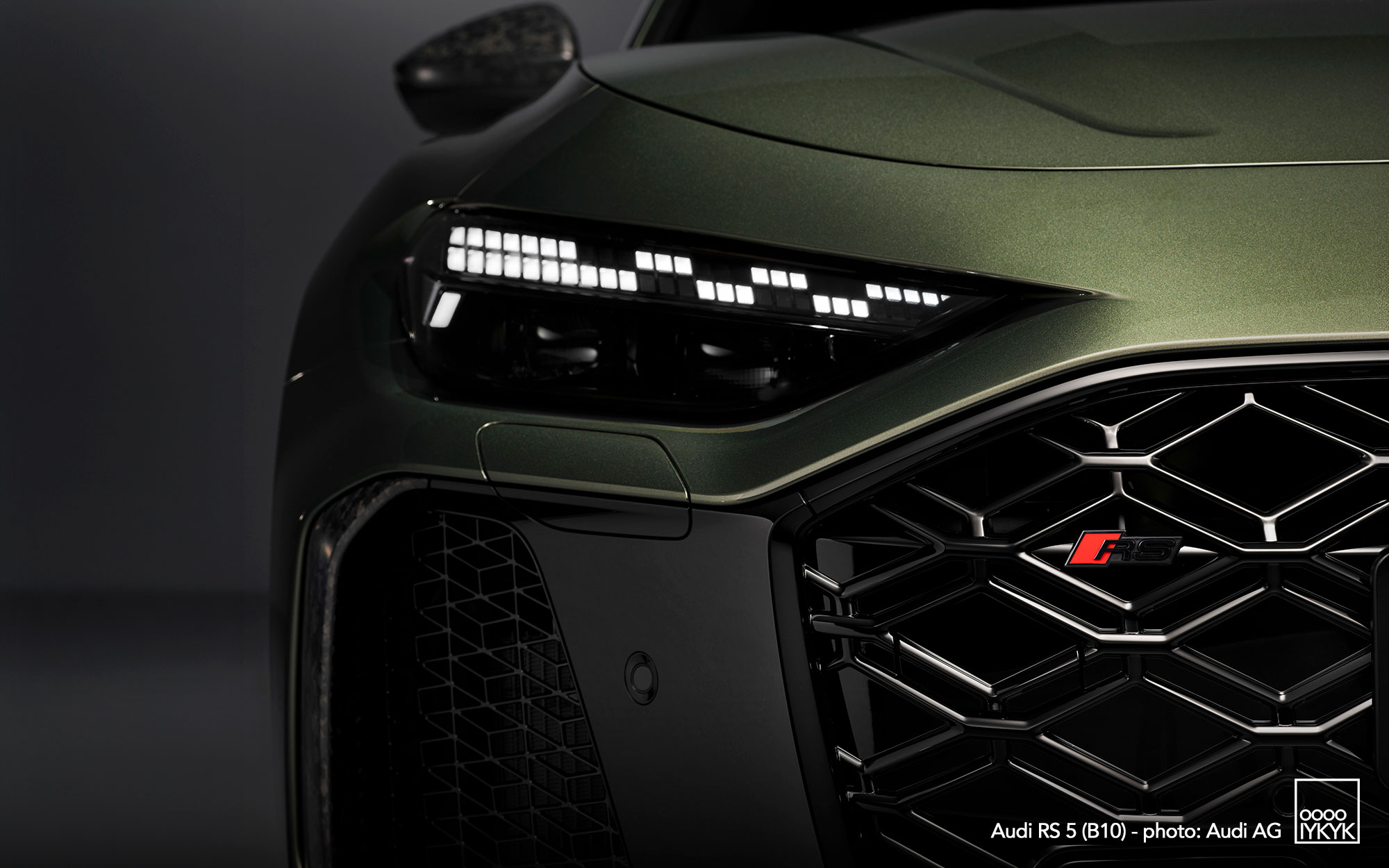
The Audi RS 5* delivers motorsport performance for the road – as is also evidenced by its styling. The optional darkened Matrix LED headlights feature an RS-specific digital day-time-running-light signature in a checkered-flag design. Matching RS-specific coming-home and leaving-home lighting scenarios reinforce the car’s dominant appearance even standing still.
THE EXTERIOR: A PURISTIC POWERHOUSE
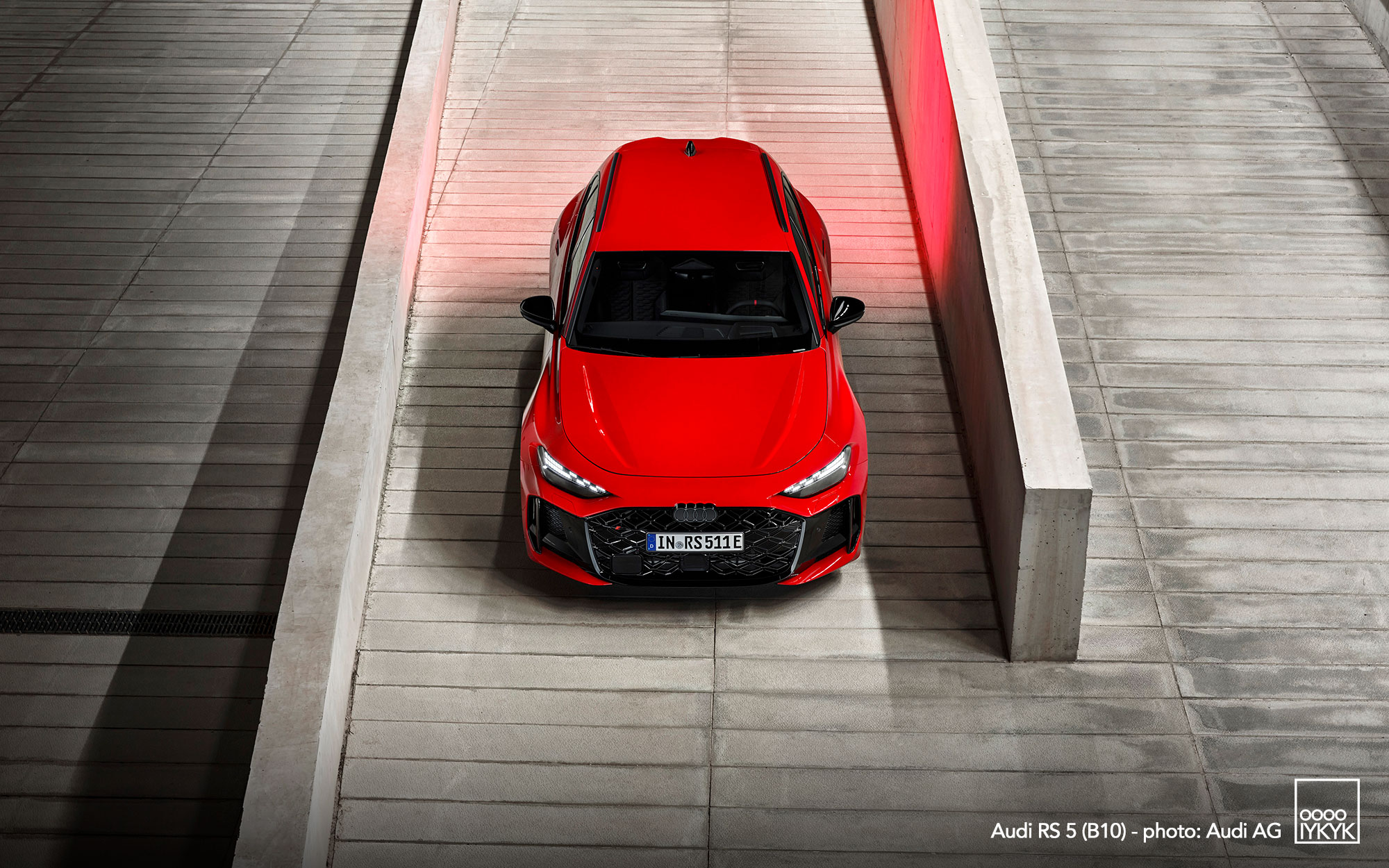
With a long wheelbase, large wheels, and low body, the Audi RS 5* always looks ready to pounce. The Sedan with its coupé-like silhouette is a symbiosis of design and functionality: the compact cabin seamlessly flows into the shallow rear window and what appears to be a short trunk lid with a striking ducktail. In actual fact, the shallow rear window is part of the trunk lid – creating plenty of space for loading and unloading. This design makes dynamics visible and increases practicality.
Just like its famous ancestors, the new RS 5* features a typically muscular RS-build. Compared to the base model A5, it has been widened by four centimeters on either side both front and rear. The Singleframe with a three-dimensional honey-comb grille dominates the front. A dark mask links it to the Air Curtains that control airflow around the front wheels, underlining the design’s functional aspects. Air vents in front of and behind the fenders underline the model’s strong presence. Powerful sculpted wheel cutouts purposefully protrude from the shoulder line – a clear homage to the legendary Audi Ur-quattro and an unmistakable trait of the RS DNA.
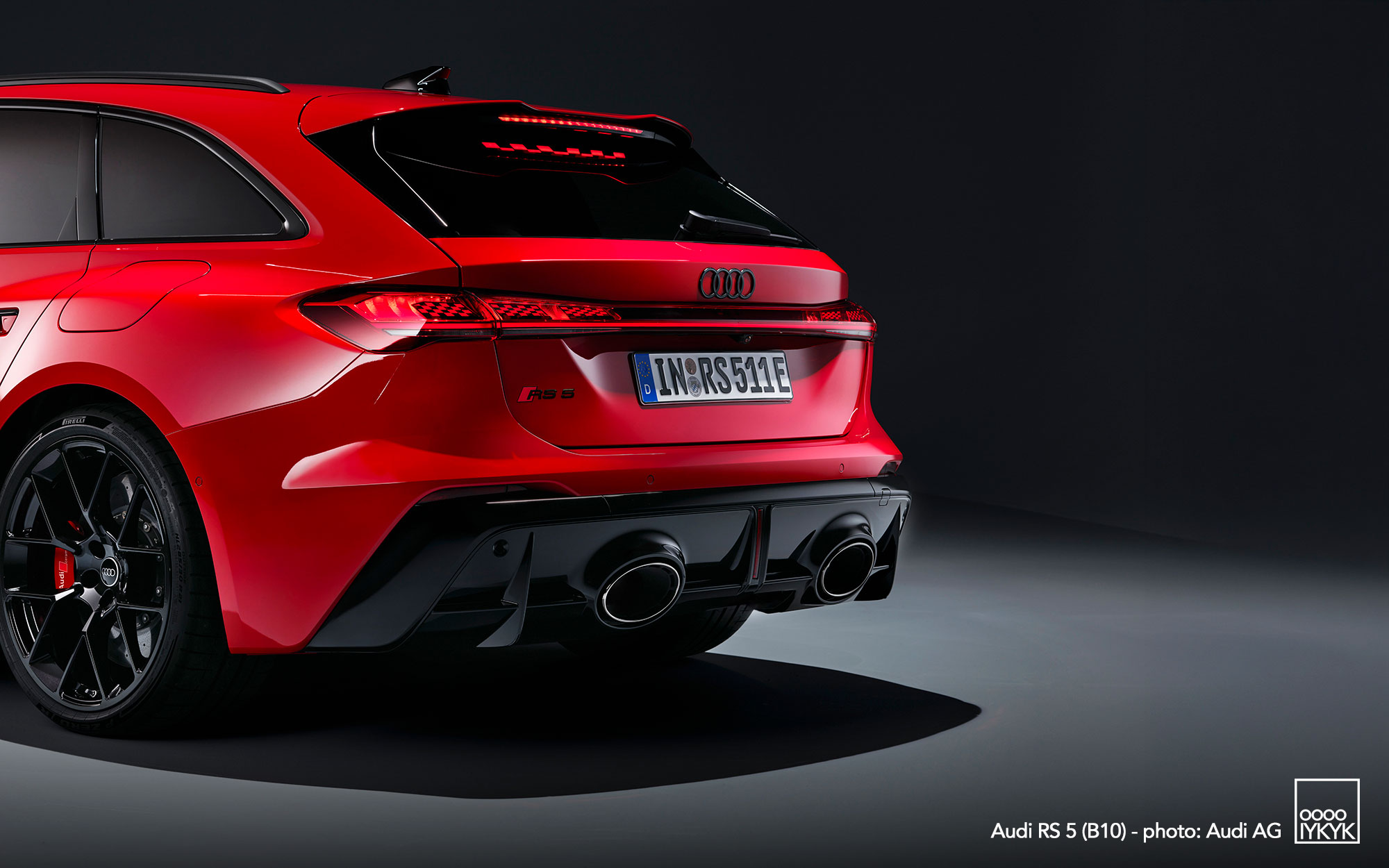
The rear impresses with an strongly modeled diffuser featuring vertical fins for maximum aerodynamics. The RS exhaust system’s tips are centrally positioned and have matte oval tailpipes. The exhaust system was developed from scratch. Its valves can open to any position, creating the right soundtrack for each driving mode. In a nod to the motorsport heritage of the RS 5*, a red reflector is vertically placed in the center of the diffuser.
LIGHT: VISIBILY EXCLUSIVE & SAFE
Its lighting technology reinforces the unmistakable character of the RS 5. The second-generation digital OLED rear lights make a convincing statement for design, functionality, and safety on the road. The exclusive light signature is designed to look like a checkered flag.
Nothing is left to be desired when it comes to safety functions in the RS 5. Like its sister models from the A5 model series, the high-performance hybrid’s digital OLED rear light 2.0 comes with communication light that can improve safety on the road. For example, it can warn other drivers ahead of accident and breakdown sites. In addition, the communication light displays a specific additional graphic with warning symbols in critical driving or traffic situations.
FORM FOLLOWS PERFORMANCE – AND LEAVES AN IMPRESSION
As standard, Audi Sport paints the RS 5* in one of nine colors, including Ascari blue, Mythos black, and Progressive red (all metallic). For those who make their cars one-of-a-kind, Audi exclusive offers a range of fascinating effect colors – such as Merlin pearl effect, Goodwood green, and Panther black crystal effect. Matte paint in Plateau grey looks especially effective on the RS 5* and is also exclusive to the model.
Style meets substance: to match the paint, Audi Sport offers tailored exterior design packages with different colors and materials.
The blades in the front bumper, inserts in the side skirts, and the diffuser at the rear come in gloss black as standard. The Sedan’s split lip spoiler comes in the same color. The carbon design package turns these elements to glossy carbon for a more sporty appearance. Besides gloss black, the exterior mirrors can be optioned in body color or carbon. A black package is standard on the RS 5*, meaning that trim pieces like the window trim, door handle inserts, and RS badges are always gloss black, the Audi rings always darkened.
The perhaps strongest contribution to the car’s look comes from the wheels. When it leaves the plant in Neckarsulm, Germany, the sportiest member of the A5 family rides on matte grey 20-inch alloy wheels with a 5 Y-spoke design and 285/35 tires as standard. A new RS-exclusive option: impressive forged 21-inch twin-spoke wheels, available in metallic black, Neodymium gray matte, or bi-color diamond-cut and black metallic.
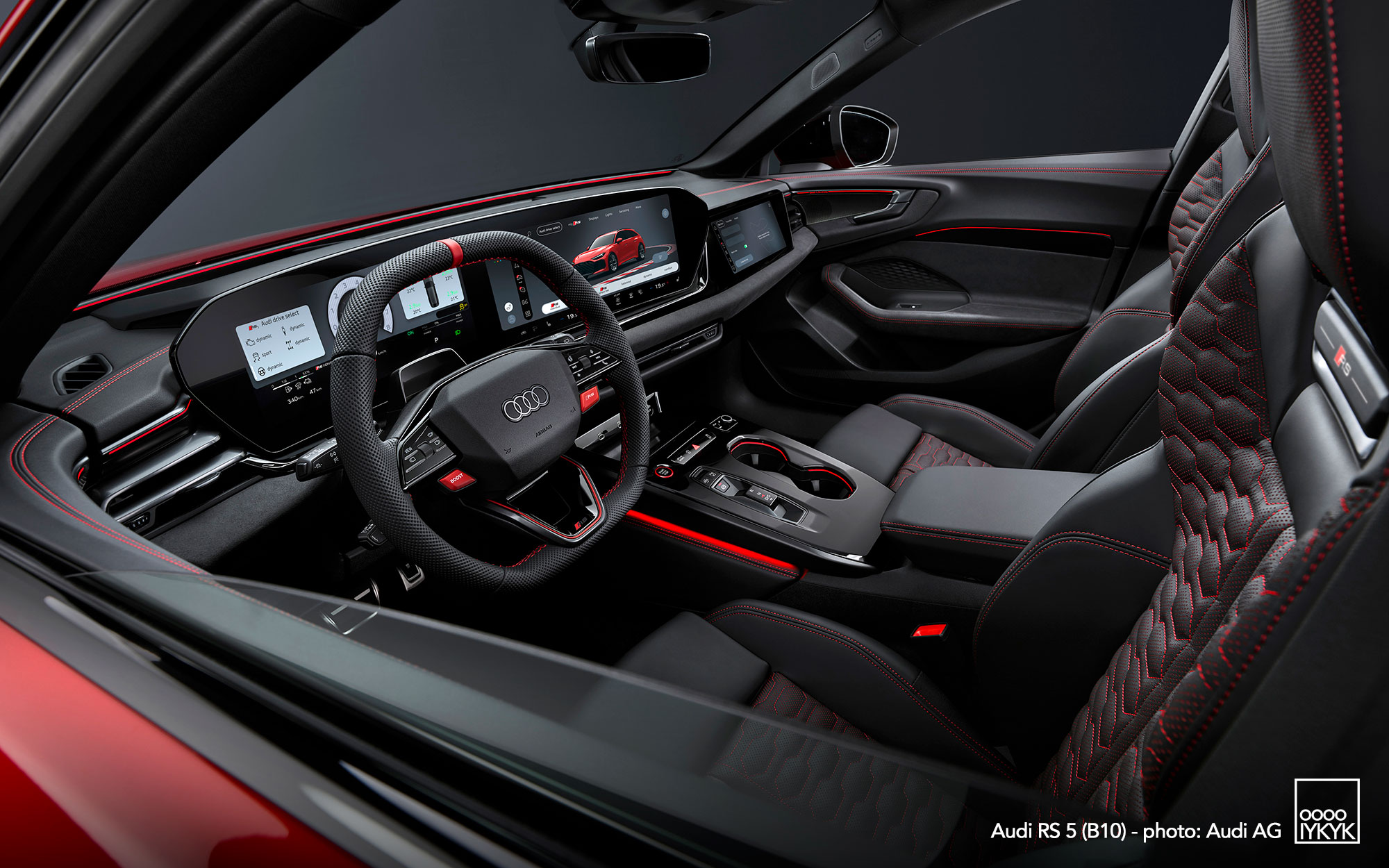
STAY INFORMED DOWN TO A TENTH OF A SECOND WITH RS-SPECIFIC DISPLAYS
The cockpit in the RS 5* is an ultra-modern, driver-oriented command post. At its center is the slim, free-standing Audi MMI Panorama display that shows the most important information at a glance. It is made up of the 11.9-inch Audi virtual cockpit and the 14.5-inch MMI Touch Display, has a curved design, and is powered by OLED technology. A 10.9-inch passenger display is standard fit and further augments the digital experience. It allows passengers to help drivers operate vehicle and navigation functions – or they can just enjoy their own entertainment spanning from media content to interactive features.
The Audi virtual cockpit offers sporty dials tailored to the RS 5* that display engine revolutions, speed, and a shift light. Keen drivers can also access performance data like G forces, temperatures and pressures for individual tires, lap times, as well as detailed information to the drivetrain, power, and acceleration.
The optional configurable head-up display brings information even closer. It projects data such as engine revolutions, speed, and the current gear onto the windshield – styled as a dial if the driver likes. The shift indicator is a special focus, precisely visualizes the ideal moment to change up. The head-up display can also show acceleration and a launch control guide.
The 14.5-inch MMI touch display of the RS 5* not only houses the well-established comfort and infotainment functions from the A5 model series but also elevates the driving experience to a new level. Being a plug-in hybrid, the model displays a detailed real-time representation of energy flows – both under acceleration and regenerative braking. The temperatures of tires, the transmission, the rear transaxle, and the battery can also be shown.
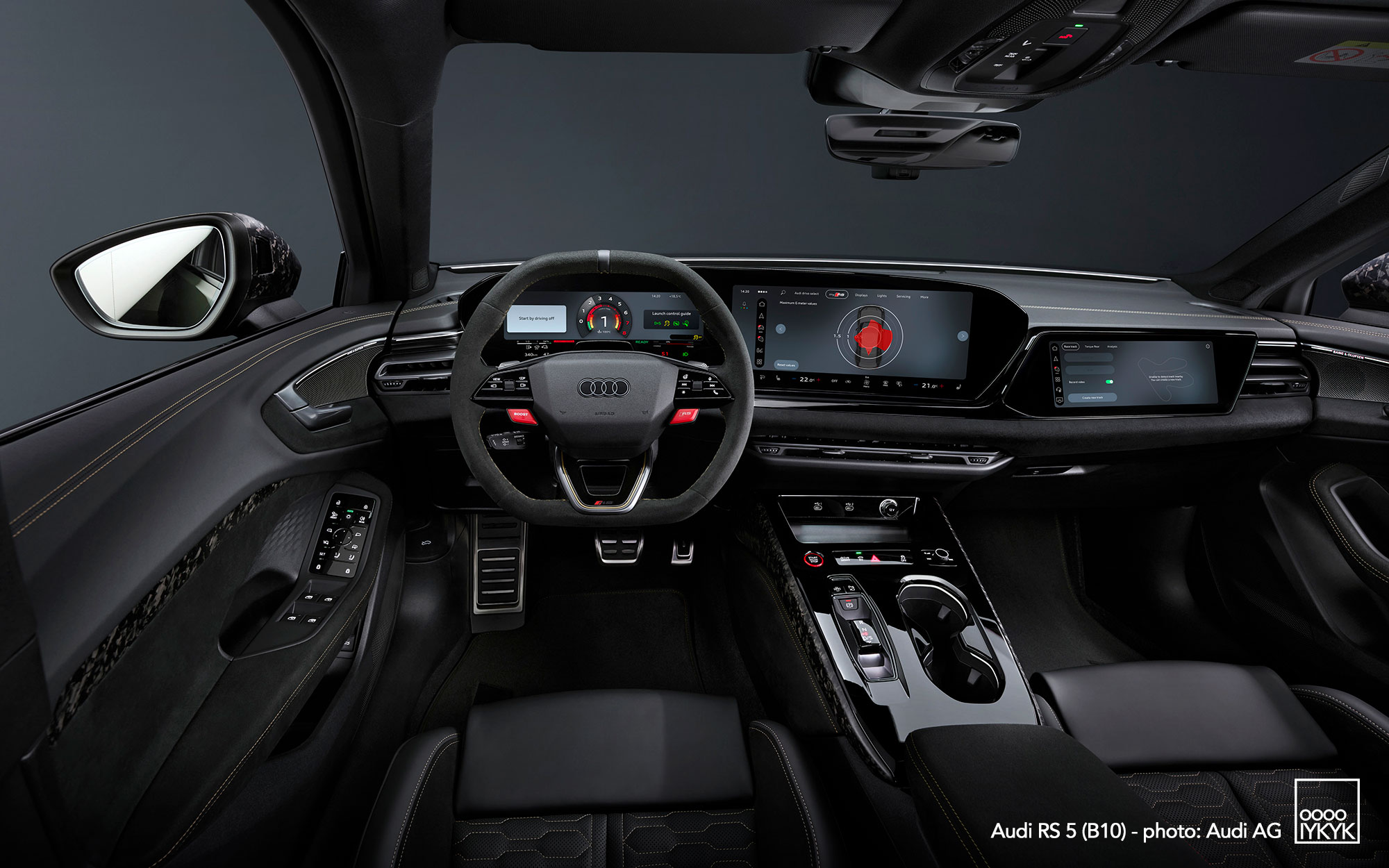
AUDI DRIVING EXPERIENCE: A HIGHLIGHT FOR PERFORMANCE ENTHUSIASTS
The factory-fitted Audi driving experience function enables particularly in-depth analysis of driver’s actions – including on world-famous race tracks, if desired. The RS 5* records data on accelerator and brake pedal use, oversteer and understeer, as well as lateral, longitudinal, and overall acceleration. Lap and sector times can be recorded accurately, saved, and compared across multiple runs.
Even unknown or private racetracks are no problem: the RS 5* automatically creates new track profiles based on a recorded lap. Users can also set up individual sectors and compare them later with previous laps – including split times and analysis of individual track segments in terms of lateral acceleration and other parameters. For a complete experience, drivers can document their journey on video: an optional dashcam, discreetly integrated into the rearview mirror, visually captures highlights, and driving achievements.
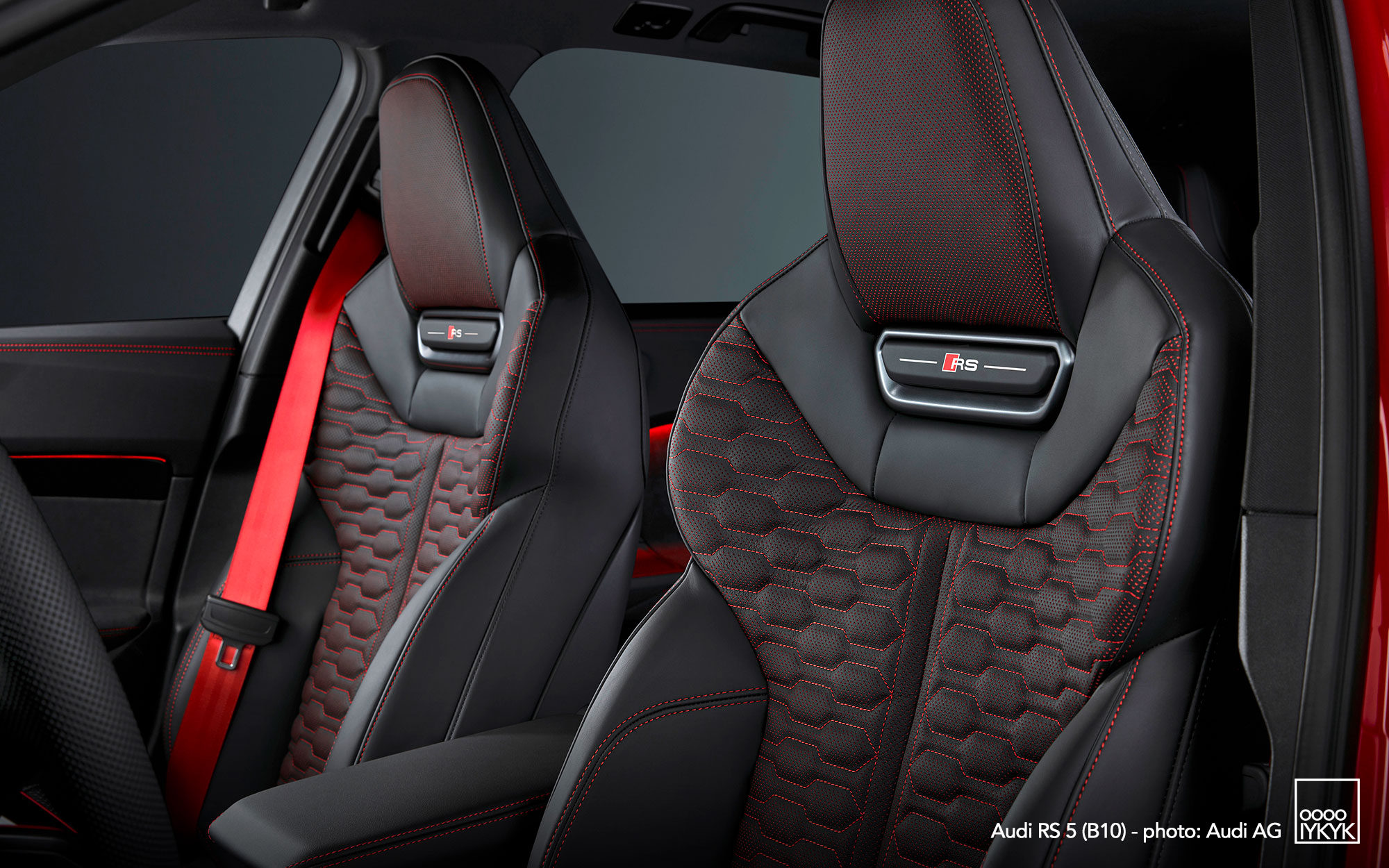
AN INTERIOR TO MATCH: UNCOMPROMISINGLY RS
The interior of the all-new RS 5* delivers the uncompromising sportiness that only an Audi Sport RS model can guarantee. Up front, sport seats plus with honeycomb quilting provide not only exceptional lateral support but also deliver outstanding comfort on extended drives. Electric adjustments and standard massage functionality ensure driver and passenger satisfaction on every journey.
Customers can choose from five distinct interior designs, each differentiated by unique materials and color schemes. They all share maximum RS differentiation, including full-length color-coordinated seat belts and RS logos on all floor mats matched to each interior color. Complementing each design, the headliner is consistently finished in black across all configurations.
The leather-free base interior features sport seats plus with Cascade cloth on the center seat panels – a sustainable material produced from textile offcuts and recycled polyester. The inner seat bolsters utilize Dinamica, a microfiber material that looks and feels like suede. It contains up to 47 percent recycled polyester sourced from textile offcuts. Dinamica also appears throughout other interiors in the knee pad, Softwrap, instrument panel, door mirrors, door armrests, and center armrest. As an alternative to the leather-free interior, customers can opt for genuine leather interiors in red or gray. These feature sport seats plus with climate control functionality. Contrast stitching flows cohesively throughout the entire cabin.
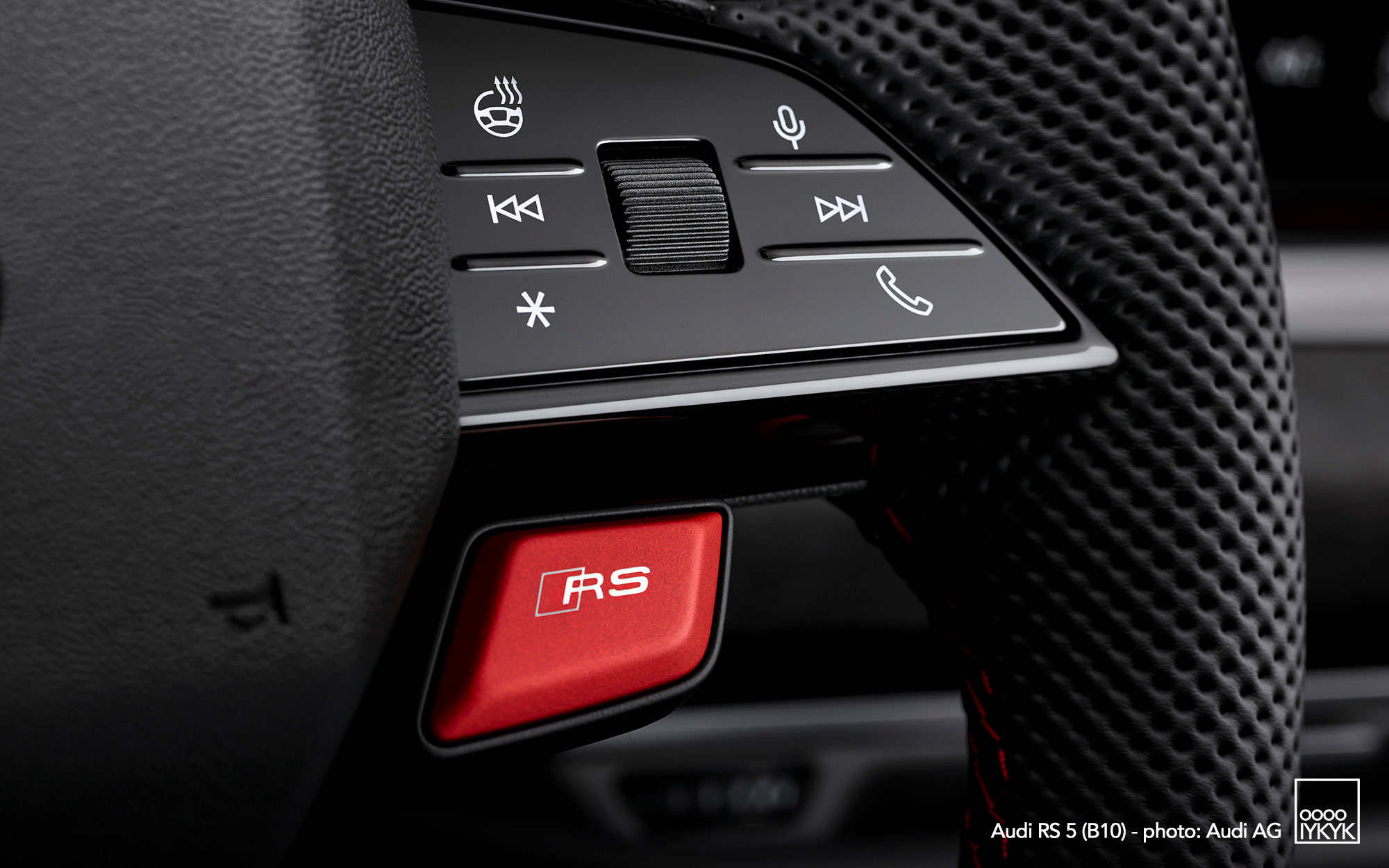
The instrument panel, armrests, and door trim are executed in soft Dinamica microfiber in black. The flat-bottom RS steering wheel matches the interior and is wrapped in perforated Nappa leather with a color-coordinated 12 o’clock marker in smooth leather. The clasp on the lower spoke is finished in red. Integrated RS satellite controls on the steering wheel enable direct selection of RS drive modes and activation of the boost function.
For the red interior, customers can also choose a variant with dynamic color accents. In this configuration, all interior elements except the seats are finished in Dinamica deep black for an especially sporty appearance – including the steering wheel, knee pads, armrest, Softwrap on the instrument panel, and door armrests.
Contributing to the athletic ambiance are highlight surfaces throughout the interior, finished as standard in dark metallic vanadium. These include the shift paddles, Audi emblem and steering wheel clasp, door handles, door sill inlays, air vents, and – exclusive to RS – the illuminated seat frame trim with RS logo.
To complete the interior, various decorative inlays are available: open-pore carbon micro twill, matte brushed aluminum with linear embossing in anthracite, and – exclusive to the RS-model – aluminum rhombus in black lacquer.
THE OPTIONAL AUDI SPORT PACKAGE: DESIGN MEETS PERFORMANCE
Audi Sport offers a new and exclusive option for those seeking to further individualize their
RS 5: the optional Audi Sport package delivers maximum equipment in design, sound intensity, performance, and personalization.
With this package, the front air intakes are even larger and more athletically styled, while the rear diffuser takes on a more dynamic design. For exterior colors, Audi Sport recommends Bedford green metallic – this color is exclusively available with the package. An exclusive variant of the 21-inch wheel in black with diamond-cut finish (bicolor) and satin matte coating is a perfect match. Behind them, the optional ceramic brake system gleams in the exclusive bronze color variant. The RS sport exhaust system with matte black tailpipes is also included, delivering an unmistakable RS sound. Additionally, the new RS 5 with the Audi Sport package achieves a top speed of 285 km/h.
The exclusive interior captivates with an absolutely athletic appearance. The leather seats are accented with Dinamica in deep black on the seat and backrest side bolsters, while Dinamica in deep black also dominates the remaining interior surfaces including the steering wheel. Brass-colored accents and contrast stitching in Serpentine green create striking contrasts – the color is offered for the first time. The seat stitching with honeycomb quilting, seat belts, floor mat stitching with RS logo, and steering wheel with specific 6 o’clock insert are exclusively accentuated in this color for the Audi Sport package.
The new Carbon Camouflage package is exclusively available in conjunction with the Audi Sport package. It includes exterior wings on the front fascia, inserts in the side sills and rear fascia, plus exterior mirror housings all in forged carbon. Inside, the decorative inlays are also executed in matte Carbon Camouflage. Optionally, the Audi Sport package can be combined with different interiors and 21-inch wheels.
Fuel/electric power consumption and emissions values of the models named above (preliminary figures):
Audi RS 5 Avant
Fuel consumption (weighted, combined): 4.5-3.9 l/100 km (52.3-60.3 US mpg) (preliminary values); power consumption (weighted, combined): 18.7-17.8 kWh/100 km (preliminary values); CO2 emissions (weighted, combined): 102-88 g/km (164.2-141.6 g/mi) (preliminary values); CO2 class (weighted, combined): C-B (preliminary values); Fuel consumption on discharged battery (combined): 10.2-9.6 l/100 km (23.1-24.5 US mpg) (preliminary values); CO2 class on discharged battery: G (preliminary values)
Audi RS 5 Sedan
Fuel consumption (weighted, combined): 4.3-3.8 l/100 km (54.7-61.9 US mpg) (preliminary values); power consumption (weighted, combined): 18.4-17.7 kWh/100 km (preliminary values); CO2 emissions (weighted, combined): 98-86 g/km (157.7-138.4 g/mi) (preliminary values); CO2 class (weighted, combined): C-B (preliminary values); Fuel consumption on discharged battery (combined): 10.0-9.5 l/100 km (23.5-24.8 US mpg) (preliminary values); CO2 class on discharged battery: G (preliminary values)