

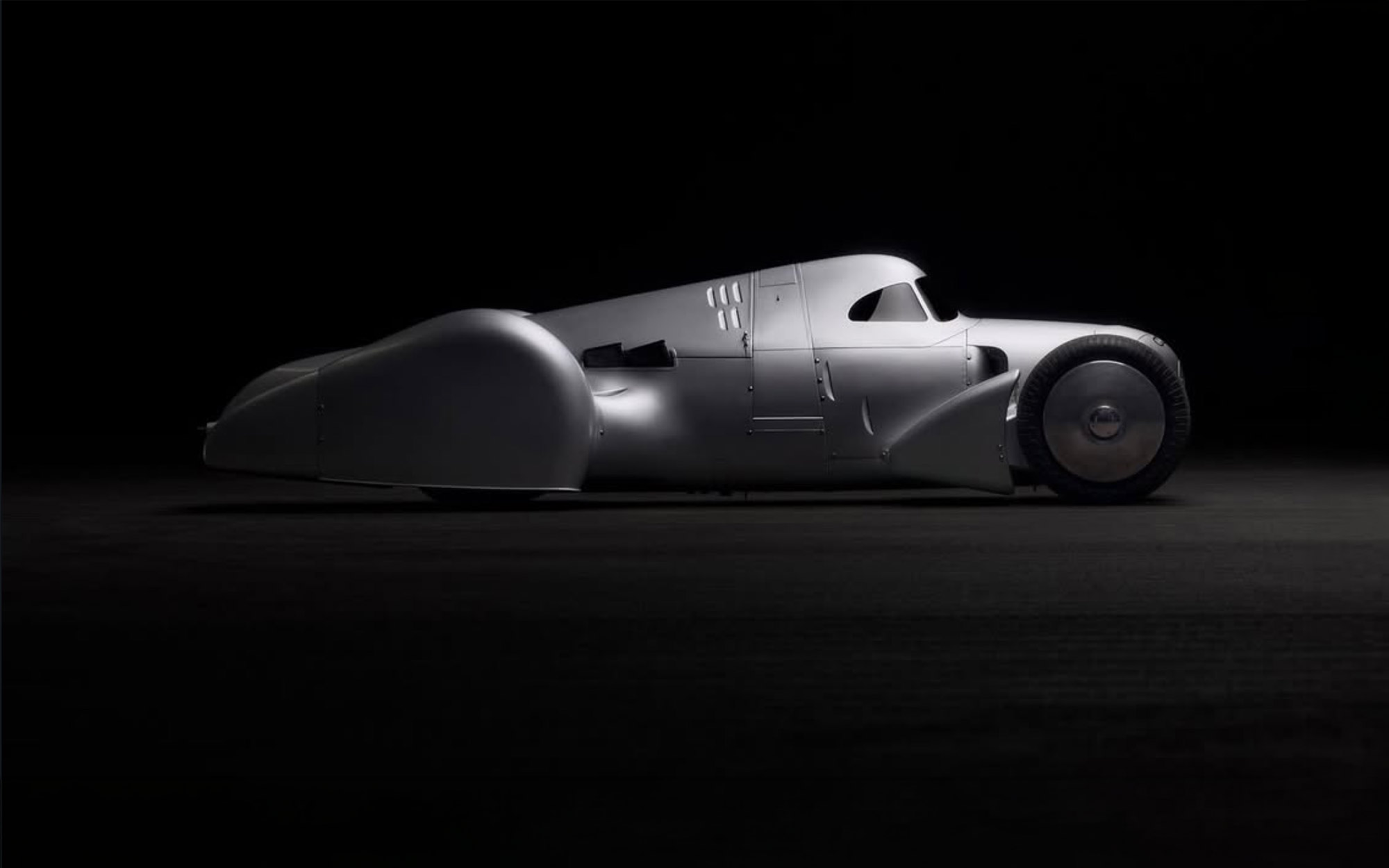

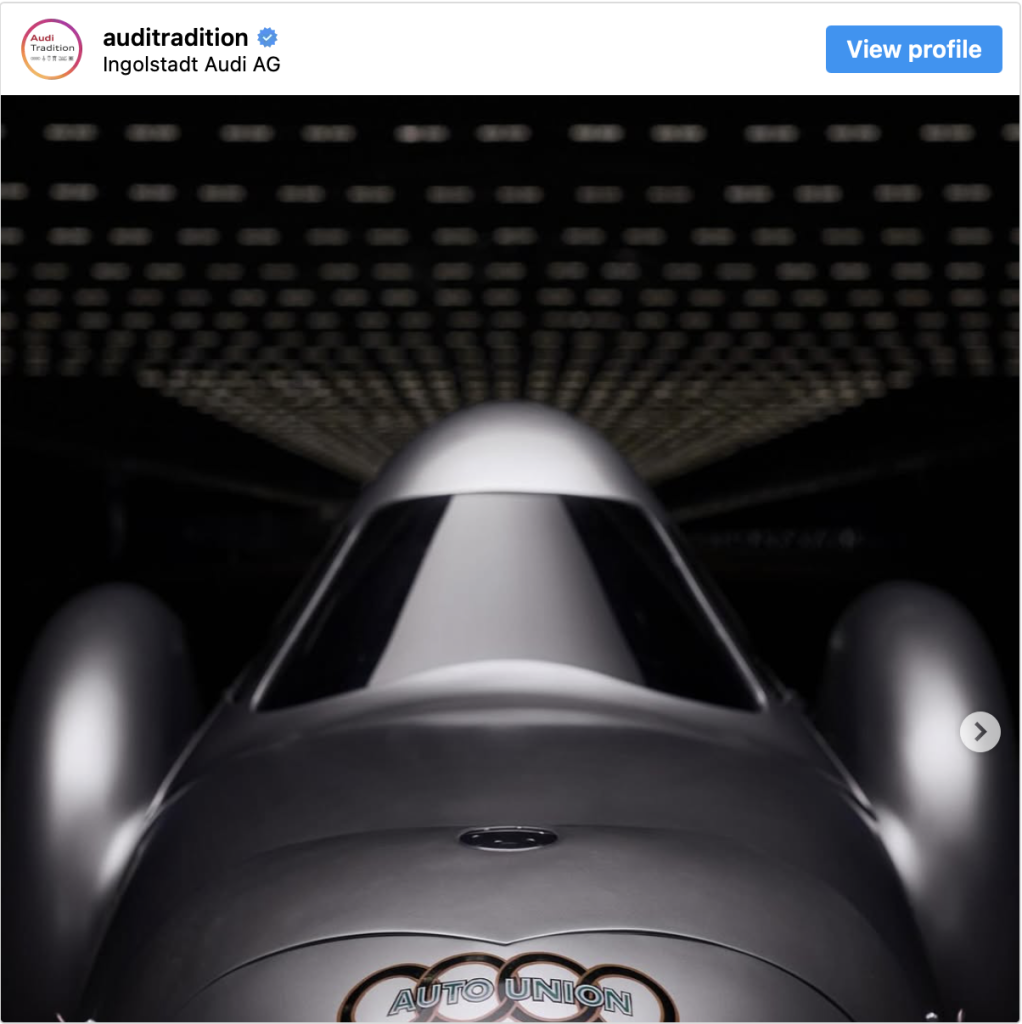
At the end of April, just last week, Audi Tradition dropped a teaser video of something old and new to come from them on May 6. In that video, the unmistakable profile of an Auto Union Rekordwagen was visible. Now, 24 hours before the official reveal, Audi’s archive and classics division has dropped a few actual photos revealing the car to be just that, and more specifically the Auto Union Type B Lucca.
We don’t know full details yet and will likely learn all that tomorrow, but here’s what we do know.
REKORD WAGEN & TYPE LUCCA SPECIFICALLY
The Auto Union Type B Rekordwagen was a specialized, streamlined derivative of the 1935 Grand Prix Type B, created specifically for high-speed record attempts rather than circuit racing. While the standard Type B introduced a more powerful supercharged V16 and numerous chassis refinements over the Type A, the Rekordwagen variant went further with a fully enclosed, aerodynamically optimized body designed to minimize drag at sustained high speeds.
Its defining moment came in early 1935 on the Autostrada Firenze–Mare near Lucca, where Hans Stuck drove the streamlined Type B to a new flying kilometer world speed record of 320.267 km/h (199.0 mph). This run not only surpassed the existing Mercedes-Benz benchmark but also demonstrated the effectiveness of Auto Union’s aerodynamic experimentation—an area heavily influenced by contemporary streamlining theory and increasingly critical in the escalating “Silver Arrows” speed war between the two brands.
The Lucca car—often referred to as the “Typ Lucca”—featured a closed body that contrasted sharply with the open-wheel Grand Prix machines used elsewhere in the 1935 season. It effectively served as a bridge between Auto Union’s race cars and later, more extreme streamliner record machines, proving the combination of high-output mid-engined layouts and low-drag bodywork for top-speed competition.
The Lucca record attempt marked the opening salvo of Auto Union’s 1935 campaign, reinforcing its technical credibility before the Type B transitioned back into conventional Grand Prix competition use. It also underscored the brand’s parallel development paths at the time: one focused on circuit success, the other on outright speed records—both central to the engineering narrative that would come to define the Auto Union Silver Arrows era.
THEORIES ON THIS PARTICULAR CAR
The “Type Luca” was believed lost to history. Following its record runs on the Autostrada Firenze–Mare in 1935, the streamlined car’s job was essentially complete. Unlike the core Grand Prix machines, which were continually updated and reused, the Lucca car was a highly specialized, single-purpose record vehicle. As Auto Union evolved its record program—moving toward even more advanced streamliners —the Lucca-bodied Type B would have became effectively obsolete almost immediately.
Period practice within both Auto Union and its rival Mercedes-Benz was to reuse valuable mechanical components while discarding or repurposing bespoke bodywork. The underlying Type B chassis and its supercharged V16 were likely returned to the racing pool or used for further development work, while the unique streamlined body was scrapped.
Even if it had survived in a forgotten corner of the Auto Union werks, the known postwar predicament in which Auto Union silver arrows were placed offered it little if any chance of survival.
In that time following the end of World War 2, most of Auto Union GmbH’s assets including its Ferdinand Porsche-design competition cars found themselves in parts of Germany that ultimately landed behind the Iron Curtain.
That fate shrouds all of those cars in further mystery. For many years, few if any examples were known to exist. Grainy images of tired hauler trucks headed east with Auto Union’s incredible creations aboard supported the historic recount involving Joseph Stalin’s youngest son Vasily. The younger Stalin was an admitted car enthusiast and had the cars brought back to the Soviet Union where he aimed to use them to create his own Soviet national F1 team.
The cars weren’t the only assets utilized. Auto Union engineers also finding themselves in the Soviet occupation zone were enlisted to aid in the process. The result of their efforts, two Sokol-650 racing cars were ultimately built to Formula 2 regulations. Their fate is a whole other story, though one did eventually end up in the museum at the Donington circuit where it is sometimes referred to as the “Auto Union Type E” given development of the Auto Unions ceased with the Auto Union Type D.
Back to the Type Lucca or frankly any Type B Rekordwagen, no complete original example is known to have survived the pre-war period, and—like many early Silver Arrows—any remaining material was almost certainly lost during the upheaval following the war.
Most of what exists today are reconstructions, exactingly built from factory drawings, surviving components and period photography, which help illustrate the Lucca car in enough detail from which to bring it back.
For previous recreations of this type, Audi has worked with the British firm Crosthwaite & Gardiner. If this car is a recreation, we’re guessing it’s been constructed by them.