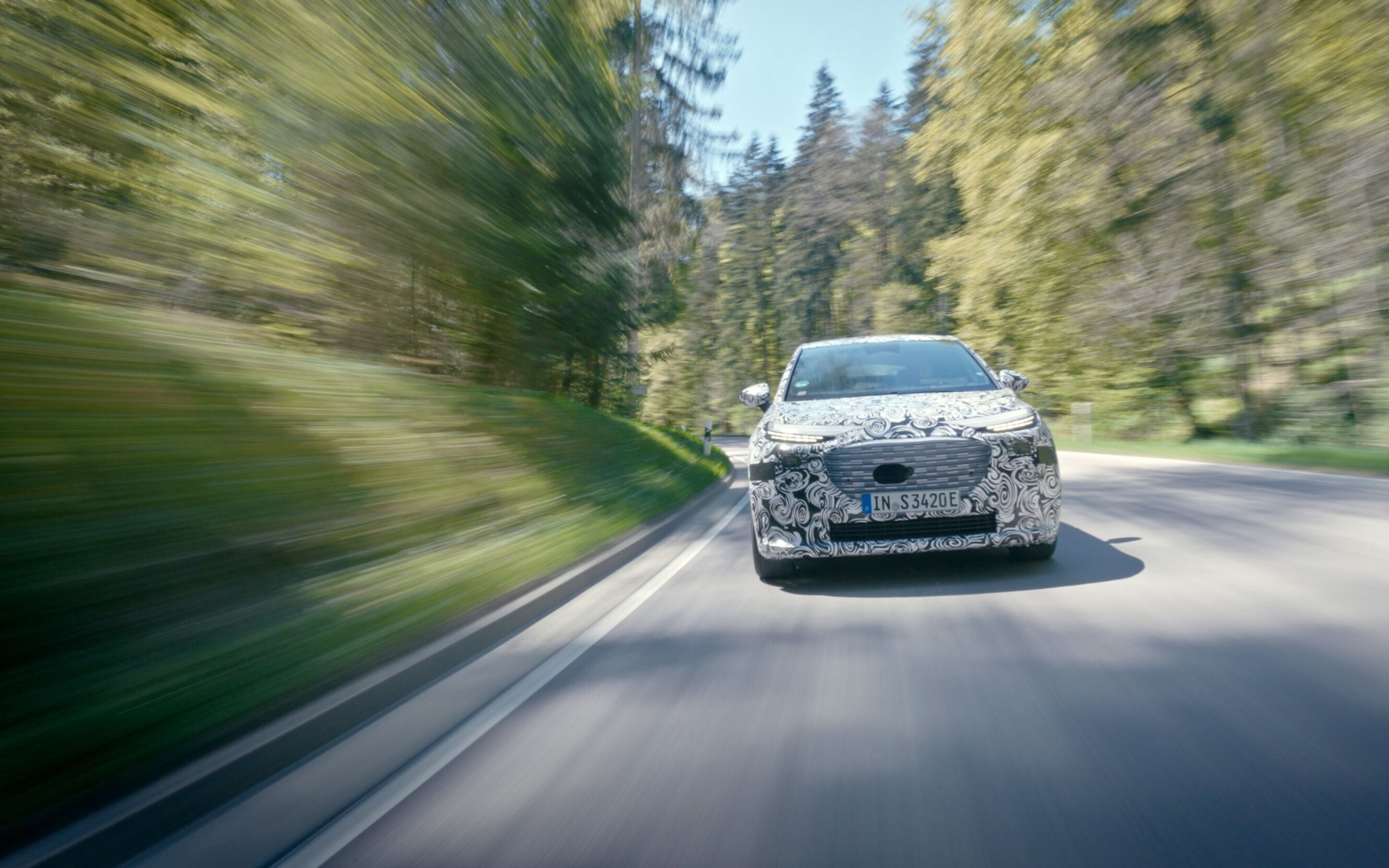

Nearly three decades after the original Audi A2 challenged convention about efficiency, packaging and lightweight construction, Audi is preparing to revive the nameplate for the electric era. The new Audi A2 e-tron is scheduled to debut this fall as an all-electric entry-level model family positioned beneath the brand’s larger EV offerings.
First officially confirmed earlier this year by Audi CEO Gernot Döllner during the company’s Annual Media Conference, the A2 e-tron represents another step in Audi’s broader EV expansion strategy. The company says the model will be built in Ingolstadt and is intended to widen access to premium electric mobility within the compact segment.
With development accelerating ahead of its reveal, Audi has now released additional details surrounding the prototype testing program. Camouflaged development cars are currently accumulating kilometers across northern Sweden, Bavaria and inside Audi’s own technical facilities in Ingolstadt.
‘
Winter testing in Lapland remains one of the most critical phases for any modern EV, particularly when it comes to thermal management and battery efficiency. Audi says engineers are evaluating the A2 e-tron on frozen lakes, snow-covered roads and low-grip test tracks in northern Sweden while fine-tuning the interaction between the electric drivetrain, brake control systems and chassis setup. Extreme cold-weather testing also allows the brand to validate charging behavior, battery conditioning and energy consumption under some of the harshest operating conditions possible.
Aerodynamics appear to be another major focus. Audi says the A2 e-tron’s roofline has been shaped specifically to improve airflow efficiency, a nod to the original A2’s reputation for slippery aerodynamics and lightweight engineering. Testing inside Audi Technical Development’s wind tunnel in Ingolstadt includes wind speeds up to 300 km/h, aeroacoustic analysis and use of a 235 km/h rolling road to simulate real-world conditions while optimizing airflow, cabin noise and thermal stability.
Audi engineers are also conducting public-road testing throughout Bavaria’s Altmühl Valley region, using the area’s steep elevation changes, uneven pavement and winding secondary roads to refine ride quality, steering calibration and driver assistance systems. Audi describes the process as essential for ensuring the car maintains the “unmistakable experience of driving an Audi” despite its entry-level positioning.
While Audi has not yet released technical specifications, the A2 e-tron is expected to play a significant role in the brand’s next-generation compact EV strategy. Its arrival also continues a broader shift at Audi toward electrification across nearly every segment of its lineup. The automaker says that after launching more than 20 new models across 2024 and 2025, it now believes it has one of the youngest portfolios among premium competitors.
The return of the A2 name carries additional significance to those who watch the brand closely. When the original A2 debuted in 1999, its aluminum-intensive construction, aerodynamic profile and unconventional design made it one of the most technically ambitious compact cars of its era. Though commercially polarizing at the time, it went on to develope a cult following among car aficionados and design enthusiasts alike.
Whether the new A2 e-tron can capture that same spirit remains to be seen, but Audi appears intent on positioning it as more than simply another entry-level EV. With testing now expanding into public view, the wait for Audi’s next compact experiment is entering its final stages.