

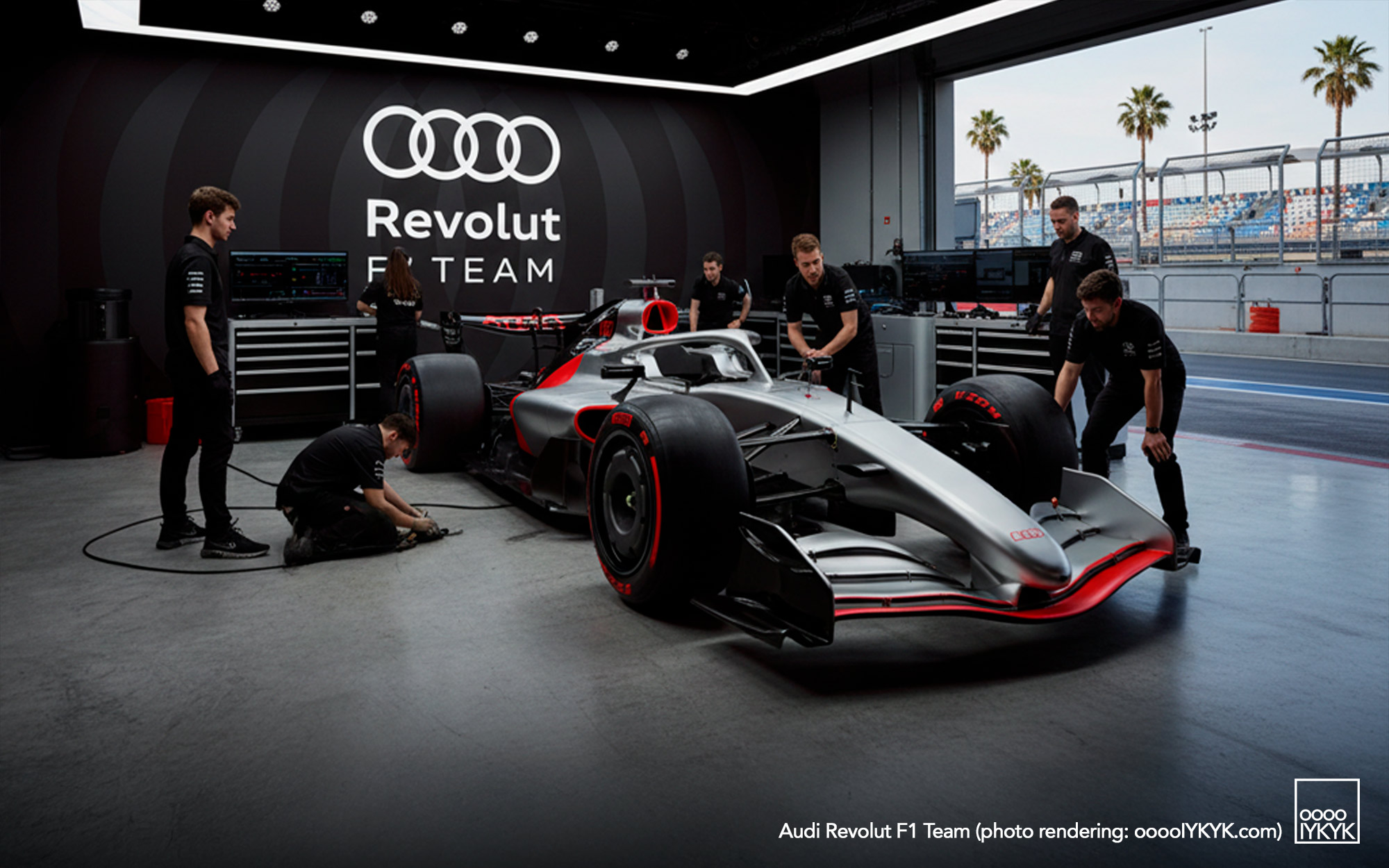

Audi’s anticipated Formula 1 debut is rumored to become reality tomorrow, with the Audi Revolut F1 Team preparing to run its first 2026-spec car at the Circuit de Barcelona-Catalunya. According to Autosport, the new Audi R26 will complete a filming day on January 9th, marking the earliest known on-track appearance of any 2026-spec Formula 1 car from any of the teams.
Both of Audi’s confirmed drivers, Nico Hülkenberg and Gabriel Bortoleto, are expected to log seat time during the shakedown. While officially classified as a “promotional event”, the outing is a significant internal milestone: the first official outing of Audi’s complete F1 package, from chassis integration to power unit systems, ahead of a radically new regulatory era.
Under filming-day regulations, Audi will be limited to just 200 kilometers of running—roughly 42 laps of the Barcelona circuit—using Pirelli demonstration tires rather than race-spec compounds. The emphasis will be on systems checks and baseline correlation rather than outright performance, but even limited mileage offers invaluable early feedback. With each team allowed two filming days in 2026, rivals are expected to follow suit quickly.
DESPITE MY RENDERINGS DON’T EXPECT THE R26 CONCEPT ON TRACK
While Audi’s R26 concept revealed in 2025 offered an early visual peek at what we can expect from the team, the car seen circulating Barcelona is unlikely to resemble that show car in any meaningful way. Don’t let the AI renderings seen here fool you.
In form, it’s likely the R26 concept was just a 2026-spec display chassis and thus not even remotely the finalized car. The livery was a design exercise, one Audi has already confirmed will be finalized in their team reveal slated for January 20th.
Also worth noting, it’s likely the 2026 Audi Revolut F1 car will be called R26. Though not the same thing as the R26 Concept that was a visual exercise, this will be the real deal – a car that will see competition and evolve as F1 cars do throughout the season.
With the Barcelona test taking place behind closed doors—no broadcast, photographers, or media access—teams are under no pressure to reveal final designs. In fact, F1 regulations reportedly require any team that has not formally launched its 2026 livery to run either plain or camouflage finishes during early testing.
Much like test mules of upcoming new road cars, camouflage liveries have a deliberate history in Formula 1. Rather than blending in, angular “dazzle” patterns are often designed to confuse the eye, breaking up the visible contours of aerodynamic surfaces and obscuring details such as wing profiles, bodywork transitions, and cooling solutions. The technique, famously used by Red Bull during multiple test campaigns, traces its roots back to First World War naval camouflage, where distorted geometry made it harder to judge a ship’s size, speed, or direction. There’s another great backgrounder on that tradition found over on Autosport as well.
For Audi, such visual misdirection would make sense. Active aero elements, revised sidepod concepts, and new hybrid packaging are precisely the areas teams are motivated to shield from rivals in these early days. Even if images were to emerge, any livery is likely to be intentionally misleading—and very much temporary.
Audi’s public-facing debut won’t be far behind. As mentioned, the team is set to host its official season launch in Berlin on January 20th, followed by the first pre-season test from January 26th-30th, also at Barcelona. For now, though, tomorrow’s quiet shakedown represents something far more important: the first official turning of a wheel for Audi’s Formula 1 project, finally out on track.